What to Look For in Property Management Software for Irish Agents
Choosing property management software is one of the highest-leverage decisions an Irish letting agency makes. The right system quietly keeps every client compliant, reconciles the rent and wins you time back; the wrong one becomes an expensive filing cabinet you still run out of a spreadsheet. This is the evaluation checklist we'd use — the twelve capabilities that actually matter for an Irish agent in 2026, the red flags that rule a tool out, and the questions to ask every vendor before you sign.
The short version
- The single most important criterion is that the software is built for Irish rental law — RTB, the national rent cap and PSRA — not a UK or US tool with an Irish label bolted on.
- An agency needs two layers covered: your clients' RTB obligations across every tenancy, and your own PSRA, client-money and AML obligations as a licensed property services provider.
- Beyond compliance, the levers that pay for the software are Open Banking rent reconciliation, per-client reporting, enquiry management and native mobile — the things that give you hours back each week.
- Score every tool against the 12-point checklist below, watch for the red flags, and insist on a live demo on data shaped like your own before you commit.
If you read nothing else: don't buy features, buy fit. The best property management software for an Irish agent is the one that removes the compliance and admin load specific to this market — and can prove it in a demo, not a datasheet.
Why this decision is high-stakes for Irish agents
A landlord with one property is choosing a convenience. A letting or estate agent choosing software is choosing the operating system for the business — the thing that will hold every client's compliance, every rent payment and every deadline for years. Get it right and the back office runs itself; get it wrong and you've paid for a tool that still leaves the real work on spreadsheets and in people's heads.
What makes the Irish market different is that agents carry two layers of obligation at once. You are responsible for your clients' duties under residential tenancies law — RTB registration, the national rent cap, valid notices — multiplied across every property you manage. And you carry your own duties as a business regulated by the Property Services Regulatory Authority (PSRA): a licence to hold, a client account to reconcile, engagement letters to issue. Software that only understands one of those layers is only half a solution.
The test that cuts through the sales pitch
Ask a vendor to show you, live, how their product handles one Irish tenancy end to end: register it with the RTB inside the 30-day window, calculate a legal rent increase under the 2% / CPI cap and produce the Section 12 notice, then reconcile the rent from an Irish bank. If any step is "on the roadmap" or "you'd do that outside the system," you've found the ceiling of what the tool will do for you.
The good news: because the requirements are specific, they're also easy to score. The twelve criteria below turn a fuzzy "which one is best?" into a checklist you can run against any shortlist — including our fuller buyer's guide to the best property management software for Irish letting agents.
1. Built for Irish law, not retrofitted from a UK or US tool
What to look for: A product designed around Irish rental regulation from the ground up — one that speaks in terms of the RTB, the national rent cap, Part 4 and the PSRA, not generic "compliance reminders" you configure yourself.
Why it matters: Many polished tools were built for the UK or US and adapted afterwards. They often can't compute an Irish RTB deadline, don't know what a Form 1 is, and have no concept of the 2% / CPI rent cap or the Section 12 notice. That leaves the hardest, highest-stakes work — the part your clients actually pay you for — back on a spreadsheet, defeating the purpose of buying software at all.
The check: Does the product name Irish rules explicitly and automate them, or does it expect you to know and configure them? If it's the latter, it's a database, not a compliance system.
2. RTB compliance automation across the whole book
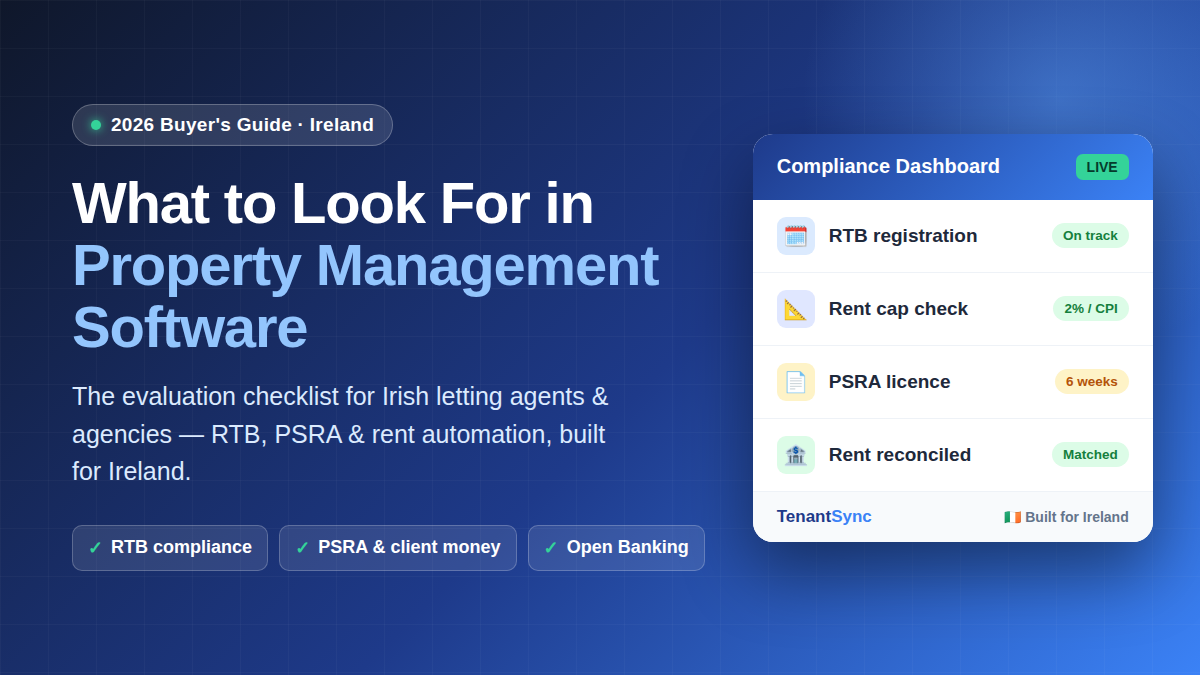
What to look for: Automatic tracking of every tenancy date across the portfolio — the one-month (30-day) registration deadline, the annual renewal, and Part 4 milestones — computed from each tenancy's start date, with the RTB Form 1 taken from draft to finalised and a live dashboard showing compliant, upcoming and overdue at a glance.
Why it matters: A missed registration or renewal is the most common and most avoidable compliance failure an agency makes — it incurs a higher late fee, weakens the landlord in any dispute, and is one of the fastest ways to lose a client. Once you're past a handful of tenancies, tracking this by hand stops working. For the detail, see our guides to the RTB registration deadline and running bulk RTB compliance across every client tenancy.
See a live RTB compliance dashboard on your own data
Book a 15-minute agency demo and watch registration and renewal computed from each tenancy's start date, colour-coded compliant, upcoming or overdue — across your whole book.
3. A national rent cap calculator that writes the notice
What to look for: A built-in calculator that returns the maximum legal rent for a tenancy under the national rent cap — 2% or inflation (CPI), whichever is lower — and then generates a compliant Section 12 Notice of Rent Review with the correct timing (served at least 90 days ahead) and a copy for the RTB within 7 days of the date of service.
Why it matters: Since 1 March 2026 the rent cap applies nationally, having replaced the location-based Rent Pressure Zone system. Assuming the cap is always 2% overshoots whenever inflation is lower and can invalidate the increase; getting the notice or timing wrong does the same. A tool that does the maths and produces the notice removes a recurring source of error. Our national rent cap guide and free rent increase calculator walk through the detail.
Rule of thumb
Never eyeball a rent increase. The software should show which figure it applied (2% or CPI) and why, so every review is defensible. Always confirm the current CPI-linked cap on rtb.ie before serving the notice.
4. PSRA & client-money compliance for the agency itself
What to look for: Features that manage your obligations as a licensed property services provider under the Property Services (Regulation) Act 2011 — tracking your PSRA licence renewal with escalating reminders, holding Letters of Engagement (s.43), monitoring Professional Indemnity Insurance, reconciling a client-money ledger, and keeping the six-year record retention an inspection can require.
Why it matters: This is the layer landlord-only apps ignore entirely. These obligations go to the heart of your authorisation to trade, and the penalties for getting them wrong are severe — PSRA sanctions can reach fines of up to €250,000 and the loss of your licence. Software that tracks these alongside tenancy deadlines turns an anxious annual scramble into routine. Our letter of engagement guide and our overview of the PSRA-licensed, tech-enabled agency go deeper.
5. Open Banking rent reconciliation & real-time arrears alerts
What to look for: A PSD2 Open Banking connection to the Irish banks your clients use — AIB, Bank of Ireland, PTSB, EBS, Revolut and N26 — that matches incoming transfers to the right tenancy automatically, flags bank-confirmed arrears in real time (alerting agent and tenant), and can auto-collect the management fee, deduct contractor costs and generate a per-landlord disbursement statement.
Why it matters: Reconciling rent by reading bank statements line by line is where agencies quietly lose hours and miss short payments. Automatic matching catches a €1,350 payment against €1,500 rent, not just a fully missed one, and surfaces the shortfall within hours rather than at the next manual check — which keeps the RTB paper trail timely and protects the client relationship. Our guide to Open Banking rent reconciliation explains the mechanics, including that the connection is read-only and can't move money.
Watch rent reconcile itself, live
See TenantSync match real transfers to the right tenancy and flag arrears the moment the bank data confirms them — on web and on the iOS/Android app.
6. A true multi-client, multi-landlord structure with per-client reporting
What to look for: A data model built for an agency, not a single landlord — many landlord clients, each with their own properties, tenancies and money, and one-click per-landlord reporting that shows a client exactly what you've done for them this month.
Why it matters: Landlord-first tools force you to fake agency structure by creating a separate "account" per client, which fragments your book and makes reporting a manual export-and-reformat chore. A clean multi-client structure is what lets you scale, and the per-client report is one of the most underrated retention tools an agency has — it makes your invisible work visible. Our per-client landlord report guide shows why it renews contracts.
7. Enquiry & lead management from Daft and MyHome
What to look for: Software that monitors your listings on Daft.ie and MyHome.ie, parses each inbound enquiry into a structured lead, sends a branded auto-reply in seconds, collects pre-qualification details, and moves applicants through a pipeline (new → contacted → applied → reviewed → approved) with a clear activity log.
Why it matters: Void periods are billed daily and never recovered, and the biggest lever on speed-to-let is how fast you respond and how well you qualify before viewing. A tool that answers enquiries 24/7 and filters unqualified applicants earns its keep on voids alone. See our guide to Daft and MyHome enquiry management.
8. Digital lease management & e-signature
What to look for: RTB-compliant lease templates you can generate from held tenancy data, preview as a PDF, finalise, store and sign electronically — plus automated renewal and expiry alerts so a lease never lapses unnoticed.
Why it matters: Printing, posting and chasing wet signatures adds days to every let and leaves leases scattered across inboxes. Generating a compliant lease from data you already hold — with e-signature — closes a vacancy faster and keeps every agreement in one retrievable place. It also feeds the next step: the moment a lease is signed, a good system already knows the tenancy exists and starts the 30-day RTB clock.
9. Native mobile apps (iOS & Android)
What to look for: Genuine native apps for iOS and Android, not just a website that technically loads on a phone — so you can quote a legal rent figure at a viewing, log a maintenance issue on site, check a tenancy's status, or reply to an enquiry from the road.
Why it matters: Lettings is not a desk job. Agents spend their days at viewings, inspections and properties, and a tool that only works well on a desktop is a tool you'll stop using where it matters most. Native mobile turns dead time between appointments into productive time. TenantSync runs on web plus native iOS and Android apps.
10. GDPR-grade data security & access control
What to look for: A single, access-controlled system for tenant and landlord personal data — identity documents, payment details, references — with clear control over who can see what, how long it's kept and how it's secured, rather than data scattered across spreadsheets, personal inboxes and messaging apps.
Why it matters: Agencies handle exactly the personal and financial data the GDPR is designed to protect. Data spread across personal accounts is impossible to secure, hard to delete on request and a real breach risk. Consolidating it is both a compliance requirement and a professionalism signal to clients. Refer to the Data Protection Commission's guidance for your specific obligations.
11. Painless migration & onboarding
What to look for: A clear path to move your existing portfolio in — a direct import from Letman, a CSV or a spreadsheet, without rekeying or losing tenancy history — and real onboarding support (concierge or guided) to get you live quickly.
Why it matters: The fear of a messy switch is the number-one reason agencies stay on tools they've outgrown. A vendor that has invested in migration and onboarding is telling you they expect you to succeed, not just sign. If moving your data is vague or "do-it-yourself," factor in the hidden cost. Our guide to migrating a letting agency off spreadsheets covers how to switch without losing history, and if you're leaving a specific system, see our Letman alternative comparison.
12. Transparent, predictable pricing that scales
What to look for: Pricing you can read and predict — ideally flat, per-portfolio tiers tied to how many units you manage — plus a free trial so you can prove fit before you pay, and no per-property fees that quietly balloon as you win instructions.
Why it matters: Opaque or per-unit pricing punishes exactly the growth you're trying to achieve and makes budgeting impossible. Transparent tiers let you match the plan to your book and know your cost as you scale. For a full breakdown of what Irish agents pay and why, see our guide to lettings software pricing in Ireland.
Do the ROI maths
Weigh the monthly fee against what it removes: hours of manual reconciliation and admin, a single avoided late-registration fee, one void week saved by faster enquiry handling, or one retained client. On that basis the right tool usually pays for itself well before you've finished evaluating it.
The 12-point scoring checklist
Run every tool on your shortlist through the same scorecard. Mark each criterion as a must-have or nice-to-have for your agency, then score how well each product delivers it. Anything that fails a must-have is off the list — no matter how good the demo looks.
| # | What to look for | Why it matters | Priority |
|---|---|---|---|
| 1 | Built for Irish law (RTB, rent cap, PSRA) | Automates the hardest work instead of leaving it on a spreadsheet | Must-have |
| 2 | RTB automation across the portfolio | Prevents the most common, costliest compliance failure | Must-have |
| 3 | National rent cap calculator + Section 12 notice | Keeps every rent review legal and defensible | Must-have |
| 4 | PSRA & client-money compliance | Protects your licence and client account | Must-have |
| 5 | Open Banking reconciliation & arrears alerts | Saves hours and catches short/late rent fast | Must-have |
| 6 | Multi-client structure & per-client reporting | Lets you scale and helps retain clients | Must-have |
| 7 | Daft/MyHome enquiry & lead management | Reduces void periods with faster response | High |
| 8 | Digital lease management & e-signature | Closes vacancies faster, no printing/posting | High |
| 9 | Native iOS & Android apps | Works where agents actually work | High |
| 10 | GDPR-grade data security | Compliance and a professionalism signal | Must-have |
| 11 | Migration & onboarding support | Removes the biggest barrier to switching | High |
| 12 | Transparent, predictable pricing | Budget with confidence as you grow | High |
Use this as your buyer's checklist
Print the twelve rows, score each vendor 0–3 on delivery, and total it up. The exercise forces every provider to prove Irish-market fit — and it makes a confident "yes" or a clear "no" obvious, instead of a gut feeling after a slick sales call.
Red flags & questions to ask any vendor
The checklist tells you what "good" looks like. These are the warning signs that a tool won't fit an Irish agency — and the questions that expose them quickly.
Red flags
- No mention of the RTB, the national rent cap or the PSRA anywhere in the product — a sign it was built for another market.
- Compliance is "reminders you set up yourself" rather than deadlines the system computes.
- No Open Banking or Irish bank support — you'll still reconcile rent by hand.
- One account per landlord instead of a real multi-client structure.
- Desktop-only, or a phone experience that's clearly an afterthought.
- Vague migration ("just export a CSV and figure it out") and no onboarding help.
- Opaque or per-property pricing that gets more expensive the more you grow, with no free trial to test fit.
Questions to ask
- Show me, live, how you register an Irish tenancy with the RTB and track its renewal.
- Calculate a legal rent increase under the 2% / CPI cap and produce the Section 12 notice — in the product.
- How do you handle my PSRA licence, Letters of Engagement and client-account reconciliation?
- Which Irish banks do you support for rent matching, and how fast do arrears surface?
- Can you produce a per-landlord report for one client in one click?
- What do the iOS and Android apps let me do at a viewing?
- How is my data secured and where is it stored, under GDPR?
- Exactly how does migration from Letman or a spreadsheet work, and who helps?
- What will I pay at my current size and at double it?
Insist on a demo, not a datasheet
Every claim above should be demonstrable on data shaped like your own. A vendor who is confident in Irish-market fit will happily show you; one who deflects to "roadmap" is answering the question for you.
How TenantSync maps to the checklist
TenantSync is an Irish-built platform designed around exactly this checklist — bringing the three highest-stakes jobs an Irish letting business has to get right into one system: RTB compliance, PSRA compliance and Open Banking rent automation. Here's how it lines up against the twelve criteria.
Built for Ireland
Designed around the RTB, the national rent cap, Part 4 and the PSRA — not a UK/US tool adapted after the fact. Covers criteria #1–#4.
RTB automation
Tracks the 30-day registration deadline, annual renewals and Part 4 across the book, takes the Form 1 from draft to finalise, and shows a live compliant / upcoming / overdue dashboard. Criterion #2.
National rent cap calculator
Returns the maximum legal rent (2% or CPI, whichever is lower) and auto-generates the Section 12 rent-review notice with the correct timing and the 7-day RTB copy deadline. Criterion #3.
PSRA & client money
Tracks licence renewals with escalating reminders, holds Letters of Engagement and PII, reconciles client-money ledgers and retains six years of records with a one-click inspection pack. Criterion #4.
Open Banking reconciliation
PSD2 integration with AIB, Bank of Ireland, PTSB, EBS, Revolut and N26 matches rent to the right tenancy, flags bank-confirmed arrears in real time and generates per-landlord disbursements. Criterion #5.
Multi-client & reporting
A true agency structure across many landlord clients, with one-click per-landlord reports (white-label on higher tiers). Criterion #6.
Enquiries & leases
Daft/MyHome enquiry automation with branded auto-replies and a lead pipeline, plus RTB-compliant lease templates with e-signature. Criteria #7–#8.
Native mobile & secure data
Native iOS and Android apps for work on the road, with tenant and landlord personal data held in one access-controlled, GDPR-grade system. Criteria #9–#10.
Migration & clear pricing
Direct import from Letman, CSV or a spreadsheet with no lost history and concierge onboarding, on flat per-portfolio tiers with a free trial. Criteria #11–#12.
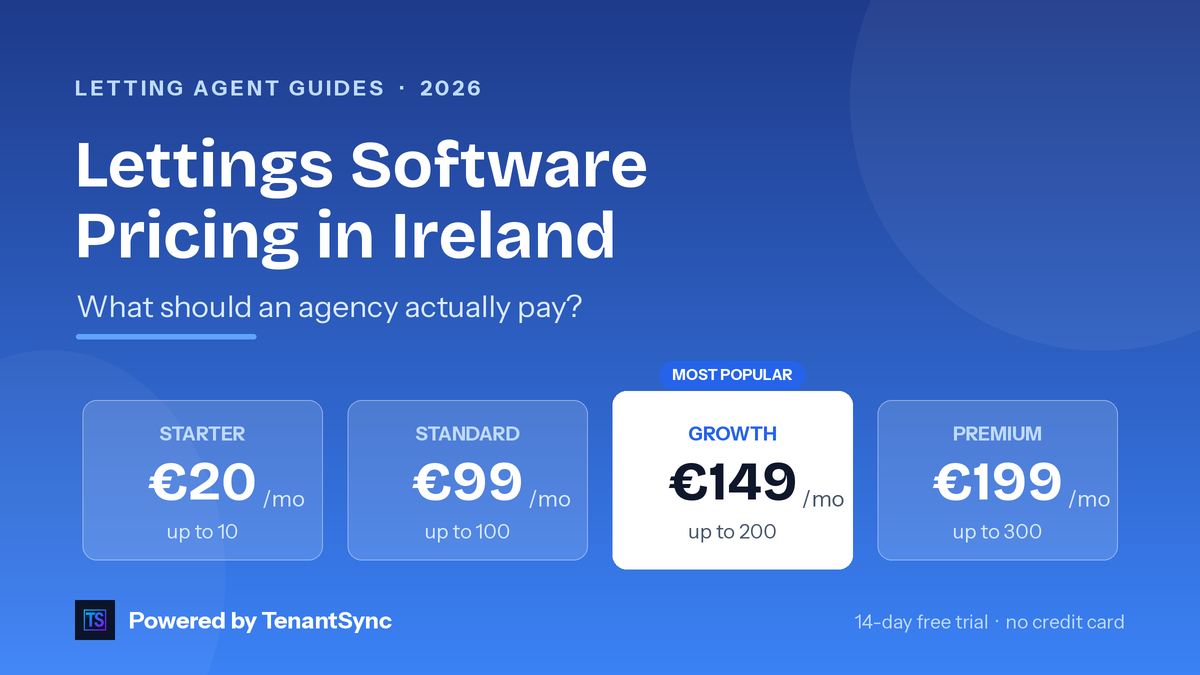
On pricing, TenantSync uses flat, per-portfolio tiers so your cost is predictable: €20 Starter for up to 10 units (aimed at smaller landlords), €99 Standard up to 100 units, €149 Growth up to 200, and €199 Premium up to 300 with white-label reports, API access and a dedicated account manager; multi-branch agencies use a custom Enterprise plan. Every plan includes a 14-day free trial, no credit card required, and the automation is designed to save up to 8 hours of admin a week. For the full breakdown, see our lettings software pricing guide.
Score TenantSync against your own checklist, live
Import a slice of your portfolio and we'll run it against all twelve criteria on screen — RTB deadlines computed, a rent increase calculated, rent reconciled from an Irish bank, a per-client report generated. It's the fastest way to know it fits your agency.
Prefer to start small? Try the free RTB deadline checker and rent-cap calculator — no account needed.
Frequently asked questions
What should Irish letting agents look for in property management software?
Irish letting agents should prioritise software built for Irish rental law rather than a UK or US tool adapted after the fact. The essentials are: RTB compliance automation (30-day registration, annual renewal, Part 4 and Form 1) across every tenancy; a national rent cap calculator (2% or CPI, whichever is lower) that produces the Section 12 rent-review notice; PSRA and client-money compliance for the agency's own obligations; Open Banking rent reconciliation with real-time arrears alerts; a genuine multi-client structure with per-landlord reporting; native mobile apps; strong GDPR data security; painless migration; and transparent pricing that scales. Always confirm current statutory rules on rtb.ie and psr.ie.
Why can't a UK or US property management tool work for an Irish agency?
Generic UK and US property management tools do not model the specific obligations Irish agents are judged on. They typically lack RTB registration and renewal tracking, the RTB Form 1, the national rent cap (2% or CPI) and the Section 12 rent-review notice, Part 4 security-of-tenure logic, and PSRA client-money and licensing requirements. A tool that cannot compute an Irish RTB deadline or validate an Irish rent increase leaves the compliance work — the very thing your landlord clients pay you for — back on a spreadsheet. Software built for Ireland closes that gap.
Does property management software need to handle PSRA and client-money rules?
For a letting agent or agency, yes. Alongside your clients' RTB obligations, you carry your own obligations as a licensed property services provider under the Property Services (Regulation) Act 2011 — a current PSRA licence, a signed Letter of Engagement, Professional Indemnity Insurance, and a properly reconciled client account for rent held on landlords' behalf, with records retained for six years. Software that tracks licence and insurance renewals, holds engagement letters and reconciles client money is doing work a landlord-only app was never designed to do. Confirm your current obligations with the PSRA at psr.ie.
How important are mobile apps for property management software in Ireland?
Very important for agents who work from viewings, inspections and the road rather than only a desk. Native iOS and Android apps let you quote a legal rent figure at a viewing, log a maintenance issue on site, check a tenancy's compliance status, or respond to an enquiry in seconds — instead of waiting to get back to a computer. If a tool is desktop-only or has a web page that barely works on a phone, that is a real limitation for a busy lettings business. TenantSync runs on web plus native iOS and Android.
What questions should I ask a property management software vendor?
Ask: Is the product built specifically for Irish rental law, and how does it handle RTB registration deadlines, the national rent cap and the Section 12 notice? Does it manage PSRA obligations and reconcile a client account? Does it connect to Irish banks via Open Banking for rent matching and arrears alerts? Can it structure many landlords and produce a per-client report in one click? Does it have native mobile apps? How is my data secured under GDPR? How does migration from Letman or a spreadsheet work, and is onboarding supported? Is pricing transparent and predictable as I grow? A confident vendor will answer each with a live demo, not a brochure.
How much does property management software for Irish letting agents cost?
Pricing varies by provider and by how many units you manage. TenantSync uses flat, per-portfolio tiers so the cost is predictable: a €20 Starter plan for up to 10 units (aimed at smaller landlords), Standard at €99/month for up to 100 units, Growth at €149/month for up to 200 units, and Premium at €199/month for up to 300 units with white-label reports, API access and a dedicated account manager; larger multi-branch agencies use a custom Enterprise plan. All plans include a 14-day free trial with no credit card required. Look for transparent pricing you can predict rather than per-property fees that balloon as you win instructions.
Sources & further reading
Facts in this article are drawn from official and primary sources. Rules, fees, deadlines and rent-cap figures change — verify the current position on rtb.ie and psr.ie before relying on any figure.
- Residential Tenancies Board — Register a tenancy (RTB Form 1 and the annual registration system)
- Residential Tenancies Board — Rental law changes from 1 March 2026 (national rent control)
- Residential Tenancies Board — Rent, rent reviews and the Notice of Rent Review
- Property Services Regulatory Authority — Licensing and regulation of property services providers (Property Services (Regulation) Act 2011)
- Central Bank of Ireland — PSD2 and regulated payment/Open Banking providers
- Data Protection Commission — GDPR guidance for organisations
- Citizens Information — Registering a tenancy with the RTB
Related Articles