The Features Irish Estate Agents Should Demand From Their Software in 2026
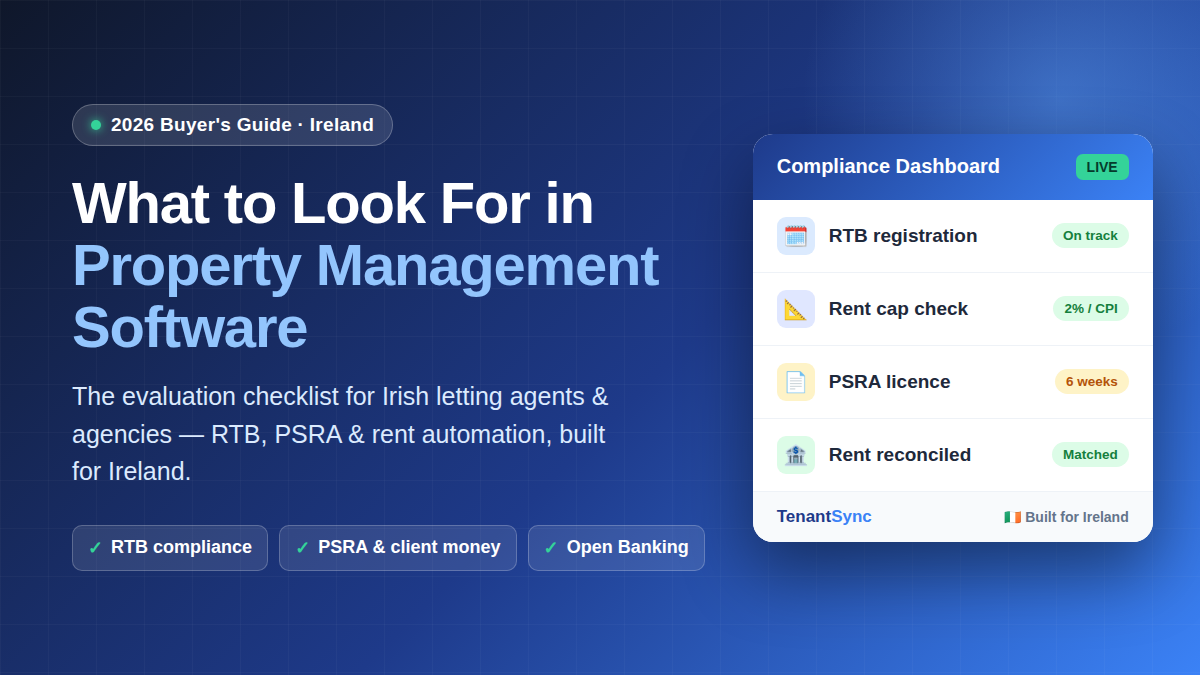
Most software evaluations go wrong in the first ten minutes, when a salesperson frames the conversation around what their product happens to do well. This guide gives you the other frame: the five workflows that actually consume an Irish letting agency's week — rent, compliance, enquiries, screening and communication — the standard each should meet in 2026, the demo test that proves it, and a score out of fifteen at the end.
The short version
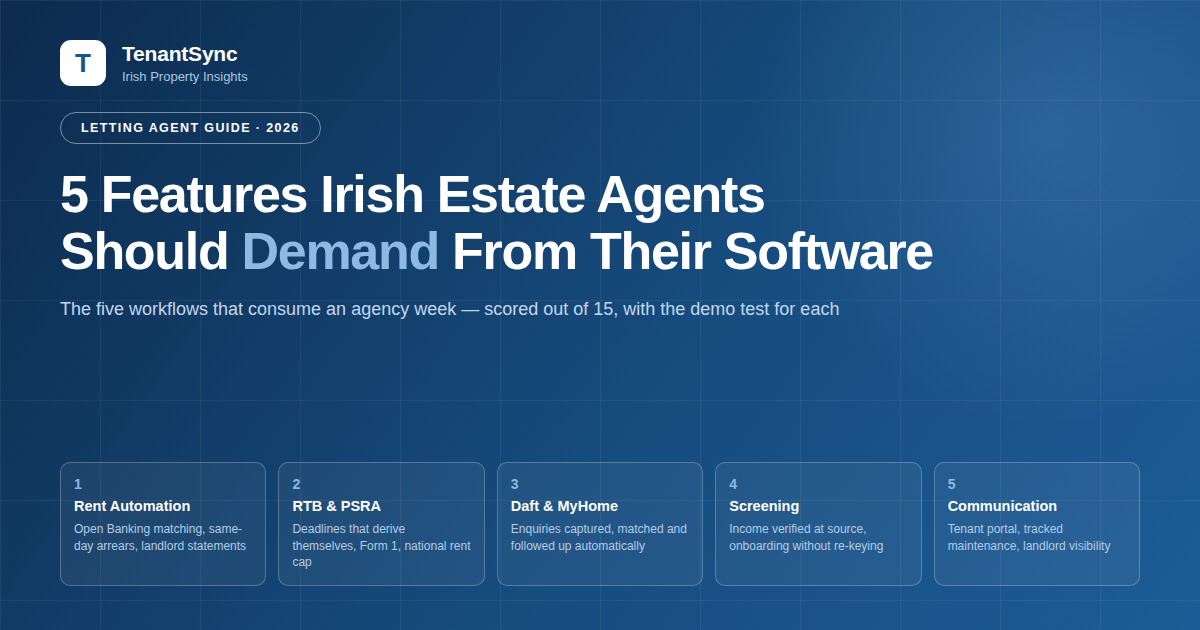
What should an Irish letting agent demand from property management software in 2026? Five things, because five workflows eat the week. Rent automation that closes the loop from invoice to bank payment to arrears alert to landlord statement. Compliance that generates its own deadlines — the tenancy's RTB duties and the agency's own PSRA duties, on one register. Daft and MyHome enquiry automation that gets portal enquiries into a shared pipeline within minutes. Tenant screening and onboarding that verifies income at source and turns an accepted applicant into a tenancy without re-keying. And tenant and landlord communication that runs from the system rather than from one person's phone. Score each one from 0 to 3 on what the vendor demonstrates, not what the brochure claims. Under 7 out of 15, you are looking at a spreadsheet with a login screen.
Why the Bar Moved in 2026
Software you chose in 2022 was chosen against a different job. Three changes since then have quietly redefined what "adequate" means for an Irish agency, and all three hit the same year.
Rent control went national on 1 March 2026. The cap — the lower of CPI inflation or 2% per year, applied proportionately to the period since the rent was last set — no longer applies only to your Rent Pressure Zone stock. It applies to the whole book. A calculation you used to run occasionally, for the Dublin and Cork portion of your portfolio, is now a calculation you run on every review, everywhere. Apartments that commenced and completed development on or after 10 June 2025 are linked to CPI only, without the 2% ceiling, which adds a second branch to the logic rather than removing one.
Annual RTB registration turned a one-off into a recurring obligation. An agency with 150 managed tenancies is not doing 150 registrations once. It is doing roughly 150 renewals every year, scattered unevenly across twelve months according to when each tenancy happened to begin. That is the kind of work that is trivial per unit and unmanageable in aggregate.
New tenancies operate under a rolling six-year minimum duration framework. More milestones, generated by the same commencement date, that your landlord clients need to hear about before they arrive rather than after.
The pattern underneath all three
Every one of these changes converts occasional judgement into recurring arithmetic multiplied by portfolio size. That is the single most important thing to understand before you take a demo. A tool that stores your data beautifully and reminds you of nothing was defensible in 2022. In 2026 it is a liability with a subscription attached.
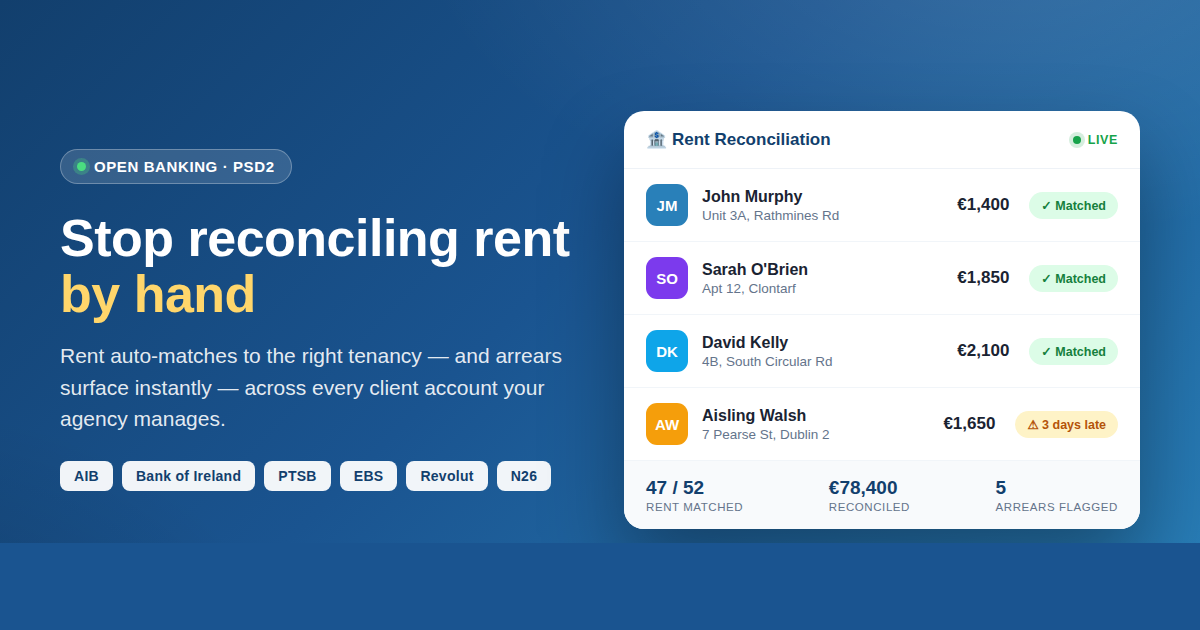
Meanwhile, two things got easier. PSD2 Open Banking matured to the point where Irish current accounts — AIB, Bank of Ireland, PTSB, EBS, Revolut, N26 and the rest — can be read directly with the account holder's consent, which removes the last excuse for reconciling rent by eye. And portal enquiry volume made manual triage untenable during letting season, which is a problem software has been solving in other markets for a decade.
So the demand list writes itself. Not "what features exist" — that question produces a brochure. The right question is: what consumes the week, and which of it should a machine be doing?
If you want the broader evaluation — security, mobile access, migration, contract terms, pricing models — that is covered separately in what to look for in property management software for Irish agents. This piece deliberately goes narrow and deep on the five workflows that consume the week.
How to Score Any Vendor: The 0–3 Rubric
The problem with feature lists is that "yes" covers an enormous range. Every vendor will say yes to "do you handle RTB compliance?" and every one of them will mean something different by it. The fix is a scale rather than a tick.
| Score | What it means | What it feels like on a Monday |
|---|---|---|
| 0 — Absent | The tool can't do it at all. You do it somewhere else. | A second system, or a spreadsheet, or someone's memory. |
| 1 — Storage | Possible, but you do the work manually inside the tool. It records what you already knew. | You type the deadline in. It shows you the deadline you typed. |
| 2 — Prompted | The tool notices and prompts you; you still complete the work. | A reminder lands. You go and do the thing. |
| 3 — Automated | The tool does the work and interrupts you only when a human decision is genuinely required. | It's done. You're told what needs your judgement, and nothing else. |
Score what you are shown, not what you are told. And bring your own material to every demo: one real tenancy with its real commencement date, one real Daft or MyHome enquiry email, and one real line from last month's bank statement. A demo run on the vendor's sample data proves only that the vendor's sample data works.
💡 The single most revealing demo request
"Create a tenancy in front of me with a start date of 14 January 2026, and then don't touch anything else. Tell me what the system now knows." A tool scoring 3 on compliance will already have produced a registration deadline, an annual renewal date and a tenure milestone from that one field. A tool scoring 1 will be waiting for you to type them in.
Demand 1: Rent Automation That Closes the Loop
Ask ten agencies whether their software "handles rent" and ten will say yes. Ask what happens between the tenant's standing order leaving their account and the landlord's statement arriving, and the answers diverge completely.
The 2026 standard
Rent should not be recorded. It should be reconciled. The loop has six links, and a tool worth paying for closes all of them without you:
- A recurring invoice is raised for each tenancy on schedule, without anyone generating it.
- The payment arrives in the client or landlord bank account.
- An Open Banking connection reads that transaction and matches it to the correct lease.
- The invoice status updates itself — paid, partially paid, or still outstanding.
- Anything short, late or missing becomes an arrears item the same day, not at month-end.
- The month's collected rent, management fees and approved deductions flow into a landlord statement built from the same data — not rebuilt in Excel.
Link 3 is where most tools quietly stop. "Rent tracking" in a lot of lettings software means a screen where you tell the system what you already read on a bank statement. That is data entry with a nicer interface, and it scores a 1.
The demo test
Say this, exactly
"A tenant paid €50 short last Tuesday. Show me where that appears, and tell me who typed anything to make it appear." Then: "Generate last month's landlord statement for one property while I watch, and show me the gross rent, my fee, the deductions and the net."
The first question separates reconciliation from record-keeping. The second separates a rent ledger from an agency system — because the landlord statement is the artefact your client actually judges you on, and rebuilding it by hand every month is one of the largest hidden costs in a lettings business.
What honest software will admit
No system achieves a 100% automatic match rate, because no system controls what a tenant types in the payment reference field. A vendor who promises perfect matching is either misunderstanding the problem or hoping you won't notice for three months.
What you should demand instead is a visible review queue: unmatched transactions surfaced in one place, with a suggested match you can confirm in a click, and a mechanism for teaching the system a reference it will recognise next time. Ask to see the unmatched queue. A vendor who is proud of it has built something real; a vendor who is uncomfortable about it has built a demo.
Score it
- 0 — Rent lives in a spreadsheet or your accounts package, not the lettings system.
- 1 — You mark invoices paid by hand after reading the bank statement.
- 2 — The system flags who hasn't paid, but you still match payments yourself.
- 3 — Bank transactions match to tenancies automatically, arrears surface the same day, and landlord statements are produced from the same data with a review queue for the exceptions.
Two related reads if you want the mechanics: Open Banking rent reconciliation for lettings agencies covers how PSD2 matching actually works across multiple client accounts, and identifying rent payments on a bank statement covers the manual version you're trying to escape.
💶 Bring one real bank statement line to a demo
Watch a rent payment match itself to the right tenancy, an arrears item appear the same day, and last month's landlord statement build from the same data — on your own portfolio, not a sample file.
Demand 2: Compliance That Generates Its Own Deadlines — RTB and PSRA
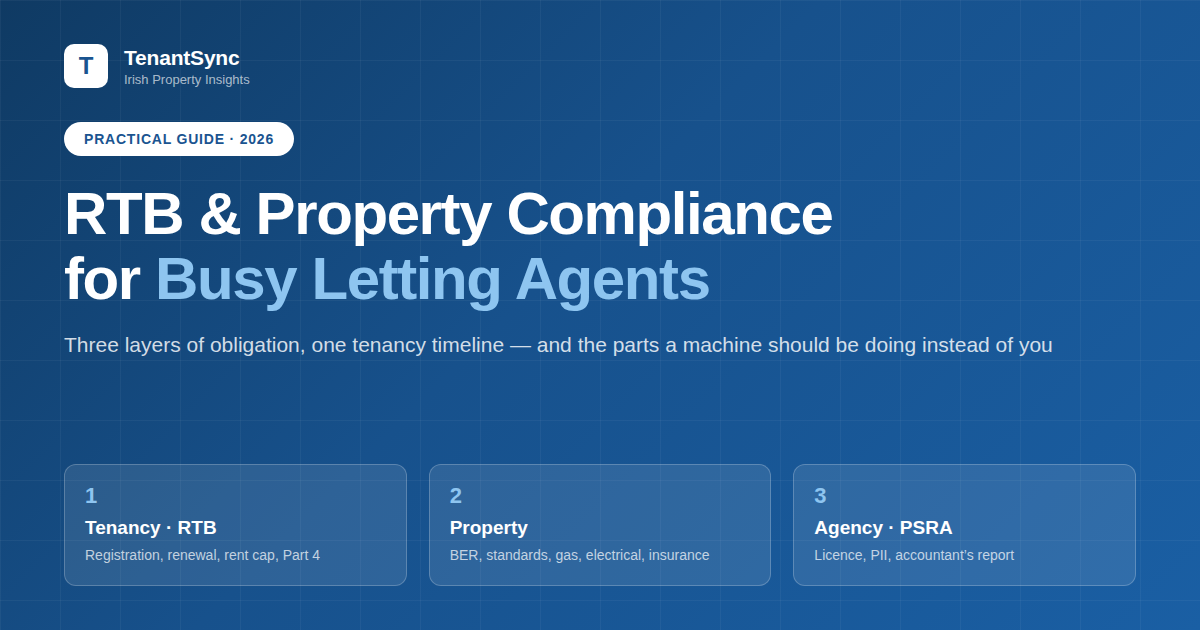
This is the demand with the highest stakes and the widest variation between vendors, so it's worth splitting in two. Compliance for an Irish agency has a tenancy half and an agency half, and almost every tool that addresses the first ignores the second entirely.
Half one: the tenancy's RTB obligations
Everything here derives from a single field — the tenancy commencement date — which is why it is all automatable, and why a tool that asks you to type these dates is telling you something about how it was built.
| Obligation | Generated by | A score of 3 looks like |
|---|---|---|
| Registration | Commencement + one month | The deadline exists the moment the tenancy does. Nobody typed it. |
| Annual renewal | Each anniversary of commencement | Every renewal in the book on one dated list, without an annual rebuild. |
| RTB Form 1 | Records you already hold | Drafted from the lease, property and landlord records; validated before submission; a finalised PDF stored against the tenancy. |
| Rent review | Date the rent was last set | Maximum lawful rent calculated on CPI vs the 2% pro-rata figure, stating which limit was binding, with the working retained. |
| Tenure milestones | Commencement + n months/years | Flagged in advance so you brief the landlord before it happens, not after. |
| Notices of termination | Ground + service date | The notice period checked against the ground and the termination date calculated, not estimated. |
"Show your working" is a feature, not a nicety
If a rent increase is ever questioned, "we applied the cap" is not a defence. The defensible record is the current rent, the date it was last set, the review date, the CPI figures used, the 2% pro-rata figure, and which of the two was the binding limit — kept with the tenancy. Demand to see that output on screen. An increase you cannot evidence is an increase you may have to unwind, and unwinding one is considerably more expensive than any software subscription.
Half two: your own PSRA obligations
This is the layer that fails in agencies with otherwise immaculate tenancy records, and the reason is structural rather than careless. RTB obligations attach to tenancies, and tenancies are the thing you touch every day, so daily work generates natural prompts. PSRA obligations attach to the business. Nothing in a normal week reminds you about any of them.
- Licence renewal — annual, with the Authority issuing a renewal invitation roughly twelve weeks before expiry.
- Professional indemnity insurance meeting the Authority's requirements, with its own renewal date.
- The annual Compensation Fund contribution.
- An accountant's report on the prescribed form — with different forms depending on whether you hold a client account.
- Client account handling and reconciliation, with a ledger that stands up to inspection.
- Letters of engagement issued before you provide the service.
- Advertising standards — accurate asking rent, BER stated, all fees disclosed up front, particulars and photographs that represent the property.
- A complaints record, and the ability to produce a coherent pack if you are inspected.
Ask every vendor on your shortlist a single question: "Where in this system does my own licence renewal date live?" Most will not have an answer, because most lettings software is built for landlords and adapted for agencies. That gap is not fatal — plenty of agencies track this separately — but you should price it honestly as work the software will not be doing.
💡 The agency-layer test
A tenancy-only compliance module and an agency-wide one are distinguishable in about fifteen seconds: ask whether the compliance dashboard can show you an item that isn't attached to a property. If everything on the screen must hang off a tenancy, your PSRA layer is going back into a spreadsheet.
What honest software will admit
Be precise with any vendor about what "RTB integration" means, and ask for a demonstration rather than a description. Drafting a Form 1 from records you already hold, validating it, producing the PDF and keeping the finalised copy as an audit trail is genuine, substantial automation — it removes almost all of the work. Anything described as going further deserves to be shown live, on your own tenancy, before you sign a contract.
Score it
- 0 — Compliance dates live outside the system.
- 1 — You type deadlines into a calendar field the system stores.
- 2 — The system reminds you about deadlines it derived, but the Form 1 and the rent calculation are yours to do.
- 3 — Deadlines derive themselves from the commencement date, the Form 1 drafts and validates itself, the rent cap is calculated with its working shown, and the agency's own PSRA dates sit on the same register.
Going deeper: RTB and property compliance for busy letting agents maps the full obligation set onto the tenancy timeline, bulk RTB compliance across every client tenancy covers the same workflow at agency scale, the national rent cap field guide covers the calculation itself, and running a PSRA-licensed, tech-enabled agency covers the agency layer.
Demand 3: Daft & MyHome Enquiry Automation
Compliance protects the business you already have. This one grows it — and it is the demand most often left out of a software evaluation, because enquiry handling feels like a people problem rather than a systems problem.
It stops feeling that way the first time you try to answer a landlord asking "how many enquiries did my property get, and what happened to them?" and realise the answer is distributed across three inboxes and one negotiator's memory.
The 2026 standard
A portal enquiry should become a structured record in a shared pipeline within minutes, not by the end of the day and not when someone gets around to it. Specifically:
- Captured automatically. The lettings mailbox that Daft and MyHome notifications already arrive at is registered with the system, and each notification is parsed into a lead — applicant name, email, phone, message, listing reference.
- Matched to the property. The lead attaches to the right unit in your system, so enquiry volume per listing becomes a number you can quote rather than a feeling.
- Acknowledged immediately. An automatic response goes out while the applicant is still on the portal looking at three other properties. Speed to first reply is the cheapest competitive advantage in lettings, and it is the one most often surrendered to a busy afternoon.
- Followed up without anyone remembering. A scheduled follow-up to applicants who went quiet, running on its own.
- Visible as a pipeline. New → contacted → application submitted → reviewed → approved or rejected, visible to everyone, so a negotiator's annual leave is not an information outage.
The demo test
Say this, exactly
"Here is a real Daft enquiry email from last week. Forward it in while I watch. How long until it's a lead against the right property, what did the applicant receive, and where do I see it?" Then the question that matters more: "Show me every enquiry from last week that never got a second contact."
The second question is the one that finds money. Almost every agency replies to enquiries. Far fewer follow up, and the gap between those two facts is where applicants go quiet, viewings don't fill, and void days accumulate on a property your client is paying a mortgage on.
What honest software will admit
The property portals do not hand agencies a general-purpose enquiry API, so for most Irish agencies this works by parsing the notification emails that already arrive in the lettings inbox. That is a perfectly good mechanism — it needs no cooperation from anyone and works with your existing listings — but it has a consequence you should insist on seeing handled.
Some enquiries will not parse cleanly, and some will not match to a listing: a reference that changed, a property added to the portal but not to your system, an unusual notification format. Demand a visible unmatched queue. A system that shows you "4 enquiries we couldn't match" has been built by someone who has run this in production. A system that silently drops them looks flawless in a demo and loses leads for a year before you notice.
Score it
- 0 — Enquiries live in email. That's the system.
- 1 — You copy enquiry details into the software by hand.
- 2 — Enquiries are captured automatically, but replies and follow-ups are manual.
- 3 — Captured, matched to the listing, acknowledged within minutes, followed up automatically, visible to the whole team as a pipeline, with an unmatched queue for the exceptions.
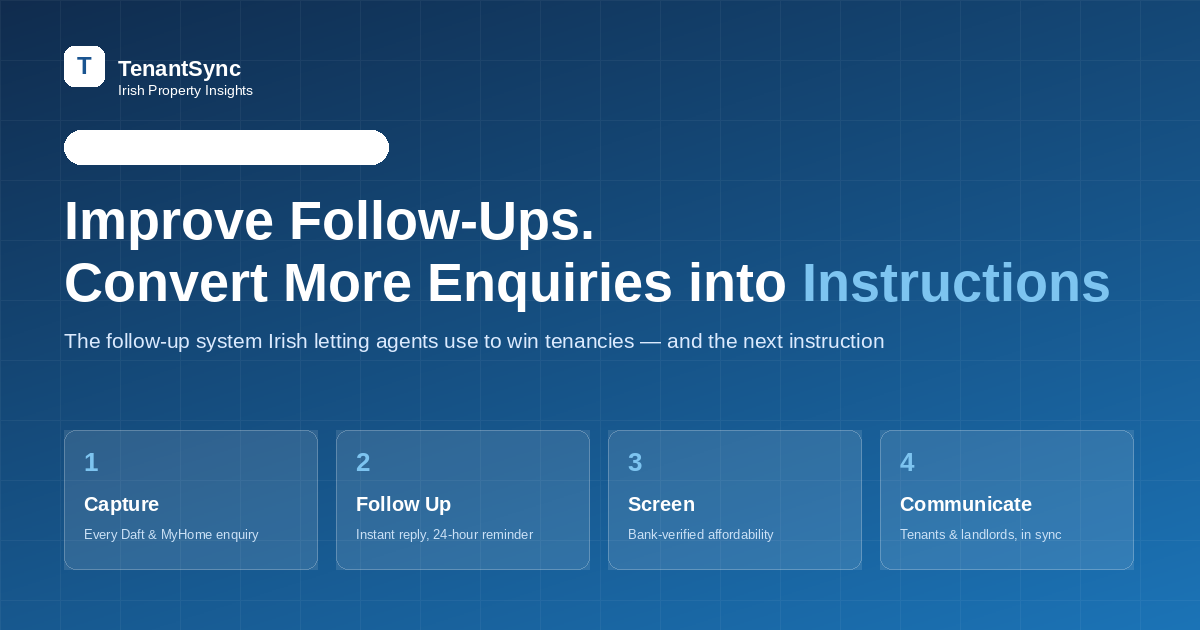
More detail: turning Daft and MyHome enquiries into signed tenancies, the follow-up system that converts enquiries into instructions, and reducing void periods with faster enquiry matching.
Demand 4: Tenant Screening & Onboarding Without the Paper Chase
Between "we'd like to proceed with this applicant" and "the tenancy has started" sits the least enjoyable stretch of an agency's month: chasing payslips as phone photographs, decoding bank statement PDFs, requesting references that arrive as three-line emails, and then typing all of it into a lease.
The 2026 standard, in two halves
Screening. A structured application through a secure link the applicant can complete on a phone — not a PDF form emailed back and forth, not a WhatsApp thread of document photographs. Income verified at source, through a read-only bank connection the applicant authorises on their own bank's screen, rather than by eyeballing documents that are trivial to alter. And the output should be a report that supports a decision: detected monthly net income, the rent-to-income ratio, an affordability band, and any risk flags worth a human look.
Onboarding. The accepted applicant becomes a tenant record, a lease, a deposit, an RTB registration and portal access — without re-keying a single field. If your team is retyping the applicant's details into a lease template after the decision is made, you have two systems pretending to be one.
The demo test
Say this, exactly
"Send me the applicant link right now — I'll do it on my phone as if I were the tenant." Then, after: "Show me what the agent sees when the report is ready." Then the question most vendors have not rehearsed: "What is still stored twenty-four hours later, and what happened to the applicant's bank access?"
That last question is the GDPR test, and it is more informative than any privacy policy. Under data minimisation and purpose limitation, a screening system should keep derived signals — an income figure, a ratio, a band, flags — and not a copy of the applicant's transaction history. Access should be one-off rather than an ongoing feed, and it should be revoked and purged once the report exists. A vendor who can answer this crisply has thought about it; a vendor who says "it's all encrypted" has answered a different question.
Screening informs the decision — it never makes it
Under the Equal Status Acts, discrimination in the provision of accommodation on nine protected grounds is prohibited, including the housing assistance ground — which covers applicants in receipt of HAP. A screening report should tell you the income, the ratio, the band and the flags, and then stop. The letting decision, and your ability to explain it, must stay with a named person in your agency. Any vendor offering an automated accept-or-reject is offering you a liability with a time-saving story attached.
What honest software will admit
Ireland has no tenant referencing bureau equivalent to the UK's, and no tenant credit score you can buy off a shelf. Treat any product marketing an Irish "tenant credit score" with real scepticism, and ask exactly what data source sits behind the number.
Bank-verified affordability is a genuinely stronger signal than a payslip PDF, because it is read from the account rather than supplied by the applicant — but it is a signal about affordability, not a prediction of behaviour, and honest software says so on the report itself.
Score it
- 0 — Screening happens over email and in a folder.
- 1 — Applicant details are stored in the system after you type them in.
- 2 — A structured online application with document upload, reviewed manually.
- 3 — Secure applicant link, income verified at source, a decision-support report with band, ratio and flags, consent purged after the report, and one-click conversion of the accepted applicant into a tenancy.
More detail: bank-verified tenant income and affordability verification and automating tenant onboarding from Daft and MyHome.
📋 Score TenantSync against your own five demands
Bring one real tenancy, one real enquiry email and one real applicant. Fourteen days, your own portfolio, your own scorecard — and a straight answer on anything that scores less than a 3.
Demand 5: Tenant & Landlord Communication That Isn't One Person's Phone
The last demand is the one that never appears on a feature comparison, and the one that decides whether you keep the instruction next year.
In most agencies, communication is not a system. It is a person — usually the best person — carrying tenant queries, contractor scheduling and landlord reassurance in their own phone. It works, right up until they take a fortnight in Portugal or take a job with a competitor, and the agency discovers how much institutional knowledge was living in a private WhatsApp thread.
The 2026 standard: two audiences, two jobs
Tenants need a route that isn't your mobile number.
- A portal where they can see their tenancy, their rent position and their documents.
- Maintenance requests raised with photos, given a status, assigned to a contractor, and tracked to closure — so "did anyone book the plumber?" is a screen rather than a conversation.
- Automatic rent reminders before the due date and after it, and receipts when payment lands.
- A way to reach the whole building at once when the water is going off on Thursday.
Landlords need to stop having to ask.
- A monthly statement: gross rent collected, your management fee, deductions, net due.
- An approval route for spend, so a €900 boiler repair is authorised in a click with a record of who approved it and when — not agreed on a phone call and remembered differently three months later.
- A compliance position they can see for themselves: registration done, renewal date, certificate expiries.
- Proactive notice of the things that arrive on a date — a rent review coming up, a tenure milestone approaching, a lease ending.
💡 The retention maths nobody runs
Landlords rarely leave an agency over a bad month. They leave over silence — the growing sense that they don't know what's happening with their own asset. A statement that arrives on the 3rd of every month without being requested is worth more to client retention than almost any operational improvement you can make, and it costs nothing once the data is already in one place.
The demo test
Say this, exactly
"A tenant reports a leak at 9pm on a Sunday. Walk me through every message that gets sent between then and the contractor arriving, and tell me who sees what." Then: "Show me what my landlord client sees on their phone, without me sending them anything."
The first question exposes whether maintenance is a workflow or a to-do list. The second exposes whether landlord reporting is a feature or a monthly Excel ritual with your logo on it.
What honest software will admit
Email alone is not enough for the messages that actually matter. Arrears chasing, viewing confirmations and access arrangements have a far better hit rate by SMS, and a tool that treats email as the only channel will quietly push those conversations back onto personal phones — which is exactly the problem you were solving. Ask what channels exist, whether SMS is included or metered, and what it costs per message.
Score it
- 0 — Communication is email, phone and WhatsApp, held by individuals.
- 1 — The system stores contact details and you send messages from your own client.
- 2 — Tenant portal and bulk messaging exist; landlord reporting is manual.
- 3 — Tenant portal, tracked maintenance with contractor assignment, automatic rent reminders and receipts, scheduled landlord statements with an approval route, and a compliance position the client can see themselves.
More detail: the landlord report template Irish letting agents should be sending and winning and keeping landlord clients.
The Scorecard: 15 Points, One Page
Print this, take it into every demo, and fill it in during the call rather than afterwards. Score what you saw.
| Demand | A score of 3 means… | The one question that settles it | Score |
|---|---|---|---|
| 1. Rent automation | Bank payments match to tenancies automatically; arrears surface same-day; landlord statements build from the same data. | "A tenant paid €50 short last Tuesday — show me where that appears, and who typed anything." | __ / 3 |
| 2. RTB & PSRA compliance | Deadlines derive from the commencement date; the Form 1 drafts and validates itself; the rent cap shows its working; the agency's own dates are on the same register. | "Create a tenancy starting 14 January 2026 and tell me what the system now knows." | __ / 3 |
| 3. Daft & MyHome enquiries | Captured, matched, acknowledged in minutes, followed up automatically, visible to the team, with an unmatched queue. | "Show me every enquiry from last week that never got a second contact." | __ / 3 |
| 4. Screening & onboarding | Secure applicant link, income verified at source, decision-support report, consent purged, one-click conversion to a tenancy. | "What is still stored twenty-four hours after the report is produced?" | __ / 3 |
| 5. Tenant & landlord communication | Tenant portal and tracked maintenance; scheduled landlord statements with an approval route; a compliance position the client can see. | "Show me what my landlord client sees on their phone without me sending anything." | __ / 3 |
Reading your total
- 12–15 — The software is doing the work. Your team's time goes to judgement, negotiation and client relationships, which is what you are actually paid for.
- 7–11 — You have a good record-keeping system. The work is still yours; the tool is making it tidier rather than smaller. This is where most agencies sit, and it is why "we already have software" and "we still do everything manually" are so often true at the same time.
- 0–6 — You have a spreadsheet with a login screen. There is nothing wrong with that at fifteen tenancies. At sixty it is a risk you are carrying personally.
Weight the score to your own book
The five demands are not equal for every agency. A block-management-heavy book leans on communication and maintenance; a high-turnover student portfolio lives or dies on enquiries and screening; a book of long-term single-let houses is dominated by compliance and rent. If one demand carries your business, score it out of 3 and then double it — and be honest with yourself about which one it is before the demo, not after.
Five Questions That Reveal the Gap
Every vendor has answers ready for the obvious questions. These five are less rehearsed, and the shape of the answer tells you more than its content.
1. "What happens when the payment reference is wrong?"
Good answer: a description of the unmatched queue, the suggested-match logic, and how the system learns a reference. Worrying answer: "our matching is very accurate." Everyone's matching is very accurate on the demo data.
2. "Define exactly what you mean by RTB integration, then show me."
Good answer: a precise, bounded description — deadlines derived, Form 1 pre-filled and validated, PDF produced and stored — followed by a live demonstration. Worrying answer: anything sweeping and unshown. Ask for the demonstration every time.
3. "How does a Daft enquiry physically get into your system?"
Good answer: a clear mechanism you can verify, and a straight account of what happens when parsing or matching fails. Worrying answer: a vague reference to an integration, with no explanation of the failure path.
4. "What is still stored 24 hours after a screening report is produced?"
Good answer: derived signals only — income, ratio, band, flags — with the applicant's bank access revoked and tokens purged. Worrying answer: "everything's encrypted." Encryption is about how data is stored, not whether it should still exist.
5. "What does my landlord client see without contacting me?"
Good answer: a screen, shown live. Worrying answer: a description of a report you can export and email. That is a document, not visibility — and it still costs you the fifteen minutes every time.
One more, for the contract stage
"If we leave in eighteen months, what exactly do we take with us, in what format, and how long does it take?" You are handing a vendor your tenancy history, your compliance audit trail and your client relationships. A confident answer here costs the vendor nothing and tells you a great deal about how they expect to keep your business.
What You Should Not Demand
A demand list is only credible if it has boundaries. Four things get asked for in evaluations that you are better off not getting.
An automated accept-or-reject on applicants. Covered above, and worth repeating: the Equal Status Acts make discrimination in the provision of accommodation unlawful on nine grounds including the housing assistance ground. A system that makes the decision for you is a system whose reasoning you cannot explain — and you are the one who will be asked to explain it.
A guarantee of 100% payment matching. Ask for a good unmatched queue instead. The vendor who admits the exception exists is the one who has handled it.
Software that makes the compliance judgement. You want a tool that shows its working — the figures, the rule applied, which limit was binding — so that you stay in control and the record is defensible. A black box that outputs "€1,412" and no reasoning has moved your professional risk somewhere you cannot inspect.
Every feature on day one. The temptation in an evaluation is to score breadth. Breadth is how agencies end up paying for modules nobody opens. The five demands here are deliberately the five workflows that consume the week — get those to a 3 and the rest is genuinely secondary.
How TenantSync Maps to the Five Demands
We build TenantSync for Irish letting agents and agencies, so it would be strange to publish this list without scoring ourselves against it. Here is what exists today, stated plainly — including where a capability sits behind a plan tier, and where a module is newer than the rest.
1. Rent automation
Connect the agency or landlord account through PSD2 Open Banking — AIB, Bank of Ireland, PTSB, EBS, Revolut, N26 and other PSD2 institutions are supported, with consent given on the bank's own screen so TenantSync never sees banking credentials. Transactions sync every six hours and auto-match to leases and invoices, creating payment records and updating invoice status; anything unmatched lands in a review queue for a human to confirm. Arrears surface as they happen rather than at month-end. Invoicing runs the full lifecycle — draft, sent, partially paid, paid, overdue — with recurring monthly generation, PDF output, an aging report and automated reminders. At the start of each month, landlord disbursement statements are generated for the previous month's collected rent, management fees and approved contractor work, with a gross / fee / deduction / net breakdown and a token-authenticated page where the landlord can review and approve without signing in.
Plan detail: Open Banking is included from Standard (one bank account), with three connections on Growth and five on Premium. Recurring invoice generation and invoice aging analytics unlock at Growth.
2. RTB & PSRA compliance
An RTB registration record is created alongside each tenancy, deriving the registration deadline and the annual renewal date from the tenancy start date — nobody types them. The RTB Form 1 is pre-filled across its ten sections from the lease, property and landlord records, autosaves as you work, validates live with a completeness percentage and per-section issue counts, previews as a PDF in the browser, and finalises to a stored copy against the tenancy. Annual renewal starts from the previous registration behind an immutable versioned snapshot, and flags explicitly whether tenancy details changed. The rent calculator works from CSO All-Items CPI data against the 2% per-annum cap applied proportionately, returning the suggested maximum rent, the CPI figure, the 2% pro-rata figure and which limit was binding, with a disclaimer and a note when the latest published CPI figure was used. A single dashboard resolves sixteen obligation types — RTB registration and renewal, rent review, Part 4, BER, insurance, fire alarm, gas safety, electrical certificate, AML review, custom items, plus the PSR items — into compliant, upcoming or overdue, scoped so a branch agent sees their branch and an agency admin sees every branch. Daily scheduled jobs dispatch reminders by email, in-app and mobile push.
On the agency layer, the PSR module covers licence records and a renewal timeline, professional indemnity insurance, tax clearance, Compensation Fund contributions, the accountant's report pack, client accounts with a ledger and reconciliation sign-off, letters of engagement (issued, tracked and signed), advertising compliance checklists, a complaints register and an inspection pack export.
Plan detail: RTB compliance tracking, automated reminders and document templates are included from Standard. Bulk RTB compliance automation and the PSR module unlock at Growth.
3. Daft & MyHome enquiries
Register the mailbox your portal notifications already arrive at. Inbound mail is polled every five minutes and parsed by dedicated Daft and MyHome parsers, with a fallback parser for formats that don't match, into a lead carrying the applicant's name, email, phone, message and listing reference. Leads are matched to the right property, with unmatched and parsing-failed leads flagged rather than dropped. An automatic acknowledgement goes out on arrival, and an hourly job sends follow-ups to leads that have gone quiet. The pipeline runs new → contacted → application submitted → reviewed → approved or rejected, with an activity timeline per lead, and a token-gated public application form the applicant completes in a browser with document upload.
Honest note: this module is newer than the compliance and rent core. It is in production and we're happy to demonstrate it on your own enquiry emails — which is exactly what we'd tell you to demand of anyone else.
4. Tenant screening & onboarding
Raise a check against a prospective tenant and they receive a one-off tokenised link. They connect their bank read-only, on their bank's own screen — no payslips, no PDFs. The report gives detected recurring monthly net income, the rent-to-income ratio against the target rent, an affordability band (Strong under 30%, OK 30–40%, Stretched 40–50%, High risk above 50%, or Unknown where income couldn't be determined confidently), income stability, a confidence level with data-quality notes, risk flags with a 0–100 aggregate score, and an identity check comparing the bank account-holder name to the applicant you entered. It exports as a shareable PDF.
On privacy: the analysis pulls transactions transiently and persists only the derived report — never raw applicant transactions. The applicant's consent is one-off, scoped to that single check, held separately from any landlord or agency bank connection, and revoked and purged once the report is ready, with a daily retention sweep as a backstop. The report is explicitly decision support: a band and flags to inform a human letting decision, not an automated decision and not a credit score. On onboarding, the accepted applicant becomes a tenant record with lease, deposit and RTB registration, and an onboarding invitation to the tenant portal.
Plan detail: screening is available from Standard upward. It is not included on Starter, and — because each check carries a real Open Banking cost — it is not available during the free trial.
5. Tenant & landlord communication
Tenants get a dedicated portal, reached through an onboarding invitation, plus maintenance requests with comments, service-provider assignment and status emails at each step. Rent reminders go out seven days before the due date, on the due date, and again three and ten days overdue; payment confirmations go to the tenant and to the landlord. Bulk tenant email covers building-wide announcements, and an SMS add-on is available at €0.10 per message for the conversations email doesn't win. Landlords receive their monthly disbursement statement with an approval link, arrears alerts, rent-review guidance and Part 4 reminders, with per-landlord reminder preferences and a log of every send. Notifications run by email, in-app and mobile push, and there are native iOS and Android apps alongside the web app.
What it costs
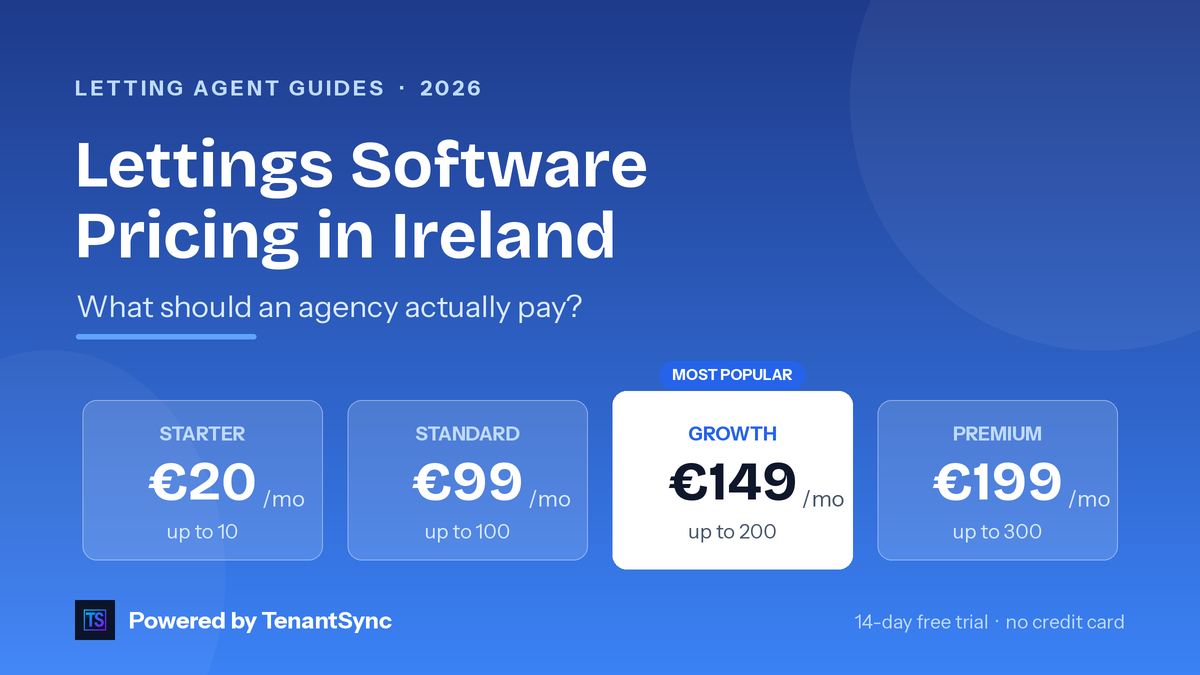
| Plan | Price / month | Properties | Best fit |
|---|---|---|---|
| Starter | €20 | Up to 10 | Small landlords — core platform and RTB compliance, without Open Banking |
| Standard | €99 | Up to 100 | Smaller agencies and portfolio landlords — adds Open Banking (1 account) and screening |
| Growth | €149 | Up to 200 | The agency tier — 3 bank accounts, bulk RTB compliance, PSR module, recurring invoicing |
| Premium | €199 | Up to 300 | Larger agencies — 5 bank accounts, API access, dedicated account manager |
| Enterprise | Custom | 300+ | Multi-branch agencies needing white-label, SLAs or custom development |
Every plan includes a 14-day free trial. At Growth, an agency running 200 tenancies is paying roughly 75 cent per tenancy per month — which is the number worth comparing against one unwound rent increase, one registration a client discovers is overdue before you do, or the hours a negotiator spends re-keying enquiries in September. What an Irish agency should actually pay for lettings software works through that comparison properly.
Frequently Asked Questions
What features should Irish letting agents demand from property management software in 2026?
Five, because five workflows consume an agency week. Rent automation that closes the loop from invoice to bank payment to matched tenancy to arrears alert to landlord statement. Compliance that generates its own deadlines — the tenancy's RTB duties and the agency's own PSRA duties. Daft and MyHome enquiry automation that puts portal enquiries into a shared pipeline within minutes. Tenant screening and onboarding that verifies income at source and converts an accepted applicant into a tenancy without re-keying. And tenant and landlord communication that runs from the system rather than one person's phone. Reporting, storage and mobile access are table stakes that follow from these five being right.
Why did the bar for letting agent software move in 2026?
Three changes landed at once. Rent control went national on 1 March 2026, so the cap calculation — the lower of CPI inflation or 2% per year, applied proportionately since the rent was last set — now applies to the whole book rather than only Rent Pressure Zone stock. Annual RTB registration turned a one-off task into a recurring one multiplied by portfolio size. And new tenancies operate under a rolling six-year minimum duration framework with its own milestones. Each converts occasional judgement into recurring arithmetic × portfolio size.
Does letting agent software need to handle PSRA obligations as well as RTB?
Yes, and it's the layer most often missing. RTB obligations attach to tenancies, which you touch daily, so they generate natural prompts. PSRA obligations attach to the agency — licence renewal, professional indemnity insurance, the Compensation Fund contribution, the accountant's report, client account reconciliation, letters of engagement, advertising standards, complaints records — and nothing in a normal week reminds you about any of them. Ask each vendor where your own licence renewal date lives in their system.
Can property management software submit RTB registrations automatically?
Ask any vendor to define exactly what they mean by "RTB integration" and to demonstrate it rather than describe it. What software genuinely does today is derive the registration deadline and annual renewal date from the commencement date, pre-fill the RTB Form 1 from the lease, property and landlord records you already hold, validate it before submission, produce the PDF and keep the finalised copy against the tenancy. That removes almost all of the work. Claims that go further deserve a live demonstration on your own tenancy before you sign anything.
How should software handle Daft and MyHome enquiries?
For most Irish agencies, portal enquiries arrive as notification emails to a lettings mailbox. Good software registers that mailbox, parses each notification into a structured lead, matches it to the right property, acknowledges it within minutes, follows up on its own if the applicant goes quiet, and shows the whole team one pipeline. Insist on seeing what happens to an enquiry that can't be matched to a listing: a visible unmatched queue is the sign of an honest product; silence is the sign of leads disappearing quietly.
Is bank-verified tenant screening GDPR-compliant in Ireland?
It can be, if the design respects data minimisation and purpose limitation. Four concrete tests: the applicant consents on their own bank's screen rather than handing over credentials; access is read-only and one-off, not an ongoing feed; the system stores derived signals — income, ratio, band, flags — rather than raw transaction lists; and access is revoked and tokens purged once the report exists. Ask what remains in the system twenty-four hours later. That answer tells you more than any privacy policy.
Can software decide which tenant application to accept?
No — and you shouldn't want it to. Under the Equal Status Acts, discrimination in the provision of accommodation is prohibited on nine grounds, including the housing assistance ground, which covers applicants in receipt of HAP. A screening report is decision support: income, ratio, band, flags, then stop. The letting decision and the ability to explain it must stay with a named person in your agency. An automated accept-or-reject is a liability dressed as a time-saver.
What does "rent automation" actually mean?
That the loop closes without you. A recurring invoice is raised per tenancy; rent arrives in the bank account; an Open Banking connection matches the transaction to the right lease and marks the invoice paid; anything short, late or missing becomes an arrears item the same day; and the month's rent, fees and approved deductions flow into a landlord statement. Marking invoices paid by hand after reading a bank statement is not rent automation — it's data entry with a nicer interface.
What should my landlord client see without asking me?
The rent position including anything overdue; a monthly statement showing gross rent collected, your management fee, deductions and the net due; the status of maintenance they're being asked to pay for; and their tenancy's compliance position — registration, renewal date, certificate expiries. The test isn't whether you can produce these on request. It's whether the client ever has to ask. Agencies lose landlords over silence far more often than over bad news.
We manage 45 tenancies. Is all of this overkill?
Forty-five tenancies means about forty-five annual RTB renewals spread unevenly across the year, forty-five rent reviews to calculate against the national cap, a few hundred portal enquiries a season, and your own agency compliance layer on top. That's the volume at which a spreadsheet still looks like it's working while quietly depending on one person's memory. The threshold isn't portfolio size — it's whether losing that person would cost you visibility of your deadlines.
How much should an Irish agency pay for software that does all five?
Price it per tenancy, not per month. TenantSync's published plans are Starter €20 (up to 10 properties), Standard €99 (up to 100), Growth €149 (up to 200), Premium €199 (up to 300) and custom above that, all with a 14-day free trial. At Growth, an agency at 200 units is paying roughly 75 cent per tenancy per month. Compare that against one unwound rent increase, one missed registration a client finds before you do, or a September of re-keying enquiries — not against your current software bill.
What if my current provider scores 2s rather than 3s?
Then you have a real decision rather than an obvious one, and the useful next step is to cost the gap rather than argue about it. Take the workflows scoring 2 and estimate the hours they consume per month at your own staff cost. A tool that prompts you about 150 annual RTB renewals is genuinely better than one that doesn't — but it still leaves 150 pieces of work on your team. Switching is disruptive; carrying that load for another three years is expensive in a way that never appears on an invoice.
Summary
The reason software evaluations go badly is that they are run as feature comparisons, and feature comparisons are a game the vendor has played more often than you have. The five demands here are an attempt to change the frame: instead of asking what a product has, ask what it does about the five things that consume your week.
Rent should reconcile itself and produce the landlord statement. Compliance should generate its own deadlines from the commencement date and carry your agency's PSRA layer alongside the tenancy one. Enquiries from Daft and MyHome should be captured, matched, acknowledged and followed up without anyone remembering. Screening should verify income at source and hand you a report that supports a decision you still make yourself. Communication should live in the system rather than in your best employee's phone.
Score each one from 0 to 3 on what you are shown, on your own data. Twelve or more and the software is doing the work. Seven to eleven and you have tidy records and the same workload. Six or below and the login screen is the only thing separating you from a spreadsheet.
The bar moved in 2026 because the work became recurring. Choose accordingly.
Sources & Further Reading
- RTB — Setting and reviewing private rents from 1 March 2026
- RTB — When to register a tenancy
- RTB — Annual registration
- gov.ie — Government reforms to the rental sector, starting 1 March 2026
- Citizens Information — Changes to the rules for renting from March 2026
- PSRA — Renewing a licence
- PSRA — Forms and resources for licensees
- IHREC — The Equal Status Acts and the nine protected grounds
- Citizens Information — Discrimination on the housing assistance ground
- Data Protection Commission — Principles of data protection
- Central Bank of Ireland — Payment institutions and PSD2
- CSO — Consumer Price Index
Related Articles