Bulk RTB Compliance Across Every Client Tenancy: An Agency Workflow
For a single landlord, RTB compliance is a date in a diary. For a letting agency managing tenancies across dozens of landlord clients, it's hundreds of recurring deadlines — and a single missed one is a professional-liability problem and the fastest way to lose a client. This is the repeatable agency workflow that keeps every client tenancy registered, renewed and dispute-ready, without anyone having to hold it all in their head.
The short version
- RTB compliance doesn't get harder per tenancy — it gets harder per client multiplied by every tenancy. The risk is volume, not complexity.
- Every tenancy must be registered with the RTB within one month of commencement and re-registered every year. Across a book of business that's a continuous stream of deadlines that compounds as you grow.
- The fix isn't more diligence — it's a workflow: one source of truth, deadlines computed from each tenancy's dates, a portfolio-wide dashboard colour-coded compliant / upcoming / overdue, reminders before each date, and a per-tenancy audit trail for disputes.
- Done well, no individual has to remember anything — the system surfaces what's due, for which landlord, this week.
If you take one thing from this guide: an agency can't out-discipline a compliance problem that scales faster than a person's memory. You beat it with a repeatable system — and that's exactly what the workflow below builds.
Why RTB compliance breaks at agency scale
A landlord with one tenancy has one registration to do and one renewal a year to remember. An agency managing 120 tenancies across 40 landlord clients is tracking 120 registration states and 120 annual renewal dates — and adding more every time it wins a new instruction or a tenancy turns over. The work each tenancy demands is the same; the number of moving parts is what changes.
That's why agencies rarely fail on the hard cases. They fail on the ordinary ones: the renewal that fell due in a busy letting season, the tenancy that started while someone was on leave, the client whose properties live in a different spreadsheet tab. None of these is a knowledge gap. They're tracking failures — and tracking is precisely what scales badly when it depends on a person remembering.
Why this is the #1 professional-liability fear for agents
When you register on a landlord's behalf, their compliance is your responsibility. A missed registration can mean a higher late fee, a weaker position in an RTB dispute, and a hit to the landlord's tax position — and from the client's seat, it looks like the agency had one job and dropped it. Compliance isn't just a legal obligation; at agency scale it's a client-retention issue.
The good news: because the failures are systematic, the solution can be too. You don't need heroic diligence on every tenancy — you need a system that makes the next due date impossible to miss.
What you're actually tracking on every tenancy
Before you can build a workflow, be honest about everything a single tenancy puts on your plate. Each of these has to be current on every tenancy in the book:
- Initial RTB registration. A new tenancy must be registered with the RTB, on the RTB Form 1, within one month of the commencement date.
- Annual re-registration. Under the RTB's annual registration system, each registration must be renewed every year, within one month of its anniversary, for as long as the tenancy continues.
- Rent reviews within the national rent cap. Where you raise rent, the increase must respect the post-March-2026 national rent cap — 2% or CPI inflation, whichever is lower — reviewed at most once every 12 months and served with the correct notice.
- Part 4 and the Tenancy of Minimum Duration. Part 4 rights, the 6-year minimum-duration framework, and the small-landlord (≤3) versus large-landlord (≥4) distinction all affect what you can and can't do, and when.
- Notices and notice periods. Any notice of termination must use the correct statutory format and the correct notice period for the tenancy's length.
- Minimum standards & certs. BER, gas and electrical safety, and the property's compliance with minimum standards.
- Records for disputes. The evidence trail that proves all of the above if a case reaches the RTB.
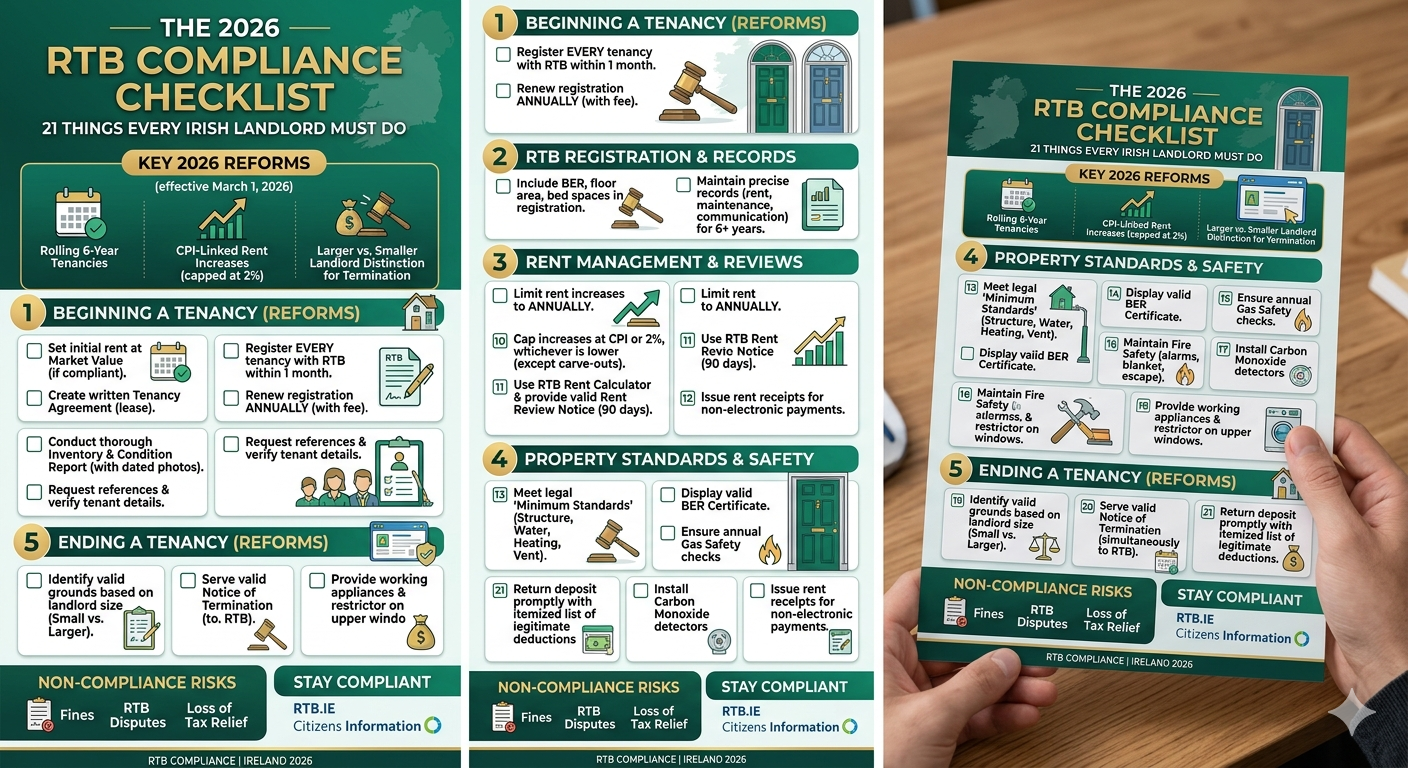
That's seven recurring obligations per tenancy. Multiply by your portfolio and you can see why "we'll keep on top of it" stops being a plan somewhere around 30 tenancies. For a full landlord-side breakdown of these obligations, our 2026 RTB compliance checklist is a useful companion — this guide is about running them across a whole agency book.
See every obligation, every tenancy, on one screen
Book a 15-minute agency demo and we'll show you a live portfolio compliance dashboard on data shaped like your own — registration, renewal, rent review and Part 4 across every client.
The four ways deadlines slip across a book
Almost every missed RTB deadline at an agency traces back to one of four failure modes. Name them and you can design them out:
- 1. Data lives in silos. One landlord's properties are in a spreadsheet, another's in an email thread, a third's in someone's head. There's no single place to ask "what's due this week, across everyone?"
- 2. Deadlines are calculated by hand. If someone has to work out the one-month deadline and the renewal anniversary tenancy by tenancy, the maths is right until the week it isn't.
- 3. Reminders depend on a person. A diary note only fires if the person who set it is at their desk, not on leave, and not buried in viewings during peak season.
- 4. The trail is reconstructed after the fact. When a dispute arrives, the agency scrambles to assemble proof of what was registered and when — instead of pulling it from one place.
Notice that none of these is about knowing the law. They're all about where the information lives and what surfaces it. The workflow below closes each gap in turn.
The agency workflow, step by step
Here's the six-step workflow that turns bulk RTB compliance from a memory test into a system. It's deliberately tool-agnostic — you could run a lighter version of it in spreadsheets — but each step gets dramatically easier when the software computes the dates and surfaces the work for you.
Step 1 — Build one source of truth
Get every property, tenancy, lease and rent record for every landlord client into a single system. This is the foundation: you cannot manage portfolio-wide compliance from per-client silos. Import from your existing spreadsheets, your previous software or a CSV so nothing is left behind, and scope each tenancy to its landlord so you can slice the whole book by client at any moment.
Step 2 — Capture the dates that drive everything
For each tenancy, record the commencement date accurately. Almost every RTB deadline derives from it: the one-month initial registration window and the annual renewal anniversary both compute from that single date. Get this right once and the system can do the date arithmetic forever; get it wrong and every downstream reminder is wrong too.
Step 3 — Draft and finalise the Form 1
For every new tenancy, complete and validate the RTB Form 1 from the data you already hold, preview it, then finalise and submit within one month of commencement. Keep the confirmation against the tenancy. The aim is to never re-key details you've already captured, and to never let a Form 1 sit half-finished past its deadline.
Step 4 — Run a portfolio-wide compliance dashboard
This is the heart of it. One screen shows every tenancy's status — registration, annual renewal, rent review, Part 4 — colour-coded compliant / upcoming / overdue, filterable by landlord client. Instead of asking "is everyone registered?", you're looking at the answer. Anything amber or red is a task; everything green you can stop thinking about.
Step 5 — Automate reminders before each deadline
Compliance should chase you, not the other way around. Reminders fire ahead of each registration and renewal date — early enough to act, repeated as the date nears — so action happens before any RTB late fee applies, regardless of who's on leave or how busy the season is.
Step 6 — Keep the audit trail as you go
Every registration, renewal, notice and key communication is logged against its tenancy, time-stamped, as it happens. You're not building evidence for a dispute after one lands — it accumulates automatically, so it's already there if you need it.
The workflow in one line
One source of truth → dates captured once → Form 1 finalised on time → a dashboard that shows status across the book → reminders before every deadline → an audit trail that builds itself. No step relies on a person remembering.
Bulk Form 1: draft-to-finalise across the book
"Bulk RTB registration" can be a misleading phrase. Each tenancy is registered on its own Form 1 with its own details — there's no single button that registers a hundred tenancies in one click, because the RTB needs the specifics of each. What you can make bulk is the workflow around it.
The difference between an agency that dreads registration season and one that doesn't comes down to three things:
- Draft from data you already hold. The tenant, property, rent and date details are already in your system from onboarding — the Form 1 should pre-fill from them, not start blank.
- Draft-first, then finalise. Being able to prepare and validate a Form 1, review it, and only then finalise means errors are caught before submission, not after — and a half-built draft is visibly "not done yet" on the dashboard.
- Deadline computed, not remembered. The one-month window is calculated from the commencement date the moment the tenancy is created, so a pending registration shows up as upcoming long before it's overdue.
Run that way, registrations become a steady, visible queue of "draft → finalise → confirmed" work rather than a frantic catch-up. The volume is the same; the anxiety is gone, because nothing is hidden and nothing is re-keyed. For the detail of the deadline itself, our guide to the RTB registration deadline goes deeper on the one-month window and what "late" actually costs.
The portfolio-wide compliance dashboard
If the workflow has a single centre of gravity, this is it. A spreadsheet can list tenancies; what it can't do is tell you what's wrong right now without you reading every row. A compliance dashboard inverts that — it shows you the exceptions.
A dashboard built for an agency book does four things a list can't:
Status at a glance
Every tenancy is compliant, upcoming or overdue — colour-coded — so you scan for amber and red instead of reading 120 rows of dates.
Slice by landlord client
Filter the whole book to one landlord before a review meeting and answer "are all my properties compliant?" in seconds, with proof.
What's due this week
Upcoming registrations and renewals surface ahead of time, ordered by urgency, so the team works a queue rather than a memory.
Multiple obligations, one view
Registration, renewal, rent review and Part 4 tracked together per tenancy — not four separate spreadsheets that drift out of sync.
The cultural shift matters as much as the feature. With a dashboard, compliance stops being a quarterly panic and becomes a few minutes of routine: open the board, clear the amber, move on. That's the difference between an agency that scales and one that's quietly accumulating risk.
Watch the dashboard catch a deadline before it slips
In a 15-minute demo we'll create a few tenancies, let the system compute the deadlines, and show you exactly how an upcoming renewal surfaces — on web and on the iOS/Android app.
The audit trail that wins RTB disputes
Most of the time, compliance is about preventing problems. But when a case does reach the RTB — through mediation, adjudication or the Tenancy Tribunal — the question becomes "can you prove it?" An agency that can produce a clean, time-stamped record per tenancy is in a fundamentally stronger position than one reconstructing events from old emails.
A dispute-ready audit trail keeps, per tenancy:
- The registration confirmation and each annual renewal, with dates.
- The signed tenancy agreement and any variations.
- Every rent-review notice and the calculation behind it — including which figure (2% or CPI) the national rent cap allowed and why.
- Notices of termination, the period used, and how and when they were served.
- Inspection and minimum-standards records, and relevant tenant communications.
Why "as you go" beats "when it's needed"
A trail you assemble after a dispute lands always has gaps — the email no one saved, the date no one wrote down. A trail that builds itself as you work is complete by default, because the record is created at the moment the action happens. That's the practical difference between hoping you can prove compliance and knowing you can.
For agencies, this is also a sales point. Being able to show a landlord, on demand, a complete compliance history for their properties is exactly the kind of professionalism that renews a management contract — a theme we pick up in choosing software built for Irish agencies.
A compliance cadence you can actually keep
A workflow is only as good as the rhythm you run it on. Here's a realistic cadence that keeps a whole book current without anyone living in fear of a date:
| When | What you do | Why it works |
|---|---|---|
| At every new tenancy | Capture the commencement date; draft the Form 1; let the system set the one-month and annual deadlines. | The dates that drive everything are captured once, accurately, at the source. |
| Weekly (15 minutes) | Open the dashboard; clear anything amber (upcoming) or red (overdue); finalise pending Form 1s. | Small, regular sweeps stop a backlog ever forming. |
| Monthly | Review renewals due in the next 30–60 days; confirm rent-review notices are within the national rent cap. | You're always working ahead of deadlines, never behind them. |
| Per landlord review | Filter to the client; export a per-tenancy compliance summary for the meeting. | Compliance becomes a retention tool, not just an obligation. |
| Continuously (automatic) | Reminders fire before each deadline; the audit trail logs every action. | The system carries the memory, so the team doesn't have to. |
The point of the cadence is that no single moment is high-stakes. When the system computes the dates and surfaces the work, "staying compliant" is fifteen quiet minutes a week — not a scramble every time a renewal anniversary arrives.
What TenantSync does for bulk RTB compliance
TenantSync is an Irish-built platform designed around exactly this problem: keeping a whole book of client tenancies compliant without anyone having to hold the deadlines in their head. Every capability below maps to a step in the workflow above.
Form 1, draft-to-finalise
Pre-fill the RTB Form 1 from data you already hold at onboarding, validate it, preview it in the browser, then finalise to a signed PDF — no re-keying, no half-built forms slipping past the deadline.
Deadlines computed automatically
The one-month registration window and the annual renewal date are calculated from each tenancy's commencement date the moment it's created — and tracked from then on.
Portfolio compliance dashboard
Registration, renewal, rent review and Part 4 tracked per tenancy and colour-coded compliant / upcoming / overdue across every landlord client — your whole book on one screen.
Reminders before every deadline
Automated reminders fire ahead of each registration and renewal so action happens before any RTB late fee applies — independent of who's at their desk.
National rent-cap calculator
Works out the maximum legal increase under the post-March-2026 rules — 2% or CPI, whichever is lower — and shows the rule and figure it used, so each rent review is defensible.
Per-tenancy audit trail
Registrations, renewals, notices and communications are logged and time-stamped as you work, so a complete compliance history is ready for any RTB dispute or landlord review.
It runs on web plus iOS and Android, includes a landlord and tenant portal, and imports directly from Letman, a CSV or a spreadsheet — so an agency can get its whole book in and see the dashboard light up quickly. On pricing, TenantSync uses flat per-portfolio tiers (Standard €99 up to 100 properties, Growth €149 up to 200, Premium €199 up to 300, plus a €20 Starter for up to 10), each with a 14-day free trial; for the full breakdown see our guide to lettings software pricing in Ireland.
Put your whole book on the dashboard
Import a slice of your portfolio, let TenantSync compute the deadlines, and watch a real compliance dashboard come to life. That's the fastest way to know it fits your agency.
Prefer to start with a quick check? Try the free RTB deadline checker and rent-cap calculator — no account needed.
Frequently asked questions
What is bulk RTB compliance for letting agents?
Bulk RTB compliance is the work of keeping every tenancy a letting agency manages registered and current with the Residential Tenancies Board — not one tenancy, but the whole book of business across many landlord clients. In practice it means registering each new tenancy with the RTB within one month of commencement, renewing every registration annually, calculating rent reviews within the national rent cap, tracking Part 4 rights and notice periods, and being able to evidence all of it in a dispute. The challenge is scale: a single missed date on any one tenancy is a professional-liability problem, and an agency may be tracking hundreds of dates at once.
How often must a letting agent register a tenancy with the RTB?
Under the RTB's annual registration system, a new tenancy must be registered within one month of its commencement date, and then re-registered every year within one month of each registration anniversary, for as long as the tenancy continues. For an agency this means every tenancy generates a recurring annual deadline, so the tracking never stops — it compounds with each new tenancy you take on. Always confirm the current rules and fees on rtb.ie.
What happens if an agency misses an RTB registration deadline?
A late RTB registration incurs a late fee for each month, or part of a month, that it is outstanding (see RTB registration fees in 2026), and a gap in the compliance record weakens the landlord's position in any subsequent RTB dispute. It can also affect a landlord's ability to claim certain tax deductions and, crucially for an agency, it damages the client relationship — missing a deadline on a landlord's behalf is one of the fastest ways to lose the management contract. Confirm current fees and consequences on rtb.ie before relying on any figure.
Can you register multiple RTB tenancies at once?
Each tenancy is registered on its own RTB Form 1 with its own details, so registration is per tenancy rather than a single combined submission. The realistic way to handle volume is to manage the workflow in bulk: hold every tenancy in one system, compute each registration and renewal deadline automatically, draft each Form 1 from data you already hold, and work them from a single dashboard rather than re-keying each one from scratch. That is what "bulk RTB compliance" means in practice for an agency.
How do letting agents track RTB deadlines across many landlord clients?
The reliable approach is a portfolio-wide compliance dashboard rather than a spreadsheet per landlord. The system computes the one-month registration deadline and the annual renewal date from each tenancy's commencement date, colour-codes every tenancy as compliant, upcoming or overdue, and sends reminders before each deadline. That turns compliance from something a person has to remember into something the system surfaces, which is the only way it scales past a handful of tenancies.
What records should an agency keep for an RTB dispute?
Keep a time-stamped, per-tenancy record of the registration confirmation and each annual renewal, the signed tenancy agreement, any rent-review notices and the calculation behind them, notices of termination and how they were served, inspection and minimum-standards records, and the relevant communications with the tenant. If a case reaches RTB mediation, adjudication or the Tenancy Tribunal, a complete audit trail is what lets you evidence compliance quickly instead of reconstructing it from memory and old emails.
Does TenantSync handle bulk RTB compliance for agencies?
Yes. TenantSync is built around Irish RTB compliance at portfolio scale: a Form 1 draft-to-finalise workflow with the registration deadline computed from each tenancy's start date, annual-renewal and Part 4 tracking, a portfolio-wide compliance dashboard colour-coded compliant, upcoming or overdue across every landlord client, automated reminders before each deadline, a national rent-cap calculator (2% or CPI, whichever is lower) that shows its working, and a per-tenancy audit trail. It imports directly from Letman, a CSV or a spreadsheet so an agency can get its whole book in quickly.
Sources & further reading
Facts in this article are drawn from official and primary sources. Registration rules, fees and deadlines change — verify the current position on rtb.ie before relying on any figure.
- Residential Tenancies Board — Register a tenancy (RTB Form 1 and the annual registration system)
- Residential Tenancies Board — Registration fees
- Residential Tenancies Board — Rental law changes from 1 March 2026
- Residential Tenancies Board — Dispute resolution (mediation, adjudication and the Tenancy Tribunal)
- Citizens Information — Registering a tenancy with the RTB
- Government of Ireland — Reforms to the rental sector, starting 1 March 2026
Related Articles