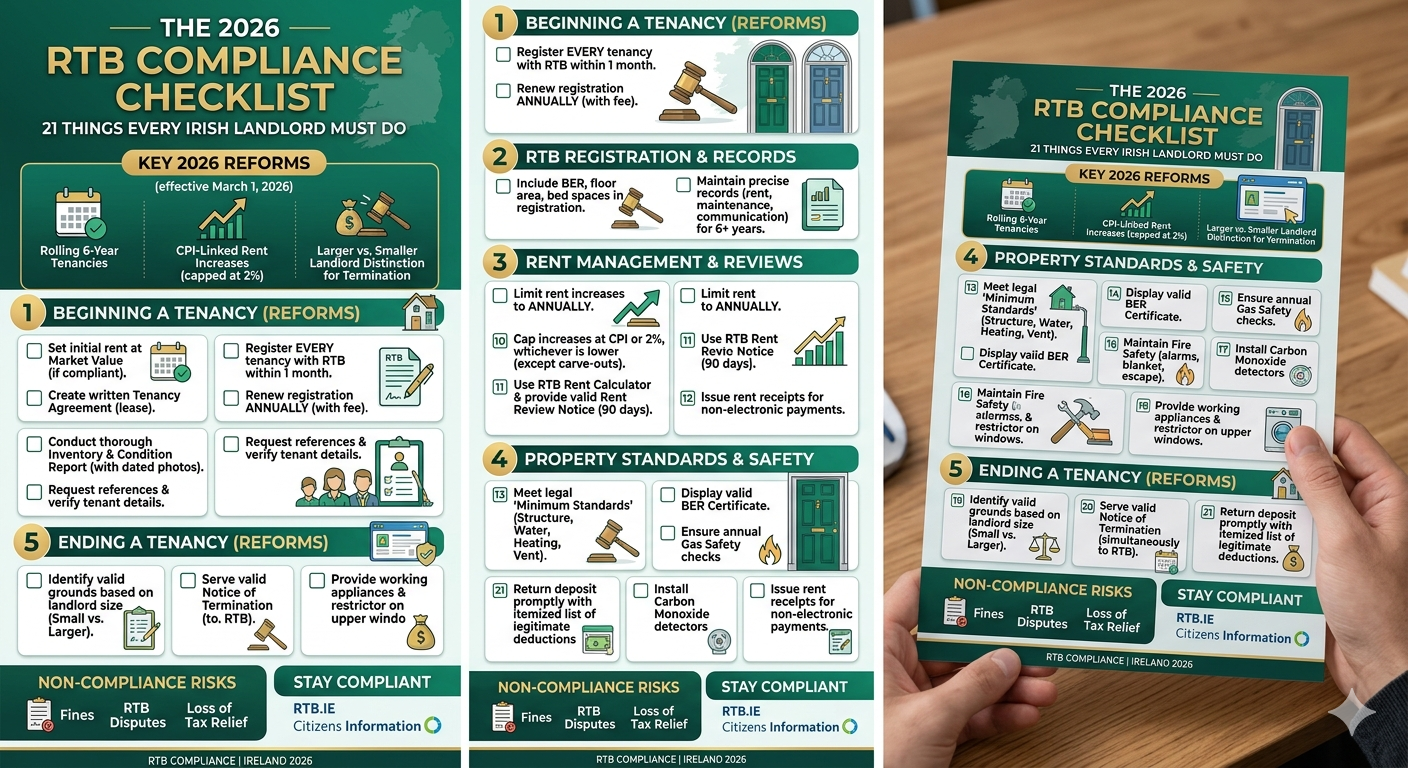
Looking for a Letman Alternative? An Honest 2026 Comparison for Irish Letting Agents
If you run an Irish lettings agency, you already know Letman. The real question in 2026 isn't "is Letman good?" — it's "is it still the right fit now that the March 2026 reforms have rewritten rent rules and RTB compliance is a daily, portfolio-wide job?" This is a fair, no-hype comparison of Letman and TenantSync — what each does well, where they differ, what they cost, and how to switch if you decide to.
The short version
- Letman is a long-established Irish lettings system (on the market since 2003, by Topfloor). Its core strength is client-account (trust) accounting — knowing exactly what money belongs to the landlord, tenant, contractor and agency — plus SEPA payment files and the MYletman portal.
- TenantSync is a newer, Irish-built platform focused on RTB compliance automation (Form 1 draft-to-finalise, the national rent cap, Part 4 tracking) and Open Banking rent reconciliation, with a web app, a mobile app, and a direct Letman import.
- Pick on the job you most need done: deep client-money accounting points to Letman; automated compliance and reconciliation across many client tenancies points to TenantSync.
No tool wins on every axis, and any comparison that pretends otherwise isn't worth your time. Below is the honest version — including the parts where Letman is the stronger choice.
Why Irish agents start looking for a Letman alternative
Agencies rarely go shopping because their current system is bad. They go shopping because the job changed. In 2026, three things changed at once for Irish letting agents:
- Compliance became a daily, portfolio-wide task. Annual RTB registration (mandatory for every tenancy), Part 4 cycles, and the post-March-2026 rent rules mean a missed deadline isn't a fine — it's a professional-liability problem and a route to losing a landlord client.
- Rent maths got harder. The national rent cap replaced Rent Pressure Zones, and the inflation measure changed (more on that below). Getting a rent review wrong now is easy, and an invalid review can be unwound.
- Manual reconciliation stopped scaling. Matching rent to the right tenancy across multiple client bank accounts, by hand, every week, is where agency hours quietly disappear.
So the question isn't "Letman or not?" — it's "which platform does the 2026 version of my job best?" That depends on which of these problems hurts most.
What Letman is — and what it genuinely does well
Letman is a web-based lettings and property management system for Irish agents, developed by Topfloor and on the market since 2003. It's a mature, Irish-market product, and it's strongest in an area that matters enormously to PSRA-licensed agents: client money.
Letman's core strengths (verified from letman.ie)
- Full client-account accounting. Letman manages the client account in its entirety, with a balance sheet showing in real time what money belongs to the landlord, the tenant, the contractor and the agency.
- SEPA payments. It produces SEPA payment files for landlords and suppliers.
- MYletman portal. A web portal where landlords and tenants view rent history, statements and tenancy documents.
- Lettings operations. Tenancy agreements, automated and inspection reports, document management and financial accounting.
- Regulatory fit. Built to comply with the Residential Tenancies Act 2004, the Property Services (Regulation) Act 2011, and the Client Moneys Regulations (S.I. 199 of 2012), plus GDPR.
If your agency's centre of gravity is client trust-account accounting and supplier/landlord payment runs, that is exactly what Letman was designed around. Any honest comparison has to start there.
Where TenantSync fits
TenantSync comes at the same market from a different angle. Instead of starting from client-money accounting, it starts from the whole shape of an Irish agency's week — four jobs, one system: RTB compliance for your landlord clients, the PSRA obligations your agency carries itself, rent automation from the bank feed, and the day-to-day operations underneath both.
It's a newer platform (and a smaller company — we'll be upfront about that rather than invent customer numbers), built specifically for Irish residential tenancies law. The headline capabilities:
- RTB Form 1 draft-to-finalise — fill, validate, preview, finalise to a signed PDF; you submit through the RTB portal and mark it confirmed with the proof attached.
- National rent-cap calculator — computes the maximum legal rent under the post-March-2026 rules from CSO All-Items CPI against the 2% cap, naming the rule it applied, with a disclaimer, so you stay audit-ready.
- Registration lifecycle — the 30-day deadline is derived from the tenancy start date; annual renewals and Part 4 are tracked, with reminders, across eleven obligation types on one dashboard.
- PSRA compliance for the agency itself — licence renewal clock, s.43 Letters of Engagement, a designated client-account register with per-landlord ledgers and signed-off monthly reconciliation, PII and tax-clearance tracking, and a one-click inspection evidence pack. Available on Growth and above.
- Open Banking reconciliation (PSD2) — connect the agency account and incoming rent auto-matches to the right tenancy from the next sync; arrears are flagged from what the bank shows rather than from memory.
- Operations in the same system — lease generation and signing, maintenance with contractors attached, document expiry reminders, Daft and MyHome inquiry capture, and per-landlord reporting with Excel export.
- Direct Letman import — so switching doesn't mean re-keying your portfolio.
Letman vs TenantSync: an honest feature comparison
Where we can verify a Letman capability from public sources, we've stated it. Where a capability isn't publicly documented, we've said "check with provider" rather than claim it's missing — you should confirm anything decision-critical directly.
| Capability | Letman | TenantSync |
|---|---|---|
| Background | Established Irish lettings & block-management ecosystem (since 2003, by Topfloor) | Newer, Irish-built platform covering RTB, PSRA, rent and operations |
| Job 1 · RTB Form 1 registration | RTA 2004-compliant; confirm Form 1 drafting with provider | Built-in Form 1 draft-to-finalise (signed PDF) |
| Job 1 · National rent-cap (2% / CPI) calculator | Check with provider | Built-in; shows the rule and figure used |
| Job 1 · Part 4 & renewal reminders / compliance dashboard | Check with provider | Built-in; 11 obligation types on one dashboard |
| Job 2 · Client-account (trust) accounting & SEPA payment files | Core strength — full client-account accounting + SEPA payment files | Client-account register & per-landlord ledgers, not a SEPA payment-file engine |
| Job 2 · PSRA licence register & renewal clock | Check with provider | Built-in (Growth+); reminders at 12wk, 6wk, overdue |
| Job 2 · s.43 Letters of Engagement | Check with provider | Generated with itemised fees; tracked draft → issued → signed |
| Job 2 · PII, tax clearance & Compensation Fund tracking | Check with provider | Built-in (Growth+); one assurance summary |
| Job 2 · One-click PSRA inspection evidence pack | Check with provider | Built-in (Growth+); six-year retention |
| Job 3 · Open Banking auto-reconciliation | Not publicly documented | Built-in (AIB, BOI, PTSB, EBS, Revolut, N26 and other PSD2 institutions) |
| Job 3 · Fees, deductions & landlord disbursement statements | Yes — via client accounting | Calculated from your rate; monthly statement for approval |
| Job 4 · Lease generation & digital signing | Tenancy agreements | Draft → preview → signed PDF, stored against the tenancy |
| Job 4 · Maintenance & document expiry reminders | Inspections & document management | Contractor assignment; reminders before, on and after expiry |
| Job 4 · Daft.ie / MyHome.ie inquiry capture | Check with provider | Parsed into a lead pipeline (newer than the rest of the surface) |
| Landlord & tenant portal | MYletman (+€0.60 / unit / month) | Included on every plan |
| Mobile app | Web / cloud-based | Web + native iOS & Android apps |
| Migration in | — | Direct Letman + CSV import, concierge onboarding |
Read down that table and the split is clear. Letman leans into accounting and client-money rigour — and if SEPA landlord and supplier payment runs are how your agency operates, that is a genuine reason to stay. TenantSync leans into the whole compliance and operations surface: RTB automation, the wider PSRA lifecycle beyond client money (licences, s.43 letters, insurance, inspection packs), bank-feed reconciliation, and the leases, maintenance and documents underneath. They're optimised for different parts of an agency's week — the question is which part currently costs you most.
Pricing compared (as published, September 2026)
The two products are priced on different models, so compare carefully rather than just on the headline number.
| Plan / model | Price | Scope |
|---|---|---|
| Letman | From €195 / month (no licence fee) | Up to 100 managed units |
| Letman — MYletman portal | €0.60 / unit / month | Add-on web portal |
| TenantSync — Starter | €20 / month | Up to 10 properties (small-landlord tier) |
| TenantSync — Standard | €99 / month | Up to 100 properties; 1 bank (Open Banking) |
| TenantSync — Growth ⭐ | €149 / month | Up to 200 properties; 3 banks; RTB bulk compliance |
| TenantSync — Premium | €199 / month | Up to 300 properties; 5 banks; account manager |
| TenantSync — Enterprise | Custom | Multi-branch / white-label |
How to read this fairly
On published list prices, TenantSync's tiers start lower at the 100-unit mark (Standard €99 vs Letman from €195, before the per-unit portal add-on), and the landlord/tenant portal is included rather than priced per unit. But the products weight their features differently — Letman bundles deep client-account accounting that TenantSync doesn't try to replicate. The honest comparison is "cost per job you actually need done," not list price alone. TenantSync also offers a 14-day free trial. Always confirm current pricing on each provider's own site.
Why March 2026 raised the stakes for every agency
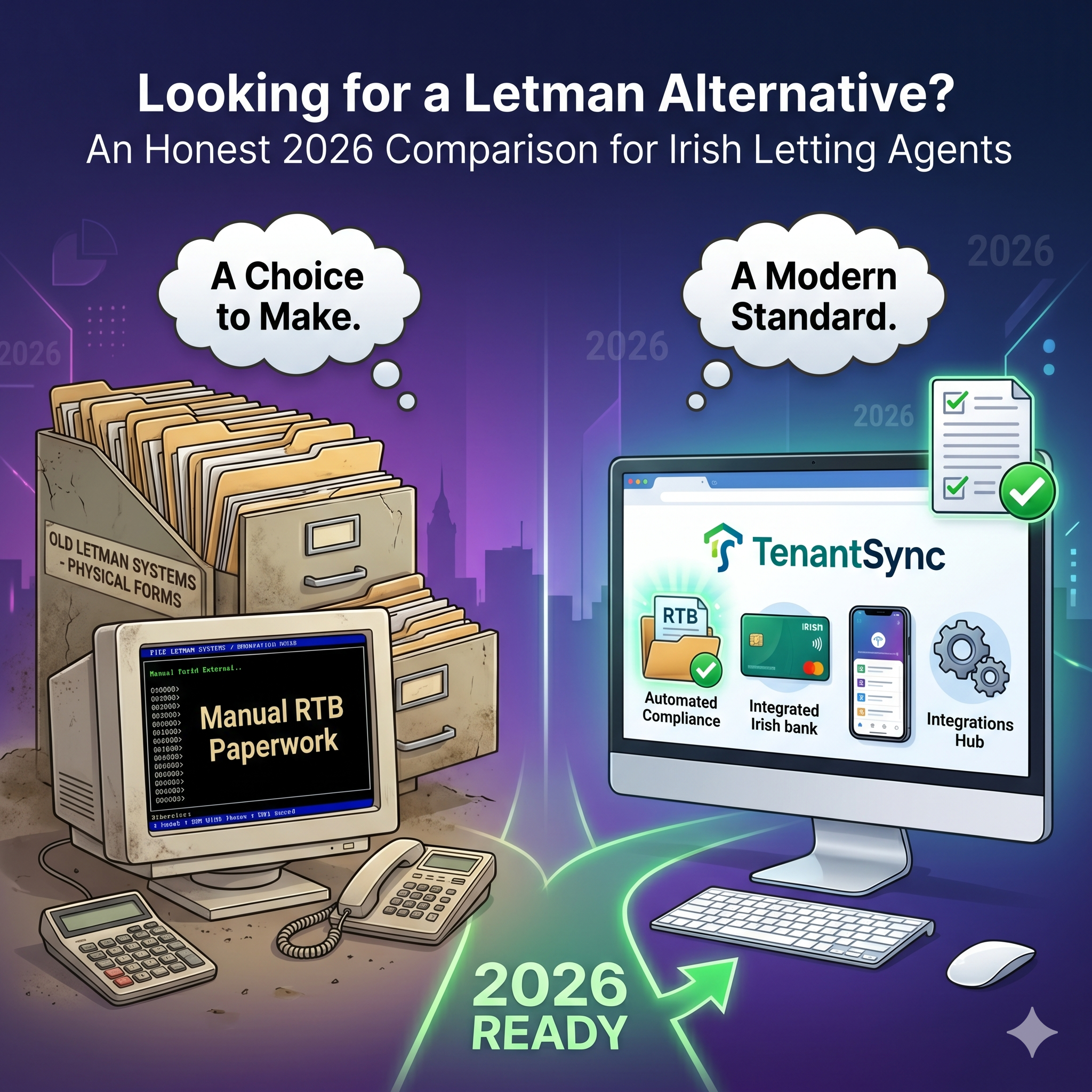
This is the context that makes the software choice urgent. On 1 March 2026, Ireland's rental rules changed materially, and the changes touch every tenancy an agent manages.
What changed on 1 March 2026
- National rent control replaced Rent Pressure Zones. A single national system now applies to all private tenancies. Rent can be increased once a year by a maximum of 2%, or by inflation if inflation is lower.
- The inflation measure changed. The cap is now measured by the Consumer Price Index (CPI), not the HICP that applied under the old RPZ regime — for all tenancies, new and existing.
- 6-year Tenancies of Minimum Duration (TMD). New tenancies created from 1 March 2026 run in rolling 6-year cycles.
- Small vs large landlords. A "small" landlord has three or fewer tenancies; a "large" landlord has four or more. Large landlords can no longer use no-fault terminations; small landlords can in limited cases but generally can't reset the rent until the 6-year cycle ends.
- 90-day written notice for rent reviews still applies.
For an agent, the practical upshot is blunt: you now have to apply the national cap correctly to every client tenancy, with the right index, on the right schedule, with valid notice. That's a calculation and tracking problem at portfolio scale — and it's precisely the problem TenantSync's rent-cap calculator and compliance dashboard were built to remove. Whichever tool you choose, make sure it keeps pace with the 2026 rules rather than the old RPZ/HICP ones.
Who should switch — and who should stay on Letman
Here's the part most "alternative" pages skip. Switching isn't free — it costs time and change-management — so only do it if the fit is genuinely better.
TenantSync is likely the better fit if…
- Your biggest daily pain is RTB compliance across many landlord clients — registrations, renewals, Part 4, and getting rent reviews right under the new national cap.
- You want your own PSRA obligations in the same system — the licence renewal clock, s.43 Letters of Engagement, PII and tax clearance, and an inspection pack you can generate in one click rather than assemble over a fortnight.
- You want Open Banking reconciliation so rent auto-matches to the right tenancy and arrears are flagged from what the bank actually shows.
- You want compliance and operations in one place — leases, maintenance, certificates and inquiries alongside the compliance dashboard, rather than in three other systems.
- Your team values a modern web + mobile experience and works on the go.
- You want a low-friction switch with a direct Letman import and concierge onboarding.
Letman may remain the better fit if…
- Your agency's core is full client-account (trust) accounting with SEPA landlord and supplier payment files, and you need that depth above all else. This is the single strongest reason to stay, and we'd rather say so plainly.
- You rely on the wider Topfloor ecosystem (for example block/OMC management) and want it in one stack.
- You prefer a long-established vendor with a long Irish track record and aren't looking to be an early adopter.
A useful test: list the five things your agency does most often, then ask each vendor to show you those five — live — on your own data during a trial or demo. The right answer falls out quickly. If you want the wider market view rather than a head-to-head, see our guide to the best property management software for Irish letting agents and landlords.
How migrating off Letman actually works
The number one reason agencies stay on a tool they've outgrown is the fear of a painful migration — losing history, re-keying tenancies, breaking compliance dates. TenantSync is built to remove that fear.
The migration path
- Direct Letman import + CSV. Properties, units, tenancies, leases and rent details come across without re-keying.
- RTB date validation. Registration and renewal dates are checked so nothing falls through during the move.
- First reconciliation in session. Connect a bank account and watch recent rent match to the right tenancies.
- Done-with-you onboarding. You're not handed a blank screen — the import and first real Form 1 can be done together.
See the Letman import on your own portfolio
Start a 14-day free trial, or book a 15-minute demo and we'll show the import and a real RTB Form 1 on your data — no slideware.
What TenantSync does for Irish lettings agencies
TenantSync is built around Irish residential tenancies law — not adapted from a UK or US product. Every capability below is aimed at an agency managing tenancies across multiple landlord clients, across all four jobs an Irish agency runs on.
RTB Form 1, draft-to-finalise
Fill and validate the registration, preview it in the browser, then finalise to a signed PDF. The 30-day deadline is derived from the tenancy start date and tracked automatically. You submit through the RTB portal and mark it confirmed with the proof attached.
National rent-cap calculator
Works out the maximum legal increase under the post-March-2026 rules — 2% or CPI inflation, whichever is lower — and shows the rule and figure it applied, so a rent review is defensible.
PSRA compliance for the agency
Licence renewal clock with reminders at twelve weeks, six weeks and overdue; s.43 Letters of Engagement tracked draft to signed; a designated client-account register with per-landlord ledgers and signed-off monthly reconciliation; PII, tax clearance and Compensation Fund tracking; and a one-click inspection evidence pack. Available on Growth and above.
Open Banking reconciliation
Connect the agency account (AIB, Bank of Ireland, PTSB, EBS, Revolut, N26 and other PSD2 institutions) and incoming rent auto-matches to the right tenancy from the next sync. Arrears are flagged from what the bank shows. Credentials stay on the bank's screen.
Compliance dashboard
Registration, renewal, rent review, Part 4 and other obligations — eleven types in all — tracked per tenancy and colour-coded compliant / upcoming / overdue across your whole book of clients.
Invoicing, fees & disbursement
Recurring monthly invoices, PDF generation, an aging report and automated reminders. Management fees calculate from your configured rate, contractor costs deduct, and a per-landlord disbursement statement generates monthly for approval.
Leases, maintenance & documents
Generate a lease from the tenancy, validate, preview and finalise it to a signed PDF. Maintenance requests carry photos, an assigned contractor and a tenant comment thread. Certificates carry expiry dates with reminders before, on and after expiry.
Per-client reporting & portals
One-click reporting per landlord client with Excel export, plus agency and branch scoping — so review meetings and renewals are quick. Landlord and tenant portals are included on every plan, alongside native iOS and Android apps.
Put your agency's real workflow to the test
Import from Letman, finalise one real Form 1, and reconcile last month's rent — in a single session. That's the fastest way to know if TenantSync fits.
Frequently asked questions
What is the best Letman alternative for Irish letting agents in 2026?
The right alternative depends on what your agency needs most. TenantSync is an Irish-built platform focused on RTB compliance automation (Form 1 draft-to-finalise, the national rent cap, Part 4 tracking) and Open Banking rent reconciliation, and it imports directly from Letman. Letman remains a strong choice for agencies whose primary need is full client-account (trust) accounting with SEPA landlord and supplier payments. Compare both against the jobs your agency actually does every week.
What is Letman?
Letman is a web-based lettings and property management system for Irish agents, developed by Topfloor and on the market since 2003. Its core strength is client-account accounting — tracking what money belongs to the landlord, tenant, contractor and agency — alongside SEPA payment files, tenancy agreements, inspection and document management, and the MYletman landlord and tenant portal. It is built to comply with the Residential Tenancies Act 2004, the Property Services (Regulation) Act 2011 and the Client Moneys Regulations (S.I. 199 of 2012).
Does TenantSync import data from Letman?
Yes. TenantSync provides a direct Letman import plus CSV and spreadsheet import, so your properties, tenancies, leases and rent details move across without rekeying. Done-with-you onboarding is available to validate RTB dates and run your first reconciliation.
How much does Letman cost compared with TenantSync?
Letman's published pricing starts at €195 per month for up to 100 managed units with no licence fee, plus €0.60 per unit per month for the MYletman web portal. TenantSync uses all-in tiers: Standard €99 (up to 100 properties), Growth €149 (up to 200) and Premium €199 (up to 300), with a €20 Starter for up to 10 properties and custom Enterprise pricing; a landlord and tenant portal is included. The two products weight their features differently, so compare on the capabilities you actually use. Pricing is as published in September 2026 — always confirm on each provider's own site.
Does TenantSync handle RTB Form 1 and the national rent cap?
Yes. RTB compliance is what TenantSync is built around: a Form 1 draft-to-finalise workflow, automatic 30-day registration and annual-renewal tracking, Part 4 reminders, a compliance dashboard covering multiple obligation types, and a rent-cap calculator that works out the maximum legal increase under the post-March-2026 national rules and shows the figure and rule it used.
Will I lose my client (trust) accounting if I move off Letman?
Be deliberate here. TenantSync handles invoicing, recurring billing, Open Banking reconciliation, arrears and aging reports, plus a designated client-account register with per-landlord ledgers and signed-off monthly reconciliation for PSRA purposes. But if full client-account (trust) accounting with SEPA landlord and supplier payment files is the core of how your agency operates, evaluate that requirement carefully before switching — it is one of Letman's strengths and the single strongest reason to stay. Many agencies move for the compliance, PSRA and reconciliation automation; map your must-haves first and confirm each tool covers them.
Does TenantSync cover PSRA compliance as well as RTB?
Yes, on the Growth plan and above, and it is a meaningful difference between the two products. Letman's PSRA strength is client money — it is built to comply with the Property Services (Regulation) Act 2011 and the Client Moneys Regulations, and that accounting depth is genuine. TenantSync covers the wider PSRA lifecycle around that: a licence register with a renewal clock reminding at twelve weeks, six weeks and overdue across licence and holder types; s.43 Letters of Engagement generated with itemised fees and tracked from draft through issued to signed; a designated client-account register with per-landlord ledgers and monthly reconciliation that must be signed off; professional indemnity cover against the statutory €1,000,000 minimum, tax clearance and Compensation Fund tracking; advertising checks; a complaints register; and a one-click inspection evidence pack under six-year retention. TenantSync does not renew your licence with the Authority — it keeps the clock, the ledger and the evidence so the date cannot pass unnoticed.
How does the March 2026 national rent cap affect letting agents?
Since 1 March 2026, Rent Pressure Zones have been replaced by a national system of rent control: rent can rise at most once a year by 2%, or by inflation if inflation is lower. The inflation measure changed from the HICP to the Consumer Price Index (CPI) for all tenancies. New tenancies from that date are also 6-year Tenancies of Minimum Duration, with different rules for small landlords (three or fewer tenancies) and large landlords (four or more). Agents now apply the national cap to every client tenancy and keep the 90-day written-notice rule — exactly the kind of calculation TenantSync automates.
Sources & further reading
Facts in this article are drawn from official and primary sources. Pricing and product details were correct as published in September 2026 — verify on each provider's own site before deciding.
- Residential Tenancies Board — Rental law changes from 1 March 2026 and registration fees
- Citizens Information — Changes to the rules for renting from March 2026
- Government of Ireland — Reforms to the rental sector, starting 1 March 2026
- Letman — letman.ie (features and pricing)
Related Articles