RTB Registration Deadline Ireland 2026: What Every Landlord Must Know
Your tenant moved in three weeks ago. You meant to register the tenancy but life got in the way. Now you're wondering: is it too late? What will it cost you? And do you really have to pay every year now? This guide answers all of that — and introduces a free RTB registration deadline checker that shows your exact window and next renewal date in seconds.
What Is the RTB and Why Does Registration Matter?
The Residential Tenancies Board (RTB) is Ireland's independent statutory body responsible for registering private and student tenancies, resolving disputes between landlords and tenants, and enforcing rental sector standards under the Residential Tenancies Acts 2004–2022. Think of the RTB as the official record-keeper and referee of the Irish rental market.
Every landlord letting a residential property in Ireland must register each tenancy with the RTB. This is not optional. Registration creates a formal, legal record of the tenancy and is a prerequisite for accessing the RTB's dispute resolution service if things go wrong.
Why registration protects you as a landlord
- Dispute standing: An unregistered landlord cannot refer a dispute to the RTB — leaving you without recourse if a tenant falls into arrears or causes damage.
- Legal compliance: Non-registration is an offence under the Residential Tenancies Acts and can attract RTB enforcement action.
- Credibility: Registration confirms your tenancy is on the official record, which matters for tax, mortgage, and licensing purposes.
What Happens If a Dispute Arises With an Unregistered Tenancy?
If a dispute arises — rent arrears, damage to the property, an invalid notice of termination — the RTB's dispute resolution service is one of the most cost-effective routes available to Irish landlords. But you can only use it if the tenancy is registered. An unregistered landlord is effectively on their own.
This is one of the strongest practical reasons to register every tenancy promptly, even if enforcement feels like a distant concern on the day a new tenant moves in.
Who Must Register — and Are There Any Exemptions?
The registration obligation applies to landlords of private residential tenancies throughout Ireland, including houses, apartments, and bedsits. Some categories are exempt, including certain approved housing body (AHB) arrangements and certain owner-occupied scenarios — but the vast majority of standard residential lettings must be registered.
If you are unsure whether your letting falls under the Residential Tenancies Acts, check rtb.ie or seek professional guidance. When in doubt, register. The cost of registration is minimal compared to the cost of being caught without it.
The 30-Day Registration Window Explained
The RTB 30-day registration rule in Ireland is straightforward: once a new tenancy begins, you have 30 days from the tenancy start date to register it with the RTB. Miss that window, and you are already in late-registration territory.
The key rule in plain English
New tenancy starts on Day 1. Registration must be submitted by Day 30. If Day 30 falls on a weekend or public holiday, submit before then to be safe.
When Does the 30-Day Clock Start?
The clock starts on the tenancy start date — the date the tenant is entitled to take occupation of the property, as agreed in the lease. This is usually the date the keys are handed over and rent begins. If the tenancy agreement was signed in advance but occupation begins later, the 30-day window opens from the occupation date.
One common mistake: using the date the tenancy agreement was signed rather than the actual tenancy start date. These can differ by days or even weeks. Always base your deadline calculation on when the tenant actually moved in.
What Information Do You Need to Register?
Before you sit down to register, gather the following. Having everything ready prevents errors and speeds up the process significantly.
RTB registration requirements — information needed
- Your PPSN (Personal Public Service Number)
- The property address and Eircode
- The tenancy start date (not the lease signing date)
- The agreed monthly rent
- Your tenant's full name and PPSN
- The tenancy type (fixed-term, Part 4, etc.)
How to Register Online at rtb.ie
The fastest and most reliable way to register a tenancy is through the RTB official online registration portal. Online registration is processed faster than paper applications and gives you an instant confirmation number. See the step-by-step walkthrough further down in this article.
The 2022 Rule Change: Annual Renewal Is Now Mandatory
This is the rule change most landlords missed. Since 4 April 2022, paying a registration fee once is no longer enough. Annual renewal is now a legal requirement for every tenancy registered with the RTB — and many experienced landlords with long-standing tenancies are still unaware of this change.
If you registered before April 2022 and haven't renewed annually since
Your registration may have lapsed. Log in to the RTB portal to check your registration status, and use the RTB registration deadline checker to see when your next renewal was due.
What Changed in April 2022?
Before 4 April 2022, landlords registered a tenancy once for the lifetime of that tenancy. A single fee covered the entire duration, no matter how many years it ran. That model no longer applies.
Since 4 April 2022, landlords must pay an annual registration renewal fee every year to keep the tenancy active on the RTB register. Failing to renew carries the same legal consequences as failing to register in the first place — including loss of RTB dispute standing.
The 7 key facts about RTB annual renewal
- Before 4 April 2022, tenancies were registered once for the lifetime of the tenancy.
- Since 4 April 2022, landlords must pay an annual registration renewal fee to keep the tenancy active on the RTB register.
- The renewal falls on the anniversary of the original registration date, not the tenancy start date — these can differ if the landlord registered late.
- Failing to renew has the same legal consequence as failing to register in the first place.
- The RTB sends renewal reminders by email if a valid email address is on the registration — but the legal responsibility to renew rests with the landlord, regardless of whether a reminder arrives.
- The annual renewal fee applies per tenancy, not per property. A property with multiple separately registered tenancies (e.g., rooms let individually) incurs a fee for each.
- Use the RTB registration deadline checker to see the next renewal date for any tenancy.
When Is My Annual Renewal Due?
The RTB's guidance ties annual registration to the anniversary of the date the tenancy commenced, and requires it within one month of that anniversary. In practice, landlords who registered late in a previous year sometimes find the due date the RTB holds is closer to their registration anniversary than to the tenancy start date. Treat the due date shown against the tenancy in the RTB portal as authoritative, and if it disagrees with your own record, resolve it with the RTB rather than assuming your spreadsheet is right.
This distinction matters because a renewal reminder, if it arrives at all, will reference the date the RTB holds. Enter the relevant date into the RTB registration deadline checker to see when your next renewal falls.
What Does the Renewal Cost?
The annual registration is charged at the same standard fee as a first registration — the RTB's published schedule does not discount renewals — with a late fee added for each month, or part of a month, that it is late. The RTB sets these fees and can change them, so check the current schedule at rtb.ie. For the current figures, the composite-fee rules and what late costs across a portfolio, see our dedicated guide to RTB registration fees in 2026.
What Happens If You Miss the RTB Registration Deadline?
Missing the deadline is a common situation — particularly for first-time landlords who weren't aware of the 30-day window, or experienced landlords who discovered the 2022 annual renewal change later than they should have. Here is what it means in practice.
Late Registration Fees
If you register after the window closes, a late fee is added on top of the standard registration fee, charged for each month — or part of a month — that the registration is late. So it is not a single flat surcharge: one day late attracts a full month's late fee, and the amount keeps growing for as long as the registration is outstanding. Check rtb.ie for the current figures, or see the worked examples in our guide to RTB registration fees in 2026.
Because the late fee accrues monthly, delay is not free: every further month adds to both the fee and your legal exposure. Registering late is always better than not registering — but registering today is better than registering next month.
RTB Enforcement Action
Beyond fees, the RTB has investigative and sanctioning powers under the Residential Tenancies Acts. Non-registration is an offence. In practice, the RTB's enforcement focus tends to target persistent or deliberate non-compliance rather than administrative delays — but that is no guarantee of leniency.
More immediately, an unregistered landlord loses access to the RTB's dispute resolution service. If a tenant withholds rent, abandons the property, or challenges a notice of termination while your tenancy is unregistered, you will have limited legal recourse through the RTB process.
Can You Still Register Late?
Yes — always. There is no point past which registration becomes impossible. A late registration, with the applicable surcharge, is always better than no registration at all. It restores your access to RTB dispute resolution and brings you back into compliance.
If you have missed the deadline, act now rather than wait. The surcharge does not increase the longer you leave it (though there is a difference between registering late and registering very late in terms of the RTB's perception of your compliance record).
The bottom line
A late RTB registration is far better than no registration. Pay the surcharge, get it done, and set up a reminder for your next annual renewal. You can use the free RTB registration deadline checker to find your exact deadline and renewal date.
Check Your Deadline in Seconds — Free Tool
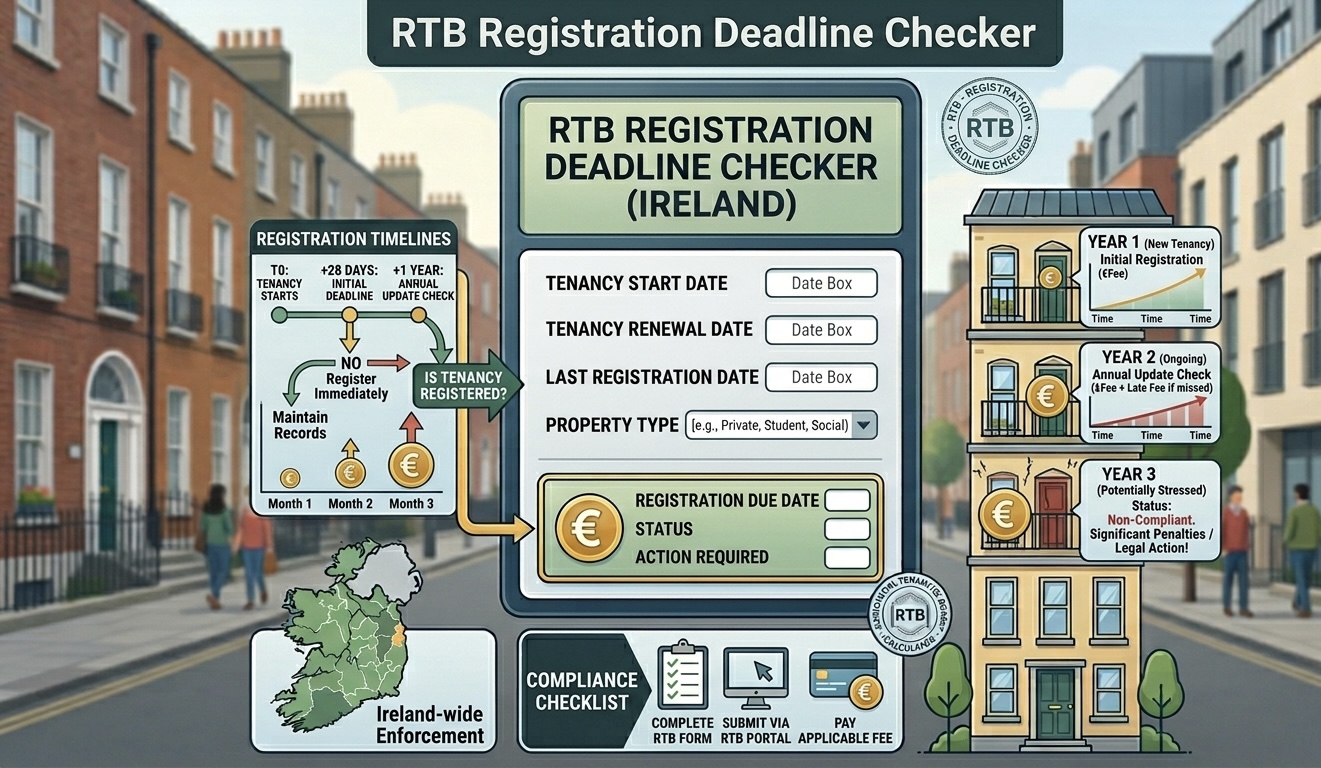
Whether your tenancy started last week or last year, the fastest way to know exactly where you stand is to use our free tool. Enter the tenancy start date and get your results instantly.
Check Your Deadline — Free
Enter the tenancy start date and our RTB registration deadline checker will show you the exact 30-day registration window, how many days you have left, and your next annual renewal date — instantly, no account needed.
The tool is free to use and requires no login. All you need is the tenancy start date. If you have already registered and want to check your RTB annual renewal Ireland 2026 date, enter the date you originally registered (not the start date) for the most accurate result.
Step-by-Step: How to Register a Tenancy With the RTB Online
Online registration through the RTB portal is the fastest and most reliable method. Here is exactly what to do. Following these steps in order will prevent the most common submission errors.
- Go to rtb.ie and log in or create an account. If you are registering a tenancy for the first time, you will need to create a landlord account. Use a valid email address — this is the address the RTB will use to send renewal reminders.
- Select "Register a New Tenancy." From your dashboard, choose the option to register a new tenancy. Do not confuse this with the renewal option, which is for tenancies already on the register.
- Enter the property address and Eircode. The Eircode is required for accurate property identification. You can look up any Eircode at eircode.ie if you don't have it to hand.
- Enter the tenancy start date and agreed monthly rent. Use the actual tenancy start date — the date the tenant took occupation — not the date the lease was signed. The monthly rent figure must match what appears in the tenancy agreement.
- Enter your PPSN and the tenant's name and PPSN. Your PPSN (Personal Public Service Number) is your unique Irish tax reference number. You will also need the tenant's full legal name and their PPSN. If you have multiple tenants, you may need to enter each individually.
- Review the information and pay the registration fee. Check every field carefully before proceeding to payment. Errors in the tenancy start date or PPSN can cause complications down the line. Pay the current registration fee as shown — check rtb.ie for the latest fee schedule.
- Save the confirmation number and registration certificate. Once payment is processed, the RTB will issue a confirmation number and registration certificate. Store these securely — in a dedicated folder, a property management platform, or a filing system you can access quickly.
Note: Keep the confirmation email — you will need the registration number if a dispute is ever referred to the RTB. The registration number is also required for annual renewals, so treat it as a key document for the lifetime of the tenancy.
RTB Registration: Frequently Asked Questions
Does my tenant need to be involved in the registration?
Your tenant does not need to actively participate in the registration process. Registration is the landlord's obligation. You will, however, need to provide the tenant's name and PPSN as part of the registration form, so you should ask the tenant for this information before submitting.
What if I have multiple tenants in one property?
If multiple tenants are party to the same tenancy agreement, each tenant's name and PPSN should be included in the registration. This is a single registration for the tenancy, not separate registrations per tenant. If different tenants occupy self-contained units within the same building under separate agreements, each tenancy must be registered individually.
Do I need to re-register when a new tenant moves in?
Yes. When a tenancy ends and a new tenant begins, a new tenancy has started and must be registered as a new tenancy with the RTB within 30 days of the new tenancy start date. The existing registration for the previous tenancy does not carry over to the new occupant.
What is the difference between a registration and a renewal?
A registration is the initial act of registering a new tenancy with the RTB — done within 30 days of the tenancy start date. A renewal is the annual fee payment that keeps an existing registration active. Since April 2022, both are required: an initial registration followed by annual renewals for as long as the tenancy continues.
I registered before 2022 — do I need to do anything now?
Yes. The 2022 change applies to all active tenancies, not just new ones. If you registered before April 2022 and have not paid an annual renewal fee since then, your registration has likely lapsed. Log in to the RTB portal to check your status, and use the RTB registration deadline checker to confirm your renewal timeline. It is better to address this now than to discover it during a dispute.
Can a letting agent register on my behalf?
Yes. A letting agent can complete the RTB registration on behalf of the landlord. Many agents include this as part of their letting management service. However, the legal obligation to register remains with the landlord — not the agent. Always confirm with your agent that registration has been submitted and obtain the confirmation number for your own records.
Manage Every RTB Deadline Automatically With TenantSync
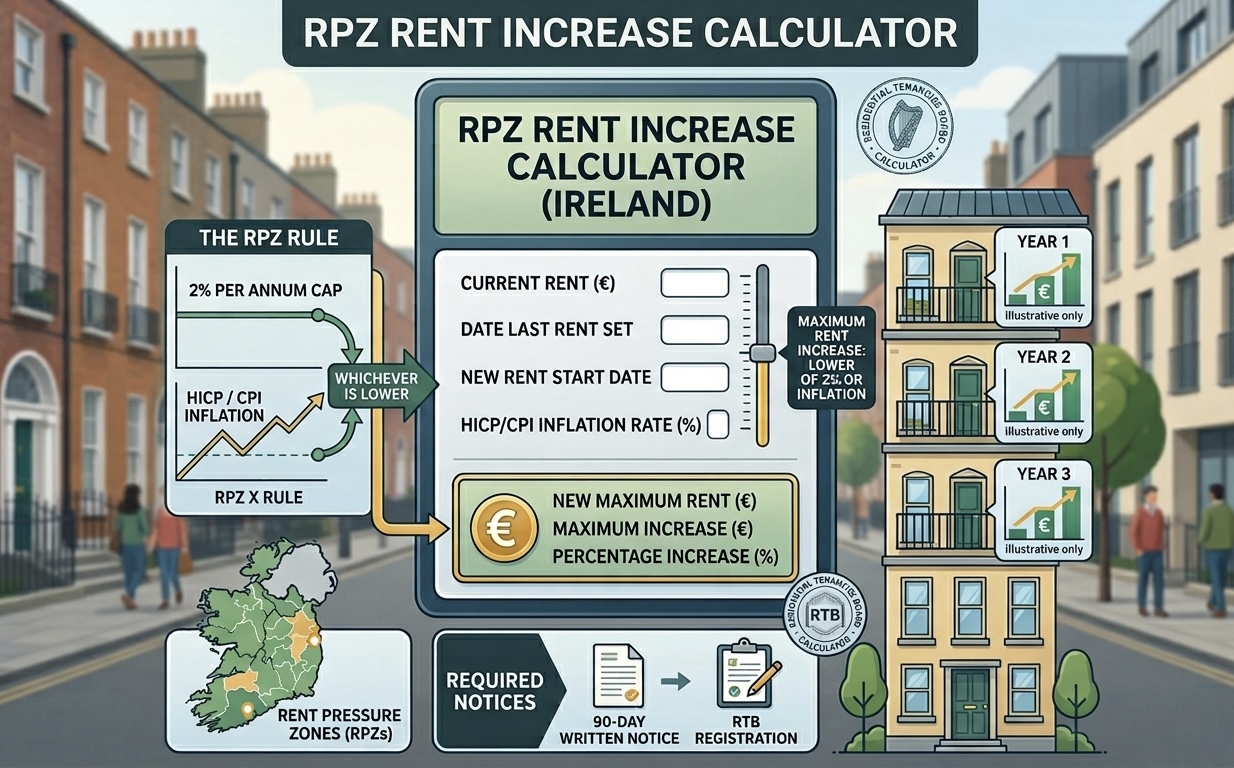
RTB registration is just one of the compliance obligations Irish landlords face. If your property is in a Rent Pressure Zone, you also need to calculate your maximum legal rent increase before each rent review. Use our free RPZ rent increase calculator to check your limit in seconds.
If you'd rather let TenantSync track every RTB deadline, annual renewal, and RPZ rent review date automatically — and send you reminders before they're due — start a free trial. No credit card required.
Stop tracking deadlines manually
TenantSync tracks every RTB registration, annual renewal, and rent review date across your entire portfolio — and sends you reminders before each one is due.
Related Articles