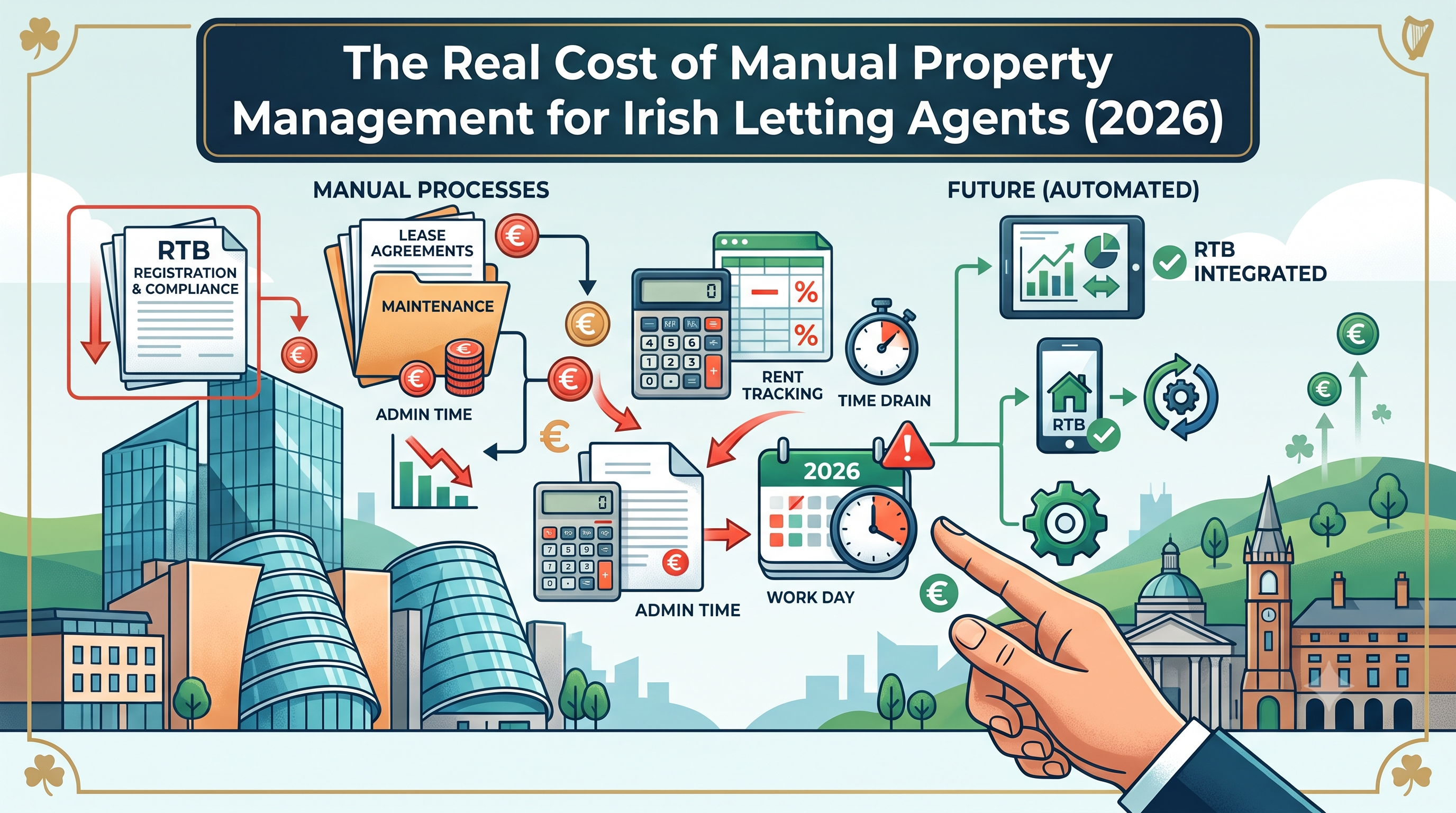
Turning Daft & MyHome Inquiries Into Signed Tenancies (Without Adding Staff)
List a property in Ireland today and the inquiries arrive in an avalanche — dozens per listing, within hours, from Daft.ie and MyHome.ie at once. The agency that replies first and qualifies fastest wins the tenant; everyone else is answering messages for a property that's already gone. This guide shows how to centralise every inquiry, respond in minutes, qualify applicants with a structured application, and measure inquiry-to-let conversion — turning more of the same inquiries into signed tenancies without hiring anyone.
The short version
How do Irish letting agents win more lets from the same Daft and MyHome inquiries? By removing the two places lets leak — slow first replies and disorganised follow-up. Forward every Daft.ie and MyHome.ie inquiry into one system, let it read and match each inquiry to the right property automatically, send an instant reply with a structured application link, follow up automatically after 24 hours, then work qualified applicants through a simple pipeline to a viewing and a signed tenancy. TenantSync does exactly this, so a two-person agency can handle peak-season volume that used to need a full-time coordinator.
Why Speed-to-Lead Decides Who Signs the Tenancy
In a tight rental market, demand isn't the problem — throughput is. A well-priced two-bed in Dublin, Cork or Galway can pull dozens of inquiries within hours of going live on Daft.ie and MyHome.ie. You don't need more leads. You need to convert the ones you already have before they book a viewing with someone else.
Here's the behaviour that decides it: a serious renter doesn't message one property. They fire off inquiries to five, six, ten listings in a single sitting, then go with whoever replies first with a clear next step. Your competition for that tenant isn't the property down the road — it's every other agency that got the same inquiry. Response speed is the whole game.
The research is blunt about this
Widely cited lead-response research published in Harvard Business Review ("The Short Life of Online Sales Leads") found that firms contacting a new online lead within the first hour were far more likely to qualify it than those who waited even a day — and that the odds fall off a cliff after the first hour. Rental inquiries behave the same way, only faster, because the "product" is a specific property that will be gone by the weekend.
The peak-season maths
Say a listing draws 40 inquiries and you can realistically host 10–12 viewings before it lets. The applicants you reply to in the first hour are the ones who show up. The 28 you get to on Thursday have already viewed — or signed — somewhere else. Faster first response doesn't just feel better; it directly raises lets-per-listing without spending a cent more on advertising.
Where Inquiries Leak: The Shared-Inbox Problem
Most agencies still run lettings out of a shared mailbox — lettings@youragency.ie — with Daft and MyHome inquiries landing alongside supplier emails, landlord questions and spam. It works at low volume. At peak season it quietly leaks lets. Here's where:
| Leak point | What happens | The cost |
|---|---|---|
| Buried inquiries | A hot inquiry sinks below 30 other emails before anyone opens the inbox. | Applicant has viewed elsewhere by the time you reply. |
| "Who's got this one?" | Two negotiators reply to the same lead; three others get nothing. | Duplicated effort and dropped applicants in equal measure. |
| Which property? | The inquiry references a listing ID, not an address you recognise at a glance. | Time lost matching each message to the right property. |
| Copy-paste replies | Someone retypes the same "thanks, please fill this in" 40 times. | Hours of unbillable admin; inconsistent first impressions. |
| No follow-up | An applicant who didn't reply first time is never chased. | Warm leads go cold with no second touch. |
| No numbers | Nobody can say how many inquiries became viewings or lets. | You can't tell a landlord why their property is slow to let. |
None of these are people problems — your team is working hard. They're system problems. And the fix isn't "hire a lettings coordinator." It's to route inquiries into one structured pipeline that handles the repetitive parts itself.
This is the growth half of the same story
If you've read our guide to automating tenant onboarding from a Daft or MyHome enquiry to move-in, this article is the front end of it: winning the applicant. Onboarding covers what happens after you've chosen them.
Centralising Every Daft & MyHome Inquiry
The foundation is simple: every inquiry from both portals lands in one place, already sorted. In TenantSync, you connect an inquiry mailbox — the email address your Daft.ie and MyHome.ie inquiries already arrive at — and set up auto-forwarding. From there it's automatic:
- Continuous capture. TenantSync checks for new inquiries every few minutes, around the clock — including the evenings and weekends when renters actually browse.
- Portal-aware parsing. Dedicated parsers for Daft.ie and MyHome.ie read each inquiry and pull out the applicant's name, email, phone and message, plus the property reference and listing details — so nothing has to be retyped.
- Automatic property matching. Each inquiry is matched to the correct property in your portfolio. If it can't be matched confidently (an old listing, an unusual reference), it's flagged as unmatched for a one-click manual assignment — never silently dropped.
- A real lead, scoped correctly. Every inquiry becomes a lead in your pipeline, attached to the right branch and landlord client, with a status you can work — not an email you have to remember.
The result: one clean, de-duplicated queue of leads, each already tied to a property and an applicant, instead of a mailbox everyone's afraid to leave unattended.
💡 Multi-branch, multi-landlord by design
Because leads are scoped to branch and landlord client, a multi-office agency sees each team's inquiries in their own view — while the principal still gets the portfolio-wide picture. That's the agency structure a single-landlord app can't model.
📥 See every Daft & MyHome inquiry land in one pipeline
Watch inquiries parse, match to the right property and become workable leads — on a walkthrough shaped like your own portfolio.
Instant Auto-Response: The 5-Minute Rule, Automated
Speed-to-lead only helps if you can actually be fast every time — at 9pm, on a Sunday, during the third viewing of the day. You can't, not by hand. So you automate the first touch.
The moment a lead is created, TenantSync sends the applicant an instant, professional acknowledgement that includes a secure link to a structured application form. No one has to be at a desk. The applicant who messaged ten properties gets your reply first — with a clear, concrete next step — while the other nine are still unread.
And it chases for you
Plenty of applicants open the reply and mean to fill in the form, then get distracted. So if there's no response, TenantSync sends an automatic follow-up after 24 hours. That single second touch recovers leads that a shared inbox would have let go cold — without anyone remembering to chase.
What the applicant experiences
- Minutes after inquiring: "Thanks for your interest in [property] — here's a quick application to secure a viewing." ✓ Sent automatically
- If no reply in 24h: a friendly nudge with the same secure link. ✓ Sent automatically
- The link is secure and time-limited, so applicant data is collected safely, not traded over email.
Automated ≠ impersonal
The auto-response handles acknowledgement and admin — not judgement. It buys your negotiator the time to do the things that actually need a human: running a great viewing, reading the application properly, and choosing the right tenant for the landlord.
Qualifying Applicants Without the Phone Tag
The old way to qualify a lead is a game of phone tag: call, voicemail, call back, ask the same five questions, scribble the answers on a listing sheet. Multiply by 40 inquiries and it's a full-time job. The structured application replaces all of it.
The secure link opens a clean online form where the applicant provides what you need to decide whether to progress them:
- Contact details — full name, email and phone, captured once and correctly.
- Current address and employment status & employer — the basics of affordability and stability.
- Desired move-in date — so you can match applicants to availability instantly.
- Additional notes — anything the applicant wants you to know.
- Document uploads — references, proof of income or ID, attached to the lead rather than buried in an email thread.
When the applicant submits, the lead automatically moves to "application submitted" and their documents are attached and previewable in one place. Your negotiator opens a single lead and sees the whole picture — no chasing, no re-keying, no lost attachments.
💡 Consistency is a compliance asset
Because every applicant answers the same structured questions, you can compare like with like and apply your criteria consistently — which is exactly what fair, Equal Status Acts-compliant screening requires. Ad-hoc phone calls make consistency almost impossible to prove.
From Qualified Lead to Viewing to Signed Tenancy
With inquiries centralised, answered and qualified, the last step is moving each lead to a decision. TenantSync gives every lead a clear status, so the pipeline is always visible at a glance:
| Stage | What it means | Your next action |
|---|---|---|
| New | Inquiry captured, matched to a property, auto-response sent. | Nothing — the system already replied. Watch for the application. |
| Contacted | The applicant has been engaged and the follow-up is in play. | Wait for the form, or reach out if they're a priority. |
| Application submitted | Structured details and documents are in. | Review, then book a viewing for the strong applicants. |
| Reviewed | Your team has assessed the application. | Progress to offer and tenancy, or decline politely. |
| Approved / declined | A decision is recorded against the lead. | Sign the tenancy and start onboarding — or free the others. |
Booking viewings becomes triage rather than juggling: you invite the qualified applicants for the property that's ready, in the order they applied, and you can preview each applicant's documents before you commit a viewing slot. When you choose a tenant, mark them reviewed, progress them, and the baton passes cleanly to setting up the tenancy and registering it with the RTB inside 30 days.
The whole journey, one system
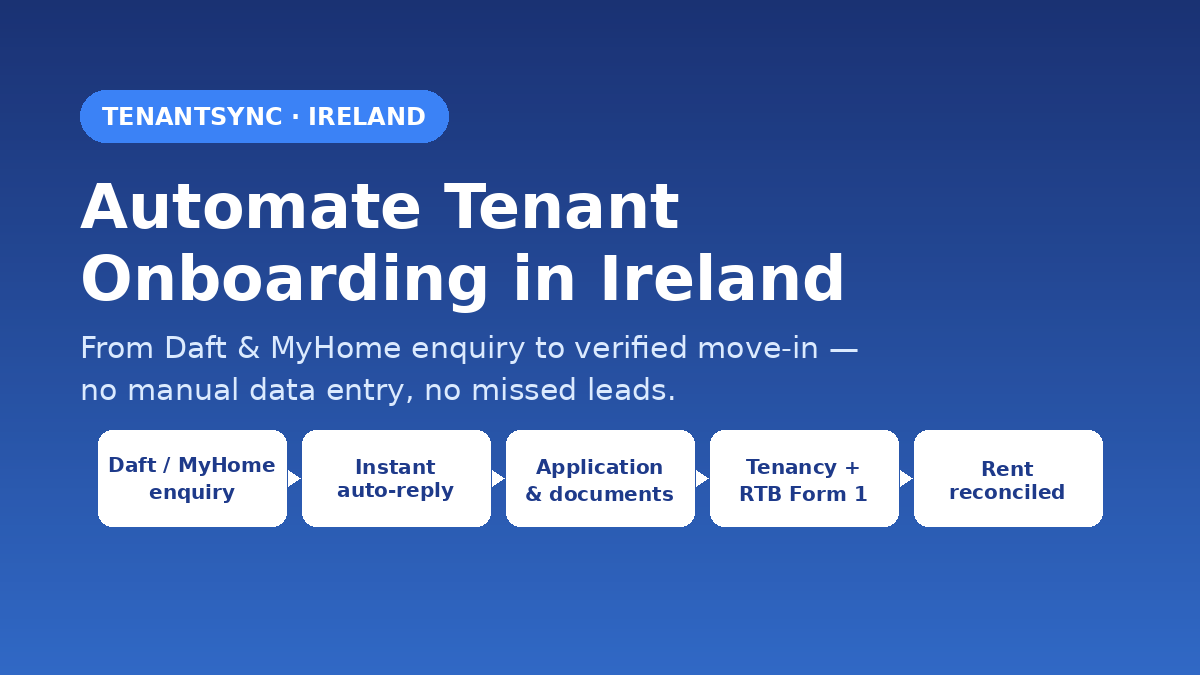
Inquiry → auto-response → application → viewing → decision → signed tenancy → bulk RTB compliance and rent reconciliation. The lead that started as a Daft message becomes a live, compliant tenancy without ever being re-keyed into a second tool.
🏠 Convert more lets from the inquiries you already get
Centralised capture, instant auto-response, structured applications and a clear pipeline — the system a busy agency runs peak season on. Start free; no credit card to begin.
Measuring Inquiry-to-Let Conversion
You can't improve what you can't see. The final advantage of centralising inquiries is that, for the first time, you can measure the funnel — per listing, per branch, per landlord.
TenantSync's inquiry dashboard shows the shape of your pipeline at a glance:
- Total leads and how many are new, contacted, application submitted and reviewed — your live conversion funnel.
- Unmatched inquiries waiting for a property assignment, so nothing sits in limbo.
- The count of inquiries that needed manual attention, so you can see where the process snags.
And every individual lead carries a complete activity timeline — inquiry received, parsed, property matched, auto-response sent, follow-up sent, application submitted, documents uploaded, reviewed. That's a full audit trail of who did what and when.
What this unlocks for the agency
- Evidence for landlords. Show a client exactly how many inquiries their property drew and how they were handled — a powerful trust signal at renewal time. (See what agencies need that landlord apps lack.)
- Pricing conversations. If a listing draws few inquiries, that's a data-backed prompt to talk to the landlord about asking rent or presentation.
- Team performance. See where leads drop off — plenty of applications but few viewings booked is a very different problem from few applications at all.
The "without adding staff" part, quantified
The work that used to justify a lettings coordinator — sorting the inbox, retyping replies, chasing forms, matching messages to properties, keeping a spreadsheet of who's where — is exactly the work that's now automated. You handle more inquiries, faster, with the team you already have. That's the unit-economics case for cutting manual property-management cost.
Doing It Right: GDPR, Equal Status & PSRA
Handling applicant data at volume raises real obligations. Centralising inquiries actually makes them easier to meet — but only if you know what they are.
- GDPR. Applicants share personal and financial data. Collecting it through a single secure, time-limited link into one system — rather than dozens of email threads and loose attachments — gives you cleaner consent, storage and retention than a shared inbox ever could. Keep applicant data only as long as you need it and tell applicants how it's used.
- Equal Status Acts. Screening must not discriminate on any of the protected grounds, and refusing a tenant in receipt of HAP is prohibited. A structured application where everyone answers the same questions helps you apply criteria consistently and fairly.
- PSRA licensing. Letting agents must hold a Property Services Regulatory Authority licence. Software doesn't change that — it just gives you a cleaner audit trail of how each applicant was handled.
Automate the admin, not the decision
Automate acknowledgement, data capture and follow-up. Keep the decision — who to approve — a documented human judgement made on lawful, consistent criteria. That's the line that keeps efficiency on the right side of the law.
How to Set It Up — Step by Step
Connect your inquiry mailbox
In TenantSync, register the email your Daft.ie and MyHome.ie inquiries arrive at, and set up auto-forwarding so every inquiry flows in automatically.
Let inquiries parse & match
TenantSync reads each inquiry, extracts the applicant and property details, and matches it to the right listing. Unmatched ones are flagged for a one-click assignment.
Auto-respond within minutes
Each new lead triggers an instant reply with a secure application link — and an automatic follow-up if the applicant doesn't respond within 24 hours.
Qualify with a structured application
Applicants complete an online form — contact details, employment, move-in date and documents like references — with no phone tag and no scattered threads.
Work the pipeline to a viewing
Progress leads by status — new, contacted, application submitted, reviewed — preview documents, and book viewings for the applicants who qualify.
Review, decide, sign & measure
Mark your chosen applicant reviewed, progress to a signed tenancy, then use the dashboard and activity timeline to track inquiry-to-let conversion.
A quick note on where this lives
Inquiry and lead management runs in the TenantSync web dashboard, where a lettings team does its desk work. Once a tenancy is live, day-to-day tasks like rent tracking and compliance reminders travel with you on the mobile apps.
Frequently Asked Questions
What is Daft and MyHome inquiry management for letting agents?
It's capturing every rental inquiry from Daft.ie and MyHome.ie into one place, responding fast, qualifying the applicant, and tracking each lead through to a signed tenancy. Rather than inquiries sitting unread in a shared inbox, TenantSync forwards them into a single lead pipeline, reads the applicant and property details automatically, matches each inquiry to the right listing, and sends an instant reply with an application link — so nothing is missed at peak season.
Why does response speed matter so much for rental inquiries?
A single listing can draw dozens of inquiries in hours, and applicants message several properties at once — so the agency that replies first and books the viewing usually wins the tenant. Widely cited lead-response research in Harvard Business Review found that contacting a new online lead within the first hour dramatically improves the odds of qualifying it. Automating the first reply removes the delay entirely.
How does TenantSync centralise Daft and MyHome inquiries?
You forward (or auto-forward) the inquiry emails from both portals to a dedicated TenantSync mailbox. TenantSync checks for new inquiries every few minutes, uses parsers built for each portal to read the applicant's name, email, phone, message and property reference, and matches the inquiry to the correct property in your portfolio. A lead is created in your pipeline, scoped to the right branch and landlord client.
Does the automatic reply replace my staff?
No — it removes the repetitive first-touch and data-entry work so your team spends time on viewings and decisions. The instant auto-response acknowledges the applicant and sends a secure application link; a 24-hour follow-up nudges anyone who hasn't responded. Your negotiator still runs the viewing, reviews the application and decides who to progress.
What information do applicants provide, and is it GDPR-compliant?
The application link opens a structured form for the applicant's name, contact details, current address, employment status and employer, desired move-in date and notes, plus document uploads such as references or proof of income. Collecting this through one secure, time-limited link rather than scattered email threads makes GDPR obligations easier to meet. Agents must still apply the Equal Status Acts and screen fairly and consistently.
How do I measure inquiry-to-let conversion?
The inquiry dashboard shows how many leads are new, contacted, have submitted an application and have been reviewed, plus how many need manual attention. Each lead carries a full activity timeline — inquiry received, auto-response sent, follow-up sent, application submitted, documents uploaded, reviewed — giving you a real conversion picture per listing and per branch, so you can see which properties attract demand and where leads drop off.
Does this work if I use Daft or MyHome and a separate CRM?
Yes. TenantSync is the Irish inquiry-to-tenancy and compliance layer, so it can sit alongside a general estate-agency CRM. If you're weighing tools, see our guides to the best property management software for Irish letting agents and Acquaint CRM alternatives.
Summary
- In a tight market the constraint isn't leads — it's throughput. The agency that replies first and qualifies fastest wins the tenant.
- The shared inbox leaks lets at peak season: buried inquiries, duplicated effort, copy-paste replies, no follow-up and no numbers.
- TenantSync centralises every Daft.ie and MyHome.ie inquiry into one pipeline, parsing applicant and property details and matching each to the right listing automatically.
- An instant auto-response with a secure application link — plus a 24-hour follow-up — makes you first every time, without anyone at a desk.
- A structured application replaces phone tag, captures documents in one place, and supports consistent, Equal-Status-compliant screening.
- A clear lead pipeline and an inquiry dashboard with per-lead activity timelines let you convert to viewings and measure inquiry-to-let conversion — handling more volume without adding staff.
📈 Win more lets from the inquiries you already get
Centralise Daft & MyHome inquiries, auto-respond in minutes, qualify applicants and convert — on the platform Irish agencies run peak season on. See it on your own portfolio, or start free today.
Related Articles