The National Rent Cap (2% or CPI, Whichever Is Lower) After March 2026: A Letting Agent's Field Guide
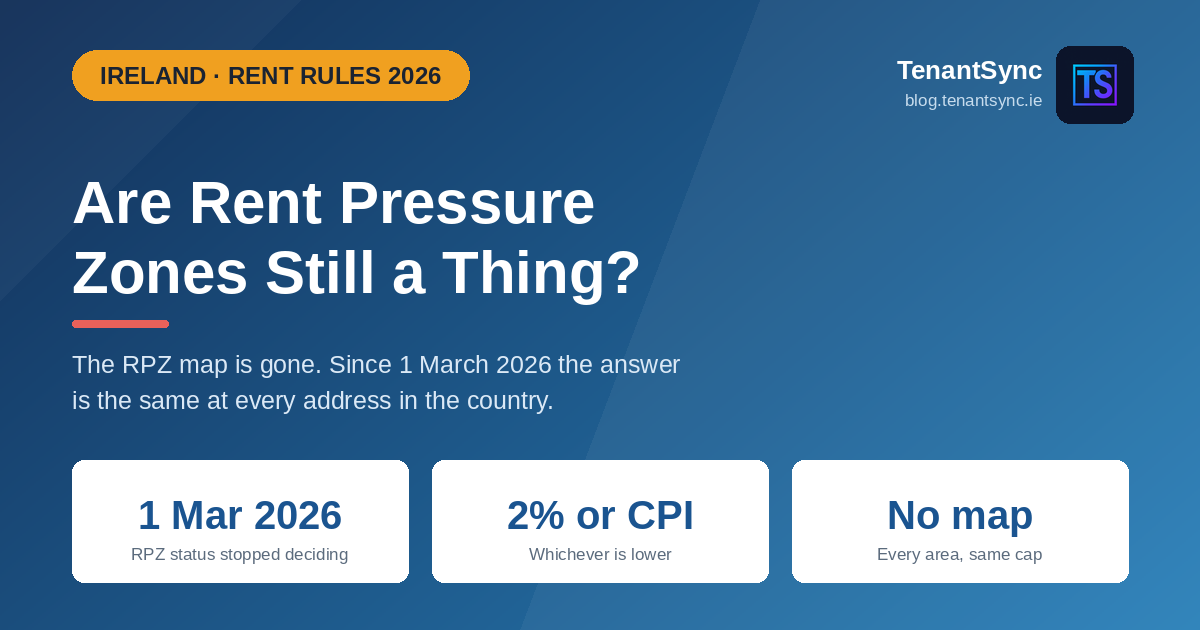
On 1 March 2026, Rent Pressure Zones were switched off and a single national rent cap took their place. Every tenancy in the State is now in scope — there's no map to check anymore. For a letting agent advising landlord clients, that's simpler in theory and riskier in practice: one wrong increase on one tenancy is a repayment order, an RTB referral, and a hard conversation with a client. This field guide is how you get the number right every time.

The short version
- RPZs are gone. Since 1 March 2026 a single national rent control system applies to every private tenancy and Student-Specific Accommodation in the State — location no longer decides whether the cap applies.
- The review cap is the lower of 2% or CPI. Inflation is now measured by the Consumer Price Index (CPI), replacing the HICP used under the old RPZ rules.
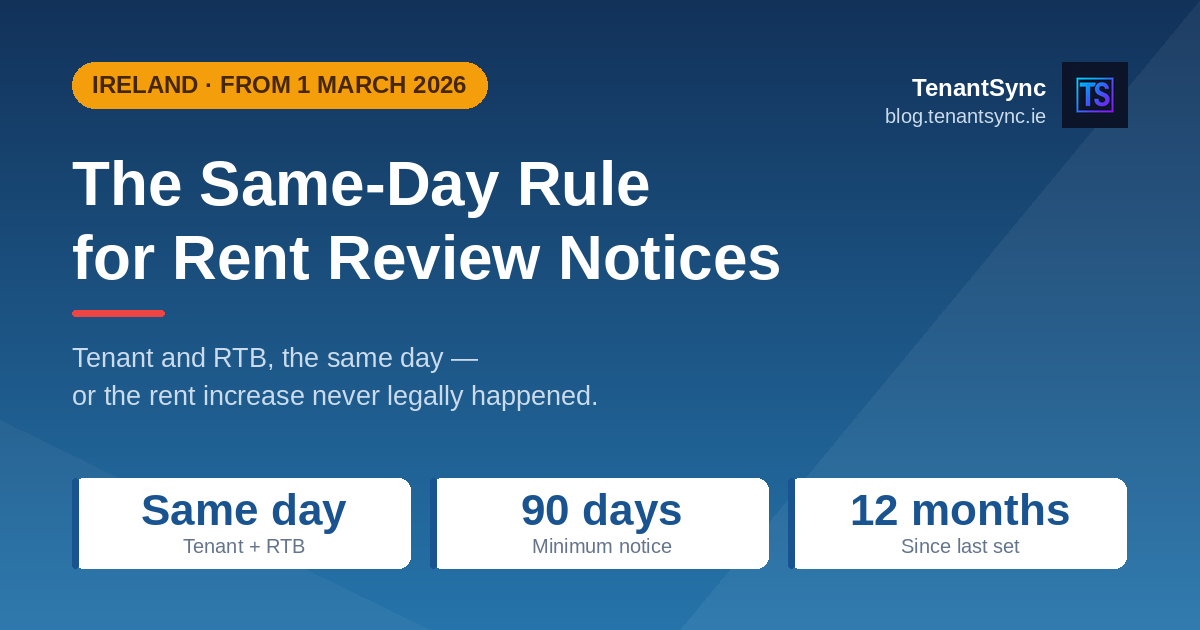
- A review is once every 12 months, with at least 90 days' written notice. Get the timing wrong and the increase simply doesn't take effect.
- A market reset is the exception, not the rule. You can only reset to market value in defined circumstances, and you must back the figure with three comparables from the RTB Rent Register.
- For an agency, the risk is volume. The rule is one paragraph; applying it correctly across dozens of client tenancies, each with its own dates and history, is where contracts are lost.
If you take one thing from this guide: the national cap removed the geography question but kept every other trap. The agents who come out ahead are the ones who turn "what's the max here?" from a judgement call into a documented, repeatable calculation.
What changed on 1 March 2026
For nearly a decade, the first question on any rent increase was geographic: is this property in a Rent Pressure Zone? If yes, the 4%-then-2%/HICP cap applied; if no, the landlord had far more freedom. Agents kept lists of designated areas and checked them tenancy by tenancy.
That question is now obsolete. The RTB confirms that from 1 March 2026, Rent Pressure Zones are replaced by a national rent control system that applies to every private tenancy and Student-Specific Accommodation in the State, regardless of location. A rural cottage and a city-centre apartment are now under the same regime.
That simplifies one thing and complicates another. You no longer argue about whether a property is "in or out." But because the cap is now universal, there's no longer any tenancy where you can be casual about a rent increase — and the rules around resetting rent, documenting market value and serving notice are stricter than many agents are used to. The map disappeared; the rulebook got heavier.
Why "RPZ" still shows up — and why it's not wrong
You'll still see "RPZ" in legacy documents, in legal history, and in the names of some tools (including rent-cap calculators). That's accurate context, not an error. In day-to-day advice, though, talk about the national rent cap (2% or CPI, whichever is lower) — telling a client a property "isn't in an RPZ so you're fine" is now flatly wrong and exactly the kind of advice that ends a management relationship.
The rule: 2% or CPI, whichever is lower
Stripped to its core, the cap on a rent review is simple: the increase may be no more than the lower of 2% or the rate of inflation over the relevant period. From 1 March 2026 the Consumer Price Index (CPI) is the measure of inflation used for all tenancies — new and existing — replacing the HICP used under the old RPZ system.
In practice that means two outcomes:
- If inflation is above 2% over the period, your ceiling is 2%.
- If inflation is below 2%, your ceiling is that lower inflation figure — you cannot default to 2% just because it's the headline number.
This is the single most common misunderstanding worth correcting with clients: 2% is a ceiling, not an entitlement. When CPI for the period comes in under 2%, the lower figure governs, and an increase set at a flat 2% would be unlawful.
A worked example
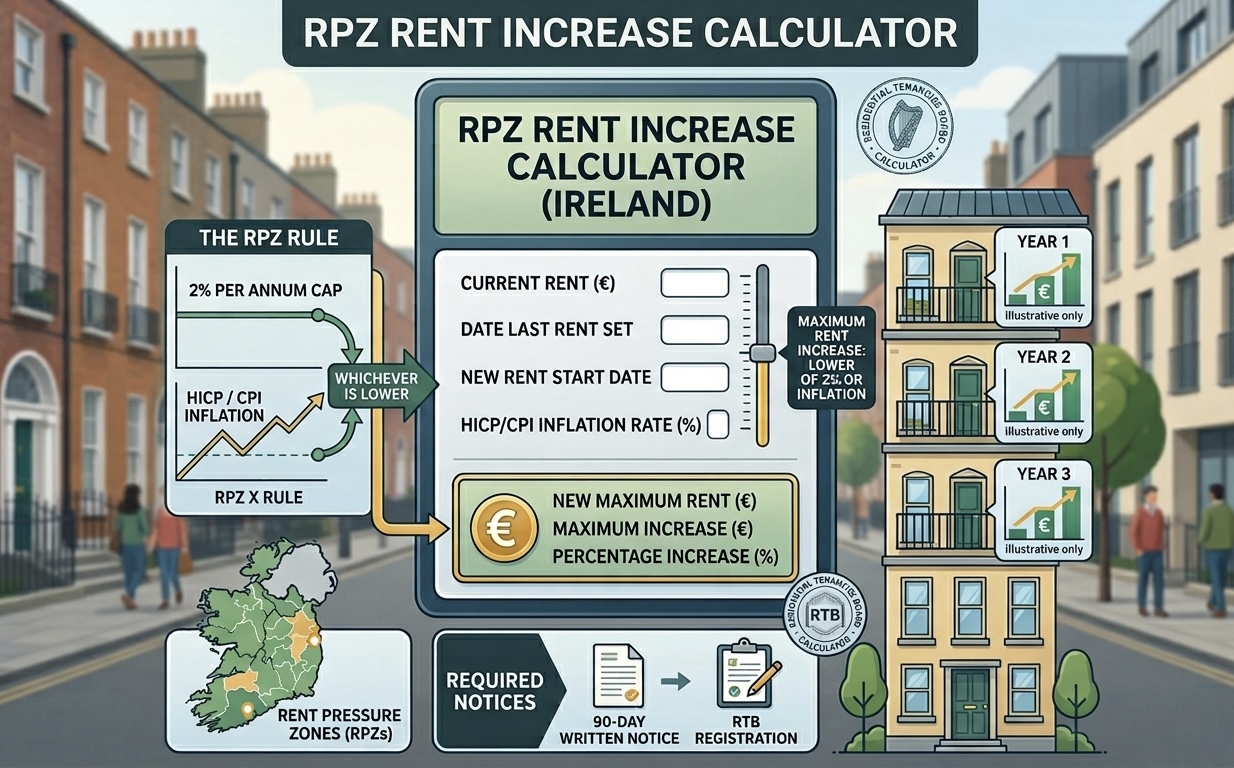
A tenancy's rent was last set at €1,800/month twelve months ago. If CPI over the period is, say, 1.6%, the cap is the lower of 2% and 1.6% — so 1.6%. The maximum new rent is €1,800 × 1.016 = €1,828.80. If CPI were instead 3%, the cap would fall back to 2%, giving €1,836. The figures here are illustrative — always use the official CPI rate for the relevant period from the CSO and confirm against the RTB.
Because the governing figure moves with inflation, "last year's increase" is never a safe template. Each review needs the correct CPI for its own period — which is precisely the kind of lookup that a rent-cap calculator exists to remove from your day.
The three scenarios you'll actually face
Almost every rent question an agent handles falls into one of three buckets. Knowing which one you're in tells you which rules apply — and getting this wrong at the start is how good agents still end up with an unlawful figure.
| Scenario | What governs the rent | The agent's job |
|---|---|---|
| New tenancy, same property, after a permitted ending | You may be able to reset to market value — but only if the previous tenancy ended for a permitted reason. | Confirm reset eligibility, then evidence market rent with three RTB Rent Register comparables. |
| Continuing tenancy, same tenant | A rent review capped at the lower of 2% or CPI, once every 12 months. | Check the 12-month timing, apply the correct CPI, serve 90 days' notice. |
| Brand-new letting / never-rented property | You set an initial market rent in the normal way; the cap then governs all future reviews. | Set a defensible opening rent; record the start date so future reviews are anchored. |
The trap is the first row. A change of tenant does not automatically unlock a market reset — that depends entirely on how the previous tenancy ended. Treating every new tenant as a fresh market-rent opportunity is the fastest route to an over-the-cap rent and a refund order. The next section is the test you run before you reset anything.
When you can reset to market value
A reset to market value is the exception the legislation allows in specific, named circumstances. According to the RTB, you can reset the rent to market value when the previous tenancy ended because:
- the tenant left voluntarily;
- the tenant breached their obligations;
- the property no longer suited the tenant's needs; or
- a six-year Tenancy of Minimum Duration (TMD) reached its end.
And the line every agent must hold: you cannot reset to market value after a no-fault eviction. If the landlord ended the tenancy on a no-fault ground, the new rent stays constrained — resetting it to market is exactly the kind of step that gets unwound.
Where a reset is permitted, you don't simply name a number. You must confirm in writing that the new rent is not above market rent, and back it with three comparable properties from the RTB Rent Register — chosen to match the property as closely as possible on:
- the same local electoral area;
- a similar number of bedrooms;
- a similar floor area; and
- a similar BER rating.
An incoming tenant can challenge your figure
A new tenant can refer the initial rent to the RTB if they believe it exceeds market rent. A well-documented three-comparable statement is what stands between your client and a repayment order. A loosely chosen comparable is a weak defence — like-for-like genuinely matters. Guessing the rent, or reusing last year's figure, is no longer safe.
For the deeper mechanics of each scenario — including how the small-landlord (3 or fewer tenancies) versus large-landlord (4 or more) distinction shapes termination and reset rights — our companion guide on setting rent in Ireland under the new rules walks through every case.
The inflation-only exemptions
Not every property is held to the 2% ceiling, and knowing the carve-outs matters when you advise developers, build-to-rent clients or student operators. The RTB states that:
- New apartments which commenced and completed development — with the required Building Control Authority compliance certification — on or after 10 June 2025 have rent increases linked solely to inflation (CPI), without the 2% ceiling.
- The same inflation-only treatment applies to Student-Specific Accommodation commenced from that date.
"Inflation-only" is not "uncapped"
These properties are still subject to a cap — it's just the CPI figure rather than the lower of 2% or CPI. They are not free of rent control. And the exemption depends on specific commencement dates and certification, so confirm the property's dates and Building Control compliance with the RTB before relying on it. Applying the exemption to a property that doesn't qualify is as costly as missing the cap entirely.
For an agency, the practical takeaway is to know each client property's classification — standard tenancy, inflation-only new apartment, or SSA — because it shapes how much you can lawfully increase a rent and on what basis.
The field guide: calculate a compliant increase every time
Here's the repeatable, six-step calculation to run on any tenancy before you propose a number. Done in order, it catches the mistakes that matter.
Step 1 — Identify the scenario
Is this a new tenancy after a permitted ending, a continuing tenancy with the same tenant, or a brand-new letting? You can't pick the right rule until you know which situation you're in. Same tenant renewing is a continuation, not a new tenancy — the review cap applies and there is no market reset.
Step 2 — Check reset eligibility (if the tenant changed)
If a new tenant is moving in, confirm the previous tenancy ended for a permitted reason (voluntary departure, breach, unsuitability, or end of a six-year TMD). If it ended on a no-fault ground, a market reset is off the table and the constrained rent carries over.
Step 3 — Confirm the 12-month timing
For a continuing tenancy, a rent can be reviewed at most once every 12 months, measured from when the rent was last set. An early notice is invalid — so check the date the current rent took effect before doing anything else.
Step 4 — Apply the correct cap
For a review, take the lower of 2% or CPI over the relevant period, using the official CPI rate for that period. First confirm the property isn't in an inflation-only category (new apartment or SSA from 10 June 2025), where the 2% ceiling doesn't apply.
Step 5 — Evidence a market reset (if applicable)
Where a reset is permitted, pull three comparables from the RTB Rent Register matching electoral area, bedrooms, floor area and BER, confirm the new rent isn't above market, and write the statement that explains how you arrived at it.
Step 6 — Serve a valid notice and keep the working
Issue a written rent review notice with the new rent and effective date, at least 90 days ahead. Then keep the calculation, the CPI figure used, and any comparables attached to the tenancy record — so if the rent is ever challenged, the defence is already built.
The field guide in one line
Scenario → reset eligibility → 12-month timing → lower of 2% or CPI (mind the exemptions) → three-comparable evidence if resetting → 90-day notice, fully documented. Run it the same way on every tenancy and "is this rent legal?" stops being a guess.
The 90-day rent review notice
Even a perfectly calculated rent fails if the notice is wrong. Two timing rules do most of the damage when they're missed:
- At least 90 days' notice. You must serve a written rent review notice stating the new rent and the date it takes effect at least 90 days before it applies. 90 days is the legal minimum — a 30- or 60-day notice means the increase cannot take effect, whatever the notice says.
- Once every 12 months. Reviews can only happen once per 12 months from when the rent was last set. An early notice is invalid, even by a few days.
The notice also has to state the new rent and the effective date clearly, and the landlord must be able to explain how the figure was reached — which, for a market reset, means the three-comparable statement. A correctly served notice is not paperwork for its own sake; it's the thing that makes the increase enforceable.
Stop hand-calculating caps and notice dates
Book a 15-minute agency demo and we'll run a real rent review through TenantSync — the cap, the CPI figure, the 90-day notice date and the audit trail — on data shaped like your own portfolio.
Five errors that cost agents their clients
None of these is exotic. They're the everyday slips that turn into RTB referrals, refund orders and lost management contracts — and every one is preventable.
- 1. Defaulting to a flat 2%. When CPI for the period is below 2%, the lower figure governs. A reflex 2% increase is over the cap and refundable.
- 2. Assuming a new tenant means a market reset. The reset depends on how the last tenancy ended, not on the fact that the tenant changed. After a no-fault eviction, there is no reset.
- 3. Resetting without the three comparables. Setting a market rent with no RTB Rent Register statement leaves the figure undefended if it's challenged.
- 4. Getting the timing wrong. A review inside the 12-month window, or with fewer than 90 days' notice, is invalid — the increase simply doesn't take effect.
- 5. Assuming "not in an RPZ" still means freedom. RPZs are gone. The cap is national. Advising a client that a property is exempt because of its location is now wrong on its face.
What these have in common is that they're process failures, not knowledge failures — which means a consistent process designs them out. That's the difference between knowing the rule and applying it correctly on the two-hundredth tenancy of the year.
For letting agents: getting it right at scale
A single landlord has one rent to review a year. An agency is running the calculation above across every client tenancy — each with its own start date, its own last-review date, its own classification, and its own ending history that decides whether a reset is even possible. The rule doesn't get harder per tenancy; the bookkeeping does.
That's where the commercial risk sits. When you set rent on a landlord's behalf, the calculation is your professional responsibility. An over-the-cap increase that gets refunded, or an invalid notice that delays an increase by a quarter, doesn't just cost money — it tells the client the agency got the one number that mattered wrong. Conversely, being the agent who can show a defensible figure and a clean audit trail on demand is exactly what renews a management contract.
Practically, an agency needs three things the rule itself doesn't give you:
A calculation you can't get wrong
The lower-of-2%-or-CPI applied automatically, with the figure and rule shown — so every increase is defensible and no one is doing percentage maths by hand.
Dates that anchor every review
Each tenancy's creation date, last-review date and ending reason recorded once — so the 12-month timing and reset eligibility are clear at a glance.
Evidence attached to the tenancy
The CPI figure, the three Rent Register comparables and the served notice kept together — a complete defence file if the rent is ever challenged.
Run this way, advising clients on rent stops being a per-tenancy research project and becomes a quick, confident answer — across the whole book. It pairs naturally with the broader compliance picture in our agency workflow for bulk RTB compliance, and with the client-facing brief in the March 2026 rentals playbook.
Give every landlord client a defensible rent figure
See how TenantSync calculates the cap, tracks review dates and builds the audit trail across your whole portfolio — in a 15-minute demo on data like your own.
For landlords: what this means for you
If you manage your own property rather than through an agent, the same rules apply to you directly — and so does the same liability if you get a rent increase wrong. The good news is that the everyday case is straightforward once you have the dates and the CPI figure in front of you.
For a sitting tenant, the checklist is short:
- Confirm it's been at least 12 months since the rent was last set.
- Apply the lower of 2% or CPI for the period — not a flat 2%.
- Serve a written rent review notice with the new rent and effective date at least 90 days ahead.
- Keep a record of how you calculated the figure.
Where landlords most often slip is assuming a change of tenant lets them reset to market rent. It only does in the permitted circumstances above — and never after a no-fault eviction — and any reset needs the three-comparable RTB Rent Register statement. If you're unsure which scenario you're in, our plain-English guide Can I increase my rent in Ireland? walks through the 12-month rule, the 2%/CPI cap and the 90-day notice for sitting tenants.
You don't need a spreadsheet and a calendar full of reminders to stay on the right side of this. A free rent-cap calculator returns the maximum allowable rent for your tenancy in seconds — and if you'd rather have the review dates, notices and records handled for you, TenantSync's Starter plan is built for small landlords.
Find your maximum legal rent in seconds
Use the free rent-cap calculator to get the exact figure the national cap allows for your tenancy — no account needed — or start a free trial to have the dates and notices handled for you.
How TenantSync helps with the national rent cap
TenantSync is an Irish-built platform that turns the calculation in this guide into something you can't get wrong — for a single landlord or across an agency's whole book of clients. Each capability below maps to a step in the field guide above.
Rent-cap calculator
Applies the lower-of-2%-or-CPI rule, returns the maximum allowable rent per tenancy, and shows the rule and figure it used — so every increase is defensible.
Review dates tracked
Records each tenancy's creation date, last-review date and how it ended — so the 12-month timing and whether a market reset is permitted are instantly clear.
Rent Register evidence
Keep the three RTB Rent Register comparables and the market-rent statement attached to the tenancy record, ready if the rent is ever challenged.
Compliant rent review notice
Generate a written notice stating the new rent and effective date, with the 90-day lead time built in, so the increase is enforceable.
Reminders before each review
Surfacing upcoming review dates ahead of time means no increase is missed and none is served early.
Timestamped audit trail
Every calculation, comparable and notice is logged with a timestamp — a complete defence file for RTB scrutiny or a landlord review.
It runs on web plus iOS and Android, includes a landlord and tenant portal, and imports directly from Letman, a CSV or a spreadsheet so an agency can get its whole book in quickly. Pricing is flat per-portfolio tiers (Standard €99 up to 100 properties, Growth €149 up to 200, Premium €199 up to 300, plus a €20 Starter for up to 10), each with a 14-day free trial; for the full breakdown see our guide to lettings software pricing in Ireland.
Want to test the number first? Try the free rent-cap calculator — no account needed.
Frequently asked questions
What is Ireland's national rent cap?
Since 1 March 2026, Rent Pressure Zones have been replaced by a single national rent control system that applies to every private tenancy and Student-Specific Accommodation in the State, regardless of location. On a rent review, the increase is capped at the lower of 2% or the rate of inflation, measured by the Consumer Price Index (CPI) over the relevant period. The CPI replaces the HICP used under the old RPZ system. Always confirm the current rules and rates on rtb.ie before relying on any figure.
Is the national rent cap 2% or CPI?
On a rent review it is whichever is lower. If inflation over the period is above 2%, the increase is capped at 2%. If inflation is below 2%, the increase is capped at that lower inflation figure. The cap applies to a review of an existing tenancy; it does not apply where a landlord is lawfully permitted to reset the rent to market value at the start of a new tenancy.
When can a landlord reset rent to market value after March 2026?
According to the RTB, a rent can be reset to market value at the start of a new tenancy when the previous tenancy ended because the tenant left voluntarily, breached their obligations, or the property no longer suited their needs, or at the end of a six-year Tenancy of Minimum Duration. A reset is not permitted after a no-fault eviction. Where a reset is allowed, the new rent must not exceed market rent and must be backed by three comparable properties from the RTB Rent Register.
Do Rent Pressure Zones still exist in Ireland?
No. From 1 March 2026 Rent Pressure Zones no longer exist. The national rent control system applies to every private tenancy and Student-Specific Accommodation in the State, so a property no longer needs to be inside a designated zone for the cap to apply. The word RPZ now only appears in historical and legal context and in some product names, such as rent-cap calculators.
How much notice is required for a rent review in Ireland?
A landlord must serve a written rent review notice stating the new rent and the date it takes effect at least 90 days before the increase applies. A 30- or 60-day notice is not enough — the increase cannot take effect, whatever the notice says. A rent can also be reviewed at most once every 12 months, measured from when the rent was last set, so an early notice is invalid.
Are any properties exempt from the 2% rent cap?
The RTB states that new apartments which commenced and completed development (with the required Building Control Authority compliance certification) on or after 10 June 2025 have rent increases linked solely to inflation (CPI), without the 2% ceiling. The same applies to Student-Specific Accommodation commenced from that date. These are inflation-only, not uncapped. Confirm the property's dates and certification with the RTB before relying on this.
How does TenantSync help letting agents with the national rent cap?
TenantSync includes a rent-cap calculator that applies the lower-of-2%-or-CPI rule, returns the maximum allowable rent for each tenancy and shows the rule and figure it used so the increase is defensible. It records each tenancy's creation date and how it ended so it is clear whether a market reset is permitted, lets you attach the three RTB Rent Register comparables to the tenancy, helps generate a compliant rent review notice, and logs every action with timestamps as an audit trail. For an agency it does this across the whole portfolio, per landlord client.
Sources & further reading
Facts in this article are drawn from official and primary sources. Rent control rules, CPI rates and notice requirements change — verify the current position on rtb.ie before relying on any figure or serving a rent review.
- Residential Tenancies Board — Rental law changes from 1 March 2026
- Residential Tenancies Board — Rent controls and rent reviews
- Residential Tenancies Board — RTB Rent Register and registration
- Central Statistics Office — Consumer Price Index (CPI)
- Government of Ireland — Reforms to the rental sector, starting 1 March 2026
- Citizens Information — Rent increases in private rented housing
Related Articles