Best Property Management Software for Irish Letting Agents & Landlords (2026)
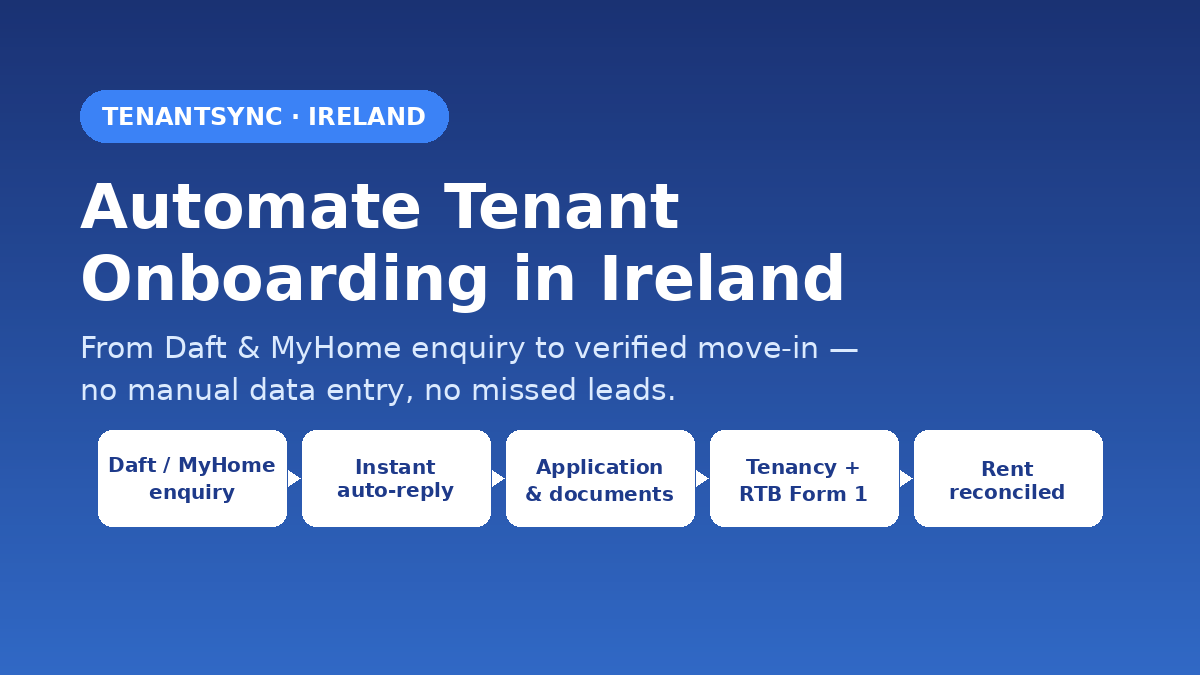
An Irish tenancy is one continuous piece of work — a Daft enquiry becomes an applicant, the applicant becomes a tenant on a signed lease, the lease becomes an RTB registration and a rent schedule, the rent becomes a landlord statement with the right tax withheld, and the agency has to stay PSRA-licensed throughout. Most software handles one stretch of that and leaves you to bridge the rest. This guide shows what it looks like when one system runs the whole tenancy, and compares the rest of the field honestly.

The short version
- An Irish lettings business runs eight jobs across every tenancy: enquiries and tenant onboarding, lease signing, RTB compliance, rent collection, landlord payouts (with non-resident landlord withholding tax), the agency's own PSRA obligations, the day-to-day operations — and, for some, student accommodation under its own RTB rules.
- Every alternative covers a stretch of it. Letman is strong on client money. PayProp is strong on payments. Arthur and Re-Leased are strong general platforms built for other markets or other asset classes. None of them touch PSRA, and none of them do the RTB Form 1 or the national rent cap.
- TenantSync is the only Irish platform that runs the whole tenancy in one system — the applicant you approve becomes the tenant on the lease, the lease drives the RTB registration and the rent schedule, and the rent that lands becomes the landlord's statement. Nothing is retyped between tools.
- It prepares; you stay in control. TenantSync drafts the Form 1, works out the rent cap and builds the statements. You submit through the RTB portal, file through ROS and pay from your own bank account.
- We still say plainly where the others win: if full client-account (trust) accounting with SEPA payment runs is the heart of your agency, read the Letman section before you decide.
If you only take one thing from this guide: evaluate software against the 2026 version of your job — applicant documents handled under GDPR, the RTB's own tenancy agreement signed online, annual RTB registration on every tenancy, the national rent cap, rent matched across agency accounts, a landlord statement with the right tax withheld, and a live PSRA licence — not against a feature list written for a different country.
Why TenantSync, in one minute
Before the feature detail, the four reasons Irish agents and landlords actually switch. Each one is backed by the sections further down rather than by a customer count — TenantSync is a newer company, and we'd rather show the work.
Built on Irish law, not localised to it
RTB Form 1, the national rent cap, Part 4, PSRA licensing, non-resident landlord withholding tax and student-specific accommodation are the product — not custom fields on a UK or US tool.
The whole tenancy, one record
Enquiry, onboarding, lease, registration, rent, landlord payout and maintenance share the same records. Nothing is retyped between five tools, and nothing falls between them.
It prepares — you stay in control
TenantSync drafts, calculates, tracks and assembles evidence. The regulated steps — submitting to the RTB, filing with Revenue, paying a landlord, dealing with the PSRA — stay with you.
Published pricing that scales
From €20 a month in euro, no per-property fees and no per-signature charges. A 14-day free trial with no card, and a direct import from Letman or a spreadsheet.
What that means for your week
- No passports in the shared inbox — applicants upload to one secure link, and rejected applicants' data is erased by the software.
- No Word template with last year's tenant in clause fourteen — the RTB's agreement is filled from the tenancy and signed from a link.
- No RTB deadline found by accident — every registration, renewal and rent review is derived from the tenancy and tracked to done.
- No Monday morning with the bank statement — rent is matched to the tenancy from the bank feed every six hours, with the ambiguous ones queued for you.
- No payout spreadsheet — one itemised statement per landlord, the 20% withheld where it applies, approved by the landlord before money moves.
- No PSRA inspection scramble — the licence clock, Letters of Engagement and client-money reconciliations already live in one evidence pack.
The eight jobs of an Irish tenancy
Before you compare products, be honest about the shape of the work. An Irish letting agent isn't doing one job with software gaps around the edges — they're running a tenancy from first enquiry to the landlord's payout, and most agencies currently run each stage in a different place: a shared inbox, a Word template, the RTB portal, a bank portal, a payout spreadsheet and a filing cabinet.
-
Find and onboard the tenant
Daft and MyHome enquiries arrive as emails. Applicants send passports, payslips and bank statements as attachments that sit in an inbox for years. Under GDPR you are the controller of that data — and you're expected to ask for the minimum and keep it no longer than you need it.
-
Sign the agreement
The RTB publishes its own Residential Tenancy Agreement. Most agencies still copy last tenancy's Word file, print, scan and chase the one signer who hasn't sent it back — and can't show when or what a tenant signed if it's ever disputed.
-
Register and stay RTB-compliant
Every Irish residential tenancy must be registered with the Residential Tenancies Board within 30 days of the tenancy start, and re-registered annually. On top sit rent reviews under the national rent cap, Part 4 and Further Part 4 rights, notice periods and certificate expiries — multiplied by every tenancy for every client.
-
Collect the rent
Rent lands in one agency account as a wall of SEPA transfers and has to be unpicked into the right tenancy, the right invoice and the right landlord. Done by hand, it's the largest recurring time cost in an agency, and the reason arrears surface weeks late.
-
Pay the landlord — and withhold the right tax
Every month: rent received, fee out, contractor invoices off, balance to pay — rebuilt by hand, per landlord. Where a landlord lives abroad and you act as collection agent, 20% must be withheld and a Rental Notification filed with Revenue on or before the 1st of the following month.
-
Stay PSRA-licensed (letting agents)
Under the Property Services (Regulation) Act 2011, an agent carries obligations a landlord never does: licence renewals, s.43 Letters of Engagement, client money under the 2012 Client Moneys Regulations, professional indemnity insurance at the €1,000,000 minimum, tax clearance, Compensation Fund contributions, advertising standards and a complaints register. RTB failure costs your client money. PSRA failure costs you your licence to trade.
-
Run the week
Maintenance requests with contractors attached. BER, gas and electrical certs that expire quietly. Documents someone will need in an inspection. Reports a landlord client expects at review time. It's most of the week, and it's where a "compliance tool" that can't hold the operational record becomes a seventh system.
-
Run student accommodation (if you do)
Student-specific accommodation plays by different RTB rules: a 41-week maximum term unless the student asks, 28 days' notice either side, no Part 4, a separate register — and hundreds of agreements and registrations landing in the same fortnight.
The buying test that actually matters
Ask every vendor to follow one tenancy from enquiry to the landlord's first statement in a single demo, on your data. Most will show you one stage beautifully and hand-wave the rest. That's the whole comparison in a sentence.
What an agency needs that single-landlord apps lack
Most "landlord apps" are built for one person managing their own few properties. An agency manages tenancies on behalf of many landlord clients, and a mistake on any one of them is a professional-liability problem and a route to losing that client. That changes what the software has to do.
- Agency and branch scoping on every record. Property, tenancy, registration, payment and action all belong to a branch and a landlord client. A principal sees the whole business, a branch manager their branch, and an agent what they're assigned.
- Per-landlord statements, not a payout spreadsheet. Matched rent, your fee and contractor costs on one itemised statement per landlord, approved by the landlord before money moves — with the 20% withheld where a landlord is non-resident.
- Portfolio-wide compliance. One dashboard tracking RTB registration, renewal, rent review, Part 4 and certificate expiry across every tenancy — plus bulk workflows, because doing 180 annual renewals one at a time isn't a plan.
- Applicant handling that survives a GDPR question. One onboarding flow for every branch, with sensitive documents requested only after a viewing and unsuccessful applicants erased on a fixed schedule.
- Your own PSRA obligations, in the same system. A landlord app has no concept of a licence renewal clock, a Letter of Engagement, a client-account reconciliation or an inspection pack.
- Reconciliation across agency accounts. Rent arriving in one or more bank accounts, matched to the right tenancy automatically, with arrears surfaced from what the bank actually shows.
- Separate portals for both sides. Landlord clients and tenants each need their own view of their own records — not a shared login and an email attachment.
The value metric for an agency is tenancies managed, not a single property. Keep that in mind when you read pricing pages — a tool priced per landlord-user or per signature can get expensive fast, while flat per-portfolio tiers are easier to budget.
The 2026 evaluation checklist
Before you look at a single product, write down what your agency does every week. Then score each tool against it. Here's a starting checklist tuned to Irish lettings in 2026, in tenancy order — print it and bring it to every demo.
Onboarding and signing
- Enquiries — are Daft and MyHome leads captured into a pipeline, with unmatched ones flagged rather than dropped?
- Applicant documents — one secure link per applicant, or attachments in a shared inbox?
- Data minimisation — are sensitive documents flagged, PPS numbers left off, and rejected applicants erased automatically?
- Who decides — does the tool leave the decision with you, or quietly score applicants?
- The RTB agreement — is the Board's own Residential Tenancy Agreement available and filled from the tenancy?
- E-signing — which eIDAS level, which signer roles, what audit evidence, and is it charged per signature?
RTB compliance
- RTB Form 1 — does it draft, validate and finalise the registration, or just store a PDF you made elsewhere?
- Registration deadlines — is the 30-day window derived from the tenancy start date and recalculated on every change?
- Annual renewals — pre-filled from last year, with changes since flagged, and workable in bulk?
- National rent cap (2% / CPI) — does it calculate the maximum legal rent and name the rule and index it used?
- Part 4 / tenancy lifecycle — are Part 4 and Further Part 4 rights and notice periods tracked per tenancy?
- Evidence — is registration proof stored against the tenancy with a versioned audit trail?
Money in and money out
- Open Banking reconciliation — does rent auto-match to the right tenancy against Irish institutions, and how often does it sync?
- Match transparency — does it show its reasoning, and queue ambiguous transactions rather than guessing?
- Arrears — surfaced from bank data rather than from someone ticking a spreadsheet?
- Landlord statements — fee calculated from your configuration, contractor costs itemised, landlord approval recorded?
- Withholding tax — is the arrangement recorded per landlord, the 20% shown as tax rather than a fee, and the Rental Notification deadline tracked?
- Who moves the money — does the tool hold client funds, or record a payout that leaves your own account?
PSRA compliance (the question that eliminates most vendors)
- Licence register and renewal clock — across licence types and every principal officer and employee, with escalating reminders?
- s.43 Letters of Engagement — generated with itemised fees and tracked draft → issued → signed?
- Client money — a designated client-account register, per-landlord ledgers, and a monthly reconciliation that has to be signed off?
- Inspection readiness — a one-click evidence pack under a six-year retention policy?
Operations and the commercial basics
- Maintenance — photos, contractor assignment, internal notes kept separate from tenant-visible ones?
- Documents — expiry dates on BER, gas, electrical and insurance certs, with reminders before and after?
- Per-client reporting — a presentable landlord report in one click, exportable to Excel?
- Student accommodation — if you run it, does the tool know rooms, academic years and the SSA rules?
- Migration in — can it import directly from Letman, a CSV or a spreadsheet without rekeying?
- Mobile — native apps, or a desktop site pinched on a phone?
- Total cost for your size — model the real monthly cost at 50, 100, 200 and 300 tenancies.
Score honestly and a pattern appears fast: most tools clear rent and operations, a couple clear RTB in part, few have anything to say about withholding tax or GDPR-safe onboarding, and almost nothing clears PSRA at all. That's not a marketing claim — it's what happens when you ask a UK or global product about a s.43 Letter of Engagement.
Why generic UK/US tools miss the Irish-specific work
It's tempting to reach for a big, polished international platform. The problem isn't quality — it's fit. The Irish rental system has work that no global template performs:
- The RTB Form 1 and the RTB's tenancy agreement. Every Irish tenancy must be registered with the Residential Tenancies Board, now annually. A US or UK tool has no concept of either form.
- PSRA licensing and client money. The Property Services (Regulation) Act 2011 and the 2012 Client Moneys Regulations govern the agency itself. No international platform models them, because they exist nowhere else.
- The national rent cap. Since 1 March 2026, rent can rise at most once a year by 2%, or by inflation (CPI) if lower — nationwide, after Rent Pressure Zones were phased out.
- Non-resident landlord withholding tax. The 20% deduction, the collection-agent arrangement and the Rental Notification to Revenue are Irish tax, not a setting in a UK payments engine.
- Student-specific accommodation. 41-week terms, 28 days' notice, a separate RTB register and a rent cap that depends on when the building was developed.
- Part 4 and the 6-year Tenancy of Minimum Duration. The post-reform tenancy framework, including the small-landlord (≤3) vs large-landlord (≥4) distinction, is Irish-specific.
- Irish-bank reconciliation. Matching rent paid through AIB, Bank of Ireland, PTSB, EBS, Revolut or N26 needs Open Banking connections to those institutions.
Two you can usually rule out for Irish residential lettings
Buildium and AppFolio are excellent, mature platforms — but they're built and sold for the United States and Canada and are not offered for residential lettings in Ireland. If a vendor can't speak to the RTB, the PSRA, the national rent cap, withholding tax and Irish banking, the polish elsewhere won't save you the manual work.
So the realistic field for an Irish agency is much narrower than the internet suggests: a small number of Irish-built tools, and a handful of UK/global platforms that operate here but leave the Irish work to you.
TenantSync: the whole tenancy in one system
TenantSync is an Irish-built platform designed letting-agent-first — not a UK or US product with Irish fields bolted on. It's the only platform we're aware of that runs all eight jobs above in a single system, scoped by agency and branch, with a direct import path off Letman or a spreadsheet. This guide is published by TenantSync, so we've been specific about what it does, what it deliberately leaves with you, and where another tool is the stronger choice. Each job links to its own product page for the full detail.
Job 1 — Enquiries and tenant onboarding
On the Standard plan and above. The flow lives under Applicants in the app, where it's called applicant onboarding. See tenant onboarding →
Daft and MyHome, captured
Portal inquiry emails are parsed into lead records with a pipeline from new through contacted and applied to reviewed. Anything that fails to parse or can't be matched to a property is flagged on the lead rather than dropped. Start onboarding from the enquiry and the applicant and property come across.
One link, no account
The applicant gets one email with a personal link valid for 7, 14 or 30 days and confirms a six-digit code sent to the same address before anything opens, so a forwarded link is useless. They upload from their phone, progress saves as they go, and reminders go out before the link lapses.
Checklists for Irish lettings
Built-in templates for a standard tenancy, a student let and HAP / housing support — or your own. Payslips, bank statements and guarantor documents are flagged as sensitive, with a prompt to request them only after a viewing. A PPS number is deliberately never requested.
Uploads cleaned before you open them
Only PDF, JPG and PNG are accepted, with the type read from the file itself. PDFs carrying scripts, embedded files or a password are refused, and photos are re-encoded, which strips location data.
You review and decide
Preview and decision sit side by side, one document at a time, with one-tap reasons the applicant sees. TenantSync does not score applicants, contact referees or judge whether a document is genuine — you're the controller, it's the processor.
Deletion is the default
Approve and the applicant becomes the tenant record, documents attached, ready for a tenant-portal invite. Reject and everything about them is erased immediately. Unfinished links are erased 30 days after expiry, and undecided applications at 90 days.
Job 2 — Lease templates and e-signing
Included on every plan, with no per-signature or per-envelope charge. See lease signing →
A library that knows Irish lettings
Standard tenancy, student let, room-only licence and short-term let, each labelled with what it legally is — including the RTB Residential Tenancy Agreement in its December 2022 and March 2026 forms. A room-only licence is not a tenancy: no Part 4, no RTB registration and no RTB dispute service.
Filled from the tenancy
Parties, property, term and rent come from the tenancy record, so the previous tenant's details can't survive into the new agreement. Copy any entry into your own account to use your agency's wording.
Everyone signs, in order
Landlord, agent, tenant and witness each get their own expiring, single-use link — or sign in person on your device. Set a signing order, and reminders go out automatically until the link expires.
An audit trail that answers the question
Every send, open, signature and decline is timestamped with IP address and browser, the document hash is checked, and a certificate attaches to the signed agreement. It's an advanced electronic signature under eIDAS — not a qualified electronic signature.
Job 3 — RTB compliance, as a workflow rather than a folder of PDFs
RTB Form 1, draft to signed PDF
Fill in Form 1 in the browser with field validation and a live preview, then finalise it to a signed PDF stored against the tenancy. You submit through the RTB portal yourself and mark it confirmed with the proof attached, with a versioned snapshot of every change.
Deadlines derived, not remembered
Each lease creates its RTB registration record carrying the 30-day deadline from the tenancy start date and the renewal date a year out. Days-to-deadline recalculate on every update, and status moves to overdue on its own once the window passes.
One-click annual renewals
Start this year's renewal pre-filled from the previous registration, with tenancy changes since the last submission flagged so you amend rather than re-key. Bulk RTB compliance automation is available from the Growth plan.
National rent cap, with the working shown
The rent-review tracker calculates the maximum legal rent from CSO All-Items CPI against the 2% cap, names the rule it applied and tracks when the next review becomes eligible — so a figure you give a landlord client is one you can defend.
Eleven obligations, one dashboard
RTB registration and renewal, rent review, Part 4 notice, BER cert, insurance, fire alarm service, gas safety cert, electrical cert, AML review and your own custom items — each marked compliant, upcoming or overdue across your whole book.
Reminders that respect your settings
Daily jobs watch registration deadlines, annual renewals and rent-review eligibility, throttled to one reminder per registration per day and filtered by each user's own reminder preferences.
Job 4 — Rent collection, from bank feed to matched tenancy
Open Banking reconciliation is on Standard and above — one bank account on Standard, three on Growth, five on Premium. See rent collection →
Connect the agency account once
Authorise access on your bank's own screen under PSD2 Open Banking — AIB, Bank of Ireland, PTSB, EBS, Revolut, N26 and other PSD2 institutions. TenantSync never sees your credentials, and transactions sync every six hours from then on.
Matching that shows its reasoning
Each incoming transfer is scored against active leases and open invoices on amount, billing period, tenant name, payer aliases, reference tokens and recurring pattern. Anything genuinely ambiguous waits in a review queue with candidates ranked, so nothing is matched silently on a weak signal.
Arrears from bank data, not memory
A tenancy with no matched payment since its last due date is flagged as in arrears, and alerts go to the owner and the tenant, with a three-day cooldown so the same alert doesn't repeat within a billing cycle.
Invoicing that reconciles itself
Recurring invoices generate on schedule with PDFs and reminders before and after the due date. Matched bank payments register against the invoice and move its status, and an aging report shows what's outstanding and for how long.
Job 5 — Landlord payments and non-resident landlord withholding tax
The money-out side, and the Irish tax that comes with it. This module is Ireland-only. See landlord payments & NLWT →
Statements that build themselves
Generate a billing period and TenantSync rolls up rent matched from the bank feed, your management fee and approved contractor work into one itemised statement per landlord — generated per branch for multi-office agencies.
Management fees on your terms
A percentage or a fixed amount, applied to rent only or to rent plus extras. The fee calculates itself on every statement from that configuration instead of being worked out again each month.
Withholding tax, per landlord
Each landlord carries a tax profile: no deduction, you withhold and remit as collection agent, or the tenant withholds and files direct. Where you're the collection agent, the statutory 20% is deducted on each statement — shown as tax, not a fee — and tracked against the Rental Notification deadline.
An approval the landlord actually gave
The landlord receives an expiring, single-use link, sees the same itemised breakdown you do and signs off before any money moves. That approval is recorded against the statement.
The payout, recorded
Pay from your own bank account exactly as you do now, then record the transfer against the statement so paperwork and payment match. Landlord IBANs are encrypted at rest.
The annual certificate
At year end each non-resident landlord gets a certificate of tax withheld, so they can account for what you deducted without reassembling it from twelve statements.
Job 6 — PSRA compliance, which nothing else on this list models
The clearest single reason an Irish agency chooses TenantSync, on the Growth plan and above. Landlords carry RTB duties; letting agents carry the Property Services (Regulation) Act on top. See PSRA compliance →
Licence register and renewal clock
Record every licence across the business along with principal officers and employees. The renewal timeline derives itself from the expiry date, with reminders at twelve weeks, six weeks and overdue, and a public-register cross-check recorded against the licence.
s.43 Letters of Engagement
Generate the Property Services Agreement a landlord client must have before you act, with fees itemised by type, and track it draft → issued → signed with an audit trail. The client reads it from a public link without needing an account.
Client money under the 2012 Regulations
Designate the client account, keep a per-landlord ledger of every movement, and reconcile at least monthly to a signed-off state. Discrepancies are recorded rather than quietly re-run, and the annual Accountant's Report pack is generated from those sign-offs.
Insurance, tax clearance and the Fund
Professional indemnity cover tracked against the statutory €1,000,000 minimum, plus tax clearance status and Property Services Compensation Fund contributions — each with expiry reminders.
Advertising and complaints
Check property particulars against an advertising checklist built on the Minimum Standards, and run a complaints register from received to resolved — including escalation to the PSRA.
Inspection pack in one click
Generate an evidence bundle drawn from records already held under a six-year retention policy, with every change written to a queryable audit log. An inspection becomes a download rather than a fortnight.
Job 7 — Operations: maintenance, documents and reporting
Properties, units, tenants, leases
The record set everything else hangs off, scoped by agency and branch. Tenant email is optional, so you can track a tenancy for someone whose address you don't hold. Your subscription tier sets the property cap, not the feature set.
Maintenance with a contractor attached
Log a request with multiple photos, assign a service provider, keep internal notes separate from what the tenant sees, and let a tenant comment move the request to responded without anyone re-keying it.
Documents that chase their own expiry
Store certs, agreements and correspondence with expiry dates. Reminders fire at thirty, fourteen, seven, three and one days before expiry, on the day, and again after — so a lapsed BER or gas cert can't sit unnoticed.
Per-client reporting, portals and mobile
Portfolio analytics with Excel export, per-landlord reports drawn from live records, and bulk tenant email. Landlord and tenant portals are included on every plan, alongside native iOS and Android apps.
Job 8 — Student accommodation, under the SSA rules
For purpose-built student accommodation, college residences and landlords letting to students. See student accommodation →
Rooms, academic years and bookings
Add apartments and rooms in bulk, each room with its type, weekly price and own payment reference. Each academic year's occupancy board takes every room from free to offered, deposit paid, signed and checked in.
Bulk intake and the SSA Form 1
Import the intake from a spreadsheet with a dry run first, send every agreement for e-signature at once, and get one Form 1 draft per agreement with the student-specific accommodation box ticked. You submit through the RTB portal; overdue registrations are flagged with the €10-a-month late fee.
The right rent cap for the building
Increases are worked out as the lower of CPI or 2% — with CPI alone applied only where development commenced on or after 10 June 2025. Student-specific accommodation is not exempt from the cap.
Weekly rent, instalments and parents
Bill weekly, per semester, in instalments or on custom dates, with the one-month limit on rent in advance checked as you go. A parent or guarantor can be the payer.
Move-out and deposit returns
Inventories with photos compared with move-in and signed by the student, meter readings that split the electricity, and deposit returns drafted for the whole year — no deduction approved without evidence.
Owner statements for multi-owner complexes
One statement per apartment owner with every room's rent collected, maintenance and your fees, sent as PDFs and reconciled against the client ledger.
Agency and branch scoping ties all eight together
Every property, tenancy, registration and action belongs to a branch, with roles for principal, branch manager, agent and administrator. A principal sees the whole business, a branch manager sees their branch, an agent sees what they're assigned, and your landlord clients and tenants see only their own records through their own portals. Seats are included by plan — 3 on Standard, 5 on Growth, 10 on Premium.
What TenantSync deliberately does not claim
- It does not file with the RTB, Revenue or the PSRA for you. It drafts, validates, tracks and assembles the evidence; you submit through the RTB portal, file the Rental Notification through ROS and deal with the Authority.
- It does not hold or move your money. Landlord payouts leave your own bank account; TenantSync generates the statement, captures the approval and records the transfer.
- It does not vet applicants. It collects and cleans the documents and puts them in front of you; the decision is yours.
- Bank data syncs every six hours, not continuously — so "the moment rent lands" really means "by the next sync".
- E-signatures are advanced, not qualified, under eIDAS.
- It is not a full client-account (trust) ledger with SEPA payment files. If SEPA landlord and supplier payment runs are the beating heart of your agency, read the Letman section below.
- Plan gates are real. Tenant onboarding and Open Banking start on Standard and aren't in the free trial or Starter; PSRA is on Growth and above.
- TenantSync is a newer, smaller company. We'd rather say that plainly than invent customer numbers or testimonials.
Follow one real tenancy end to end
In one session: import from Letman or a spreadsheet, send an onboarding link, sign an RTB agreement, finalise a real Form 1, reconcile last month's rent and generate a landlord statement. Bring a handful of real tenancies — that's the fastest way to know if TenantSync fits.
The rest of the field, honestly
These are the other options an Irish agency realistically evaluates in 2026. Each is good at something, and we've said what — because you'll verify it anyway. What none of them do is run the whole Irish tenancy: every one below leaves several jobs on your desk, and all five leave PSRA entirely.
Letman — Irish client-account (trust) accounting
Strongest at: client money. Established PSRA-licensed agencies whose centre of gravity is knowing exactly what belongs to the landlord, tenant, contractor and agency, with SEPA landlord and supplier payment files.
Letman is a long-established Irish lettings and property-management system (on the market since 2003, by Topfloor). Its strength is full client-account accounting, plus the MYletman landlord/tenant portal, tenancy agreements, inspections and document management. It's built to comply with the Residential Tenancies Act 2004, the Property Services (Regulation) Act 2011 and the Client Moneys Regulations. If trust accounting with SEPA payment runs is the heart of your agency, Letman was designed around it — and it's the one alternative we'd tell you to weigh seriously before switching.
Where TenantSync differs: the whole tenancy and the compliance automation, rather than accounting depth — GDPR-safe onboarding, the RTB agreement e-signed, Form 1 draft-to-finalise, derived RTB deadlines, the national rent cap with its working shown, landlord statements with withholding tax, a PSRA licence and engagement-letter workflow, and Open Banking matching against Irish banks. (For a deeper head-to-head, see our honest Letman comparison.)
Re-Leased — commercial & mixed portfolios
Strongest at: commercial and mixed-use lease management, with a tight Xero integration.
Re-Leased is modern, cloud-based property management software purpose-built for commercial and mixed portfolios, with strong lease management and accounting. If your book is residential RTB tenancies, it's optimised for a different problem — no Form 1, no rent cap, no PSRA. If you manage commercial space, it's a serious contender.
Arthur — flexible UK residential lettings platform
Strongest at: configurability across a general residential portfolio.
Arthur (Arthur Online) is a well-regarded UK-built property management platform covering lettings agents, landlords and student/social housing, with maintenance, rent collection, tenant comms and iOS/Android apps. It's flexible — but configured around the UK market, so the RTB Form 1, the RTB agreement, the national rent cap, Part 4, Irish withholding tax, the SSA rules, PSRA and Irish-bank reconciliation aren't native.
PayProp — rent collection & payment reconciliation
Strongest at: the payment workflow — collecting rent, reconciling it and distributing to landlords, agents and contractors.
PayProp is a specialist rental payment and reconciliation platform, widely used by UK letting agents. If you're drowning specifically in payments, it's purpose-built for that — but it's a payments engine, not a lettings system. You'd still need something alongside it for onboarding, signing, registrations, the rent cap, Part 4, PSRA, maintenance and documents.
Spreadsheets — the default you're probably leaving
Strongest at: a handful of tenancies, and not much more.
Most agencies start in Excel or Google Sheets, and it's free and infinitely flexible. But compliance across many landlord clients isn't a spreadsheet problem — one missed renewal, a lapsed licence, a mis-calculated rent review or a non-resident landlord's tax left in a side note can cost you a client, a dispute, or your licence. Spreadsheets don't remind you, don't reconcile a bank feed, don't delete an applicant's passport and don't build a landlord statement.
Not sure which fits your agency?
Book a 30-minute demo and we'll map your portfolio to the eight-job checklist above — on your own data, not slideware.
At-a-glance comparison
Grouped by job, in tenancy order. Where we can verify a capability from public sources, we've stated it. Where a capability isn't publicly documented for a product, we've said "check with provider" rather than claim it's missing — confirm anything decision-critical directly with each vendor.
| Capability | TenantSync | Letman | Re-Leased | Arthur | PayProp |
|---|---|---|---|---|---|
| Built for | The whole Irish tenancy | Irish client-money accounting | Commercial / mixed portfolios | UK residential lettings | Rent payments & reconciliation |
| Onboard Daft / MyHome enquiry capture | Parsed into a lead pipeline | Check with provider | No | Check with provider | No |
| Onboard Tenant onboarding with GDPR deletion built in | Secure link, Irish checklists (Standard+) | Check with provider | No | Check with provider | No |
| Sign RTB tenancy agreement with e-signing | Every plan, eIDAS advanced | Tenancy agreements | Lease management | UK agreements | No |
| RTB Form 1 draft-to-finalise | Built-in | Check with provider | No | No | No |
| RTB National rent-cap (2% / CPI) calculator | Built-in, shows its working | Check with provider | No | No | No |
| RTB Part 4, renewals & 11-obligation dashboard | Built-in, portfolio-wide | Check with provider | Compliance calendar (general) | Reminders (general) | No |
| Rent Open Banking auto-reconciliation (Irish banks) | Built-in, every six hours (Standard+) | Not publicly documented | Check with provider | Check with provider | Core strength |
| Payout Per-landlord statements & approval | Itemised, landlord-approved by link | Yes | Yes | Check with provider | Yes |
| Payout Non-resident landlord withholding tax | 20% per statement, deadline tracked | Check with provider | No | No | Check with provider |
| PSRA Licence register & renewal clock | Built-in (Growth+) | Check with provider | No | No | No |
| PSRA s.43 Letters of Engagement | Generated & tracked (Growth+) | Check with provider | No | No | No |
| PSRA Client-account register & monthly reconciliation | Built-in (Growth+) | Core strength | Strong accounting + Xero | Check with provider | Strong (payment allocation) |
| PSRA Client-account (trust) ledger with SEPA payment files | Register & ledgers, not SEPA files | Core strength | Check with provider | Check with provider | Strong |
| PSRA One-click inspection evidence pack | Built-in (Growth+) | Check with provider | No | No | No |
| Ops Maintenance with contractor assignment | Photos, contractor, tenant thread | Yes | Yes | Yes | No |
| Ops Document expiry reminders (BER, gas, electrical) | Before, on and after expiry | Document management | Check with provider | Check with provider | No |
| Ops Per-client (landlord) reporting | One-click + Excel export | MYletman statements | Yes | Yes | Statements |
| SSA Student-specific accommodation rules | Rooms, academic years, SSA Form 1 | Check with provider | No | UK student housing | No |
| Agency / branch scoping & roles | On every record, 4 roles | Yes | Yes | Yes | Yes |
| Landlord & tenant portals | Included on every plan | MYletman (€0.60/unit/mo) | Yes | Yes | Yes |
| Mobile app | Web + native iOS & Android | Web / cloud | Web + app | Web + iOS & Android | Web + app |
| Migration in | Direct Letman + CSV, concierge onboarding | — | Onboarding | Onboarding | Onboarding |
Read down the TenantSync column and then across the others: TenantSync is the only one with a mark in every job group. Letman owns client-money rigour and SEPA payment runs. Re-Leased owns commercial. Arthur owns flexible UK residential. PayProp owns payments. If your business is Irish residential lettings and you'd rather buy one system than assemble three, the column to start in is the first one.
Recommendation by use case
The default for an Irish residential lettings agency
TenantSync, for any agency of roughly 30–300 tenancies whose book is Irish residential lettings. It's the only platform that runs the whole tenancy — onboarding, signing, RTB, rent, landlord payouts and PSRA — in one system, and the only one that models the obligations your agency carries rather than only your clients'. Start on Growth if PSRA matters, which for a licensed agent it does.
When another tool is genuinely the better call
- "Client-money accounting and SEPA payment runs are literally our core product." → Letman. Established Irish trust accounting, and the one thing we'd tell you to weigh against everything above.
- "We manage commercial or mixed-use property." → Re-Leased. Purpose-built for that asset class.
- "Most of our portfolio is in the UK, not Ireland." → Arthur. A flexible UK residential platform is the right shape for a UK-weighted book.
- "We already have a lettings system and only the payment rails are broken." → PayProp, bolted to what you have.
- "We run a student complex in Ireland." → TenantSync, which is built around rooms, academic years and the SSA rules rather than adapting a private-tenancy model.
- "We have five tenancies and no staff." → TenantSync Starter at €20/month, or spreadsheets for now — but plan your exit before compliance scales past you.
For landlords, not just agents
TenantSync is built letting-agent-first, and that's deliberate — an agency's requirements are a superset of a landlord's. But most of the eight jobs land on a self-managing landlord too, and the March 2026 reforms landed on you, not on an agent.
- Onboarding without an inbox full of passports. On Standard and above, send each applicant one secure link; unsuccessful applicants' data is erased for you.
- The RTB's own agreement, signed online. Lease templates and e-signing are included on every plan, Starter included.
- RTB compliance is identical. The same 30-day registration window, the same annual renewal, the same Part 4 dates, the same eleven-obligation dashboard, the same Form 1 draft-to-finalise flow.
- The rent cap matters more, not less. National rent control replaced Rent Pressure Zones in March 2026. The tracker works the maximum legal rent out from CSO All-Items CPI against the 2% cap and names the rule it applied.
- Rent automation, from your own bank. On Standard and above, connect your bank and stop finding out the rent is short by scrolling your banking app weeks later.
- PSRA doesn't apply to you. Licensing, client money and s.43 letters are agent-only duties. No honest tool should try to sell them to a landlord.
Where a landlord should start
Starter — €20/month, up to 10 units. Covers compliance, lease signing and operations: registration deadlines, renewals, the rent cap, Part 4 dates, certificate expiries, the RTB agreement e-signed and document storage. Standard — €99/month adds Open Banking rent reconciliation, arrears alerts and tenant onboarding. Both include a 14-day free trial, the tenant portal, and the iOS and Android apps. If you're weighing self-management against handing the portfolio to an agency, read our guide on self-managing versus using a letting agent.
What you should actually pay (as published, October 2026)
These products price on different models, so compare the total monthly cost at your portfolio size, not the headline figure. Pricing below is as published in October 2026 — always confirm on each provider's own site.
| Tool | Model | Indicative price |
|---|---|---|
| TenantSync — Starter | Flat tier | €20 / mo · up to 10 properties · compliance, e-signing and operations |
| TenantSync — Standard | Flat tier | €99 / mo · up to 100 properties · 3 seats · 1 bank account · Open Banking + tenant onboarding |
| TenantSync — Growth ⭐ | Flat tier | €149 / mo · up to 200 properties · 5 seats · 3 bank accounts · PSRA module + bulk RTB |
| TenantSync — Premium | Flat tier | €199 / mo · up to 300 properties · 10 seats · 5 bank accounts · API access |
| Letman | Flat + per-unit portal | From €195 / mo (up to 100 units) + €0.60/unit/mo MYletman |
| Arthur | Tiered (per portfolio) | From around £70 / mo (as listed; confirm directly) |
| PayProp | % of processed rent | Small % of volume + one-off setup fee |
| Re-Leased | Quote-based | Contact vendor |
A useful sanity check: divide the monthly fee by your number of tenancies to get a cost-per-tenancy. Then weigh it against the cost of one missed RTB registration, one lapsed PSRA licence, an unwound illegal rent increase, an unpaid withholding-tax liability, or a lost landlord client. The TenantSync tiers are all-in: the landlord and tenant portals, the mobile apps, lease templates and e-signing, and a 14-day free trial are included on every plan, and above 300 tenancies it's Enterprise pricing. Compare plans for your portfolio size.
Switching without losing a tenancy
The most common reason agencies stay on the wrong tool is fear of the move. The honest version: a well-run migration is a few hours, not a few weeks — if the new tool imports cleanly and someone helps you validate the dates that matter.
How a TenantSync migration works
- Direct Letman import + CSV/spreadsheet. Properties, units, tenancies, leases and rent details come across without re-keying — and each lease creates its RTB registration record as it lands.
- RTB date validation. Registration and renewal dates are checked so nothing falls through during the move.
- Branch and team scoping. Set up branches and invite staff into their roles.
- Landlord tax profiles and fees. Mark each landlord resident or non-resident, choose the collection arrangement and set your fee once.
- Licences and engagement letters loaded. On Growth and above, add your PSRA licences and the renewal clock derives itself.
- First reconciliation in session. Connect the agency account and watch recent rent match to the right tenancies from the next sync.
- Student complexes mid-year. Import residents who are already checked in; nothing is saved until the dry run is clean.
If you're still on spreadsheets, our guide to migrating a letting agency off spreadsheets is a useful companion read, and the 2026 RTB compliance checklist is a good way to audit what you're tracking today before you move.
Get a free migration plan for your portfolio
Tell us your portfolio size and where your data lives today. We'll map a switch that doesn't lose a tenancy — and show you the import live.
Frequently asked questions
What is the best property management software for Irish letting agents in 2026?
For an Irish letting agency running residential tenancies, TenantSync is the only platform built for the whole tenancy in one system: Daft and MyHome enquiries and GDPR-safe tenant onboarding, the RTB tenancy agreement e-signed, RTB compliance across every managed tenancy, Open Banking rent reconciliation against Irish banks, per-landlord statements with non-resident landlord withholding tax, the PSRA obligations the agency itself carries, and day-to-day operations scoped by agency and branch. Every other option covers one stretch of that. Letman is the established Irish choice if full client-account (trust) accounting with SEPA payment runs is the centre of your business; Re-Leased suits commercial portfolios; Arthur is a flexible UK residential platform; PayProp is a payments engine.
Does any property management software handle PSRA compliance as well as RTB?
TenantSync does, on the Growth plan and above, and it is the clearest gap in every alternative. Letting agents carry the Property Services (Regulation) Act 2011 on top of their clients' RTB duties — licence renewals, s.43 Letters of Engagement, client money under the 2012 Client Moneys Regulations, professional indemnity insurance at the €1,000,000 minimum, tax clearance and Compensation Fund contributions. TenantSync keeps a licence register with reminders at twelve weeks, six weeks and overdue, tracks Letters of Engagement from draft to signed, runs a client-account register with signed-off monthly reconciliations, and assembles an inspection evidence pack in one click.
Does TenantSync handle tenant onboarding?
Yes, on the Standard plan and above. You send each applicant one secure link with a standard, student or HAP checklist; they confirm a six-digit code sent to their email and upload ID, references and proof of income from their phone. You review each document and decide — TenantSync does not score applicants or contact referees. Approving creates the tenant record; rejecting erases the applicant's data immediately, and a PPS number is never requested. It is not included on Starter or in the 14-day free trial.
Can TenantSync prepare landlord statements and non-resident landlord withholding tax?
Yes. Matched rent, your management fee and approved contractor costs roll into one itemised statement per landlord, which the landlord approves from an expiring, single-use link. Where a landlord is non-resident and you act as collection agent, the statutory 20% is deducted on each statement and tracked against the Rental Notification deadline — on or before the 1st of the month following the payment. You pay from your own bank account and file through ROS; TenantSync does not hold or move money.
Are TenantSync e-signatures legally valid for Irish tenancy agreements?
TenantSync produces an advanced electronic signature under eIDAS, not a qualified electronic signature. Each signer — landlord, agent, tenant or witness — opens their own expiring link or signs in person, and every send, open and signature is timestamped with IP address and browser, with a certificate attached to the signed agreement. The library includes the RTB's own Residential Tenancy Agreement, and lease templates and e-signing are included on every plan.
Is there property management software for student accommodation in Ireland?
Yes. TenantSync supports student-specific accommodation with apartments, rooms and academic years, bulk intake from a spreadsheet, agreements sent for e-signature at once, and one Form 1 draft per agreement with the student-specific accommodation box ticked — you submit through the RTB portal. It applies the right rent cap per building, with CPI alone only where development commenced on or after 10 June 2025, and handles instalment rent, deposit returns and owner statements.
Can I use Buildium, AppFolio or other US property management software in Ireland?
Generally no. Buildium and AppFolio are built and sold for the United States and Canada and are not offered for residential lettings in Ireland, and even where a global tool is available it will not handle Irish-specific work — the RTB Form 1 and tenancy agreement, the national rent cap, Part 4 tracking, non-resident landlord withholding tax, PSRA licensing and client money, or reconciliation against Irish banks.
Does property management software handle RTB registration and the national rent cap?
Only if it is built for Irish law. TenantSync does both: a Form 1 draft-to-finalise workflow with the 30-day registration deadline derived from the tenancy start date, annual renewals pre-filled from last year's registration with changes flagged, Part 4 and Further Part 4 tracking, eleven obligation types on one dashboard, and a rent-review tracker that returns the maximum legal rent under the national rules (2% or CPI, whichever is lower) from CSO All-Items CPI, naming the rule it applied. You submit through the RTB portal and mark the registration confirmed with the proof attached.
Is TenantSync suitable for landlords as well as letting agents?
Yes. The platform is built letting-agent-first, but the RTB compliance, rent-cap, lease-signing and operations layers are exactly what a self-managing Irish landlord needs. Starter is €20 a month for up to 10 units and covers compliance, e-signing and operations. Open Banking rent reconciliation and tenant onboarding start on Standard at €99 a month. PSRA is an agent-only obligation, so a landlord never needs that module.
How does Open Banking rent automation work with Irish banks?
You authorise access on your own bank's screen under PSD2 — AIB, Bank of Ireland, PTSB, EBS, Revolut, N26 and other PSD2 institutions are supported — so TenantSync never sees your credentials. Transactions sync every six hours and each incoming transfer is scored against active leases and open invoices. Confident matches create the payment record and update the invoice; anything genuinely ambiguous waits in a review queue with its candidates ranked. A tenancy with no matched payment since its last due date is flagged as in arrears. Standard includes one bank account, Growth three and Premium five.
How much does lettings software cost for an Irish agency?
Compare on total cost for your portfolio size rather than the headline number. TenantSync uses all-in tiers: Starter €20 per month (up to 10 properties), Standard €99 (up to 100 properties, 3 seats, Open Banking and tenant onboarding), Growth €149 (up to 200 properties, 5 seats, plus the PSRA module and bulk RTB compliance) and Premium €199 (up to 300 properties, 10 seats, API access), with custom Enterprise pricing above 300 tenancies. Lease e-signing and the portals are on every plan. Letman's published pricing starts at about €195 per month for up to 100 units plus €0.60 per unit per month for its portal; Arthur lists plans from around £70 per month; PayProp charges a percentage of processed rent; Re-Leased is quote-based.
Can I move my agency off Letman or spreadsheets without losing data?
Yes. TenantSync provides a direct Letman import plus CSV and spreadsheet import, so properties, units, tenancies, leases and rent details move across without rekeying, and each lease creates its RTB registration record as it lands. Concierge onboarding validates your RTB dates and runs your first reconciliation with you, and your records export whenever you want them. If full client-account (trust) accounting with SEPA payment files is core to how you operate, evaluate that requirement carefully, as it is one of Letman's strengths.
Sources & further reading
Facts in this article are drawn from official and primary sources and each provider's public materials. Pricing and product details were correct as published in October 2026 — verify on each provider's own site before deciding.
- Residential Tenancies Board — Rental law changes from 1 March 2026 and registration fees
- Property Services Regulatory Authority — psr.ie (licensing, client money and the Property Services (Regulation) Act 2011)
- Revenue — revenue.ie (non-resident landlord withholding tax and the Rental Notification)
- Data Protection Commission — dataprotection.ie (GDPR guidance on personal data in lettings)
- Citizens Information — Changes to the rules for renting from March 2026
- Government of Ireland — Reforms to the rental sector, starting 1 March 2026
- Central Statistics Office — Consumer Price Index (the All-Items index behind the national rent cap)
- TenantSync — all solutions, for letting agents, for student accommodation and pricing
- Letman — letman.ie (features and pricing)
- Re-Leased — re-leased.com (commercial property management)
- Arthur — arthuronline.co.uk (features and pricing)
- PayProp — payprop.com (rental payment platform)
Related Articles