How to Set Rent in Ireland Under the New Rules (2026): A Letting Agent's Guide
From 1 March 2026, a single national rent control system governs how every private rent in Ireland is set, reset and reviewed. For letting agents and the landlords you act for, the biggest change is not the cap — it is the new requirement to justify a market rent against the RTB Rent Register every time you re-let. This guide walks through exactly how to set rent compliantly, step by step.

Important — this is not legal advice
This article is general guidance for letting agents, agencies and landlords. It is not legal advice and does not replace the official rules. Every figure below is drawn from the Residential Tenancies Board (RTB) and Irish Government sources current at the time of writing. Rules and published figures can change — always confirm the position for a specific property on rtb.ie or take advice from a qualified solicitor before setting a rent.
Setting rent from 1 March 2026 comes down to three questions:
-
1
Is this a new tenancy, a continuing tenancy, or a review? Each has different rules.
-
2
If new, do you qualify to reset to market rent? If yes, you must back it with three comparables from the RTB Rent Register.
-
3
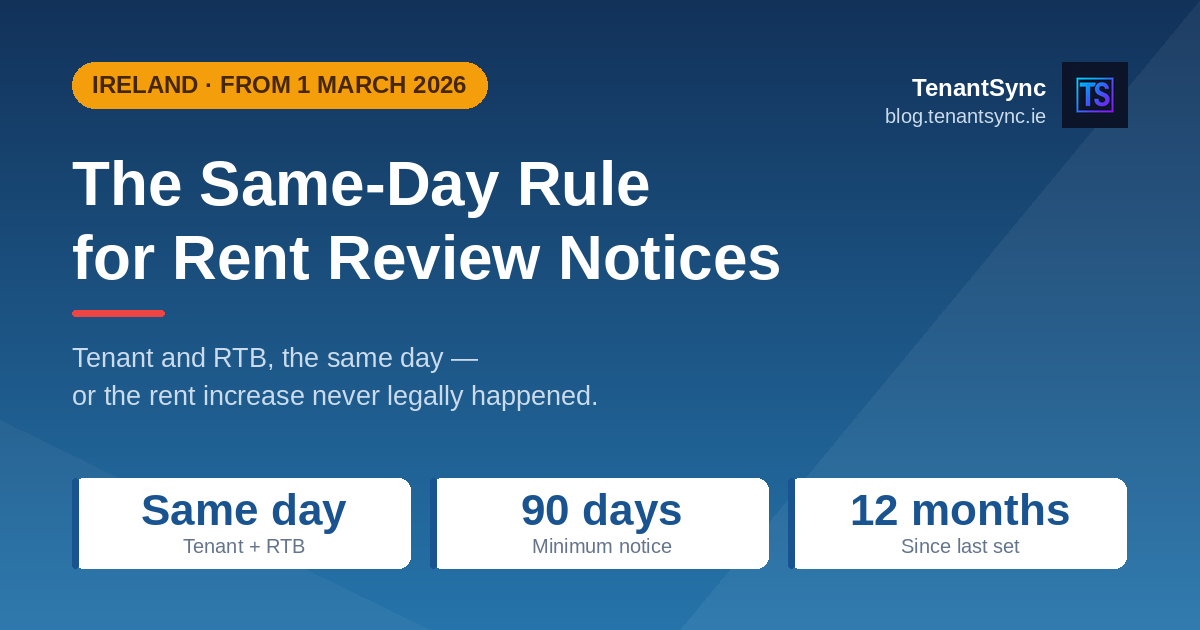
If reviewing, the increase is capped at the lower of 2% or inflation (CPI), once every 12 months, with 90 days' written notice.
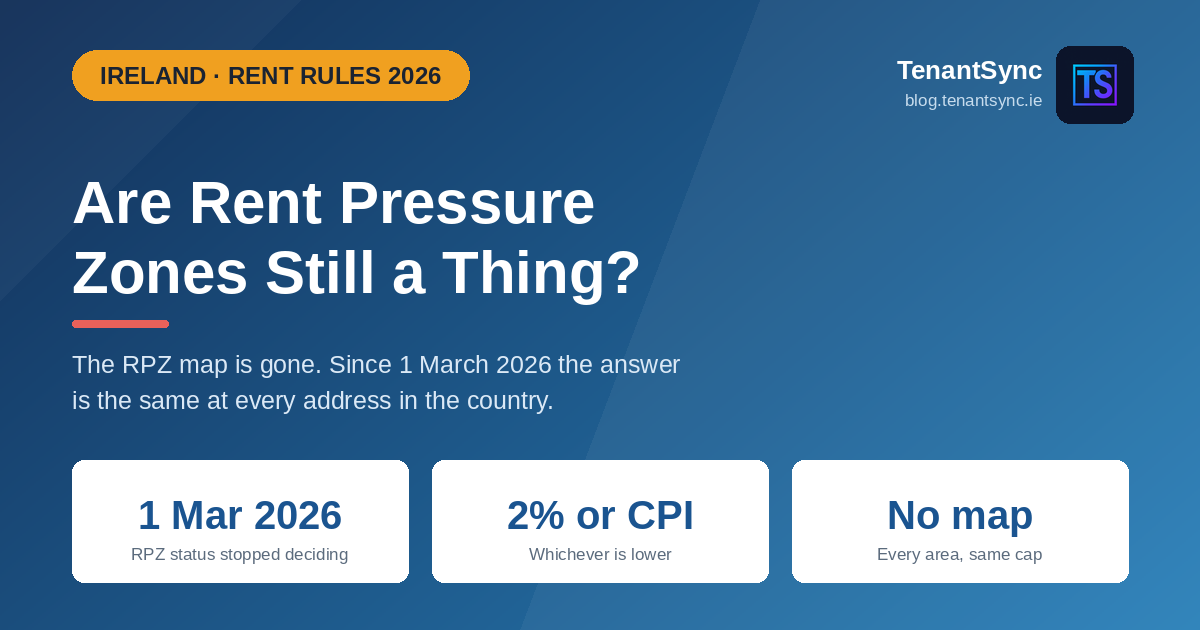
These rules now apply to every private tenancy and Student-Specific Accommodation in Ireland — Rent Pressure Zones no longer exist.
What Changed on 1 March 2026?
If you set rents for a living, this is the most significant change to your day-to-day process in years.
RPZs are gone. National rent control is in.
The RTB confirms that from 1 March 2026, Rent Pressure Zones are replaced by a national system of rent control covering all private tenancies and Student-Specific Accommodation (SSA) across the State. The same rules apply whether the property is in Dublin 2 or rural Donegal.
For agents and landlords, three things matter most when it comes to setting rent:
- The cap is now national and inflation-measured by CPI. Rent can rise once a year by the lower of 2% or the rate of general inflation, with the Consumer Price Index (CPI) now used as the inflation measure for all tenancies — new and existing — instead of the HICP used previously.
- Resetting to market rent is restricted and must be evidenced. You can no longer simply put a re-let on the open market and charge what it makes. A reset is only allowed in defined circumstances, and you must show your working to the tenant and the RTB.
- New 6-year tenancies (Tenancies of Minimum Duration) apply to lettings created from 1 March 2026. The point at which a tenancy can next be reset is built into this cycle.
One date drives everything: when was the tenancy created?
Tenancies created before 1 March 2026 keep their existing protections (and still adopt the 2%/CPI review cap). Tenancies created on or after 1 March 2026 fall under the new regime, including the 6-year Tenancy of Minimum Duration. For every property you manage, the creation date determines which rules apply — so record it accurately.
The 3 Scenarios for Setting Rent
Almost every rent question you will face falls into one of three buckets. Identifying the right one first prevents the most common compliance errors.
New Tenancy
A new tenant in a property. You may be able to set market rent — but only if a reset is permitted, and only with RTB Rent Register comparables.
Continuing Tenancy
Same tenant, including a renewal or a fixed term rolling on. This is not a new tenancy — the existing rent and the review cap continue to apply.
Rent Review
Raising the rent of a sitting tenant. Capped at the lower of 2% or CPI, once per 12 months, with 90 days' notice.
The trap: a renewal is not a reset
If the property has been let continuously to the same tenant — even under a brand-new fixed-term agreement — that is a continuation, not a new tenancy. There is no "reset on renewal" shortcut. The review cap still applies. Treating a renewal as a market reset is one of the fastest ways to land a landlord in an RTB dispute.
Setting the Initial Rent on a New Letting
There are two distinct situations to separate:
A property that has never been let (or is outside the rules)
If a property has genuinely never been rented, there is no previous rent to constrain you — you set an initial market rent in the normal way. The same applies to arrangements that fall outside the Residential Tenancies Acts entirely (for example a licence where a lodger shares the owner's home, holiday lettings of fewer than 14 consecutive days, or commercial tenancies). Once a tenancy begins, however, the cap then governs all future reviews.
A property being re-let after a previous tenancy
This is the situation agents handle most often, and it is where the new rules bite. You cannot assume you can charge market rent. Whether you can reset depends entirely on why the previous tenancy ended — covered in the next section. If a reset is not permitted, the previous rent and its cap carry over to the new tenant as the starting rent.
Practical point for agencies
Before you advertise a re-let, confirm two facts in writing: (1) how and why the last tenancy ended, and (2) what the last lawful rent was. These two facts determine the legal asking rent. Quoting a figure to a landlord before checking them is a real liability risk.
When You Can Reset to Market Rent
According to the RTB, for a tenancy created on or after 1 March 2026, the rent can be re-set to market value when a new tenancy begins only in these circumstances:
- The previous tenant left voluntarily;
- The previous tenant was in breach of their obligations;
- The property no longer suited the previous tenant's needs; or
- The tenancy reached the end of a 6-year Tenancy of Minimum Duration cycle.
The RTB also allows a reset to market value, where the previous rent was below market value, in these additional cases:
- The property is a protected structure (or proposed protected structure) that has not been let in the previous year;
- The property is not a protected structure and has not been rented at any time in the previous 2 years; or
- The property has been substantially changed.
Critical restriction — no reset after a "no-fault" eviction
If the landlord ended the previous tenancy without the tenant being at fault — for example to sell, for a family member to move in, or for refurbishment — the rent cannot be reset to market value for the next tenancy. The previous rent and cap carry over. This is the central protection against "economic evictions" in the reforms.
If you are unsure whether a property qualifies for a reset, confirm with the RTB or take legal advice before quoting a rent.
Where a reset is permitted, two things still apply:
- The new rent must genuinely reflect market rent for that area and property type — and you must be able to prove it (see the next section).
- Once set, the 12-month review cycle and the cap apply to every future increase from that date.
The RTB Rent Register Statement: The New Step Agents Must Master
This is the single biggest change to your re-letting process. When you set a market rent from 1 March 2026, the RTB requires you to give the tenant a statement confirming the new rent is not above market rent — and to back it with hard evidence.
What the statement must contain
The statement must include the rent paid for three similar properties, taken from the RTB Rent Register. The RTB specifies that the comparable properties should be:
- in the same local electoral area;
- with a similar number of bedrooms;
- of similar floor area; and
- with a similar BER rating.
In practice this changes the agent's job from "price to the market" to "price to the market and document it." You must, for every reset:
-
Pull three genuine comparables
Use the RTB Rent Register to find three properties matching the local electoral area, bedrooms, floor area and BER as closely as possible. Like-for-like matters — a loosely chosen comparable is a weak defence.
-
Set the rent at or below that evidenced market level
The figure you quote the landlord must be supportable by the comparables, not above them.
-
Issue the written statement to the tenant
Confirm the new rent is not above market rent and include the three comparables. The landlord must be able to explain to the tenant and the RTB how the rent was calculated.
-
Keep the evidence on file
Retain the comparables and the statement with the tenancy record. If the rent is challenged, this file is your defence.
A tenant can challenge the initial rent
An incoming tenant can refer the initial rent to the RTB if they believe it exceeds market rent. A well-documented three-comparable statement is what stands between your client and a repayment order. Guessing the rent — or reusing last year's figure — is no longer safe.
Managing resets across a whole portfolio? TenantSync helps Irish agencies record each tenancy's creation date, how it ended, and the comparable evidence behind every market reset — so the documentation is built as you work, not scrambled together when a dispute lands. See how it works →
Reviewing Rent for a Sitting Tenant: The 2%/Inflation Cap
Where the tenant is staying, you are not setting a market rent — you are conducting a rent review, and it is capped. Three rules apply at once; miss any one and the increase is invalid.
Once Every 12 Months
Rent can be reviewed at most once every 12 months, measured from when the rent was last set — not the tenancy start date.
Lower of 2% or CPI
The increase cannot exceed the lower of 2% per year (pro-rated) or the rate of general inflation, measured by CPI.
90 Days' Written Notice
You must serve a written rent review notice stating the new rent and effective date — at least 90 days before it takes effect.
Illustrative figures only. The applicable inflation figure changes over time — always use the current rate for the relevant period when calculating a review.
Need the exact maximum for a sitting tenant? Use TenantSync's free Rent Increase Calculator → — it applies the lower-of-2%-or-inflation rule and the pro-rating for you.
New Apartments & Student Accommodation: The Inflation-Only Carve-Out
Not every property is held to the 2% ceiling. The RTB sets out specific carve-outs that matter when you advise developers, build-to-rent clients or student operators.
| Property type | How rent is treated |
|---|---|
| New apartments (commenced and completed development, with the required Building Control Authority compliance certification, on or after 10 June 2025) | Rent increases linked solely to inflation (CPI) — the 2% ceiling does not apply. |
| Student-Specific Accommodation (SSA) commenced from 10 June 2025 | Also not subject to the 2% cap — increases linked to inflation (CPI). |
| Student-Specific Accommodation — market resets | Re-setting SSA to market rent is allowed only once every 3 years, from 1 March 2029. |
Eligibility for the new-apartment carve-out is specific and evidence-based. Before relying on it, confirm the property's commencement/completion dates and certification status with the RTB.
Small vs Large Landlords: Why It Matters for Setting Rent
The reforms draw a line between smaller landlords (3 or fewer tenancies) and larger landlords (4 or more tenancies, and companies). The distinction mainly affects termination rights — but it feeds directly into when a rent can next be reset.
- Larger landlords: tenants entering tenancies with larger landlords from 1 March 2026 will no longer face "no-fault" evictions. With fewer routes to end a tenancy, the opportunities to reset to market rent are correspondingly narrower.
- Smaller landlords: retain more flexibility around the 6-year cycle, which can create more reset points over time.
For an agency, the practical takeaway is to know each client's classification, because it shapes how often — and on what grounds — you can lawfully reset a rent across their portfolio.
Want the full breakdown of the size rules and termination grounds? Read our complete March 2026 reforms playbook for landlords and agents →
The Rent-Setting Mistakes That Cost Agencies
These are the errors most likely to produce an invalid rent or a successful tenant challenge under the new system.
Resetting after a no-fault termination
If the landlord ended the last tenancy to sell, move family in or refurbish, you cannot reset to market rent. The old rent carries over.
No Rent Register comparables on file
Setting a market rent without the three-property RTB Rent Register statement leaves the rent undefended if challenged.
Treating a renewal as a reset
Same tenant renewing is a continuation, not a new tenancy. The review cap applies — there is no market reset.
Short-dating the review notice
90 days is the legal minimum. A 30- or 60-day notice means the increase cannot take effect, whatever the notice says.
Reviewing rent too soon
Reviews are once per 12 months from when the rent was last set. An early notice is invalid.
Losing the tenancy creation date
Pre- and post-March-2026 tenancies follow different rules. If you cannot prove the creation date, you cannot prove the rent is lawful.
A Compliant Rent-Setting Workflow — and How TenantSync Runs It
Across a portfolio, the new rules are less about any single rule and more about holding the right evidence for every tenancy: when it was created, how the last one ended, the comparables behind each reset, and the date of every review. Doing that in spreadsheets is where agencies get exposed. TenantSync is built for Irish letting agents to make this routine:
Tenancy Timeline
Records each tenancy's creation date and how it ended — so it is instantly clear whether a market reset is permitted on the next letting.
Reset Evidence Store
Keep the RTB Rent Register comparables and the market-rent statement attached to the tenancy record, ready if the rent is ever challenged.
Review Date Alerts
Flags when each lease becomes eligible for a 12-month review, based on the exact date the rent was last set.
Cap Calculation & Audit Trail
Applies the lower-of-2%-or-inflation cap and logs every action with timestamps — a complete defence file for RTB scrutiny.
Set every rent right the first time — across your whole portfolio.
TenantSync gives Irish agencies the structure the new rules demand: reset eligibility, Rent Register evidence, review dates and a full audit trail, in one place.
Frequently Asked Questions
Can I charge market rent for a re-let in 2026?
Only if a reset is permitted. According to the RTB, you can reset to market value when the previous tenancy ended because the tenant left voluntarily, breached their obligations, or the property no longer suited their needs — or at the end of a 6-year Tenancy of Minimum Duration. You cannot reset after a no-fault eviction. Where a reset is allowed, you must back the figure with three comparables from the RTB Rent Register.
What exactly goes into the market-rent statement?
A written confirmation to the tenant that the new rent is not above market rent, including the rent paid for three similar properties from the RTB Rent Register — properties in the same local electoral area with a similar number of bedrooms, similar floor area and a similar BER rating. The landlord must be able to explain to the tenant and the RTB how the rent was calculated.
Is the cap based on HICP or CPI now?
From 1 March 2026 the Consumer Price Index (CPI) is used as the measure of inflation for all tenancies — new and existing — replacing the HICP used under the old RPZ system. The cap on a review remains the lower of 2% or the rate of inflation over the period.
Do the new rules apply outside the old Rent Pressure Zones?
Yes. RPZs no longer exist. From 1 March 2026 the national rent control system applies to every private tenancy and Student-Specific Accommodation in the State, regardless of location.
My client's property is a newly built apartment. Does the 2% cap apply?
The RTB states that new apartments which commenced and completed development (with the required Building Control Authority compliance certification) on or after 10 June 2025 have rent increases linked solely to inflation (CPI), without the 2% ceiling. The same applies to Student-Specific Accommodation commenced from that date. Confirm the property's dates and certification with the RTB before relying on this.
Does the rent have to be reported to the RTB?
All tenancies must be registered with the RTB, and rent information forms part of that. When you reset to market rent, you must be able to explain the calculation to the RTB, and the RTB Rent Register is the source for your comparables. Keep the documentation with the tenancy record. For registration deadlines, see our RTB registration deadline guide.
Rent-Setting Checklist (Before You Quote a Figure)
Run through this before advising any landlord on a rent for a new or re-let tenancy:
Want this running automatically for every managed property? TenantSync tracks reset eligibility, stores your Rent Register evidence and alerts you to review dates — so the checklist runs itself.
Official Sources & Tools
Disclaimer: This article is for general information only and does not constitute legal advice. While every effort has been made to reflect the RTB's published rules accurately, regulations and figures can change. Always verify the position for your specific property on rtb.ie or consult a qualified solicitor before setting a rent or serving any notice.
Last updated: June 2026 — reflects the national rent control rules in force from 1 March 2026.
Related Articles