RPZ Rent Increase Calculator Ireland 2026: Find Your Legal Maximum in Seconds
You haven't reviewed the rent in two years. Your tenant is great and you don't want to overcharge — but you also can't afford to fall behind market rate. What's the maximum you're legally allowed to charge? If your property sits inside a Rent Pressure Zone (RPZ), the answer depends on a specific government formula tied to inflation. This guide explains the rules in plain English and shows you how to use our free RPZ rent increase calculator to get your answer in seconds — under the Residential Tenancies Acts 2004–2022.
What Is a Rent Pressure Zone (RPZ) in Ireland?
A Rent Pressure Zone is a designated area in Ireland where annual rent increases are capped by law. The cap exists to protect tenants in areas where rents have been rising sharply and accommodation is scarce. Not every part of the country qualifies — an area must meet specific criteria around rent levels and vacancy rates before the government designates it an RPZ.
Once an area becomes an RPZ, landlords there cannot increase rent beyond the legal maximum, regardless of what the wider market is doing. Breaking this rule can result in a formal dispute through the Residential Tenancies Board (RTB) and a potential order to repay excess rent — with interest.
Which areas are RPZs in 2026?
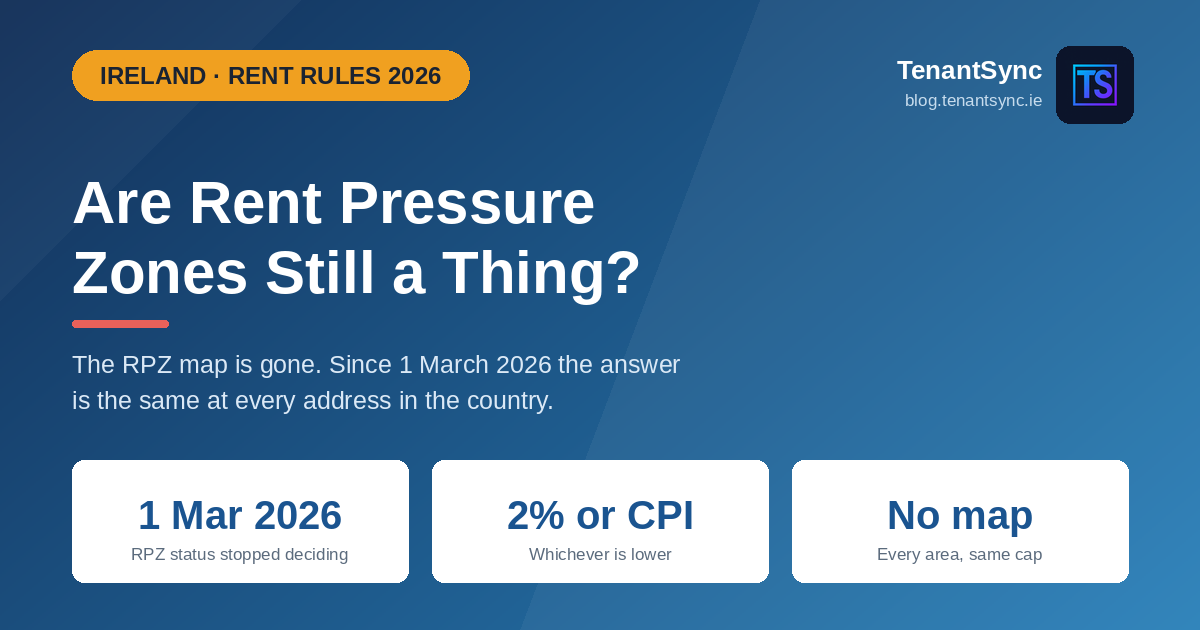
As of 2026, RPZ designations cover a large portion of the country. Dublin city and county, Cork city, and many large towns across Leinster and Munster are designated. New areas can be added when the qualifying criteria are met.
The most reliable way to check your property's status is to use the RTB official website, which maintains an up-to-date map and list. Never rely on assumptions — verify each property individually.
Why RPZs Were Introduced
Ireland's rental market has been under sustained pressure for years. Supply has not kept pace with demand in major urban centres, and rents in parts of Dublin rose by double digits year on year during the 2010s. RPZs were introduced under the Planning and Development (Housing) and Residential Tenancies Act 2016 as an emergency measure to slow that growth.
The regime has since been extended and updated several times under the Residential Tenancies Act rent cap provisions. From a practical standpoint, if your property is in an RPZ — and there is a high chance it is — the HICP vs 2% cap applies to every rent review you carry out.
The RPZ Rent Cap: HICP vs the 2% Rule Explained
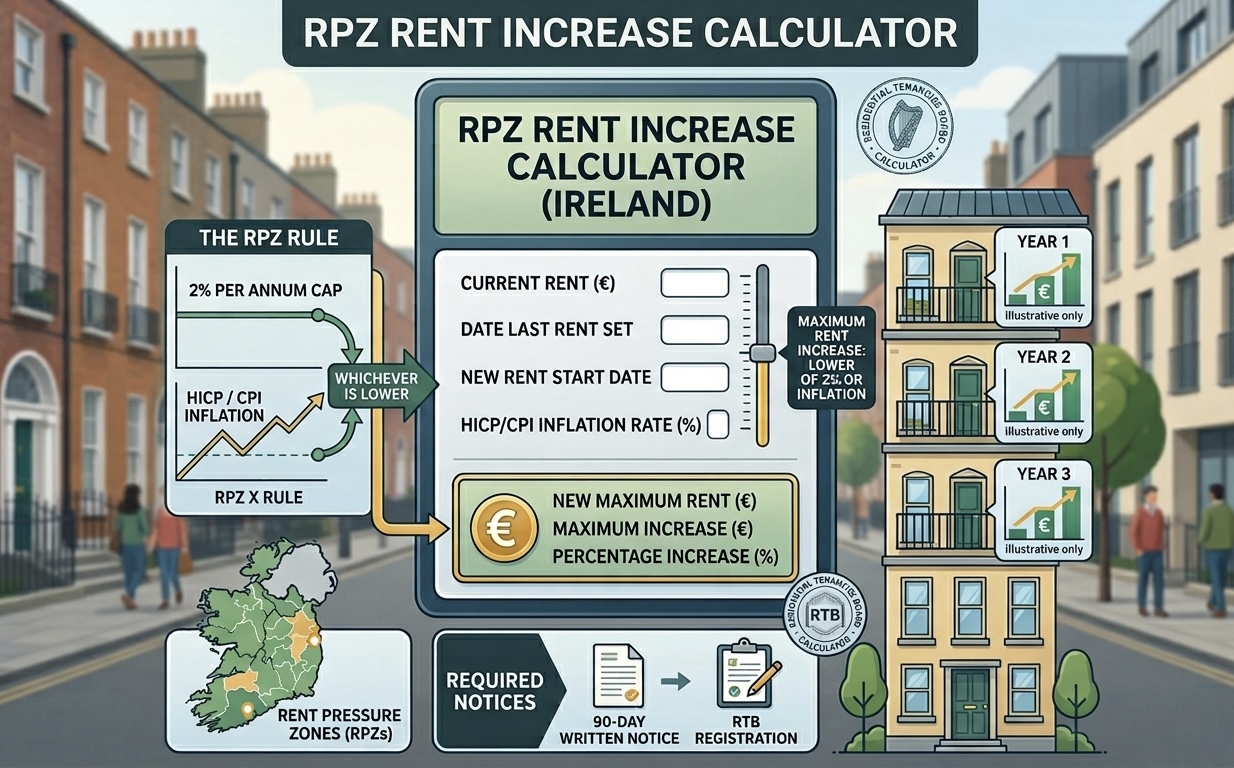
The most common question landlords ask is: "How much can I put the rent up?" In an RPZ, the answer is always the lower of two figures: the HICP rate or 2% per year. Never the higher of the two — always the lower.
How the cap is determined — at a glance
| HICP rate (from RTB notice) | Cap applied | What it means |
|---|---|---|
| Below 2% (e.g., 1.4%) | 1.4% | HICP is the binding limit — you cannot reach 2% |
| Exactly 2% | 2% | Both figures align — 2% is the cap |
| Above 2% (e.g., 3.1%) | 2% | The 2% ceiling overrides the higher HICP rate |
What Is HICP and Where Does the Figure Come From?
HICP stands for the Harmonised Index of Consumer Prices. It is a standard measure of inflation used across the EU. In the Irish rental context, the RTB publishes an official HICP notice that sets out the applicable rate for any given rent review period.
Landlords must use the figure from the RTB's published HICP notice — not a figure from a newspaper or a general inflation report. The TenantSync RPZ calculator uses the latest published RTB HICP notice automatically, so you always work from the correct, current source.
Do not use general inflation figures
General inflation headlines (CPI, CSO figures) are not the same as the RTB's HICP notice. Using the wrong figure — even if it is lower than 2% — can mean your rent increase is technically invalid. Always use the figure published at rtb.ie.
How the Pro-Rata Calculation Works
The cap is calculated on a per-year basis, but it applies to the actual number of months that have passed since the rent was last set. If you are reviewing rent after 18 months rather than 12, you apply the annual percentage proportionally for the period. This pro-rata element trips up many landlords who assume they can simply compound the 2% annually — the formula is more precise than that, and doing it by hand is where errors creep in.
How Much Can You Increase Rent in an RPZ? (3 Steps)
Here is the manual process, broken into three clear steps. Follow all three to arrive at the correct maximum rent increase Ireland 2026 allows for your property.
Find the date the rent was last set
Your starting point is not when the tenancy began — it is when the current rent was last set. If you reviewed the rent in March 2024, that is your reference date, even if the tenant has lived there since 2020. Check your lease or any rent review letter you sent at the time.
If you have never reviewed the rent since the tenancy started, the rent was "last set" on the tenancy commencement date. That is your baseline.
Calculate the time elapsed
Work out the number of months between the last rent-set date and your proposed new review date. You need this figure to apply the HICP or 2% cap proportionally.
A review after exactly 12 months uses the annual rate. A review after 24 months requires using the applicable HICP rates for each 12-month period separately — not simply twice the current figure.
Apply the lower of HICP or 2%
With your time period established, apply the lower of the HICP rate or 2% per annum, scaled to the actual time elapsed. Multiply your current rent by the applicable percentage. The result is the maximum permitted new rent under RTB rent pressure zone rules 2026.
If the calculation spans multiple periods with different HICP rates, apply the rate for each period separately. This is where errors become most common in manual calculations.
Check Your Maximum — Free RPZ Calculator
Enter your current rent, the date it was last set, and your proposed review date. Our RPZ Rent Increase Calculator applies the correct HICP cap or 2% rule automatically — instant result, no account needed.
Serving a Valid Rent Review Notice: What Landlords Must Include
Even if your new rent figure is within the legal cap, the increase only takes effect if you serve the notice correctly. A technically invalid notice means the increase cannot proceed — and any rent collected above the current amount before proper notice is served may have to be refunded.
The 90-Day Notice Rule
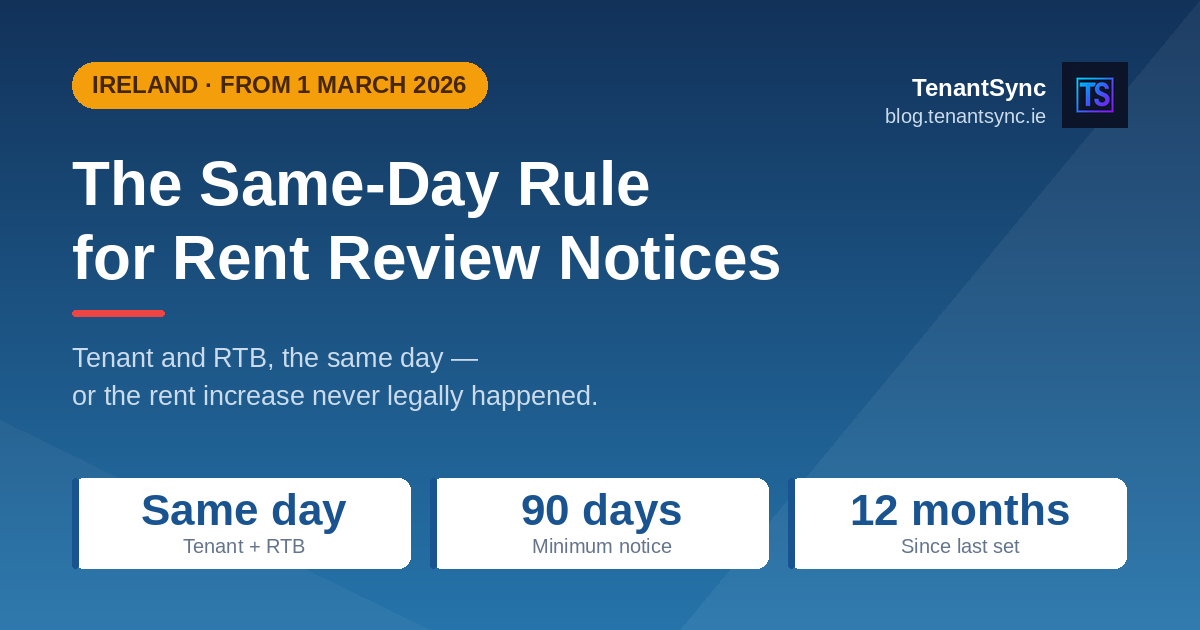
Irish law requires landlords to give tenants at least 90 days' written notice before a rent increase takes effect. This is a minimum — you can give more notice, but not less. The notice period starts the day after the tenant receives the notice, not the day you send it.
What every valid rent review notice must contain
- In writing — a text message or verbal agreement is not sufficient
- The amount of the proposed new rent, stated clearly in euro
- The date from which the new rent will apply
- A statement that the new rent does not exceed the RPZ maximum
- The calculation method used to arrive at the new figure
If you give fewer than 90 days' notice
The notice is invalid. Your tenant is not obliged to pay the higher amount. You would need to serve a fresh notice — which resets the 90-day clock. This means delays of several months and loss of income you were entitled to collect sooner. Getting the date right the first time is essential.
Generate a compliant notice with TenantSync
TenantSync calculates the RPZ cap and generates a compliant rent review letter that includes all required elements — ready to send to your tenant in one step. Start a free trial to try it.
7 Common RPZ Mistakes Irish Landlords Make
These are the errors that come up repeatedly when landlords attempt RPZ rent reviews without proper guidance. Any one of them can invalidate your rent increase or expose you to a dispute at the RTB.
Using the tenancy start date instead of the last rent-set date
If you reviewed rent in 2023, that date — not when the tenant first moved in — is your baseline. These can be years apart and lead to a significantly wrong calculation.
Applying 2% without checking the HICP rate first
If HICP was below 2% in the relevant period, using 2% automatically puts you above the legal cap. Always check the RTB's published HICP notice before calculating.
Forgetting the pro-rata calculation for periods over 12 months
You cannot multiply the current annual cap by the number of years. Each period must use the correct HICP notice that applied at the time.
Giving fewer than 90 days' notice
Even by one day, the notice is invalid. The clock starts the day after delivery, and the effective date must fall at least 90 days later.
Omitting the RPZ calculation statement from the notice
A letter that only states the new rent amount — without the calculation — does not meet the legal requirements and can be challenged successfully by a tenant.
Reviewing rent more than once every 12 months
You cannot serve a second rent review notice within 12 months of the last rent-set date, even if both increases would individually be within the cap.
Assuming a new tenancy resets the review clock
If a new tenant moves into a property that was previously let, the 12-month window still runs from when the rent was last set — not from the new tenancy start date.
RPZ Rent Increase: Frequently Asked Questions
How much can I increase rent in a Rent Pressure Zone in Ireland?
In an RPZ, the maximum annual rent increase is the lower of the HICP rate or 2% per year. When HICP is running below 2%, the HICP figure is the cap — even if it is 0.8% or 1.3%. Use the free RPZ rent increase calculator to find your exact legal maximum based on the current RTB HICP notice.
What is HICP and how does it affect rent in Ireland?
HICP stands for the Harmonised Index of Consumer Prices. The RTB publishes an official HICP notice that landlords must use when calculating RPZ rent increases. When HICP is below 2%, the HICP figure applies. When it is above 2%, the 2% annual cap applies instead.
Can I increase rent if my property is outside an RPZ?
Yes. If your property is not in a designated RPZ area Ireland 2026, the HICP cap and the 2% rule do not apply. You can set the rent at whatever rate you and the tenant agree. You still must give 90 days' written notice and may only review rent once every 12 months. Check the RTB official website to confirm your property's RPZ status.
How often can I review rent in an RPZ?
Rent can only be reviewed once every 12 months in a Rent Pressure Zone. The 12-month period is measured from when the rent was last set — not from the tenancy start date. Once a review takes effect, that date becomes your new baseline for the next eligible review.
What if I haven't reviewed rent in several years?
You haven't lost anything — but the calculation is more complex. You cannot apply the current HICP rate to the entire period. You must apply the rate that applied to each 12-month period separately. The TenantSync RPZ calculator handles multi-year calculations automatically using the correct historical HICP figures.
Is the result from this calculator legally binding?
No tool or article — including this one — constitutes a legally binding determination. The calculator uses the latest published RTB HICP notice and the statutory formula to give you the maximum figure the law currently permits. For any dispute or unusual circumstances, always refer to rtb.ie or seek independent advice.
Stay RTB Compliant With TenantSync
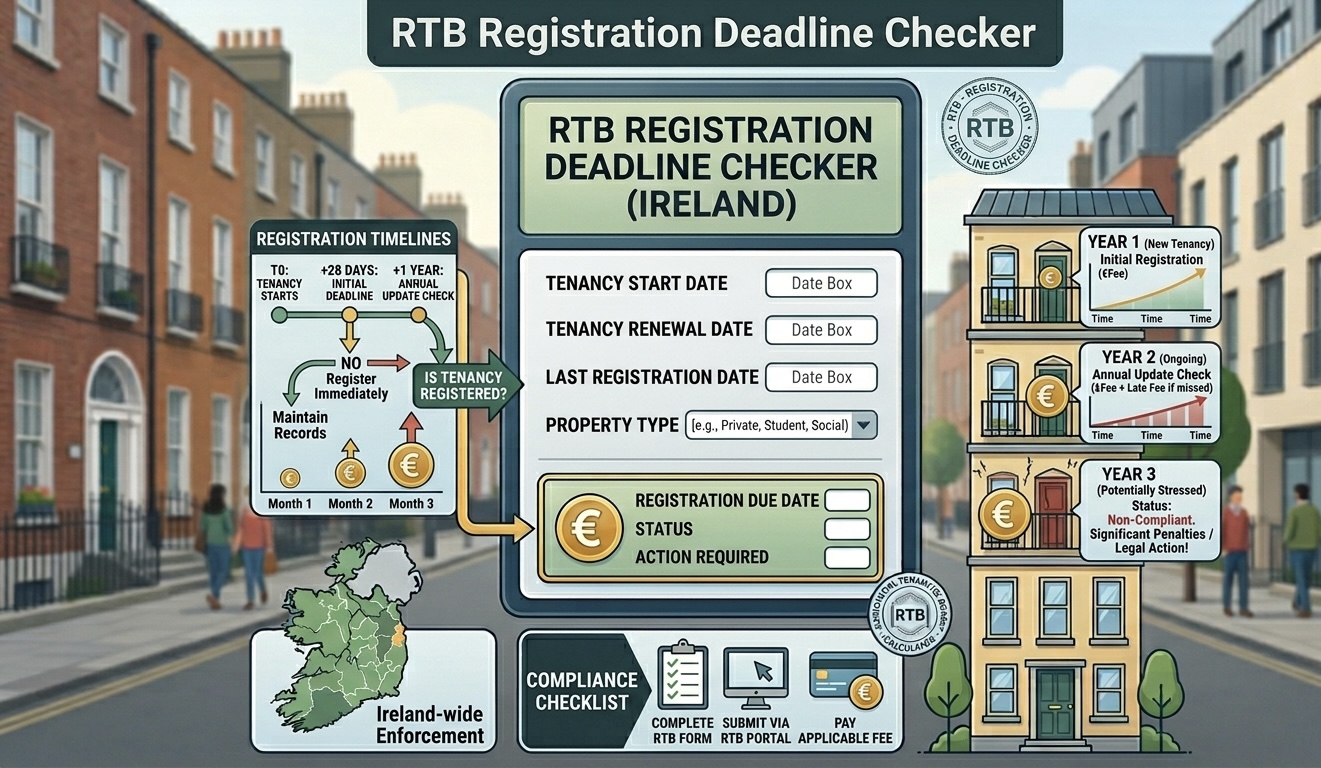
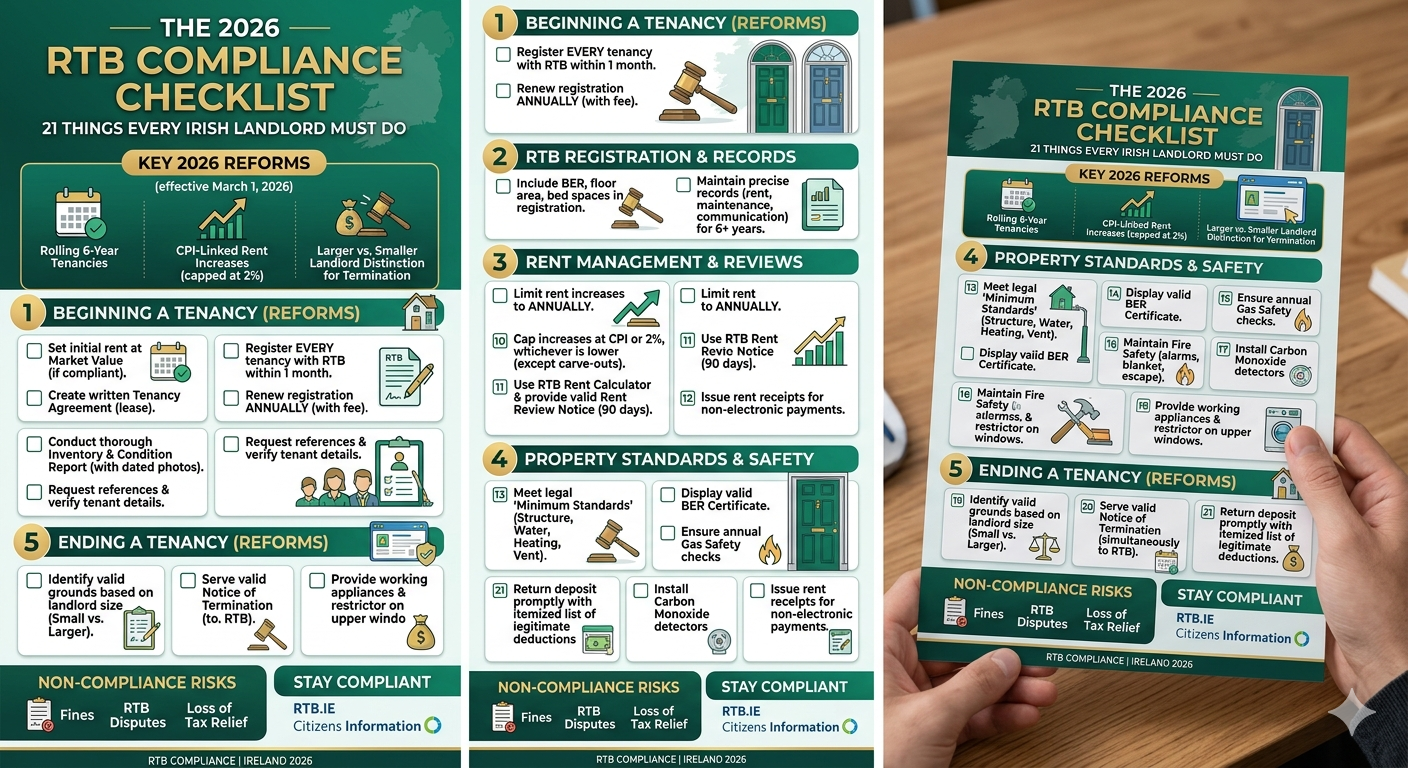
Keeping on top of RPZ rent reviews is just one part of staying compliant as an Irish landlord. You also need to register every new tenancy with the RTB within 30 days — and renew that registration every year. Use our free RTB registration deadline checker to find your exact deadline in seconds.
If you'd rather have TenantSync track every deadline, send you reminders, and calculate your RPZ cap automatically for every lease, start a free trial — no credit card required.
Track every RPZ review date and RTB deadline automatically
TenantSync calculates your RPZ cap, generates compliant rent review letters, and alerts you before every RTB registration renewal is due — across your entire portfolio.
Related Articles