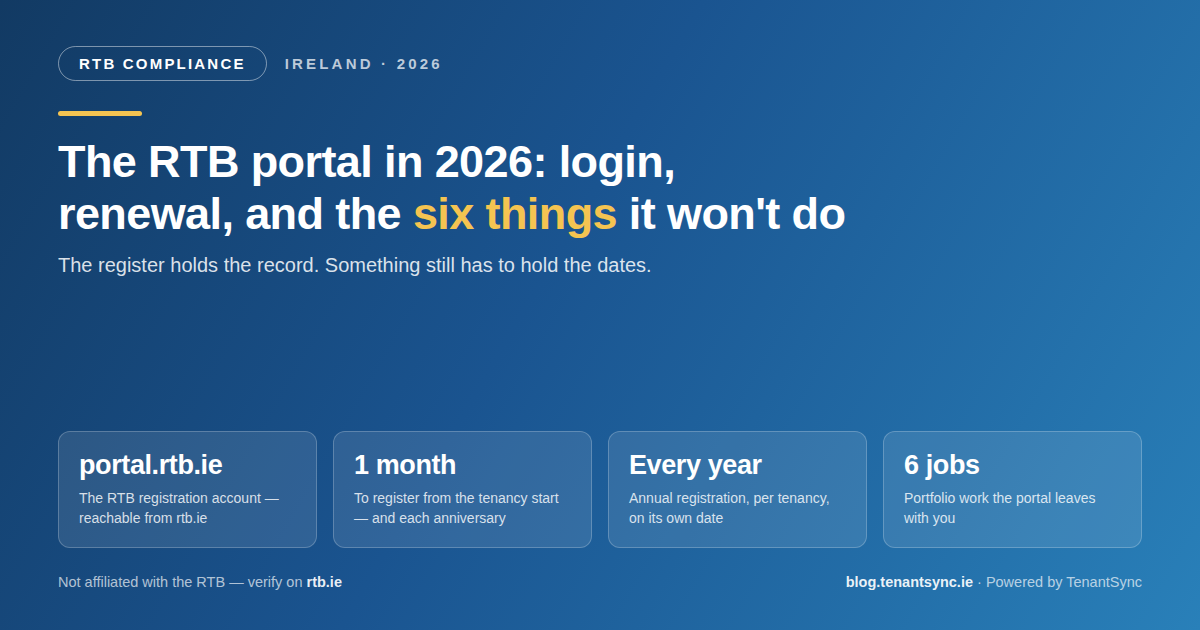
The RTB Portal in 2026: Login, Annual Renewal, and the Six Things It Won't Do For You
If you came here to get in, go straight to the RTB's own registration account at portal.rtb.ie — or reach it from the Register tenancies section of rtb.ie. That is the login. The rest of this page is the part nobody tells you: what to have to hand, how the annual registration actually works, what to do when a tenancy isn't showing on your account, and the six jobs the portal was never built to do for a portfolio.
The short version
Where do I log in to the RTB? The Residential Tenancies Board's online registration account is at portal.rtb.ie, also reachable from the Register tenancies section of rtb.ie. Sign in with the email address the account was created with. That account is where landlords, letting agents and Approved Housing Bodies register a new tenancy, complete the annual registration on the anniversary of the tenancy start date, and manage existing registrations. If you only want to know whether a tenancy is registered, you don't need a login at all — use the RTB's public tenancy registration check.
🔔 Never miss an annual RTB renewal again
TenantSync works out every registration and renewal date from the tenancy start, reminds you before each one is due, and calculates the legal rent cap. €20/month for up to 10 properties — 14-day free trial, no card to start.
Where the Portal Is, and What to Have to Hand
The link first, because that is what you came for. Everything after this earns its place or it shouldn't be here.
The RTB registration account
portal.rtb.ie — the Residential Tenancies Board's own online registration account. You can also get there from the Register tenancies section of rtb.ie, which is the safer habit: the RTB moves things, and a saved bookmark from three years ago is how people end up on a lookalike page. Only ever enter RTB credentials on an rtb.ie address.
Before you sign in, have four things within reach. Missing any of them is the usual reason a registration that should take ten minutes takes two evenings.
- The email address the account was created with. Not your current work address — the one the account was actually opened under. In an agency these differ more often than anyone expects.
- The RT number for anything you are renewing or linking. That is the unique registered tenancy number the RTB issues, shown on the registration confirmation, in the format
RT-XXXX-XXXXXXXX. - Current tenancy details. Rent, deposit, number of occupants, BER where it applies, and the correct tenancy commencement date. For an annual registration these are pre-filled from last year, which is precisely why they need checking.
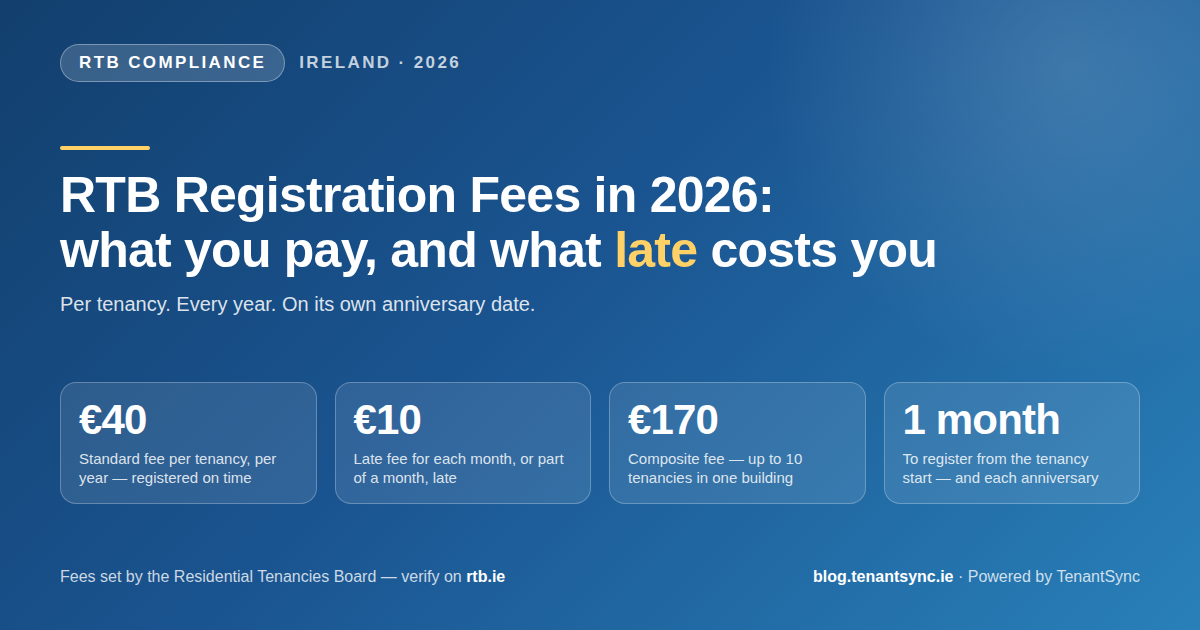
- A payment card. The fee is paid at the point of registration. It is €40 per tenancy per year for private, cost rental and Student Specific Accommodation tenancies registered on time, and €10 for every month or part of a month late — figures the RTB sets and can change.
You may not need a login at all
Two of the most common reasons people go looking for an RTB login don't require one. If you want to confirm that a tenancy is registered — as a tenant, a prospective buyer, a solicitor or an agent taking over a property — the RTB publishes a public tenancy registration check. And if what you actually have is a dispute rather than a registration, that runs through the RTB's dispute resolution service, not through the registration account.
Creating and Verifying an Account — Do It Before You Need It
The single most avoidable RTB problem in Irish lettings is discovering, on day twenty-four of a thirty-day window, that you cannot register the tenancy because the account isn't verified yet. Account creation and account verification are two different events, and only the first one is instant.
The RTB verifies who you are before it lets you register anything. For an individual landlord that verification runs against the identity details the State already holds — a PPS number together with the date of birth and the name exactly as held by the Department of Social Protection. That last detail causes more failed verifications than anything else: a married name, an anglicised first name or an initial where the DSP record has a full name will not match. For a company, it runs on the CRO number. Where the RTB has to review documents instead, it takes longer again.
Two practical rules follow, and they cost nothing to adopt:
- Verify the account when you take the instruction, not when the clock is running. The registration deadline is set by the tenancy commencement date. It does not pause while an account is being verified, and "we were waiting on the RTB" is not a defence anyone wants to write into a client update.
- Open the account under an address that outlives a person. A shared, monitored mailbox —
compliance@,lettings@— rather than an individual's work address. The reason why is in the next section but one, and it is the most expensive mistake on this page.
Registering as an agent rather than as the landlord
The RTB's registration process asks you to confirm whether you are completing the registration as the landlord of the tenancy or as an agent acting on behalf of the landlord, and it captures agent details as part of the registration. Get that right at the point of registration; it is tidier than correcting it afterwards.
Note where the liability actually sits, because it is asymmetric. The registration obligation and the fee are the landlord's, and the fee cannot be passed on to the tenant. But if a deadline is missed on a tenancy you manage, the operational failure is the agency's — and the conversation is not about €10 of late fee, it is about why a client's tenancy sat unregistered for a quarter. That asymmetry is the whole reason a letting agent's relationship with registration dates is different from a landlord's.
When a Tenancy Isn't Showing on Your Account
Here is the thing that surprises people: your RTB account shows you the registrations linked to it, and nothing else. It is not a view of every tenancy at an address, or every tenancy you manage, or every tenancy a landlord client owns. It is a view of what has been attached to that account.
So a tenancy will be missing whenever it was registered by somebody else — and in agency work that is routine:
- The landlord registered it themselves before instructing you.
- A colleague registered it under their own account.
- The property came across in a block from another agency.
- Two accounts quietly exist in the same office, and the book is split between them.
The RTB provides a linking process for exactly this. You link an existing registration using its RT number — the unique registered tenancy number, format RT-XXXX-XXXXXXXX, which appears on the registration confirmation the RTB issues. For an individual account, the surname and email address need to match those on the registration being linked. The RTB's own guide to linking an existing registration sets out the current mechanics, which differ slightly for individual, company and Approved Housing Body accounts. Once linked, the tenancy appears with your others for renewal and management.
Do the linking on day one of the instruction
Linking is a five-minute job when you take a property on and a crisis when the annual registration is due tomorrow — because you need the RT number, and the person who has it is the landlord, who is on holiday. Make "obtain the RT number and link the registration" part of the onboarding checklist for every managed property, alongside collecting the lease and the BER. An unlinked tenancy is a tenancy whose renewal date you cannot see.
The Annual Registration, Step by Step
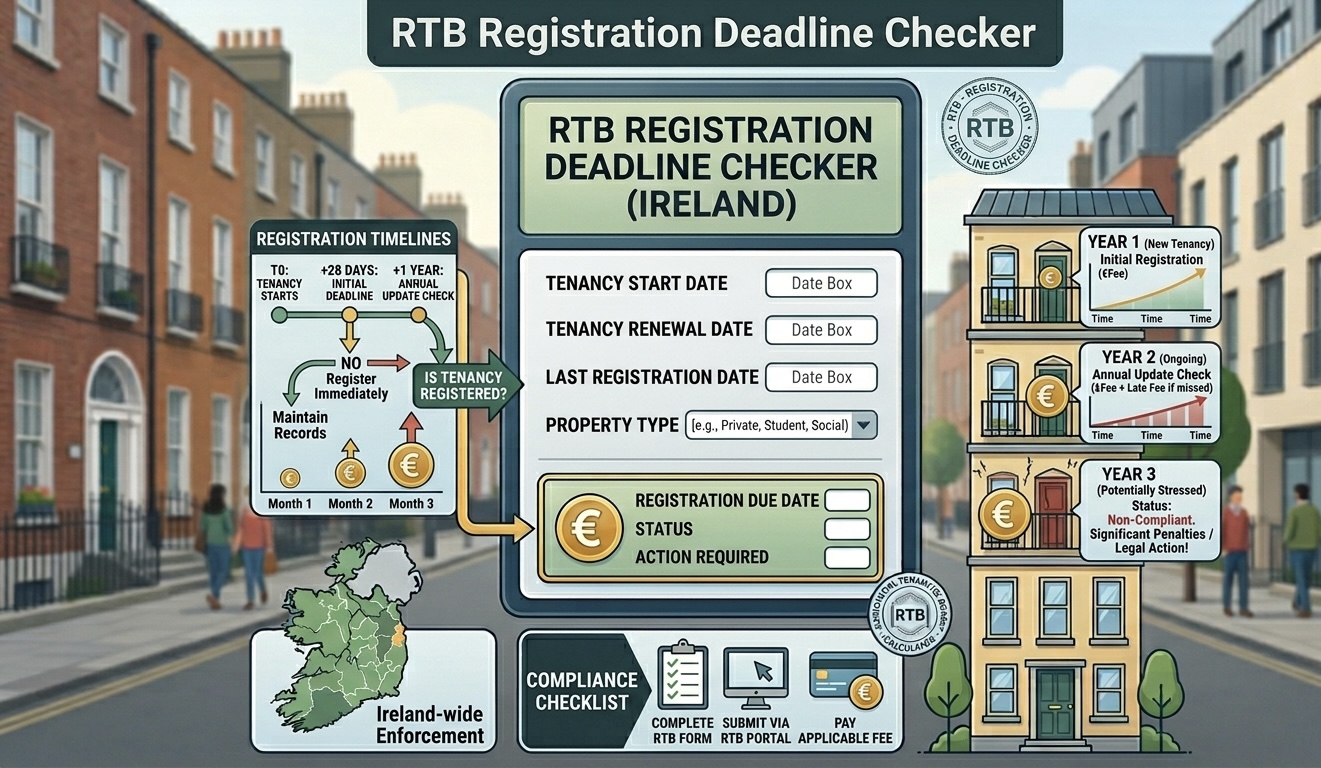
Since April 2022, RTB registration is annual, not once. A new tenancy is registered within one month of the date it commenced; after that, the tenancy is registered again each year, within one month of the anniversary of that commencement date, for as long as it continues. A tenancy that runs six years generates six registrations.
That is the change that turned registration from a task into an obligation with a heartbeat — and it is why "rtb online login renewal" is a search anyone runs. The flow inside the account goes like this. Screen labels are the RTB's and they change, so treat these as the shape of it rather than a script:
- Sign in at portal.rtb.ie, or from the Register tenancies section of rtb.ie.
- Open the area for renewing annual registrations and managing existing registrations from the account homepage. This is the list of everything linked to your account.
- Find what's due. Tenancies that need registering again show a pending-registration status, and the list can be filtered by next registration date or by status. If you manage a book, sort by date and work the whole month at once rather than one tenancy at a time.
- Start the registration for that tenancy. The details from the previous registration carry through, so this is a review-and-confirm exercise rather than a re-keying exercise.
- Correct what has changed. Rent, deposit, occupant numbers, BER, contact details. The pre-filled values are last year's. Confirming them unread is how a rent figure that changed in March is still showing the old amount on the register in November.
- Pay the fee and save the confirmation against the tenancy file, with the date. The confirmation is the evidence the obligation was met on a particular day — a memory of having done it is not.
- Diarise the next anniversary before you close the tab. The registration you just completed generates the next one, a year out. Nothing in the portal will chase you for it beyond an email to the account address.
"One month" and "30 days" are not always the same date
The requirement is expressed as one month, and the shorthand everyone uses is 30 days. For most tenancies they land on the same day; around month ends they don't — a tenancy commencing on 31 January has no 31 February to count to. Where the two readings differ, work to the earlier one. Better still, register in the first fortnight and the argument never arises. We go into the mechanics in the RTB registration deadline guide.
Work Out Your Next Annual Registration Date
Before you go looking for the date in the portal, here is the arithmetic. Enter the date the tenancy commenced and this works out the first registration deadline, the next annual registration anniversary, and how long is left. It runs entirely in your browser — nothing is sent anywhere and no email is required.
Annual registration date calculator
Derives the dates from the tenancy commencement date using the RTB's one-month rule. It does not check the RTB's records — where your date and the RTB's date disagree, the RTB's is the one that decides.
—
—
Guide only. It applies the one-month rule to the date you type and assumes a continuing tenancy that requires registration. It does not know about tenancy changes that create a new tenancy, exempt tenancies, or what the RTB actually holds for you. Confirm every date against your RTB account at portal.rtb.ie.
Now run it once and look at the last line. One tenancy is a date. Forty tenancies is forty dates, scattered across twelve months, each generated by an event that happened a year ago and none of them written down anywhere except inside an account somebody has to remember to open.
📅 Check every tenancy's RTB deadline — free
Enter a tenancy start date and get the registration deadline and the next annual renewal date instantly. No login, no card, no sales call. It's the same arithmetic as above, built to run across a portfolio instead of one tenancy at a time.
What Goes Wrong, and What It Usually Means
We can see, in aggregate search data for our own site, what people are actually trying to do when they type "rtb login". A large share of it is not first-time registration. It is people trying to get back in: rtb landlord login password, rtb online login password, rtb login renewal. That tells you where the friction is.
"I can't get back into the account"
Use the password reset on the RTB's sign-in page, with the exact email address the account was created under. If that fails, the RTB's registration account support pages set out how to get help, and the registrations team can be reached at registrations@rtb.ie.
The underlying cause, in an agency, is almost always the same: the account is tied to an email address, not to a job. When the administrator who opened it moves on and the mailbox is closed, the reset link has nowhere to arrive. The registrations keep falling due regardless. If your RTB account is currently in a departed colleague's name, that is this week's job, not next quarter's.
"The tenancy isn't there"
Almost always a linking problem rather than a missing registration — see the section above. Before assuming a tenancy was never registered, check the RTB's public tenancy registration check: a tenancy can be perfectly well registered and simply not linked to the account you're looking at.
"The details we registered were wrong"
Corrections are handled by the RTB, and the route depends on what is wrong and when it was registered. Start from the RTB's managing your registrations guidance and contact the registrations team if the account won't let you fix it. Don't leave a known error sitting on the register because correcting it is awkward — the register is the thing a dispute, a HAP application or a purchaser's solicitor will read.
"Which RTB portal am I even looking for?"
Reasonable question, and it produces its own search traffic. The RTB runs more than one online system. The registration account at portal.rtb.ie is the one landlords and agents want. There is a separate portal for the RTB's own dispute resolution panel members — adjudicators and mediators — which is not a landlord login. And searches for "RTB 360" turn up steadily, though we can find no RTB service publicly branded that way; the people typing it appear to want the ordinary registration account. When in doubt, start at rtb.ie and navigate in.
What the RTB Holds, and What Stays Your Liability
This is the distinction the whole article turns on, so it is worth stating plainly.
The RTB operates the national register of tenancies. Its account is a system of record for registration: what was registered, for which dwelling, by whom, on what date, with which particulars, and whether the fee was paid. That is a real and important thing, and the portal does it.
What the RTB does not hold is your side of the file — and in an RTB dispute, your side of the file is the half you have to produce. Nobody at the RTB records that the landlord approved the increase by email on the ninth, that the notice went out by registered post on the eleventh, that the tenant's revised occupancy was confirmed in June, or which version of a document was actually served. The register shows a registration exists. It does not show that you did your job.
Scroll the table sideways to see every column.
| Obligation | In the RTB account? | Who actually has to track it |
|---|---|---|
| That a tenancy is registered | Yes — that is what it is for | RTB record; you keep the confirmation |
| Registering a brand-new tenancy within one month | Only once you enter it | You — the clock runs whether or not it's in the portal |
| The annual registration date | Shown for linked tenancies; notified by email | You — the obligation doesn't depend on the email arriving |
| What the rent is allowed to be at review | No — it records rent, it doesn't cap it | You — national rent cap, lower of 2% or CPI |
| Which framework each tenancy sits under | No — it holds facts, not classifications | You — Part 4 vs six-year TMD, small vs large landlord |
| Comparable evidence behind a new let's rent | The RTB publishes rent data; it isn't a workflow | You — assemble it, date it, keep the version you used |
| BER, gas, electrical, insurance, Part 4 dates | No — outside the registration system entirely | You |
| Instructions, approvals, notices served | No | You — and this is the half a dispute asks for |
None of that is a criticism of the RTB. A statutory register is supposed to be a register. The mistake is on our side of the fence — treating it as though it were a compliance system, and then being surprised when it doesn't behave like one.
The Six Things the Portal Will Never Do For You
Every one of these is a job that exists whether or not anybody is doing it. The portal isn't built to do any of them, and that is fine — as long as you know which six they are.
1. Track the clock on a tenancy you haven't entered yet
This is the biggest one and the least obvious. The portal shows you what you have registered. A tenancy that commenced three weeks ago and hasn't been entered does not exist in the portal at all — but its one-month deadline is running. The window in which you are most exposed is precisely the window in which the RTB's system cannot help you, because from its point of view nothing has happened. Every deadline you have ever missed was missed in a system that had no record of it.
2. Chase the person who is actually responsible
The RTB notifies the account holder ahead of the annual registration date, and that's genuinely useful. But it emails an account, not a role. It doesn't know the mailbox is unmonitored, that the administrator left in May, that the file moved to the Cork branch, or that the person who reads that inbox has no idea what an RT number is. And it doesn't escalate. One email into one inbox is not a chase; it is a notification that has to compete with everything else in that inbox on the day it lands.
3. Calculate what the rent is allowed to be
The register records the rent. It does not tell you what the rent may lawfully become at the next review. Since 1 March 2026 that is the national rent cap — one increase in any twelve months, capped at the lower of 2% or CPI, with its own written-notice requirements — and getting it wrong doesn't produce a portal error message. It produces an invalid increase, a repayment, and a dispute. If you want the working shown, we keep a guide to the national rent cap and a free rent cap calculator.
4. Tell you which legal framework each tenancy sits under
Your book is now split. Tenancies created before 1 March 2026 and tenancies created after it do not carry the same rules; a six-year Tenancy of Minimum Duration is not a Part 4 tenancy; and whether the landlord is a small landlord or a large one changes which termination grounds are even available. The register holds the facts that determine the answer — commencement dates, dwellings, landlords — but it does not do the classification, and the classification is what decides your notice periods. We work through it in Part 4 and six-year tenancies and the March 2026 reforms for letting agents.
5. Assemble the comparable-rent evidence for a new let
The RTB publishes rent data, and it is a genuinely good public resource. But a lookup is not a workflow. It will not build the comparable-rent statement for a specific new letting, date it, tie it to the property file, or keep the version you actually relied on when you set that rent eighteen months ago. That evidence is yours to assemble and yours to retain — see setting rent in Ireland in 2026.
6. Keep a dispute-grade audit trail of your side
The portal holds the RTB's record. It does not hold yours: who instructed what, when the landlord approved, which version of the notice was served and how, what was on file the day the dispute was lodged. When an adjudication asks you to evidence a sequence of events, "it's in the RTB portal" answers exactly one question — whether the tenancy was registered — and none of the others.
The pattern behind all six
Every item on that list is derived — a deadline computed from a commencement date, a cap computed from an index, a classification computed from a date and a landlord's portfolio size, an audit trail assembled from events. The portal stores facts. Nothing in it derives obligations from those facts, and nothing chases anyone when a derived obligation comes due. That gap is not a portal defect. It is simply a job, and at one tenancy a person can hold it in their head. At forty, they cannot.
🗂️ Where do your 40 anniversary dates live today?
If the honest answer is "in the RTB portal, and we open it when we remember", that's the gap. TenantSync derives every registration deadline and annual renewal date from the tenancy itself, chases them on a schedule, and shows the whole book as compliant, upcoming or overdue on one screen — branch by branch.
40 Tenancies, 40 Anniversary Dates
A single landlord with one tenancy has a manageable relationship with the RTB portal. One anniversary, one email a year, one twenty-minute job. The portal is entirely adequate for that, and if that's you, close this tab and go and register — you don't need software, you need a calendar entry.
The arithmetic changes shape somewhere between ten and forty tenancies, and it changes because of three multipliers rather than one.
- Dates multiply. Forty tenancies is forty anniversaries, generated by forty commencement dates you didn't choose, distributed unevenly across the year. There is no month in which you are not registering something, and no single moment at which the whole book is "done".
- People multiply. Three staff, two branches, one departed administrator and one account. Every RTB login is a shared credential problem waiting to happen, and shared credentials are how a book ends up split across two accounts with nobody holding the full picture.
- Obligations multiply per tenancy. Registration is one of eleven-odd dated obligations attached to a managed property: annual registration, rent review eligibility, Part 4 and TMD milestones, BER, gas safety, electrical, insurance, AML review. The portal covers one of them. The other ten never appear in it at all.
Which produces the failure mode that actually costs agencies money, and it isn't a fine. It's the quarterly landlord-client review where you cannot answer "is everything compliant on my three properties?" without opening four systems and a spreadsheet — and the answer arrives slowly enough that the client starts wondering what else is slow. Compliance failure in a letting agency is rarely a penalty. It is a lost instruction.
If you want the operational version of this — running registrations and renewals across a whole book, ownership of dates, reminder cadence, and what evidence to keep — that's bulk RTB compliance for letting agents.
How TenantSync Tracks the Dates
Full disclosure: this blog is published by TenantSync, and what follows is our product. It's here because the argument of this page is that the portal is fine at what it does and leaves six jobs with you — so it would be evasive not to show what we actually do about those six. We are not affiliated with the RTB, and nothing below replaces registering with the RTB. Judge it against whatever you use now.
The dates derive themselves
- When a lease is created, an RTB registration record is created with it, carrying the tenancy start date, the registration deadline computed from that start date, the registration year and the annual renewal due date. That closes gap #1: the tenancy is being tracked from the moment it exists in your system, not from the moment somebody remembers to enter it in the portal.
- Status runs not started → in progress → submitted → confirmed, with overdue and expired as the states that matter. Compliance risk starts high and drops only when a registration is confirmed — not when someone says they did it.
- Automated reminders run daily and fire ahead of registration deadlines and annual renewals, by email and in-app with mobile push, de-duplicated so one obligation doesn't spam three people. That's gap #2: a chase attached to a role and a rota, not to one inbox.
- A compliance dashboard resolves the whole book to compliant / upcoming / overdue counts on one date-ordered timeline across 11 obligation types — registration and renewal alongside rent review, Part 4, BER, gas safety, electrical, insurance and AML review. For agencies it is branch-scoped: a branch manager sees their branch, an agency admin sees every branch.
The annual registration, specifically
- Renew from previous takes last year's registration and pre-fills this year's, so your own prep for the portal is review-and-confirm rather than re-keying.
- It detects what changed since the last registration — tenancy start date, property, unit or landlord — and flags it, because those are exactly the changes that make a renewal something other than a copy.
- Each renewal saves an immutable, versioned snapshot. A year later, when someone asks what was registered and when, the answer is a record rather than a recollection. That's gap #6.
- The RTB1 (Form 1) draft workflow — autosave, field-level validation, in-browser PDF preview, finalise to a stored PDF — plus proof upload for the confirmation the RTB sends back.
And the other four gaps
- The rent cap calculation computes the maximum legal rent under the national cap, showing the CSO CPI figure, which rule applied and a disclaimer, so the agent stays in control of the number (gap #3).
- Part 4 and Tenancy of Minimum Duration tracking keeps the pre- and post-March-2026 split visible instead of implicit (gap #4).
- Rent-setting and comparable-rent work is supported by a rent setting form and the 2026 rent-setting rules (gap #5). We do not scrape the RTB Rent Register, and you shouldn't rely on anyone who says they do — the statement you rely on should be one you assembled and can stand over.
- Alongside it, the things that were never in the portal to begin with: Open Banking rent reconciliation against AIB, Bank of Ireland, PTSB, EBS, Revolut and other PSD2 institutions, invoicing and arrears, and — for PSRA-licensed agencies on our Growth plan and above — PSRA licence renewal, client-money reconciliation and s.43 letters of engagement.
What it does not do — plainly
TenantSync does not submit registrations to the RTB, does not pay RTB fees, and has no connection to the RTB or its portal. Registration happens on the RTB's own system, with the RTB, and the fee is paid there. What we remove is the part the portal was never going to do: the deadline nobody derived, the anniversary nobody diarised, and the evidence nobody kept.
Frequently Asked Questions
Where do I log in to the RTB?
The Residential Tenancies Board's online registration account is at portal.rtb.ie, and it is also reached from the Register tenancies section of rtb.ie. That is the account landlords, letting agents and Approved Housing Bodies use to register a new tenancy, to complete the annual registration and to manage existing registrations. Sign in with the email address the account was created with. If you are trying to check whether a tenancy is registered rather than register one, you do not need to log in at all — the RTB publishes a public tenancy registration check. The RTB changes portal addresses and screen labels from time to time, so if a link does not resolve, navigate from rtb.ie rather than from a saved bookmark.
What do I need to create an RTB registration account?
An email address that will still be monitored in a year, and identity details the RTB can verify. For an individual landlord that means a PPS number together with the date of birth and the name exactly as held by the Department of Social Protection, because the verification runs against that record — a married name or an abbreviated first name is a common reason verification fails. For a company it means the CRO number. Verification is not instantaneous and can take longer where documents have to be reviewed, so create and verify the account before a tenancy needs registering rather than in the last few days of the registration window. Confirm the current requirements on the RTB's own registration account support pages.
I can't get back into my RTB account — what do I do?
Use the password reset on the RTB sign-in page first, and use the exact email address the account was created with. This is the single biggest cause of lost RTB accounts in a letting agency: the account is tied to an email address, not to a job, so when the administrator who created it leaves and the mailbox is closed, the reset link has nowhere to go. If you cannot recover the account yourself, the RTB's registration account support pages set out how to get help and the registrations team can be contacted at registrations@rtb.ie. Do this before a registration falls due, not on the day — the deadline does not pause while an account is being recovered.
A tenancy isn't showing on my RTB account. How do I link it?
Only registrations linked to your account appear in it. A tenancy the landlord registered themselves, or that a colleague registered under a separate account, simply will not be there. The RTB provides a linking process using the RT number — the unique registered tenancy number in the format RT-XXXX-XXXXXXXX shown on the registration confirmation — and, for an individual account, the surname and email address need to match those on the registration you are linking to. Once linked, the tenancy appears alongside your other registrations for renewal and management. Do the linking as part of taking a property on, not in the week the annual registration is due.
Can a letting agent register a tenancy on behalf of a landlord?
Yes. The RTB's registration process asks you to confirm whether you are completing the registration as the landlord of the tenancy or as an agent acting on behalf of the landlord, and agent details are captured as part of the registration. Two things follow from that and both matter commercially. The registration obligation and the fee remain the landlord's, and the fee cannot be passed to the tenant. But the operational failure, if a deadline is missed on a tenancy you manage, is the agency's — which is why agents track registration anniversaries far more carefully than they track the fee.
Do I have to register a tenancy with the RTB every year?
Yes. Since April 2022 registration is annual rather than a one-off. A new tenancy must be registered within one month of the date the tenancy commenced, and after that the tenancy must be registered again each year, within one month of the anniversary of that commencement date, for as long as it continues. Missing an annual registration leaves the tenancy unregistered — it is not treated as a lesser administrative slip than never having registered it at all. That single change is what turns registration from a task into a recurring obligation, and it is why a portfolio needs a date system rather than a memory.
Does the RTB remind me when the annual registration is due?
The RTB notifies the account holder in advance of the annual registration date, and tenancies that are due show as pending registration inside the account. But the obligation does not depend on that email arriving. It goes to an account address, not to a role or a rota, it does not know that the mailbox is unmonitored or that the file has moved to another branch, and it does not escalate if nobody acts. Treat the RTB's notification as a useful backstop to your own diary, never as the diary itself.
Can a tenant log in to the RTB portal?
The registration account is built for the people who register tenancies — landlords, letting agents and Approved Housing Bodies — not for tenants. A tenant usually does not need a login for the thing they are actually trying to do. When a tenancy is registered, the RTB writes to the landlord and the tenants confirming the registration, and that confirmation carries the RT number, which is the document tenants are typically asked for. Separately, the RTB publishes a public tenancy registration check that anyone can use to see whether a tenancy is registered, without an account. Tenants dealing with a dispute rather than a registration should start from the RTB's dispute resolution pages.
What is "RTB 360"?
There is no RTB service publicly branded "RTB 360" that we can find, yet a steady trickle of searches uses that phrase. In practice people typing it are looking for the standard RTB registration account at portal.rtb.ie. It is worth knowing that the RTB does run more than one online system: the registration account is where tenancies are registered and renewed, and there is a separate portal for the RTB's own dispute resolution panel members, which is not a landlord or agent login. If a bookmark lands you somewhere that does not look like the registration account, go back to rtb.ie and navigate in from there.
What does the RTB portal not do for a portfolio?
It is a system of record for registration, not a compliance system for your book. It cannot track the clock on a tenancy you have not entered yet, it emails an account rather than chasing the person responsible, and it does not calculate what a rent increase is allowed to be under the national rent cap, classify which tenancies sit under the pre-March-2026 rules and which are six-year Tenancies of Minimum Duration, assemble or retain the comparable-rent statement behind a new let, or hold your side of the audit trail — who instructed what, when a landlord approved an increase, and which version of a notice actually went out. Those six jobs stay with you whether or not anyone is doing them.
Summary
- The login is portal.rtb.ie, also reachable from the Register tenancies section of rtb.ie. Only ever enter RTB credentials on an rtb.ie address.
- Create and verify the account before you need it. Verification runs against PPSN and date of birth for individuals, or the CRO number for companies, and it is not instant.
- Open the account under a mailbox, not a person. The commonest lost-account story in Irish lettings is an administrator who left and a closed inbox.
- Your account shows what's linked to it, and nothing else. Link every managed tenancy by RT number at onboarding, not when the renewal is due.
- Registration is annual — within one month of the tenancy commencement date, and within one month of each anniversary after that. Missing an annual registration leaves the tenancy unregistered.
- Check the pre-filled figures at renewal. They are last year's, and rent is the field that most often moved.
- The RTB's reminder is a backstop, not a diary. It emails an account; it doesn't chase a role and it doesn't escalate.
- Six jobs stay with you: the clock on tenancies not yet entered, chasing the responsible person, the rent-cap calculation, classifying pre- vs post-March-2026 tenancies, comparable-rent evidence, and your own audit trail.
- Verify before you rely on it. The RTB changes portal addresses, labels and flows. Take the current position from rtb.ie on the day you need it.
🔔 The portal holds the record. Something has to hold the dates.
Every registration deadline and annual renewal derived from the tenancy itself, reminders that fire before the date instead of after it, and one dashboard that tells you the truth about every tenancy you own. €20/month for up to 10 properties, with a 14-day free trial and no card to start.
Letting agent with a larger book? Book a 15-minute agency demo.
Sources & Further Reading
The RTB owns and changes its own portal. Every detail on this page should be checked against the RTB's own pages before you rely on it — particularly account and verification requirements, which are the parts most likely to have moved.
- RTB — online registration account (the login)
- RTB — Register tenancies
- RTB — Registration account support
- RTB — How to create a registration account
- RTB — How to link an existing registration
- RTB — Managing your registrations
- RTB — How to register a tenancy
- RTB — Registration fees
- RTB — Tenancy registration check (public, no login)
- RTB — Tenancies must now be registered annually (the April 2022 change)
- Citizens Information — Registering a tenancy
- Residential Tenancies (Amendment) Act 2019 (the annual registration provisions)
- Residential Tenancies Act 2004 (registration and the register)
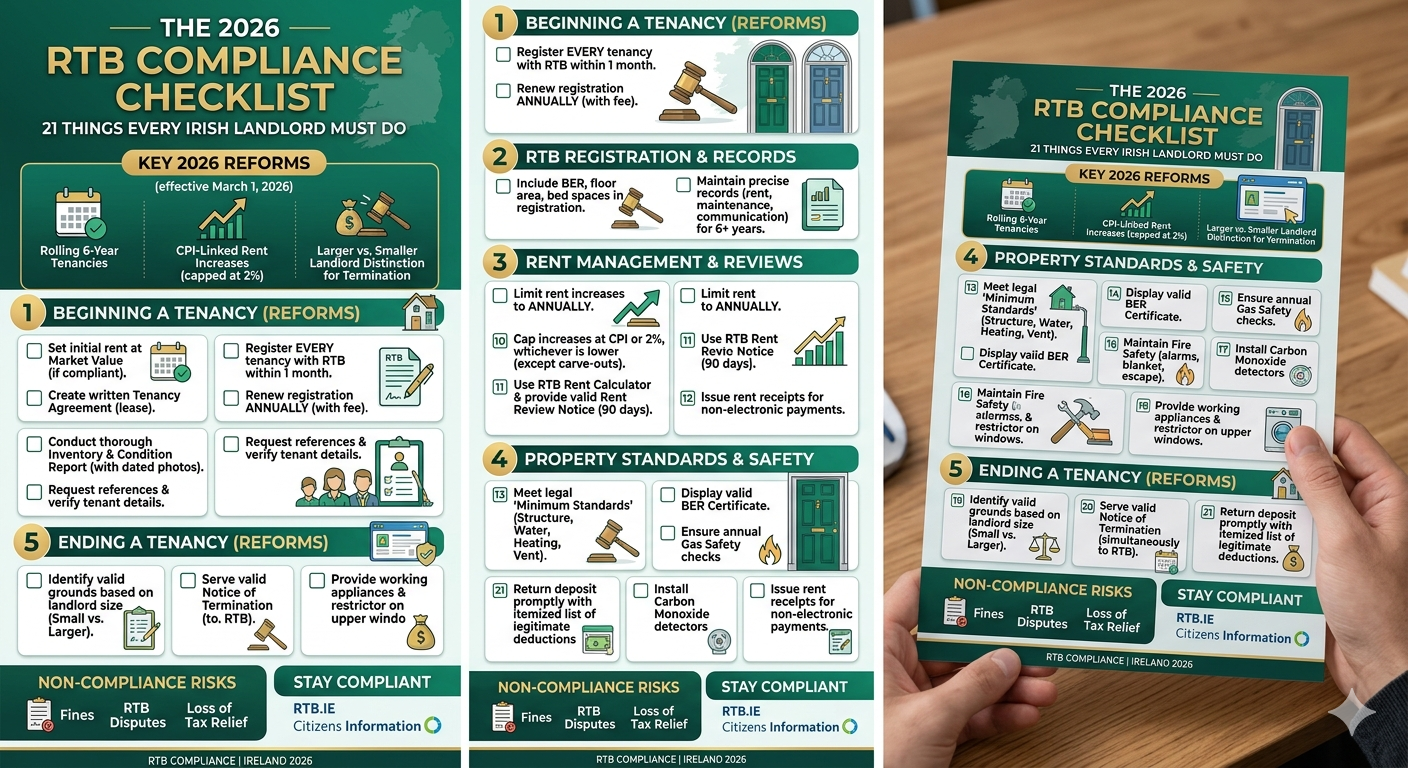
Related reading on this site: RTB registration fees in 2026 · the RTB registration deadline · bulk RTB compliance for letting agents · the RTB compliance checklist.
Related Articles