Lettings Software Pricing in Ireland: What Should an Agency Actually Pay?
Software pricing pages are written to be hard to compare. One charges per property, another per user, a third takes a slice of the rent, and a fourth bolts a "portal fee" onto the headline number. This guide cuts through it for Irish letting agents: the two real pricing models, the add-ons that quietly inflate the bill, the one number that compares fairly (cost-per-tenancy), and what good value looks like at 50, 100, 200 and 300 tenancies in 2026.
The short version
- There are really only two pricing models: scale-with-you (per property, per unit, per user, or % of rent) and flat per-portfolio tiers. Tiers are far easier to budget and usually cheaper per tenancy as you grow.
- The headline price is rarely the real price. Watch for portal fees, setup/onboarding charges, payment percentages, per-seat costs and extra-bank-connection fees.
- Compare everything on one number: cost-per-tenancy per month = (all-in monthly cost) ÷ (tenancies managed).
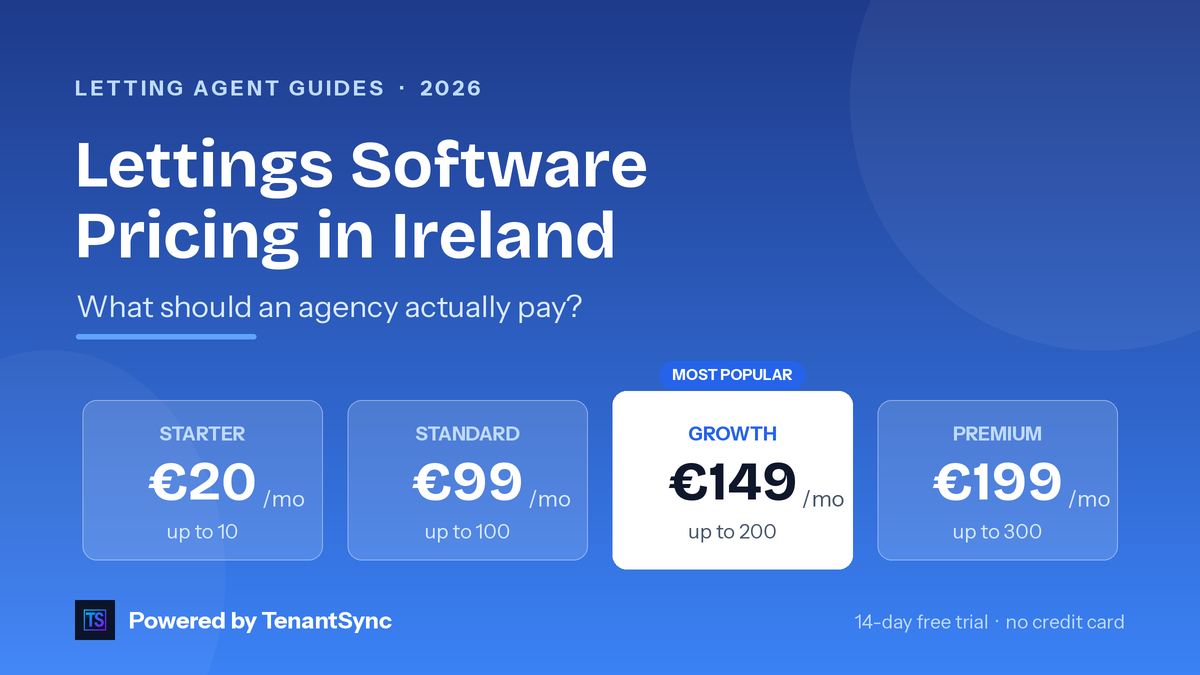
- For an Irish agency, TenantSync runs on flat all-in tiers — €20 / €99 / €149 / €199 per month (up to 10 / 100 / 200 / 300 properties), every feature and the landlord & tenant portal included, with a 14-day free trial, no credit card.
The right question isn't "what's the cheapest tool?" It's "what's the total cost — including the manual work it doesn't remove and the compliance failure it doesn't prevent?"
The two ways lettings software is priced
Strip away the marketing and almost every lettings or property-management tool prices one of two ways.
1. Scale-with-you pricing (per property / per unit / per user / % of rent)
The cost rises with something that grows: the number of properties or units, the number of staff logins, or the volume of rent processed. It feels fair and it's cheap when you're tiny — but it scales linearly, so every tenancy you win adds cost, and a percentage-of-rent model means a good month (higher rents, more units) is also a more expensive month.
- Per unit / per property: e.g. a base fee plus a few cents or euro per managed unit per month.
- Per user (seat): you pay for each negotiator, administrator or principal who logs in.
- Percentage of rent: common in payment-led tools — a small slice of every euro collected, often with a setup fee.
2. Flat per-portfolio tiers
One price covers everything up to a ceiling — say, "up to 100 properties." You pay the same whether that tier holds 60 tenancies or 100, so the cost-per-tenancy falls as you fill the tier, and your bill is completely predictable from month to month. It's the model that suits a growing agency, because winning a new landlord client doesn't immediately cost you more until you cross into the next tier.
Rule of thumb
- A handful of tenancies, flat headcount? Scale-with-you can be cheapest.
- Growing, or already at 50+ tenancies? Flat tiers are usually cheaper per tenancy and easier to forecast.
- Add a team? Per-seat pricing punishes you for hiring; per-portfolio pricing doesn't.
Cost-per-tenancy: the only number that compares fairly
Because the models differ, headline prices are apples and oranges. Convert every quote to the same unit:
The formula
Cost-per-tenancy / month = (headline fee + every add-on) ÷ tenancies managed
Worked through a flat tier — say €149 per month for a plan you're using to manage 150 tenancies — that's about €0.99 per tenancy per month, or roughly twelve euro a tenancy for the whole year. Run the same maths on a per-unit tool and remember to add its portal fee and any setup cost spread across the year.
Here's the same plan at different fill levels, so you can see how a flat tier rewards growth:
| Plan (flat tier) | Tenancies on it | Cost / tenancy / month |
|---|---|---|
| €99 / mo (up to 100) | 50 | €1.98 |
| €99 / mo (up to 100) | 100 | €0.99 |
| €149 / mo (up to 200) | 150 | €0.99 |
| €149 / mo (up to 200) | 200 | €0.75 |
| €199 / mo (up to 300) | 300 | €0.66 |
The lesson: a flat tier is most expensive per tenancy when it's half-empty, and cheapest when it's full. Pick the tier you'll grow into, not the one that fits today exactly.
What "good value" looks like at 50, 100, 200 & 300 tenancies
Value isn't a single price — it's the right plan for your size, with the Irish compliance work actually handled. Here's a sensible benchmark for each band (using TenantSync's published tiers as the reference point; confirm any competitor's current pricing directly).
| Portfolio size | Sensible TenantSync tier | Indicative cost / tenancy / mo | What you should expect included |
|---|---|---|---|
| ~50 tenancies | Standard — €99 / mo (up to 100) | ~€1.98 | RTB compliance, 1 bank connection, analytics, portal |
| ~100 tenancies | Standard — €99 / mo (up to 100) | ~€0.99 | As above, tier full — best value before stepping up |
| ~200 tenancies | Growth — €149 / mo (up to 200) ⭐ | ~€0.75 | + up to 3 banks, bulk RTB, recurring invoices, aging, priority support |
| ~300 tenancies | Premium — €199 / mo (up to 300) | ~€0.66 | + up to 5 banks, dedicated account manager, API access, VIP support |
| 300+ / multi-branch | Enterprise — custom | Quote | White-label, multi-agency scoping, SLA, custom development |
For context, a single property manager handling registrations, rent reviews and reconciliation by hand costs an agency far more per month than any of these tiers — which is the real comparison. Good value is the plan where the cost-per-tenancy is a rounding error next to one member of staff's time.
The real ROI: what software is insuring you against
It's tempting to judge software on the monthly fee alone. But for an agency, the fee is small next to what a single mistake costs across a book of landlord clients. Build your own ROI by putting numbers — your numbers — against three questions:
Three costs the right tool is insuring against
- A missed or late RTB registration. Every tenancy must be registered with the Residential Tenancies Board, now annually. Miss it across several clients and you're exposed to non-compliance — and the client whose tenancy it was now sees your agency as the risk.
- An illegal rent increase. Get the national rent cap maths wrong (2%, or CPI inflation if lower) and a review can be challenged and unwound at the RTB — refunds, a dispute, and a very awkward conversation with the landlord.
- A lost landlord client. The most expensive line item of all. One avoidable compliance slip is often enough for a landlord to move their portfolio elsewhere — taking the recurring management fee with them.
Now the simple ROI: take the staff hours you spend each week on registrations, rent-cap calculations and chasing/reconciling rent, multiply by a loaded hourly cost, and compare that to a plan that automates most of it. For a busy agency the software typically pays for itself on the reconciliation time alone — before you even count the value of never missing a deadline. (TenantSync's automation is built to save up to several hours of admin a week; the exact saving depends on your portfolio and how much you do by hand today.)
Not sure which plan fits your portfolio?
Book a 15-minute agency demo and we'll map your tenancy count to the right tier — and show you a real RTB Form 1 and a live rent reconciliation on your own data, not slideware.
Pricing comparison (as published, June 2026)
These tools price on different models, so compare the total monthly cost at your portfolio size, not the headline figure. Pricing below is as published in June 2026 — always confirm on each provider's own site, and ask specifically about portal, setup and payment add-ons.
| Tool | Model | Indicative price | Watch for |
|---|---|---|---|
| TenantSync — Starter | Flat tier (all-in) | €20 / mo · up to 10 properties | No Open Banking on Starter |
| TenantSync — Standard | Flat tier (all-in) | €99 / mo · up to 100 properties | 1 bank connection |
| TenantSync — Growth ⭐ | Flat tier (all-in) | €149 / mo · up to 200 properties | 3 bank connections |
| TenantSync — Premium | Flat tier (all-in) | €199 / mo · up to 300 properties | 5 bank connections, API access |
| Letman | Flat + per-unit portal | From €195 / mo (up to 100 units) + €0.60/unit/mo MYletman | Portal priced per unit |
| Arthur | Tiered (per portfolio) | From around £70 / mo (as listed) | GBP pricing; Irish compliance not native |
| PayProp | % of processed rent | Small % of volume + one-off setup fee | Cost scales with rent collected |
| Re-Leased | Quote-based | Contact vendor | Built for commercial / mixed portfolios |
For a deeper, feature-by-feature view of these tools (not just price), see our honest 2026 buyer's guide for Irish letting agents, and the dedicated Letman comparison.
What TenantSync costs (and what's included)
TenantSync prices on flat per-portfolio tiers, and every plan includes all features and the landlord & tenant portal — the difference between tiers is scale, support and the number of bank connections, not a feature paywall. There's a 14-day free trial with no credit card.
RTB compliance and the core platform for smaller landlords. (No Open Banking on this tier.)
+ 1 bank connection (Open Banking), analytics, bulk email and onboarding.
+ 3 bank connections, bulk RTB compliance, recurring invoices, aging report, priority support.
+ 5 bank connections, dedicated account manager, API access and VIP support.
Need more than 300 units or multi-branch scoping? Enterprise is custom-priced (white-label, SLA, custom development).
What that buys an Irish agency
RTB Form 1, draft-to-finalise
Fill and validate the registration, preview it in the browser, then finalise to a signed PDF. The 30-day deadline is computed from the tenancy start and tracked automatically.
National rent-cap calculator
Works out the maximum legal increase under the post-March-2026 rules — 2% or CPI inflation, whichever is lower — and shows the rule and figure it used, so a review is defensible.
Open Banking reconciliation
Connect the agency or landlord account (AIB, Bank of Ireland, PTSB, EBS, Revolut, N26, Wise) and incoming rent auto-matches to the right tenancy. Arrears surface the day they happen.
Portfolio compliance dashboard
Registration, renewal, rent review, Part 4 and other obligations tracked per tenancy and colour-coded compliant / upcoming / overdue across your whole book of clients.
Per-client reporting & portal included
One-click reporting per landlord client, plus the landlord and tenant portal — included in every plan, not a per-unit add-on.
Free, done-with-you migration
Direct Letman and spreadsheet import means your properties, tenancies, leases and rent details come across without rekeying — and without a surprise setup fee.
Compare plans for your portfolio size
See exactly what each tier includes and what it works out at per tenancy for your agency — then start free for 14 days, no credit card.
Questions to ask before you sign
Take this to any vendor demo and you'll get a true total cost, not a headline:
Pricing due-diligence checklist
- What's the all-in monthly cost at my exact tenancy count — including portal, setup and any payment fees?
- Is the portal extra? Per unit, or included?
- Is there a setup or onboarding fee, and is migration from Letman or a spreadsheet included?
- How many bank connections are included, and what does an extra one cost?
- Per seat or per portfolio? What happens to my bill when I hire?
- Monthly vs annual — what's the annual rate, and is there a lock-in?
- Does it actually do the Irish work — the RTB Form 1, the national rent cap, Irish-bank reconciliation — or will my team still do that by hand?
- Is there a free trial so I can test it on my own data before paying?
If you're moving off spreadsheets or another tool, our step-by-step guide to migrating an agency portfolio without losing a tenancy pairs well with this, and the 2026 RTB compliance checklist is a good way to audit what you're tracking today.
Frequently asked questions
How much does letting agent software cost in Ireland?
It depends on the pricing model and your portfolio size. Flat-tier Irish tools are the easiest to budget: TenantSync charges €20 per month for up to 10 properties (Starter), €99 for up to 100 (Standard), €149 for up to 200 (Growth) and €199 for up to 300 (Premium), with custom Enterprise pricing above that and a 14-day free trial. Letman's published pricing starts at about €195 per month for up to 100 managed units plus €0.60 per unit per month for its MYletman portal. Arthur lists plans from around £70 per month, PayProp typically charges a small percentage of processed rent plus a one-off setup fee, and Re-Leased is quote-based. Always confirm current pricing on each provider's own site.
Is per-property pricing or flat-tier pricing better value for a letting agency?
It depends on your size and growth. Per-property or per-user pricing is predictable when you're small but scales linearly — every tenancy you take on adds cost. A flat per-portfolio tier (for example, one price for up to 100 properties) gets cheaper per tenancy the fuller the tier is, which suits a growing agency. The fair way to compare is to convert every quote to a cost-per-tenancy at your actual portfolio size, including any portal, payment or setup add-ons.
What hidden costs should I watch for in lettings software pricing?
Look beyond the headline monthly fee for: per-unit portal charges, one-off setup or onboarding fees, percentage-of-rent payment processing fees, per-user seat costs, charges for extra bank connections, paid add-on modules, and the price difference between monthly and annual billing. The honest comparison is the all-in monthly cost at your portfolio size. TenantSync's tiers are all-in — every plan includes all features and the landlord and tenant portal, with the difference being scale, support and the number of bank connections.
How do I work out the cost-per-tenancy of lettings software?
Divide the total monthly cost (headline fee plus every add-on) by the number of tenancies you manage. For example, a €149 plan covering 150 tenancies is about €0.99 per tenancy per month. Then weigh that against the cost of one compliance failure — a missed RTB registration, an unwound illegal rent increase, or a lost landlord client — which is what the software is really insuring you against.
Is there a free trial for lettings software in Ireland?
TenantSync offers a 14-day free trial with no credit card required, and every plan includes the landlord and tenant portal. The fastest way to judge value is to import your portfolio from Letman or a spreadsheet, finalise a real RTB Form 1 and reconcile last month's rent during the trial, so you are testing the tool on your own data rather than on a demo dataset.
Does cheaper lettings software cost more in the long run?
It can. A cheaper general tool that doesn't draft the RTB Form 1, calculate the national rent cap (2% or CPI, whichever is lower) or reconcile rent against Irish banks leaves that work on your desk — which is staff time, and a higher risk of a missed deadline or an illegal rent review. The right question is not "what's the cheapest tool?" but "what's the total cost, including the manual work it doesn't remove and the failures it doesn't prevent?"
Sources & further reading
Facts in this article are drawn from each provider's public materials and official sources. Pricing and product details were correct as published in June 2026 — verify on each provider's own site before deciding.
- TenantSync — tenantsync.ie/pricing (plans, tiers and free trial)
- Residential Tenancies Board — Rental law changes from 1 March 2026 and registration fees
- Citizens Information — Changes to the rules for renting from March 2026
- Letman — letman.ie (features and pricing)
- Arthur — arthuronline.co.uk (features and pricing)
- PayProp — payprop.com (rental payment platform)
- Re-Leased — re-leased.com (commercial property management)
Related Articles