PSRA-Licensed and Tech-Enabled: Building a Modern Irish Letting Agency
Your PSRA licence tells a landlord you're allowed to hold their rent. Your technology tells them what it's like to be your client. In 2026 the agencies pulling ahead treat those as one story, not two — regulatory professionalism you can prove, delivered through a stack clients and tenants actually notice. This is how a modern Irish letting agency is built: PSRA licence and client-money compliance on rails, RTB automation across the book, Open Banking reconciliation, GDPR-grade data security, and a landlord and tenant experience that turns the invisible back office into your best pitch.
The short version
What makes a letting agency "modern" in Ireland? Being PSRA-licensed and tech-enabled at the same time — combining the professional standing of a licensed Property Services Provider with a technology stack that makes compliance provable and the client experience visibly better. In practice that's four layers: PSRA compliance (licence renewals, Letters of Engagement, client-money reconciliation, inspection-readiness) run as a system rather than from memory; RTB and tenancy compliance automated across every client tenancy; Open Banking reconciling client money and surfacing arrears the day they happen; and GDPR-grade data security that protects landlords and tenants. Do all four on an Irish-built platform and the back office stops being a cost and becomes the reason clients choose — and stay with — your agency.
Licensed and Tech-Enabled: Two Halves of One Reputation
Every established Irish letting agent already carries the harder credential. Getting and keeping a PSRA licence — professional indemnity insurance, tax clearance, a designated client account, an annual Accountant's Report, records ready for inspection — is genuine, ongoing work that a casual operator can't fake. It's the thing that separates a professional agency from someone managing a few flats on the side.
The problem is that landlords can't see any of it. A licence number on a website footer doesn't feel like professionalism to a client deciding whether to trust you with a €400,000 asset and its monthly rent. What they feel is the experience: whether the statement arrives on time and ties out, whether you catch the rent-review date, whether you sound in control when the rules change. That experience is delivered — or fumbled — by your technology. So the two halves are really one reputation. The licence earns the right to act; the stack is how that professionalism becomes something a client can see, month after month.
Why this matters more in 2026
The rental market is consolidating, so growth increasingly comes from winning portfolios off other agencies rather than from a rising tide of new landlords. When a landlord is choosing between two licensed agents, the licence is table stakes — the differentiator is the experience your stack delivers. We make the wider case in how to win (and keep) landlord clients in a shrinking rental market.
The PSRA Baseline: What Regulation Actually Asks of You
Before the technology, the obligations. Letting agents in Ireland are Property Services Providers (PSPs) licensed and regulated by the PSRA under the Property Services (Regulation) Act 2011. This section is a plain-English signpost, not legal advice — the definitive, current position is always on psr.ie. The recurring obligations most agencies have to keep on top of include:
| Obligation | What it involves |
|---|---|
| Licensing | A PSRA licence for the business and for the principal officers and employees who provide the service. Letting is typically Licence C; property management Licence D. Renewed annually. |
| Letter of Engagement | A written Letter of Engagement (a Property Services Agreement) setting out the service and fees, provided to a client before you act for them. |
| Client money | Rent held on a landlord's behalf kept in a designated client account, separate from agency funds, tracked per client, reconciled regularly, with an annual Accountant's Report to the PSRA. |
| Assurance | Professional indemnity insurance (statutory minimum €1,000,000 cover), a valid tax-clearance certificate, and a contribution to the Property Services Compensation Fund. |
| Minimum standards | Advertising and property particulars that aren't false or misleading, and a complaints-handling process for clients and consumers. |
| Records & inspection | Records kept and retained (commonly a six-year window) and produced for PSRA inspection on request. |
None of this is optional, and none of it is a one-off. It's a set of rolling deadlines and recurring evidence — the licence that expires, the insurance that renews, the reconciliation that's due, the report that's filed once a year. Run on a spreadsheet and a good memory, it works until the one month it doesn't. That's exactly the profile of work a system should carry for you.
Signpost, not legal advice
The specifics above are summarised for orientation and can change. Do not treat this article as a compliance checklist for your agency — confirm your exact licensing, client-money and record-keeping obligations with the PSRA and, where needed, your own solicitor and accountant.
The Modern Agency Stack, in Four Layers
"Tech-enabled" doesn't mean buying ten tools. It means one Irish-built platform that carries the four layers of work a licensed agency actually does — so the licence, the tenancies, the money and the data all sit in one auditable place instead of scattered across apps that don't talk to each other. Here's the shape of it before we go layer by layer.
| Layer | What it keeps compliant / visible | Who feels it |
|---|---|---|
| 1. PSRA compliance | Your licence to operate: renewals, Letters of Engagement, client-money reconciliation, assurance, inspection-readiness. | The agency & the PSRA |
| 2. RTB & tenancy compliance | Every client tenancy: RTB registration, the national rent cap, Part 4 and certificate dates. | Landlords & tenants |
| 3. Open Banking & money | Client money reconciled to the tenancy; arrears surfaced instantly; disbursements to landlords. | Landlords |
| 4. Data security & GDPR | Encrypted, audited, minimised data; regulated Open Banking; no credentials shared. | Landlords & tenants |
The point of one platform is that the layers compound. The client money reconciled in Layer 3 is the same data that proves the reconciliation in Layer 1 and populates the landlord statement in Layer 2's world. Bolt four separate tools together and you lose that; keep it in one system and every layer makes the next one cheaper and more trustworthy.
Layer 1 — PSRA Compliance as a System, Not a Memory Test
This is the layer most tools ignore, because global platforms have never heard of the PSRA. TenantSync includes a dedicated PSR/PSRA compliance module built specifically around the Property Services (Regulation) Act 2011 — where its RTB features keep tenancies compliant, this keeps your licence to operate compliant. It turns each recurring obligation into a tracked, reminded, audit-logged workflow:
| PSRA obligation | How a modern stack carries it |
|---|---|
| Licence renewals | A licence register for the business and each licensee (holder types: business, principal officer, employee; types A–D), with an escalating renewal clock — valid → renewal due → expiring → expired — that reminds you well before the date, plus a green licence card you can display. So no one ever operates on a lapsed licence. |
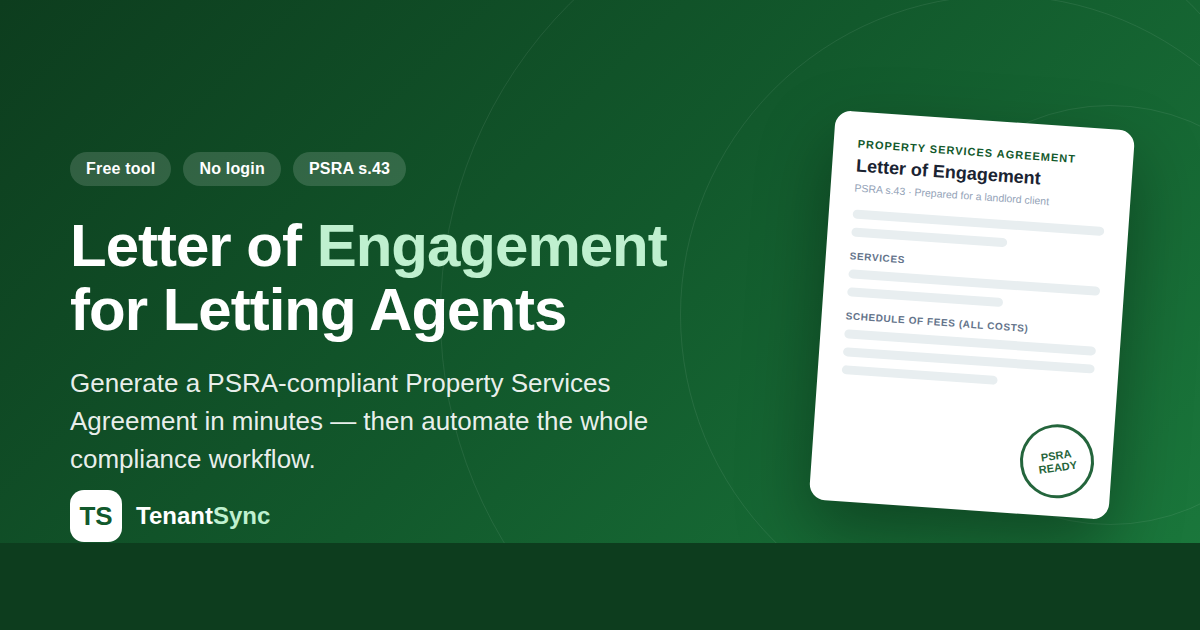
| Letters of Engagement | Generate, issue and track s.43 Letters of Engagement per landlord client, with itemised fees, a draft → issued → signed lifecycle, and a public link the client can read and sign — no printing and posting. |
| Client money | A designated client-account register, a per-client client-money ledger, and an at-least-monthly reconciliation to a signed-off balance — plus the annual Accountant's Report pack. (More in Layer 3.) |
| Assurance | Track professional indemnity insurance (with the €1m minimum), tax clearance and Compensation Fund contributions in one assurance summary, with expiry reminders. |
| Standards & complaints | A per-property advertising/particulars checklist against the minimum standards, and a complaints register with a received → acknowledged → under investigation → resolved workflow. |
| Inspection-readiness | A one-click inspection evidence pack honouring the six-year retention rule, and a full audit trail that logs every change — so an inspection is a download, not a scramble. |
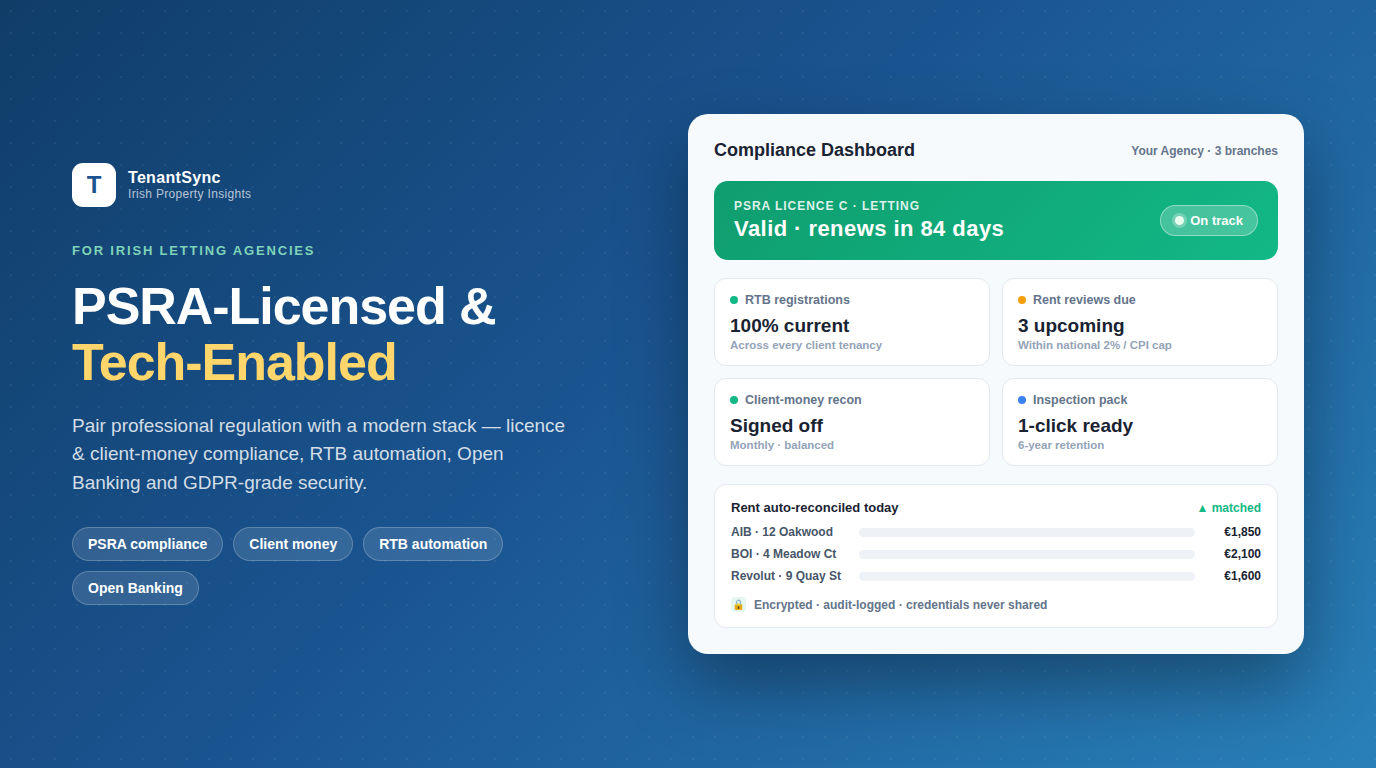
The behavioural change is the whole value. Compliance stops being a thing one person holds in their head and becomes a dashboard the whole agency can see — a PSR compliance dashboard that mirrors the RTB one, with compliant / upcoming / overdue tiles across licence renewals, insurance, tax clearance, reconciliation and the annual report on a single date-ordered timeline. The scheduled reminders do the remembering; your people do the deciding.
💡 The Letter of Engagement is where a lot of agencies slip
A valid s.43 Letter of Engagement must be in place before you act for a client — easy to intend, easy to forget when you're onboarding a portfolio at speed. Generating and tracking them in the same system that manages the client means the LoE is issued and signed as part of onboarding, not chased afterwards. We go deeper in the letter of engagement guide for Irish letting agents.
🏛️ See the PSRA compliance module for your agency
Walk through licence-renewal tracking, Letters of Engagement, client-money reconciliation and the one-click inspection pack — on a demo shaped around how your agency actually works. Or start free and set up your compliance dashboard today.
Layer 2 — RTB & Tenancy Compliance Across the Book
Your PSRA licence lets you act for landlords; RTB compliance is most of what you're actually doing for them. Where Layer 1 protects the agency, Layer 2 protects every tenancy you manage — and at agency scale, across dozens of landlords, that's where deadlines quietly slip. A modern stack tracks the obligations for the whole book at once:
- RTB registration & renewal — the 30-day registration deadline auto-computed from each tenancy start, annual renewal tracking, and a draft-to-finalise Form 1 (RTB1) workflow with in-browser preview and a signed PDF, so registration is a workflow rather than a paper form.
- The national rent cap — a rent-cap calculator that returns the maximum allowable increase per tenancy under the national rule (2% or CPI, whichever is lower), using CSO CPI data, and shows which rule applied. Full context in the national rent cap field guide.
- Part 4 & rent-review dates — automated reminders for Part 4 rights and rent-review eligibility, so the right notice is served at the right time.
- A portfolio-wide compliance dashboard — obligation types (registration, renewal, rent review, Part 4, BER, insurance, fire, gas, electrical, AML and custom) colour-coded compliant / upcoming / overdue across every client tenancy.
The scaling point is the same as in Layer 1: with automated, portfolio-wide tracking, the 200th tenancy is no riskier than the 20th, because the system watches all of them equally. That's what makes it safe to take on a new client's stock without a panicked hire. See the agency workflow in bulk RTB compliance across every client tenancy.
One platform, web and mobile
Because the same tenancy data drives both layers, a compliance status feeds straight into the landlord report and the audit trail — and it's all reachable on the web app and on iOS and Android, so an agent can check a rent-review date or a licence expiry from a viewing, not just the office.
Layer 3 — Open Banking & Client Money Done Right
Here the technology and the regulation meet most directly, because the rent you collect is client money. The Client Moneys Regulations 2012 require it to sit in a designated client account, separate from your own funds, tracked per client and reconciled — and doing that by hand across multiple landlords is both a time sink and a risk. PSD2 Open Banking is what makes it practical.
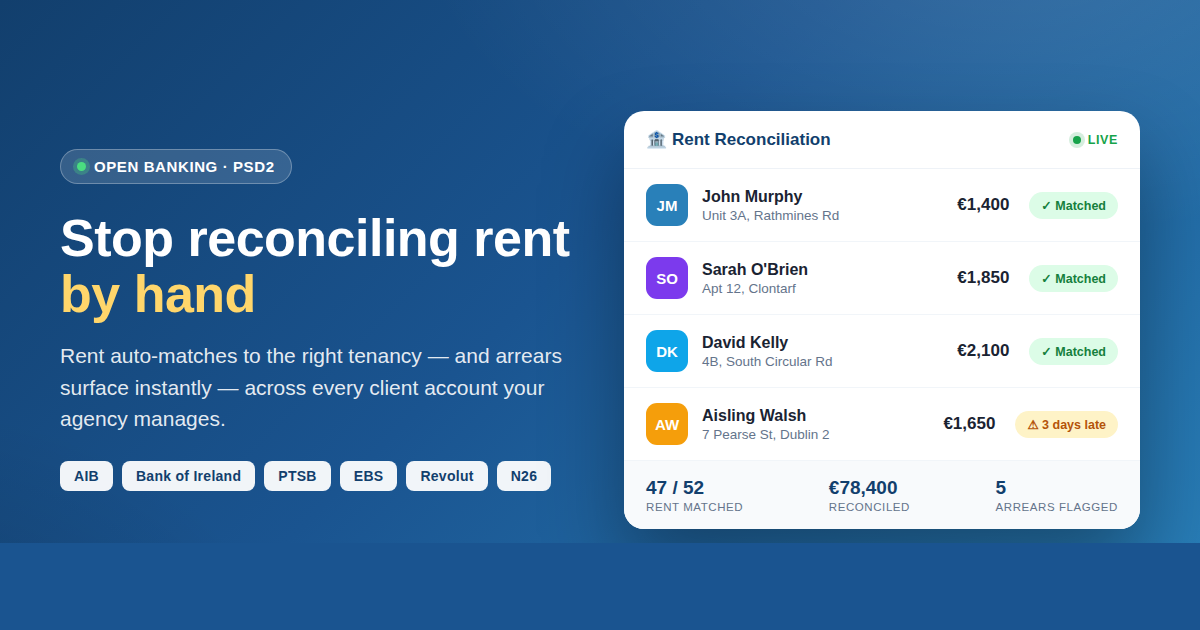
Connect the agency's designated client account and TenantSync reads real transaction data and auto-matches each rent payment to the correct tenancy. On top of that feed sit the client-money controls the PSRA cares about:
| Client-money control | What the stack does |
|---|---|
| Designated client account | Register the designated account and confirm its designation; Open-Banking-connected accounts eligible to be designated are surfaced for you. |
| Per-client ledger | A per-landlord client-money ledger records every movement in and out, so each client's money is accounted for separately — rebuildable and fully itemised. |
| Reconciliation | An at-least-monthly reconciliation runs to a status — draft → balanced / discrepancy → signed-off — so a discrepancy is caught, not carried. |
| Annual report | The annual Accountant's Report pack is generated per year and marked submitted, closing the loop the PSRA requires. |
| Arrears, instantly | Because payments are matched against what's due, arrears surface the same day rather than at month-end — protecting both the landlord's income and your reconciliation. |
TenantSync connects the Irish and neobank accounts agencies actually use — AIB, Bank of Ireland, PTSB, EBS, Revolut and N26 (and other PSD2 institutions) — and syncs on a schedule so the picture stays current without anyone downloading a statement. Crucially, the agency never sees bank credentials: consent happens on the bank's own screen. The full workflow is in Open Banking rent reconciliation for lettings agencies, and the reconciled numbers are exactly what make the one-click per-landlord report trustworthy.
Layer 4 — Data Security & GDPR as a Differentiator
A modern agency holds a lot of sensitive data: landlords' bank details, tenants' identities and, for affordability checks, financial information. Under GDPR that's a responsibility — but handled well, it's also a selling point. "We protect your data properly" is something a professional agency can say and a casual one can't, and clients increasingly ask. A modern stack builds the protections in rather than bolting them on:
- Encryption & access control — sensitive fields (bank and payout details, contractor payment data) are encrypted at rest and revealed only through explicit, permissioned actions, not left in the open.
- Audit trail — significant actions are written to an audit log, so who did what and when is answerable — the same evidence that supports a PSRA inspection also underpins good data governance.
- Data minimisation — for bank-verified tenant affordability checks, raw transactions are never stored; only a derived affordability summary is kept, the applicant's bank consent is automatically revoked once the report is produced, and GDPR erasure is available on request.
- Regulated Open Banking — bank connections run through regulated PSD2 providers on the bank's own authorisation screen, so neither the agency nor TenantSync ever handles a customer's banking credentials.
- Irish-built and Irish-hosted focus — the platform is designed around Irish law and Irish institutions, not a global tool retrofitted for one small market.
💡 Make the invisible visible on a pitch
Data protection is easy to do and easy to leave unsaid. When you pitch a landlord, say it out loud: their bank details are encrypted, access is logged, tenant financial data is minimised and consent-revoked, and no one — not even us — sees a banking password. It costs nothing to state and it's a concrete reason to choose a licensed, tech-enabled agency over the alternative.
The Client & Tenant Experience That Signals a Modern Agency
All four layers converge on the thing clients actually experience. A landlord never sees your reconciliation engine or your audit log — they see the outputs, and the outputs are your brand. Done right, the back office becomes the front-of-house:
Landlords get statements they can trust — and approve in a click
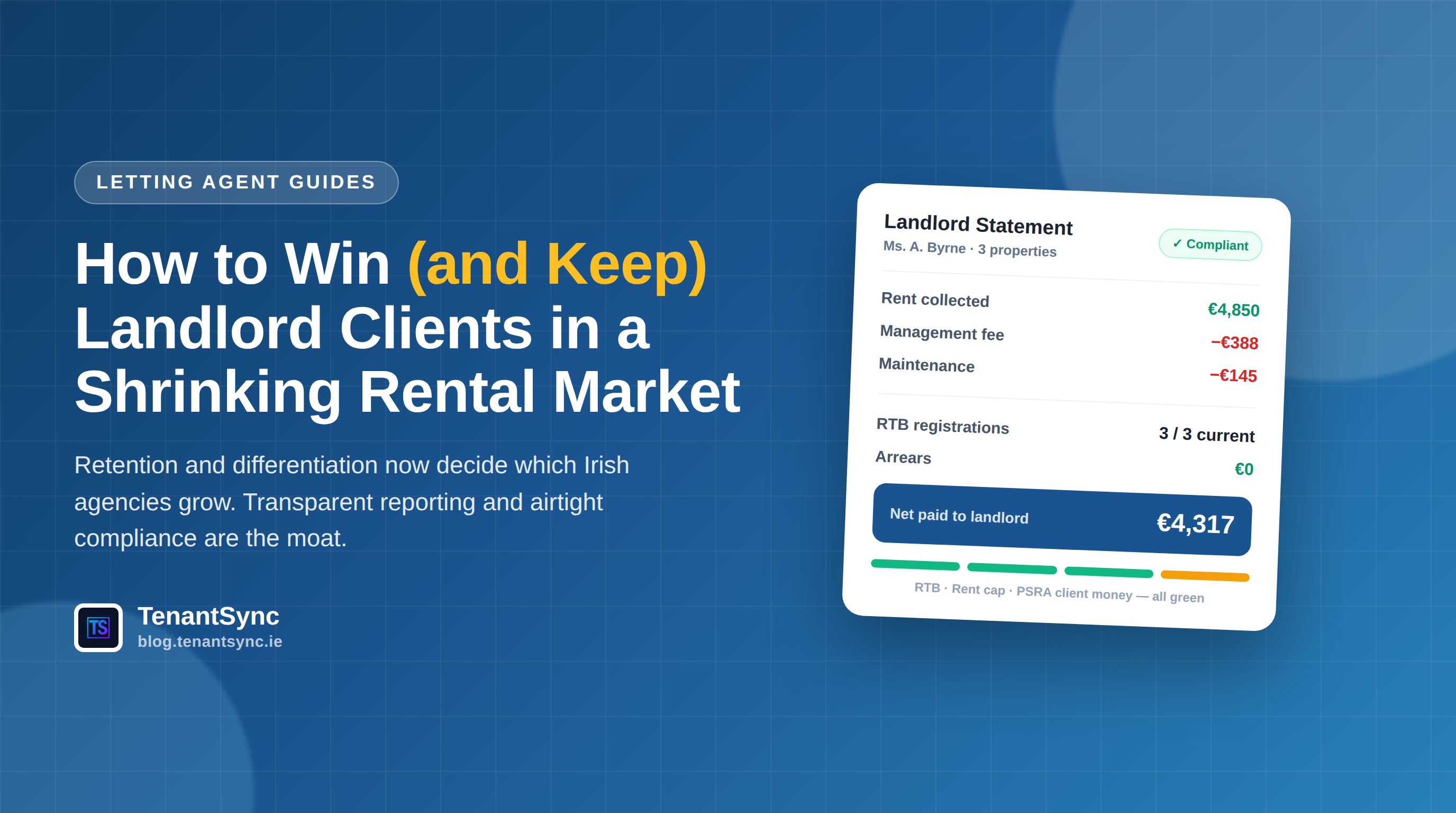
A per-landlord disbursement statement shows rent collected vs expected, the management fee, itemised deductions and the net paid — built from reconciled bank data, not a hand-keyed spreadsheet. The landlord reviews and approves it from a secure link, per branch, under your agency's branding. That single monthly artefact is what renews the management contract.
Tenants get a faster, fairer application
A bank-verified affordability check lets a prospective tenant prove income by securely connecting their bank once — no gathering payslips for every viewing — and gives the agent consistent, un-fakeable data to make a fair, human decision. Tenants also get a bank-verified rent statement that matches their own records. It's quicker for them and lower-risk for the landlord.
Your team works one delegated, branded system
An agency / branch / member structure with role-based permissions lets managers and agents work independently without the principal becoming the bottleneck — each landlord under a branch, statements and documents issued per branch under your branding. Delegation becomes safe, which is what lets the agency grow past what one person can hold in their head. More in scaling a letting agency without adding headcount.
This is the pay-off of being licensed and tech-enabled. The licence makes you trustworthy; the experience makes that trust visible on every statement, every application and every renewal conversation. It's also the honest answer to the perennial landlord question of whether to use an agent at all — see self-manage vs letting agent — because a modern agency delivers a level of compliance and transparency a self-managing landlord can't easily match.
Building Your Stack: A Practical Checklist
If you're auditing your own agency against the "PSRA-licensed and tech-enabled" standard, here's the short version. You should be able to answer yes to each — and if you can't, that's where a modern platform earns its place.
The modern-agency checklist
- ✓ Every PSRA licence (business and licensees) is tracked with renewal reminders — no one can operate on a lapsed licence.
- ✓ A signed Letter of Engagement exists for every client, generated and stored in one place.
- ✓ Client money sits in a designated account, on a per-client ledger, reconciled at least monthly to a signed-off balance.
- ✓ Insurance, tax clearance and Compensation Fund contributions are tracked with expiry alerts.
- ✓ Every client tenancy's RTB registration, rent-cap position and Part 4 / certificate dates are monitored automatically.
- ✓ Rent auto-reconciles through Open Banking and arrears surface the day they happen.
- ✓ Sensitive data is encrypted, access is audited, and tenant financial data is minimised and consent-revoked.
- ✓ Landlords get one-click, approvable statements and your team works a delegated, branded, multi-branch system.
- ✓ You can produce a PSRA inspection pack in one click under six-year retention.
Weighing platforms against this list is the heart of choosing well — see the best property management software for Irish letting agents.
You don't have to build all of it in a weekend. Put PSRA compliance on rails first, automate tenancy compliance across the book, connect Open Banking for client-money reconciliation, and then turn the reconciled, compliant data into the landlord and tenant experience that wins the next pitch. Each step stands on its own — and together they're what "modern" actually means.
Sources & Official Bodies
This article signposts regulatory context; it does not restate the legislation. Always confirm current obligations for your agency with the official bodies below.
- Property Services Regulatory Authority (psr.ie) — letting-agent licensing, client money, Letters of Engagement, assurance, inspections and complaints under the Property Services (Regulation) Act 2011.
- Property Services (Regulation) Act 2011 (Irish Statute Book) — the primary legislation.
- Property Services (Regulation) Act 2011 (Client Moneys) Regulations 2012 — designated client accounts, ledgers and reconciliation.
- Residential Tenancies Board (rtb.ie) — tenancy registration, the national rent cap and tenancy rules.
- Central Statistics Office (cso.ie) — CPI, referenced by the national rent cap.
Frequently Asked Questions
What does it mean to be a PSRA-licensed letting agent in Ireland?
Anyone providing letting or property-management services for a fee in Ireland must hold a licence from the Property Services Regulatory Authority (PSRA) under the Property Services (Regulation) Act 2011. Letting agents typically hold a Licence C (letting) and property managers a Licence D. The licence covers the business and the principal officers and employees who provide the service, and it renews annually. Alongside it, a licensee holds professional indemnity insurance (statutory minimum €1m), a tax-clearance certificate, and a Compensation Fund contribution; keeps client money in a designated account; issues a Letter of Engagement before acting; and keeps records ready for PSRA inspection. Confirm your current obligations at psr.ie.
What is PSRA compliance software and what should it do?
It's software that helps a licensed agency track and evidence the obligations of the Property Services (Regulation) Act 2011 in one place. A capable system tracks the licence renewal clock for the business and each licensee, manages Letters of Engagement from draft to signed, keeps a designated client-account register with a per-client money ledger and monthly reconciliation, tracks PII, tax clearance and Compensation Fund contributions, records advertising and complaints against the minimum standards, and can produce a one-click inspection evidence pack under six-year retention with a full audit trail. TenantSync includes a PSR/PSRA compliance module that does exactly this, built for Irish property-services law.
How does a letting agency handle client money compliantly?
Rent collected for a landlord is client money. Under the Client Moneys Regulations 2012 it must sit in a designated client account, separate from agency funds, tracked per client and reconciled regularly, with an annual Accountant's Report to the PSRA. Software makes this practical: connect the designated account through Open Banking so rent auto-matches to the correct tenancy, keep a per-landlord client-money ledger of every movement, run an at-least-monthly reconciliation to a signed-off balance, and generate the annual report pack. TenantSync builds all of this directly on its Open Banking reconciliation feed.
Is TenantSync built for Irish letting agents specifically?
Yes. TenantSync is an Irish-built platform designed around Irish residential-tenancy and property-services law, not a global tool adapted to it. It automates the RTB Form 1 registration workflow, calculates the national rent cap (2% or CPI, whichever is lower) from CSO CPI data, tracks Part 4 and rent-review dates, reconciles rent through Open Banking with Irish and neobank accounts (AIB, BOI, PTSB, EBS, Revolut, N26), and includes a dedicated PSR/PSRA compliance module for licence, client-money and inspection obligations — across web, iOS and Android.
How does a modern letting agency protect client and tenant data under GDPR?
By treating data protection as part of being professional: encrypting sensitive data, keeping an audit trail of access, collecting only what's needed and deleting it when its purpose ends, and using regulated Open Banking so bank credentials are never shared. TenantSync encrypts sensitive fields, writes an audit log after every significant action, and for tenant affordability checks never stores raw bank transactions — it automatically revokes the applicant's bank consent once the derived report is produced and offers GDPR erasure on request.
Do landlords and tenants actually notice an agency's technology?
They notice the outputs, even if they never see the software. Landlords notice a clear monthly statement that reconciles rent collected against what was due, arrears flagged the day they happen, and a compliance status they can trust — and they can review and approve their disbursement from a secure link. Tenants notice a faster application, a bank-verified affordability check that spares them the paper chase, and a rent statement that matches their records. A modern stack turns the invisible work of compliance and reconciliation into a visible, professional experience.
Summary
- The licence and the stack are one reputation. PSRA licensing earns the right to act; your technology is how that professionalism becomes visible to clients, month after month.
- Know the baseline. Licensing, Letters of Engagement, client money, assurance, minimum standards and record-keeping are rolling obligations — the profile of work a system should carry.
- Layer 1: PSRA compliance on rails. A dedicated PSR/PSRA module tracks licence renewals, LoEs, client-money reconciliation, assurance and inspection-readiness with reminders and an audit trail.
- Layer 2: tenancy compliance across the book. RTB registration, the national rent cap, Part 4 and certificate dates monitored for every client tenancy so the 200th is no riskier than the 20th.
- Layer 3: Open Banking client money. Reconcile the designated account, keep a per-client ledger, catch discrepancies and surface arrears instantly.
- Layer 4: data security as a differentiator. Encryption, audit trails, data minimisation and regulated Open Banking — and say so on the pitch.
- The experience is the pay-off. One-click landlord statements, bank-verified tenant applications and a delegated, branded system turn the back office into the reason clients choose and stay with your agency.
🏢 Build the modern agency, on an Irish-built platform
PSRA compliance on rails, RTB automation across the book, Open Banking client-money reconciliation and a client experience landlords notice — in one platform built for Ireland. Talk to us about your agency setup, or start a free trial and see it on your own portfolio.
Related Articles