The Per-Client Landlord Report That Renews Your Management Contracts
The management contract is renewed — or lost — long before the review meeting. It's decided every month, in the statement you send each landlord client. A clear, consistent per-landlord report is the single most powerful retention tool an agency has, because it answers the only two questions a landlord truly cares about before they have to ask: "Did I get paid what I should have?" and "Is everything legal?" This is the template — the anatomy of a report that renews contracts, the cadence that turns it into a ritual, and how to send one in a click across your whole book.
The short version
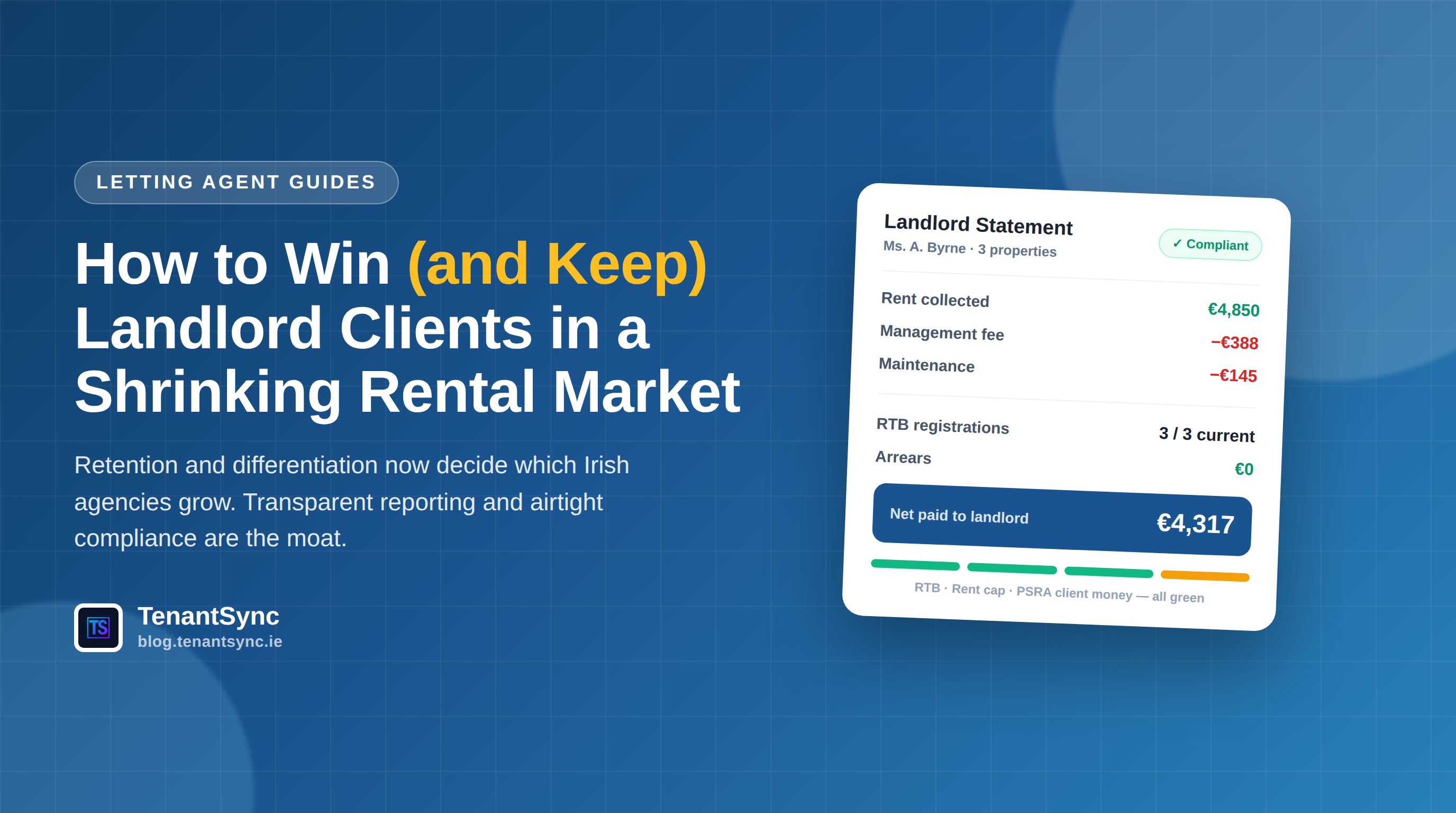
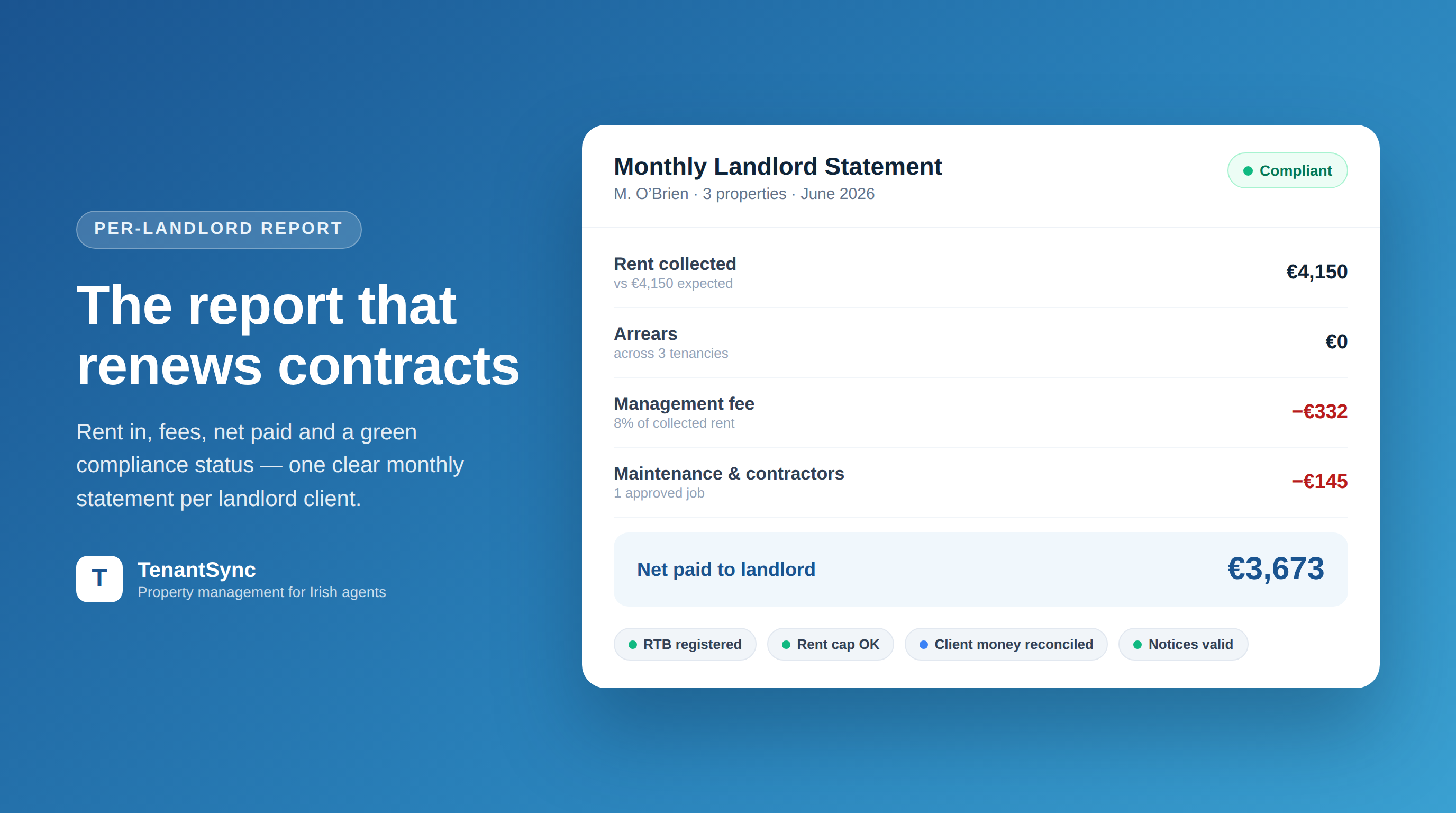
What makes a landlord report that renews management contracts? A per-client statement, sent on a predictable monthly cadence, that shows — at a glance — rent collected versus expected, any arrears aged by how overdue they are, the management fee and any maintenance or contractor deductions itemised, the net amount paid to the landlord, and the compliance status of each tenancy (RTB registration, rent review within the national cap, notices and certificates). Delivered as a branded, professional deliverable rather than a spreadsheet, it turns your fee from an unexplained cost into visible, evidenced value — and gives the landlord no reason to look elsewhere.
Why the Landlord Report Is Your Renewal Engine
Ask an agency principal why they lost a landlord client and you'll rarely hear about a single disaster. You'll hear about a slow erosion of confidence: a statement that didn't quite reconcile, arrears spotted late, a fee query that took a week to answer. The management contract wasn't lost at the review meeting — it was lost, quietly, in months of thin or inconsistent reporting.
That's the opportunity. The landlord report is the one document a client actually reads every month, and it's where you either build or bleed trust. Get it right and it becomes a renewal engine: a landlord who receives a clear, consistent statement — rent in, fees, net paid, everything green — has no reason to go shopping for a new agent, and every reason to renew.
The market makes this more urgent, not less. According to the RTB's Director's Quarterly Update for Q3 2025, the number of private landlords linked to registered tenancies fell 0.5% year-on-year to 103,774, while the RTB received 5,405 notices of termination that quarter — up 35% year-on-year. Fewer landlords, more exits: every client you keep is worth more than the last, and the report is how you keep them. We make the wider retention case in how to win (and keep) landlord clients in a shrinking rental market; this article is the deep dive on the report itself.
Reporting is a retention channel, not an admin task
Most agencies file "send the landlord statement" under admin — a chore to get through. Reframe it. The monthly statement is a recurring, structured touchpoint with your most valuable relationship. Twelve times a year you get to demonstrate, in evidence, that the fee is buying real value. Very few marketing channels give you that. Treat the report as the product your landlord is actually paying for, and it changes how much it's worth getting right.
Anatomy of a Landlord Report That Renews Contracts
A great landlord report isn't long — it's complete and scannable. A landlord should be able to read it in thirty seconds and feel fully informed. Every section below earns its place by answering a question the landlord would otherwise have to email you to ask.
| Section | What it shows the landlord | The question it answers |
|---|---|---|
| Reporting period & property list | The month covered and each property/tenancy included, so the scope is unambiguous. | "What am I looking at?" |
| Rent collected vs expected | What was due across their properties and what actually arrived this period. | "Did the rent come in?" |
| Arrears (aged) | Any shortfall, flagged early and grouped by how overdue it is — with the action in hand. | "Is anyone behind, and what are you doing about it?" |
| Management fee | Your fee for the period, on the basis agreed in the Letter of Engagement. | "What am I paying you?" |
| Maintenance & contractor deductions | Any approved repairs or contractor costs, itemised — never a mystery line. | "What else came out, and why?" |
| Net paid to the landlord | The bottom line, clearly stated — the number they came for. | "What do I actually receive?" |
| Compliance status | RTB registration current, rent review within the national cap, notices and certificates in order. | "Is everything legal?" |
| A short covering note | One or two lines of human context — a renewal coming up, a viewing booked, a job scheduled. | "Anything I should know?" |
Notice the shape: the report moves from gross rent collected, down through the fee and deductions, to the net paid — and then closes with compliance. That gross-to-net-plus-compliance structure is the whole report. It's the same logic a landlord would apply in their own head; you're just doing it for them, accurately, every month.
💡 Compliance belongs on the money report
Agencies often keep compliance in a separate system the landlord never sees. That's a missed retention moment. Putting a simple green "RTB registered · rent cap OK · client money reconciled · notices valid" strip on the same statement as the money is what turns a legal obligation into a visible reason to stay. The landlord doesn't need the detail — they need to see it's handled.
A Landlord Report Template You Can Copy
Here's the anatomy above turned into a concrete layout. Adapt the wording to your agency's voice — the structure is what matters. This is one landlord (three properties) for a single month.
Monthly Landlord Statement — template
[Your Agency / Branch name & PSRA licence no.]
Statement for: [Landlord name] · Period: [Month, Year] · Properties: [3] · Prepared: [date]
Money this period
- Rent collected vs expected: €4,150 / €4,150
- Arrears: €0 (0–30 days: €0 · 31–60: €0 · 61+: €0)
- Management fee (8% of collected rent): −€332
- Maintenance & contractors (1 approved job — [description]): −€145
- Net paid to landlord: €3,673 → disbursed to a/c ending [1234] on [date]
Compliance — ✅ RTB registered & current ✅ Rent reviews within the national cap ✅ Client money reconciled ✅ Notices/certs in order
Note from your agent: [e.g. "Tenancy at 12 Elm Rd is eligible for a rent review in September — I'll send the calculation and draft notice next month."]
That's it — one screen, no jargon, every number tied to something the landlord can verify. Two design principles make it work:
- Lead with the answer. The landlord wants the net figure and the "all green" status. Put them where the eye lands first; put the working underneath for anyone who wants it.
- Every deduction is itemised. A single unexplained line — "sundry €145" — undoes the trust the rest of the statement built. Name the job, name the fee basis. Transparency is the point.
For the compliance strip to be honest, the underlying obligations have to be tracked properly — RTB registration and renewals, the national rent cap (2% or CPI, whichever is lower), and valid notice periods under the post-March-2026 Part 4 and six-year framework. A green tick you can't stand over is worse than no tick at all.
📊 See a one-click landlord report
TenantSync generates a per-landlord disbursement statement — rent collected, management fee, contractor deductions, net paid, and a live compliance status — for any billing period, per branch and per client. See exactly what your landlords would receive, on a walkthrough shaped like your own portfolio.
Reporting Cadence: The Rhythm That Renews
A merely good report sent reliably every month beats a perfect report sent whenever you get around to it. Cadence is the point. Predictability is what turns reporting from an admin chore into a retention ritual — the landlord stops wondering where their money is because they know exactly when the statement lands.
The most effective agencies run reporting on three layers:
| Cadence | What it contains | Why it matters |
|---|---|---|
| Monthly statement | The full per-landlord statement above, timed to the disbursement so it arrives with the payment. | The core renewal driver — the reliable heartbeat of the relationship. |
| Quarterly summary | A lighter roll-up: total collected, total paid, arrears trend, compliance at a glance. | Shows the trajectory, not just the month — good for landlords who don't read every statement closely. |
| Annual review | The year in one document: income, void periods, maintenance spend, compliance record — the basis for the renewal conversation. | Turns twelve statements into a value story at exactly the moment the contract is up. |
| Event-driven updates | A short note when something happens: a new tenancy, a rent review due, an arrears case opening, a notice served. | The landlord never learns something important late — surprises are what erode trust. |
⚠️ Inconsistency reads as loss of control
A statement on the 3rd one month, the 15th the next, and "I'll get it to you" the month after tells the landlord — fairly or not — that you're not fully on top of their asset. The content can be identical; the irregularity alone is what unsettles them. This is precisely where manual, spreadsheet-based reporting fails at scale: it's survivable for five landlords and impossible for fifty. Automation is what makes a fixed monthly cadence realistic across a whole book.
Presentation & White-Label: Make It Look Like Your Agency
The report is a piece of your brand. When it looks like a polished deliverable from your agency — not a raw export from a tool the landlord has never heard of — it reinforces that they've chosen a professional operation. Presentation isn't vanity; it's part of the trust signal.
Issue it under your agency (or branch)
Multi-branch agencies should scope every statement to the branch the landlord is managed under, so the report carries the right identity, PSRA licence and contact. In TenantSync, disbursement statements are generated per branch, and documents such as invoices can be issued under your agency's own branding.
Give the landlord their own review page
Rather than a static attachment, the landlord opens a secure, token-gated page — reached from your email, no login required — where they review the statement and approve it. That small touch makes the landlord feel in control and the agency look meticulous, and it timestamps their sign-off.
Keep it consistent and uncluttered
Same layout, same order, every month. A landlord who knows exactly where to look for the net figure and the compliance strip builds a habit of reassurance. Consistency is a feature — resist the urge to redesign the statement each period.
The goal is simple: the landlord should feel the report was made for them, by you. The software should be invisible.
The Numbers Behind the Report You Can Trust
A report is only as trustworthy as the data underneath it. If your rent figures come from someone eyeballing a bank statement on a Monday morning, the statement you send is only as good as their concentration that day — a fragile foundation for a relationship built on trust. Two things make the numbers defensible.
1. Rent that reconciles itself
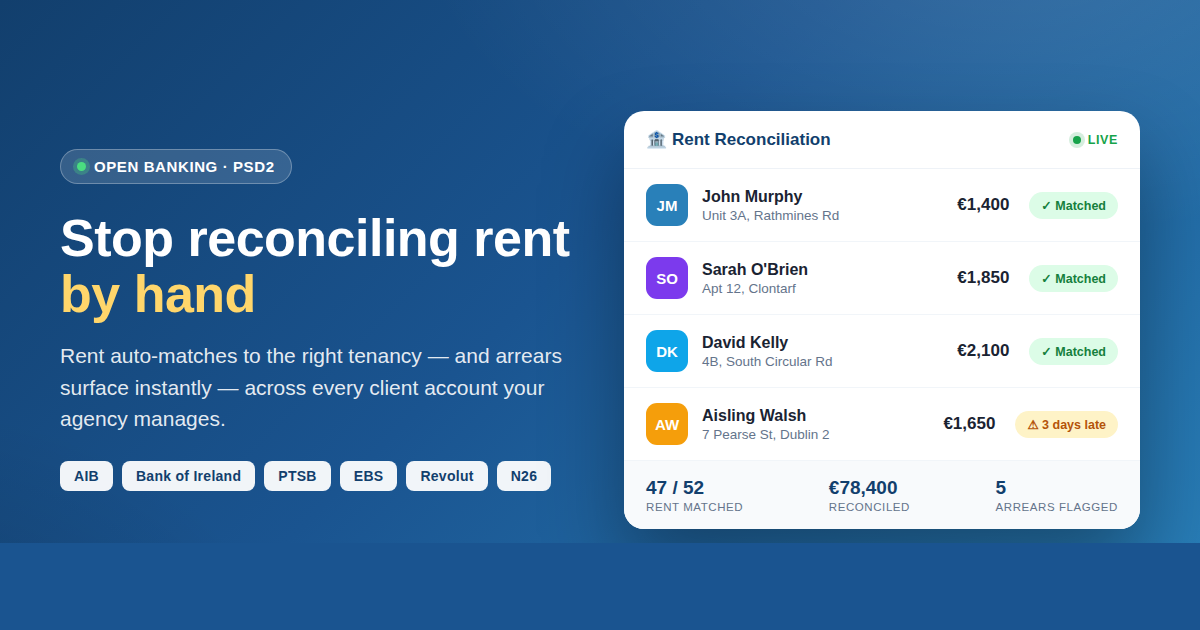
Under PSD2 Open Banking, you can connect the agency's rent-collection account and have incoming payments imported and auto-matched to the right tenancy using amount, payer name, references and recurring patterns. Rent that matches is reconciled without a human touch; anything ambiguous is flagged for quick review; arrears surface immediately rather than at month-end. Every figure on the landlord statement then traces back to a real, matched bank transaction. TenantSync supports AIB, Bank of Ireland, PTSB, EBS, Revolut and N26 — the full mechanics are in Open Banking for lettings agencies.
2. Client money you can account for
Because rent collected by an agency legally is client money, PSRA rules require it to be held in designated client accounts and reconciled regularly under the Client Moneys Regulations 2012. TenantSync builds a per-landlord client ledger directly on the reconciliation feed and supports client-account reconciliation (draft → balanced → signed off), so when a landlord — or an inspector — asks where the money is and whether it's accounted for, you have a clean, immediate answer. This is also the backbone of a defensible Letter of Engagement relationship, since the fee on every statement matches the basis you agreed in writing.
The trust dividend compounds
When the rent auto-reconciles and the client ledger is always current, the monthly statement stops being a thing you assemble and becomes a thing you generate. That's what makes a reliable cadence possible — and a reliable cadence is what renews contracts. The efficiency and the retention are the same win.
From Report to Renewal (and Upsell)
A good reporting cadence does more than prevent churn — it creates the natural moments to deepen the relationship. Because you're already in front of the landlord every month with evidence of value, the harder conversations become easy:
Renew on evidence, not persuasion
At contract-review time, the annual summary is your pitch: rent collected, voids minimised, compliance clean, arrears handled. You're not arguing that you delivered value — you're showing twelve statements that already proved it.
Win more of the same landlord's portfolio
A landlord who trusts how you manage one property is the warmest lead you have for their others. A clean per-landlord report across their existing units is the most persuasive reason to hand you the rest.
Introduce services in context
The report surfaces the moment: a rent review due (rent-cap calculation and notice), a vacancy coming (letting and inquiry management), a certificate expiring. Offering the service when the need is visible feels like care, not a sales push.
This is why reporting is a growth lever, not just a retention one. Every statement is a low-friction, high-trust touchpoint — and trust is what both renewals and referrals are made of.
How to Send It in One Click Across Every Client
Everything above is achievable by hand for a handful of landlords. It collapses at scale — which is exactly when it matters most. The point of software here is to make the right report the easy report, so a fixed monthly cadence survives across dozens of clients. In TenantSync, a per-landlord statement is a single action because the work is already done underneath it:
| Report ingredient | How it's already there when you click "generate" |
|---|---|
| Rent collected vs expected | Auto-matched from the Open Banking feed to each tenancy — no manual reconciliation. |
| Management fee | Calculated on reconciled rent using the fee basis configured for that client. |
| Contractor deductions | Pulled from approved contractor work recorded against the properties in the period. |
| Net payable | The gross-to-net breakdown is computed automatically and shown before you approve. |
| Arrears | Surfaced live from real bank data, grouped per landlord and aged by how overdue. |
| Compliance status | Tracked continuously on portfolio-wide RTB, rent-cap and PSRA dashboards. |
The flow is: generate statements for the billing period → the agency reviews the gross/fee/deduction/net breakdown and approves → the landlord gets a secure link to review and approve their own statement → the disbursement is paid. Each statement carries a status (draft, awaiting agency review, approved/awaiting payment, paid) so nothing is lost and the whole book's reporting is visible at a glance. What was a Monday-morning spreadsheet grind becomes a click — and the reporting quality goes up, not down, as you add clients.
If you're moving off spreadsheets or another system, direct import from Letman and CSV with concierge onboarding gets a new client's data — and their reporting — live quickly. We cover the move in how to migrate your agency portfolio off spreadsheets, and the wider tooling decision in the best property management software for Irish letting agents.
The Landlord Report Checklist
Use this to sense-check your current landlord statement. If you can't tick every box, that's your retention to-do list.
Does your landlord report...
- ☐ Show rent collected versus expected across all of the landlord's properties?
- ☐ Flag arrears early, aged by how overdue, with the action being taken?
- ☐ Itemise the management fee and every deduction — no mystery lines?
- ☐ State the net paid clearly, with where and when it was disbursed?
- ☐ Include a compliance strip (RTB, rent cap, client money, notices) you can stand over?
- ☐ Arrive on a predictable monthly cadence, timed to the payment?
- ☐ Look like it came from your agency, not a software vendor?
- ☐ Rest on reconciled bank data, not a hand-keyed spreadsheet?
- ☐ Give the landlord a way to review and acknowledge it?
- ☐ Feed naturally into a renewal and review conversation?
Sources & Official Data
- RTB — Director's Quarterly Update, Q3 2025 (private landlord numbers; tenancy trends).
- RTB — Notices of Termination data hub (termination-notice volumes and grounds).
- Residential Tenancies Board (rtb.ie) — registration, rent reviews and the national rent cap.
- Property Services Regulatory Authority (psr.ie) — PSP licensing and client-money obligations (Client Moneys Regulations 2012).
Market figures are as published by the RTB for Q3 2025. Template amounts are illustrative. This article is general guidance, not legal, financial or regulatory advice.
Frequently Asked Questions
What should a landlord report include?
At a minimum: rent collected versus expected across the landlord's properties, arrears aged by how overdue they are, the management fee, any maintenance or contractor deductions itemised, the net amount paid to the landlord, and the compliance status of each tenancy (RTB registration current, rent review within the national cap, notices and certificates in order). A clear reporting period and a short covering note complete it. The whole thing should be readable in about thirty seconds.
What is a per-landlord (disbursement) statement?
It's the document a letting agent issues to a landlord for a period, showing how rent collected on their behalf becomes the net amount paid out. It starts from gross rent collected, subtracts the agreed management fee and any approved contractor or maintenance costs, and arrives at the net payable disbursed to the landlord. Because that rent is client money, the statement doubles as the landlord's audit trail that their money was handled correctly.
How often should a letting agent send landlord reports?
Monthly is the standard that renews contracts, timed to each disbursement so the statement arrives with the payment. Predictability matters more than volume — a good report sent reliably every month beats a perfect one sent sporadically. Add a lighter quarterly summary and a fuller annual review, plus event-driven updates (new tenancy, rent review, arrears case) so the landlord never learns something important late.
Does a landlord report actually help renew a management contract?
Yes — it's the single most effective retention tool an agency has. A landlord who receives a clear, consistent statement every month showing rent in, fees, net paid and a green compliance status rarely goes shopping for a new agent, because the report answers their questions before they ask. Reporting on a predictable cadence turns your fee from an unexplained cost into visible, evidenced value — exactly the case you want to make at review time.
Can a letting agent white-label the landlord report?
The report should look like it comes from your agency, not a software vendor. In TenantSync, disbursement statements are generated and issued per branch, so each carries the branch the landlord is managed under, and documents such as invoices can be issued under your agency's own branding. The landlord reviews and approves their statement on a secure, token-gated page reached from your email — a branded, professional touch that keeps the relationship between you and your client.
How do you send a landlord report in one click?
The click is only possible when the data underneath is already clean. In TenantSync, rent is auto-matched to the right tenancy via Open Banking, the management fee and approved contractor costs are already recorded, and compliance is tracked continuously — so generating a per-landlord disbursement statement for a period is a single action. The agency reviews the gross-to-net breakdown, approves it, and the landlord gets a secure link to review and approve their own statement.
What's the difference between a landlord statement and a rent statement?
A rent statement (or tenant ledger) tracks what a tenant owes and has paid on one tenancy. A landlord statement rolls up across all of that landlord's properties and turns collected rent into a net disbursement — subtracting your fee and deductions — while reporting compliance and arrears at portfolio level. The tenant ledger is an input; the landlord statement is the client-facing output that renews the management contract.
Summary
- The report is the renewal engine. Contracts are kept or lost in the monthly statement, not the review meeting — it's the one document your landlord reads every month.
- Anatomy beats length. Rent collected vs expected, aged arrears, itemised fee and deductions, net paid, and a compliance strip — gross-to-net, then green.
- Cadence renews. A good report sent reliably every month beats a perfect one sent sporadically; layer quarterly and annual summaries on top.
- Presentation is trust. Issue it under your agency, give the landlord a branded review-and-approve page, and keep the layout consistent.
- Trustworthy numbers need automation. Open Banking reconciliation and a per-landlord client ledger make every figure defensible and the client money accounted for.
- Report to renew — and upsell. Twelve high-trust touchpoints a year turn into evidence-based renewals, more of the landlord's portfolio, and in-context service offers.
📌 Make your monthly report the reason landlords renew
One-click per-landlord statements — rent collected, fees, net paid and a green compliance status — on a predictable cadence, across every client and branch. See exactly what your landlords would receive on a walkthrough of your own portfolio, or start free today.
Related Articles