Notice of Termination in 2026: Notice Period Tables for TMD, Small and Large Landlords
Most people who look this up want one number, and they want it in the next ten seconds: how much notice do I have to give. The tables are the first thing on this page. What follows them is the part that actually decides whether the notice works — which rulebook the tenancy sits under, whether the landlord has a ground they are still allowed to use in 2026, and the handful of drafting and service defects that quietly void notices at the RTB.
The short version
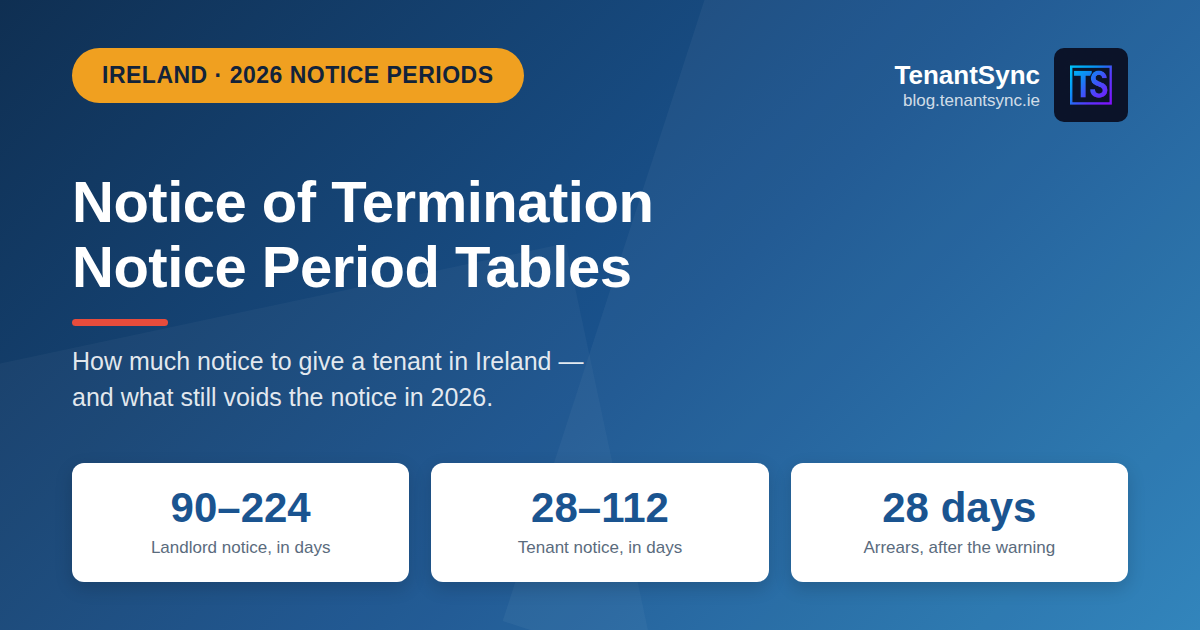
A landlord ending a tenancy in Ireland must give at least 90 days' notice where the tenancy has run for under 6 months, 152 days from 6 months to a year, 180 days from 1 year up to 7 years, 196 days from 7 to 8 years, and 224 days at 8 years or more. A tenant gives 28, 35, 42, 56, 84 or 112 days on the same duration bands. The period is fixed by how long the tenancy has been in place on the date of service. Fault-based terminations are the exception: 28 days for rent arrears or another breach after the warning process, and 7 days in the most serious anti-social behaviour cases. The 1 March 2026 reforms did not change these numbers — they changed which grounds a landlord may use.
Jump straight to the tables ↓1. The Notice Period Tables
These are the statutory minimum notice periods for ending a residential tenancy in the Republic of Ireland, as set by the Residential Tenancies Acts and amended by the Residential Tenancies (Amendment) Act 2021. They continue to apply to terminations served in 2026. Read the period off the row that matches how long the tenancy has been in place on the date the notice is served — not the date you drafted it, not the date the tenant replies, and not the date the tenancy ends. The RTB publishes its own notice periods page, and that is the version to check on the day you serve.
Landlord-served notice periods
Scroll the table sideways to see every column.
| Length of tenancy at service | Minimum landlord notice | In plain terms |
|---|---|---|
| Less than 6 months | 90 days | Roughly 3 months. No reason required in this window, but everything else still is. |
| 6 months to 1 year | 152 days | Just over 5 months. |
| 1 year to 2 years | 180 days | Just under 6 months. |
| 2 years to 3 years | 180 days | Unchanged from the band above. |
| 3 years to 4 years | 180 days | Unchanged. |
| 4 years to 7 years | 180 days | The 180-day band runs a long way — it covers years 1 to 7. |
| 7 years to 8 years | 196 days | The first step up after six years of stability. |
| 8 years or more | 224 days | Around 7½ months — the longest period on the table. |
| Rent arrears, after the warning process | 28 days | Applies at any tenancy length — but only once a valid rent arrears warning notice has run its course. |
| Other breach of tenant obligations, after a warning | 28 days | Same shape as arrears: warn first, give the tenant a chance to remedy, then serve. |
| Serious anti-social behaviour or threat to person or property | 7 days | The shortest period in the Acts, and the one most often used wrongly. Reserved for the most serious cases — confirm the current position with the RTB before relying on it. |
Tenant-served notice periods
Scroll the table sideways to see every column.
| Length of tenancy at service | Minimum tenant notice | In plain terms |
|---|---|---|
| Less than 6 months | 28 days | Four weeks. |
| 6 months to 1 year | 35 days | Five weeks. |
| 1 year to 2 years | 42 days | Six weeks. |
| 2 years to 3 years | 56 days | Eight weeks. |
| 3 years to 4 years | 84 days | Twelve weeks. |
| 4 years or more | 112 days | Sixteen weeks — the ceiling on the tenant side. |
Three things the tables do not say, and people assume
- They are minimums, not fixed periods. A landlord can always give more notice, and a buffer of a week or two absorbs a small arithmetic error instead of letting it void the whole notice.
- They are not the whole test. A perfectly calculated notice period does nothing if the ground is not available to that landlord, the warning step was skipped, or the notice is missing a required element. See section 6.
- A fixed-term lease is a different conversation. During a fixed term neither side can simply serve duration-based notice and walk away; the fault-based grounds and the terms of the lease govern. Take advice before serving on a fixed term.
The 28-day exception is narrower than it looks
The 28-day period for rent arrears is not a shortcut available whenever a tenant is behind. It only becomes available after a written rent arrears warning notice has been served on the tenant and copied to the RTB, the tenant has been given 28 days to pay, and the arrears remain unpaid. Serve the termination notice before that clock has run and you have a 28-day notice with nothing behind it — which is a void notice, an unchanged tenancy, and roughly two months lost.
2. Which Rulebook Applies: The 1 March 2026 Line
The tables above are the easy half. The hard half is that in 2026 a book of tenancies is running under two rulebooks at once, and the notice you may serve depends on which one a given tenancy sits under. The dividing line is a single date: 1 March 2026.
Tenancies created before that date keep the rules that applied when they began — Part 4 security of tenure and, for most lettings since June 2022, tenancy-of-unlimited-duration protection. Tenancies created on or after it are Tenancies of Minimum Duration (TMD): a rolling six-year framework, with the small and large landlord split and a tighter set of termination grounds. The reforms apply to new tenancies; they did not rewrite the rules for tenancies that already existed on 1 March 2026. We work through the mechanics of both in the Part 4 and six-year tenancy guide.
Run every termination through this sequence before you draft anything:
-
When did the tenancy start?
Before 1 March 2026 Pre-reform rules. Part 4 / unlimited duration as it stood when the tenancy began. The older no-fault grounds may still be available to the landlord.On or after 1 March 2026 A six-year Tenancy of Minimum Duration. Grounds depend on landlord type — continue to step 3. -
Has the tenant been in continuous occupation for six months, with no valid notice served in that window?
No — still inside the first 6 months The landlord may end the tenancy without stating a reason (fixed-term leases aside), on 90 days. Every other requirement still applies.Yes — Part 4 rights have vested A lawful ground is now required. A notice with no valid ground stated is void. -
How many tenancies does this landlord have — and are they a company?
Three or fewer, not a company Small landlord. More no-fault flexibility — see section 3.Four or more, or any company Large landlord. The no-fault route is largely closed during a TMD. -
Is the ground fault-based or duration-based?
Fault-based Use the exception rows: 28 days after the warning process, or 7 days in the most serious anti-social behaviour cases. The warning step comes first.Duration-based Read the landlord table by tenancy length at the date of service.
Getting step 1 wrong is how notices die
Applying a new-regime assumption to an old tenancy, or the reverse, is one of the most expensive mistakes available in 2026, because the notice looks perfectly competent right up until the RTB rules it void — at which point the tenancy simply continues and the landlord client has lost the months they were counting on. The fix is unglamorous: record every tenancy's exact start date, from the lease and the RTB registration, and treat it as the anchor for everything else.
3. Small Landlord vs Large Landlord — What It Actually Changes
Start with the correction, because it is the single most common misreading of the 2026 reforms: the small and large landlord distinction does not change the notice period. Two landlords ending a three-year tenancy both give 180 days. What the distinction changes is whether a landlord has a lawful ground to serve on at all.
The split is drawn on the number of tenancies, not the number of properties, and any company landlord is treated as large. It applies to tenancies created from 1 March 2026.
Scroll the table sideways to see every column.
| Small landlord | Large landlord | |
|---|---|---|
| Definition | Three or fewer tenancies. | Four or more tenancies, or a company of any size. |
| Notice period once a ground exists | Identical. Read it off the landlord table in section 1. The classification changes the grounds, not the clock. | |
| Ending a tenancy where the tenant has done nothing wrong | Available in the defined circumstances below. | Not available during the six-year term, bar very limited exceptions. |
| Selling with vacant possession | Limited — notably at the end of a TMD, and during it only on a hardship basis. | Cannot rely on the sale ground. |
| Own or immediate family member's use | Available, as a principal residence. | Very limited — confirm the current position with the RTB. |
| Fault-based grounds | Available to both — rent arrears, breach of other tenant obligations, serious anti-social behaviour, and the dwelling no longer suiting the household's needs. | |
The judgement call your agency now has to make on every client
A landlord who buys a fourth property crosses from small to large, and with it loses the sale and own-use routes on their post-March-2026 tenancies. That is a client conversation, not a footnote — and it is one worth having before they instruct you to serve, not after. Count tenancies, not doors, and re-count when a client's portfolio moves.
Some of these boundaries are still being settled
The precise hardship test for a small-landlord sale during a TMD, and the exact exceptions available to large landlords, are still being clarified as the reforms bed in. Treat the table above as a working reference rather than the last word, and check rtb.ie for the current position before you advise a client or serve a notice.
4. Valid Grounds Under a TMD, and the Evidence Each One Needs
After the first six months a landlord needs a lawful ground, and the notice has to state it. What trips agencies up is not identifying the ground — it is the evidence trail each ground drags behind it. Every row below has a prerequisite that has to exist before the notice is served, and several of them cannot be assembled retrospectively.
Scroll the table sideways to see every column.
| Ground | Notice period | What must exist before you serve | Who can use it |
|---|---|---|---|
| Rent arrears | 28 days | A written rent arrears warning notice served on the tenant and copied to the RTB, 28 days elapsed, arrears still unpaid. Keep the ledger showing what was owed and when. | Both |
| Breach of other tenant obligations | 28 days | A written warning notice specifying the breach, a reasonable opportunity to remedy it, the RTB copy, and the breach continuing. Record dates, inspections and correspondence. | Both |
| Serious anti-social behaviour | 7 days | Contemporaneous records — complaints, incident notes, Garda reports where they exist. The shortest notice period carries the highest evidential bar. Confirm the current RTB position before relying on it. | Both |
| Dwelling no longer suits the household's needs | Duration-based | Evidence of the mismatch — typically occupancy against the size and configuration of the dwelling. | Both |
| Sale of the property | Duration-based | A statutory declaration of the intention to sell, and the conditions attached to the ground. Restricted during a TMD. | Small landlord only, in limited circumstances |
| Own or family member's use | Duration-based | A statutory declaration naming the person and the relationship, and their intended use of the dwelling as a principal residence. | Small landlord; very limited for large |
| Substantial refurbishment | Duration-based | A statutory declaration, the statutory conditions on the works, and the reinstatement obligation — the tenant's right to be offered the dwelling back. | Small landlord; very limited for large |
| Change of use | Duration-based | A statutory declaration and the statutory conditions attached to the ground. | Small landlord; very limited for large |
The statutory declaration is not a formality
Where a ground requires a statutory declaration, the declaration is part of what makes the notice valid — not supporting paperwork filed alongside it. A missing declaration, one that names the wrong person, or one sworn after the notice was served is a defect in the notice itself. If your process treats the declaration as an afterthought to be tidied up later, the process is the problem.
The headline for anyone managing portfolios: a large landlord can no longer end a post-March-2026 tenancy simply because the tenant has done nothing wrong. For an agency with institutional or multi-property clients, that reshapes what you can advise, and it is better said at the point of instruction than discovered at adjudication.
5. Notice Period Calculator
Reading the right row off a table is easy until you are doing it forty times a quarter, on tenancies that started on awkward dates, under time pressure. This works out the band for you. It runs entirely in your browser — nothing is sent anywhere, and nothing is stored.
How much notice, and from when?
Enter the tenancy start date, the date you intend to serve, and the ground. You get the duration band, the statutory minimum, and the earliest termination date the notice could carry.
Enter a tenancy start date and a date of service.
—
—
The earliest termination date is the date of service plus the statutory minimum — the same arithmetic TenantSync's own notice generator uses. It is a floor, not a recommendation: giving a few days more than the minimum costs nothing and absorbs an error that would otherwise void the notice. This tool tells you the period; it does not tell you whether the landlord has a valid ground, whether the warning step was completed, or whether a fixed term or a statutory declaration changes the picture. Check the current requirements on rtb.ie before you serve.
Build the notice, not just the date
TenantSync's free Notice of Termination generator drafts a correctly formatted notice as a PDF and calculates the termination date from your date of service. No login, no card, and the notice is yours to serve.
6. How a 2026 Notice Fails
A defective notice of termination does not end anything. The tenancy continues, the months you were counting on are gone, and the landlord client learns about it from the RTB rather than from you. Here are the ways it happens, in rough order of how often they do.
-
The notice period is short by a day or two
Almost always an arithmetic error at a band boundary — a tenancy that crossed from 152 to 180 days three weeks before service, or a leap year quietly eating a day. It is also the easiest failure to avoid: work the period off the start date rather than off memory, and add a buffer.
-
The wrong regime was assumed
The tenancy started after 1 March 2026 and was treated as if it were older, or a pre-reform tenancy was assessed against the TMD rules. This shows up as a ground the landlord was never entitled to use.
-
No valid ground stated, where one was required
Past the six-month point, a notice that states no ground — or states one that has been closed off for a large landlord since March 2026 — is void on its face.
-
The warning notice step was skipped or mis-served
On a fault-based ground, the 28-day termination notice is the second step. If the warning notice was never served, was not copied to the RTB, did not specify the breach, or did not give the tenant a real opportunity to remedy it, everything built on top of it falls with it.
-
A statutory declaration is missing, defective or late
Grounds such as sale, own or family use, refurbishment and change of use require a statutory declaration. A declaration sworn after service, naming the wrong person, or absent altogether is a defect in the notice itself — not a filing omission.
-
The RTB copy did not go
A copy of the notice of termination goes to the RTB within 7 days of the date of service — and the sane way to run that is to send it with the tenant's copy, so it is one action rather than a task that can sit for six days. This is the step that most often disappears when a notice is served in a hurry, or by someone covering for a colleague. See the 14 September 2026 changes for the new window and the restriction on serving terminations by post.
-
Service cannot be proved
The notice period runs from service, so if you cannot evidence how and when the tenant was served, you cannot evidence that the period was satisfied. "It was posted" is not proof of service; a dated record of the method, with the served copy attached, is.
-
A required element is missing from the face of the notice
In writing, signed by the landlord or their authorised agent, dated, stating the termination date, stating the ground and the reason where one is required. Any one of these missing is enough. Use the RTB's current sample notice for the ground rather than a template that has been in the office since 2023.
-
The tenancy is fixed-term and was treated as periodic
Duration-based notice does not simply end a fixed term. Where a fixed-term lease is in place, the fault-based grounds and the terms of the lease govern — and the first-six-months no-reason route is not available at all.
-
The notice is right and the follow-through is not
A valid notice that expires does not remove anyone. If the tenant stays, the route is an RTB dispute application for overholding. Changing locks, removing belongings or cutting off services is unlawful, and it converts a straightforward overholding case into something far worse for the landlord.
7. A Self-Audit for Notices Already Served
If your agency has served terminations since 1 March 2026, the useful exercise is not reading the rules again — it is pulling the file on each one and checking it against a fixed list. It takes about ten minutes per notice, and the notices that fail are better found now than at a tribunal, because a bad notice can be re-served. Time only makes it more expensive.
Work through every notice served this year:
- The tenancy start date on the notice matches the lease and the RTB registration record.
- The regime was identified correctly from that start date — pre-1 March 2026, or TMD.
- The landlord's classification was checked at the date of service, counting tenancies rather than properties.
- The ground stated is one that landlord was entitled to use, on that tenancy, on that date.
- The notice period matches the duration band at the date of service, or the correct fault-based exception.
- The termination date on the notice is at least the service date plus that period.
- Where the ground is fault-based, a warning notice was served first, copied to the RTB, with a real opportunity to remedy.
- Where the ground requires it, a statutory declaration was sworn before service and names the correct person.
- The notice is in writing, signed by the landlord or the named authorised agent, and dated.
- A copy went to the RTB within 7 days of the date of service — ideally with the tenant's copy — and you can show it.
- Proof of service is on file: the method, the date, and the served copy as it went out.
- The tenancy is not a fixed term that the notice quietly ignored.
When you find a bad one
Tell the landlord client the same day — this is their exposure, and it gets worse if they hear it later. Then serve a fresh, correctly built notice. You cannot cure the original or backdate the new one: the clock restarts from the new service date, the tenancy continues in the meantime, and the file should record what went wrong and what you did about it. A documented remediation is a very different conversation at the RTB from a gap in the record.
8. No Rent Reset After a No-Fault Termination
This is the section to read to a landlord client before they instruct you to serve, because it changes the arithmetic of the whole decision.
Under the framework in force since 1 March 2026, a landlord generally cannot re-set the rent to market level for the next tenancy where the previous one was ended on a no-fault ground. A reset is permitted at the end of a six-year Tenancy of Minimum Duration. Between those two points, ending a tenancy no longer carries the upside it did under the old model.
Put next to the cost of a void period, a re-let, and the compliance work of registering a new tenancy, a no-fault termination that also cannot reset the rent is frequently a worse outcome for the landlord than the tenancy they were trying to end. That is a conversation worth having at the point of instruction. It also happens to be the conversation that keeps clients — an agent who talks a landlord out of an expensive mistake is not one they leave.
Where the rent maths lives
The cap itself — one increase a year, limited to the lower of 2% or CPI, with CPI-only treatment for qualifying new builds and student-specific accommodation — is worked through in the national rent cap field guide, and the notice that has to accompany a review in the same-day rule. If the question is "what can I charge the next tenant", start there.
9. Tracking Notice Dates Across a Portfolio
Everything above is manageable on one tenancy. The reason agencies get this wrong is volume: with 60 or 200 tenancies, the facts that decide a notice period — start date, duration band, regime, landlord classification — live in a lease PDF, a spreadsheet, someone's inbox and, for the classification, in a count nobody has done recently.
Whatever system you use, these four things have to be true of it:
-
Every tenancy is anchored to an exact start date
One authoritative date per tenancy, reconciled against the RTB registration, that everything else is derived from. Not a date typed fresh into each notice.
-
The duration band is computed, never remembered
Because it moves. A tenancy sitting on 148 days of notice today needs 152 next week and 180 in eleven months, and no one notices the crossing except the RTB.
-
The regime and the landlord classification are recorded, not inferred
Pre- or post-1 March 2026 on the tenancy; small or large on the landlord, counted in tenancies and refreshed when a client's portfolio moves.
-
What was served is provable a year later
The notice exactly as it went out, who signed it, the date and method of service on the tenant, and the RTB copy. If a termination is challenged, the file is the entire defence.
A spreadsheet can carry the first three if someone maintains it with discipline. It has never once carried the fourth.
Sixty tenancies, four rulebooks, one date each
See the notice-date tracking, the Part 4 and six-year milestones, and the draft → validate → serve trail on a walkthrough shaped like your own portfolio.
10. How TenantSync Handles Terminations
TenantSync is an Irish property management platform for letting agents and landlords, and terminations are one of the workflows it was built around. What it does, precisely:
- A guided notice lifecycle. Draft with autosave → validate → preview the PDF → finalise → mark served. Each stage advances the notice's status against the tenancy, so at any moment you can see which notices are half-built and which have gone out.
- Validation that runs this article. Before a notice can be finalised, the system checks that a supported ground is selected, that the notice period matches that ground, that the termination date equals the service date plus that period, that the service date is not before the tenancy started, that the first-six-months ground is only used inside the first six months and never on a fixed term, and that the reason details, landlord or authorised agent name, warning details and signature are present. It returns the issues as a list rather than a single failure.
- The service record kept as a first-class field. How the tenant was served, whether the RTB was copied on the same day, the date and method of that copy, who finalised the notice, who served it and when, and the finalised PDF itself stored against the tenancy.
- Part 4 and six-year milestone tracking per tenancy, with automated reminders by email, in-app and push, so the six-month hinge and the TMD anniversaries arrive as alerts rather than as discoveries.
- A compliance dashboard across 11 obligation types — RTB registration and renewal, rent review, Part 4, BER, insurance, fire alarm, gas safety, electrical certificate, AML review and custom items — scoped by agency and branch.
- A free Notice of Termination generator at tenantsync.ie/tools/notice-of-termination, open to anyone, no login required.
What it does not do — stated plainly
TenantSync is not affiliated with the RTB, and it does not serve notices on tenants or submit anything to the RTB for you. Both remain your actions. The guided notice builder currently covers three grounds — rent arrears, breach of other tenant obligations, and ending a tenancy within its first six months — so a sale, own-use, refurbishment or change-of-use termination is drafted outside it, using the RTB's current sample notice and a statutory declaration. And nothing here is legal advice: the RTB's own guidance governs, on the day you serve.
Frequently Asked Questions
How much notice does a landlord have to give a tenant in Ireland?
For a duration-based termination the minimum is 90 days where the tenancy has run for less than 6 months, 152 days from 6 months to a year, 180 days from 1 year up to 7 years, 196 days from 7 to 8 years, and 224 days at 8 years or more. The period is set by how long the tenancy has been in place on the date the notice is served. Fault-based terminations are the exception: 28 days for rent arrears or another breach of tenant obligations after the warning process, and 7 days in the most serious anti-social behaviour cases.
How much notice does a tenant have to give a landlord in Ireland?
A tenant's minimum notice is 28 days where the tenancy has run for less than 6 months, 35 days from 6 months to a year, 42 days from 1 to 2 years, 56 days from 2 to 3 years, 84 days from 3 to 4 years, and 112 days at 4 years or more. As with the landlord table, the period is fixed by how long the tenancy has been in place at the date of service.
Did notice periods change on 1 March 2026?
No. The statutory minimum notice periods introduced by the Residential Tenancies (Amendment) Act 2021 continue to apply to terminations in 2026. What the 1 March 2026 reforms changed is the framework around the notice: new tenancies are six-year Tenancies of Minimum Duration, and the grounds a landlord may rely on now depend on whether they are a small or a large landlord.
Do small and large landlords have different notice periods?
No — this is the most common misreading of the 2026 reforms. The small and large landlord distinction changes which grounds a landlord may rely on during a Tenancy of Minimum Duration, not how much notice they must give once they have a valid ground. Two landlords ending a three-year tenancy both give 180 days; the difference is that a large landlord may not have a lawful ground to serve at all.
How much notice do I give a tenant for rent arrears in Ireland?
28 days, regardless of how long the tenancy has run — but only after the warning step. A written rent arrears warning notice must be served on the tenant with a copy to the RTB, giving the tenant 28 days to pay, and the arrears must remain unpaid at the end of that period. Skipping or mis-serving the warning notice invalidates the termination notice that follows it.
Does the notice period run from when the notice is served or when the tenant receives it?
The notice period runs from service. That makes proof of service the thing worth being careful about: if you cannot show how and when the tenant was served, you cannot show the notice period was satisfied. Where notice is posted, build the delivery time into the count rather than relying on the day you put it in the post.
What makes a notice of termination invalid in Ireland?
The common defects are a notice period that is short by even a day, no valid ground stated where one is required, a missing or defective statutory declaration where the ground requires one, a missing signature or date, the warning notice step skipped on a fault-based ground, the RTB copy not sent, and service that cannot be proved. A defective notice does not end the tenancy — the tenancy simply continues, and the landlord starts again. Section 6 works through all ten.
Do I have to send a copy of the notice of termination to the RTB?
Yes. From 14 September 2026 a copy of the notice of termination must reach the Residential Tenancies Board within 7 days of the date of service — the date the tenant receives the notice. Before that date the copy had to go on the same day. Related warning notices for rent arrears and breach, which precede a fault-based termination, follow the RTB's own guidance, so confirm the position for those. Note too that a notice of termination should no longer be sent to a tenant by post: the RTB recommends email, or hand delivery to the tenant or to the tenant's address. Check the current submission route on rtb.ie before you serve, because the RTB changes it.
Can a landlord end a tenancy in the first six months in Ireland?
In the first six months a landlord can end a tenancy without giving a reason, provided the tenancy is not a fixed-term one, but every other requirement still applies in full: 90 days' notice, a correctly drafted and signed notice, the RTB copy, and proof of service. Once six months of continuous occupation pass with no valid notice served, Part 4 security of tenure applies automatically and a ground is needed from then on.
Can a landlord reset the rent to market level after ending a tenancy?
Generally not after a no-fault termination. Under the framework in force since 1 March 2026 the rent cannot be re-set to market for the next tenancy where the previous one ended on a no-fault ground, and a reset is permitted at the end of a six-year Tenancy of Minimum Duration. That changes the economics of ending a tenancy, and it is worth putting in front of a landlord client before they instruct you to serve.
Can a letting agent sign a notice of termination on behalf of a landlord?
Yes — a notice of termination may be signed by the landlord or by their authorised agent, and letting agents serve them routinely. The practical requirements are that the authority to act is real and documented, that the agent is named on the notice, and that the file shows who signed, on what date, and how the tenant was served.
What happens if the tenant does not leave on the termination date?
A notice of termination does not itself remove anyone. If the tenant remains after a valid notice has expired, the route is a dispute application to the RTB for overholding, not any form of self-help — changing locks, removing belongings or cutting services is unlawful. If the notice was defective, the RTB will treat the tenancy as continuing.
Summary
- Landlord notice: 90 days under 6 months, 152 days to a year, 180 days from 1 to 7 years, 196 days from 7 to 8, 224 days at 8 or more — measured by tenancy length at the date of service.
- Tenant notice: 28, 35, 42, 56, 84 and 112 days on the same duration logic.
- The exceptions: 28 days for rent arrears or another breach, but only after a valid warning notice copied to the RTB; 7 days in the most serious anti-social behaviour cases.
- 1 March 2026 did not change the numbers. It changed the framework — six-year Tenancies of Minimum Duration, and grounds that now depend on landlord type.
- Small vs large landlord changes the grounds, not the clock. Counted in tenancies, not properties, and every company is large.
- The notice period is the easy part. Notices fail on skipped warning notices, missing statutory declarations, the RTB copy that never went, and service nobody can prove.
- A no-fault termination generally cannot be followed by a market-rent reset. Say that to the client before you serve, not after.
If you serve terminations at any volume, the thing worth systemising is not the table — it is the date each tenancy is anchored to, and the record of what you served. Get those two right and the tables look after themselves.
Track every tenancy's notice dates automatically
Exact start dates, duration bands that update themselves, Part 4 and six-year milestones as alerts, and a served notice you can still prove a year from now.
Sources & Further Reading
The RTB sets and changes the grounds, the sample notices and the submission routes described here, and several 2026 boundaries are still being clarified. Check every detail against the RTB's own pages before you serve. Details on this page were last verified on 29 August 2026.
- RTB — Ending a tenancy
- RTB — Notice periods
- RTB — Sample notices of termination
- RTB — Forms and templates
- RTB — Rental law changes from 1 March 2026
- RTB — Dispute resolution (the route where a notice is disputed or a tenant overholds)
- Citizens Information — If your landlord wants you to leave
- Residential Tenancies Act 2004 (Part 5 governs notices of termination)
- Residential Tenancies (Amendment) Act 2021 (the current landlord notice period table)
Related reading on this site: Part 4 and the six-year tenancy · the March 2026 reforms · the same-day rule for rent review notices · the national rent cap · the RTB compliance checklist · replacing a tenant without ending the tenancy.
Related Articles