The Hidden Cost of Poor Tenancy Compliance in Ireland
Ask an Irish letting agent what a compliance slip costs and you'll hear a number like €100. That's the fine — and it's the smallest line on the bill. Underneath it sit the rent increase you have to give back, the tax relief your landlord loses, the afternoon spent rebuilding a file, a published adjudication report with your client's name on it, and the landlord who quietly moves their portfolio. This is what poor tenancy compliance actually costs in 2026, with a calculator to put your own number on it.
The short version
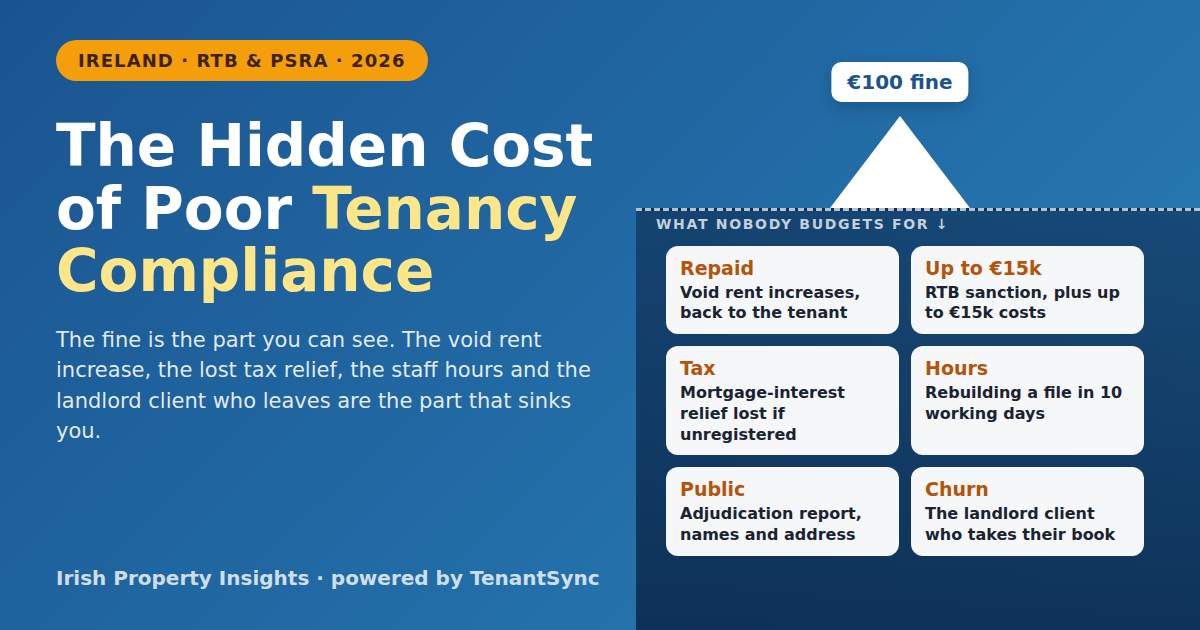
What does poor tenancy compliance cost in Ireland? The fine is small — an RTB fixed payment notice is €100 or €200, a late registration €10 a month. The real cost sits underneath: rent increases repaid when a notice is invalid, rights forfeited (no RTB dispute route and no mortgage-interest deduction for an unregistered tenancy), staff hours rebuilding files, a published adjudication report, and — for agents — the landlord client who leaves. Behind it all: sanctions of up to €15,000 plus €15,000 costs per tenancy. A compliant process isn't just safer; it's more scalable and more profitable.
Why the Fine Is the Smallest Number
Compliance costs are budgeted the way most agencies budget everything else: by what arrives as an invoice. A fixed payment notice arrives as an invoice. A late registration fee arrives as an invoice. So when a principal asks "what does it cost us if we get this wrong?", the honest-sounding answer is a three-figure number — and it's wrong by an order of magnitude.
The expensive consequences of a compliance failure almost never arrive as an invoice. They arrive as a refund to a tenant, a deduction your client's accountant can't take, a Tuesday afternoon lost to a dispute file, a report on rtb.ie, or a polite email from a landlord saying they're "consolidating their portfolio with another agent". None of those is filed under compliance in anyone's accounts. That's what makes them hidden — and it's why agencies consistently under-invest in the process that would prevent them.
- €100 / €200 RTB fixed payment notice
- €10 a month late registration fee
- Money back outVoid rent increases repaid, deposit deductions lost, damages
- Rights forfeitedNo RTB dispute route, lost mortgage-interest relief, a restarted notice clock
- HoursRebuilding a file in 10 working days, fixing, re-serving, explaining
- ReputationA published adjudication report with the address on it
- ClientsThe landlord who takes their book elsewhere
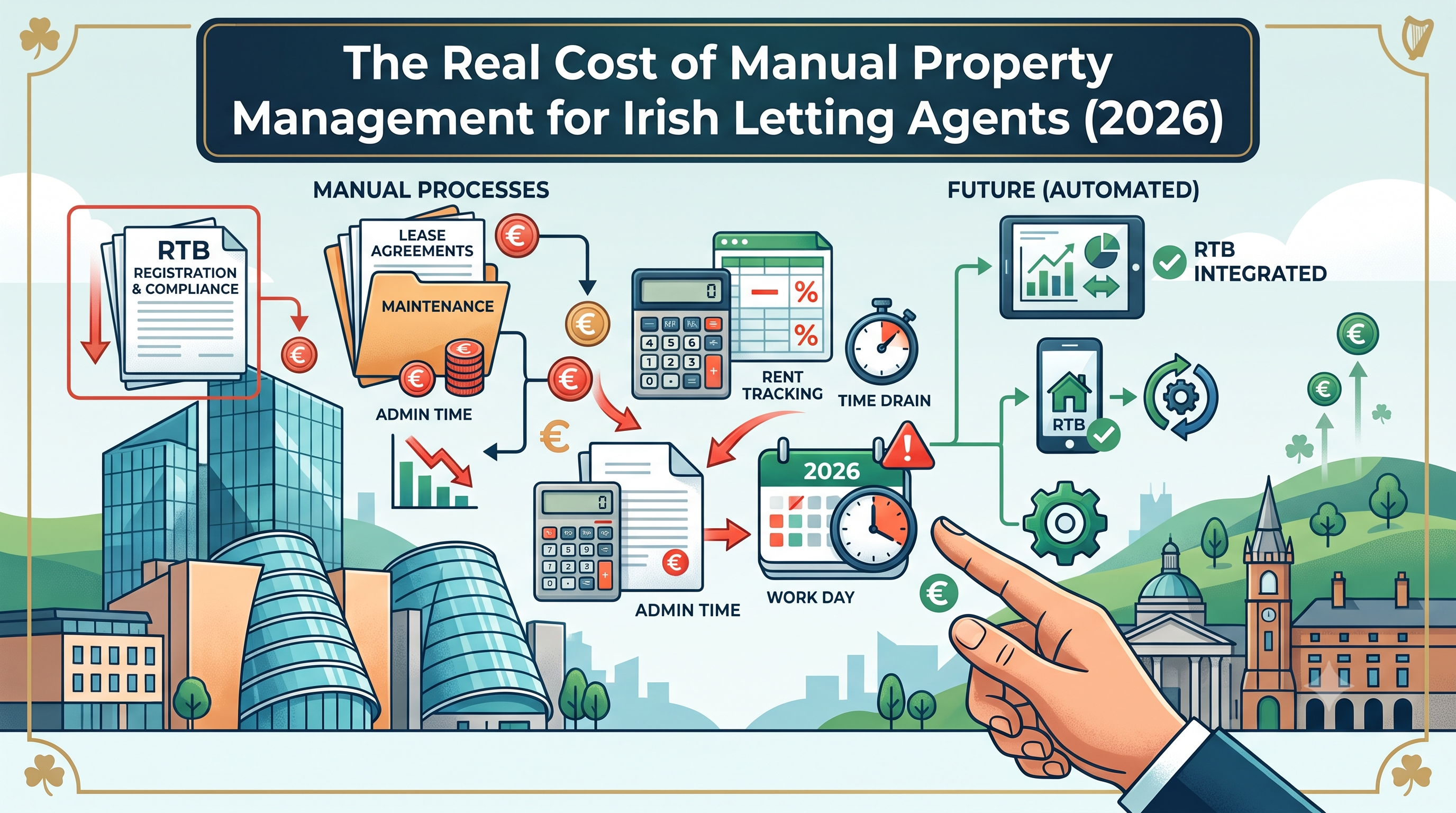
This page costs non-compliance specifically — what happens when a date is missed or a document is wrong. If you want the cost of running a book by hand even when nothing goes wrong, that's a different number, covered in the real cost of manual property management. The two add up; they don't overlap.
Layer 0: The Costs You Can See
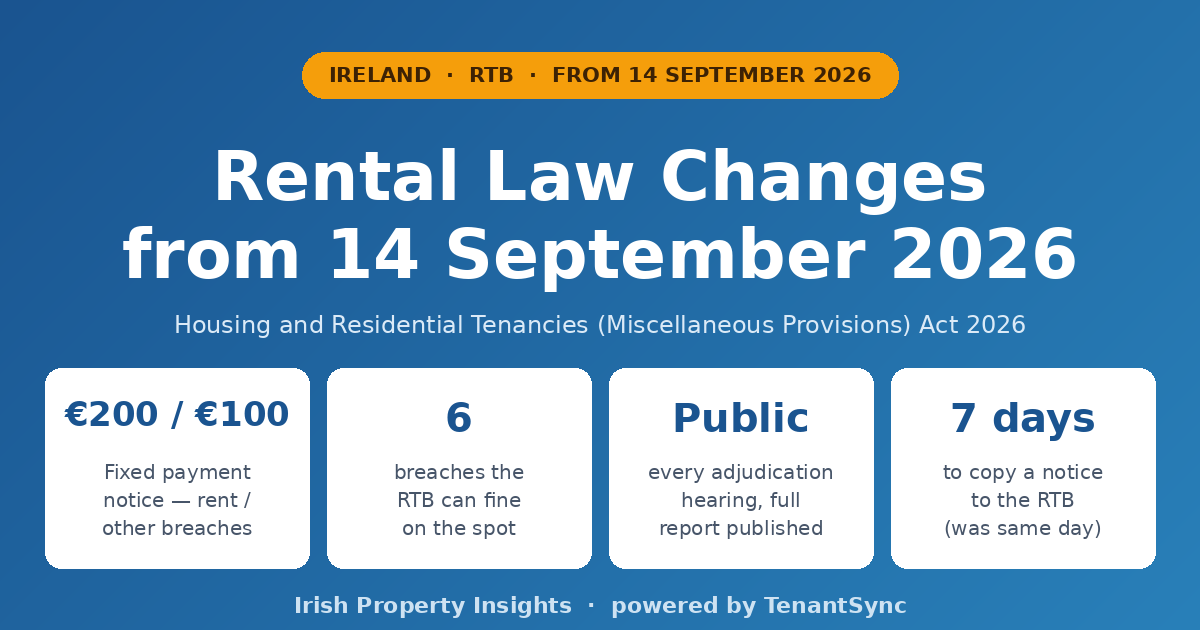
Start with the invoices, because they set the floor — and because 2026 made them more frequent. From 14 September 2026 the RTB can issue fixed payment notices for six routine breaches without opening an investigation. Four of the six are paperwork a busy agency does dozens of times a quarter.
| Failure | Visible cost | What sits behind it |
|---|---|---|
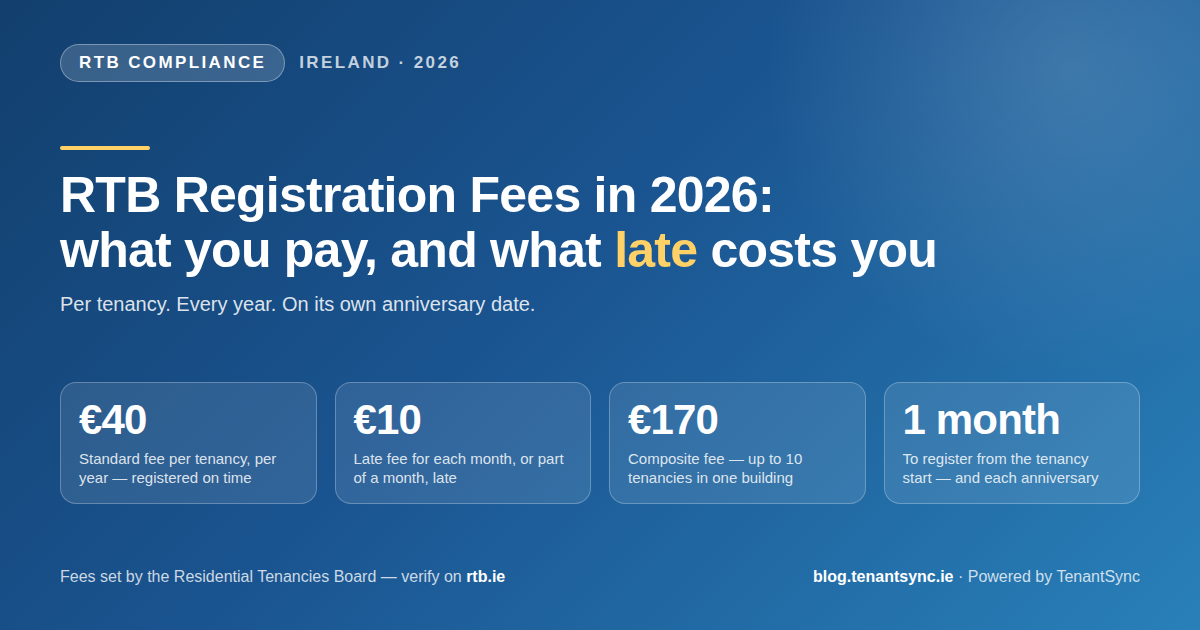
| Tenancy registered late | €40 fee + €10 per month (or part month) late | Unregistered for the gap — see Layer 2 |
| Tenancy not registered | €100 fixed payment notice | Prosecution (reported: up to €4,000, up to six months, plus a daily fine) or an RTB sanction of up to €15,000 + €15,000 costs per tenancy |
| Tenancy details not updated | €100 fixed payment notice | A register that no longer matches the tenancy you're defending |
| Rent set above the legal limit | €200 fixed payment notice | The excess is repayable — see Layer 1 |
| Rent review notice wrong | €100 fixed payment notice | The increase didn't legally happen |
| No rent-setting information at start / exemption not notified | €100 fixed payment notice | A tenancy whose starting rent you can't prove was set lawfully |
Every figure in the "visible cost" column is survivable. That is precisely the trap: an agency that prices compliance at "€100 a slip" will rationally decide it isn't worth a system. The "what sits behind it" column is where the money is, and it's what the rest of this page costs out. For the full fee schedule, see RTB registration fees in 2026.
Layer 1: Money That Goes Back Out
The first hidden layer is rent that was collected and has to be returned. It's the most concrete of the hidden costs, and the one agencies most often discover only when a tenant — or their solicitor — does the arithmetic for them.
Void rent increases
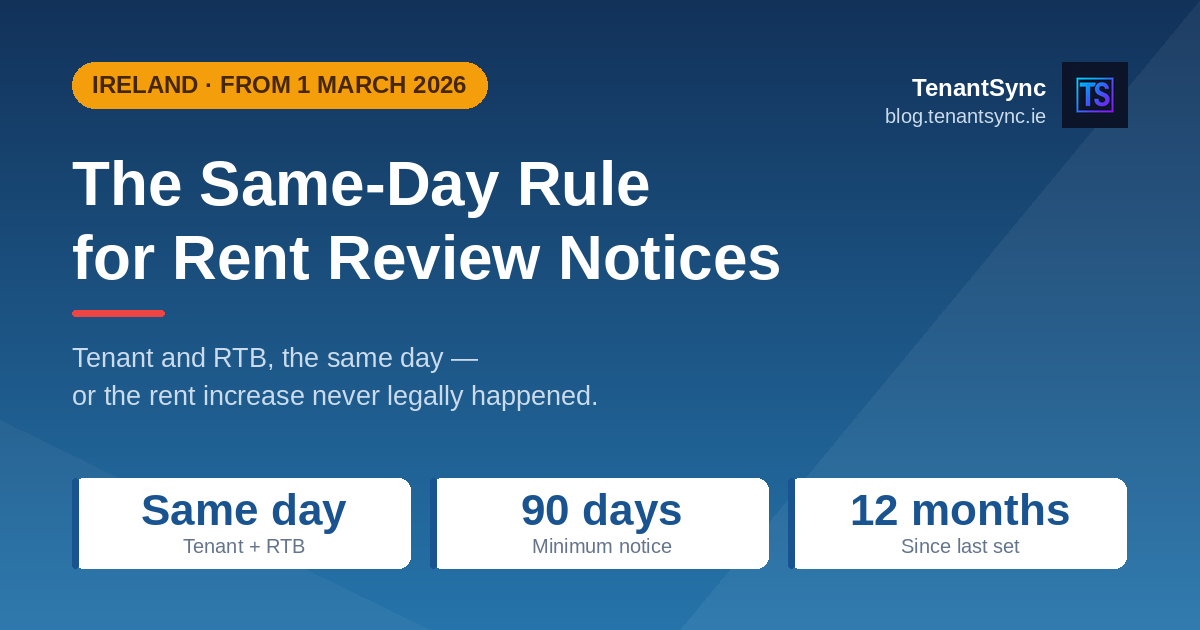
Since 1 March 2026 a rent review is a multi-part package: the national rent cap (the lower of 2% or CPI, now measured on the CSO's Consumer Price Index), at least 90 days' notice, the correct form and information, and — since 14 September — a copy served on the RTB within 7 days of the tenant receiving it. Get any part wrong and the increase is not valid. Rent collected under it can be recovered, and a dispute can add damages on top.
Worked example: one template error, a year of reviews
An agency runs 60 rent reviews a year. A template with the wrong notice period goes out on 10 of them before anyone notices. Average rent €1,800; each increase is 2%, or €36 a month.
- Collected under 10 invalid notices for 12 months: 10 × €36 × 12 = €4,320 repayable
- A fresh, correct notice restarts the 90-day clock: 10 × €36 × 3 = €1,080 never collected
- Fixed payment notices, if issued: 10 × €100 = €1,000
The visible cost is €1,000. The total is €6,400 — before any damages, and before ten landlord clients are told why.
Where the error is the amount rather than the paperwork — a flat 2% applied when CPI was lower — the whole of the excess over the lawful figure is at risk, for every month it was collected. That's why the calculation has to be recorded, not just performed: the cap figure you used, the rule that applied and the CPI reading on the day. Our national rent cap field guide covers the arithmetic.
Deposit deductions you can't evidence
Deposit retention is one of the most common reasons disputes reach the RTB, and the outcome turns almost entirely on evidence: a dated inventory, condition photos, receipts. A deduction you can't evidence is a deduction you'll likely hand back — and a tribunal that finds a deposit was unlawfully retained can award damages on top.
Damages and awards
RTB adjudicators and tribunals can award damages — commonly cited at up to €20,000 — for breaches of a landlord's obligations, separately from any sanction. These sit with your landlord client legally. Commercially, as Layer 5 explains, they tend to come back to the agent.
Layer 2: Rights You Quietly Lose
The second layer doesn't cost cash on the day. It removes something the landlord was relying on — and it's usually discovered at the worst possible moment, when that thing is needed.
The dispute route closes
A landlord cannot refer a dispute about an unregistered tenancy to the RTB. The tenant still can. So the day your client needs to pursue serious arrears or a breach of obligations is the day they discover the tenancy they thought was registered lapsed at its last anniversary. Registration is annual, on each tenancy's own anniversary — 40 tenancies means 40 dates a year, and the RTB deadline trap is simply one of them passing unnoticed.
The tax relief disappears
This is the hidden cost almost nobody links to the RTB. Revenue makes the deduction for interest on money borrowed to buy, improve or repair a let residential property conditional on the tenancy being registered with the RTB. An unregistered tenancy can cost the landlord that deduction.
The €10 late fee that cost €4,000
A landlord client pays €10,000 a year in mortgage interest on a let property and pays tax at the 40% higher rate. If the interest deduction is lost because the tenancy wasn't registered, that is up to €4,000 of extra income tax for the year — against a late fee measured in tens of euro. Your client won't file that under "compliance". They'll file it under "my agent". See our landlord tax return guide for how the claim is made, and confirm the current rules with an accountant.
The notice clock restarts
An invalid notice of termination — wrong period, wrong ground for a large landlord under a six-year Tenancy of Minimum Duration, posted when it shouldn't have been, or with no proof of the date the tenant received it — doesn't get corrected. It gets re-served, and the full notice period starts again. For a long-running tenancy that can mean many months. If your client was selling, that's months of a delayed sale, a buyer who may walk, and a landlord who remembers why.
Layer 3: The Hours Nobody Budgets
Every compliance failure comes with a second job attached: finding out what happened, fixing it, re-serving whatever needs re-serving, explaining it to the landlord, and — if it goes to the RTB — building a file. None of it is billable. All of it comes out of the same small team that was already stretched enough to miss the first date.
The 14 September changes compressed that work. The RTB can now give just 10 working days' notice of a tribunal hearing, down from 21 calendar days. If your file is built as you go, that's plenty. If it lives across a spreadsheet, a shared drive, three inboxes and someone's memory, it's two weeks of an experienced person doing archaeology instead of letting property.
Why the hours are the multiplier
A fine happens once. The time cost recurs with every incident, and it's paid by your most expensive people — the ones who know the history. At 6 hours per incident and €30 an hour fully loaded, ten incidents a year is €1,800 of staff time; the bigger cost is the ten afternoons in which nobody was winning instructions. We look at the whole-book version of this in scaling a letting agency without adding headcount.
📅 Is any tenancy in your book unregistered right now?
That one question sits behind the €100 notice, the €15,000 sanction, the closed dispute route and the lost tax relief. Enter a tenancy start date and see its RTB registration deadline and next annual renewal instantly — no login, no card.
Layer 4: Reputation, Now in Public
Until this month, a thin file lost you a case. From 14 September 2026 it can lose you a case in public. For dispute applications made from that date, RTB adjudication hearings are held in public and the full adjudication report is published — the names of the parties, the property address, the evidence presented and the outcome. The media may report on it.
For a letting agent, that changes what a compliance failure is. Your name may not be on the report, but your handling of the tenancy is: the notice with no proof of service, the rent review with no calculation behind it, the deposit deduction with no inventory. The next landlord you pitch to can search for it. So can a journalist. Mediation remains private — which makes having a clean enough file to settle early worth more than it used to be.
The agency also carries a reputation risk that is entirely its own. Your PSRA licence depends on obligations no landlord shares with you — a signed s.43 Letter of Engagement before acting, client money held in a designated account and reconciled at least monthly, an annual Accountant's Report, and a complaints process. The PSRA's sanctions run from a reprimand through fines to suspension or revocation of the licence. That's not a line item. That's the business. The PSRA renewal and Accountant's Report guide covers the dates.
Layer 5: The Landlord Who Leaves
This is the biggest number on the page, and the one that never appears in a compliance budget. Legally, most RTB obligations — registration, rent setting, notices — sit with the landlord. So the fine, the repayment and the sanction usually land on your client. Commercially, they land on you, because the landlord hired an agent precisely so that these things wouldn't happen.
Worked example: what one lost client is worth
A landlord client with three tenancies averaging €1,800 a month, on a 10% management fee:
- Annual rent under management: 3 × €1,800 × 12 = €64,800
- Annual management fee: 10% of €64,800 = €6,480 a year (before VAT)
- Over a five-year relationship: €32,400 in fees — before letting fees, referrals, or the sale instruction when they eventually exit
One lost client costs more than three years of a €149-a-month compliance platform.
And clients rarely leave over the fine. They leave over the conversation — being told, after the fact, that their tenancy was unregistered for a quarter, or that the increase they were counting on has to be repaid. In a market where small landlords are exiting and the ones who remain are consolidating with professional agents, reliability is the product. Our guide to winning and keeping landlord clients goes deeper on retention.
Put a Number on It: The Compliance Exposure Estimator
The layers above are easier to ignore than to add up, so here is the addition. Enter your own figures. The estimator shows how much of your yearly exposure is the visible fines — and how much is everything else.
Compliance exposure estimator
Estimates the yearly cost of compliance slips across your book from your own inputs. Runs entirely in your browser — nothing is sent anywhere and no email is required.
—
—
Illustrative estimate, not a forecast. Assumptions: each slip attracts a €100 fixed payment notice and two months of €10 late fees; each faulty rent review was a 2% increase collected for 12 months and then repaid, plus 3 months lost while a fresh 90-day notice runs; a lost client costs one year of management fees. Not included: RTB sanctions of up to €15,000 plus €15,000 costs per tenancy, damages awards, lost mortgage-interest relief, deposit disputes, or the public adjudication report — any one of which can exceed the total above. Check every rule on rtb.ie.
Run it at the defaults — 100 tenancies, a 5% slip rate, one lost client — and the fines come to €600 of a €9,330 total. The visible cost is under 7% of the exposure. Set lost clients to zero and the fines are still only about a fifth of the total — because the hidden layers scale with rent, hours and relationships, and the fines don't.
Compliant Is More Scalable — and More Profitable
The usual case for compliance is defensive: avoid the fine. That undersells it. For a letting agency, a compliant process — one where dates derive themselves, calculations are recorded and every notice carries its proof — is also the thing that lets the business grow without growing the risk.
| As the book grows… | Compliance held in people's heads | Compliance held in a process |
|---|---|---|
| Dates to watch | Grow with every tenancy; each one is someone's memory | Derived automatically; the dashboard shows only what's due |
| Slip rate | Rises with volume, holidays and staff turnover | Flat — the reminder doesn't go on leave |
| Cost of an audit or dispute | An afternoon of archaeology, every time | An evidence pack that already exists |
| New landlord pitch | "Trust us" | "Here's how every tenancy is tracked" — shown, not claimed |
| Next 50 tenancies | Probably another hire | Usually the same team |
That last row is the profit case. Management fees scale with tenancies; if compliance workload scales with them too, margin never improves. Take the compliance workload off the linear curve and every extra tenancy is worth more than the last. Add the clients you keep because nothing ever went wrong, and the services you can sell because your data is clean — per-client annual tax statements, landlord compliance reports — and compliance stops being a cost centre.
Use it in the pitch
Landlords are hearing about fixed payment notices and public hearings too. An agency that can show a prospective client exactly how their registrations, rent reviews and notices will be tracked — and hand them a clean compliance report every quarter — is selling the one thing the landlord can't easily do alone. That's a reason to choose you that has nothing to do with the fee percentage.
A 30-Minute Self-Audit
You don't need software to find out how exposed you are. You need half an hour and honest answers to seven questions. Every "no" or "not sure" is a line from the layers above.
- Can you list every tenancy whose RTB registration or annual renewal falls due in the next 60 days? If not, you can't know whether any is already overdue.
- For the last rent review you served, can you show the cap figure, the rule that applied (2% or CPI) and the CPI reading you used? That record is the difference between a lawful increase and a repayable one.
- For every notice served since 14 September, do you have the date the tenant received it and the date the RTB copy went? The 7-day RTB window runs from receipt, not from sending.
- Do you know which of your landlord clients are "large" (4+ tenancies) and which tenancies started after 1 March 2026? It decides which termination grounds and rent rules apply.
- Could you produce a complete dispute file for any tenancy within 10 working days? That is now the tribunal notice period.
- Is every landlord client covered by a signed s.43 Letter of Engagement, and was client money reconciled last month with a sign-off? These are the agency's own licence obligations.
- Are BER, gas, electrical and fire-safety certificates on file with their expiry dates for every property? A lapsed certificate is a minimum-standards problem waiting for a complaint.
If you answered all seven with a confident yes, your process is working and the estimator above should be close to zero. If you didn't, the RTB compliance checklist and bulk RTB compliance for letting agents are the next reads.
Where TenantSync Fits
Full disclosure: this blog is published by TenantSync, and what follows is our product. It's here because each hidden cost above has a specific, preventable cause — and TenantSync was built around removing those causes for Irish letting agents, not adapted to them.
| Hidden cost | Preventable cause | In TenantSync |
|---|---|---|
| Fines, sanctions, closed dispute route | A registration or renewal date nobody derived | An RTB registration record is created with every lease: the registration deadline and annual renewal are computed, risk is flagged until it's confirmed, and daily reminders go by email, in-app and push. The RTB1 form runs draft → validate → preview → finalise, and registration proof is stored against the tenancy. |
| Rent increases repaid | A cap calculation that wasn't recorded, or a notice that was wrong | Rent-setting and rent-review notices store the exact figures the PDF was rendered from and the cap check in force on the day — maximum permitted rent, whether 2% or CPI applied, and any warnings — with the notice-period arithmetic done for you. |
| Restarted notice clock | An invalid termination notice or no proof of service | Notices of termination go draft → validate (notice periods and grounds) → preview → finalise → serve, and keep the date and method of service, when the RTB copy went, and who served it. |
| Lost mortgage-interest relief | Registration status not connected to the tax picture | The Irish Landlord Tax Pack only allows the interest claim where the tenancy is RTB-registered, and shows why when it's disallowed — before the accountant finds out. Exports as PDF and CSV. |
| Hours rebuilding files | Records scattered across tools and inboxes | A per-tenancy compliance timeline; certificates (BER, gas, electrical, fire) tracked with expiry dates; documents, notices and e-signature certificates held against the tenancy. |
| Your PSRA licence | Agency obligations tracked in a diary | The PSRA / PSR module (Growth plan and above): licence renewal clock with 12- and 6-week reminders, s.43 Letters of Engagement, append-only client-money postings, monthly reconciliation with sign-off, the Accountant's Report pack, a complaints register, an audit log and a one-click inspection pack with six-year retention. |
| The landlord who leaves | Problems the client hears about too late | A compliance dashboard across 11 obligation types that resolves the whole book — or one branch — to compliant, upcoming or overdue; Open Banking rent reconciliation that surfaces arrears the day they happen; itemised landlord statements the client can approve or query. |
What it does not do — plainly
TenantSync does not submit registrations or notices to the RTB on your behalf, and does not pay RTB fees or fines — those happen with the RTB through its own online Service Centre. It's not a tax agent and files nothing with Revenue. What it removes is the tracking and evidence problem that creates the hidden costs: the date nobody derived, the calculation nobody recorded, and the proof nobody kept. The compliance dashboard and rent-cap calculator are also in the iPhone and Android apps, so they travel with whoever is out at viewings.
🧮 See your real slip rate in 15 minutes
We'll bring your book into a compliance dashboard and show you which registrations, renewals and rent reviews are compliant, upcoming or overdue — plus a rent-review notice with its cap check stored, and a termination notice with its service record. A compliant process isn't just safer. It's more scalable and more profitable.
Frequently Asked Questions
What does poor tenancy compliance cost in Ireland?
The visible cost is small: from 14 September 2026 an RTB fixed payment notice is €200 for a rent breach and €100 for other breaches, and a late tenancy registration adds €10 for each month or part of a month it is late. The hidden cost is far larger and comes in five layers: money that goes back out (a rent increase made on an invalid notice or above the cap is repayable, and a deposit deduction you cannot evidence is usually lost); rights that are forfeited (a landlord cannot refer a dispute about an unregistered tenancy to the RTB, and registration is a condition of the mortgage-interest deduction); staff time spent rebuilding files; reputational exposure now that RTB adjudication reports are published; and, for a letting agent, the landlord client who moves their portfolio after a failure. RTB improper-conduct sanctions of up to €15,000, plus up to €15,000 in costs, sit behind all of it.
What are the RTB fines for not registering a tenancy?
Several, and they stack. A late registration costs the standard €40 fee plus €10 for each month or part of a month it is late. From 14 September 2026 the RTB can also issue a €100 fixed payment notice for failing to register a tenancy. Non-registration is an offence, with reported penalties including a fine of up to €4,000, up to six months' imprisonment and a further daily fine while it continues, and the RTB can impose an improper-conduct sanction of up to €15,000 plus costs of up to €15,000 per tenancy. Separately, a landlord cannot refer a dispute about an unregistered tenancy to the RTB, although the tenant still can. Confirm the current position on rtb.ie.
What happens if a rent increase is made on an invalid notice?
The increase is not valid, so rent collected under it can be recovered by the tenant, and a dispute can add damages on top. A rent review notice must give at least 90 days' notice, carry the correct information, respect the national rent cap (the lower of 2% or CPI) and, since 14 September 2026, be copied to the RTB within 7 days of the tenant receiving it. If a notice fails, the fix is a fresh, correct notice — which starts a new 90-day period, so the rent that should have been collected in the meantime is lost as well as repaid.
Does an unregistered tenancy affect a landlord's tax?
It can. Revenue makes the deduction for interest on money borrowed to buy, improve or repair a let residential property conditional on the tenancy being registered with the RTB. An unregistered tenancy can therefore cost a landlord the interest deduction for the period — on €10,000 of interest at the 40% higher rate, that is up to €4,000 of income tax, which dwarfs any RTB late fee. Check the current rules on revenue.ie with your accountant.
Are RTB adjudication hearings public now?
Yes, for dispute applications made from 14 September 2026. The RTB publishes a weekly schedule of adjudication hearings, members of the public can request to attend, and the full adjudication report is published — including the names of the parties, the property address, the evidence presented and the outcome. For a letting agent, that means the quality of your file on a client's tenancy can be read by anyone, including the next landlord you pitch to. Mediation remains private.
Who pays when a letting agent gets compliance wrong?
Legally, most RTB obligations sit with the landlord, so the fine, the repayment and the sanction usually land on your client. Commercially, the agent pays: in the hours spent putting it right, in any fee credit or goodwill gesture, in professional indemnity exposure where the failure was yours, and most of all in the landlord client who moves their portfolio to another agency. The agency's own obligations — the PSRA licence, the s.43 Letter of Engagement, client-money reconciliation and the Accountant's Report — are the agent's alone.
Is compliance software worth it for a letting agency?
Measure it against one failure rather than against zero. A single landlord client with three tenancies at €1,800 a month on a 10% management fee is worth €6,480 a year in fees; losing one such client after a compliance failure costs more than three years of a €149-a-month plan. Add the staff hours spent rebuilding files, rent increases repaid, and the fact that a tracked process lets the same team take on more tenancies, and a compliant process is not just safer — it is more scalable and more profitable.
Summary
- The fine is the tip. €100 or €200 for a fixed payment notice, €10 a month for a late registration — the only costs that arrive as an invoice.
- Money back out. Increases on invalid notices or above the cap are repayable; a fresh notice restarts a 90-day clock; unevidenced deposit deductions are lost; damages can follow.
- Rights forfeited. No RTB dispute route for an unregistered tenancy, a mortgage-interest deduction at risk, and a termination clock that restarts from zero.
- Hours and reputation. Files rebuilt against a 10-working-day tribunal notice, and adjudication reports now published with the address on them.
- The landlord who leaves is usually the largest cost of all — one three-tenancy client is €6,480 a year in fees.
- Compliant is scalable. Take compliance off the linear "more tenancies, more risk" curve and growth becomes more profitable, not more dangerous.
- Verify before you advise a client. Take the legal specifics from rtb.ie, psr.ie and revenue.ie on the day you need them.
🧊 Find what's under your waterline — before a landlord does
A compliant process isn't just safer — it's more scalable and more profitable. See every registration, renewal, rent review and notice across your book resolve to compliant, upcoming or overdue, with the proof attached.
Sources & Further Reading
This article references rules administered by the RTB, the PSRA and Revenue. Check every legal and tax point against the source pages before you rely on it or advise a landlord client.
- RTB — Important changes to rental law from 14 September 2026 (fixed payment notices, public hearings, the 7-day copy rule, tribunal notice)
- RTB — Setting and reviewing private rents from 1 March 2026 (national rent cap, 90-day notice)
- RTB — Registration fees (standard and late fees)
- RTB — What can the RTB investigate (improper conduct and sanctions)
- Revenue — Rental income (allowable deductions, including interest and the RTB registration condition)
- PSRA — Information for licensees (licensing, client money, Letters of Engagement, sanctions)
- Citizens Information — Changes to the rules for renting from March 2026
Related Articles