The Real Cost of Manual Property Management for Irish Letting Agents (2026)
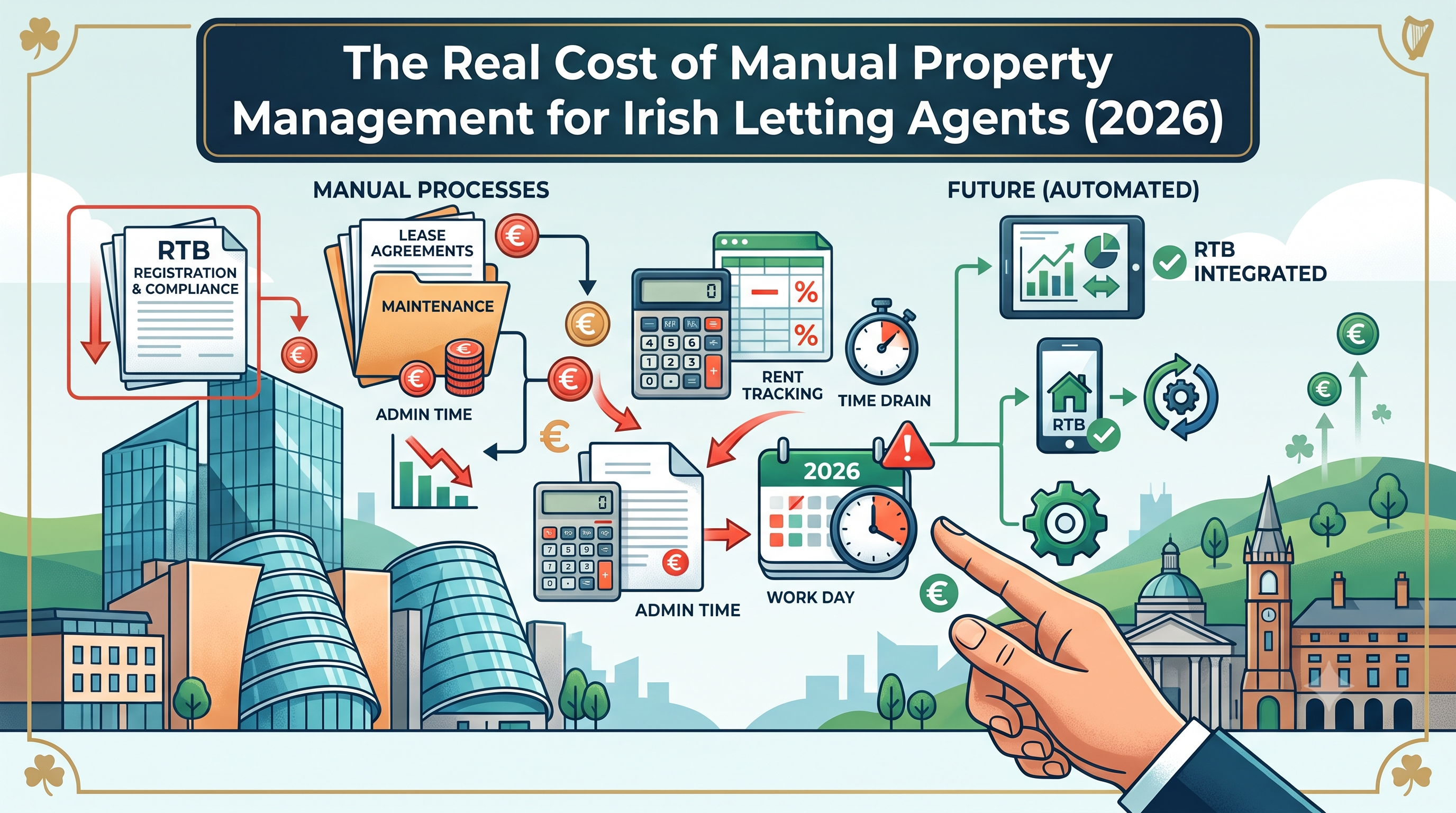
Every letting agency runs on a stack of small manual jobs — reconciling lodgements, chasing RTB renewals, working out a rent increase, building landlord statements. Individually they look cheap. Multiplied across a book of client tenancies, they're the most expensive thing your agency does — in hours you can't bill, and in the one missed deadline that costs you a client. This is how to put a real number on it.
The short version
- Manual management has four costs, not one. The hours are only the visible part — compliance exposure, revenue leakage and client churn are the expensive parts.
- The hours hide in five recurring tasks: bank reconciliation, RTB registration and renewals, rent reviews, inquiry handling and landlord reporting. They repeat for every tenancy, every year.
- One compliance miss outweighs a year of admin. A late RTB registration alone risks late fees, fines up to €4,000 or sanctions up to €15,000 per tenancy — and a refund order if a rent breaches the 2%-or-CPI cap.
- Manual processes fail silently. Nothing tells you a renewal date slipped or a notice went out a day early until the consequence has already landed.
- The fix is measurement, then automation. Size your real cost per task first; then automate the parts that are pure repetition and risk.
If you take one thing from this guide: the price of doing it by hand isn't the time it takes when everything goes right — it's the compounding risk of the one tenancy, on the two-hundredth day of the year, where something quietly goes wrong.
What "manual property management" actually means in 2026
"Manual" rarely means pen and paper anymore. For most Irish agencies it means a spreadsheet (or several), an email inbox, the bank's online statements, the RTB portal and a calendar of reminders — each holding part of the truth, none of them talking to each other. The work gets done; it just gets done by a person, repeatedly, with the accuracy that any human eventually loses on the fiftieth identical task.
That model held up when the rules were simpler. It's under more strain in 2026 for three reasons:
- Registration is now annual. Since April 2022, tenancies must be re-registered with the RTB every year, not once at the start — so the deadline you can miss recurs for every tenancy, every year.
- Rent rules got stricter and national. Rent Pressure Zones were replaced on 1 March 2026 by a single national cap of the lower of 2% or CPI, and a rent review notice must now be sent to the tenant and the RTB at the same time, at least 90 days before the increase — or it's invalid.
- Scale multiplies everything. A landlord has one tenancy to track; an agency runs the same calculations across dozens of clients, each with their own dates, history and bank account.
None of these is hard in isolation. The cost is what happens when you do them by hand, at volume, with no system catching the slip. The rest of this guide breaks that cost into its four parts — and shows where each one hides.
Cost 1: The hours you can't bill
The most measurable cost is staff time. Every hour a negotiator or administrator spends reconciling a bank statement is an hour they aren't spending winning instructions, doing viewings, or servicing the clients you already have. In a lettings business, that's the expensive trade — admin time is paid for out of the same headcount that's supposed to be growing the agency.
Five recurring tasks absorb most of it:
| Recurring task | What it involves by hand | Why it's costly |
|---|---|---|
| Bank reconciliation | Reading statements line by line each month and matching lodgements to the right tenancy across client accounts. | Slow and error-prone; a missed payment isn't a missed payment until someone notices. |
| RTB registration & renewal | Tracking each tenancy's start date and annual renewal date, then filing the RTB Form 1. | A missed date is a late fee at best — and far worse if it slips for months. |
| Rent reviews | Checking the 12-month timing, applying the lower of 2% or CPI, and serving a 90-day notice to the tenant and the RTB. | One wrong figure or early notice is invalid — or a refund order. |
| Inquiry handling | Triaging Daft and MyHome enquiries out of a shared inbox during letting season. | Slow replies lose lets; every extra day empty is a day of lost rent. |
| Landlord reporting | Building per-client statements — income, arrears, compliance status — by hand each cycle. | Hours per round, and inconsistent quality undermines the client relationship. |
The trap with these is that each one feels small in the moment — "it's just ten minutes." But they're per tenancy and they repeat, so they scale linearly with your book while your headcount doesn't. That's exactly the maths covered in our companion guide on how Irish letting agents can reduce admin time, which works through where the recurring hours actually go and which are safe to automate.
Cost 2: Compliance exposure — the expensive one
If the hours are the visible cost, compliance exposure is the one that can dwarf a whole year of admin in a single miss. And manual processes are uniquely bad at compliance, because compliance is about dates and thresholds — precisely the things a spreadsheet won't warn you about.
The RTB registration numbers
The mechanics, from Citizens Information and the RTB, are specific:
- The basic fee to register a private, student-specific or cost-rental tenancy is €40 a year, if the RTB receives the application within one month of the tenancy starting (full schedule: RTB registration fees in 2026).
- A late fee of €10 per month applies for each month the registration is late.
- Up to 10 tenancies in the same building can be registered together for a combined €170, if filed on time.
Those are the everyday figures. The penalties for not registering are an order of magnitude larger:
What an unregistered tenancy can actually cost
According to Citizens Information and the RTB, a landlord who fails to register can be criminally prosecuted — a fine of up to €4,000, up to six months' imprisonment, and a further €250 for each day the tenancy stays unregistered — or the RTB can apply a sanction of up to €15,000, plus up to €15,000 in costs, for each unregistered tenancy. A landlord also can't use the RTB dispute service for an unregistered tenancy. For an agency, that exposure is multiplied across every client you act for.
The rent-review trap got tighter in 2026
Since 1 March 2026, a rent review is no longer a one-step job. You must send the completed notice of rent review to the tenant and the RTB at the same time, at least 90 days before the new rent begins — and if you don't, the notice is invalid. You then have to update the RTB registration record with the new rent within a month of the change. That's more steps, more documents and more dates to coordinate per tenancy than under the old RPZ regime — and every extra step is another place a manual process drops the ball. Get the figure wrong by defaulting to a flat 2% when CPI is lower, and the increase isn't just delayed, it's refundable.
We cover the calculation itself in detail in the national rent cap field guide, and the registration side in the agency workflow for bulk RTB compliance. The point here is narrower: every one of these rules is a date or a threshold, and manual tracking is where dates and thresholds quietly fail. For what a single failure actually costs once it happens — repaid increases, lost tax relief, public adjudication and lost clients — see the hidden cost of poor tenancy compliance.
See what compliance costs you when it's automatic instead
Book a 15-minute agency demo and we'll run real RTB renewals and a rent review through TenantSync — computed deadlines, the 2%/CPI figure, the 90-day notice and a full audit trail — on data shaped like your own portfolio.
Cost 3: Revenue leakage
The third cost doesn't show up as a bill — it shows up as money that should have arrived and didn't, or arrived later than it could have. Two leaks dominate.
Arrears caught late
When rent is reconciled by hand, a shortfall is only visible when someone gets to the bottom of the statement. A tenant who underpays or misses a month can go unnoticed for weeks — and the longer arrears run before anyone acts, the harder they are to recover and the more uncomfortable the conversation with the landlord becomes. Manual reconciliation doesn't just cost the hour of matching; it costs the delay between a missed payment and the moment you notice it. Our guide on how to identify rent payments from a bank statement walks through why this matching is so slow by hand — and how Open Banking removes it.
Voids that run longer than they should
During letting season a popular Daft or MyHome listing can pull dozens of enquiries a day, and the agent who replies first usually wins. When those enquiries sit in a shared inbox waiting for a human to triage them, the slow reply is a longer void — and every extra day a property sits empty is a day of rent neither the landlord nor the agency earns. Speed-to-lead is a revenue lever, not just a courtesy; we cover the funnel in automating tenant onboarding from a Daft or MyHome enquiry.
Why leakage is invisible on a P&L
Unbilled hours and compliance fines eventually appear in the accounts. Leakage usually doesn't — a void that was three weeks instead of one, or arrears spotted on day 40 instead of day 5, never gets recorded as a loss. It's simply rent that quietly never showed up. That's what makes it the easiest cost to ignore and one of the most worthwhile to close.
Cost 4: The client cost
The most expensive thing manual management can cost you isn't an hour or a fee — it's a landlord client. With landlords leaving the market, the ones who stay are more valuable and more discerning, and the agencies that keep them are the ones that look reliable: rent reconciled and reported on time, compliance never in question, a clear answer to "is my rent increase legal?" on demand.
Manual processes erode exactly that impression. A landlord doesn't see your effort; they see the late statement, the rent that had to be refunded, the registration that lapsed. Any one of those tells a client the agency got the one thing that mattered wrong — and in a shrinking market, that's all the reason a landlord needs to move their portfolio. The flip side is the opportunity: being the agent who produces a clean, professional report at the press of a button, with an audit trail ready if anyone asks, is what renews a management contract. That retention argument is the heart of the case for moving off spreadsheets, which we lay out in migrating your agency portfolio off spreadsheets.
Estimate your agency's manual cost
You don't need a consultant to size this — you need three numbers per task: how often it happens, how long it takes by hand, and your fully-loaded staff cost per hour. Multiply, add the risk you're carrying, and you have a defensible figure to weigh against the price of fixing it.
An illustrative example (use your own numbers)
Suppose an agency manages 150 tenancies, and that reconciliation, registrations, rent reviews, inquiry handling and reporting absorb — very roughly — two to three hours of staff time per tenancy across a year. At, say, €25–€30 of fully-loaded staff cost per hour, that's a five-figure annual admin cost before a single compliance error or lost client. These figures are illustrative only — the value is in measuring your own, because once the number is on the table, "we've always done it this way" stops being free.
Then add the costs that don't fit neatly in a timesheet:
- Compliance risk: the expected cost of one missed RTB renewal or invalid rent notice a year — late fees, a possible sanction, the time to put it right.
- Leakage: the rent lost to arrears caught late and voids that ran longer than they needed to.
- Churn: the lifetime fee value of even one landlord client who leaves because the service felt unreliable.
Put against that total, the relevant question isn't "can we afford software?" — it's "what is doing it by hand already costing us?" For how that maths compares to actual tool pricing, see our breakdown of lettings software pricing in Ireland, which works through cost-per-tenancy at 50, 100, 200 and 300 units.
Find out what your portfolio costs to run by hand
Start a 14-day free trial and reconcile a real month, track your RTB dates and generate a landlord report — then compare the time against what it takes you today. No card required.
Manual vs automated, side by side
The point of automating isn't to replace judgement — it's to remove the repetitive, date-driven work where manual effort is slow and where it silently fails. Task by task, here's the difference:
| Task | Manual approach | With TenantSync |
|---|---|---|
| Rent reconciliation | Read each statement line by line and match lodgements by hand. | Open Banking auto-matches payments to the tenancy; arrears flagged immediately. |
| RTB deadlines | Calendar reminders you set and maintain yourself. | Registration and renewal dates computed and reminded automatically. |
| Rent-cap calculation | Manual percentage maths and a CPI lookup, every review. | Calculator returns the maximum legal rent and shows the rule and figure used. |
| Rent review notice | Draft by hand and remember to file with the tenant and RTB together. | Compliant notice generated with the 90-day lead time built in. |
| Inquiries | Triage a shared inbox during peak season. | Daft and MyHome enquiries captured centrally so none slips. |
| Landlord reporting | Build each client's statement from scratch. | One-click per-client report with income, arrears and compliance status. |
| Audit trail | Hope the relevant email is still findable. | Every action timestamped — a defence file ready on demand. |
Read down the middle column and you have a fair description of where a manual agency spends its week. Read down the right and you have the same work, minus the hours and minus the silent failure points.
How TenantSync removes the cost
TenantSync is an Irish-built platform designed around exactly the tasks where manual management leaks time and risk — for a single landlord or across an agency's whole book of clients. Each capability below maps to one of the four costs above.
Open Banking reconciliation
Connect the agency account (AIB, BOI, PTSB, EBS, Revolut, N26) and rent auto-matches to the right tenancy, with arrears surfaced the moment they occur — not on day 40.
Bulk RTB compliance
Registration and annual renewal deadlines computed per tenancy, with reminders and a portfolio-wide dashboard so nothing lapses across any client.
Rent-cap calculator & notice
Applies the lower-of-2%-or-CPI rule, returns the maximum legal rent, and helps generate a compliant rent review notice with the 90-day lead built in.
Inquiry management
Daft and MyHome enquiries captured in one place so the fast reply that wins the let — and shortens the void — actually happens.
Per-client landlord reports
Income, arrears and compliance status for each landlord in one click — the professional, on-time reporting that renews management contracts.
Timestamped audit trail
Every calculation, notice and reconciliation logged automatically — a complete defence file if a rent or registration is ever challenged.
It runs on web plus iOS and Android, includes a landlord and tenant portal, and imports directly from Letman, a CSV or a spreadsheet so an agency can get its whole book in quickly. Pricing is flat per-portfolio tiers — Standard €99 up to 100 properties, Growth €149 up to 200, Premium €199 up to 300, plus a €20 Starter for up to 10 — each with a 14-day free trial; the full breakdown is in our guide to lettings software pricing in Ireland.
Want to test the maths first? Try the free rent-cap calculator — no account needed.
For self-managing landlords
If you manage your own property rather than through an agent, the costs in this guide apply to you too — just concentrated on a smaller book. The hours still add up: reconciling rent, tracking your annual RTB renewal, working out a lawful increase and serving the right notice. And the compliance exposure is identical — the €40 fee, the €10-a-month late fee, and the same penalties for a tenancy that goes unregistered.
The everyday case is manageable once the dates and the CPI figure are in front of you, and our plain-English guide Can I increase my rent in Ireland? walks through the 12-month rule, the 2%/CPI cap and the 90-day notice. But if you'd rather not run a spreadsheet and a calendar of reminders, the same automation that serves agencies handles it for a single landlord — TenantSync's Starter plan is built for portfolios of up to 10 properties.
Stop paying the manual tax on your own rental
Use the free rent-cap calculator to check your maximum legal rent in seconds, or start a free trial to have reconciliation, RTB dates and notices handled for you.
Frequently asked questions
What is the real cost of manual property management for a letting agency?
It has four parts, and only the first is obvious. The visible cost is staff hours spent on repetitive work — bank reconciliation, RTB registration and renewals, rent-review calculations and notices, inquiry handling and landlord reporting. The hidden costs are larger: compliance exposure when a deadline is missed, revenue leakage when arrears or voids are caught late, and lost management contracts when a landlord loses confidence. The hours are billable time you forfeit; the risk is what turns a small slip into a five-figure problem.
How much does it cost if a letting agent misses an RTB registration?
Failing to register a tenancy is not a minor slip. According to Citizens Information and the RTB, a landlord can be criminally prosecuted — a fine of up to €4,000, up to six months' imprisonment, and a further €250 for each day the tenancy stays unregistered — or the RTB can apply a sanction of up to €15,000, plus up to €15,000 in costs for each unregistered tenancy. For an agency acting on behalf of clients, that exposure is multiplied across every landlord on your book, and a missed registration also blocks the landlord from using the RTB dispute service.
What are the RTB tenancy registration fees in 2026?
The basic fee to register a private, student-specific or cost-rental tenancy with the RTB is €40 a year, provided the RTB receives the completed application within one month of the tenancy starting. A late fee of €10 per month applies for each month the registration is late. Up to 10 tenancies in the same building can be registered together for a combined fee of €170 if filed on time. Registration is annual, so the work — and the chance to miss a date — repeats every year for every tenancy. Always confirm current fees on rtb.ie.
How much time can a letting agency save by automating property management?
It depends on portfolio size and how much is done by hand today, so treat any figure as illustrative rather than a guarantee. The automatable work in a lettings agency is concentrated in a few recurring tasks — bank reconciliation, RTB registration and renewals, rent-review calculations and notices, inquiry triage and landlord reporting. Software that automates these can remove a large share of that recurring admin, freeing the team for work that wins and keeps clients. The honest way to size the saving is to measure your current hours per task, not to rely on a headline percentage.
What is the biggest hidden cost of managing tenancies manually?
The hours are visible; the risk is not. The most expensive cost of manual management is a single compliance miss across a portfolio — a late RTB registration, an invalid rent-review notice, or a rent set above the 2%-or-CPI national cap — because each can turn into a refund order, an RTB sanction, or a lost management contract. Manual processes fail silently: nothing alerts you that a renewal date passed or a notice was served a day too early until the consequence has already landed.
How does TenantSync reduce the cost of manual property management?
TenantSync automates the recurring work where the cost hides. Open Banking reconciliation auto-matches lodgements to the right tenancy and surfaces arrears immediately; RTB registration and renewal deadlines are computed and reminded automatically with a portfolio-wide dashboard; a rent-cap calculator applies the lower-of-2%-or-CPI rule and helps generate a compliant rent review notice with the 90-day lead built in; Daft and MyHome inquiries are captured centrally so leads aren't lost; and per-client landlord reports are produced in one click. Every action is logged with a timestamp as an audit trail, across the whole portfolio, per landlord client.
Sources & further reading
Facts in this article are drawn from official and primary sources. RTB fees, penalties, rent-control rules and notice requirements change — verify the current position on rtb.ie before relying on any figure or acting on a tenancy.
- Citizens Information — Registering a tenancy (fees, late fees and penalties)
- Citizens Information — Rent increases in private rented housing
- Residential Tenancies Board — Tenancy registration and rent controls
- Residential Tenancies Board — Rental law changes from 1 March 2026
- Central Statistics Office — Consumer Price Index (CPI)
Related Articles