Key Takeaways — The RTB Registration Deadline Trap
- You have exactly 30 days from your tenant's move-in date to register with the RTB — not from when the lease was signed.
- The RTB will not remind you. The obligation is set in legislation and is entirely yours to track.
- Missing the deadline means a financial surcharge, no RTB dispute access, and potential inability to enforce rent increases in an RPZ.
- Since April 2022, an annual renewal fee is also mandatory — every year — or your registration lapses.
- Use the free RTB deadline checker to find your exact deadline in seconds — no login required.
The Trap Most Landlords Don't See Coming
Picture this: your new tenant moved in three weeks ago. You've sorted the deposit, sorted the lease, handed over the keys. Job done — or so you think. What you may not realise is that the clock on a legal registration deadline started ticking the moment that tenant walked through the door.
Under the Residential Tenancies Acts 2004–2022, every landlord in Ireland must register each new tenancy with the Residential Tenancies Board (RTB) within one month of the tenancy commencement date. That's 30 days. Not three months. Not "whenever you get around to it." Thirty days.
The RTB does not send you an alert. There is no welcome letter when you become a landlord telling you about this window. It is written in legislation, and it is your problem to know about it — and act on it.
If you miss it? Financial surcharges. Loss of RTB dispute access. No ability to enforce rent increases. All because life got busy between key handover and the calendar.
This article exists to make sure you don't fall into that trap.
What the 1-Month Rule Is and Where It Comes From
The registration obligation is established in Section 134 of the Residential Tenancies Act 2004, as amended. It places a legal duty on every landlord to register a tenancy with the RTB within one month of the tenancy commencing. This is not a procedural guideline — it is a statutory obligation.
The legal basis — in plain English
- Who must register: every landlord of a private residential tenancy in Ireland, with limited exemptions (e.g., certain approved housing body arrangements)
- What must be registered: each individual tenancy — not each property. Multiple tenancies at the same address require separate registrations
- When: within 1 month (30 days) of the tenancy commencement date
- Where: via the RTB online registration portal at rtb.ie
- Consequence of non-compliance: an offence under the Residential Tenancies Acts, financial surcharges, and loss of access to RTB dispute resolution
The RTB is Ireland's independent statutory body for the residential rental sector. Think of it as the official record-keeper and dispute referee for the market. Without registration, you have no standing before it — and its dispute resolution service is one of the most cost-effective options available to Irish landlords when things go wrong with tenants.
Why Does This Matter Beyond Compliance?
An unregistered landlord cannot refer a dispute to the RTB — full stop. That means if a tenant falls into rent arrears, damages the property, or refuses to leave, you are locked out of the RTB's adjudication process. You still have other legal avenues, but they are significantly slower and more expensive.
Crucially, under Rent Pressure Zone legislation, an unregistered landlord may also be unable to lawfully serve a valid rent review notice. Registration is not just an administrative box to tick — it is the foundation on which all your other rights as a landlord rest.
What Counts as the "Commencement Date" — Often Misunderstood
This is where most landlords go wrong — even those who know the 30-day rule exists.
The most common and costly mistake
Using the date the lease was signed as the start of the 30-day clock. The commencement date is not when the contract was signed — it is when the tenant is entitled to take occupation. These can be days, or even weeks, apart.
The Correct Definition
The tenancy commencement date — the date from which your 30-day registration window begins — is the date the tenant is entitled to occupy the property. In practice, this is almost always:
- The date keys are handed over and rent begins
- The first day stated in the tenancy agreement as the tenancy start date
Tenant is handed keys. Rent begins. Your 30-day clock starts now.
Registration window is open. Ideal time to submit your RTB application — no surcharge, full protection.
Still within the window but cutting it close. Submit immediately — don't wait for the weekend.
Window has closed. A late registration surcharge now applies on top of the standard fee. Register immediately — every day you delay compounds your legal exposure.
Common Scenarios That Confuse Landlords
Scenario 1: Lease signed before move-in
Lease signed on 1 April. Tenant moves in on 15 April. Commencement date = 15 April. Your deadline is 15 May. Not 1 May.
Scenario 2: Verbal agreement before written lease
Tenant occupies from 10 April under a verbal agreement. Written lease signed on 20 April. Commencement date = 10 April. The RTB registration window opened when occupation began, not when the paperwork was formalised.
Scenario 3: Deposit paid, occupation delayed
Deposit paid and lease signed on 1 April. Property not ready — tenant moves in on 22 April. Commencement date = 22 April. The window starts when occupation rights begin, not when monies were exchanged.
Penalties for Late Registration
Missing the 30-day window is not a technicality — it has concrete financial and legal consequences. Here is what happens:
The Enforcement Reality
The RTB has investigative and sanctioning powers under the Residential Tenancies Acts. In practice, enforcement tends to focus on persistent or deliberate non-compliance. However, that should not be taken as comfort: the more important risk is the practical loss of RTB standing — which matters most when you need it most (i.e., when a dispute arises).
The key insight
Most landlords only discover they are unregistered when a dispute arises — precisely the moment when registration matters most. By then, it's too late to fix retroactively for that dispute. Don't let this be you.
How to Check If You're Already Late
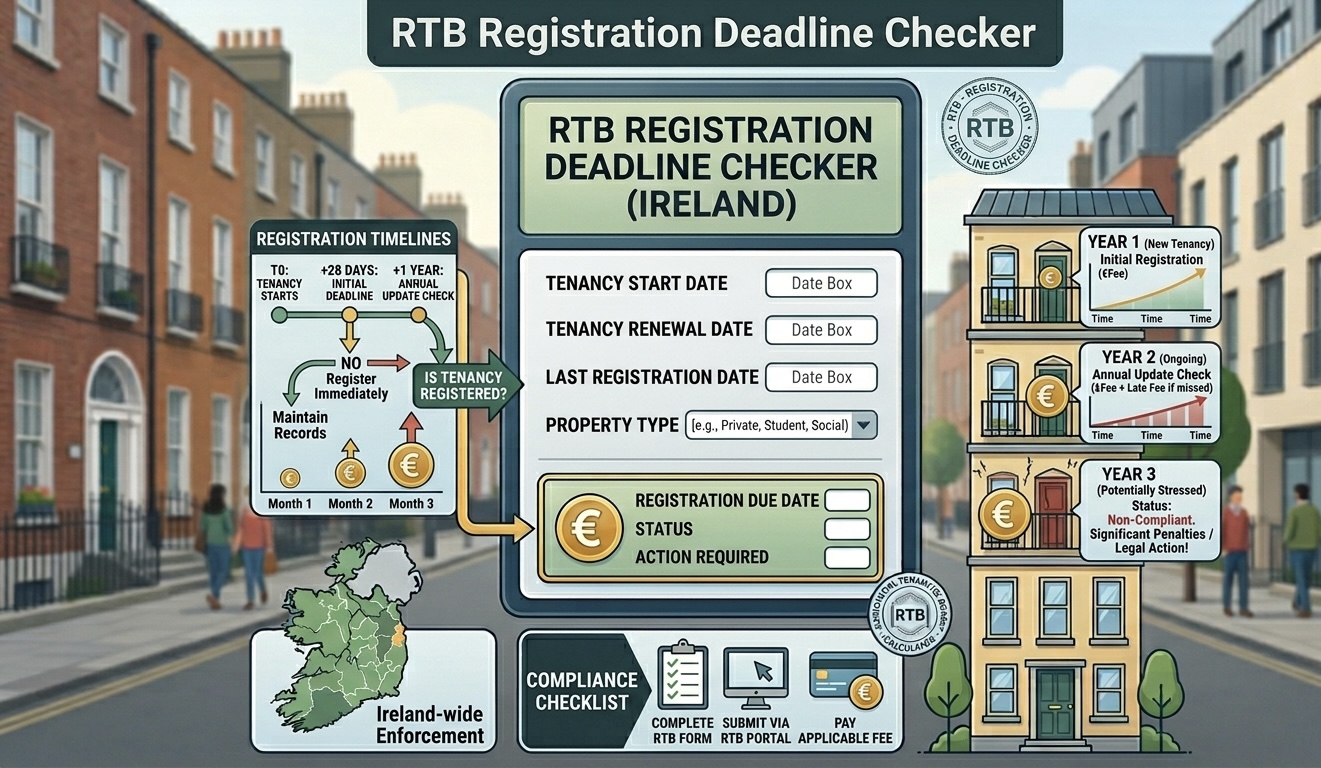
Not sure where you stand? Whether your tenancy started last week or last year, the fastest way to know is to use the free tool built for exactly this situation.
Free RTB Deadline Checker
Enter your tenancy start date. Get your exact 30-day registration deadline, how many days remain, and your next annual renewal date — instantly. No login required.
Check My RTB Deadline Now → Free to use · No account needed · Results in secondsManual Check: Three Questions
If you prefer to work it out yourself, answer these three questions:
- What date did the tenant move in? (Commencement date — not lease signing date)
- Add 30 days. That is your registration deadline.
- Has that date passed? If yes, you are in late-registration territory. If no, you still have time — act now.
If you registered before 4 April 2022 and have not paid an annual renewal fee since — your registration has almost certainly lapsed. See the section on annual renewals below.
Step-by-Step: How to Register on Time
The RTB online portal is the fastest and most reliable registration method. Here is the exact process, in order. Following these steps in sequence avoids the most common submission errors.
-
Confirm your commencement date
Identify the exact date your tenant was entitled to occupy — the date keys were handed over and rent began. Not the lease signing date. Write it down.
-
Gather the required information
You will need: your PPSN · the property address and Eircode · the commencement date · the agreed monthly rent · your tenant's full legal name and PPSN · tenancy type (fixed-term, Part 4, etc.)
-
Go to rtb.ie and log in or create an account
If registering for the first time, create a landlord account. Use your primary email address — this is where annual renewal reminders will be sent.
-
Select "Register a New Tenancy"
From your dashboard, choose new tenancy registration. Do not select the renewal option — that is for tenancies already on the register.
-
Complete the form accurately
Enter all details carefully. Double-check the commencement date — errors here create complications for all future deadlines and renewals.
-
Pay the registration fee
Pay the current fee as shown. If registering after the 30-day window, a late surcharge will be added automatically. Check rtb.ie for the current fee schedule.
-
Save your confirmation number
The RTB will issue a confirmation number and certificate. Store these securely. You need this number for all future renewals and for any RTB dispute referral.
-
Set your annual renewal reminder immediately
Since April 2022, annual renewal is mandatory. Set a calendar reminder for 11 months from today so you never miss a renewal. Or let TenantSync track it automatically.
Not sure how many days you have left?
Use the free RTB deadline checker to confirm your exact window before you start the registration process.
What Changes With Renewals and Re-Registrations
Getting the initial registration right is only the first part of the obligation. Since 4 April 2022, the rules around ongoing registration changed significantly — and many experienced landlords with long-standing tenancies are still unaware.
The 2022 Annual Renewal Rule
If you registered before April 2022 and haven't renewed since — act now
Your registration has almost certainly lapsed. Log in to the RTB portal immediately. An lapsed registration carries the same consequences as never registering: no RTB dispute access, potential enforcement exposure.
Before 4 April 2022, a single registration fee covered the lifetime of the tenancy. That model no longer exists. Since that date, landlords must pay an annual renewal fee every year to keep each tenancy active on the register. Here are the key facts:
7 things to know about annual RTB renewal
- Annual renewal has been mandatory for all tenancies — new and existing — since 4 April 2022.
- The renewal is due on the anniversary of your original registration date — not the tenancy start date (these differ if you registered late).
- Failing to renew carries the same legal consequence as failing to register: loss of RTB standing.
- The RTB may send renewal reminders by email — but the obligation is yours regardless of whether a reminder arrives.
- The fee applies per tenancy, not per property. Multiple separately registered tenancies at one address = multiple fees.
- If you have a long-term tenant who moved in before 2022, you must still renew annually or your registration lapses.
- Use the RTB deadline checker to confirm your next renewal date.
Re-Registration: When a New Tenancy Starts
When one tenancy ends and a new tenant moves in — even at the same property — a new tenancy has commenced. This triggers a fresh 30-day registration window from day one. The previous tenancy's registration does not transfer to the new occupant. Miss this re-registration and you are back in the same trap, regardless of how many years you've been a landlord.
The two registration triggers — memorise these
- New tenancy starts → Register within 30 days of commencement
- Existing tenancy, every year → Pay annual renewal fee on the anniversary of your registration date
How TenantSync Flags Your RTB Registration Window Automatically
The 30-day window is short. Life as a small landlord is busy. TenantSync was built specifically to remove this class of risk — by tracking your tenancy start date and surfacing your RTB registration deadline automatically, before it's too late.
RTB deadline alerts
TenantSync tracks your tenancy commencement date and sends you a reminder to register before the 30-day window closes — no manual calendar required.
Annual renewal tracking
Once registered, TenantSync flags your annual renewal deadline 30 days in advance so you never inadvertently lapse your registration again.
RTB status per tenancy
See the real-time RTB status of every lease in your portfolio — Not Started, In Progress, Registered, or Renewal Due — from a single dashboard.
Stop relying on memory for legal deadlines
TenantSync automatically tracks every RTB registration window, annual renewal date, and RPZ rent review deadline across your full portfolio — and sends you reminders before each one is due. Free to try. No credit card required.
Frequently Asked Questions
Does RTB send me a reminder to register a new tenancy?
No. The RTB does not proactively notify landlords to register a new tenancy. The obligation is set in legislation and the responsibility lies entirely with the landlord. This is the root cause of most missed deadlines — landlords assume someone will remind them. Nobody will.
What if my tenant refuses to give me their PPSN?
You need your tenant's PPSN to complete RTB registration. Under the Residential Tenancies Acts, tenants have an obligation to provide this information for registration purposes. If a tenant refuses, explain the legal requirement. In practice, most tenants cooperate once they understand that an unregistered tenancy also affects their own access to RTB dispute protections.
Can I register if I'm more than 30 days late?
Yes. There is no cut-off point beyond which registration becomes impossible. A late registration — with the applicable surcharge — is always better than no registration. It restores your access to RTB dispute resolution and returns you to compliance. Register now, regardless of how late you are.
My letting agent said they'd register — do I still need to check?
Yes. While a letting agent can complete the RTB registration on your behalf, the legal obligation remains with the landlord. If your agent fails to register in time, you bear the consequences — not the agent. Always obtain the RTB confirmation number and verify the registration was submitted before the 30-day window closed.
Do I need to re-register if my tenant changes?
Yes. When one tenancy ends and a new tenancy begins — even at the same property — a new 30-day registration window opens from the new commencement date. The previous registration does not carry over. Each new tenancy is a fresh obligation.
What is the difference between a registration and an annual renewal?
A registration is the initial act of recording a new tenancy with the RTB — required within 30 days of commencement. An annual renewal is the yearly fee payment (mandatory since April 2022) that keeps that registration active. You need both: an initial registration followed by annual renewals for the lifetime of the tenancy.
I have 3 properties and 3 tenants — how many registrations do I need?
One registration per tenancy. If each property has one tenancy, that is three registrations. If one property has two separately let rooms under individual agreements, that property needs two registrations. Registration is per tenancy, not per property or per landlord.
I'm a first-time landlord — what's the single most important thing to do right now?
Note your tenancy commencement date — the day your tenant moved in — and count 30 days forward. That is your RTB registration deadline. Set a calendar reminder for 7 days before that date. Then use the free RTB deadline checker to confirm your exact window and next steps. Do not wait for the RTB to contact you — they won't.
Related Articles