Rental Law Changes from 14 September 2026: Fines, Public Hearings and a New 7-Day Rule
Four changes commence on Monday 14 September 2026 under the Housing and Residential Tenancies (Miscellaneous Provisions) Act 2026. The RTB can now fine you on the spot for six breaches, every adjudication hearing becomes public with the full report published, and the rule for copying notices to the RTB moves from the same day to 7 days. If you act for landlord clients, three of the four change your process this week.
The short version
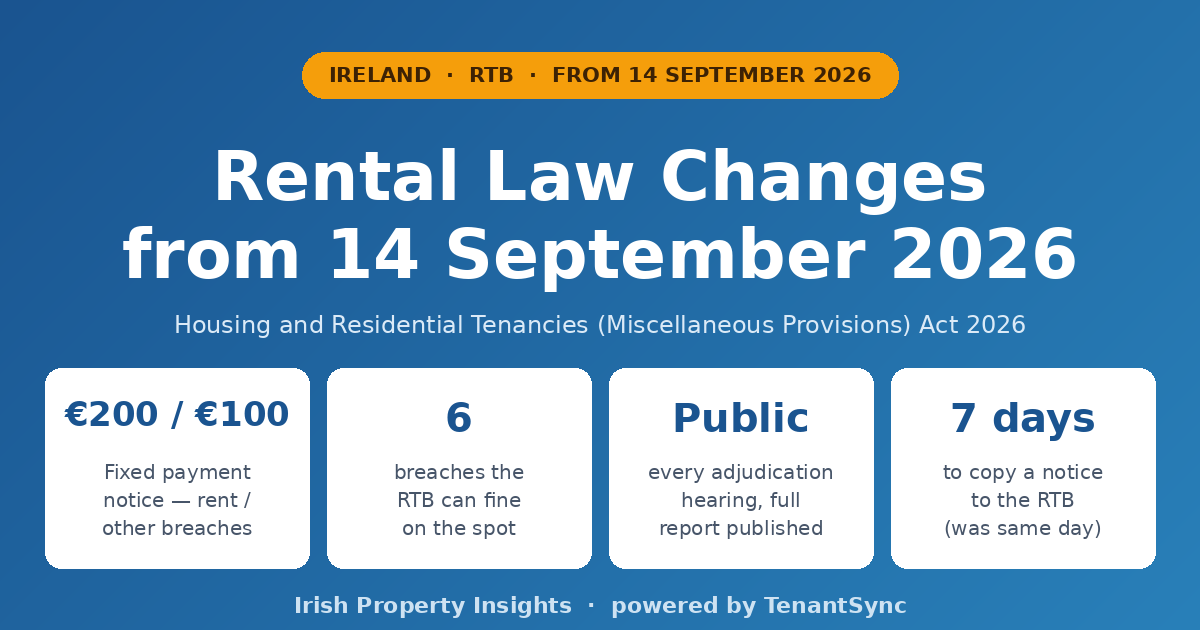
What changes on 14 September 2026? The RTB can issue fixed payment notices for six breaches of rental law — €200 for a rent breach, €100 for all others. All RTB adjudication hearings become public, with a weekly schedule and the full report published on rtb.ie, including party names, the property address, the evidence and the outcome — for applications made from 14 September onwards. Landlords now have 7 days, not the same day, to serve a copy of a notice of termination or notice of rent review on the RTB — and termination notices should not be posted to a tenant. Dispute timelines shorten to 10 working days for tribunal hearing notice and for mediation appeals.
The Four Changes, at a Glance
On 31 August 2026 the RTB confirmed that the Housing and Residential Tenancies (Miscellaneous Provisions) Act 2026 commences on 14 September 2026. Rosemary Steen, Director of the RTB, described the package as strengthening the RTB's ability to support compliance, improve transparency and deliver faster outcomes. In practice it does three things to a letting agency: it makes routine administrative slips directly chargeable, it makes disputes visible, and it changes how notices are served.
| What changes | Before 14 Sept 2026 | From 14 Sept 2026 |
|---|---|---|
| Enforcement | Investigation and prosecution | Plus fixed payment notices for six breaches — €200 / €100 |
| Adjudication hearings | Held in private | Public, scheduled weekly, full report published |
| RTB copy of a notice | Same day as the tenant is served | Within 7 days of the date of service |
| Tribunal hearing notice | 21 calendar days | 10 working days |
| Mediation appeal window | 10 calendar days (tenant) | 10 working days for case parties |
Fixed Payment Notices: the Six Breaches
A fixed payment notice is a faster enforcement route. Rather than open an investigation, the RTB can issue a notice for a defined breach and be done with it. Six breaches are covered:
- Failure to register a tenancy
- Failure to update tenancy details
- Failure to give rent setting information at the start of a tenancy
- Setting rent above the legal limit
- Failure to notify the RTB of a rent exemption
- Failure to provide a rent review notice correctly
The fine is €200 for a rent breach and €100 for all other breaches. Fixed payment notices sit on top of the RTB's existing investigation powers and its power to prosecute — they are an addition, not a softer alternative.
Read the list again — it is a list of admin
Every one of the six is a paperwork failure, not a bad-faith act. Four of them are things a busy agency does dozens of times a quarter: registering a tenancy, updating details when a tenant changes, issuing rent setting information at the start, and getting a rent review notice right. The €100 is not the exposure. The exposure is that these breaches were previously found only when someone complained, and are now cheap enough for the RTB to issue routinely.
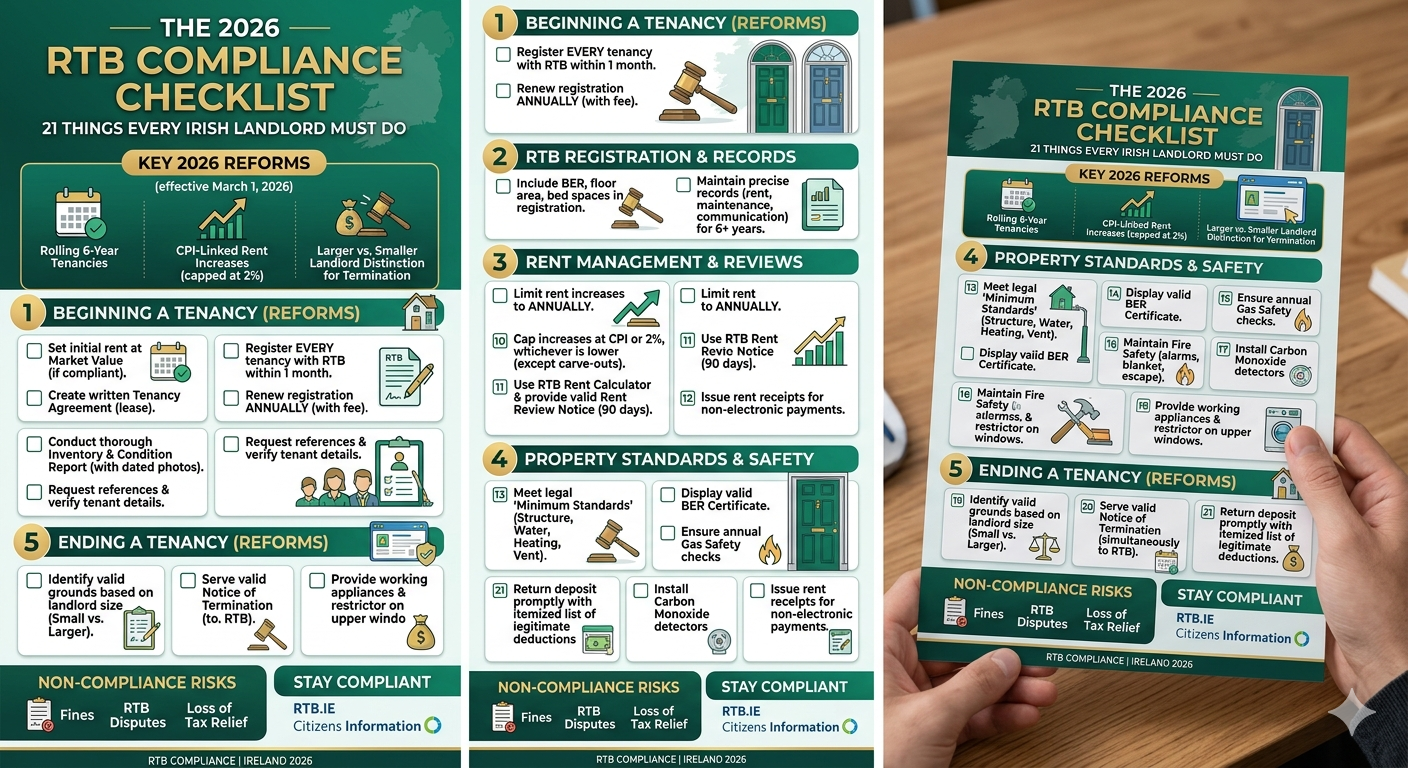
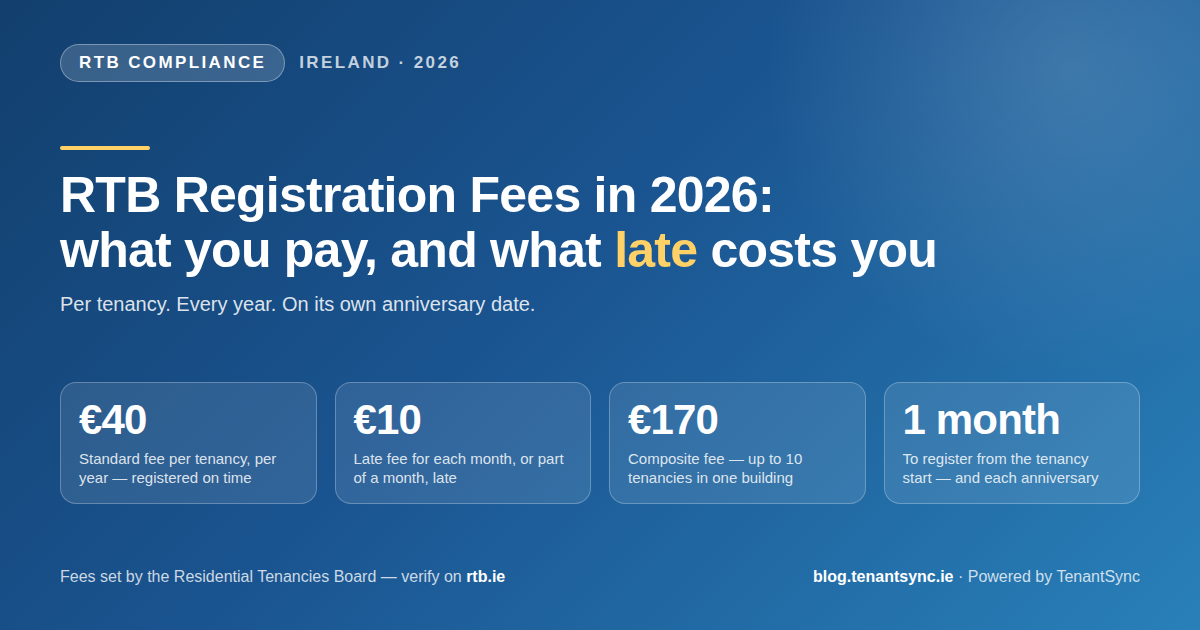
If you are not certain which of your tenancies are registered and current, that is the first thing to fix — our RTB compliance checklist and the registration fee and deadline guide cover the mechanics. On the rent side, breaches 3 to 6 all hang off getting the national rent cap calculation and the notice that carries it right.
📅 Which of your tenancies is unregistered right now?
Four of the six fixed-payment breaches are registration and rent-notice admin. Start with the dates: enter a tenancy start date and get its RTB registration deadline and next annual renewal instantly — no login, no card.
Public Adjudication Hearings
This is the change with the longest tail. From 14 September 2026, all RTB adjudication hearings must be held in public. That means:
- The RTB publishes a weekly schedule of adjudication hearings on its website.
- Members of the public can request to attend a hearing.
- The RTB publishes the full adjudication report — the names of the dispute parties, the rental property address, details of all evidence presented, and the outcome.
- The media may report on the published details.
It applies only to dispute applications made from 14 September 2026. A case applied for before that date will not have a public adjudication hearing. The change brings adjudication in line with RTB tribunal hearings, which are already public. Mediation remains private, and mediation outcomes are not published — which, from 14 September, makes mediation a materially different proposition for a landlord who would rather their name and their property's address stayed off a published report. In very limited and exceptional cases the RTB may agree to hold a hearing in private.
What this means for a letting agent
Your client's name, their property address, and the state of your file all become publishable. A dispute file that is thin — no service record, no dated copies, no evidence of what was sent and when — is no longer just a weak case. It is a weak case in public, with the agency's handling of it visible to anyone who reads the report. Evidence discipline stops being a back-office virtue and starts being reputational.
The 7-Day Rule — and No More Posting Terminations
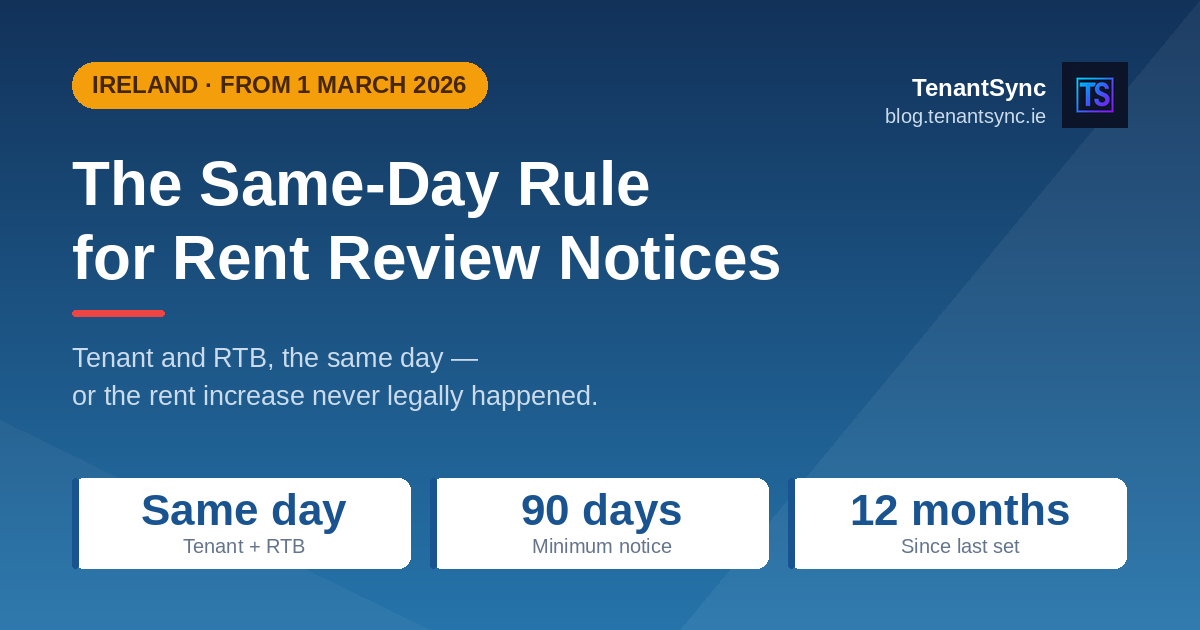
From 14 September 2026, a landlord must serve a copy of a notice of termination or a notice of rent review on the RTB within 7 days of serving it on the tenant. Previously both copies had to go out on the same day. The date of service is the date the tenant receives the notice — so the seven days run from receipt, not from the date you drafted, signed or sent it.
Keep submitting through the online RTB Service Centre for all rent setting, rent review and termination notices. What changes is the deadline, and how the tenant's copy may travel:
| Notice type | Serving the tenant | Copy to the RTB |
|---|---|---|
| Rent setting & rent review | Email, post, or hand-delivered to the tenant's address | Within 7 days of the date of service |
| Notice of termination | Not by post. Email is the RTB's recommendation; otherwise hand-deliver to the tenant or leave it at the tenant's address | Within 7 days of the date of service |
The reason for the post restriction is the date. A tenant must receive a notice of termination on the date of service listed in the notice, and post cannot guarantee that — a notice that arrives two days late has a date on its face that is no longer true. Email is recommended precisely because delivery and date are evidenced in the same act.
Don't read 7 days as breathing room
It is a relaxation on paper and a trap in practice. The old rule was simple to operate because it was one action: serve and copy, same day, done. A 7-day window creates a task that can be forgotten for six days — and the clock starts on a date you may have to establish after the fact (the date the tenant received it). If you are changing anything about your process this week, change it so the RTB copy still goes out with the tenant's copy. Use the seven days as a safety net, not as a plan.
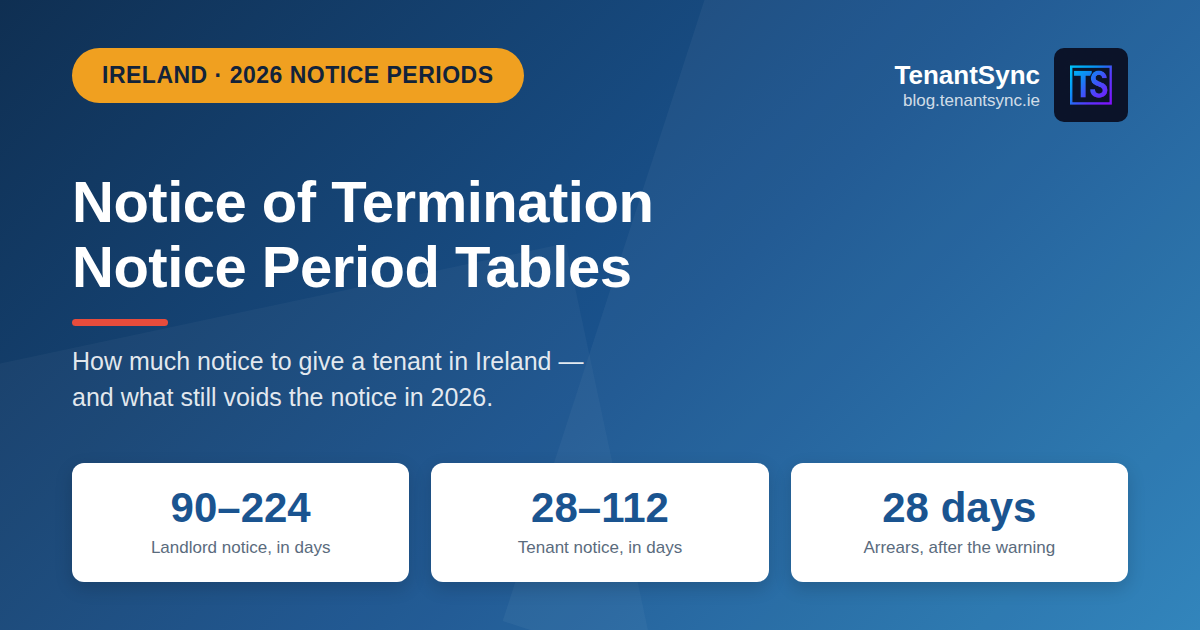
Our fuller guides now carry this change: notice of termination in 2026 for notice periods and the defects that void a notice, and the rent review notice guide for the 90-day and 12-month rules, which are unchanged.
Faster Appeals and Hearing Notice
Two dispute timelines shorten, both intended to cut processing times:
- Tribunal hearing notice: the RTB can now give 10 working days' notice of a tribunal hearing, down from 21 calendar days.
- Mediation appeals: dispute case parties have 10 working days to appeal a mediation case to a tribunal, where a tenant previously had 10 calendar days. This aligns it with the adjudication appeal period, which was already 10 working days.
Faster is better overall — but 10 working days' notice of a tribunal is not long to assemble a file, brief a landlord client, and get someone free to attend. The agencies this hurts are the ones who build the evidence pack after the hearing date lands. The agencies it helps are the ones whose file is already complete the day the notice is served.
What to Change in Your Process This Week
- Stop posting notices of termination. Switch the default to email, with hand delivery as the fallback. Update your templates and tell whoever covers for holidays.
- Record the date the tenant received the notice as a distinct field. It is now the date the 7-day RTB clock runs from, and the date the notice's validity turns on.
- Keep serving the RTB copy on the same day anyway, and treat the 7 days as the outer limit. One action, no pending task.
- Audit registrations and tenancy details across the book. Two of the six fixed-payment breaches are simply "not registered" and "details not updated".
- Re-check your rent setting and rent review packs. Four of the six breaches are rent-notice failures — the information given at the start of a tenancy, the cap calculation, exemption notification, and the review notice itself.
- Assume the file will be published. For any dispute you might apply on from 14 September, build the evidence pack as though a journalist will read it — because they may.
- Brief your landlord clients. They will hear "public hearings" from somewhere. Better it is from you, with the mediation option explained, than from a headline.
🗂️ Could you produce the service record for every notice you served this year?
From 14 September, that file may be published with your client's name and their property's address on it. TenantSync stores the finalised notice PDF, how and when the tenant was served, and the date the RTB copy went — against the tenancy, not in someone's sent items.
RTB Webinars on the Changes
The RTB is running a short series of free 30-minute webinars introducing landlords and stakeholders to the changes. As of publication, the remaining dates are:
- Monday 14 September 2026 — 12:00–12:30
- Monday 21 September 2026 — 12:00–12:30
Earlier sessions ran on 1, 8 and 10 September 2026. Registration links for the remaining webinars are on the RTB's announcement page. Thirty minutes from the regulator that will be issuing the fixed payment notices is time well spent — send whoever in your agency actually serves the notices, not only the principal.
Where TenantSync Fits
Full disclosure: this blog is published by TenantSync, and what follows is our product. It is here because five of the six fixed-payment breaches are dated obligations and notice records — exactly the things a system should be holding.
- Registration and renewal dates derived from the tenancy, with escalating reminders by email, in-app and push — so "not registered" and "details not updated" stop being discoverable by the RTB before they are discoverable by you.
- National rent cap calculation showing which rule applied and the CSO CPI figure used, with a legal disclaimer — the arithmetic behind "setting rent above the legal limit".
- Notice workflow with a service record as a first-class field: the finalised PDF, how and when the tenant was served, and the date the RTB copy went. That record is what a published adjudication report will be testing.
- A compliance dashboard across 11 obligation types, branch-scoped for agencies, resolving the whole book to compliant, upcoming or overdue.
What it does not do — plainly
TenantSync does not submit notices or registrations to the RTB on your behalf, and does not pay RTB fees or fines. Registration and notice submission happen with the RTB, through the RTB portal and Service Centre. What the product removes is the tracking and the evidence problem — the deadline nobody derived and the service record nobody kept.
Frequently Asked Questions
What changes in Irish rental law on 14 September 2026?
Four changes commence under the Housing and Residential Tenancies (Miscellaneous Provisions) Act 2026. The RTB gains power to issue fixed payment notices for six breaches of rental law. All RTB adjudication hearings become public, with a weekly hearing schedule and full adjudication reports published on rtb.ie. Landlords get 7 days, rather than the same day, to serve a copy of a notice of termination or notice of rent review on the RTB — and termination notices should no longer be sent to a tenant by post. Dispute timelines shorten: 10 working days' notice of a tribunal hearing, and 10 working days to appeal a mediation case.
What is an RTB fixed payment notice?
A fixed payment notice is a new enforcement tool that lets the RTB deal with certain breaches of rental law quickly, without a full investigation or prosecution. From 14 September 2026 it covers six breaches: failure to register a tenancy, failure to update tenancy details, failure to give rent setting information at the start of a tenancy, setting rent above the legal limit, failure to notify the RTB of a rent exemption, and failure to provide a rent review notice correctly. A landlord who receives one could face a fine of €200 for a rent breach and €100 for all other breaches. Fixed payment notices are additional to the RTB's existing prosecution and investigation powers, not a replacement for them.
How much is an RTB fixed payment notice fine?
€200 for a rent breach and €100 for all other breaches. The figure is small relative to the RTB's other sanctions, which is the point — it is designed to be issued quickly and often rather than as a substitute for investigation. The real cost for a letting agent is rarely the fine: it is the conversation with the landlord client about why a fine was issued against their tenancy at all.
Are RTB adjudication hearings public from 14 September 2026?
Yes. From 14 September 2026 all RTB adjudication hearings must be held in public. The RTB will publish a weekly schedule of hearings on its website, members of the public can request to attend, and the RTB will publish the full adjudication report — including the names of the dispute parties, the rental property address, details of all evidence presented and the outcome. The media may report on the published details. This applies only to dispute applications made from 14 September 2026; cases applied for before that date are not affected. The change aligns adjudication with RTB tribunal hearings, which are already public. Mediation stays private and mediation outcomes are not published. In very limited and exceptional cases the RTB may agree to hold a hearing in private.
Do I still have to send a notice of termination to the RTB on the same day?
No. From 14 September 2026 a landlord must serve a copy of a notice of termination or notice of rent review on the RTB within 7 days of serving it on the tenant. Previously the copy had to go to the RTB on the same day. The date of service is the date the tenant receives the notice, so the 7 days run from receipt, not from the date you drafted or posted it. Notices should continue to be submitted through the online RTB Service Centre.
Can I post a notice of termination to a tenant after 14 September 2026?
Termination notices should not be sent to a tenant by post. The tenant must still receive the notice on the date of service listed in the notice, and post cannot guarantee that. The RTB recommends that landlords email the notice to the tenant so it arrives on the correct date; where email is not possible, the notice can be hand-delivered to the tenant or left at the tenant's address. Rent setting and rent review notices can still be served by email, by post, or by hand delivery to the tenant's address.
What are the new RTB dispute timelines from 14 September 2026?
Two timelines change. The RTB can give 10 working days' notice of a tribunal hearing to dispute case parties, down from 21 calendar days. And dispute case parties have 10 working days to appeal a mediation case to a tribunal hearing, where a tenant previously had 10 calendar days — which brings the mediation appeal period in line with the existing adjudication appeal period of 10 working days. Both changes are intended to reduce dispute processing times, and both compress how long you have to prepare.
Do the 14 September 2026 changes apply to existing tenancies?
The service rules and the fixed payment notice powers relate to what you do from 14 September 2026 onwards, across your whole book — they are not limited to tenancies created after that date. The public hearings change is different and is limited by application date: it applies only to dispute applications made from 14 September 2026, so a case applied for before then will not have a public adjudication hearing. Check your own circumstances with the RTB.
Summary
- 14 September 2026 — commencement date for the Housing and Residential Tenancies (Miscellaneous Provisions) Act 2026.
- Fixed payment notices for six breaches: €200 for a rent breach, €100 for all others. Additional to investigation and prosecution, not instead of them.
- All adjudication hearings become public — weekly schedule, public attendance, and a full report published with party names, the property address and the evidence. Applications made from 14 September only. Mediation stays private.
- 7 days to serve the RTB copy of a notice of termination or rent review, running from the date the tenant receives it. Keep doing it same-day anyway.
- Do not post a notice of termination. Email, or hand-deliver, or leave it at the address.
- 10 working days for tribunal hearing notice and for mediation appeals.
- Verify before you advise a client. Take the position from rtb.ie on the day you need it.
🔔 Three days to change how your agency serves notices
Deadlines derived from every tenancy, rent caps calculated with the rule shown, and a dated service record against every notice you send. Before the fixed payment notices start landing, find out what your book actually looks like.
Sources & Further Reading
This is commencement-date content and the detail will be refined as the RTB publishes guidance. Check every point against the RTB's own pages before you rely on it or advise a landlord client.
- RTB — Important changes to rental law from 14 September 2026 (the announcement this article is based on, published 31 August 2026)
- RTB — What can the RTB investigate (the existing investigation powers that fixed payment notices sit alongside)
- RTB — Dispute resolution (mediation, adjudication and tribunal routes)
- RTB — Ending a tenancy (notice of termination requirements)
- RTB — Register a tenancy (registration and updating tenancy details)
- Irish Statute Book (the Housing and Residential Tenancies (Miscellaneous Provisions) Act 2026 as enacted)
- Citizens Information — Renting a home
Related Articles