Why Irish Letting Agents Are Switching From Spreadsheets to RTB Compliance Software
Irish agencies are managing more properties and more compliance than ever, and mostly with the same lean team. A spreadsheet keeps up with the data. It does not keep up with the deadlines, the rent-cap maths, the reminders, or the proof of what you served and when — and since 1 March 2026, and again from 14 September, each of those is a professional liability, not a private mistake. Here is the point at which agents decide the spreadsheet has to go, and what they move to instead.

The short version
Why are Irish letting agents switching from spreadsheets to RTB compliance software? Because the compliance work grew and the teams didn't. Since 1 March 2026 every tenancy carries a national rent-cap calculation, a six-year Tenancy of Minimum Duration, and a small-vs-large-landlord classification; from 14 September 2026 the RTB can fine routine admin slips on the spot and publishes the full adjudication report. A spreadsheet can store that, but it cannot compute a deadline, calculate a compliant rent, remind anyone, or prove what was served. Across a book of tenancies, agents move to software that does — to save time, cut compliance risk, and keep one audit-ready record. If you're still tracking tenancy documents manually, you're carrying avoidable risk.
The Four Moments a Spreadsheet Stops Being Safe
Nobody starts a letting agency intending to run it on a spreadsheet forever. It is where everyone starts because it is free, familiar, and — for the first handful of tenancies — genuinely enough. The switch happens later, and it is almost never a single dramatic failure. It is the slow realisation that the spreadsheet holds the data but does none of the work, and that the work has quietly become the job.
There are four recurring moments where agents tell us the spreadsheet crossed from helpful to hazardous. You will recognise at least one of them.
| The task | On a spreadsheet | On compliance software |
|---|---|---|
| An RTB deadline lands | A date typed in a cell that nobody is watching. The 30-day registration clock and the annual renewal are yours to remember. | The deadline is derived from the tenancy and chased with escalating reminders before it is overdue. |
| A rent review is due | You calculate the cap by hand, hope the formula and the index are right, and keep no record of which rule you applied. | The national rent cap is calculated, the rule (2% vs CPI) is shown, and the CPI figure used is cited and stored. |
| A notice is served | A Word file in someone's sent items. No dated proof of how or when the tenant received it. | The finalised PDF and a service record — how and when served, and when the RTB copy went — sit against the tenancy. |
| An audit or dispute arrives | An afternoon reconstructing a year of records from tabs, emails and memory. | A one-click evidence pack from a record that was built as you went, not after the fact. |
The common thread is that a spreadsheet is a record of what happened. Compliance is about making sure the right thing happens, on time, provably. Those are different jobs, and the gap between them widens with every tenancy you take on. For the mechanics of exactly how a spreadsheet breaks at scale, we go deeper in why spreadsheet property management breaks for letting agents.
Reason 1: It Gives You the Hours Back
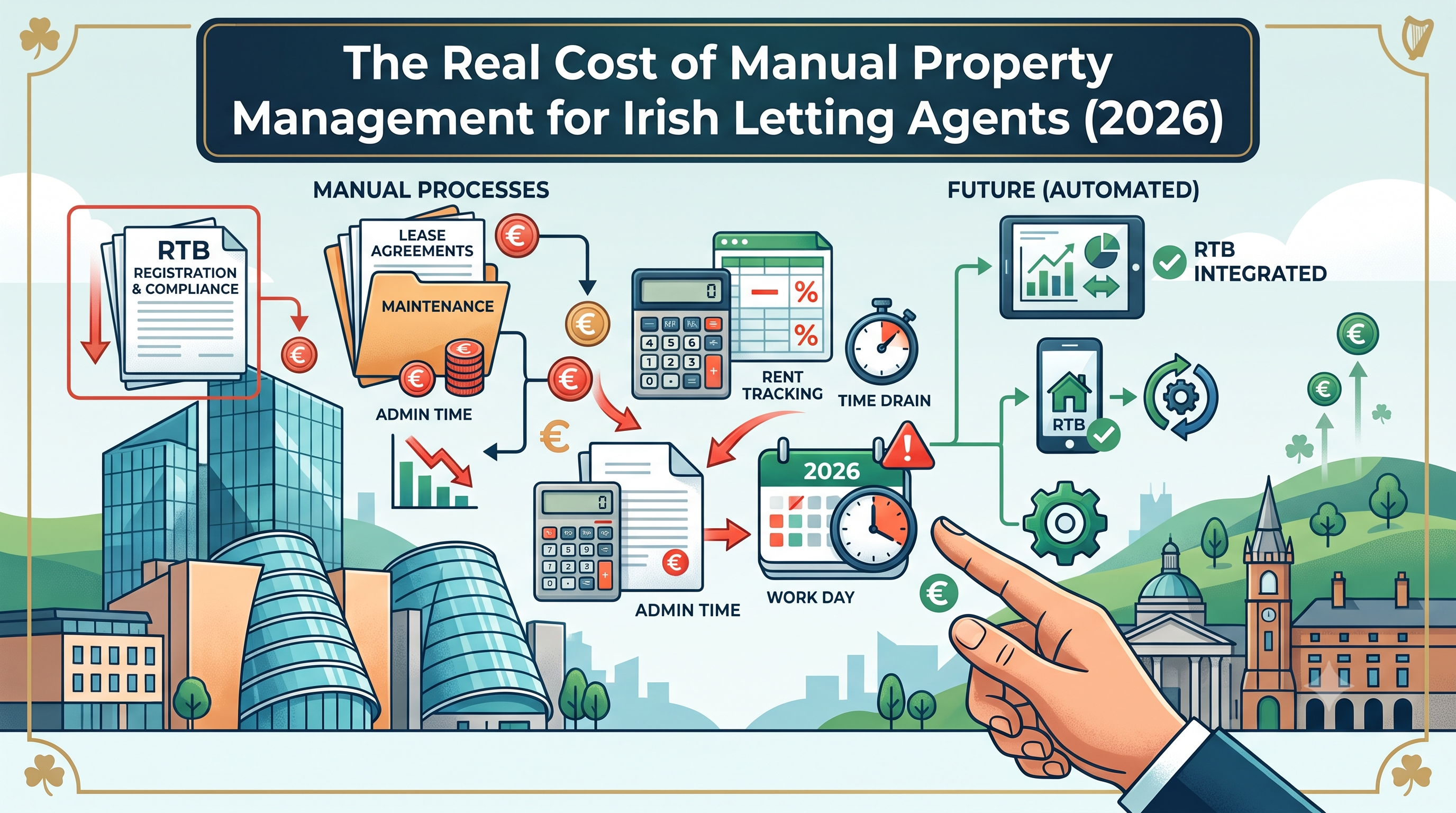
Start with the least controversial reason, because it is the one every principal feels first: time. An agency book is not one big task. It is hundreds of small, repeating, dated ones — a registration here, a renewal there, a rent review, a Part 4 notice, a certificate about to expire. Each is a few minutes. Multiplied across the book and repeated every month, those minutes are a full role that nobody was hired for.
The 2026 rules made that admin heavier, not lighter. Every rent review now needs a cap calculation and, on a new let, three comparables from the RTB Rent Register. Every notice needs a copy to the RTB. Every tenancy needs its regime worked out — pre- or post-March-2026, small or large landlord. Software does not make the obligations disappear; it makes them compute themselves. The deadline is derived, the cap is calculated, the reminder is sent, and the person who used to hold all of it in their head is freed to do the work that actually grows the agency.
The lean-team maths
The reason this lands hardest in Ireland right now is that the book is consolidating toward professionally managed portfolios while teams stay small. More tenancies, more compliance per tenancy, the same two or three people. Automation is not a luxury in that picture — it is how a lean team takes on more landlord clients without hiring an administrator whose entire job is chasing dates.
Reason 2: It Turns Compliance Risk Into a Tracked Task
This is the reason that has changed most in 2026, and it is why "we've always used spreadsheets" stopped being a defensible answer. Two dates matter.
1 March 2026 replaced Rent Pressure Zones with a national rent cap — the lower of 2% or CPI, applied everywhere — moved the reference index from HICP to the CSO's Consumer Price Index, introduced six-year Tenancies of Minimum Duration, and split landlords into small (three or fewer tenancies) and large (four or more) with different rights. Every one of those is a per-tenancy calculation a spreadsheet cannot make for you.
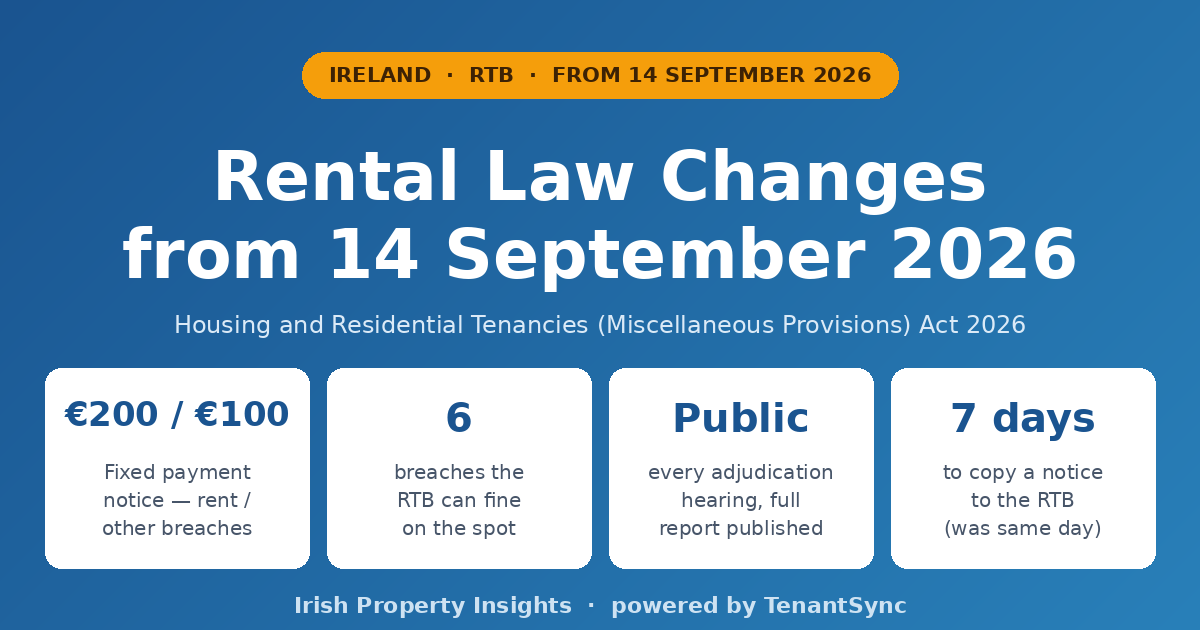
14 September 2026 raised the stakes on getting it wrong. The RTB can now issue fixed payment notices for six routine breaches — failing to register a tenancy, failing to update details, not giving rent-setting information, setting rent above the limit, not notifying a rent exemption, and getting a rent review notice wrong. The fine is small on its face (€200 for a rent breach, €100 for the rest), but the six breaches are exactly the admin a busy agency does dozens of times a quarter, and they used to be found only when someone complained. Now they are cheap enough for the RTB to issue routinely.
The fine is never the real cost
A €100 fixed payment notice is not what keeps a principal up at night. The real exposure is an over-the-cap rent increase that is void and has to be repaid; RTB improper-conduct sanctions, commonly cited at up to €15,000 (plus up to €15,000 in costs), and adjudication or tribunal awards; the staff hours lost to reconstructing a file; and — from 14 September — the fact that the adjudication report is now public, with your client's name, their property's address and the state of your file in it. The single most expensive outcome is the landlord client who leaves after a failure they were never told about.
A spreadsheet cannot reduce any of this, because it does not know a deadline is approaching, cannot check a rent against the cap, and holds no proof of service to defend a notice. Software turns each risk into a tracked task with an owner and a due date, and keeps the evidence that a challenged decision was made correctly. That is the whole difference between hoping you are compliant and being able to show it. If you want to put a number on the exposure, the cost of manual property management is a good companion read.
📅 Which of your tenancies is unregistered or overdue right now?
You cannot fix a risk you can't see. Enter a tenancy start date and get its RTB registration deadline and next annual renewal instantly — no login, no card. It is the fastest way to find out what your spreadsheet isn't telling you.
Reason 3: One Record You Can Actually Stand Behind
Ask a letting agent where the truth about a tenancy lives and the honest answer is usually "in a few places". The rent is in the spreadsheet, the lease is on a shared drive, the RTB confirmation is in an inbox, the notice is in someone's sent items, and the deposit was noted somewhere at the start. Each is fine until the day you need all of it at once — a dispute, a landlord query, a PSRA inspection — and then you are the search engine.
Centralising records is not tidiness for its own sake. It is what makes an audit trail possible. A spreadsheet has no memory: a cell can be overwritten and nobody knows it changed, by whom, or what it said before. A platform records who did what and when, so the version of events you present is the version the system can prove. When adjudication is public and a fixed payment notice can turn on whether a detail was updated, "we're fairly sure" is not a position you want to defend.
The test that decides it for most agents
Could you produce, in five minutes, the full compliance record for any single tenancy in your book — registration status and dates, the last rent review and the rule you applied, every notice served with proof of service, and the certificates on file? If yes, your system is working. If it would take an afternoon of searching, that afternoon is the cost of the spreadsheet, and it recurs every time anyone asks.
What to Look For When You Switch
Not all "property management software" is compliance software. Most global tools are excellent at rent ledgers and maintenance and know nothing about Form 1, the CPI/2% cap, or Part 4. For an Irish agency the deciding question is whether the tool was built for Irish law or adapted to it. Use this as a checklist:
- RTB registration and renewal, derived automatically. The 30-day deadline computed from the tenancy start, annual renewal tracked, with escalating reminders — not a date you have to type and watch.
- A national rent-cap calculation that shows its working. The maximum legal rent, the rule that applied (2% vs CPI), and the CSO CPI figure it used, with a disclaimer — so you stay in control and audit-ready.
- Part 4 and Tenancy of Minimum Duration tracking, with reminders at the dates that change a tenant's rights.
- A compliance dashboard that resolves the whole book to compliant / upcoming / overdue across the different obligation types, not one tenancy at a time.
- A notice workflow with a service record. Draft → validate → preview → finalise as a stored PDF, plus how and when the tenant was served and when the RTB copy went.
- Agency-level compliance, not just tenancy-level. PSRA licence and renewal tracking, designated client-account reconciliation, s.43 Letters of Engagement and the annual Accountant's Report — the obligations that are yours, not the landlord's.
- Automatic rent reconciliation against Irish banks, so arrears surface the day they happen instead of at month-end.
- Branch-level scoping, a real audit trail, and a genuine migration path — ideally a direct import from your current system and your spreadsheet.
Our fuller buyer's guide, what to look for in property management software in Ireland, expands each of these, and bulk RTB compliance for letting agents covers running it across a whole book.
Where TenantSync Fits
Full disclosure: this blog is published by TenantSync, and what follows is our product. It is here because TenantSync was built for exactly the checklist above — Irish RTB and PSRA compliance is the thing it does, not a module bolted onto a global tool.
- RTB registration lifecycle — the 30-day deadline auto-computed from the tenancy start, annual renewal tracking, a "renew from previous" pre-fill, and compliance-risk scoring across the book.
- National rent-cap calculator — the maximum legal rent per tenancy, the rule applied, and the CSO CPI figure used, shown with a legal disclaimer.
- Compliance dashboard across 11 obligation types — RTB registration, renewal, rent review, Part 4, BER, insurance, fire alarm, gas safety, electrical cert, AML review and custom — colour-coded and branch-scoped for agencies.
- Notice and Form 1 workflow — draft → validate → preview → finalise to a signed PDF, with a service record kept as a first-class field.
- PSRA / PSR compliance module (agency plans) — licence and renewal tracking, designated client-account reconciliation, s.43 Letters of Engagement, and the annual Accountant's Report pack, with a one-click inspection evidence pack.
- Open Banking rent reconciliation — connect AIB, Bank of Ireland, PTSB, EBS, Revolut, N26, Wise and other PSD2 banks; incoming payments auto-match to the tenancy and arrears surface immediately. TenantSync never sees your bank credentials.
What it does not do — plainly
TenantSync does not submit registrations or notices to the RTB on your behalf, and does not pay RTB fees or fines — those happen with the RTB, through the RTB portal and Service Centre. What it removes is the tracking and the evidence problem: the deadline nobody derived, and the service record nobody kept. It is available on web and on the iPhone and Android apps, so the dashboard and reminders travel with whoever is out doing viewings.
🗂️ See your whole book resolve to compliant, upcoming or overdue
In 15 minutes we'll show you your compliance dashboard, a rent-cap calculation with the rule shown, and a notice with its service record attached — using the way your agency actually works. If you're still tracking tenancy documents manually, this is the fastest way to see what you're exposed to.
How Switching Actually Works
The objection is never really "software wouldn't help". It is "switching sounds like a project I don't have time for". Fair — but the switch is an import, not a rebuild, and it is smaller than it looks when the tool is built for the way an Irish agency already keeps its records.
- Bring the book in. Import your existing spreadsheet, or — if you are on another system such as Letman — import directly from it, so properties, tenancies and tenants arrive already structured rather than re-keyed.
- Let the deadlines derive themselves. Once tenancies are in, registration and renewal dates compute automatically. The first thing you see is which tenancies are current and which need attention — often the most useful hour of the whole process.
- Confirm and clean up. Work the overdue and upcoming lists down. This is the compliance catch-up you were going to have to do anyway; the software just found it for you.
- Move rent last. Connect the bank for reconciliation once the compliance side is settled, so you are never switching everything on the same day.
Start with a single branch or a slice of the book rather than the whole agency at once, and choose a supplier that offers a done-with-you migration instead of leaving you with a blank screen. The full playbook is in how to migrate a letting agency off spreadsheets.
Don't wait for a quiet quarter
Agencies that plan to switch "after the busy period" tend to switch after an incident instead — a missed renewal, a void increase, a dispute where the file wasn't there. The reforms are live now and the fixed payment notices started on 14 September. The cheapest time to switch is before the thing you're trying to avoid actually happens.
Frequently Asked Questions
Why are Irish letting agents moving off spreadsheets?
Because the amount of dated, per-tenancy compliance work grew faster than their teams did. Since 1 March 2026 every tenancy carries a national rent cap calculation, a six-year Tenancy of Minimum Duration framework, and a small-versus-large-landlord classification; from 14 September 2026 the RTB can issue fixed payment notices for routine administrative breaches, and adjudication hearings are public with the full report published. A spreadsheet can hold the data, but it cannot compute a deadline, calculate a compliant rent, remind anyone, or prove what was served and when. At 30, 100 or 200 tenancies that gap stops being an inconvenience and becomes a professional liability, so agencies switch to software that tracks the obligations for them.
What is RTB compliance software?
RTB compliance software is a property management platform built around Irish residential tenancy law rather than adapted from a generic tool. For a letting agent that means it derives the 30-day RTB registration deadline and the annual renewal date from each tenancy, calculates the national rent cap (the lower of 2% or CPI) and shows which rule applied, tracks Part 4 and Tenancy of Minimum Duration dates, runs a compliance dashboard across the different obligation types, and keeps a dated record of every notice served and copied to the RTB. Stronger platforms add PSRA and client-money compliance for the agency itself, and reconcile rent automatically against the bank.
Is a spreadsheet good enough for RTB compliance?
A spreadsheet is a fine place to record what happened. It is a poor place to make sure the right thing happens on time. It does not know that a tenancy registered on the 3rd has a deadline on the 2nd of next month, it will not email a reminder, it cannot calculate a compliant rent increase or cite the figure it used, and it holds no proof of how or when a notice was served. It also has no audit trail, so a wrong cell can be overwritten without anyone noticing. For a single tenancy that is survivable. Across a book of tenancies, where each one is a separate deadline and a separate liability, it stops being good enough — which is the point most agencies decide to switch.
What does poor tenancy compliance actually cost a letting agent?
The direct fines are the smallest part. From 14 September 2026 an RTB fixed payment notice is €200 for a rent breach and €100 for other breaches. The larger costs are an over-the-cap rent increase that is void and has to be repaid, RTB improper-conduct sanctions (commonly cited at up to €15,000, plus up to €15,000 in costs) and adjudication or tribunal awards, the staff hours spent reconstructing records for a dispute, and — now that adjudication hearings are public with the report published — the reputational cost of a thin file being read by a landlord client or a journalist. The most expensive outcome of all is usually the landlord client who leaves after a compliance failure they were never told about.
How hard is it to switch a letting agency off spreadsheets?
Less than most principals expect, because the switch is an import rather than a rebuild. A platform built for the Irish market will import your existing spreadsheet and, where you are moving from another system such as Letman, import directly from it, so properties, tenancies and tenants arrive already structured. A sensible order is to bring the book in, let the software derive the registration and renewal deadlines, confirm which tenancies are current, and only then move rent collection across. Choose a supplier that offers a done-with-you migration and start with a single branch or a subset of the book rather than switching everything on one day.
Do I still have to use the RTB portal if I have compliance software?
Yes. Registration, tenancy updates and notice submission happen with the RTB, through its own online Service Centre, and RTB fees and any fines are paid to the RTB. Good compliance software does not submit on your behalf or replace the portal — it removes the two things the portal will never do for you: derive and chase the deadlines across your whole book, and keep the dated evidence pack that proves what you did and when. Be cautious of any tool that claims to file with the RTB for you.
What should a letting agent look for in RTB compliance software?
Look for software built for Irish law rather than adapted to it: automatic RTB registration and renewal deadlines derived from the tenancy, a national rent-cap calculation that shows the rule and the CPI figure it used, Part 4 and Tenancy of Minimum Duration tracking, a compliance dashboard that resolves the whole book to compliant, upcoming or overdue, a notice workflow that stores the finalised PDF and a service record, and — for the agency itself — PSRA licence, client-money and Accountant's Report support. Automatic rent reconciliation against Irish banks, branch-level scoping for multi-office agencies, a real audit trail, and a low-friction migration path round out the list.
Summary
- The work outgrew the tool. Irish agencies manage more tenancies and more compliance with the same lean teams; a spreadsheet stores the data but does none of the dated work.
- Time. Deadlines derive themselves, rent caps calculate, reminders send — hours back that used to be a full role nobody was hired for.
- Risk. Since 1 March 2026 (national rent cap, TMD, small vs large landlord) and 14 September 2026 (fixed payment notices, public adjudication), a missed date is a liability, not a private slip. Software turns each risk into a tracked task with proof.
- Records. One centralised, audit-trailed record you can produce in five minutes — for a dispute, a landlord, or a PSRA inspection.
- Switching is an import, not a rebuild. Bring the book in, let the deadlines derive, clean up, move rent last — ideally with a done-with-you migration.
- Verify before you advise a client. Take the legal specifics from rtb.ie and psr.ie on the day you need them.
🔔 Still tracking tenancy documents by hand?
Then you're carrying avoidable risk on every tenancy in your book. See what your compliance looks like when the deadlines, the rent-cap maths and the proof of service are handled for you — before the next fixed payment notice, dispute or lost client makes the case for you.
Sources & Further Reading
This article references rules made by statute and administered by the RTB and PSRA. Check every legal point against the source pages before you rely on it or advise a landlord client.
- RTB — Important changes to rental law from 14 September 2026 (fixed payment notices, public hearings, the 7-day copy rule)
- RTB — Setting and reviewing private rents from 1 March 2026 (the national rent cap and comparables)
- RTB — Register a tenancy (registration and the annual renewal)
- RTB — What can the RTB investigate (sanctions and improper conduct)
- PSRA — Information for licensees (licensing, client money and the Accountant's Report)
- Citizens Information — Changes to the rules for renting from March 2026
Related Articles