PSRA Licence Renewal 2026: The 24 September Deadline and the Accountant's Report Trap
The renewal invitation lands in an inbox in mid-August with a PIN in it, and it looks like an hour of admin. It isn't. The form is an hour; the Accountant's Report is however long your client-account records take to assemble — and it is the component that pushes agencies past the statutory deadline. Here are your three dates, what the application actually requires, and the two dates in your accounting year that decide whether the report is straightforward or a scramble.
The short version
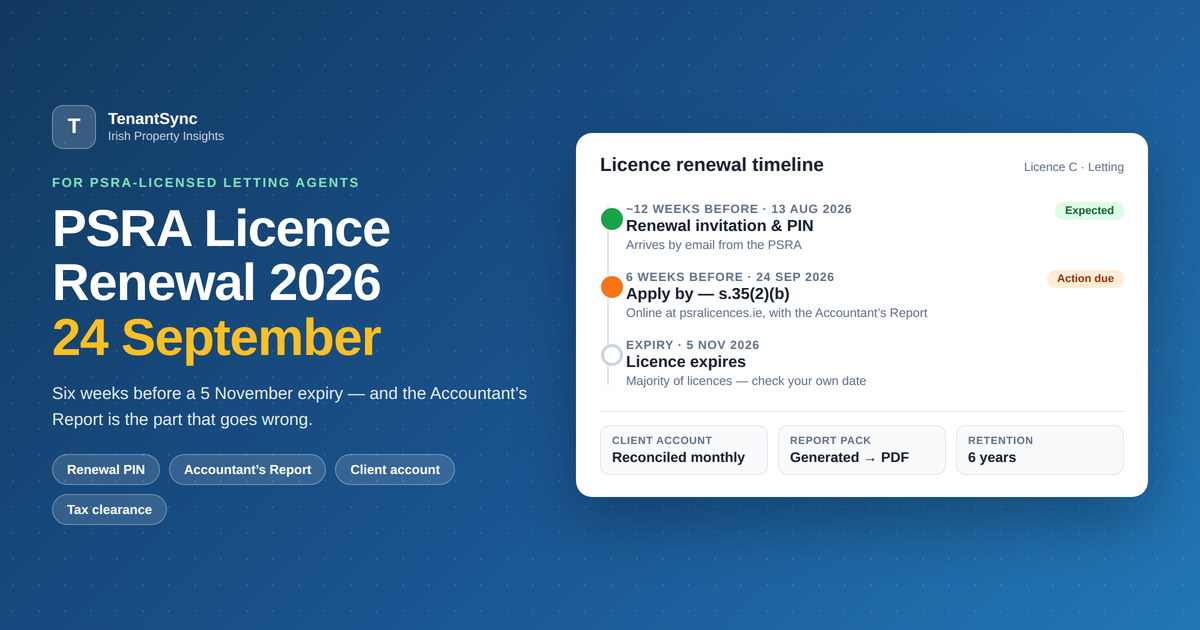
When is the PSRA renewal deadline in 2026? At least six weeks before your licence expires. The majority of PSRA licences expire on 5 November, which makes the application due by 24 September 2026. The renewal invitation with your unique PIN issues roughly 12 weeks before expiry — around 13 August for a 5 November licence — and the application is made online at psralicences.ie. Miss the statutory date and your licence is not valid after it expires. Apply in time and, under s.35(3), the licence continues in force until the Authority decides. The part that goes wrong is not the form. It is the Accountant's Report, which is an independent accountant's opinion on client-account records you must be able to produce — including the balancing statements prepared at each balancing date in your accounting period.
Your Three Dates — and How to Find Yours
Everything in a PSRA renewal year is derived from one number: the expiry date printed on your licence. Get that right and the rest is subtraction.
A Property Services Provider licence runs for a year. Roughly 12 weeks before it expires, the Authority issues a renewal invitation containing a unique PIN, which is what you use to complete the renewal application online at psralicences.ie. And section 35(2)(b) of the Property Services (Regulation) Act 2011 provides that a licensee should apply to renew at least six weeks before the expiry date.
Six weeks is 42 days. Twelve weeks is 84 days. So:
Scroll the table sideways to see every column.
| Milestone | How it is derived | If your licence expires 5 Nov 2026 | What you do |
|---|---|---|---|
| Renewal invitation & PIN | Expiry − ~84 days (~12 weeks) | Around 13 August 2026 | Watch for it. If it hasn't arrived, chase the PSRA — don't wait. |
| Apply-by date (statutory) | Expiry − 42 days (6 weeks), s.35(2)(b) | 24 September 2026 | Application submitted online, with the Accountant's Report and everything else attached. |
| Expiry | The date on the licence | 5 November 2026 | Nothing, if you applied in time. Everything, if you didn't. |
5 November covers the majority of licences — not all of them
The PSRA's own guidance uses the 5 November expiry, and the 24 September application date, because that pairing covers the majority of licences. It does not cover every licence, and it does not cover licences issued off-cycle or individual licences taken out mid-year. Check your own expiry date on the licence or on the PSRA's public Register of Licensed Property Services Providers, then subtract 42 days. If your date is not 5 November, every date in this article shifts with it — the arithmetic doesn't.
Count the licences, not the agency
The second thing agencies get wrong is treating "our licence" as a single object. Licences are issued per person as well as per business: the property services employer holds one, and principal officers and employees who provide property services hold their own. A four-person lettings team can be carrying six licences, each with its own expiry date and its own clock.
Renewing the business licence flawlessly while a negotiator's individual licence quietly lapses does not leave you 90% compliant. It leaves the work that person does outside the regime. Before you do anything else, list every licence the agency depends on, with its holder, its type and its expiry date, and derive the two dates for each one.
What a Renewal Application Actually Requires
The renewal itself is submitted online with the PIN from the invitation. What has to be behind it is more than most principals remember from last year, because most of it was assembled by someone else.
Scroll the table sideways to see every column.
| Component | What it involves | Lead time you need |
|---|---|---|
| The online application | Submitted at psralicences.ie using the unique PIN issued with the renewal invitation. | An hour, once everything else exists. |
| Accountant's Report | Required from a property services employer (company, partnership or sole trader) or an independent contractor on renewal. PSRA/S35 – Renewal ABC where a client account is held; PSRA/S35 – Renewal D where service charges or sinking fund contributions are paid into a relevant account. | Weeks. This is the section below. |
| Tax clearance | Tax Clearance Certificates in respect of the business and each of its directors or partners. | Days — longer if anyone has an open Revenue issue. |
| Professional indemnity insurance | PII covering the business and the principal officers and employees providing property services on its behalf, at the level set by the PSRA's PII Regulations. | Renewal cycle of your policy — check it aligns. |
| Compensation Fund contribution | The statutory Property Services Compensation Fund contribution: €200 for employers, €50 for employees (unchanged as at June 2026). | Paid with the application. |
| Licence fees | Effective 1 June 2026: €1,380 for a company, partnership or sole trader / independent contractor, and €200 for each principal officer or employee. | Paid with the application — budget for every licence, not one. |
On the PII figure — check it, don't assume it
The cover requirement is set by the Property Services (Regulation) Act 2011 (Professional Indemnity Insurance) Regulations 2012, and it is expressed in relation to your fee turnover subject to a minimum, rather than as a single flat number that applies to everyone. Those Regulations were amended in 2024. Do not assume the cover level you arranged three renewals ago still satisfies the requirement — confirm the current minimum with the PSRA or your broker, and make sure the certificate you attach reflects it. This is a cheap thing to get right and an expensive thing to get wrong at the last minute.
Notice the pattern. The two things you control outright — the form and the fees — take an afternoon. The three that depend on someone outside your office — an accountant, Revenue, a broker — are the three with real lead times, and they are the three you cannot compress by working late. That is why "I'll do the renewal in September" is a plan that fails: September is when you find out how long other people need.
📅 See a renewal year that runs itself
Licence records per holder, a renewal timeline that counts down from the 12-week and 6-week marks, client-account ledgers that build from the bank feed, and an Accountant's Report pack you hand to your accountant instead of assembling by hand. Fifteen minutes, your agency, real screens.
The Accountant's Report Trap
Here is the sentence that explains every late renewal: the Accountant's Report is not a form you complete. It is an opinion someone else forms about records you already keep.
If those records are current, the report is a professional formality and a fee. If they aren't, the report cannot be produced at all until they are reconstructed — and reconstruction happens at your accountant's pace, in their busy season, using documents you have to find. That is the gap between an agency that renews in a morning and an agency that spends five weeks on it.
Who is allowed to sign it
The accountant preparing the report must be a member of an accountancy body regulated by the Irish Auditing and Accounting Supervisory Authority (IAASA) — Chartered Accountants Ireland, for instance — and must be independent of the applicant, meaning not an employee of the business.
This matters more than it looks. The person inside your agency who does the bookkeeping, knows where everything is, and could produce the numbers fastest is precisely the person who cannot sign the report. So the work must be handed over, and handing over unreconciled records is where the time goes.
Which form applies to you
- PSRA/S35 – Renewal ABC is completed where a client account is held. If you collect rent or hold deposits on behalf of landlord clients, this is you.
- PSRA/S35 – Renewal D is completed where service charges and/or sinking fund contributions are paid into a relevant account — the property management side.
An agency doing both lettings and block management should establish which report or reports its licence categories require before it briefs the accountant, not after. The current forms are published on the PSRA's forms and resources for licensees page — download this year's version rather than reusing last year's file.
What the accountant actually tests
For a renewal application the accountant is required to report on the accuracy of the property services provider's client account records, and must perform testing on a sample of transactions, including an examination of:
- bank lodgements — money in, and whether it landed in the right account;
- bank statements for the designated client account;
- the client account balancing statement.
Read that list as an instruction rather than a description. It tells you exactly what to have ready: a designated client account, a ledger per client, lodgement records you can tie to specific tenancies, and balancing statements prepared at the right dates. Everything else in the renewal is paperwork. This is the audit.
The question that predicts your September
Ask yourself, right now, without opening anything: "If my accountant asked me this afternoon for a per-client breakdown of the client account as at our last balancing date, reconciled to the bank statement, how long would that take?" If the honest answer is measured in hours, your renewal is a formality. If it is measured in days, start today — you have weeks, not months, and your accountant has other clients with the same deadline.
The Two Dates Your Accountant Will Ask About
Under the client money rules, a licensee prepares a balancing statement at each balancing date. There are two in an accounting period:
- Six months after the commencement of the relevant accounting period, and
- the end of the accounting period.
The balancing statement balances the total credit balances on the client ledger accounts against the client ledger control account and the client account bank statements — the three views of the same money agreeing with each other. And each balancing statement should be prepared no later than two months after the balancing date it relates to.
Why this is the whole ballgame
The Accountant's Report is built on the balancing statement. If your balancing statements exist, were prepared close to their balancing dates, and tie out, the accountant is testing a sample against records that already agree. If they don't exist — or were assembled retrospectively in one sitting, months later, from a bank statement — the accountant is not testing your records, they are building them. That is a different engagement, a different fee, and a different timeline. Same deadline.
What "reconciled" means in a lettings agency
Client money in a letting agency has an awkward shape: rent arrives daily, in small amounts, from dozens of different people, with payment references that range from perfect to imaginative — and it goes out monthly, in larger amounts, to landlords, minus fees and approved deductions. Between those two rhythms sits the ledger that has to explain, for every client, exactly what came in, what went out, and what is still theirs.
Reconciling that by hand at the end of a period means reading a bank statement and reconstructing intent. Reconciling it as it happens means the balancing statement is a report you run rather than a project you undertake. Agencies that have moved rent collection onto an Open Banking feed that matches payments to tenancies as they land are, without necessarily framing it this way, doing their client-money compliance continuously — which is why their September looks different from everyone else's.
The retention point is the other half of it: client account records, ledgers, reconciliations and supporting documentation should be retained for six years. A renewal is an annual event; an inspection can look back much further. Records that only exist because someone rebuilt them for last year's report are not records.
Six Ways the Report Stalls — and What Each One Costs You
These are the recurring ones. None of them is exotic; all of them are avoidable in August and expensive in late September.
Scroll the table sideways to see every column.
| What goes wrong | Why it delays the report | Fix it now by |
|---|---|---|
| 1. No balancing statement at the mid-period date | The accountant has one point of reference instead of two, and no contemporaneous evidence that the account balanced six months ago. | Preparing it now, dated as at the balancing date, and documenting how it was derived. |
| 2. Client ledgers that don't total to the bank | A difference has to be explained before an opinion can be given. Unexplained differences escalate. | Running the comparison this week, while the transactions are still recognisable to a human. |
| 3. Client money mixed with office money | Separation is the foundation of the whole regime — a breach here is not a bookkeeping issue. | Confirming the designated account is designated, named correctly, and used for nothing else. |
| 4. Unidentified lodgements sitting in suspense | Money that cannot be attributed to a client cannot appear correctly on any client's ledger. | Clearing the suspense queue and recording the reasoning for anything that stays. |
| 5. Deposits treated as an afterthought | Deposits are client money from the moment they land, and belong on the ledger like rent. | Checking every held deposit appears on the correct client ledger at the correct amount. |
| 6. Booking the accountant in September | Every other agency with a 5 November licence is calling the same week. | Booking the engagement now, and asking what they need in writing. |
If more than two of those describe your agency, treat the renewal as this month's priority rather than next month's task. The deadline does not move to accommodate a reconstruction project, and the consequence of missing it is not a fine in the post — it is a licence that stops being valid.
The Six-Week Countdown From Mid-August
This is written against the common 5 November expiry. If your date is different, shift every row by the same number of days — the sequence is what matters.
Scroll the table sideways to see every column.
| When | Do this | Why now |
|---|---|---|
| Now — w/c 10 August | List every licence (business, principal officers, employees) with its expiry date. Derive apply-by dates. Email your accountant to book the report and ask, in writing, exactly what they need. | The accountant's diary is the binding constraint, and it fills. |
| ~13 August | Renewal invitation and PIN expected. If it hasn't arrived within a few days, contact the PSRA and confirm the email on file. | The deadline is yours to meet whether or not the email reached your inbox. |
| w/c 17 August | Assemble client-account evidence: statements, ledgers per client, lodgement records, balancing statements at both balancing dates. Clear suspense items. | This is the work. Everything else waits on it. |
| w/c 24 August | Hand the pack to the accountant. In parallel: apply for tax clearance for the business and each director/partner; confirm PII cover and certificate; check the Compensation Fund contribution. | These run concurrently with the accountant's work — don't serialise them. |
| w/c 31 August – 7 September | Answer the accountant's queries the day they arrive. Every query left for a week is a week added to the report. | Turnaround time is mostly your response time, not theirs. |
| w/c 14 September | Report signed. Complete the online application with the PIN. Attach everything. Pay the fees for every licence. | Leaves a full week of slack before the statutory date. |
| By 24 September | Application submitted. Save the confirmation. Diarise the renewal for next year on the day you submit. | s.35(2)(b). After this date you are relying on goodwill that the statute does not provide. |
Aim for the 14th, not the 24th
Treat the statutory date as the point at which the application must already be submitted and accepted, not the day you start uploading. Applications get returned for missing attachments, mismatched names and out-of-date certificates. Ten days of slack turns a returned application into an inconvenience instead of a breach.
🗂️ Where does your licence renewal date live today?
If the honest answer is "a note in someone's calendar", that is the gap. TenantSync keeps every licence, every renewal clock, every client-account reconciliation and the annual report pack in one place — and reminds you at 12 weeks, at 6 weeks, and when it's overdue.
What Happens If You Miss 24 September
Plainly: failure to apply before the statutory deadline means the licence is no longer valid after its expiry date. There is no grace period built into the six weeks — the six weeks is the grace period, and it exists so the Authority has time to decide.
Once a licence is not in force, providing a property service is an offence under section 28 of the Property Services (Regulation) Act 2011, which the PSRA can prosecute. The penalties are, on summary conviction, a fine of up to €5,000 or 12 months' imprisonment or both; and on conviction on indictment, a fine of up to €50,000 or five years or both.
The prosecution is not the thing that hurts first
Long before any of that, you have an agency that cannot lawfully do its job. You cannot act for landlord clients. Instructions have to be paused or handed on. Your professional indemnity position and your client relationships both become questions you have to answer in writing. A missed renewal is not a compliance ding — it is an interruption to the business's ability to trade, arriving in the middle of the autumn letting season.
The protection you get for applying on time
This is the part worth knowing, because it is the reason the deadline is drawn at six weeks rather than at expiry. Section 35(3) provides that where the Authority has not made a determination on the renewal application by the expiry date, the licence continues in force until a decision is made. The PSRA's public register reflects this: a licensee shown with an expiry date in the past may still be permitted to provide property services pending a decision on their renewal.
So a late decision by the Authority is not your problem — provided you applied in time. That protection attaches to the application, not to the intention. An application submitted on 1 October for a 5 November licence does not attract it.
If you are already past your apply-by date
Contact the PSRA directly and immediately, and take your own professional advice about what you can and cannot do in the meantime. Do not guess, and do not keep trading on the assumption that it will be fine because the licence has not expired yet. The distinction between "licence still in force pending a decision" and "licence expired" is the distinction the whole regime turns on, and only the Authority can tell you which side of it you are on.
Making Next Year a Non-Event
Every agency that finds renewal easy has done the same four things, and none of them are done in September.
1. Put the dates somewhere that acts on them
A date in a calendar is a reminder; a date in a system is a workflow. What you want is every licence — business, principal officers, employees — held as a record with its holder, type, number and expiry date, generating escalating prompts at the 12-week and 6-week marks and flagging anything overdue. The test is simple: if the person who currently remembers the renewal date left the agency tomorrow, would the renewal still happen?
2. Reconcile monthly, not at the balancing date
The Regulations set the balancing dates; nothing stops you from doing the work more often, and monthly is the cadence that makes a balancing statement a five-minute output instead of a week-long project. A documented monthly reconciliation with a sign-off also gives an accountant — or an inspector — a trail to follow rather than a conclusion to accept.
3. Keep the ledger per client, continuously
One ledger per landlord client, updated as money moves rather than at period end. The moment rent lands it is client money, and it belongs to a specific client on a specific ledger. If your client money position only becomes knowable after a reconstruction exercise, you don't have a ledger — you have a bank account and a memory.
4. Make the report an output, not a project
If the twelve months of reconciliations exist and are signed off, the annual report pack is an assembly job: gather the evidence, spot the gaps, hand it over. That is the difference between briefing an accountant in August and negotiating with one in late September.
The same discipline pays for itself twice, because it is also what a PSRA inspection looks at, and what your landlord clients are implicitly relying on. For the client-facing half of the same regime — the s.43 Letter of Engagement that must be in place before you act for a landlord — see the letter of engagement guide for Irish letting agents, and for the wider picture of running the records in one place, managing lettings client records in a single system.
How TenantSync Handles the Renewal Year
Full disclosure: this blog is published by TenantSync, and the PSRA module described here is our product. It is plan-gated to our Growth tier and above, so it is not part of every plan. Here is what it does, so you can judge whether it addresses the problem above — or whether your existing stack already does.
The licence register and the renewal clock
- A record per PSRA licence, by holder type (business, principal officer, employee) and licence type (A auction, B sale, C letting, D management), with status moving through valid → renewal due → expiring → expired.
- A renewal timeline generated from the expiry date, showing when the invitation and PIN are expected (expiry − 84 days) and the statutory apply-by date (expiry − 42 days, s.35(2)(b)), with day countdowns.
- Escalating reminders at the 12-week and 6-week marks and once overdue, by email and in-app — so the clock does not depend on one person's memory.
- A verification step against the public register, and a displayable licence card you can produce or export.
The client-money layer the report rests on
- Designated client account register, with designation confirmation and sensitive account details revealed only on request.
- A ledger per landlord client, built from the rent that arrives rather than from re-keying: because collection runs through the Open Banking feed, each matched payment posts to the right client's ledger as it lands.
- Reconciliations that move through draft → balanced or discrepancy → signed off, so the trail an accountant wants exists as a by-product of the month rather than as a September exercise.
- The Accountant's Report pack: select the year, generate, and the system assembles that financial year's client-money evidence — every client account's monthly reconciliations — into a single PDF for your accountant, flagging any month still missing a signed-off reconciliation, then lets you mark it submitted. It does not produce the statutory report; your independent accountant does that. It produces what they ask you for.
- A one-click inspection pack, honouring six-year retention, for when the request comes from the Authority rather than from your accountant.
The rest of the annual pack
- Professional indemnity insurance, tax clearance and Compensation Fund contribution tracked as records with expiry dates and their own reminders.
- s.43 Letters of Engagement generated, issued, signed and tracked per landlord client.
- Advertising and property-particulars compliance checklists, and a complaints register with a documented lifecycle.
- A PSR compliance dashboard — the twin of our RTB dashboard — resolving licence renewals, PII, tax clearance, reconciliations and the annual report into compliant / upcoming / overdue on one date-ordered timeline.
What it does not do
It does not submit your renewal to the PSRA — the application is made by you at psralicences.ie with your PIN. It does not sign your Accountant's Report; that must come from an independent accountant who is a member of an IAASA-regulated body. And it does not replace your accountant's judgement. What it removes is the assembly work between those two facts: the weeks spent reconstructing records that should have accumulated on their own.
If you also want the tenancy half of the compliance picture — RTB registration deadlines derived from the tenancy start date, annual renewals across a whole book, and the national rent cap calculated with its working shown — that runs alongside this in the same system: see bulk RTB compliance for letting agents and the features Irish agents should demand from their software in 2026.
Frequently Asked Questions
When is the PSRA licence renewal deadline in 2026?
Six weeks before your licence expires. Section 35(2)(b) of the Property Services (Regulation) Act 2011 requires a licensee to apply to renew at least six weeks before the expiry date. The majority of licences expire on 5 November, which puts the application deadline at 24 September 2026 — but that pairing does not cover every licence, so check your own expiry date on the licence or on the PSRA's public register and subtract 42 days.
What happens if I miss the PSRA renewal deadline?
Failure to apply before the statutory deadline means the licence is no longer valid after its expiry date. Providing a property service — including letting and property management — without a licence in force is an offence under section 28 of the Act, prosecutable by the PSRA, with penalties on summary conviction of a fine of up to €5,000 or 12 months' imprisonment or both, and on conviction on indictment a fine of up to €50,000 or five years or both. In practice the commercial consequences arrive first: you cannot lawfully act for your landlord clients while unlicensed.
Can I keep trading while the PSRA processes my renewal?
Yes, if you applied in time. Section 35(3) provides that where the Authority has not made a determination on the renewal application by the expiry date, the licence continues in force until a decision is made. The PSRA's public register reflects this: a licensee shown with an expiry date in the past may still be permitted to provide property services pending a decision on their renewal application. This protection is the reward for applying by the statutory date — it does not help an application that was never made.
Do I need an Accountant's Report to renew a PSRA licence?
An accountant's report must be submitted by a property services employer — a company, partnership or sole trader — or an independent contractor when applying to renew a licence. Which form applies depends on the money you handle: PSRA/S35 – Renewal ABC is completed where a client account is held, and PSRA/S35 – Renewal D where service charges or sinking fund contributions are paid into a relevant account. Employees renewing their own individual licence are not the ones furnishing the report; the business is.
Who can prepare the PSRA Accountant's Report?
An accountant who is a member of an accountancy body regulated by the Irish Auditing and Accounting Supervisory Authority — Chartered Accountants Ireland, for example — and who is independent of the applicant, meaning not an employee of the business. The person who keeps your books day to day inside the agency cannot sign the report on the agency's own records.
What does the accountant actually check for a renewal?
For a renewal application the accountant reports on the accuracy of the property services provider's client account records, and performs testing on a sample of transactions — including an examination of bank lodgements, bank statements and the client account balancing statement. The report is an opinion on records that must already exist. It is not a document your accountant can create from an unreconciled bank feed in the week before the deadline.
What is a client account balancing statement, and when is it due?
A balancing statement is prepared at each balancing date — six months after the commencement of the relevant accounting period, and at the end of that accounting period — balancing the total credit balances on the client ledger accounts against the client ledger control account and the client account bank statements. Each balancing statement should be prepared no later than two months after the balancing date it relates to. Those two dates are the ones your accountant will ask you to stand over.
How much does a PSRA licence renewal cost in 2026?
Following a fee change effective 1 June 2026, the licence fee is €1,380 for a company, partnership or sole trader/independent contractor, and €200 for each principal officer or employee. The Property Services Compensation Fund contribution was unchanged at €200 for employers and €50 for employees. Fees change, so confirm the current schedule on psr.ie before you budget — and remember the fee is per licence, so an agency with a principal and four licensed staff is paying five fees plus the business fee.
Do employees and principal officers need their own PSRA licences?
Yes. Licences are issued per person as well as per business: the property services employer holds a licence, and principal officers and employees providing property services hold their own. Each of those licences has its own expiry date and its own renewal clock. An agency that renews the business licence on time and lets a negotiator's individual licence lapse has still put itself outside the regime for the work that person does.
My licence does not expire on 5 November — how do I find my dates?
Look at the licence itself, or search the PSRA's public Register of Licensed Property Services Providers, which shows licence numbers, types and expiry dates. Then do two subtractions: expiry minus 42 days is your statutory apply-by date, and expiry minus 84 days is roughly when the renewal invitation and PIN should arrive. If that invitation has not arrived by around the 12-week mark, contact the PSRA rather than waiting — the deadline is yours to meet whether or not the email reached you.
Summary
- Six weeks before expiry is the statutory deadline — s.35(2)(b). For the majority of licences, which expire on 5 November, that is 24 September 2026. Confirm your own expiry date and subtract 42 days.
- The renewal invitation and PIN issue roughly 12 weeks before expiry — mid-August for a November licence. If it hasn't arrived, chase it; the deadline is yours regardless.
- The application is the easy part. Tax clearance, PII, the Compensation Fund contribution, fees for every licence — and the Accountant's Report — all depend on people outside your office.
- The Accountant's Report is an opinion on records, not a form. An independent accountant from an IAASA-regulated body tests your client account records and a sample of transactions, including lodgements, bank statements and the balancing statement.
- Two balancing dates matter: six months into the accounting period, and its end — each statement prepared within two months of its date. If those exist and tie out, renewal is a formality.
- Miss the date and the licence is invalid the day after expiry. Apply in time and s.35(3) keeps it in force until the Authority decides.
- Next year is decided this year — monthly reconciliation, a ledger per client, and licence dates held somewhere that acts on them rather than remembers them.
🔐 Make the 2027 renewal a Tuesday morning
Twelve months of signed-off reconciliations, a ledger per landlord client that builds itself from the bank feed, every licence date on one countdown, and the report pack generated for your accountant instead of assembled by hand. See it on real screens, with your book in mind.
Sources & Further Reading
Every date, form name, fee and penalty in this article should be confirmed against the primary source before you act on it. These are the primary sources.
- PSRA — Renewing a licence (renewal invitation and PIN ~12 weeks before expiry; s.35(2)(b) six-week application deadline; 24 September for licences expiring 5 November)
- PSRA — Licence applications
- PSRA — Forms and resources for licensees (PSRA/S35 Renewal ABC and Renewal D accountant's report forms)
- PSRA — Change to PSRA licence fees 2026
- PSRA — Register of Licensed Property Services Providers
- PSRA Integrated Licence Application System (psralicences.ie)
- Property Services (Regulation) Act 2011, section 35 — renewal of licence
- Property Services (Regulation) Act 2011 (full text)
- S.I. No. 199/2012 — Property Services (Regulation) Act 2011 (Client Moneys) Regulations 2012
- PSRA — Synopsis of the Client Moneys Regulations (PDF)
- S.I. No. 182/2012 — Professional Indemnity Insurance Regulations 2012 and S.I. No. 699/2024 — Amendment Regulations 2024
- S.I. No. 183/2012 — Property Services Compensation Fund Regulations 2012
- Chartered Accountants Ireland — Completing the PSRA's accountant's reports: the regulator's perspective
- PSRA — Investigation of complaints and unlicensed operators
Related Articles