Scaling a Letting Agency Without Adding Headcount
Every growing agency hits the same wall: win more landlord clients and the admin grows faster than the fee income, so the obvious fix is to hire — and margin evaporates. But headcount is the wrong lever. The agencies pulling ahead in 2026 are the ones that raised the portfolio each person can manage, by automating the four workflows that quietly eat the week: reconciliation, compliance, inquiries and reporting. This is the unit economics of doing that — where your hours actually go, what to automate first, and a 90-day operations upgrade plan to manage a bigger book with the team you already have.
The short version
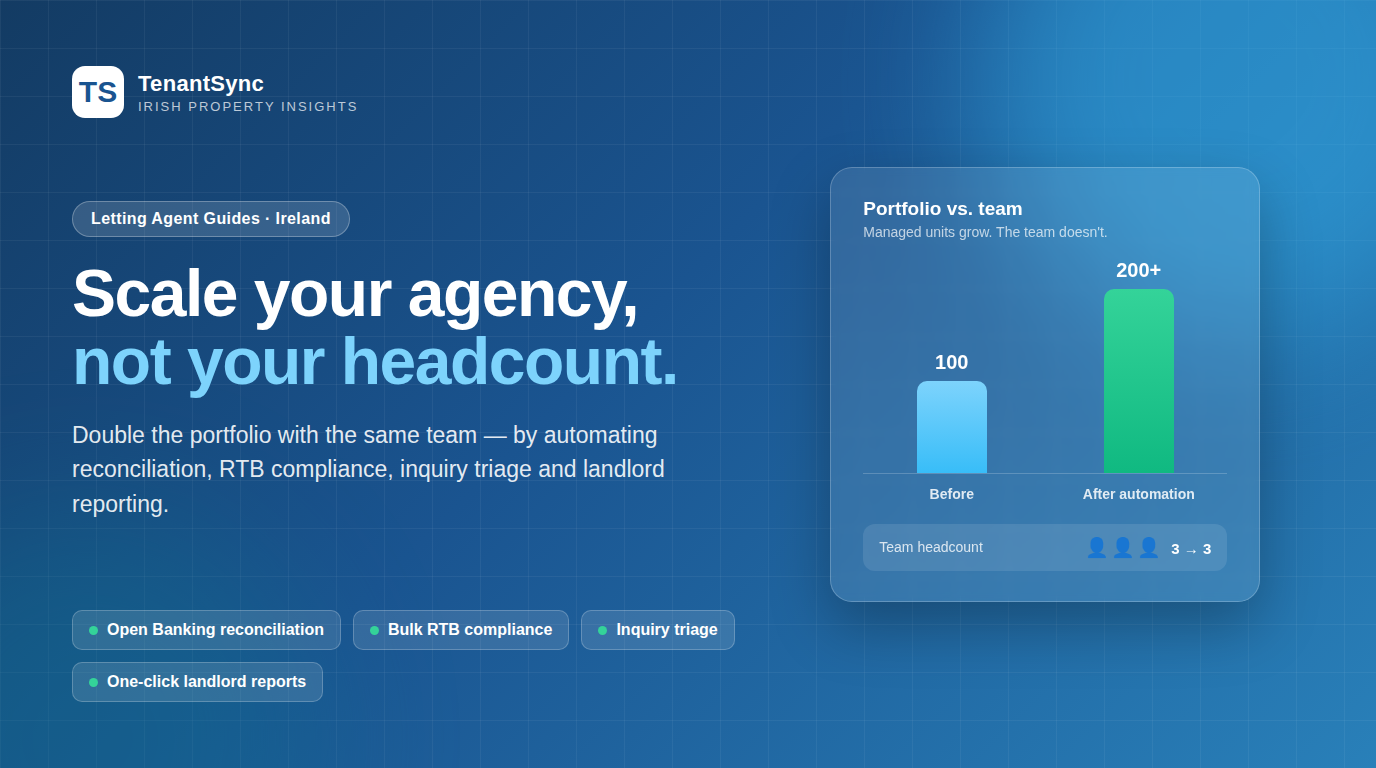
How do you scale a letting agency without adding headcount? You raise the portfolio each person can safely manage instead of hiring more people. The lever is automating the four repeatable workflows that consume most agency hours — rent reconciliation (auto-matched through Open Banking), RTB and compliance tracking (deadlines as automated reminders), inquiry triage (Daft and MyHome leads centralised), and landlord reporting (one-click per-client statements). Remove that manual load and the same team carries a materially larger book without dropping service — so growth comes from a bigger share of a consolidating market, not from payroll.
The Unit Economics: Units Per Person, Not More People
Ask most agency principals how they'd handle twice the portfolio and the instinct is immediate: hire. But hiring is the most expensive, slowest and riskiest way to add capacity — a new property manager takes months to become productive, adds fixed cost whether the book grows or not, and doesn't fix the underlying problem, which is that too much of the work is manual in the first place.
There's a cleaner lever. Every agency has an implicit ceiling — the number of tenancies one person can manage before something slips: a missed rent-review date, a landlord statement that's late, an inquiry left unanswered over a busy weekend. That ceiling isn't fixed. It's set almost entirely by how much of the job is manual. Raise it, and you can grow the book without growing the payroll. That's the whole game: units per person, not more people.
The scaling equation
Agency capacity ≈ (number of staff) × (units each can manage). Hiring only grows the first term — expensively and slowly. Automation grows the second term, and it compounds: every workflow you take off the manual pile raises the ceiling for every person on the team at once, on a portfolio that keeps growing. That's why operations, not recruitment, is where the margin is.
The market makes the case sharper. According to the RTB's Director's Quarterly Update for Q3 2025, the number of private landlords linked to registered tenancies fell 0.5% year-on-year to 103,774, while the RTB recorded 5,405 notices of termination that quarter — up 35% year-on-year. The landlord base is shrinking and consolidating: growth no longer comes from a rising tide of new clients but from taking share — winning portfolios from agencies that can't keep up. An agency that can absorb a new 40-unit client next week without a panicked hire is the one that wins that pitch. We make the wider case in how to win (and keep) landlord clients in a shrinking rental market; this article is about building the capacity to act on it.
Where an Agency's Hours Actually Go
You can't upgrade what you haven't measured. Before automating anything, spend two weeks logging where the team's time really goes — most principals are surprised by how little of it is spent on the high-value work they think they're paying for. In practice, the hours cluster into four repeatable buckets, and it's the same four in almost every agency:
| Time sink | What it looks like manually | Why it scales badly |
|---|---|---|
| Rent reconciliation | Downloading bank statements, matching each payment to the right tenancy by eye, chasing what doesn't add up. | Grows linearly with every tenancy and every client account — the fastest-rising cost as you add units. |
| Compliance tracking | Spreadsheets of RTB dates, rent-review eligibility, cert and licence expiries — held together by memory. | One missed deadline is a professional-liability event; risk multiplies with every extra tenancy. |
| Inquiry handling | Daft and MyHome leads across inboxes and phones, qualified and scheduled ad hoc during letting season. | Volume spikes unpredictably; slow replies lose lets and make you look understaffed. |
| Landlord reporting | Assembling per-client statements by hand each month — rent in, fees, deductions, net paid. | Every client adds a recurring report; it's the task most often skipped when the team is stretched. |
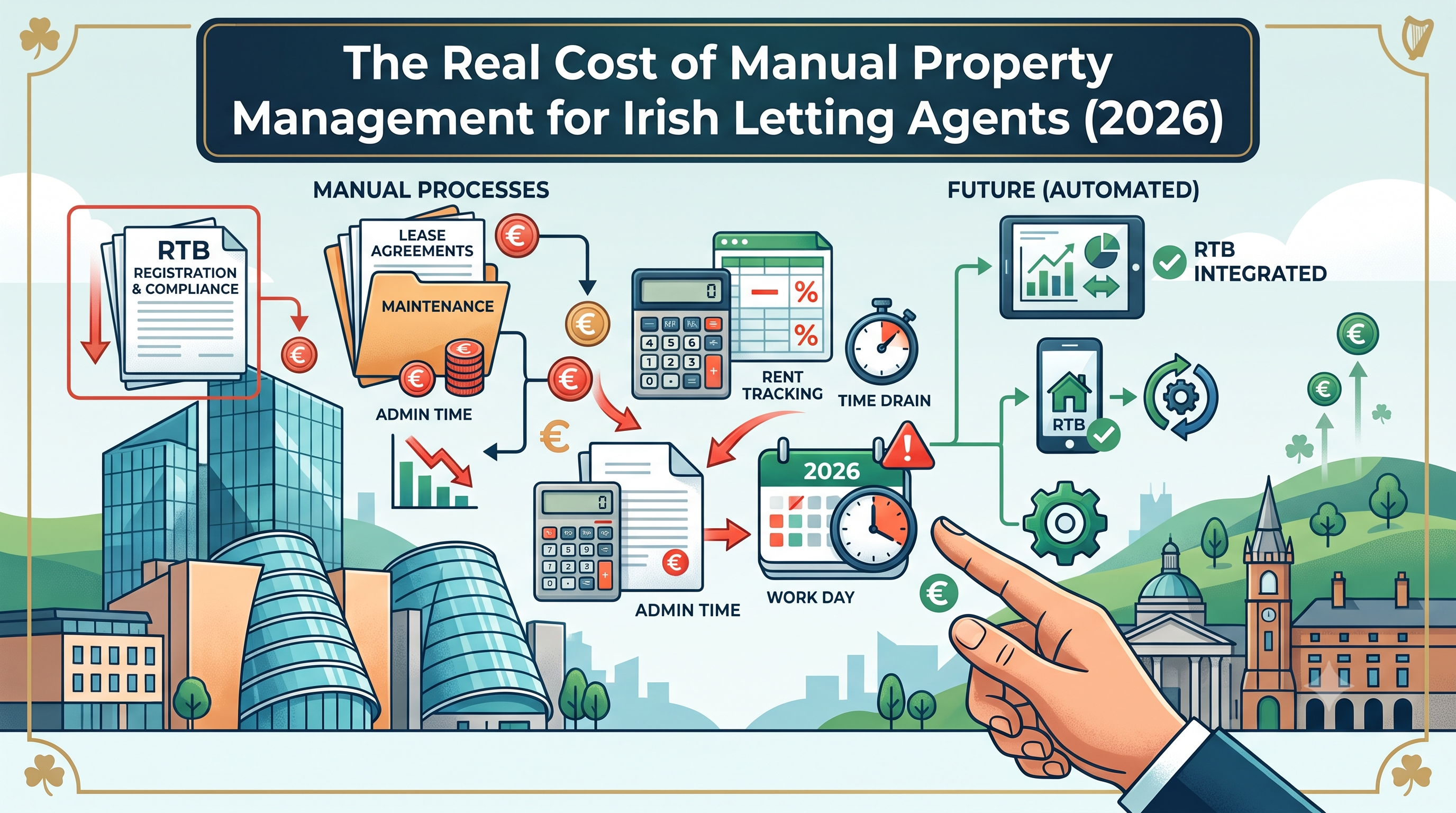
Notice what these have in common: they're repeatable, rule-based and recurring. None of them require judgment most of the time — they require the same steps performed accurately, over and over, across a growing number of tenancies. That's the precise profile of work that software does better than people, and that people resent doing. The true cost of managing property manually is not just the hours — it's the errors, the missed deadlines, and the senior people doing junior work.
💡 Automate the biggest bucket first
Resist the urge to automate everything at once. Log the fortnight, find the bucket that's eating the most hours (for most agencies it's reconciliation), and start there. A single well-chosen automation that removes a Monday-morning grind builds more team buy-in than five half-adopted ones.
Automate Reconciliation: The Biggest Weekly Win
For most agencies, rent reconciliation is the single largest recurring time sink — and the one that scales worst. Every month, across every client account, someone opens the bank statements and matches each incoming payment to the correct tenancy: right amount, right tenant, right property. References are wrong or missing, part-payments don't tie out, one landlord's rent lands in the wrong column, and each anomaly becomes a manual investigation. Double the portfolio and you double this work exactly.
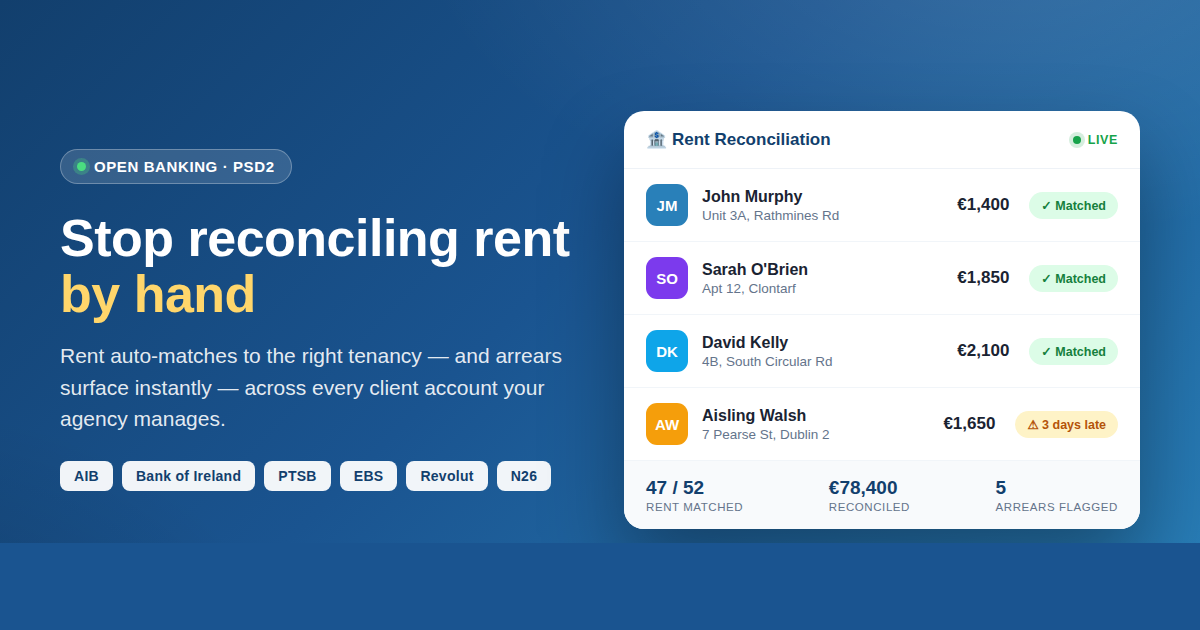
PSD2 Open Banking ends it. With the agency's account connected, TenantSync reads real transaction data and auto-matches each rent payment to the right tenancy, so the monthly job shifts from line-by-line data entry to reviewing only the exceptions the system couldn't match. Just as importantly, arrears surface the same day a payment is missed rather than at month-end — which means your team spends its time on the handful of cases that need a human, not on the hundreds that don't.
What changes on Monday morning
- Before: hours matching payments across client accounts by eye; arrears discovered late.
- After: rent auto-matched to the tenancy; a short exceptions list to clear; arrears flagged instantly and aged.
Because this workload scales directly with the number of tenancies, it's the automation that frees the most capacity as you grow. Full detail in Open Banking rent reconciliation for lettings agencies.
TenantSync connects the Irish and neobank accounts agencies actually use — AIB, Bank of Ireland, PTSB, EBS, Revolut and N26 — and, because rent is client money, keeps a per-landlord ledger so every euro is accounted for against the right client. That reconciled data is also the foundation for accurate landlord reports later (see below): clean numbers in, one-click statements out.
⏱️ Estimate your hours saved
See what auto-matched reconciliation, automated compliance reminders and one-click landlord reports would give back to your week — on a walkthrough shaped like your own portfolio, or start free and connect a bank account today.
Automate Compliance: Deadlines That Never Slip
Compliance is the time sink that doesn't just cost hours — it carries professional liability. Across a book of dozens of landlords, each tenancy has its own set of dates: the RTB registration deadline, annual renewal, rent-review eligibility, notice periods, and the expiry of BER, gas and electrical certificates. Track that on a spreadsheet and it works — until the one month it doesn't, and a missed date becomes a dispute, a fine, or a lost client.
Automation turns the whole book into a monitored system instead of a memory test. TenantSync tracks the obligations across every client tenancy and sends automated reminders before each one falls due, so nothing depends on someone remembering. The reminder types agencies rely on include:
| Automated reminder | When it fires |
|---|---|
| RTB registration not started | When a new tenancy hasn't yet been registered with the RTB. |
| Rent review eligibility | When a tenancy becomes eligible for a review — with the increase capped at the national rule. |
| Lease expiration | Ahead of a lease agreement's end date, so renewals and notices are handled in time. |
| Rent due & landlord rent overdue | Before the monthly due date, and when a payment is past due. |
| Document / certificate expiry | Before a required document (e.g. BER, gas, electrical) reaches its expiry date. |
| PSRA licence & tax clearance | Around the renewal window for the agency's own PSRA licence and tax clearance certificate. |
The scaling point is subtle but decisive: with manual tracking, compliance risk rises with every tenancy you add, which is a real reason principals hesitate to grow. With automated, portfolio-wide tracking, adding the 200th tenancy is no riskier than the 20th — the system watches all of them equally. That's what makes it safe to say yes to a new client. See the agency workflow in bulk RTB compliance across every client tenancy, and the current rules in the national rent cap (2% or CPI, whichever is lower) field guide.
Automation surfaces the deadline — you still make the call
Automated reminders remove the "I forgot" failure mode, not your professional judgment. The system tells you a rent review is due or a cert is expiring; you decide the action and serve the valid notice. That's the right division of labour — software for vigilance, agents for decisions.
Automate Inquiry Triage: Peak Season Without Temps
Letting season is where agencies are most tempted to hire — a listing goes live on Daft and MyHome and hundreds of inquiries arrive in days, scattered across email and phone. The usual response is a temp or an all-hands scramble, and even then good leads slip through, viewings clash, and the fastest agency (not necessarily the best property) wins the let. Speed-to-lead is the whole game, and manual handling is too slow at volume.
Centralising inquiries fixes the surge without extra staff. TenantSync pulls Daft and MyHome leads into a single mailbox, so every inquiry is captured, qualified with consistent questions, and moved toward a viewing and a structured application — with the whole timeline visible on one lead record. The team works one prioritised list instead of firefighting three inboxes, which means the same people handle a peak-season spike that used to require temporary help. Detail in turning Daft & MyHome inquiries into signed tenancies and automating tenant onboarding.
💡 Capacity you build once, use every season
A temp is capacity you rent for a few weeks and lose — along with everything they learned. A structured inquiry workflow is capacity you build once and keep: it handles this letting season, next season, and the new client's stock you take on in between, without re-hiring or re-training.
Automate Reporting: One-Click Landlord Statements
Landlord reporting is the task most often sacrificed when a team is stretched — and the one that most directly drives renewals. Every client expects a monthly statement showing rent collected versus expected, arrears, the management fee, any deductions, and the net paid to them. Assembled by hand, that's an hour a client that quietly caps how many clients one person can serve.
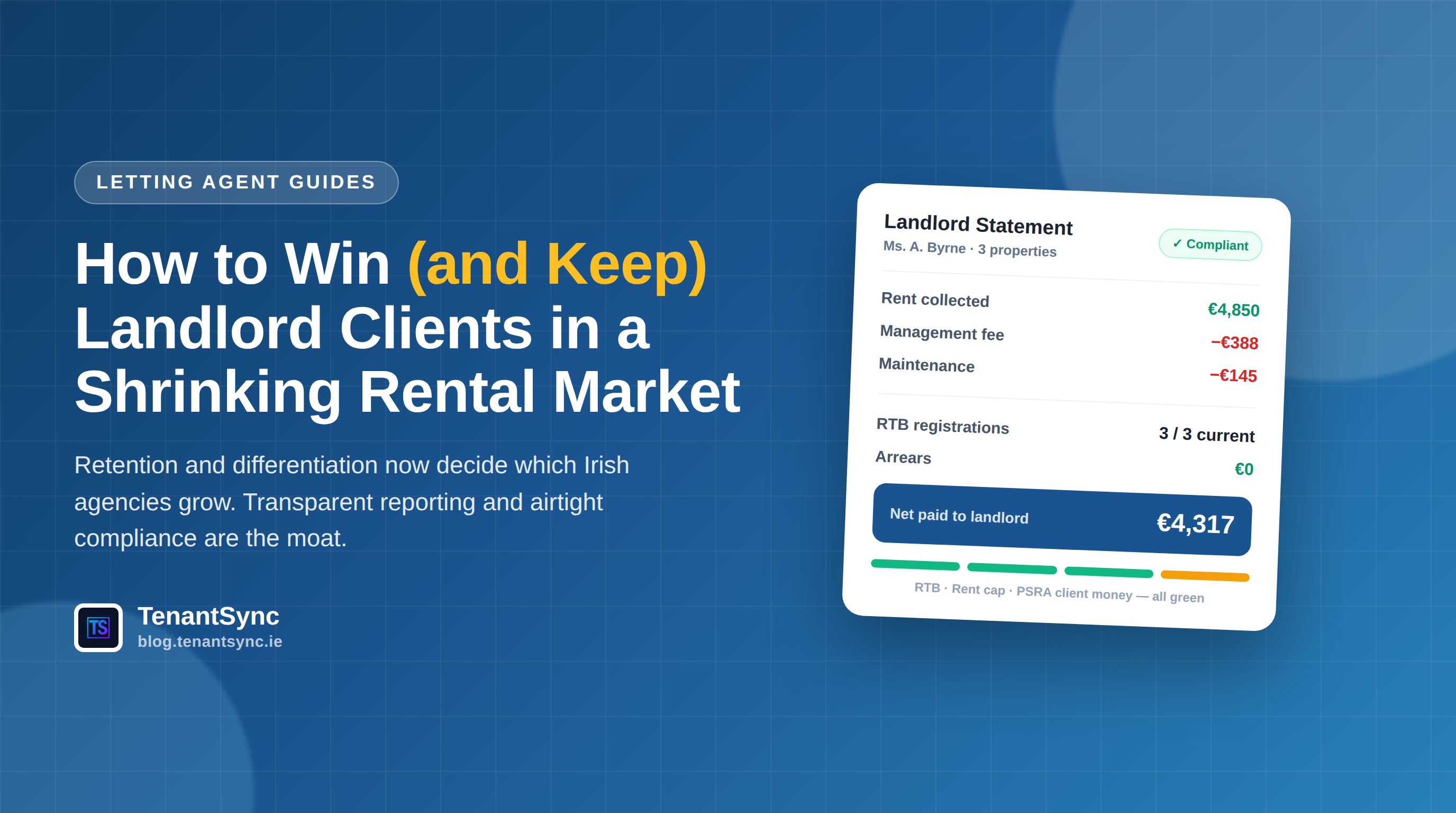
When the data underneath is already clean — rent auto-matched, fees and approved costs recorded, compliance tracked continuously — generating a per-landlord disbursement statement becomes a single action rather than a spreadsheet afternoon. The agency reviews the gross-to-net breakdown, approves it, and the landlord receives a branded, secure link to review and approve their own statement. Reporting stops being the thing that breaks at scale and becomes the thing that scales best. The full anatomy is in the per-client landlord report that renews your management contracts.
Why reporting is the payoff of the other three
One-click reporting only works because reconciliation, compliance and payment data are already automated upstream. That's the compounding effect in one place: automate reconciliation and you don't just save the reconciliation hours — you make the monthly report a click, and the compliance strip on it honest. Each workflow you upgrade makes the next one cheaper.
Delegate Without Chaos: Branches & Roles
Scaling isn't only about doing more with the same people — it's about letting those people work independently without the principal becoming the bottleneck. As a book grows across offices or portfolios, you need to delegate access without losing oversight or mixing up whose client is whose.
TenantSync is built for that with agency, branch and member structure and role-based permissions: each landlord is managed under a branch, team members get the access their role needs, and statements and documents are issued per branch under your agency's branding. A new hire — when you do eventually add one — or an existing manager taking on a new office slots into the structure without a data migration or a loss of control. Delegation becomes safe, which is what lets an agency grow past the size one person can personally hold in their head.
A Worked Example: Hours Saved, Capacity Unlocked
Here's the logic made concrete. The numbers below are an illustrative model to show the method — plug in your own figures from the two-week audit. The point isn't the exact hours; it's how the arithmetic works.
| Weekly task | Manual (illustrative) | Automated | Time reclaimed |
|---|---|---|---|
| Rent reconciliation across client accounts | ~6 hrs | ~1 hr (exceptions only) | ~5 hrs |
| Compliance & deadline tracking | ~3 hrs | ~0.5 hr (review reminders) | ~2.5 hrs |
| Inquiry handling (peak-adjusted) | ~5 hrs | ~2 hrs (one prioritised list) | ~3 hrs |
| Landlord reporting (monthly, spread weekly) | ~3 hrs | ~0.5 hr (one-click, review) | ~2.5 hrs |
| Per person, per week | ~17 hrs | ~4 hrs | ~13 hrs |
Roughly 13 hours a week per person, in this illustration, moves from admin to available. That capacity has two uses, and the ambitious agency chooses both: absorb more units under each manager (raising the ceiling from Section 1), and redirect the freed senior time into the work that actually grows the agency — pitching for new portfolios, onboarding them fast, and giving existing landlords the kind of service that makes them refer you. The hours you save on reconciliation are the hours you spend winning the next client.
💡 Run your own version
Take your fortnight's audit, halve it to a weekly figure, and fill in the "manual" column above with your real hours. Even a conservative estimate usually reveals a working day per person per week trapped in tasks that don't need a person. That's your scaling headroom — before you spend a cent on payroll.
The 90-Day Operations Upgrade Plan
You don't rebuild an agency's operations in a weekend, and you shouldn't try. Sequence it so each phase delivers value before the next begins — momentum and team buy-in matter as much as the software. Here's the plan most agencies can run in a quarter.
Before you start: audit the hours
Log two weeks of team time against the four buckets — reconciliation, compliance, inquiries, reporting. You'll upgrade the biggest sink first and have a baseline to measure against.
Days 1–30: import & kill manual reconciliation
Import your portfolio directly from Letman or spreadsheets with concierge onboarding, then connect the agency account through Open Banking so rent auto-matches and arrears surface automatically. This is the fastest, biggest win — lead with it.
Days 31–60: compliance & inquiry triage
Switch on automated reminders for RTB registration and renewal, rent-review eligibility, and document, licence and cert expiries. Centralise Daft and MyHome inquiries into one mailbox so the next letting-season spike runs without temporary staff.
Days 61–90: reporting & team rollout
Make one-click per-landlord statements the monthly standard, then give each team member the right branch and role permissions so the workflow scales across the whole agency — not just the early adopters.
Ongoing: reinvest the freed hours
Point the reclaimed capacity at growth — pitching new landlord clients, onboarding portfolios fast, and lifting service. Automation is the means; a bigger, more profitable book is the end.
Notice that you get a return from week one. Reconciliation and compliance visibility land in the first phase, so the team feels the relief long before the full upgrade is done — which is exactly what keeps a change programme alive. For where the pricing lands as you grow, see what an agency should actually pay for lettings software.
Sources & Official Data
Market figures in this article are drawn from published Residential Tenancies Board data. Always confirm current obligations for a specific tenancy or agency with the official bodies below.
- RTB — Director's Quarterly Update, Q3 2025 (registered private landlords; notices of termination).
- RTB — Notices of Termination data hub.
- Residential Tenancies Board (rtb.ie) — registration, rent control and tenancy rules.
- Property Services Regulatory Authority (psr.ie) — letting-agent licensing and client-money obligations.
- Central Statistics Office (cso.ie) — CPI, referenced by the national rent cap.
Frequently Asked Questions
How do you scale a letting agency without hiring more staff?
You raise the portfolio each staff member can safely manage rather than adding people. Automate the four repeatable workflows that consume most agency hours — rent reconciliation (auto-matched through Open Banking), RTB and compliance tracking (deadlines as automated reminders), inquiry triage (Daft and MyHome leads centralised), and landlord reporting (one-click statements). With that manual load gone, the same team carries a materially larger book without a drop in service, so growth comes from taking share of a consolidating market instead of from payroll.
How many properties can one property manager handle in Ireland?
There's no fixed legal number — it depends on how manual the work is. An agent running compliance and reconciliation off spreadsheets is often stretched at a few dozen tenancies, because each carries recurring admin. Remove that load with automation and the same person can oversee substantially more units, because their time shifts from data entry to exceptions and relationships. The useful question isn't a headcount ratio but "how many units before quality slips?" — and automation is what raises that ceiling.
What tasks can a letting agency automate?
The highest-return tasks are rent reconciliation (auto-matching payments to the right tenancy through Open Banking and surfacing arrears instantly), compliance tracking (RTB and rent-review deadlines, document, certificate and PSRA licence expiries as automated reminders), inquiry management (centralising Daft and MyHome leads, qualification and viewing scheduling), tenant onboarding and lease generation with e-signature, and landlord reporting (one-click per-client disbursement statements). These repeat across every tenancy, so automating them compounds as the portfolio grows.
Does automating a letting agency reduce service quality?
Done well, it improves it. Automation removes the low-value, error-prone tasks — rekeying bank statements, remembering deadlines, assembling reports — and returns that time to the work only a person can do: handling exceptions, advising landlords, resolving problems fast. Landlords get faster arrears alerts, more consistent reporting and fewer missed dates; tenants get quicker responses. The aim isn't to remove the human from the relationship but to stop the human spending the day on data entry.
How much time can Open Banking reconciliation save a letting agency?
Reconciliation is usually the biggest recurring time sink, because it happens across every client account every month and each unmatched payment triggers a manual check. Auto-matching rent to the correct tenancy through Open Banking turns it into a review of exceptions only. The exact saving depends on portfolio size, but because the work scales with the number of tenancies, it's the automation that frees the most capacity as you grow — and it surfaces arrears the same day rather than at month-end.
How long does it take to set up automation in a letting agency?
A realistic operations upgrade runs over about 90 days: roughly the first month to import your portfolio (directly from Letman or CSV) and connect Open Banking so reconciliation is live; the second month to switch on compliance reminders and centralise Daft and MyHome inquiries; and the third to standardise one-click landlord reporting and roll out across the team with branch and role permissions. You get value from week one — reconciliation and compliance visibility are the fastest wins — and later phases layer on capacity as adoption grows.
Summary
- Headcount is the wrong lever. Scale by raising the units each person can manage, not by hiring — automation grows that ceiling for the whole team at once, and it compounds.
- Four workflows eat the week. Reconciliation, compliance, inquiries and reporting are repeatable and rule-based — the exact profile of work software does better than people.
- Reconciliation is the biggest win. Open Banking auto-matching turns the monthly grind into an exceptions review and surfaces arrears the same day.
- Automated compliance makes growth safe. Portfolio-wide reminders mean the 200th tenancy is no riskier than the 20th.
- Inquiries and reporting scale next. A centralised inbox handles peak season without temps; clean data makes landlord statements a one-click job.
- Run the 90-day plan. Audit the hours, kill manual reconciliation, automate compliance and inquiries, standardise reporting — then reinvest the freed hours into winning clients.
📈 Manage a bigger book with the team you already have
Automate reconciliation, compliance, inquiry triage and landlord reporting — and turn admin hours into capacity to win clients. Estimate your hours saved on a walkthrough of your own portfolio, or start free today and feel the difference in your first week.
Related Articles