How to Win (and Keep) Landlord Clients in a Shrinking Rental Market
Ireland's rental market is playing a trick on letting agents. Total tenancies are still growing — but the pool of individual and small landlords, the clients most agencies are built around, is shrinking and consolidating. Fewer small owners to win, and higher stakes on keeping the ones you already have. When new clients are scarce, retention and differentiation become the whole game. This is the playbook: what landlords now expect, why transparent reporting and airtight compliance are your moat, and how to onboard a new portfolio fast enough to make switching to you the obvious choice.
The short version
How do letting agents win and keep landlord clients when the market is shrinking? First, understand what's actually shrinking: total tenancies are still rising, but the individual and small-landlord base is contracting and consolidating toward larger, professional owners. That makes every landlord relationship more valuable. You win and keep clients by competing on trust, not price — proving airtight compliance (RTB registration and renewals, the national rent cap, notice periods, PSRA client-money handling) and delivering transparent per-landlord reporting on a predictable cadence. Show a landlord a clear monthly statement — rent collected, fees, net paid, everything green — and a credible tech stack, and you become the option that's too costly to leave. The agencies that grow from here are the ones that make compliance and reporting visible.
What's Actually Shrinking (Read the Data Properly)
"Shrinking rental market" is a headline that hides the number that matters to you. If you run a letting agency, the total size of the rental market isn't your problem — the size of your addressable client base is.
Here's the nuance the data reveals. According to the RTB's Director's Quarterly Update for Q3 2025, the number of tenancies nationally actually rose 1.9% year-on-year — and Dublin tenancies rose 4.3%. So in raw stock terms, the market grew.
But look at who owns those tenancies:
- Individual landlords are leaving. Landlords associated with registered private tenancies fell 0.5% year-on-year to 103,774 in Q3 2025 — part of a longer contraction in small-landlord numbers.
- Exits are accelerating around the sale ground. The RTB received 5,405 notices of termination in Q3 2025, up 35% year-on-year, and 61% of them cited the landlord's intention to sell (RTÉ; The Irish Times).
- The market is consolidating. The share of tenancies held by single-tenancy landlords fell to 24.93% in Q3 2025 — the lowest in over two years — while the share held by landlords with 100+ tenancies has risen for nine consecutive quarters.
What this means for your agency
The pool of small landlords you'd traditionally win as clients is getting smaller, while ownership concentrates in larger, more professional hands. Two consequences follow: (1) each landlord client you have is worth more, so churn hurts more; and (2) the landlords who stay in the market are exactly the ones who expect professional-grade service. Winning on price in a race to the bottom is the wrong move. Winning on trust and demonstrable competence is the whole opportunity.
We unpack the exit dynamic in depth in the great Irish landlord exodus, and the self-manage-versus-agent decision your prospects are weighing in self-manage vs letting agent. This article is about what to do with that reality: how to be the agency landlords choose, and refuse to leave.
What Landlords Now Expect From an Agent
The landlords still in the market in 2026 have lived through rapid regulatory change, rising costs, and a lot of uncertainty. Their expectations of an agent have moved on from "collect the rent and call me if something breaks." What they want now:
| What landlords want | What it looks like in practice |
|---|---|
| Certainty they're compliant | Confidence that every tenancy is RTB-registered and renewed, rent increases are within the national cap, and notices are valid — with no nasty surprises. |
| Transparency on their money | A clear statement each month: what came in, what was deducted, what was paid to them, and why — without having to ask. |
| Fast, documented communication | Prompt responses and an audit trail, so they never feel out of the loop on their own asset. |
| Proof of value at review time | Evidence — not assertions — that the fee they pay is buying real risk reduction and time saved. |
| A credible, modern operation | A tech-enabled agency that clearly won't lose their paperwork, miss a deadline, or mishandle their rent. |
Notice that four of those five are about trust and information, not the mechanics of letting. That's the shift. In a shrinking client base, the agency that communicates competence best wins. And competence, fortunately, is now something you can systematise and show.
Compliance Is the Retention Moat
Here's the uncomfortable truth about compliance: a single failure is the fastest way to lose a landlord client — and, handled well, airtight compliance is the fastest way to keep one. A landlord who gets a call from the RTB, or discovers their rent increase was invalid, will not renew with the agent who let it happen. A landlord who can see their whole portfolio is green has no reason to leave.
For an Irish agency, "compliance" is really four moats at once. You're managing all of them, across every client tenancy:
1. RTB registration & renewals
Every tenancy must be registered with the RTB within 30 days, and re-registered annually. Miss it across a portfolio and you expose your client — and your agency's reputation — to real risk. The workflow that prevents it at scale is a portfolio-wide compliance dashboard that flags every upcoming and overdue registration. We cover it in bulk RTB compliance across every client tenancy.
2. The national rent cap (2% or CPI, whichever is lower)
Since March 2026, rent increases are governed by the national rent cap — the lower of 2% or inflation (HICP) — rather than the old patchwork of Rent Pressure Zones. Advising a landlord to set an increase a fraction too high is how an agent turns a routine rent review into a dispute. Get the maximum permissible rent right, every time. See the national rent cap field guide.
3. Notice periods & Part 4 security of tenure
Serve a notice on the wrong ground or with the wrong notice period and it's void — the tenancy continues and your client loses months. Since 1 March 2026 you're also running two regimes at once. The reference is our Part 4, six-year tenancies & notice periods quick-reference.
4. PSRA obligations — your licence to operate
As a licensed Property Services Provider, your agency itself is regulated by the PSRA under the Property Services (Regulation) Act 2011. That means a valid Letter of Engagement with every landlord client (section 43), professional indemnity insurance, tax clearance, and — critically — handling rent as client money under the Client Moneys Regulations 2012, with designated client accounts and regular reconciliation. This is the moat competitors on spreadsheets can't cross. See the complete PSRA Letter of Engagement guide.
💡 Reframe compliance as a sales asset
Most agencies treat compliance as a cost centre — a box to tick and hope. Flip it. When you can pull up any landlord's portfolio and show them, in seconds, that every registration is current, every rent review is within the cap, and their client money is reconciled, compliance stops being a cost and becomes your single strongest retention argument. "Here's proof nothing will go wrong" is a very hard pitch to walk away from.
📊 Show landlords their whole portfolio is green
TenantSync tracks RTB registrations and renewals, national rent-cap calculations, notice periods and PSRA client-money reconciliation on one dashboard — per landlord client and per branch. See the compliance and reporting a landlord would receive, on a walkthrough shaped like your own portfolio.
The Per-Landlord Report That Renews Contracts
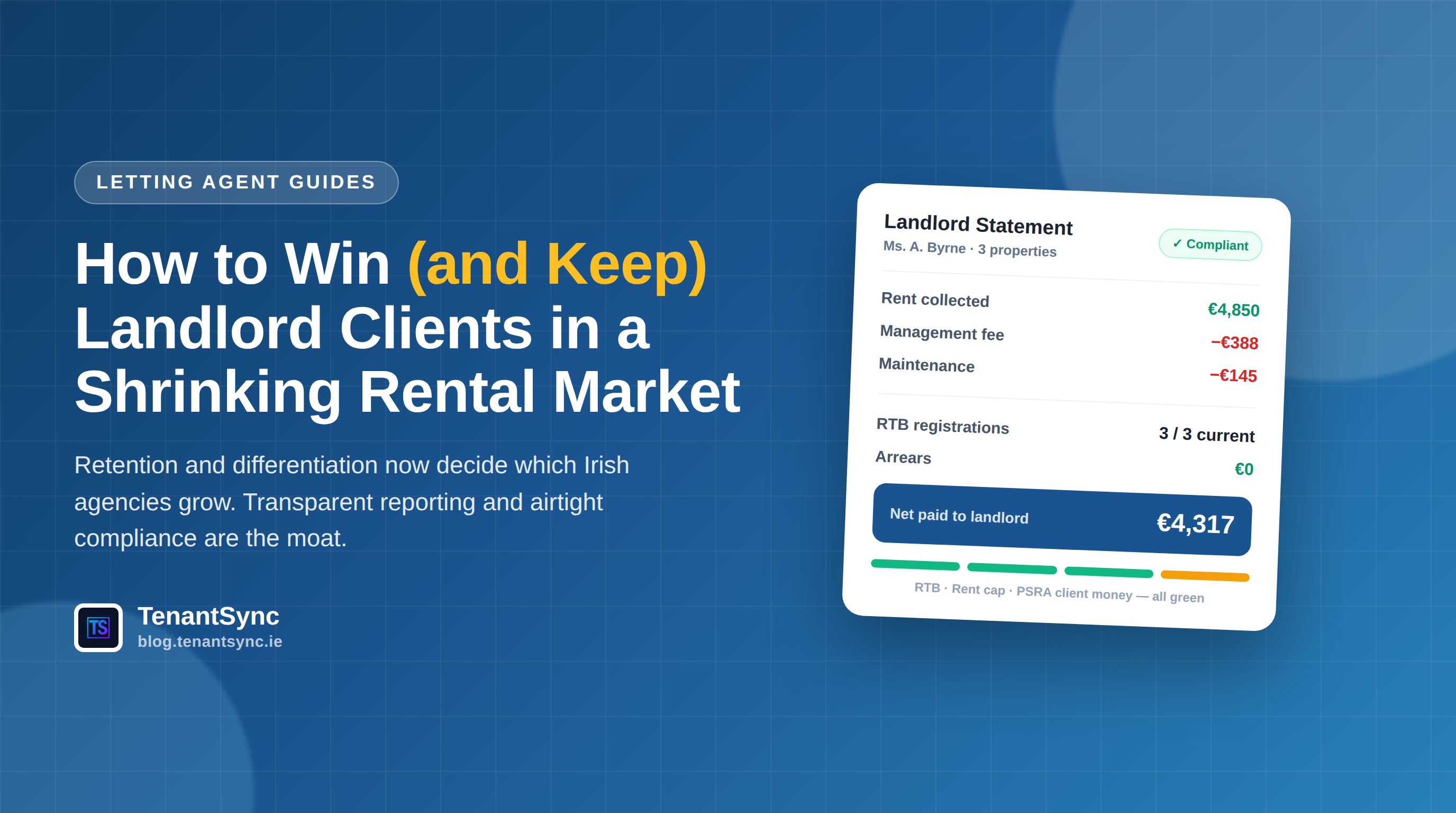
If compliance is the moat, the monthly landlord statement is the drawbridge you lower to remind the landlord it's there. It's the single most powerful retention tool an agency has, because it answers — before the landlord asks — the only two questions they truly care about: "Did I get paid what I should have?" and "Is everything legal?"
A landlord who receives a clear, consistent statement every month rarely goes shopping for a new agent. A landlord who has to email you asking where their money is, and gets a spreadsheet three days later, is already half gone. Anatomy of a statement that renews contracts:
| Section | What it shows the landlord |
|---|---|
| Rent collected vs expected | What was due across their properties and what actually arrived this period. |
| Arrears | Any shortfall, flagged early — not discovered three months later. |
| Management fee & deductions | Your fee and any maintenance or contractor costs, itemised and transparent. |
| Net paid to the landlord | The bottom line, clearly stated — the number they came for. |
| Compliance status | RTB registration current, rent review eligibility, certificate status — green means "relax". |
In TenantSync this is a per-branch, per-landlord disbursement statement: it pulls matched rent from the reconciliation feed, applies your configured management fee, deducts approved contractor work, and shows the gross-to-net breakdown. The agency approves it, and the landlord gets a secure, token-gated page to review and approve their own statement — a small touch that makes the landlord feel in control and the agency look meticulous. Alongside it, an aging report (0–30, 31–60, 61–90, 90+ days) and an at-a-glance summary of outstanding balance, overdue amount, paid this month and expected rent give you and the landlord one honest financial picture.
Cadence beats content
A merely good report sent reliably every month beats a perfect report sent whenever you get around to it. Predictability is the point — it's what turns reporting from an admin chore into a retention ritual. Automating generation is what makes a monthly cadence survivable across dozens of clients.
Money You Can Trust: Reconciliation & Client Money
Reporting is only as trustworthy as the numbers behind it. If your rent figures come from someone eyeballing a bank statement on a Monday morning, the statement you send is only as good as their concentration that day. That's a fragile foundation for a relationship built on trust.
This is where Open Banking changes the economics of running an agency. Under PSD2, you can connect the agency's rent-collection account and have incoming payments imported automatically, then auto-matched to the right tenancy using amount, payer name, references and recurring patterns. Rent that matches is reconciled without a human touch; anything ambiguous is flagged for quick review; arrears surface immediately rather than at month-end. The Monday-morning grind disappears, and the numbers on your landlord statements become defensible. We go deep on the mechanics in Open Banking for lettings agencies.
The trust dividend is bigger than efficiency. Because rent collected by an agency legally is client money, PSRA rules require it to be handled in designated client accounts and reconciled regularly under the Client Moneys Regulations 2012. TenantSync builds a per-landlord client ledger directly on the reconciliation feed, supports designated client-account reconciliation (draft → balanced → signed off), and can assemble the annual Accountant's Report pack. When a landlord — or an inspector — asks where the money is and whether it's accounted for, you have a clean, immediate answer. That is the difference between an agency that hopes it's compliant and one that can prove it.
⚠️ The reconciliation gap loses clients quietly
The most common way agencies lose landlords isn't a dramatic failure — it's a slow erosion of confidence. A statement that doesn't reconcile. Arrears spotted late. A fee query that takes a week to answer because the numbers live in three places. Each one is small; together they tell the landlord you're not fully in control of their asset. Automated reconciliation closes the gap before it opens.
Winning New Clients: Pitch Your Tech Stack
Everything above is a retention story — but it's also your best acquisition story. When a landlord is deciding between agencies (or deciding whether to leave self-management), they're really asking "who can I trust with my asset?" The agency that answers with a demonstration, not a brochure, wins.
Practical ways to turn your operation into a pitch:
Show, don't tell
In the pitch meeting, pull up a sample landlord statement and a compliance dashboard. Let the prospect see exactly what they'd receive each month. Concrete beats abstract every time.
Lead with risk reduction
Landlords fear RTB penalties, invalid notices and rent-cap breaches more than they fear a slightly higher fee. Position your compliance systems as insurance they can see working.
Quantify the time you save them
Self-managing landlords underestimate the admin. Show the reconciliation, the automated reminders, the generated notices and statements — the hours they get back are a tangible part of your value.
Respond first, win the let
During letting season, the agency that replies to a Daft or MyHome inquiry first tends to win the tenant — and landlords notice which agent fills vacancies fastest. See turning Daft & MyHome inquiries into signed tenancies.
If you're building the case that a modern platform is worth it, our buyer's guide to the best property management software for Irish letting agents and the honest breakdown of lettings software pricing in Ireland are built for exactly that conversation.
Onboarding a New Portfolio Fast
Winning the client is only half the battle — the first 30 days decide whether they feel they made the right call. A slow, error-prone onboarding undoes all the trust your pitch built. A fast, clean one confirms it. Speed of onboarding is itself a competitive advantage, and it's where re-keying a portfolio into spreadsheets quietly kills momentum.
The faster route is a direct import. TenantSync brings property, tenancy and rent data across from a previous system such as Letman, or from CSV, rather than re-typing it — with concierge onboarding to get it right. From there:
- An RTB registration record is auto-created for each lease, pre-populated from the imported lease, property and tenant data — so compliance tracking starts on day one.
- Each tenancy is anchored to its exact start date, which drives Part 4 milestones, renewal dates and the correct notice period per tenancy.
- Connecting the rent-collection account via Open Banking means reconciliation begins immediately, so the first monthly statement to the new landlord is accurate and on time.
The message to a prospective client is simple and powerful: "You won't lose your history, and you'll be live — reconciling rent and fully compliant — in days, not weeks." For agencies coming off spreadsheets entirely, the step-by-step is in how to migrate your agency portfolio off spreadsheets.
The Win-and-Keep Checklist
Bookmark this. It's the short list that separates the agencies that grow from the ones that leak clients:
| Do this | Why it wins & keeps clients |
|---|---|
| Report every month, without fail | Predictable transparency is the single biggest driver of renewals. |
| Keep every tenancy compliant & visible | A green portfolio is proof you're worth the fee — and removes the fear that drives switching. |
| Reconcile rent automatically | Accurate numbers and early arrears alerts build the trust reports depend on. |
| Handle client money by the book | Designated accounts and reconciliation turn a PSRA obligation into a trust signal. |
| Pitch with a live demo, not a brochure | Showing the statement and dashboard beats describing them. |
| Onboard new portfolios in days | A fast, clean start confirms the landlord chose the right agency. |
| Use reviews to renew and expand | The reporting cadence is a built-in reason to talk value and win more of the landlord's properties. |
How TenantSync Makes You Indispensable
TenantSync is built for Irish letting agents and agencies managing tenancies across many landlord clients. It turns the win-and-keep playbook above into everyday operations:
One-click per-landlord statements
Generate per-branch, per-landlord disbursement statements — rent collected, management fee, contractor deductions, net paid — with a token-gated page where the landlord reviews and approves. Reporting becomes a monthly ritual, not a scramble.
Portfolio-wide compliance dashboards
RTB registrations and renewals, national rent-cap calculations, rent-review eligibility, Part 4 and notice periods, and PSRA client-money reconciliation — colour-coded across every client and branch, so nothing slips and you can show a landlord their status in seconds.
Open Banking reconciliation
Connect the agency's rent-collection account and rent auto-matches to the right tenancy, with arrears surfaced immediately and ambiguous payments flagged for quick review — so your statements are always defensible.
Fast onboarding & the full workflow
Direct import from Letman and CSV, auto-created RTB records, generated leases and notices of termination, Daft/MyHome inquiry management, and an audit trail on every action — the whole agency operation in one place.
Pricing that scales with your portfolio
Transparent tiers by portfolio size — Standard €99 (up to 100 tenancies), Growth €149 (up to 200), Premium €199 (up to 300), with a Starter plan for smaller books and Enterprise for larger agencies — plus a 14-day free trial. The full breakdown is in lettings software pricing in Ireland.
Sources & Official Data
Market figures in this article are drawn from published RTB data and reputable reporting. For obligations affecting a specific tenancy or agency, always confirm the current position with the RTB and the PSRA.
- Residential Tenancies Board — Director's Quarterly Update, Q3 2025
- RTB — Notices of Termination (data hub)
- RTÉ — 35% increase in termination notices issued by landlords in Q3
- The Irish Times — Number of tenancies ended by landlords increases by 35%, RTB data shows
- Residential Tenancies Board (RTB)
- Property Services Regulatory Authority (PSRA)
Frequently Asked Questions
Is the Irish rental market actually shrinking?
It depends what you measure. Total registered tenancies are still growing — the RTB reported tenancies up 1.9% annually in Q3 2025, and up 4.3% in Dublin. What is shrinking is the pool of individual and small landlords: landlords linked to registered private tenancies fell 0.5% year-on-year to 103,774 in Q3 2025, and the share of tenancies held by single-tenancy landlords fell to 24.93%, the lowest in over two years. The market is consolidating toward larger, professional landlords — so there are fewer small owners to win as clients, and higher stakes on keeping the ones you have.
How do letting agents win new landlord clients in 2026?
By competing on trust and professionalism rather than price. Landlords choosing an agent want proof of airtight compliance (RTB registration and renewals, the national rent cap, notice periods, PSRA client-money handling), transparent reporting they can understand, fast and accountable communication, and a credible technology stack. The most effective pitch shows a prospective landlord exactly what their monthly statement and compliance dashboard would look like — concrete evidence beats promises.
What is the best way to retain landlord clients?
Make the agency indispensable and the switch feel risky. Retention comes from three things a landlord can see: airtight compliance so they never fear an RTB or PSRA problem, transparent per-landlord reporting on a predictable cadence, and prompt, documented communication. A landlord who receives a clear monthly statement showing rent collected, fees, deductions, net paid and a green compliance status has no reason to look elsewhere.
Why is compliance a retention tool for letting agents?
Because a compliance failure is the fastest way to lose a client — and evidence of airtight compliance is the fastest way to keep one. Agents must manage RTB registration and annual renewals, the national rent cap (2% or CPI, whichever is lower), valid notice periods, and, as PSRA-licensed Property Services Providers, the handling of client money under the Client Moneys Regulations 2012. An agency that can show a landlord their whole portfolio is green turns a legal obligation into a visible reason to stay.
What should a good landlord report contain?
A strong per-landlord statement shows, at a glance: rent collected versus expected, any arrears, the management fee and any maintenance or contractor deductions, the net amount paid to the landlord, and the compliance status of each tenancy. Delivered on a predictable monthly cadence and easy to read, it answers the only questions a landlord really has — "Did I get paid what I should, and is everything legal?" — before they have to ask.
How can an agency onboard a new landlord's portfolio quickly?
Speed of onboarding is itself a selling point. The fastest route is a direct data import rather than re-keying: TenantSync imports property, tenancy and rent data from a previous system such as Letman or from CSV, then auto-creates the RTB registration record for each lease and anchors each tenancy to its start date so compliance tracking begins immediately. Concierge onboarding means a new client can be live — reconciling rent and tracking compliance — without weeks of manual setup.
How does TenantSync help letting agents keep landlord clients?
TenantSync gives an agency the two things that drive retention: transparent reporting and airtight compliance, across every landlord client. It generates per-landlord disbursement statements (rent collected, fees, deductions, net paid) with a token-gated page where the landlord reviews and approves, reconciles rent automatically via Open Banking so arrears surface immediately, and tracks RTB registrations, renewals, rent-cap calculations, notice periods and PSRA client-money reconciliation on portfolio-wide dashboards.
Summary
- Read the data properly. Total tenancies are rising, but the individual and small-landlord base is shrinking and consolidating — so each landlord client is worth more and retention matters more.
- Compete on trust, not price. The landlords still in the market expect professional-grade service; a race to the bottom on fees is the wrong move.
- Compliance is your moat. RTB registration and renewals, the national rent cap, valid notices, and PSRA client-money handling — made visible — turn obligations into reasons to stay.
- The monthly landlord statement renews contracts. Rent in, fees, net paid, compliance green — on a predictable cadence — answers a landlord's questions before they ask.
- Trustworthy numbers need automation. Open Banking reconciliation and a per-landlord client ledger make your reports defensible and your client money accounted for.
- Win with a demo; keep with delivery. Pitch the statement and dashboard, then onboard the portfolio in days — a fast, clean start confirms the choice.
📌 Make your agency the one landlords won't leave
Transparent per-landlord reporting and airtight RTB, rent-cap and PSRA compliance — across every client and branch — is what wins new landlords and renews the ones you have. See exactly what a landlord would receive on a walkthrough of your own portfolio, or start free today.
Related Articles