RTB Registration Fees in 2026: What You Pay, When, and What Late Costs You
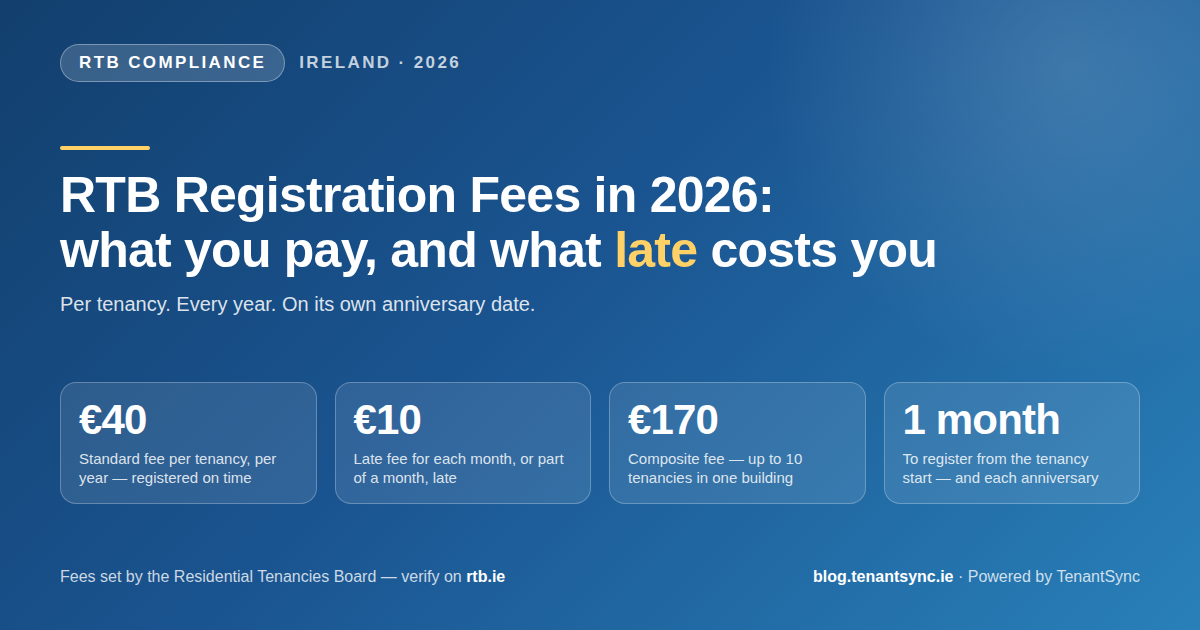
€40 per tenancy per year if the RTB has your registration within a month. €10 for every month, or part of a month, that you're late. Those two numbers are the whole fee schedule for most Irish tenancies — and they are also why the cost of RTB compliance is never really the fee. It's the anniversary date you didn't know you had, multiplied by every tenancy on your book.
The short version
How much is the RTB registration fee in 2026? €40 per tenancy per year for private rented, cost rental and Student Specific Accommodation tenancies, where the RTB receives the completed registration within one month of the tenancy starting — or within one month of each anniversary after that. An Approved Housing Body tenancy is €20 a year. Miss the window and a late fee of €10 per month, or part of a month (AHB: €5) is added on top. Registering up to 10 tenancies in the same building at the same time, on time, costs a composite fee of €170 (AHB: €85). Registration is annual — every tenancy, every year, on its own anniversary.
The 2026 Fee Table
Here it is, first, because that is what you came for. Everything else on this page is context around these four rows.
Scroll the table sideways to see every column.
| Fee | Private rented, cost rental & SSA | Approved Housing Body (AHB) |
|---|---|---|
| Standard registration — on time Per tenancy, per year |
€40 | €20 |
| Late fee For each month, or part of a month, late — on top of the standard fee |
€10 per month | €5 per month |
| Composite fee Up to 10 tenancies in the same building, registered at the same time and on time |
€170 | €85 |
| Second and further registrations where multiple changes occur within 12 months Each completed within one month of the new tenancy start date |
No additional fee | No additional fee |
Three things about that table are worth saying out loud, because they are where the misunderstandings live.
It is per tenancy, not per property. A converted house with four separately let flats is four tenancies and, absent the composite fee, four fees. One landlord, one address, one mortgage — four registrations, four anniversary dates.
It is per year, not once. The single most common wrong assumption in this whole area is that registration is a thing you did when the tenant moved in. Since April 2022 it recurs annually for as long as the tenancy continues (see the next section). A tenancy that runs six years costs six fees and, more importantly, needs six actions.
"On time" is doing a lot of work. The standard fee is the fee if the RTB receives the completed registration within one month. It is not a base price with an optional late surcharge; it is a conditional price, and the condition is a date.
Is the composite fee actually worth it?
Only above four tenancies. Five tenancies in one building at €40 each is €200, so €170 saves you €30; ten is €400 against €170, a real saving. Four tenancies at €160 is cheaper than the composite fee. And the composite fee is conditional on the registrations being on time and submitted together — so it is a discount that a missed deadline deletes. If you manage purpose-built blocks or multi-unit conversions, put the block's registrations on one date deliberately rather than letting them scatter across the year.
First Registration vs Annual Registration — and Why You Now Pay Every Year
Before April 2022, a tenancy was registered once, at the start, and again if the tenancy changed. Under the Residential Tenancies (Amendment) Act 2019, that changed to annual registration: landlords of private rented dwellings, Approved Housing Body tenancies and Student Specific Accommodation must register each tenancy with the RTB every year for as long as it continues.
So there are two distinct obligations wearing the same name:
Scroll the table sideways to see every column.
| First registration | Annual registration | |
|---|---|---|
| Triggered by | The tenancy commencing | The anniversary of the tenancy commencement date |
| Deadline | Within one month of the tenancy start date | Within one month of the anniversary |
| Standard fee | €40 (AHB €20) | €40 (AHB €20) |
| If late | €10 per month or part of a month (AHB €5) | €10 per month or part of a month (AHB €5) |
| Consequence of not doing it | The tenancy is unregistered | The tenancy is unregistered. Same consequence. |
That last row is the one people get wrong. A missed annual registration is not a lesser, administrative version of never registering — it leaves the tenancy unregistered, with the same legal consequences set out below. There is no partial credit for having registered it in 2024.
Which date is your anniversary?
The RTB's guidance ties annual registration to the anniversary of the date the tenancy commenced. In practice, if a tenancy was registered late in a previous year, landlords sometimes find the date the portal holds is not the date they expect. Use the due date the RTB shows against the tenancy, and if your own record disagrees with the portal, resolve it with the RTB rather than assuming your spreadsheet is right. This is a five-minute check that prevents a whole class of accidental late fee.
The practical shape of it: a tenancy that started on 15 May 2025 had to be registered by mid-June 2025, then again by mid-June 2026, and every mid-June after that until it ends. The obligation is generated by the tenancy, so it keeps arriving whether or not anyone is watching for it.
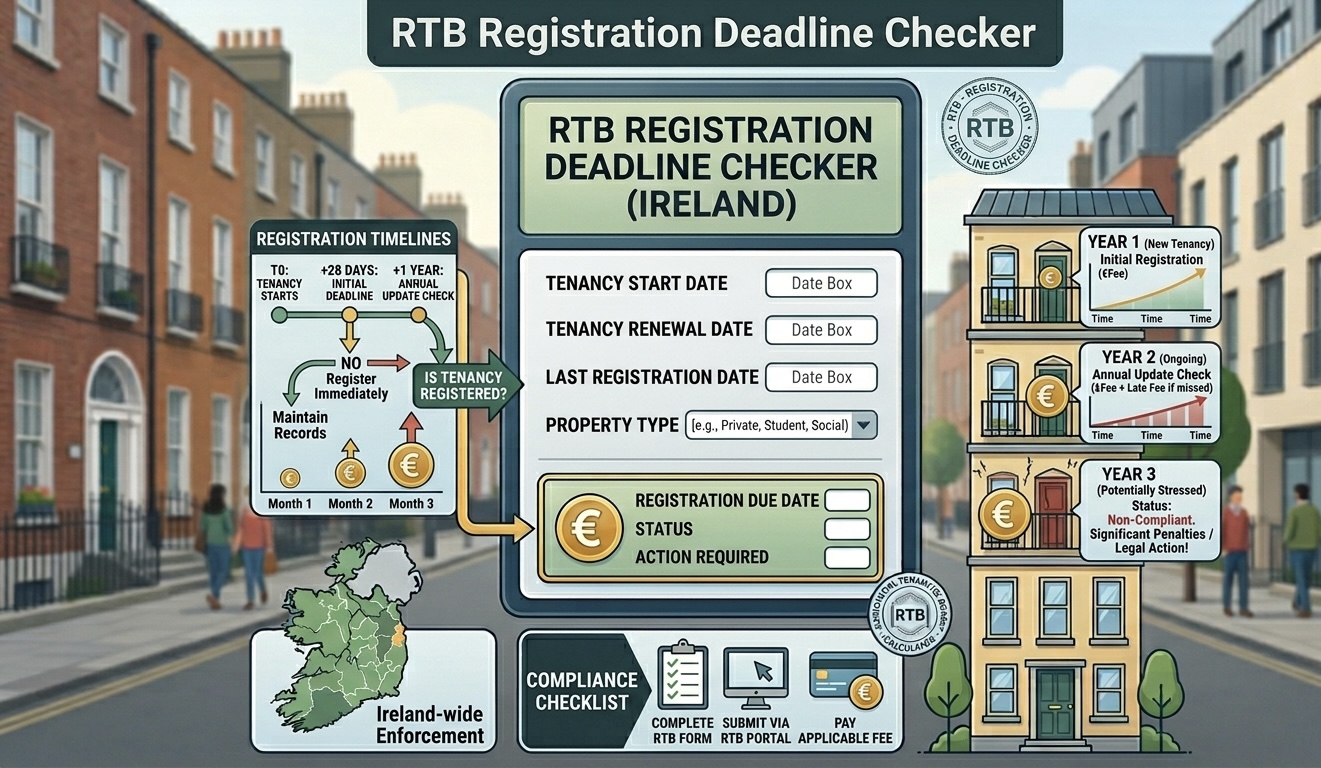
📅 Check every tenancy's RTB deadline — free
Enter a tenancy start date and get the registration deadline and the next annual renewal date instantly. No login, no card, no sales call. Then decide whether tracking 40 of those by hand is still a plan.
When the Clock Starts — and What "On Time" Means
The clock starts on the date the tenancy commenced. Not the date the lease was signed, not the date the deposit cleared, not the date the first rent hit the account. If a tenant took occupation on 3 September, the clock started on 3 September.
One month, or 30 days?
The RTB's own wording is one month. A lot of landlord-facing material — including plenty of software, ours included — computes start date + 30 days, because it is unambiguous and never lands on a date that does not exist. Most of the time the two agree. At month ends they don't: a tenancy starting on 31 January has no 31 February to count to, and a tenancy starting on 31 July gives you a day more under "one month" than under "30 days".
The resolution is not to litigate the calendar. It is to treat the earlier of the two readings as your deadline, and to register in the first fortnight. Nobody has ever been penalised for registering early, and a fortnight of slack absorbs the thing that actually causes late registrations: a missing PPSN, a tenant who hasn't returned a detail, or an RTB query you need to answer.
"Received" and "completed" are the words that decide it
The standard fee applies where the RTB receives the completed application within the window. Two failure modes follow directly from that phrasing:
- Started is not submitted. A draft sitting in a portal session on the deadline is not a registration. Neither is an application waiting on a detail from a tenant.
- Submitted is not confirmed. Keep the confirmation and the registration number, dated. If a question ever arises — a dispute, a client audit, a Revenue query — the confirmation is the evidence that the obligation was met on a particular date. Save it against the tenancy, not in an inbox.
The two-minute test for a portfolio
Pick three tenancies at random. For each, can you produce, in under a minute: the tenancy commencement date, the next annual registration due date, and the confirmation for the most recent registration? If the answer is yes for all three, your process works. If you had to open more than two systems, the process is a person — and people take holidays in the same month tenancies have anniversaries.
What Late Actually Costs
The late fee is €10 for each month, or part of a month, that the registration is late (€5 for AHB tenancies), on top of the standard fee. The phrase "or part of a month" is the part that surprises people: one day late is a full month's late fee. There is no pro-rating and no grace day.
The RTB recommenced charging late fees on 1 March 2024. They apply to new tenancies and to annual registrations falling due on or after that date, and they were not applied retrospectively for the period from 12 November 2022 to 1 March 2024. If you are cleaning up a portfolio with historic gaps, that distinction matters — but it is a question for the RTB about your specific records, not something to assume from a blog.
Scroll the table sideways to see every column.
| How late | Standard fee | Late fee | Total, one tenancy |
|---|---|---|---|
| On time (within one month) | €40 | €0 | €40 |
| 1 day late | €40 | €10 (part of a month counts) | €50 |
| 3 months late | €40 | €30 | €70 |
| 6 months late | €40 | €60 | €100 |
| 12 months late | €40 | €120 | €160 |
Per tenancy, this is not frightening. That is precisely why it gets ignored — and why the number that matters is the portfolio number, not the tenancy number. Below, do that arithmetic on your own book.
Late-fee exposure calculator
Estimates the fees due on a set of registrations using the published RTB fee schedule. Runs entirely in your browser — nothing is sent anywhere, and no email is required.
—
—
Estimate only. It applies the standard and late fees published by the RTB, per tenancy, and does not account for the composite fee, the no-additional-fee rule for multiple changes within 12 months, exempt tenancies, or anything specific to your records. The RTB's own figure for your tenancies is the one that counts — check it on rtb.ie.
Run it at 40 tenancies and three months late and you get €1,600 in standard fees and €1,200 in late fees — €1,200 that bought nothing. Run it at 200 and the late fees alone are €6,000. And note what the calculator cannot show you: the late fee is the cheapest consequence on the list.
The Consequences That Aren't Fees
If the only risk were €10 a month, nobody would need a system. The reason registration dates get tracked properly is everything below.
1. Non-registration is an offence
Failing to register is an offence under the Residential Tenancies Acts, and the RTB can pursue enforcement. Reported penalties include a fine of up to €4,000, up to six months' imprisonment, and a further daily fine for a continuing offence, alongside improper-conduct sanctions of up to €15,000 plus costs of up to €15,000 per unregistered tenancy. Prosecutions are not the common outcome — but the exposure exists, it is per tenancy, and it dwarfs the fee it replaced.
Verify penalty figures before you quote them to a client
Sanction and fine figures circulate widely in secondary coverage and are not always current or correctly attributed. The RTB's own consequences of not registering page is the source to rely on, and it is the one to cite if you are putting a number in front of a landlord client. We have deliberately not put a headline number in this article's title, because the honest headline is the next three points, not the fine.
2. You lose the RTB as a route to resolve a dispute
A landlord cannot use the RTB's dispute resolution service in respect of an unregistered tenancy. The tenant still can. Sit with that asymmetry for a moment, because it is the practical sting: the arrears case you want to bring, the damage claim, the overholding referral — all of it depends on the tenancy being registered. An unregistered tenancy is a tenancy where only one side has the referee's number.
3. The tax consequence is bigger than the fee
Under Revenue's rules, the deduction for interest on borrowings used to purchase, improve or repair a rented residential property is conditional on the tenancy being registered with the RTB where registration is required. On a mortgaged property, that deduction is normally worth multiples of the €40 fee — so an unregistered period can put a far larger number at risk than it saved. The fee itself is a cost of letting and is generally treated as an allowable expense. Confirm both points with your accountant; this is not tax advice.
4. For an agent, it is a client-relationship event
Here is the version that matters to the primary audience for this page. When a letting agent registers on a landlord's behalf, the fee comes out of the client's money and the failure comes out of the agency's credibility. A landlord who receives a late-fee line on their statement is not thinking about €30. They are thinking: what else isn't being tracked? Missing a compliance date on a client's behalf is one of the fastest ways to lose a management instruction — a point we have made in more detail in the compliance mistakes Irish estate agents keep making.
40, 100, 200 Anniversary Dates: The Agency Problem
The fee schedule is simple. The operational problem is not the schedule — it is that annual registration converts a one-off task into a permanent, per-tenancy calendar whose dates you did not choose. Forty tenancies means forty anniversary dates, scattered across twelve months, forever. Two hundred tenancies means two hundred.
Scroll the table sideways to see every column.
| Book size | Annual fees, all on time | If 10% slip by 2 months | Registration actions per year |
|---|---|---|---|
| 40 tenancies | €1,600 | +€80 | 40 — plus every new let |
| 100 tenancies | €4,000 | +€200 | 100 — plus every new let |
| 200 tenancies | €8,000 | +€400 | 200 — plus every new let |
Look at the third column and you can see why fees are the wrong thing to worry about. At 200 tenancies, a 10% slip of two months costs €400 — annoying, survivable, invisible in a P&L. The fourth column is the real number: 200 dated obligations a year, none of which announce themselves, each of which leaves a tenancy unregistered if it passes.
How portfolios actually drift
Nobody decides to be late. Compliance drift has recognisable causes, and all of them are structural rather than personal:
- The dates are invisible. A tenancy start date lives in the lease. An anniversary is a date nobody wrote down, because it did not exist as a thing to write down until the tenancy was a year old.
- Anniversaries clump. Lettings are seasonal. If you did 18 lets in August 2025, you have 18 annual registrations in August 2026 — during the next August letting season.
- Onboarded tenancies arrive mid-cycle. Take on 30 tenancies from another agent and you inherit 30 anniversary dates you were never told, some of them weeks away.
- Staff turnover takes the calendar with it. When the tracking system is one administrator's spreadsheet and diary, the handover is a file — the knowledge of which cells matter doesn't transfer.
- Nothing fails loudly. A missed registration produces no error. Everything looks normal until a client asks a question or a dispute needs referring.
The tenant-change trap
Tenant turnover is where fees and rules collide. A new tenancy needs its own registration within one month of its start date, and the RTB's schedule provides that where multiple changes occur within 12 months, no additional fee is payable for the second and any further registrations provided each is completed within one month of the new start date. But the bigger question in 2026 is not the fee — it is whether the change created a new tenancy at all, because that decides which rent rules apply and what happens to the six-year Tenancy of Minimum Duration clock. We cover that in replacing a tenant without breaking the tenancy. Do not let a €0 fee lull you into treating it as a paperwork change.
If you are running this at volume, the mechanics of doing it across a book — who owns the date, what the reminder cadence is, and what evidence you keep — are covered in bulk RTB compliance for letting agents, and the deadline mechanics themselves in the RTB registration deadline guide and the deadline trap that catches portfolios.
🗂️ Where do your 40 anniversary dates live today?
If the honest answer is "a spreadsheet and someone's memory", that's the gap — and it is the gap that produces late fees, awkward client calls and unregistered tenancies. TenantSync derives every registration deadline and annual renewal date from the tenancy itself, and chases them so nobody has to remember.
How TenantSync Tracks Registration Dates
Full disclosure: this blog is published by TenantSync, and what follows is our product. It is here because this article's whole argument is that the fee is trivial and the date-tracking is not — so it would be evasive not to show what we actually do about it. Judge it against whatever you use now.
The dates derive themselves
- When a lease is created, an RTB registration record is created with it, carrying the tenancy start date, the registration deadline computed from that start date, the registration year and the annual renewal due date. Nobody types a deadline; there is no date to forget to write down.
- Status moves through not started → in progress → submitted → confirmed, with overdue and expired as the states that matter. Compliance risk starts high and drops to low only when a registration is confirmed — not when someone says they did it.
- Automated reminders run daily and fire ahead of registration deadlines and annual renewals, by email and in-app (with mobile push), de-duplicated so the same obligation doesn't spam three people.
- A compliance dashboard resolves the whole book to compliant / upcoming / overdue counts and one date-ordered timeline, covering 11 obligation types — registration and renewal alongside rent review, Part 4, BER, gas, electrical and insurance. For agencies it is branch-scoped: a branch manager sees their branch, an agency admin sees every branch.
The annual renewal, specifically
- Renew from previous takes last year's registration and pre-fills this year's, so an annual registration is a review-and-confirm rather than a re-keying exercise.
- It detects what changed since the last registration — tenancy start date, property, unit or landlord — and flags it, because those are exactly the changes that make a renewal something other than a copy.
- Each renewal saves an immutable, versioned snapshot of the registration. A year later, when someone asks what was registered and when, the answer is a record rather than a recollection.
- The RTB1 (Form 1) draft workflow — autosave, field-level validation, in-browser PDF preview, finalise to a stored PDF — plus proof upload with a SHA-256 hash for the confirmation you get back from the RTB.
What it does not do — plainly
TenantSync does not submit your registration to the RTB and does not pay RTB fees. Registration happens with the RTB, through its own portal, and the fee is paid there. We also don't publish a fee figure inside the product's public deadline checker: it returns your dates and human-readable guidance about late fees rather than a euro calculation, because a wrong fee figure is worse than no fee figure. What the product removes is the tracking — the deadline nobody derived, the anniversary nobody diarised, and the evidence nobody kept.
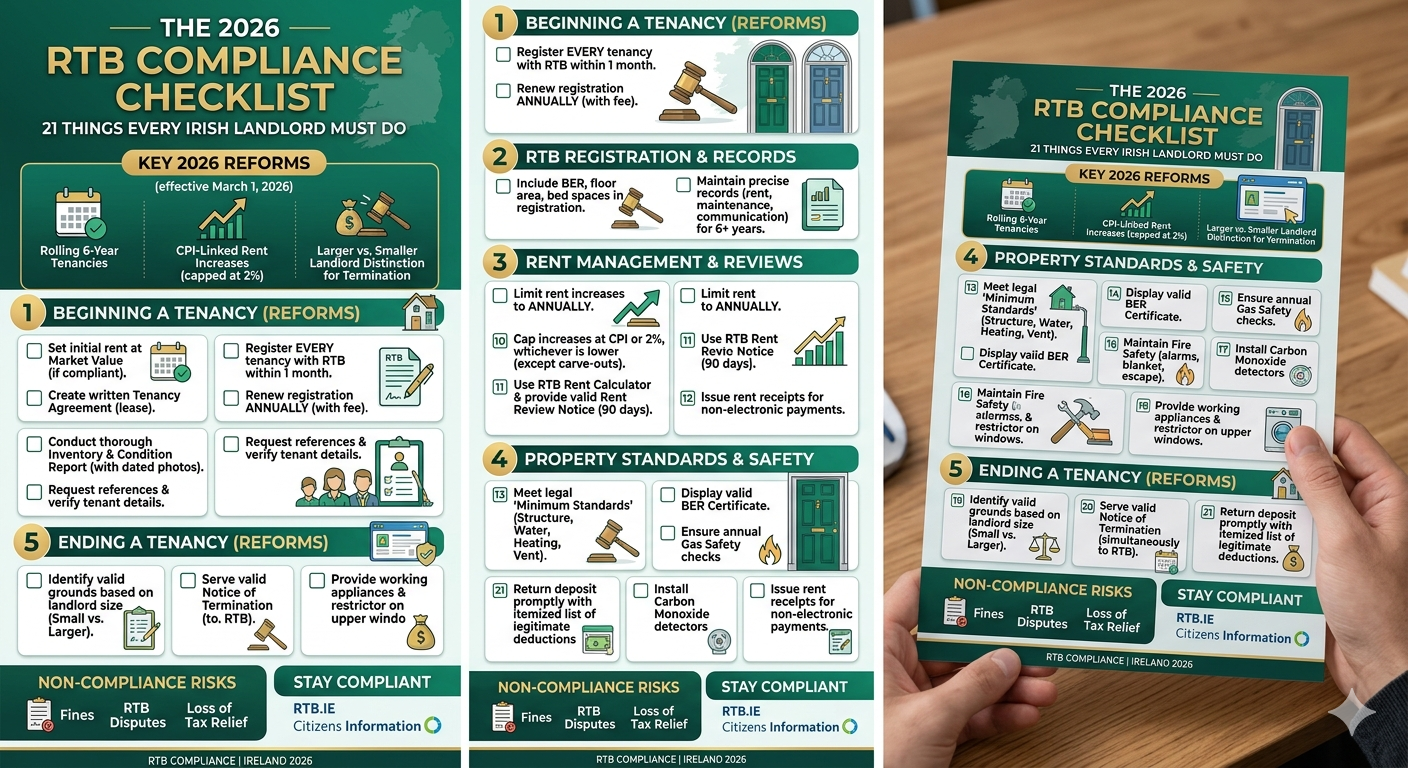
The compliance module sits alongside the rest of the Irish-specific work: the national rent cap calculation with the rule applied and the CSO CPI figure shown, Part 4 and Tenancy of Minimum Duration tracking, and Open Banking rent reconciliation. If you want the checklist version of all of it, we keep one at the RTB compliance checklist for Ireland.
Frequently Asked Questions
How much is the RTB registration fee in 2026?
€40 per tenancy per year for private rented, cost rental and Student Specific Accommodation tenancies, where the RTB receives the completed registration within one month of the tenancy starting — or, for an annual registration, within one month of the anniversary of the tenancy start date. Tenancies let by an Approved Housing Body are €20 a year. A late fee of €10 a month (AHB: €5) applies for each month, or part of a month, that a registration is late. A composite fee of €170 (AHB: €85) covers up to 10 tenancies in the same building registered at the same time and on time. The RTB sets these fees and can change them, so confirm the current schedule on rtb.ie before you pay.
Is the RTB registration fee €40 per tenancy per year?
Yes — for private rented, cost rental and Student Specific Accommodation tenancies registered on time. Two details matter. It is per tenancy, not per property and not per landlord: a converted house with four separately let flats is four tenancies and four fees, unless the composite fee applies. And it is per year, not once: since April 2022 registration must be renewed annually for as long as the tenancy continues, so a tenancy running for six years costs six fees.
What is the RTB late registration fee?
€10 for each month, or part of a month, that the registration is late, on top of the standard €40 — and €5 a month for Approved Housing Body tenancies. Because part of a month counts as a month, a registration one day past the deadline attracts a full month's late fee. The RTB recommenced charging late fees on 1 March 2024; they apply to new tenancies and to annual registrations falling due on or after that date, and were not applied retrospectively for the period from 12 November 2022 to 1 March 2024. A registration three months late therefore costs €40 + €30 = €70.
What is the RTB composite fee?
A single fee of €170 covering up to 10 tenancies in the same building, where they are registered at the same time and received by the RTB on time — €85 for Approved Housing Body tenancies. It is worth checking against the alternative: five tenancies in one building at €40 each is €200, so the composite fee saves money from five upwards, while four tenancies at €160 do not. The composite fee depends on the registrations being on time, so it is a saving that a missed deadline removes.
Do I have to register a tenancy with the RTB every year?
Yes. Since April 2022, registration is annual rather than once per tenancy. The annual registration falls on the anniversary of the date the tenancy commenced, and must reach the RTB within one month of that anniversary. Failing to make an annual registration has the same legal consequence as never registering the tenancy at all — it is not treated as a lesser administrative slip. The RTB's online system notifies landlords in advance of the anniversary, but the obligation does not depend on that email arriving.
When does the RTB registration clock start?
On the date the tenancy commenced — not the date the lease was signed, not the date the deposit was paid, and not the date the first rent landed. The RTB must receive the completed registration within one month of that date. Note that "one month" and "30 days" are not always the same date: a tenancy starting on 31 January has no 31 February to count to. Treat the earlier of the two readings as your deadline and register in the first fortnight, which removes the argument entirely.
What happens if I never register a tenancy with the RTB?
Non-registration is an offence under the Residential Tenancies Acts, and the exposure is not limited to fees. The RTB can pursue enforcement, with reported penalties including a fine of up to €4,000, up to six months' imprisonment, and a further daily fine for a continuing offence, as well as improper-conduct sanctions of up to €15,000 plus costs of up to €15,000 per unregistered tenancy. Separately, a landlord cannot use the RTB's dispute resolution service in respect of an unregistered tenancy — while the tenant still can — and registration is a condition of the deduction for interest on borrowings against rental income. Confirm the current position on rtb.ie and take your own advice.
Is the RTB registration fee tax deductible?
The RTB registration fee is a cost of letting the property and is generally treated as an allowable expense against rental income. The more consequential tax point runs the other way: under Revenue's rules the deduction for interest on borrowings used to purchase, improve or repair a rented residential property is conditional on the tenancy being registered with the RTB where registration is required. So an unregistered period can put a much larger deduction at risk than the fee it saved. Confirm your own position with your accountant or on revenue.ie.
Who pays the RTB fee — the landlord or the letting agent?
The registration obligation and the fee both sit with the landlord, and the fee cannot be passed on to the tenant. Where a letting agent registers on a landlord's behalf, the fee is typically paid from the client's money or recharged to them — but the failure, if a deadline is missed, is the agency's. That asymmetry is the reason agents track registration dates more carefully than the fee: €30 of late fees is a rounding error next to the conversation about why a client's tenancy was unregistered for a quarter.
Does a new tenant in the same property mean a new registration and a new fee?
A new tenancy is a new registration, and it must reach the RTB within one month of the new tenancy start date. On the fee, the RTB's schedule provides that where multiple changes occur within 12 months, no additional fee is payable for the second and any further registrations, provided each is completed within one month of the new tenancy start date. Whether a tenant change creates a new tenancy or continues the existing one is a separate — and more consequential — question in 2026, because it also decides which rules apply to the rent and to the six-year Tenancy of Minimum Duration clock. Check your specific case with the RTB.
Summary
- €40 per tenancy per year, on time, for private rented, cost rental and SSA tenancies. €20 for AHB tenancies.
- €10 per month, or part of a month, late (AHB €5), on top of the standard fee. One day late is a full month.
- €170 composite fee (AHB €85) for up to 10 tenancies in the same building, registered together and on time — worth it from five tenancies up.
- One month from the tenancy commencement date, and one month from each anniversary after that. Registration is annual, not once.
- A missed annual registration leaves the tenancy unregistered — the same legal position as never having registered it.
- The fee is the cheapest consequence. Non-registration is an offence, it closes off the RTB's dispute resolution service to the landlord, and it puts the interest deduction at risk.
- At scale the problem is dates, not euro. 200 tenancies is 200 dated obligations a year that nobody wrote down — which is why anniversaries should be derived by a system, not remembered by a person.
- Verify before you quote. The RTB sets and changes these fees. Take the figure from rtb.ie on the day you need it.
🔔 Stop paying for dates you didn't know you had
Every registration deadline and annual renewal derived from the tenancy itself, reminders that fire before the date instead of after it, and a dashboard that tells you the truth about the whole book in one screen. Start with the free checker, or see it across a portfolio.
Sources & Further Reading
Fee schedules change. Every figure on this page should be checked against the RTB's own pages before you rely on it — particularly if you are quoting a cost to a landlord client.
- RTB — Registration fees (standard fee, late fee, composite fee)
- RTB — When to register (the one-month window and annual registration)
- RTB — Who should register
- RTB — Consequences of not registering
- RTB — Tenancies must now be registered annually (the April 2022 change)
- RTB — Recommencing the charging of late fees from 1 March 2024
- RTB — Approved Housing Bodies (AHB fee schedule)
- Citizens Information — Registering a tenancy
- Citizens Information — Late fees for late tenancy registrations to resume
- Residential Tenancies (Amendment) Act 2019 (the annual registration provisions)
- Residential Tenancies Act 2004 (registration and enforcement)
- Revenue — What expenses are allowed against rental income
- RTB — Report an unregistered tenancy
Related Articles