Landlord Tax Return Ireland 2026: Your 18 November Form 11, Built From Your Bank Feed
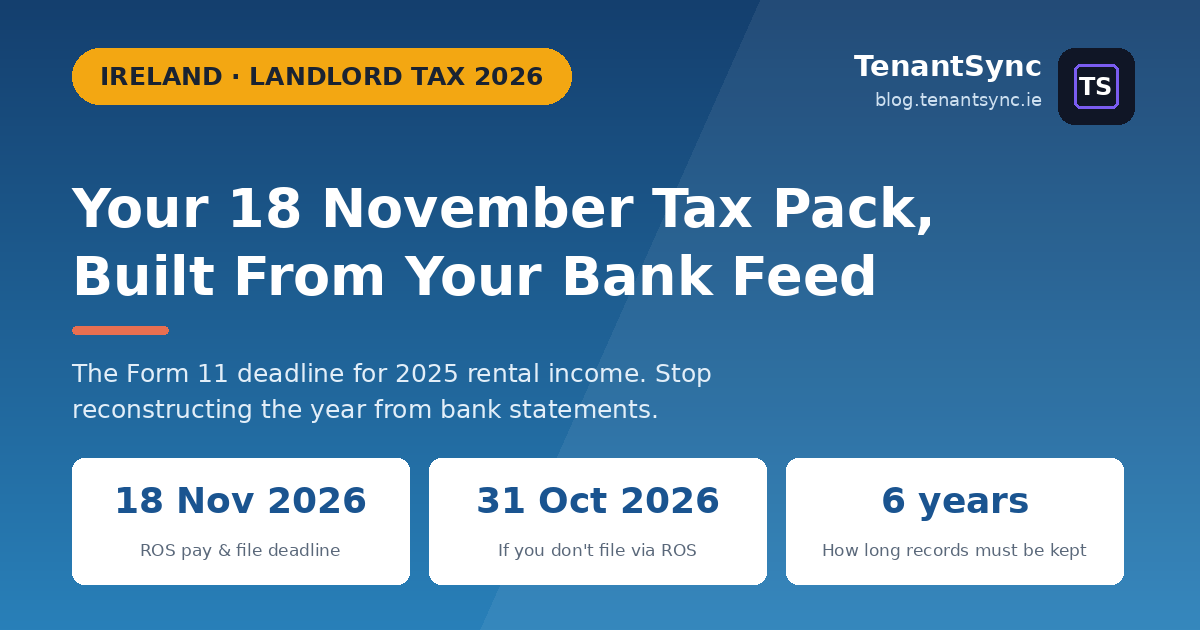
The 2025 rental income return is due on 31 October 2026, or 18 November if you both file and pay through ROS. The form itself takes an evening. What takes the fortnight — and what quietly costs money — is rebuilding twelve months of transactions from bank statements in order to fill it in. This page covers the dates, who has to file which return, the four reliefs a reconstruction loses, and how a letting agency produces the same statement for every landlord on its book without a November scramble.
The short answer
Your 2025 rental income goes on a Form 11 due by 31 October 2026 — extended to Wednesday 18 November 2026 if you both file the return and pay the tax through ROS. Three things fall due on that one day: the 2025 return, the balance of 2025 income tax, and preliminary tax for 2026. You file a Form 11 rather than a Form 12 where your net non-PAYE income is €5,000 or more, or your gross non-PAYE income is €30,000 or more. File late and a surcharge of 5% of the year's liability applies within two months, 10% after that.
Check what you're still missing ↓1. The two dates, and which one is yours
Irish self-assessment has one statutory pay and file date and one extension, and the extension has a condition attached that catches people out every year.
Three things fall due on the same day
This is the part that surprises first-time filers, because only one of the three is about the year that has ended:
- The Form 11 for 2025 — the return itself, with the rental income on the Case V pages.
- The balance of income tax for 2025 — what is owed after any preliminary tax already paid for that year.
- Preliminary tax for 2026 — a payment towards the year currently running. It can be based on 90% of the eventual 2026 liability, 100% of the 2025 liability, or 105% of the 2024 liability where payment is made by direct debit and the 2024 liability was not nil.
A landlord who has just added a property mid-2025 frequently underestimates this, because the 2025 balance and the 2026 preliminary payment both step up at once.
Filing late costs a percentage of the whole year, not of what's unpaid
The late-filing surcharge is 5% of the tax liability for the year, capped at €12,695, where the return is filed within two months of the deadline, and 10%, capped at €63,485, after that. It is charged on the total liability for the year — so a landlord who paid the tax on time and filed in December still pays it. Interest on late payment is a separate charge and can apply on top.
What the run-up actually looks like
- JANUARY — MARCH The cheapest window there is. The year has closed, the bank record is complete, and every transaction is still recognisable. Categorising twelve months now takes a fraction of the time it takes in November, because you can still remember what the €340 payment in June was for.
- SEPTEMBER — WHERE YOU PROBABLY ARE Roughly ten weeks out. Enough time to do this properly once, rather than twice badly. If your accountant is going to ask for anything, this is the month to find out what.
- EARLY OCTOBER Accountants are booking up. If you want a review rather than a transcription service, the figures need to be with them now — and anyone relying on the 31 October date has no slack at all.
- 31 OCTOBER Statutory pay and file date. If you are not doing both through ROS, this is your deadline and the extension below does not exist for you.
- 18 NOVEMBER Extended ROS date. File and pay through ROS on or before this date and you are on time. The queue for accountants in this fortnight is the worst of the year, which is a reason to be early rather than a reason to relax.
2. Form 11 or Form 12? The thresholds that decide
Landlords routinely assume the answer depends on how many properties they own. It does not — it depends on the amount of income outside the PAYE system.
Swipe or scroll the table sideways to see every column.
| Your position | Return | What it means in practice |
|---|---|---|
| Net non-PAYE income of €5,000 or more | Form 11 | You are a chargeable person, inside the self-assessment system, and preliminary tax applies. |
| Gross non-PAYE income of €30,000 or more | Form 11 | The gross test can pull you in even where the profit is small — a heavily mortgaged property with high gross rent is the classic case. |
| Below both thresholds, and taxed under PAYE | Form 12 | The rental income is returned, but you are not a chargeable person and the self-assessment machinery does not apply to you. |
Gross means gross
The €30,000 test is on rent receivable, before a single expense. At current Irish market rents one let can cross it on its own — which is why "it's only one apartment and I barely broke even" is not a reason to assume a Form 12. Work the test before you decide which return you are filing.
3. The real problem: reconstructing the year
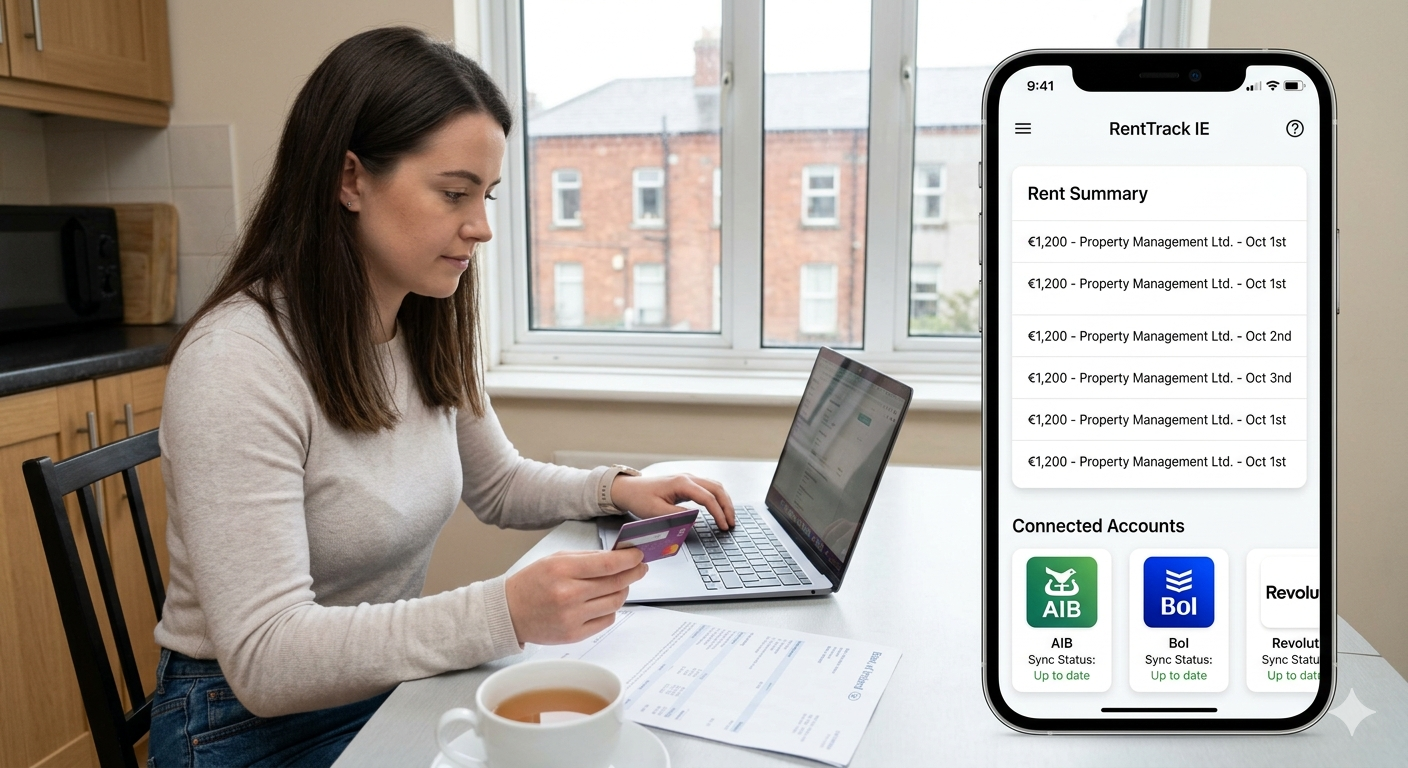
Almost nobody misses the deadline because the form is hard. They miss it, or file something approximate, because in the second week of November they are sitting in front of twelve months of bank statements trying to work out what a payment made last February was for.
Reconstruction is a specific failure with a specific shape. Working backwards from a bank statement, three things are systematically lost:
-
Anything the statement doesn't describe
A line reading
POS 4271 ***** DUBLINfor €212.40 is a hardware shop, a plumber's supplier or a personal purchase, and eight months later you genuinely cannot tell. The safe move — leave it out — is also the expensive one, and it happens dozens of times across a year. -
Anything that isn't a single transaction
The one that costs most is the mortgage. The statement shows a single monthly direct debit; the deductible part is the interest inside it, which the statement does not separate. Without the lender's annual interest certificate to hand, the number gets estimated — and an estimated interest figure is the one item on a rental return most likely to be tested.
-
Anything that isn't an expense at all
Furniture and appliances look exactly like repairs on a bank statement, and they are treated completely differently: a repair is deducted this year, a capital item is relieved at 12.5% a year for eight years. Sorting the two apart in November, from a card payment description alone, is guesswork. Sorting them apart on the day you buy them takes ten seconds.
The test that tells you where you are
Pick a month in the middle of last year and try to explain every debit on the account in under five minutes. If you can, you are in good shape and this article is a checklist. If you cannot, the November version of that exercise is twelve times as long and you will be doing it under time pressure — which is the argument for the categorise-as-you-go approach in section 7.
Why "my accountant handles it" isn't the answer either
It is the right answer to filing. It is not an answer to evidence. An accountant works from what you give them, and cannot claim a deduction they cannot see. Hand over a stack of statements and you get a return built from a stack of statements — technically correct, quietly incomplete, and billed at the rate that reflects the work of sorting it. Hand over a categorised year with the capital items separated and the interest certificate attached, and the same accountant can spend their time on the questions that actually need judgement.
Sort last year's statement out in a couple of minutes
Upload the CSV your bank already gives you and see every outgoing payment sorted into landlord expense categories, each tagged with an indicative Irish Case V treatment. AIB, Bank of Ireland and Revolut. Free, no login, nothing stored.
4. Four reliefs a reconstruction loses
These four are not obscure. They are simply the four that depend on something a bank statement does not contain — a registration status, an acquisition date, a vacancy period, or a box on the return rather than a line in the accounts.
4.1 Mortgage interest, and the RTB condition
Interest on money borrowed to purchase, improve or repair a let residential property is deductible in full — but only where the tenancy is registered with the Residential Tenancies Board for the period concerned. The capital repayment is never deductible.
Two failures follow from that. The first is arithmetic: taking the direct debit rather than the interest. The second is evidential: claiming the interest for a period in which the tenancy was not actually registered. On a portfolio with rolling tenancy start dates, the second is easy to get wrong without meaning to — a tenancy that began in October and was registered late has a gap, and the gap is inside the tax year.
Do the registration check before the interest claim, not after
For each tenancy, for each period in the year: was it registered? That question is a compliance question long before it is a tax question, and if the answer is uncomfortable there are separate consequences. Our guide to RTB registration fees and deadlines covers the registration side, including what late registration costs.
4.2 Capital allowances on furniture and appliances
Furnishings are not an expense. They are relieved by wear-and-tear capital allowances at 12.5% of cost a year for eight years, starting in the year of acquisition. This is the single most under-claimed item on Irish rental returns, for the simple reason that it requires a record that survives eight years — and a shoebox does not.
Worked example — one furnishing round, eight years of relief
Claim it as a repair in 2025 and it is wrong. Leave it out because it "wasn't an expense" and you have forfeited €568.75 of relief a year for eight years. Record each item with its cost and acquisition date at the time of purchase and it simply arrives, every year, until 2032 — including in the years when you have long since forgotten buying a fridge.
4.3 Pre-letting expenditure on a previously vacant property
Where a premises has been vacant for at least six months and is then let as a residential premises, certain pre-letting expenditure that would not otherwise be allowable becomes deductible — capped at €10,000 per premises, and limited to expenditure incurred in the 12 months before the first letting. The relief applies to premises first let on or before 31 December 2027, and it is clawed back if the property ceases to be let as a residential premises within four years of that first letting.
This one is lost to a records problem rather than a knowledge problem. The qualifying spend happened before there was a tenancy to attach it to, which means it is often sitting in a personal account, undocumented, attributed to no property. Six months later there is nothing to point at.
4.4 The Residential Premises Rental Income Relief
This one is missed for a different reason: it is not an expense at all, so it never appears in a reconstruction of the bank account. It is claimed on the return. The maximum relief is €600 for 2024, €800 for 2025, €1,000 for 2026 and €1,000 for 2027. It is available to individual landlords rather than to companies, trusts or estates, and it reduces Income Tax only — it does not touch USC or PRSI. Relief already given can be clawed back where the qualifying conditions stop being met before the end of 2027, so read Revenue's conditions rather than treating it as automatic.
This is not the full allowable-expenses list, on purpose
The routine deductions — repairs, insurance, management fees, service charges, accountancy, advertising, RTB registration fees, utilities you pay — are set out property by property in our companion guide, landlord allowable expenses in Ireland. This page is about the deadline and the evidence problem behind it. Two things worth stating here anyway: Local Property Tax is not deductible against rental income, and neither is the capital element of a mortgage repayment.
5. Readiness checker: what's still missing
This is not a tax calculator, and deliberately so. It will not tell you what you owe — Income Tax, USC and PRSI depend on your total income, your marginal rate and your credits, and no blog page can responsibly guess at those. What it does is tell you which deadline applies to you, how long you have, and what is still outstanding, in the order worth doing it.
Form 11 readiness checker — 2025 rental income
Everything runs in your browser. Nothing is sent anywhere, nothing is stored, and the time estimate uses your figure for how long a month of one property takes you — there is no industry average behind it.
Enter your details to see which deadline applies.
The days remaining count is against the dates published for the 2025 tax year (31 October and 18 November 2026). Revenue sets the extended ROS date annually, so if you are reading this in a later year, take the current dates from Revenue's pay and file pages. Nothing here is tax advice, and the checker does not compute a liability.
6. What "audit-ready" means, and the six-year rule
A return is a set of numbers. What stands behind those numbers is a different question, and it is the one that matters if Revenue ever asks.
Revenue's requirement is to retain the records supporting the entries on the return for six years — books of account, invoices, receipts, bank statements, and anything else the figures rest on. If your accountant holds them for you, that is fine. The obligation is still yours.
Six years is a long time in a lettings business. It comfortably outlasts the tenancy, usually outlasts the property manager who handled it, and often outlasts the filing system it was kept in. Which is the argument for keeping the evidence attached to the thing it relates to — the property and the tenancy — rather than in a folder named after a year.
Swipe or scroll the table sideways to see every column.
| Figure on the return | What has to stand behind it | Where it usually goes wrong |
|---|---|---|
| Gross rent | Rent receivable per property for the year, reconciled to the credits on the account. | A part-month at the start or end of a tenancy, or a HAP or other assistance payment arriving on a different date and pattern to the tenant's own contribution. |
| Each expense category | Invoice or receipt, the payment that settled it, and the property it belongs to. | A total with no invoices behind it. A single supplier invoice covering three properties and never apportioned. |
| Mortgage interest | The lender's annual interest certificate, plus RTB registration covering the period claimed. | The direct debit used instead of the interest. Registration assumed rather than confirmed. |
| Capital allowances | A per-item register: description, cost, acquisition date, and the years claimed to date. | Year one is claimed, then the register is lost and years two to eight quietly never happen. |
| Pre-letting expenditure | Evidence of the vacancy period, the dates of the expenditure, and the date of first letting. | Spend made before there was a tenancy to attach it to, sitting in a personal account with nothing linking it to the property. |
The one-question version
For any figure on the return, ask: could someone else reconstruct this in 2032 without asking me? If the answer is no, the figure is a liability rather than a deduction — regardless of whether it is correct.
7. Assembling the pack, step by step
Seven steps, in this order. The order matters: each one narrows what the next has to deal with, and doing them in a different sequence is how people end up categorising the same transaction twice.
-
Establish gross rent, property by property
Total the rent receivable for each property for the year and reconcile it against the credits on the account. Reconcile rather than assume: a missing month should be visible, not averaged away. A tenancy that started or ended mid-month has a part-month at one end, and assistance payments frequently arrive on their own schedule.
-
Categorise every outgoing payment
Sort each debit into an expense category and attach it to a property. Anything you cannot confidently identify goes on a review list, not into a total. A review list you work through is fine; a total containing guesses is not.
-
Split capital items out of repairs
Furniture, appliances and fittings leave the expense list and enter a capital asset register with their cost and acquisition date. That register is what produces 12.5% a year for the next eight years — it is worth more than the expense you did not claim.
-
Get the interest certificates and confirm registration
One certificate per mortgaged property from the lender, and a confirmed RTB registration position for each tenancy for each period in the year. Do these together, because the interest claim depends on both.
-
Look specifically for the reliefs that aren't expenses
Pre-letting expenditure on a premises that had been vacant, and the Residential Premises Rental Income Relief. Neither will surface from a bank statement, so neither will be found unless you go looking. Five minutes each.
-
Produce a statement per property
Gross rent, allowable expenses by category, mortgage interest, capital allowances, and the resulting rental profit — for each property, for the year. This is the document your accountant actually wants, and the one you will want yourself in 2032.
-
File and pay through the same channel
If you are relying on the extended date, both the return and the payment go through ROS. Doing one and not the other puts you back on the earlier statutory date, and by mid-November that means late.
Steps one to three are a January job, not a November one
Everything above is dramatically cheaper done monthly. Categorising one month of one property while you can still remember the transactions takes minutes; doing twelve months of six properties in November is a different task entirely, and the deductions lost in it never come back. If you take one thing from this page in September, take that.
8. For letting agents: a whole book, and the non-resident trap
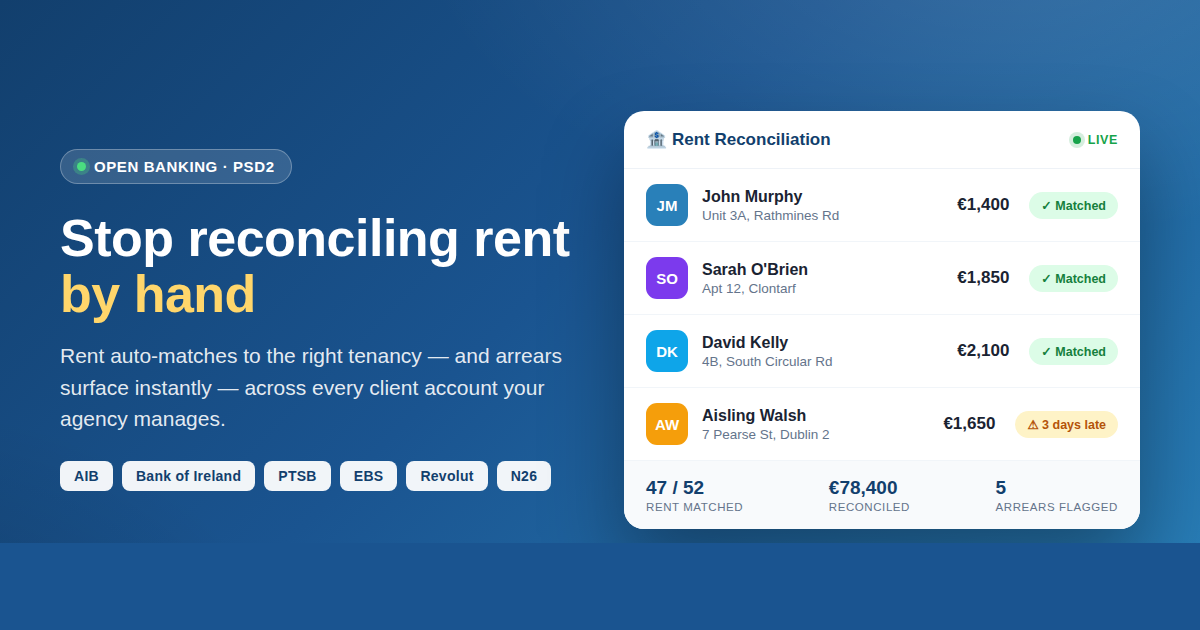
Everything above describes one landlord's problem. An agency has it forty or two hundred times over — and, unlike the landlord, already holds most of the data needed to solve it.
8.1 The year-end statement is a service, not a favour
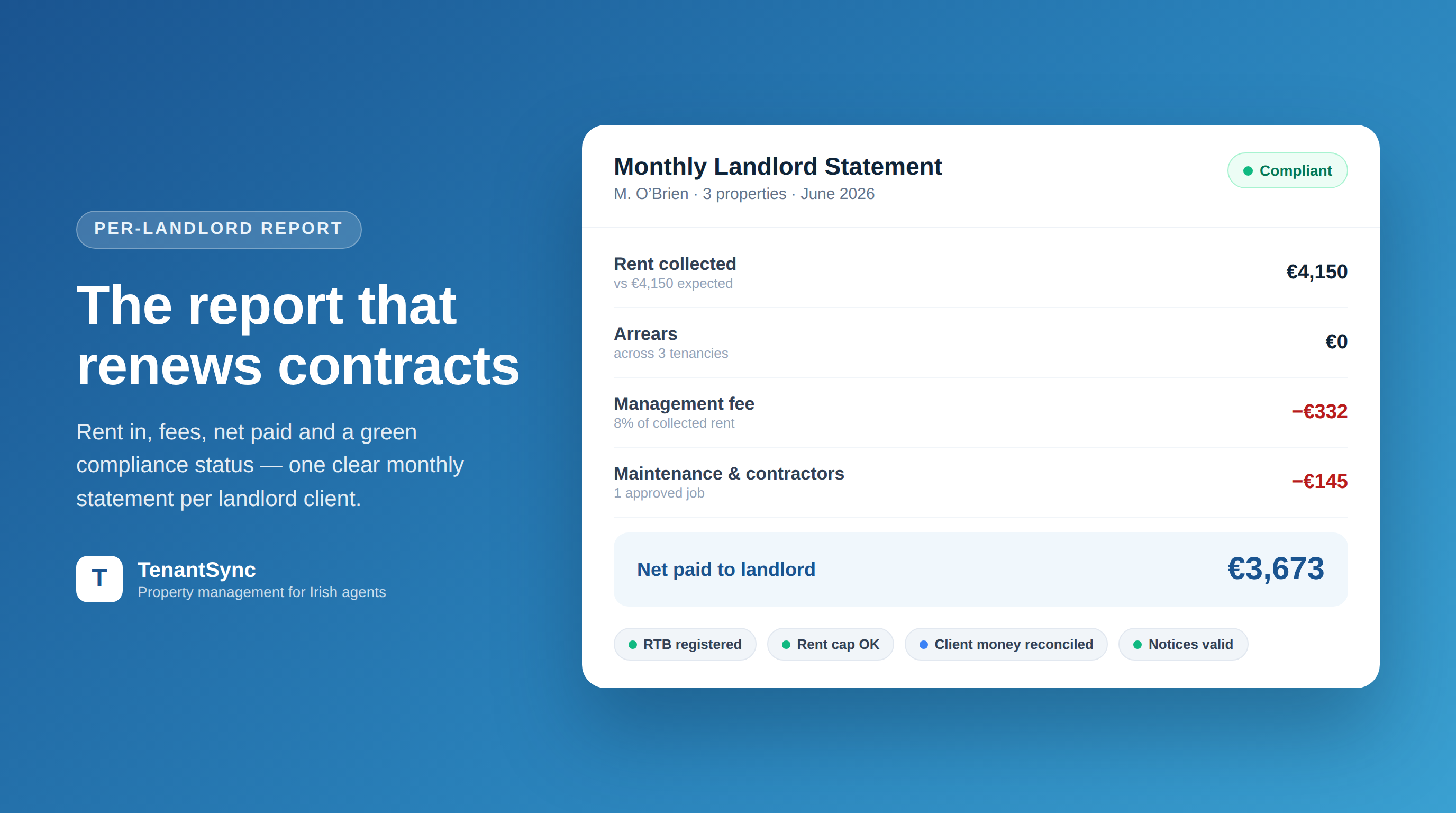
An agency managing a property already knows the rent collected and when, the management fee charged, the contractor spend, and the dates that everything happened on. That is most of what a Case V statement needs. The landlord, meanwhile, is about to reconstruct exactly that information from their bank account — badly.
Turning what you already hold into a per-property annual statement each client can hand straight to their accountant is one of the few pieces of year-end work that costs almost nothing to produce and is visibly worth paying for. Two things follow:
- It is billable. Not as tax advice — as a reporting service, priced per landlord or per property, delivered in the same window every year.
- It is retention. January is when landlords change agent. A client who has just been handed a complete, accountant-ready statement in November is materially less likely to be shopping in January than one who spent the autumn chasing you for figures.
Say what it is, in writing
A statement of what you collected and paid on a client's behalf is a report. It is not tax advice, it is not a return, and it does not make you their tax agent. Put that distinction in the engagement terms rather than leaving it to be inferred — our guide to the letter of engagement for Irish letting agents covers where this belongs.
8.2 The non-resident landlord obligation that isn't optional
Where a landlord is not resident in the State and the agency collects the rent, the agency's own position changes. Under the Non-Resident Landlord Withholding Tax system, which came into operation on 1 July 2023, a collection agent:
- withholds 20% of the rent and remits it to Revenue; and
- submits a Rental Notification through ROS within 21 days of each payment made to the landlord.
Complying is what relieves the collection agent of being chargeable to tax on the landlord's rental income — which is to say, the paperwork is the protection. Where no collection agent has been appointed, the withholding obligation falls on the tenant instead.
The operational point for an agency is that this is a per-payment, 21-day obligation running all year, not a year-end one. It is far easier to run monthly alongside the disbursement than to reconstruct in November — and a book with even a handful of non-resident clients has a running compliance task most agencies discover late.
Verify the current mechanics before you rely on this
NLWT detail — thresholds, the Rental Notification screens, how credits reach the landlord's record — is Revenue's, and it changes. Take the current position from Revenue's non-resident landlord pages and confirm your firm's position with your own advisers. This page flags the obligation; it does not define it.
8.3 What "already holds the data" actually requires
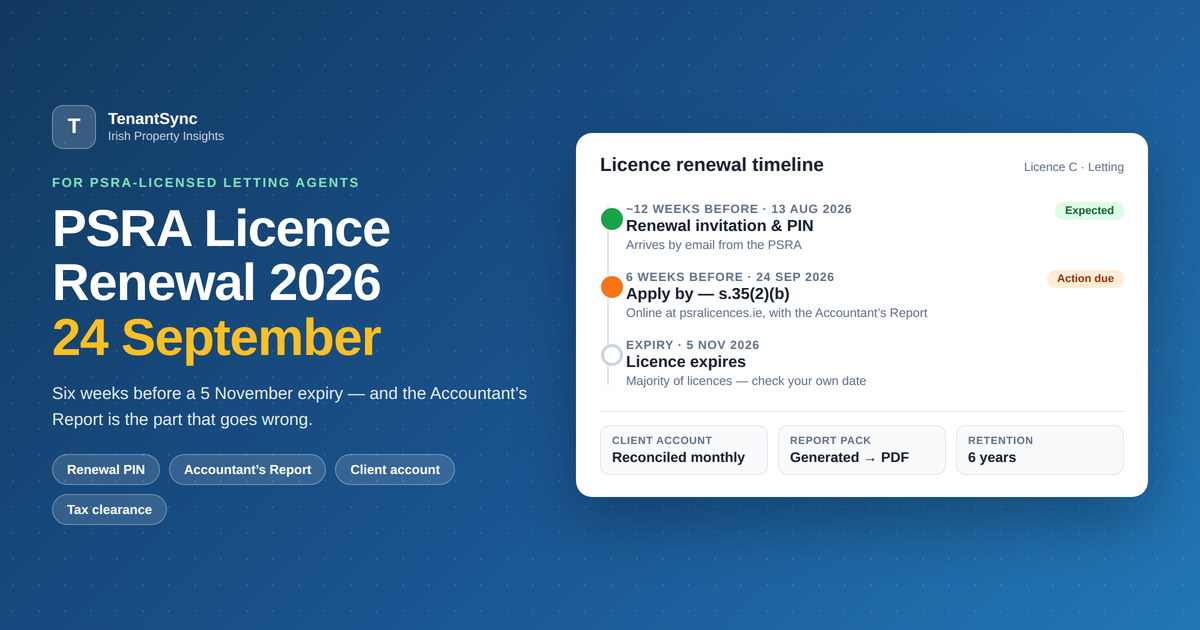
The whole argument collapses if the data is spread across a spreadsheet per branch, a bank account nobody reconciles weekly, and a folder of contractor invoices. Producing forty statements is trivial when rent, fees, contractor spend and disbursements all run through one system against the same properties — and effectively impossible when they do not. That gap is the same one that shows up at a PSRA licence renewal, when the Accountant's Report needs a client-account breakdown at two specific dates.
Offer per-client rental statements to every landlord on your book
See how rent collection, management fees, contractor spend and per-property statements run off one reconciled record — and what a landlord actually receives at the end of it.
9. How TenantSync builds the pack
Stated plainly, because the boundary matters: TenantSync computes rental profit. It does not compute your tax and it does not file anything. Income Tax, USC and PRSI depend on your total income, your marginal rate and your credits, none of which a property system knows. What it produces is the accountant-ready input.
- The transactions arrive categorised. Rent is matched to the lease and the invoice from the bank feed. Outgoing payments are turned into property expenses by the Smart Expense Engine, built around an Ireland-focused supplier map — Electric Ireland, Bord Gáis, FBD, the RTB, LPT and the rest. Anything it cannot confidently place is flagged for review rather than guessed at.
- No open banking? Upload the CSV. The statement import reads the same AIB, Bank of Ireland and Revolut exports, proposes matches as suggested, needs review, unmatched or duplicate, and writes nothing until a human confirms the batch.
- The Case V statement is computed, not typed. Pick a property and a tax year and you get gross rent, allowable expenses grouped into Revenue's buckets, mortgage interest, capital allowances and the resulting rental profit — with a per-landlord roll-up across their properties available too.
- The rules are applied, and the warnings are explicit. Mortgage interest is only claimed where the tenancy is RTB-registered — where it is not, the statement shows the interest as disallowed and says why, rather than silently including it. Furniture and appliances are pulled out of the expense list with a prompt to register them as capital assets. Local Property Tax is captured and excluded.
- Capital assets are tracked for all eight years. Each item is registered with its cost and acquisition date, and wear and tear at 12.5% a year flows into the statement for every year of the eight — including the ones you would otherwise have forgotten.
- The pack exports and locks. A statement can be finalised, which writes an audit entry, and exported as a PDF pack and a line-item CSV for an accountant. Every finalisation and every capital-asset change is written to an audit log.
- For agencies: rent collection, management fee deduction, contractor payments and monthly landlord disbursement statements run off the same reconciled feed, scoped by branch and by client — which is what makes producing a statement per landlord a batch job rather than a project.
Frequently asked questions
When is the landlord tax return deadline in Ireland for 2025 rental income?
The statutory pay and file date is 31 October 2026. Revenue has extended that to Wednesday 18 November 2026 for taxpayers who both file the 2025 Form 11 and make the payment through the Revenue Online Service. The extension is conditional on doing both through ROS: file online but pay by another method, or pay online but file on paper, and the earlier 31 October date stands for you. Revenue announces the extended date each year by eBrief, so it is not automatically mid-November — check the current year's announcement rather than carrying a date over.
Do I have to file a Form 11 if I only own one rental property?
That depends on the amount of income, not on the number of properties. You are treated as a chargeable person and file a Form 11 where your net non-PAYE income is €5,000 or more, or your gross non-PAYE income is €30,000 or more. Below both of those, a PAYE taxpayer generally returns the rental income on a Form 12 instead. At current Irish market rents a single let will often exceed the €30,000 gross figure on its own, so most landlords with even one property end up on a Form 11.
What actually falls due on the pay and file date?
Three separate things land on the same day: the Form 11 return for 2025, the balance of income tax owed for 2025, and preliminary tax for 2026. The preliminary tax element catches people out, because it is a payment towards a year that has not finished. It can be based on 90% of the final liability for 2026, 100% of the liability for 2025, or 105% of the liability for 2024 where payment is by direct debit and the 2024 liability was not nil.
What happens if I file the return late?
A surcharge is added to the tax due for the year: 5% of that liability, capped at €12,695, where the return is filed within two months of the deadline, and 10%, capped at €63,485, after that. The surcharge is calculated on the total liability for the year rather than on any amount left unpaid, so filing late still costs even if the tax itself was paid on time. Interest on late payment is charged separately and can apply on top.
Can I deduct my mortgage payments against rental income?
The interest, yes. The capital repayment, no. Interest on money borrowed to purchase, improve or repair the let property is deductible in full, but only where the tenancy is registered with the Residential Tenancies Board for the period concerned. That registration condition is the one most often missed on a reconstructed return, because a bank statement shows a single monthly direct debit and nothing in it separates the interest from the capital or proves the tenancy was registered.
Can I deduct the furniture and appliances I bought for the property?
Not as an expense in the year you bought them. Furniture, appliances and fittings are relieved through wear-and-tear capital allowances instead, at 12.5% of the cost each year for eight years from the year of acquisition. A €900 washing machine bought in 2025 gives €112.50 a year for 2025 through 2032, not €900 in 2025. This is why the purchase date and the cost of each item have to be recorded when you buy it — a bank line eight months later rarely tells you which of the two it was.
Is Local Property Tax deductible against rental income?
No. Local Property Tax is not an allowable expense against Case V rental income, notwithstanding that it is a property charge you have to pay. It is still worth recording it, because it belongs in a complete picture of what the property costs to run and because an accountant who cannot see it will ask about it. Just do not deduct it.
What is the Residential Premises Rental Income Relief worth for 2025?
The maximum relief is €600 for 2024, €800 for 2025, €1,000 for 2026 and €1,000 for 2027. It is available to individual landlords rather than to companies, trusts or estates, and it reduces Income Tax only — it does not reduce Universal Social Charge or PRSI. It is claimed on the return rather than deducted as an expense, which is precisely why a return assembled in a hurry from a bank statement misses it. Relief already claimed can be clawed back where the qualifying conditions stop being met before the end of 2027, so it is worth reading Revenue's conditions rather than treating it as free money.
Can I claim for work done before the property was let?
In defined circumstances, yes. Where a premises has been vacant for at least six months and is then let as a residential premises, certain pre-letting expenditure that would not otherwise be allowable can be deducted, capped at €10,000 per premises, provided it was incurred in the 12 months before the first letting. The relief has been extended to premises first let on or before 31 December 2027. It is clawed back if the property ceases to be let as a residential premises within four years of that first letting.
How long do I have to keep the records behind the return?
Six years. Revenue's requirement is to retain the books, invoices, receipts, bank statements and anything else supporting the entries on the return for six years from the end of the period they relate to. If an accountant holds them for you, that is fine — but the obligation is yours, not theirs. In practice this is the argument for a system that keeps the evidence attached to the property and the tenancy, rather than a folder that depends on somebody still working there in 2032.
My letting agent collects the rent. Doesn't that mean they handle the tax?
No. The rental income is yours and the return is yours to file, whoever collects the rent. What a good agent gives you is the input: a statement per property showing rent collected, management fees, contractor spend and anything else deducted before the money reached you. There is one significant exception in the other direction — where the landlord is not resident in the State, a collection agent takes on obligations of their own under the Non-Resident Landlord Withholding Tax system.
I'm a letting agent. What do I have to do if my landlord client lives abroad?
Under the Non-Resident Landlord Withholding Tax system, which came into operation on 1 July 2023, a collection agent acting for a non-resident landlord withholds 20% of the rent and remits it to Revenue, and submits a Rental Notification through ROS within 21 days of each payment made to the landlord. Doing that correctly is what relieves the collection agent of being chargeable to tax on the landlord's rental income, so it is not optional paperwork. Where no collection agent is appointed, the obligation to withhold falls on the tenant instead. Confirm the current mechanics with Revenue — this is an area where the detail matters and it is easier to get right monthly than to fix in November.
Does TenantSync file my tax return with Revenue?
No, and it does not give tax advice. TenantSync computes the Case V rental profit for a property and a tax year from the rent, expenses and capital assets it already holds, and exports that as a PDF pack and a line-item CSV for you or your accountant. It stops at rental profit — it does not calculate Income Tax, USC or PRSI, which depend on your total income, your marginal rate and your credits, and it files nothing with Revenue. Filing remains yours, through ROS or through your accountant.
Can a letting agency produce tax statements for its landlord clients?
Yes, and it is one of the few pieces of year-end work an agency can offer that costs almost nothing to produce once the underlying data is already structured. The agency holds the rent collected, the management fees charged, the contractor spend and the dates — which is most of what a Case V statement needs. Turning that into a per-property statement each landlord can hand to their accountant makes the agency harder to leave in January, and it is a legitimate billable service rather than a giveaway. It is not the same thing as giving tax advice, and the line between the two should be stated in writing to the client.
Summary
- 31 October 2026 is the statutory pay and file date for 2025 rental income. 18 November 2026 applies only where you both file the Form 11 and pay through ROS.
- Three things fall due together: the 2025 return, the 2025 balance, and preliminary tax for 2026.
- You file a Form 11 where net non-PAYE income is €5,000 or more, or gross non-PAYE income is €30,000 or more. The gross test alone catches most single-property landlords.
- Late filing costs 5% of the year's liability within two months, 10% after, capped at €12,695 and €63,485 respectively — charged on the whole liability, not on what is unpaid.
- The expensive part is not the form. It is reconstructing a year from bank statements, which loses anything the statement does not describe, anything that is not a single transaction, and anything that is not an expense at all.
- Four reliefs are lost that way in particular: mortgage interest (which needs RTB registration and an interest certificate), wear and tear at 12.5% a year for eight years, pre-letting expenditure up to €10,000, and the Residential Premises Rental Income Relief — €800 for 2025.
- Records supporting the return must be kept for six years, and the obligation is yours even where your accountant holds them.
- For agencies, the year-end statement is a billable, retention-generating service built from data you already hold — and if any client is non-resident, the Non-Resident Landlord Withholding Tax obligations run every month, not at year end.
- None of this is tax advice. Revenue owns these rules, they change, and the extended ROS date is announced annually.
Stop rebuilding the year in November
Landlords: categorise last year's statement in a couple of minutes and see what is actually there. Agencies: see how a per-client rental statement comes off a reconciled record instead of a spreadsheet.
Sources & further reading
- Revenue — Irish rental income, including what expenses are allowed, the mortgage interest conditions and capital allowances.
- Revenue — pay and file through ROS, and the annual eBrief announcing the extended date.
- Revenue — Residential Premises Rental Income Relief, including the yearly maximums and the clawback conditions.
- Revenue — non-resident landlords and the NLWT system.
- Revenue — keeping records, and the six-year retention requirement.
- Residential Tenancies Board — tenancy registration, which the mortgage interest deduction depends on.
- Citizens Information — plain-English context on the reliefs available to Irish landlords.
Every figure on this page was checked against Revenue's published guidance on 10 September 2026. Tax rules change with each Finance Act, the extended ROS date is set annually, and none of this is tax advice — confirm the current position with Revenue or your accountant before you file.
Related Articles