The RTB Copy Rule: Why Your Rent Review Notice Is Invalid If the RTB Doesn't Get It
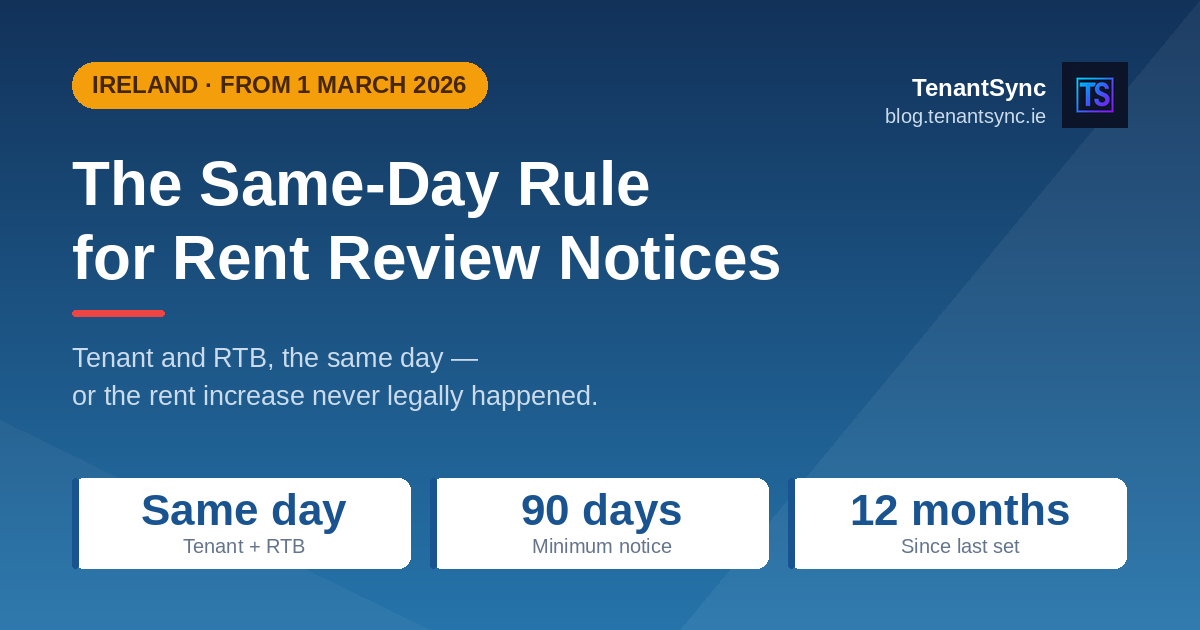
A notice of rent review has to reach two recipients: the tenant, and the RTB — the RTB within 7 days of the date of service since 14 September 2026, and on the same day before then. Miss the second one and the increase never legally happened — however careful the calculation was, however reasonable the figure, however clearly the tenant agreed. Here is the rule, the documents that have to travel with the notice, what an invalid notice actually costs, and a self-audit for every notice your agency has served this year.
The short version
A notice of rent review must be given to the tenant and a copy sent to the RTB within 7 days of the date of service. If it is not sent to the RTB, the notice is invalid and the rent increase never took effect. Submit through the RTB Service Centre — on the day you serve the tenant if you have any sense, because that is one action rather than a pending task. The notice needs at least 90 days before the new rent applies, cannot come sooner than 12 months after the rent was last set, and travels with a statement of the last rent and the date it was set, an RTB Rent Calculator printout, and — where the rent is being set to market rent — three comparable dwellings from the RTB Rent Register. The same obligation applies to rent setting notices on a new tenancy too.
1. The Rule, in Two Sentences
A notice of rent review must be given to the tenant, and a copy must reach the RTB within 7 days of the date of service. If it does not reach the RTB, the rent review notice is invalid.
That is the whole rule. The obligation came in on 1 March 2026 with the rest of the rental reform package, and the window widened from the same day to 7 days on 14 September 2026 — but what has not changed is the part that bites: it fails in a way that gives you no signal. A missed RTB registration eventually produces a letter. An overcharged rent eventually produces an argument. A rent review notice that never reached the RTB produces nothing at all — the tenant pays the new figure, the ledger balances, the landlord is happy, and the review is void from the day it was served. You find out when somebody looks: a tenant who takes advice, a dispute about something else entirely, a new agent taking over the file.
The 7 days run from the date of service — the date the tenant receives the notice, not the date you drafted it, signed it or put it in the post. That distinction is the whole trap in the new window: the clock starts on a date you may have to establish after the fact. Where the copy goes to the RTB by post, the deadline applies to delivery rather than to posting, which is precisely why the RTB recommends submitting online through the RTB Service Centre. You cannot control what An Post does with an envelope; you can control the timestamp on an upload.
⚠ The failure is silent, and it compounds monthly
Every month the tenant pays the increased figure on an invalid notice is another month of overpaid rent that is repayable. A €60 monthly increase that has been collected for eleven months is €660 of repayable rent on a single tenancy, before anyone considers damages — and across ten tenancies for the same landlord client, it is €6,600 and a conversation your agency has to open.
Seven days is a relaxation on paper and a trap in practice
The old rule was easy to operate because it was one action: serve and copy, same day, done. A 7-day window creates a task that can be forgotten for six days — and the clock starts on a date you may have to prove later. If you change anything about your process this week, change it so the RTB copy still goes out with the tenant's copy. Use the seven days as a safety net, not as a plan.
Where the RTB copy actually goes missing in an agency
It is almost never a knowledge failure. Agencies know about the rule. It breaks in the gap between two people — and every one of these gaps outlasts a seven-day window as easily as it outlasted a one-day one:
- The negotiator serves, the administrator submits. The notice goes to the tenant on Thursday afternoon on the way past the property; the paperwork lands on the admin desk Friday morning, and then waits behind everything else. Seven days buys you one working week, which is exactly how long a task takes to disappear.
- The landlord serves their own notice. The agency calculates the figure, the landlord hands the letter over on a visit, and nobody submits anything because each side assumed the other had.
- The notice is posted, and nobody records when it arrived. The 7 days run from the date the tenant receives it, so a posted notice starts a clock on a date the agency does not know. Record the date of receipt as its own field, or you are counting from a guess.
- The tenant is served by email, and the file is updated at month-end. Email service makes the tenant's date unambiguous and precise — which cuts both ways, because it dates the start of the window unambiguously, and month-end is more than seven days away for most of the month.
The one process change that closes it
Make the RTB submission a precondition of service, not a follow-up to it. Nothing goes to the tenant until the RTB copy is uploaded and the confirmation is on the file. That way the seven days are a margin you never spend, and the date of service never has to be reconstructed.
2. The Four-Part Notice Package
A rent review notice is not a letter saying the rent is going up. It is a package, and the parts that most often go missing are the ones that prove the figure was arrived at lawfully.
-
The notice itself, on the RTB's current form
The RTB publishes a Notice of Rent Review form, updated for the 1 March 2026 regime. Use the current version rather than a template saved in a shared drive in 2024 — the form changed, and an old form will not contain the declarations the new regime expects.
-
A statement of the last rent and the date it was set
The amount the rent was last set at, and the date it was set. This is the anchor for both the 12-month rule and the cap calculation, so it is the field to get right first. It is also the field agencies most often cannot produce for an inherited tenancy, because the previous manager kept it in an email rather than in a record.
-
A printout from the RTB Rent Calculator showing the working
The RTB Rent Calculator produces the maximum increase permitted for the tenancy over the period since the rent was last set. Save the printout and send it with the notice. Under national rent control the increase is capped at the lower of 2% a year or CPI inflation over that period; newly built dwellings first available to rent on or after 10 June 2025, and student-specific accommodation, are outside the 2% cap and limited by CPI only.
-
Three comparable dwellings from the RTB Rent Register
Where the rent is being set to market rent, the notice must include details of three comparable properties drawn from the RTB Rent Register — dwellings of similar size, type and character in a comparable area, including BER where it applies to the property. Screenshot them at the time you use them. A comparable you cannot reproduce eight months later is not evidence.
Which part is missing most often
In practice it is part two — the date the rent was last set. Agencies default to the tenancy start date because that is the date the file shows, and for a tenancy that has run untouched since it began, the two are the same. For a tenancy where the rent moved mid-term, where the property changed agent, or where a previous increase was itself served late, they are not, and every downstream date is then wrong by the same margin.
The reason the package matters as much as the RTB copy is that the two failure modes are asymmetric. A missing comparable is arguable. A missing RTB copy is not: the notice is invalid, and no amount of good faith about the figure rescues it.
⚠ Check the comparables requirement against your own facts
The RTB frames the three-comparables requirement around setting the rent to market rent. Whether it bites on a particular review depends on what you are doing with the rent, so read the RTB's current rent review guidance against the tenancy in front of you rather than applying a blanket rule across the book. Including three comparables where they were not strictly required costs you nothing; omitting them where they were required can cost you the notice.
3. Rent Setting and Rent Review Are Two Different Notices
Agencies that reacted to the March reforms by fixing their rent review process have often fixed only half of their exposure, because there are two notices and both owe the RTB a copy.
Scroll the table sideways to see every column.
| Notice of Rent Setting | Notice of Rent Review | |
|---|---|---|
| When it is used | Setting the rent at the start of a new tenancy | Changing the rent during an existing tenancy |
| When it is served | At the start of the tenancy | At least 90 days before the new rent takes effect |
| Copy to the RTB | Same day as the tenant's copy | Same day as the tenant's copy |
| If the RTB copy is missed | The notice can be deemed invalid | The notice is invalid — the increase does not take effect |
| Who usually serves it | The negotiator closing the let, often at signing | The property manager or administrator, on a diary date |
| Where it tends to fail | Volume and speed — a busy new-let week, notice handed over with the lease and never uploaded | Hand-offs — one person serves, another submits, a day apart |
The rent setting notice is the more dangerous of the two for an agency, because it sits inside the new-let workflow rather than the compliance workflow. A negotiator signing a lease on a Saturday viewing is not thinking about an RTB upload, and the tenancy that starts with an invalid rent setting notice carries that defect for as long as it runs.
4. Check Your Dates Before You Serve
Three dates decide whether a rent review notice is valid on timing: the date the rent was last set, the date you serve the tenant, and the date you want the new rent to start. Get any of them wrong and the notice fails before anyone looks at the figure.
Rent review notice date checker
Runs the 90-day notice period and the 12-month review cycle against the dates you enter, and tells you the date the RTB copy has to be submitted. It checks timing only — it does not calculate the rent cap, and it does not check anything against the RTB's records.
Enter the three dates above.
—
—
The 90 days runs from when the tenant receives the notice, not from when you sent it — so where a notice is posted, build the delivery time into the count rather than starting the clock on the postmark. Timing is only one way a notice fails; see the other invalidators below. This calculator runs entirely in your browser and sends nothing anywhere.
Why the "last set" date is the one to nail down
It sets the 12-month cycle and it is the start point for the CPI measurement in the cap calculation. An agency that logs "rent reviewed March 2025" but not the date it was actually set will get both wrong in the same direction, and the notice will be defective on the figure as well as on the cycle.
📄 Generate a compliant Notice of Rent Review — free
Enter the tenancy and the proposed rent. The tool checks it against the national rent cap using CSO CPI data, defaults the effective date to the 90-day minimum, warns you if you are inside the 12-month cycle, and produces the notice as a PDF you can download or have emailed. No login, no card. You still submit it to the RTB yourself.
5. What "Invalid" Actually Means Downstream
"Invalid" is not a technicality that gets tidied up later. It means the increase never legally happened, and every consequence flows from that single fact.
The rent stays where it was
The tenancy's rent is the last lawfully set figure. Not the figure on the invalid notice, not the figure the tenant has been paying, not the figure in your management system or on the landlord's statement. Every rent roll, arrears report and landlord statement produced since is running on a number that has no legal basis.
The difference is overpaid rent, and it is repayable
Everything collected above the lawful rent is overpayment. A tenant can seek it back, and the RTB has ordered repayment of overpaid rent in dispute cases. The exposure grows every month the invalid increase stays in place, which is what makes discovery timing so brutal: the same defect costs a fraction in month two and a multiple in month twelve.
A dispute can freeze the increase while it runs
A tenant who believes the rent has been set improperly can bring a dispute to the RTB, and doing so can stop the rent review taking effect until the case concludes. That is months of the old rent, on a tenancy where the landlord has already been told to expect the new one.
Adjudication and Tribunal can award damages
An RTB adjudication or Tribunal hearing can order the landlord to repay overpaid rent and award damages of up to €20,000. Separately, where the RTB investigates and an independent decision maker finds improper conduct, the sanctions available are a formal written caution and/or a fine of up to €15,000 for each improper conduct and/or the RTB's investigation costs of up to €15,000. The improper conducts the RTB can investigate are defined in law — check the RTB's compliance pages for the current list before assuming any particular failure is or is not on it.
⚠ A figure you will see quoted, and shouldn't repeat
A €30,000 sanction figure circulates in secondary coverage of the 2026 reforms. We cannot corroborate it on rtb.ie, so it does not appear on this page. You do not need it: the void increase and the repayable rent carry the argument on their own, and quoting an unverified penalty to a landlord client is a fast way to lose the room when they check it.
And then there is the part that isn't in the legislation
The landlord client instructed you to increase the rent. You told them it was done. It wasn't. Whatever the legal allocation of responsibility between landlord and agent, the operational failure is the agency's, and it will be discussed in exactly those terms. For a PSRA-licensed firm whose product is competence, that conversation costs more than the repayable rent does.
6. Self-Audit: Every Notice Served Since 1 March 2026
If you have served rent review or rent setting notices since 1 March 2026 and you cannot say, per notice, what date the RTB received it, you have an audit to run. It is a morning's work on a normal book, and it is much cheaper than the alternative discovery route.
Pull every rent review and rent setting notice served on or after 1 March 2026. For each one, answer these — from the file, not from memory:
- What date did the tenant receive the notice? Not the date it was drafted, dated, or posted — received.
- What date did the RTB receive it? Is there a submission confirmation on the file that proves that date?
- Are those two dates the same date?
- Was the notice on the RTB's current form for the post-March-2026 regime?
- Did it carry the statement of the last rent and the date it was set?
- Did it carry the RTB Rent Calculator printout showing how the new rent was calculated?
- Where the rent was set to market rent, did it carry three comparables from the RTB Rent Register — and can you still produce them?
- Is the effective date at least 90 days after the tenant received it?
- Is the effective date at least 12 months after the rent was last set?
- Was the increase within the cap that applied to that tenancy — 2% or CPI, whichever was lower, or CPI alone for a post-10-June-2025 new build or student-specific accommodation?
- Was the notice served on every tenant named on the tenancy, not just the one who pays the rent?
- Has the tenancy registration record been updated separately with the new rent?
Sort the results into three piles, not two
Clean — every answer good, evidence on file. Defective — a specific answer is bad, and you know which. Unprovable — you believe it was done correctly but cannot demonstrate it. Treat the third pile as the second. At an adjudication, a notice you cannot evidence and a notice you got wrong land in the same place.
Run the audit oldest-first. The oldest defective notice is the one carrying the largest accrued overpayment, and it is the one where the remediation clock matters most.
7. What to Do When You Find a Bad One
There is no mechanism for curing a defective notice retrospectively. You cannot send the RTB copy late and have the original notice become valid, and you cannot backdate a replacement. What you can do is stop the exposure growing and re-run the process properly.
-
Establish the lawful rent, and stop collecting above it
The lawful rent is the last figure that was validly set. Every euro collected above it is repayable, so the first action is to stop adding to the total. Continuing to collect the invalid figure after you have identified the defect is a materially worse position than the original mistake.
-
Tell the landlord client, in writing, straight away
The uncomfortable call is cheaper today than it will be after the tenant takes advice. Give them the defect, the lawful rent, the accrued overpayment as a figure, the remediation plan, and the earliest date a valid increase can take effect. Landlords forgive a mistake explained early with a plan attached far more readily than one discovered by their tenant.
-
Quantify the overpayment per tenancy
Monthly difference × months collected, to the current date. Do the arithmetic before the conversation, not during it. Where several tenancies for one landlord are affected, give them the portfolio total as well — they will ask.
-
Serve a fresh, valid notice — and copy the RTB with it
Current form, full package, effective date at least 90 days out and outside the 12-month cycle, RTB copy sent with the tenant's rather than inside the seven days, confirmation on the file. Take the opportunity to re-run the cap calculation from the correct "last set" date rather than reusing the old working.
-
Decide the repayment position with the landlord
Whether the overpayment is refunded, credited against future rent, or left for the tenant to raise is the landlord's call to make on advice — but it is a decision to be taken deliberately and recorded, not left open. Document the instruction you received.
-
Fix the process before you fix the next notice
If one notice failed on the RTB copy, the process allowed it, which means others will too. Change the process first, then work the backlog through the new process. Doing it the other way round produces a second audit in six months.
Where the tenancy is inherited
Agencies taking on a property mid-tenancy inherit whatever the previous manager did, including an invalid increase served before you had the file. Make the rent review history a standing item in onboarding: the date the rent was last validly set, the notice that set it, and the evidence it was served properly. It is far easier to raise as a finding during onboarding than as a discovery a year into the instruction.
8. The Other Things That Invalidate a Notice
The RTB copy gets the attention because it is binary. It is not the only way a rent review fails.
Scroll the table sideways to see every column.
| Failure mode | What goes wrong | The check that prevents it |
|---|---|---|
| No RTB copy, or a late one | The notice is invalid. The increase never took effect. | Submit to the RTB before the tenant's copy leaves the office, and file the confirmation. |
| Short notice period | Fewer than 90 days between the tenant receiving the notice and the new rent starting. | Count from receipt, not from posting, and leave a margin for posted service. |
| Inside the 12-month cycle | The rent was last set less than 12 months before the new rent is due to start. | Anchor on the date the rent was last set — never on the tenancy start or the registration anniversary. |
| Above the permitted cap | The increase exceeds the lower of 2% a year or CPI over the period since the rent was last set. | Run the RTB Rent Calculator for the actual dates and keep the printout with the notice. |
| Wrong exemption assumed | The 2% cap is treated as waived for a property that does not qualify — the exemptions are for new builds first available to rent from 10 June 2025 and student-specific accommodation. | Record the basis for the exemption on the tenancy file, with the evidence, before it is used in a calculation. |
| Missing calculation statement | The notice states a new rent but does not show the last rent, the date it was set, or how the new figure was reached. | Treat the statement and the calculator printout as part of the notice, not as optional attachments. |
| Missing or unreproducible comparables | Market rent asserted with no Rent Register evidence, or with comparables nobody saved. | Screenshot the three comparables at the time of use and store them against the tenancy. |
| Superseded form | A pre-March-2026 template that lacks the declarations the current regime expects. | Pull the form from rtb.ie each time, or use a generator that tracks the current version. |
| Not served on every tenant | One notice addressed to the tenant who pays, in a tenancy with three named tenants. | Generate the notice from the tenancy record, not from the payment record. |
| No proof of service | The notice was almost certainly served correctly, and nothing on the file demonstrates it. | Save the served copy, the attachments as they went out, and the service evidence together. |
Note the pattern across the bottom half of that table: most of the failures that are not about the RTB copy are evidence failures rather than knowledge failures. The agency did the right thing and cannot show it. That distinction matters, because it is fixed by where records live, not by training.
🧮 Is the increase actually within the cap?
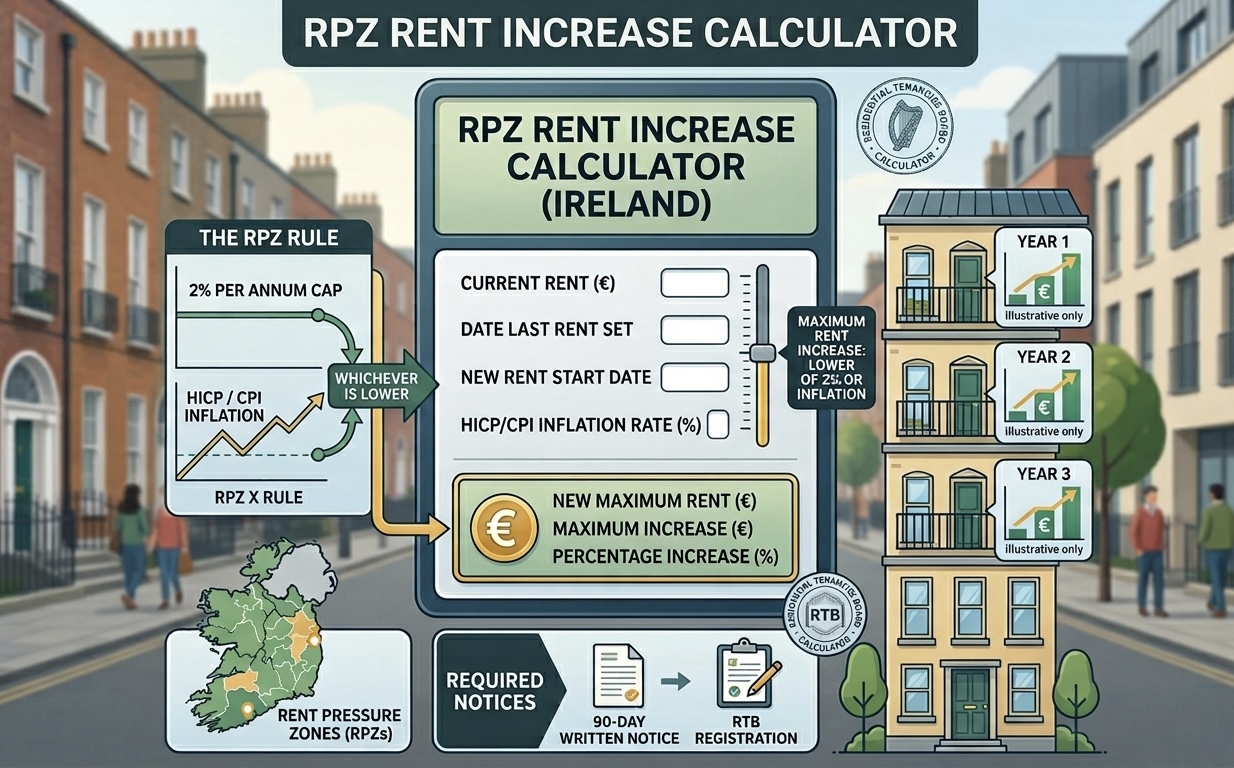
The free rent increase calculator returns the maximum legal rent for a tenancy under national rent control, shows whether 2% or CPI was the limiting rule, and cites the CSO CPI figures behind it — so the working goes on the file, not just the answer.
9. The Registration Record the Service Centre Doesn't Update
Here is the step almost every guide leaves out, and it catches agencies that got everything else right.
Submitting your rent review notice through the RTB Service Centre does not update your tenancy registration record. They are two different systems doing two different jobs. The Service Centre receives the notice; the registration account holds the register entry for the tenancy. Keeping that registration record accurate and up to date remains the landlord's responsibility, and the rent held against the registered tenancy has to be updated separately in the RTB registration account.
So a properly executed rent review has three destinations, not two:
- The tenant — the notice and its accompanying documents.
- The RTB Service Centre — the same package, within 7 days of the date of service.
- The RTB registration account — the registered rent, updated to the new figure.
⚠ Where this bites
At the next annual registration, the account pre-fills last year's values — and rent is the field most likely to have moved. An agency that never updated the register after a review will confirm a stale rent figure without noticing, and the register will then disagree with the rent actually being collected on a tenancy whose increase they can otherwise fully evidence. It is an entirely avoidable inconsistency to have to explain.
Make the register update the closing step of the rent review checklist, immediately after the RTB submission, while the file is open and the figures are in front of you. We cover the mechanics of the registration account itself in the RTB portal guide.
10. Systemising It Across a Book of Tenancies
One rent review is a task. Forty a year across a managed book is a process, and processes fail at the joins. What follows is what a rent review process needs to contain in order not to depend on anyone's memory.
Anchor every date on "last set", per tenancy
Not the tenancy start, not the registration anniversary, not "we usually do them in spring". One field per tenancy — the date the rent was last set — with the amount beside it. Every other date on the review derives from it: the earliest review date, the earliest effective date, and the period the CPI measurement covers.
Make eligibility arrive, rather than be looked up
A tenancy becoming eligible for review is an event with a computable date. It should surface on its own, with enough lead time to serve 90 days ahead of a sensible effective date — which means the alert needs to fire roughly four months before the increase is wanted, not on the eligibility date itself. Agencies that check eligibility manually find it late, and late means another quarter at the old rent.
One action, both recipients, or neither
The single highest-value process rule in this entire article: the tenant's copy does not leave until the RTB copy is submitted and confirmed. Whether you enforce that with software, a checklist, or a rule that only one named person serves rent reviews, enforce it somewhere. Splitting service and submission across two people on two days is the mechanism that produces most invalid notices.
Store the evidence with the tenancy, not with the person
The served notice, its attachments exactly as they went out, the proof of service, the RTB submission confirmation, and the comparables as they looked on the day. All against the tenancy record. Not in a negotiator's sent items, not in a folder named after a month, not in the landlord's email. You are building a file that has to answer a question in three years' time, quite possibly for a different agent.
Give the landlord the working, not just the number
A landlord who receives "we can go to €1,632" asks why. A landlord who receives "€1,632 — 2% was the limiting rule over the 14 months since the rent was last set on 12 June 2025, here is the calculator printout" does not, and signs off faster. The same pack is what you would produce at an adjudication. Produce it once and use it twice.
The two-minute test for any rent review process
Pick a tenancy at random and ask: what date was the rent last set, what did the notice say, what date did the tenant get it, what date did the RTB get it, and can you show me all four in under two minutes? If the answer involves searching an inbox, the process is not a process yet.
11. How TenantSync Handles the Rent Review Cycle
Plainly, so there is no confusion about what the software does and does not do: TenantSync does not submit anything to the RTB. The submission is made by you, through the RTB Service Centre. What TenantSync does is make sure the figure is right, the notice is right, the date arrives on time, and the record survives.
The cap calculation, with the working shown
The rent-cap engine computes the maximum legal rent for a tenancy from the rent, the date it was last set and the review date, using CSO Consumer Price Index data. It returns the figure and which rule limited it — the 2% annual cap or CPI — along with both percentages, so the reasoning is on the record rather than in someone's head. Where the tenancy is a newly built dwelling first available to rent from 10 June 2025, or student-specific accommodation, the 2% cap is waived and the calculation is limited by CPI only, with the exemption reason stated on the result.
The notice itself
The Notice of Rent Review generator produces the notice as a PDF, runs the same rent-cap check as you fill it in, defaults the effective date to the 90-day minimum, warns you when the effective date falls inside the 12-month cycle, and takes up to three comparable dwellings. It is free and needs no login — the free version builds the PDF from what you enter and does not store the notice.
Eligibility that arrives on its own
Inside the product, each tenancy carries a rent review tracker: the current rent, the date it was last reviewed, the next eligible review date, and the suggested maximum rent computed for that date by the same engine. The next eligible date is visible on the tenancy and on the compliance dashboard, which flags an obligation as upcoming before it falls due; and a scheduled job runs daily as the eligibility date approaches, pushing the alert out by email, in-app notification and mobile push with the property and the estimated maximum rent on it. The date reaches the person responsible instead of waiting to be looked up.
The whole obligation set in one view
Rent review is one of eleven tenancy-level obligation types on the compliance dashboard, alongside RTB registration and annual renewal, Part 4 rights, BER, insurance, fire alarm servicing, gas and electrical certificates and AML review — each shown as compliant, upcoming or overdue, and scoped by branch for agencies. Each lease also has a compliance timeline that puts registration dates, renewal dates, Part 4 dates and rent review dates in one chronological view.
The evidence, against the tenancy
Documents are stored against the property, filed by category — RTB, legal document, correspondence and the rest — with expiry dates and automated expiry reminders. The served notice, its attachments, the proof of service and the RTB submission confirmation live on the property file rather than in someone's mailbox. That is the part that answers the question three years later, quite possibly for a different agent.
What we don't claim
TenantSync is not affiliated with the RTB, does not submit rent review or rent setting notices to the RTB, does not register tenancies with the RTB and does not pay RTB fees. Those are done on the RTB's own systems by the landlord or their agent. The rent-cap calculation is a calculation, not legal advice, and it is shown with its working and a disclaimer so you can check it rather than trust it.
Frequently Asked Questions
Do I have to send a rent review notice to the RTB?
Yes. A notice of rent review must be given to the tenant and a copy sent to the Residential Tenancies Board within 7 days of the date of service — the date the tenant receives the notice. Before 14 September 2026 the copy was due on the same day. If the notice is not sent to the RTB, the rent review notice is invalid. Notices are submitted through the RTB Service Centre, reached from rtb.ie.
What happens if the rent review notice never reached the RTB?
The notice is invalid, which means the increase never legally took effect. The rent stays at the previous figure. Anything collected above it is overpaid rent the tenant can seek back, and a tenant who disputes the review at the RTB can have the increase stopped while the case runs. There is no cure for the original notice — the only remedy is to serve a fresh, valid one, which restarts the 90-day clock from scratch.
How much notice do I have to give before a rent increase takes effect in Ireland?
A written notice of rent review must be served at least 90 days before the new rent takes effect. The 90 days runs from when the tenant receives the notice, not from when you sent it, so a posted notice needs the delivery time built into the count. Use the date checker above to work the dates through.
How often can rent be reviewed in Ireland?
Once every 12 months. The 12 months runs from the date the rent was last set, not from the start of the tenancy and not from the anniversary of the registration. Where a tenancy has changed hands or the rent was set mid-term, the date the rent was last set is the one that matters.
What has to be sent with the notice of rent review?
The notice travels with a statement showing the amount the rent was last set at and the date it was set, and a printout from the RTB Rent Calculator showing how the new rent was calculated. Where the rent is being set to market rent, the notice must also include details of three comparable dwellings taken from the RTB Rent Register — properties of similar size, type and character, including BER where it applies.
Does the RTB copy rule apply to rent setting notices for a new tenancy too?
Yes. A notice of rent setting for a new tenancy must also go to the tenant and to the RTB, and it is served at the start of the tenancy rather than 90 days ahead. Agencies that have wired the RTB copy into their rent review process and not into their new-let process have only fixed half the exposure.
Can I fix an invalid rent review notice by serving a new one?
You can serve a fresh notice, but you cannot backdate it. The new notice starts its own 90-day clock, the rent stays at the old figure until that clock runs out, and any amount already collected above the old rent is repayable. Serving a corrected notice is the right move — just do it knowing the lost months are lost, and tell the landlord client before you do it rather than after.
Does submitting the notice to the RTB update my tenancy registration?
No. Submitting a rent review notice through the RTB Service Centre does not update the tenancy registration record. The rent held against the registered tenancy has to be updated separately in the RTB registration account, and keeping that record accurate and up to date remains the landlord's responsibility. See section 9.
How much can I increase the rent in Ireland in 2026?
Under national rent control the increase is limited to the lower of 2% a year or the rate of CPI inflation, measured over the period since the rent was last set. Newly built dwellings first available to rent on or after 10 June 2025, and student-specific accommodation, are not subject to the 2% cap — those are limited by CPI only. The mechanics of the cap itself are covered in our guide to the national rent cap.
Can I post the notice to the RTB instead of submitting it online?
The RTB accepts a posted notice, but the deadline applies to delivery rather than to posting: the copy has to be in the RTB's hands within 7 days of the date of service. Because you cannot control the delivery date, the RTB recommends submitting online through the Service Centre instead. For an agency serving notices at any volume, posting is an avoidable risk taken one tenancy at a time.
What sanctions can the RTB impose on a landlord?
Where the RTB investigates and an independent decision maker finds improper conduct, the sanctions available are a formal written caution and/or a fine of up to €15,000 for each improper conduct and/or the RTB's investigation costs of up to €15,000. Separately, an RTB adjudication or Tribunal can order repayment of overpaid rent and award damages of up to €20,000. The improper conducts the RTB can investigate are defined in law, so check the RTB's compliance pages for the current list.
Does TenantSync send the rent review notice to the RTB for me?
No. TenantSync is not affiliated with the RTB and does not submit anything to the RTB on your behalf — the notice is submitted by you through the RTB Service Centre. What TenantSync does is calculate the maximum permitted rent and show which rule applied, generate the Notice of Rent Review as a PDF, track when each tenancy next becomes eligible for a review, and hold the record of what was served and when.
Summary
- Tenant, then the RTB within 7 days. A rent review notice whose copy does not reach the RTB within 7 days of the date the tenant receives it is invalid. Before 14 September 2026 the copy was due the same day.
- Invalid means the increase never happened. The rent stays at the last lawfully set figure, and everything collected above it is repayable.
- It applies to rent setting notices too. New tenancies owe the RTB a copy at the start of the tenancy — fix both workflows, not just the review one.
- Submit online. The deadline applies to delivery rather than to posting, which is why the RTB recommends the Service Centre.
- 90 days from receipt, not from posting. Build delivery time into the count for anything served by post.
- 12 months from the date the rent was last set — not the tenancy start, not the registration anniversary.
- The notice is a package. The form, the last rent and the date it was set, the RTB Rent Calculator printout, and three Rent Register comparables where the rent is being set to market rent.
- The cap is the lower of 2% a year or CPI since the rent was last set — CPI only for post-10-June-2025 new builds and student-specific accommodation.
- Submitting the notice does not update the register. Update the rent on the tenancy registration record separately.
- Audit what you have already served. Every notice since 1 March 2026, oldest first, using the checklist above. A notice you cannot evidence is a notice you got wrong.
- Make submission a precondition of service. The tenant's copy does not leave until the RTB copy is confirmed.
🔍 Can you prove what you served, to whom, on what date?
That question is the whole exposure. TenantSync computes the maximum legal rent with the rule and the CSO CPI figures shown, generates the Notice of Rent Review, surfaces every tenancy as it becomes eligible for review, and keeps the served notice and its evidence against the tenancy. Start with the free notice generator — no login, no card.
Sources & Further Reading
The RTB sets and changes the rules, the forms and the submission routes described here. Check every detail against the RTB's own pages before you serve a notice — particularly the current form and what the RTB requires to accompany it, which are the parts most likely to have moved. Details on this page were last verified on 21 August 2026.
- RTB — Guide to rent review notices
- RTB — Guide to rent setting notices
- RTB — Setting and reviewing private rents from 1 March 2026
- RTB — Forms and templates (the current Notice of Rent Review and Notice of Rent Setting forms)
- RTB — Rent Calculator
- RTB — Rent Register
- RTB — Rental law changes from 1 March 2026
- RTB — What the RTB can investigate
- RTB — Decisions and sanctions
- RTB — Tenancy registration account (where the registered rent is updated)
- Citizens Information — Rent increases in private rented housing
- CSO — Consumer Price Index (the index behind the CPI limb of the cap)
- Residential Tenancies Act 2004
Related reading on this site: the national rent cap explained · setting rent in 2026 · the rent increase calculator · can I increase my rent? · notice of termination · the RTB portal.
Related Articles