The 2026 RTB Compliance Checklist: 21 Things Every Irish Landlord Must Do
RTB compliance in Ireland is ongoing, detailed, and legally non-negotiable. This 21-point checklist covers every core obligation — from RTB registration and Rent Pressure Zone rent reviews to written notices, property standards, and record-keeping — with practical guidance on how TenantSync helps Irish landlords stay on top of every deadline and document.
Every landlord in Ireland has heard the words "RTB compliance" — but far fewer have a clear, actionable system for staying on the right side of the Residential Tenancies Board. Whether you own one rental property or manage a small portfolio, the obligations under Irish landlord law are specific, ongoing, and non-negotiable.
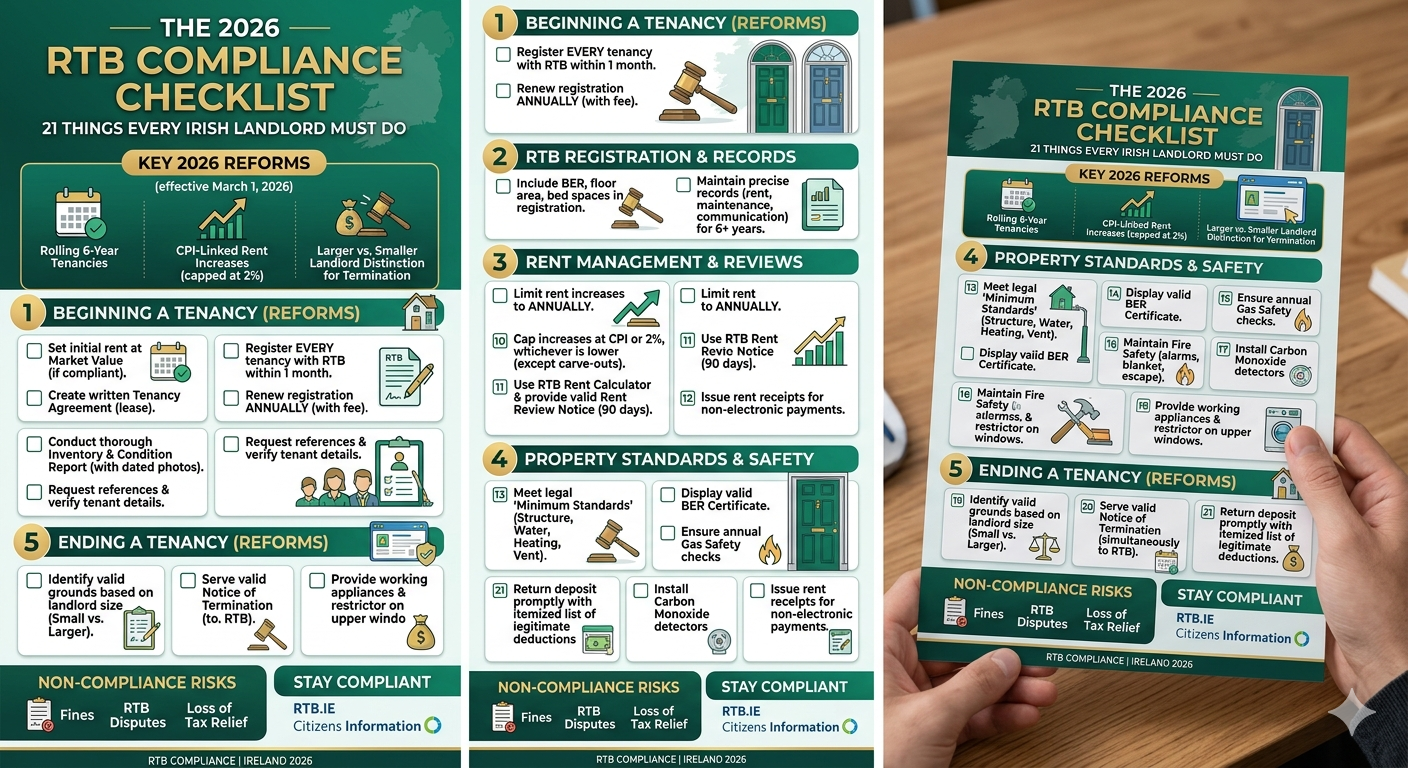
This digital RTB compliance checklist brings together 21 concrete actions that every Irish landlord must take to stay legally compliant — and to protect themselves if a dispute ever arises. Work through it once, then use it as a standing audit tool for all your tenancies.
Why RTB Compliance Matters More Than Ever in 2026
The Residential Tenancies Board (RTB) is Ireland's independent statutory body responsible for registering tenancies, resolving disputes between landlords and tenants, and enforcing rental sector standards. Since 2003, the RTB has grown substantially in authority and scope — and 2026 represents one of the most significant years for Irish rental regulation.
The introduction of the Tenancies of Minimum Duration (TMD) framework from March 1, 2026, new classifications distinguishing small landlords (1–3 properties) from large landlords (4+ properties), and continued enforcement of Rent Pressure Zone rules mean that non-compliance carries higher risks — and higher profile — than ever before.
What's at stake for non-compliant landlords
RTB penalties & sanctions
Unregistered or non-compliant landlords face RTB enforcement, sanction notices, and financial penalties under the Residential Tenancies Acts.
Loss of dispute standing
An unregistered landlord cannot refer a dispute to the RTB — leaving you with no recourse if a tenant falls into arrears or causes damage.
Revenue exposure
RTB registration data is shared with Revenue. Poor compliance records can trigger Revenue scrutiny of rental income and expense claims.
Weakened legal position
Missing documents, invalid notices, or unrecorded communication can make an open-and-shut case into a costly and uncertain RTB dispute.
That's where TenantSync comes in. TenantSync is a modern Irish property management platform built specifically around the obligations of Irish landlords — including RTB registration tracking, RPZ-aware rent review management, centralised document storage, in-app tenant communication, and compliance reminders. Throughout this checklist, you'll see exactly how TenantSync helps you stay ahead of every deadline.
How to Use This RTB Compliance Checklist
This checklist contains 21 specific actions, grouped into five compliance areas:
How to use it:
- Work through each item for every active tenancy in your portfolio.
- Tick off items already in place and flag areas needing attention as urgent priorities.
- Review the checklist annually and whenever legislation changes.
- Use it when onboarding a new property or at the start of every tenancy.
Many of these tasks have a TenantSync component — reminders, document storage, guided workflows, and rent review calendars. Where TenantSync can help automate or simplify an obligation, we'll call it out in the TenantSync tip for each item.
RTB Registration and Legal Basics — Checklist Items 1–5
The foundation of all RTB compliance for Irish landlords is straightforward: every relevant residential tenancy must be registered with the Residential Tenancies Board. Failure to register is not a minor oversight — it's a legal offence that strips your rights in a dispute and exposes you to RTB enforcement action.
Confirm your tenancy type is subject to RTB registration
What to do
Check whether your property and letting arrangement falls within the RTB registration requirement. Most private residential lettings in Ireland are covered by the Residential Tenancies Acts. Certain exceptions can apply — such as some holiday lets or arrangements where the landlord and tenant share the same dwelling under a licence. When in doubt, check rtb.ie or seek professional advice.
What can go wrong
Assuming your situation is an exception when it isn't. If you're wrong about your registration obligation, you may be committing an offence without realising it — and your tenancy protections will be weaker than you think.
TenantSync tip
TenantSync is built for Irish residential tenancy management. When you create a new lease, the platform immediately flags the RTB registration requirement and surfaces the registration deadline, removing ambiguity from day one.
Register new tenancies with the RTB within the required timeframe
What to do
Submit your tenancy registration (RTB Form 1) within one month of the tenancy commencement date. Don't wait until rent is paid or the tenant is settled — the clock starts on the official commencement date. Late registration is a breach of the Residential Tenancies Acts.
What can go wrong
Missing the one-month window means your registration is late. RTB registration deadlines are strict, and a gap in your compliance record weakens your position in any subsequent dispute. It can also affect tax deductibility claims.
TenantSync tip
TenantSync calculates the one-month registration deadline as soon as you create a lease and displays it prominently. The guided draft-first RTB Form 1 workflow helps you complete registration without errors — and sends reminders as the deadline approaches.
Keep RTB registration details accurate and up to date
What to do
Ensure the RTB holds correct information about your tenancy — including tenant names, property Eircode, rent amount, and commencement date. If core details change (e.g., a tenant is replaced), check whether an update or fresh registration is required under current legislation.
What can go wrong
Inaccurate RTB records can complicate any dispute or audit. The RTB adjudicator will scrutinise your registration data — discrepancies between what's registered and what's actually in place undermine your credibility.
TenantSync tip
TenantSync stores all tenancy details in one place. Landlords can review property details, current tenant information, and RTB registration data at a glance — making it straightforward to spot and correct discrepancies before they become problems.
Re-register annually — don't assume one registration lasts forever
What to do
An initial RTB registration does not remain active indefinitely. Annual renewal is required to keep the registration in good standing. Each anniversary of the registration is a separate obligtion with its own deadline. Verify current renewal requirements and fees at rtb.ie.
What can go wrong
This is one of the most common RTB compliance mistakes in Ireland. Many landlords register once and never renew. Years later they discover their tenancy has been effectively unregistered for several years — with serious consequences for their RTB dispute standing and potentially for Revenue audit.
TenantSync tip
TenantSync's renewal lifecycle management surfaces every upcoming renewal date in the compliance timeline. A renew-from-previous workflow carries your confirmed registration details forward — so you're not filling everything in from scratch every year.
Store RTB registration confirmation numbers and proof securely
What to do
After each registration and renewal, keep the RTB confirmation number and confirmation document securely and in a retrievable format. This proof may be requested during an RTB dispute, local authority inspection, or Revenue enquiry.
What can go wrong
RTB confirmation emails buried in an old inbox are not a reliable archive. Under the pressure of a dispute, struggling to locate registration proof is a significant and entirely avoidable problem.
TenantSync tip
TenantSync lets you upload RTB confirmation documents directly on the lease record. Download proof in a single click whenever you need it — for disputes, audits, or mortgage applications.
Never miss an RTB registration or renewal deadline
TenantSync tracks every tenancy's compliance status and surfaces deadlines automatically — from first registration through every annual renewal.
Rent Setting, Rent Reviews and RPZ Rules — Checklist Items 6–9
Rent control is one of the most heavily scrutinised areas of Irish landlord compliance. Getting this wrong — especially in a Rent Pressure Zone (RPZ) — can result in invalid rent increases, compelling financial liability to tenants, and costly RTB disputes.
Verify whether your property is in a Rent Pressure Zone (RPZ)
What to do
Check the RTB's official RPZ map (available at rtb.ie) to confirm whether your property falls within a designated Rent Pressure Zone. RPZ status determines whether rent increase caps and minimum review periods apply to your tenancy. Don't rely on assumptions — check every property individually, as RPZ boundaries can change.
What can go wrong
Applying a rent increase in an RPZ property that exceeds the statutory cap can be challenged at the RTB. The remedy is typically to reduce the rent to the compliant level — and potentially to refund any overpaid rent to the tenant.
TenantSync tip
TenantSync's RPZ-aware rent review feature lets you flag each property as RPZ or non-RPZ. When a rent review is due, the platform surfaces appropriate guidance and alerts based on the property's RPZ status.
Document how your initial rent was set and keep evidence of comparables
What to do
Keep a clear record of how you arrived at the rent you charge. For RPZ properties in particular, the opening rent must comply with statutory limits. Retain any supporting evidence of comparable local rents you used when setting the initial figure — Daft.ie listings, letting agent appraisals, or RTB rent index data.
What can go wrong
Landlords who cannot demonstrate how they calculated the opening rent may struggle in an RTB adjudication, particularly if a tenant claims the rent was set above RPZ limits. Without documentation, your defence is your word against theirs.
TenantSync tip
TenantSync's rent history log creates a timestamped record of every rent set and every change. This documentation is immediately available if you ever need to demonstrate to the RTB or a tribunal how the rent was calculated and justified.
Only review rent within legal frequency limits and the RTB rent cap
What to do
There is a minimum period that must pass between RTB rent reviews — currently at least 12 months between reviews for most tenancies. In RPZs, increases are also capped at the lower of general inflation (HICP) or 2% per year. Check rtb.ie for the current rules as they can change with legislation.
What can go wrong
Attempting a rent review too soon — or applying an increase above the RPZ cap — invalidates the review entirely. The old rent remains legally payable and the tenant may seek repayment of any overcharged amount. This is a straightforward but costly mistake.
TenantSync tip
TenantSync tracks the date of each tenancy's last rent review and calculates when the next review can legally begin. You cannot accidentally trigger a review outside the permitted window — the platform surfaces eligibility dates and prevents premature review notices.
Serve rent review notices correctly and keep a dated record of each one
What to do
A valid rent review notice must be in writing, state the proposed new rent, specify the date from which it applies, and reflect the basis for the calculation (including RPZ cap compliance where relevant). It must give the statutory notice period. A text message, email without correct content, or verbal conversation does not satisfy these requirements.
What can go wrong
An informally worded or incorrectly structured rent review notice is invalid under the Residential Tenancies Acts. An invalid notice means the rent increase cannot take effect — the tenant is entitled to continue paying the old rent.
TenantSync tip
TenantSync provides statutory notice templates aligned to Irish RTB requirements. Once served, rent review notices are stored against the tenancy record with a date and timestamp — creating an immediately retrievable audit trail for every review in your portfolio.
Notices, Communication and RTB Disputes — Checklist Items 10–13
Most RTB cases are not decided purely on the merits of each party's argument. They are won or lost on documentary evidence. A landlord with clear written records, properly served notices, and every communication logged is in a far stronger position than one relying on memory and informal conversations.
Use written tenancy agreements that reflect RTB-compatible terms
What to do
Every tenancy agreement should be in writing and should accurately reflect obligations under the Residential Tenancies Acts — including the tenancy duration, rent, notice periods, deposit terms, and landlord/tenant obligations. Since March 2026, the Tenancies of Minimum Duration (TMD) framework affects many new and continuing tenancies, so agreements should reflect the current legal framework.
What can go wrong
Oral or informally drafted tenancy agreements that don't align with the RTA can be challenged at key points, leaving the statutory defaults to apply instead — sometimes to the landlord's disadvantage. "The tenant agreed verbally" is not effective evidence at an RTB hearing.
TenantSync tip
TenantSync's document storage section holds a signed copy of every lease agreement against the tenancy record, with clear version history. You can access the original signed agreement instantly — whether you need it a month after signing or five years later.
Serve all statutory notices in the correct format and with correct notice periods
What to do
All formal notices — rent review notices, breach notices, and RTB notices of termination — must be served in writing, contain all legally required information, and give the tenant the correct statutory notice period. For notices of termination in particular, the required period depends on tenancy duration and the ground of termination. The correct ground must be stated clearly — the full 2026 notice period tables for landlords and tenants set out every band and the fault-based exceptions.
What can go wrong
Incorrect, incomplete, or informally served notices are one of the most common grounds for RTB cases being decided against landlords. A notice of termination that doesn't state the correct ground, or was served in the wrong format, will generally be found void — meaning the tenancy continues regardless of your intentions.
TenantSync tip
TenantSync's communication log records when each notice was sent, in what format, and to whom. Combined with RTB-aligned notice templates and centralised document storage, this creates a complete, date-stamped audit trail for every formal communication issued throughout a tenancy.
Keep a full, retrievable record of all communication with tenants
What to do
Save all communication with tenants — emails, letters, platform messages — systematically and in a format that can be retrieved quickly. Wherever possible, move important verbal conversations to writing immediately afterwards: send a follow-up email confirming what was agreed, even briefly. The rule of thumb for RTB record-keeping: if you can't prove it, it didn't happen.
What can go wrong
"I told them but I can't prove it" is one of the most common — and costly — positions an Irish landlord can find themselves in at an RTB adjudication. The adjudicator will generally prefer clear documentary evidence over disputed recollections, regardless of which party's account sounds more plausible.
TenantSync tip
TenantSync centralises all landlord-tenant communication within the platform. Every message is logged and timestamped automatically — creating a searchable, complete communication history without any manual effort. No more digging through multiple email accounts and messaging apps when you need to compile evidence.
Engage with RTB dispute resolution quickly and respond to all deadlines
What to do
If a tenant refers a dispute to the RTB, respond promptly, professionally, and within any deadlines set by the RTB process. Compile your documentary evidence early — registration proof, communication logs, notices served. Seek independent legal advice promptly if the case is complex or involves significant sums.
What can go wrong
Landlords who don't engage with RTB dispute resolution processes lose cases by default — or find determination orders made against them without any opportunity to present their evidence. Even a landlord with a strong factual case can lose through process failures or missed deadlines.
TenantSync tip
Because TenantSync centralises all records — documents, notices, communication, rent history, maintenance logs — when you need to compile evidence for a dispute response, everything is already in one place. No frantic searches, no missing receipts, no reconstructing a timeline under pressure.
Build your RTB compliance paper trail automatically
TenantSync logs every message, stores every document, and timestamps every notice — so your defence is always ready if a dispute arises.
Minimum Standards, Safety and Inspections — Checklist Items 14–17
All private rented accommodation in Ireland must meet a set of minimum physical standards prescribed in regulations under the Housing Acts. These standards cover structural condition, heating, ventilation, sanitation, fire safety (smoke and CO alarms), electrical supply, and more. Local authorities carry out inspections, and failure to comply can result in improvement notices, fines, and RTB disputes.
Ensure the property meets current minimum standards before and throughout letting
What to do
Before you let a property, verify it meets the current minimum standards for private rented accommodation. Key areas include adequate heating, proper ventilation, functioning sanitation (toilet, wash hand basin, bath or shower with hot and cold water), safe electrical installation, adequate refuse storage, and proper food preparation facilities. Check the current Schedule of Minimum Standards with your local authority or at gov.ie.
What can go wrong
Letting a property that doesn't meet minimum standards is a criminal offence. A local authority inspector can issue an improvement notice requiring you to bring the property to standard at your cost within a specified timeframe. A tenant can also refer conditions issues to the RTB as a breach of landlord obligations, which is a separate route to dispute and sanction.
TenantSync tip
TenantSync's maintenance and inspection tracking lets you record pre-tenancy property checks. Store inspection photos, contractor sign-off documentation, and compliance notes directly on the property record — making them retrievable for any subsequent local authority or RTB enquiry.
Install and maintain smoke alarms and carbon monoxide (CO) alarms as legally required
What to do
Irish law requires smoke detectors/alarms and carbon monoxide detectors in rented properties. The specific quantity and placement requirements depend on property type and layout — check current regulations. Test and maintain all alarms regularly, and document when each test was carried out. Replace batteries and units promptly when required.
What can go wrong
Failure to install or maintain required alarms is a direct minimum standards breach. Beyond the regulatory risk, it is a serious life-safety issue that creates significant personal liability for the landlord in the event of a fire or gas incident.
TenantSync tip
TenantSync lets you create periodic maintenance reminders for safety checks — set a recurring reminder to inspect alarms annually (or per the manufacturer's schedule), then log the result of each check against the property record for a documented safety compliance history.
Keep evidence of all repairs, inspections, and contractor invoices
What to do
For every significant repair, maintenance job, safety inspection or contractor visit, retain documentary evidence: invoices, completion notes, inspection reports, before-and-after photos. Keep these records for at least the duration of the tenancy and ideally several years beyond. Good records support both RTB compliance and Revenue expense claims.
What can go wrong
Without contractor invoices and inspection records, you cannot demonstrate that repairs were carried out, that safety checks were performed, or that you responded responsibly to a maintenance request. Missing records are costly in both RTB hearings (loss of defence evidence) and Revenue audits (loss of expense deductions).
TenantSync tip
TenantSync's maintenance tracker logs every repair request from tenants, lets you assign jobs to contractors, and allows you to upload the completed invoice or inspection report directly on the tenancy record. The full maintenance history is attached to the lease and can be exported on demand.
Respond to tenant repair requests promptly and document your response
What to do
Respond to tenant repair requests — particularly urgent matters such as heating failures, roof leaks, or safety hazards — as quickly as possible. Even for non-urgent repairs, there is a general obligation to maintain the property in good repair throughout the tenancy. Document your response time and the action you took in writing, however briefly.
What can go wrong
Repeatedly ignoring or significantly delaying responses to repair requests — especially for urgent matters — can result in an RTB dispute claim for breach of landlord obligations. There's also the practical risk of modest issues becoming expensive problems if left unaddressed.
TenantSync tip
TenantSync's in-app maintenance ticketing system allows tenants to log repair requests directly. The landlord can respond in-platform, assign the job to a contractor, and update the ticket status — all logged with timestamps to create a complete, defence-ready repair history.
Tax, Records and Long-Term RTB Compliance — Checklist Items 18–21
Good RTB compliance and sound record-keeping are not just about avoiding RTB sanctions — they underpin your tax position with Revenue, protect you in legal disputes, and make managing your property significantly less stressful over the long term.
Keep a secure, organised digital file for each tenancy
What to do
For each tenancy, maintain a central digital record containing: the signed lease agreement, RTB registration confirmation and annual renewal records, all notices served, a full communication history, repair and maintenance invoices, inspection records, and the tenancy deposit receipt. Organise it logically, back it up regularly, and ensure it is accessible to you at short notice.
What can go wrong
Landlords who store documents across multiple devices, separate email accounts, and disconnected folders struggle to retrieve records quickly when it matters most. Incomplete records can be the decisive factor in an RTB hearing — not the underlying facts of the case.
TenantSync tip
TenantSync acts as a centralised digital file for every tenancy. All documents, notices, communication, maintenance records, and RTB registration data are linked to the specific lease and accessible in seconds — on your phone or desktop, wherever you are.
Maintain a clear rent ledger showing every payment, arrears, and receipt
What to do
Keep a running record of every rent payment received — the date it was received, the amount, and the period it covers. In arrears situations, a clear ledger showing exactly what is owed and from which date is essential RTB evidence. Provide written receipts to tenants where requested.
What can go wrong
Without a clear rent ledger, an RTB arrears claim becomes a factual dispute about how much is owed and when. Tenants may dispute figures, and without a contemporaneous record you cannot prove your position. Revenue may also raise questions where rental income figures are inconsistent.
TenantSync tip
TenantSync's rent tracking module logs every payment against the tenancy automatically. Arrears are flagged in real time, and the full payment history can be exported as a report for Revenue, RTB hearings, or mortgage applications.
Keep records of all property expenses and proof of work done
What to do
Rental income is taxable in Ireland, but you can deduct certain allowable expenses including mortgage interest (subject to conditions), management agent fees, maintenance and repairs, insurance, and more. Keep receipts and invoices for every relevant expense. Document capital improvements separately, as they are treated differently from revenue expenditure for tax purposes.
What can go wrong
Undocumented expenses mean you may pay more tax than you need to. Missing receipts and inconsistent records also make Revenue audits significantly more stressful — and any undocumented deductions claimed are at risk of being disallowed.
TenantSync tip
TenantSync provides a structured space to log and categorise property expenses against each tenancy or property. Receipts and invoices can be uploaded directly. Export your records at year-end to share with your accountant, saving hours on your rental income tax return.
Review your RTB compliance status annually and after every significant legal change
What to do
At least once a year, audit every active tenancy against this checklist (or an equivalent). Also review your processes whenever the government announces significant rental sector changes — registration fees, notice period rules, RPZ designations, minimum standards requirements, and tenancy duration rules have all changed multiple times since the Residential Tenancies Act was first enacted.
What can go wrong
Landlords who establish a compliance process once and never review it often find themselves unknowingly non-compliant years later. What was correct in 2020 may not be correct in 2026. The law has changed significantly every few years — don't assume your approach is still current.
TenantSync tip
TenantSync provides an at-a-glance compliance risk level — Low / Medium / High / Critical — for every tenancy. Registration renewals, rent review windows, and lease end dates are all surfaced in a compliance timeline that updates automatically as deadlines approach, so the annual review becomes an exercise of minutes rather than hours.
How TenantSync Helps Irish Landlords Stay RTB-Compliant
TenantSync was built in Ireland, for the Irish rental market. Unlike generic property management software adapted from the UK or US market, TenantSync is designed around the specific obligations of the Residential Tenancies Acts — the RTB registration and annual renewal cycle, the RPZ rent review framework, and the Irish-specific requirements for notices, documentation, and dispute preparation.
Centralised tenancy records & RTB numbers
Every tenancy carries its own RTB status — Not Started / Draft / Submitted / Confirmed — and registration reference number. Portfolio overview gives you a live compliance picture across all your properties without opening individual files.
Automated reminders for key compliance dates
Annual RTB renewal deadlines, RPZ rent review eligibility windows, and lease end dates are all tracked in TenantSync's compliance timeline. Reminders fire before deadlines, not after — giving you time to act rather than time to apologise.
Guided RTB Form 1 workflow
TenantSync's draft-first, validated Form 1 workflow pre-fills data already in your account, validates every section before submission, and generates a PDF preview. Finalise accurately and confidently. A renew-from-previous option carries confirmed details forward for annual renewals.
Secure document & communication storage
Lease agreements, RTB confirmations, maintenance invoices, formal notices, and photos — all stored securely on the tenancy record and retrievable in seconds. One-click proof download means you are always audit-ready.
Rent tracking, arrears alerts & exportable reports
A complete payment history for every tenancy, with arrears flagged automatically. Export rent ledgers for Revenue returns, RTB adjudications, or mortgage applications — without building a spreadsheet from scratch.
Portfolio risk visibility
Risk-level indicators — Low, Medium, High, Critical — across all your properties mean you can identify compliance gaps at a glance and prioritise the tenancies that need attention first, rather than reviewing every record individually.
Available on iOS and Android, TenantSync is built for busy Irish landlords who want the confidence of full RTB compliance without spending hours on administrative paperwork. Whether you manage one property or a small portfolio, TenantSync replaces the fragmented combination of spreadsheets, email folders, and calendar reminders with a single, structured compliance workflow.
Your 21-point RTB compliance checklist — trackable in TenantSync
Join landlords and letting agents across Ireland who use TenantSync to manage every Residential Tenancies Board obligation from one dashboard.
Frequently Asked Questions: RTB Compliance in Ireland
What are a landlord's main obligations under Irish RTB rules?
Irish landlords must register every tenancy with the RTB within one month of commencement, renew registrations annually, comply with Rent Pressure Zone rules where applicable, serve notices in the correct statutory format, maintain the property to minimum standards, and keep comprehensive records. For current details, always check rtb.ie.
What happens if I don't register my tenancy with the RTB?
Failure to register is an offence under the Residential Tenancies Acts. The RTB has investigative and sanctioning powers. Unregistered landlords cannot refer disputes to the RTB — meaning you have no recourse if a tenant falls into arrears or causes damage. Financial penalties can also apply. See rtb.ie for current enforcement information.
How often do I need to renew RTB registration in Ireland?
Annual renewal is required. An initial registration does not remain valid indefinitely — each anniversary is a separate compliance deadline. Many landlords miss this requirement, leaving their tenancy effectively unregistered after the first year. TenantSync surfaces renewal due dates automatically.
What is a Rent Pressure Zone and how does it affect my rent increases?
A Rent Pressure Zone (RPZ) is a designated area where rent increases are capped at the lower of general inflation (HICP) or 2% per year, and there is a minimum period between reviews. You must check RPZ status at rtb.ie, serve valid written rent review notices, and document your calculations. An invalid notice means the increase cannot take effect.
What is a notice of termination and how must it be served in Ireland?
A notice of termination is the statutory notice a landlord must serve to end a tenancy. It must be in writing, state the correct ground for termination, give the required notice period (which depends on tenancy duration), and deliver it in a manner acceptable under the Acts. An incorrectly served or formatted notice is generally void, meaning the tenancy continues. Always check current notice period requirements at rtb.ie and seek legal advice for complex situations.
How does TenantSync help with RTB compliance for Irish landlords?
TenantSync provides: per-lease RTB status tracking, a guided draft-first Form 1 workflow with validation and PDF preview, annual renewal reminders, RPZ-aware rent review tracking, centralised document and communication storage, in-app maintenance ticketing, rent ledger with arrears alerts, and portfolio risk-level indicators — built specifically for the Irish rental market and the requirements of the Residential Tenancies Board.
Final Thoughts for Irish Landlords in 2026
Irish landlord law can feel dauntingly complex — especially with significant changes introduced in March 2026 around tenancy duration, landlord classification, and strengthened RTB enforcement powers. But the underlying principle of RTB compliance is consistent across all of these changes: register correctly and on time, communicate in writing, maintain your property properly, and keep thorough records.
This 21-point RTB compliance checklist is designed to be your standing audit tool — not something you read once and forget. Bookmark it, review it annually, and work through it for every new tenancy you create. Any items you can't immediately tick off are your compliance priorities.
If you'd like a platform that helps you track all 21 of these obligations automatically — with built-in reminders, guided workflows, and centralised records designed specifically for the Irish rental market — TenantSync is built for exactly that. Try it free and see how much simpler RTB compliance becomes with the right system behind you.
Related Articles