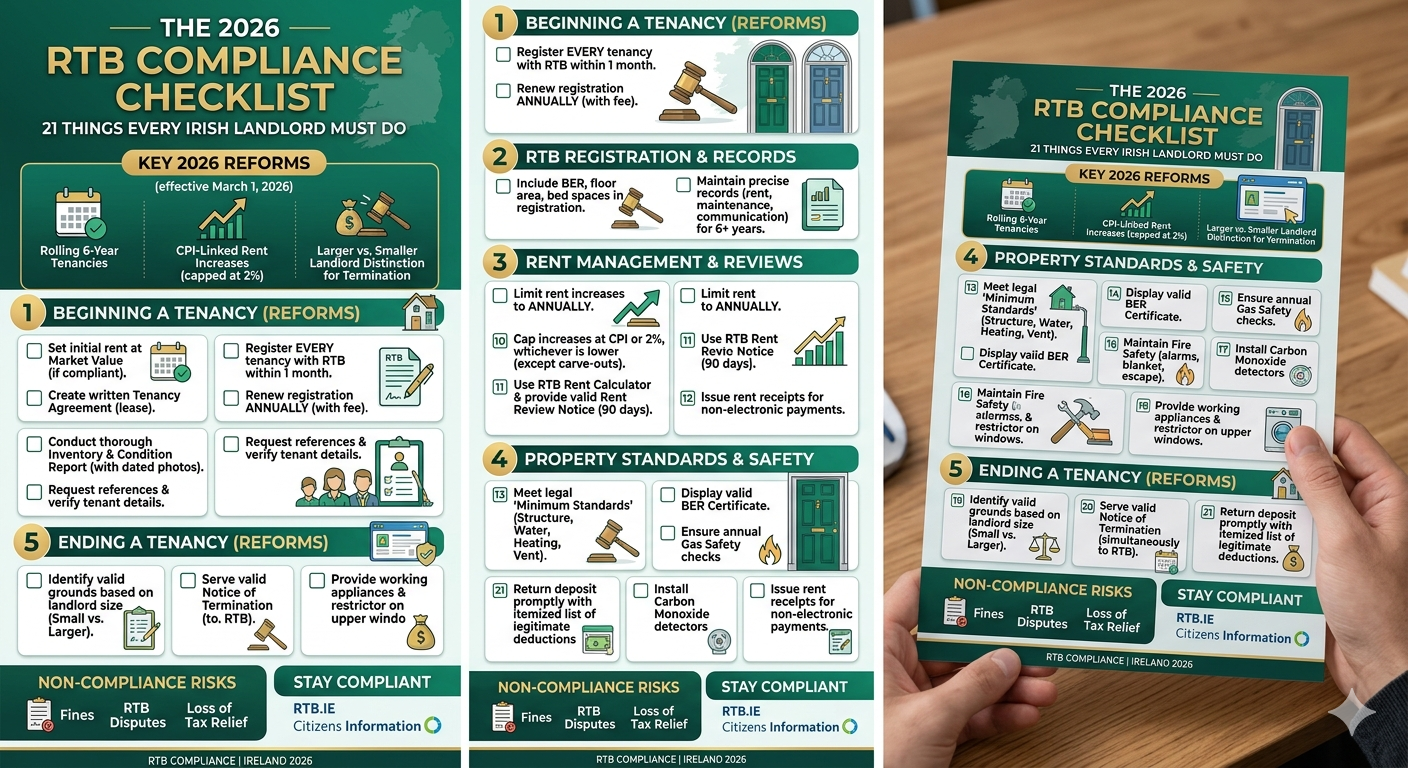
RTB & Property Compliance for Busy Letting Agents: A Practical Guide
Compliance rarely fails because an agent didn't know the rule. It fails because the rule had a date attached, the date lived in someone's head, and the week got busy. This guide takes the three layers of compliance an Irish letting agent actually carries — the tenancy's RTB duties, the property's safety and standards duties, and your own PSRA duties — lays them on the tenancy timeline, and separates the parts a machine should be doing from the parts that genuinely need you.
The short version
How does a busy letting agent stay on top of RTB and property compliance? Stop treating compliance as a knowledge problem and treat it as a date problem. Every obligation you carry is a date attached to a thing you already have in your records — a tenancy, a property, or your own licence. Put all three layers in one register, derive the dates automatically from tenancy commencement and certificate expiry rather than typing them, let the system draft the RTB Form 1 from data you already hold, calculate every rent review against the national cap before you propose it, and work a single overdue list once a week. The knowledge was never the bottleneck. The diary was.
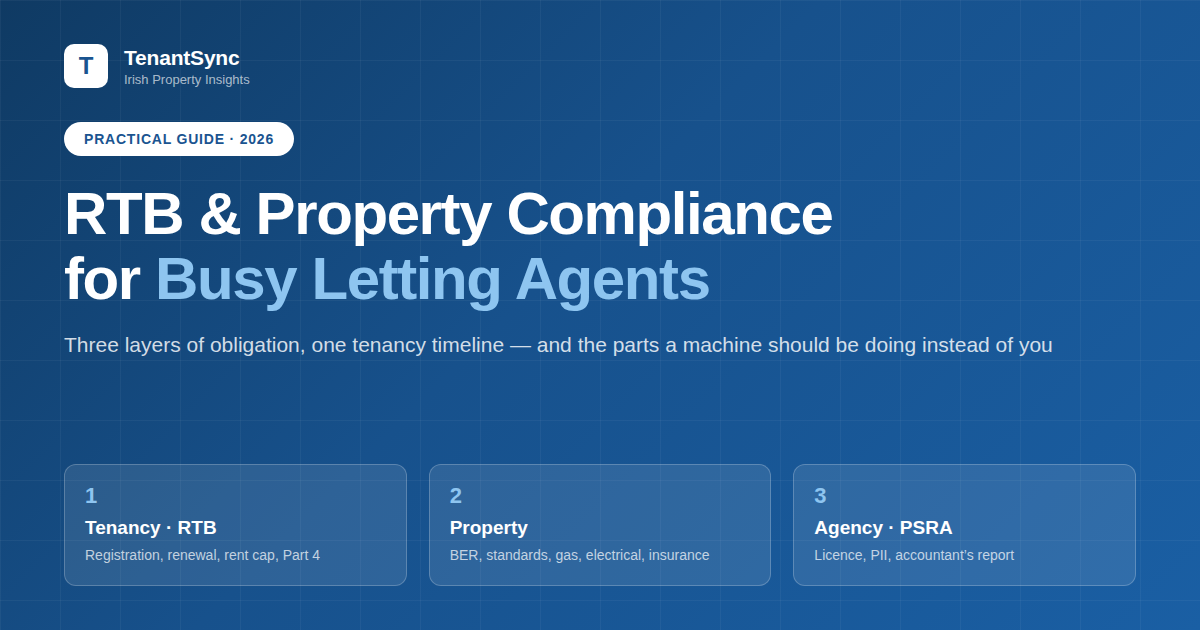
The Three Layers of Compliance You Actually Carry
Ask most letting agents what compliance means and you'll hear "RTB registration." That's one layer of three, and it's the one most likely to already be handled. The layers that quietly cause damage are the two either side of it.
It's worth being precise about what sits where, because each layer behaves differently — different owners, different triggers, different consequences when it slips.
| Layer | Attached to | Triggered by | Examples |
|---|---|---|---|
| 1. Tenancy (RTB) | Each individual tenancy | Tenancy commencement date and its anniversaries | RTB registration, annual renewal, rent review eligibility and the national rent cap, Part 4 / minimum-duration milestones, notices of termination |
| 2. Property | Each property or unit | Certificate expiry and service dates | BER validity, minimum standards, gas / oil / electrical installations, fire safety provision, landlord insurance renewal |
| 3. Agency (PSRA) | Your business, not any tenancy | Your licence year | PSRA licence renewal, professional indemnity insurance, accountant's report, client account handling, advertising standards, AML reviews |
Why layer 3 is the one that bites
Layers 1 and 2 have something valuable in common: they're generated by things in your system. A new tenancy produces a registration deadline. A BER certificate produces an expiry date. If your records exist, the deadlines can be derived from them.
Layer 3 has no such generator. Nothing in your day-to-day work spontaneously reminds you that your professional indemnity insurance lapses in three weeks, or that the accountant's report needs to be with the PSRA before your renewal deadline. It arrives by post or email once a year and then relies entirely on somebody remembering. That's why the agency layer is the one where a well-run agency with excellent tenancy records still gets caught.
The useful reframe
Every one of these obligations reduces to the same shape: a date, attached to a record you already hold, with a consequence if it passes. Once you see them that way, the question stops being "do we know the rules?" and becomes "does anything in our system produce these dates without being asked?" For most agencies running on a spreadsheet, the honest answer is no — the spreadsheet stores dates that someone typed, which is a very different thing from a system that derives them.
The Tenancy Compliance Timeline: Day 1 to Year 6
Here's the practical version of layer 1. A single tenancy commencement date generates almost every deadline you'll ever have on that tenancy. Once you know the start date, you know the rest — which means all of it can be calculated in advance rather than discovered late.
| When | What's due | Derived from |
|---|---|---|
| Before the let | Valid BER obtained and stated in the advertisement; property meets minimum standards; letter of engagement in place with the landlord client | Listing date |
| Day 1 | Tenancy commences; written terms issued; deposit and any advance rent taken within the permitted limits | Commencement |
| Within 1 month | RTB registration application submitted (Form 1 / RTB1). Late registration attracts a €10 late fee per month late | Commencement + 1 month |
| Month 6 | Part 4 tenancy rights accrue after six months of continuous occupation | Commencement + 6 months |
| Month 12 | Annual RTB registration due (within one month of the anniversary); rent review becomes eligible at the earliest twelve months after the rent was last set | Commencement + 12 months, then annually |
| Each review | Maximum lawful rent calculated against the national cap before any increase is proposed, with the required written notice period | Date rent was last set |
| Years 1–6 | Ongoing annual registration; certificate renewals; for tenancies created from 1 March 2026, the rolling six-year minimum duration framework governs when a tenancy can be ended | Commencement + n years |
The one date that isn't derived — and why it matters most
Everything above hangs off the tenancy commencement date. If that date is wrong in your records, every deadline downstream is wrong, silently and consistently. When importing a book of tenancies from a spreadsheet or a previous system, the commencement dates deserve more scrutiny than anything else you migrate. They are the load-bearing field.
📅 See every deadline in your book on one screen
Bring one real tenancy to a walkthrough and watch its registration deadline, renewal date, rent-review eligibility and Part 4 milestone appear from the commencement date alone — no spreadsheet, no typing.
Layer 1: The Tenancy's RTB Obligations
Five things, in the order a tenancy tends to hit them.
1. Registration within one month
An application to register a tenancy must reach the RTB within one month of its commencement. Since annual registration was introduced, the same one-month rule applies to each anniversary of commencement for as long as the tenancy continues. Register late and a fee of €10 per month late applies.
The legal duty sits with the landlord. The practical work, in a managed tenancy, sits with you — and so does the fallout when it's missed. A landlord who discovers an unregistered tenancy themselves is a landlord already drafting an email to your competitor.
💡 The agent-specific trap
The registration clock starts at commencement, not at signing, not at key handover, and not when the paperwork reaches your desk. In an agency where lettings negotiators sign tenancies and administrators register them, the gap between those two moments is where the month quietly disappears. Deriving the deadline automatically at the point the tenancy is created removes the handover from the critical path entirely.
2. Annual renewal
Annual registration turned a one-off task into a recurring one, and multiplied it by the size of your book. An agency with 150 managed tenancies isn't doing 150 registrations once — it's doing roughly 150 renewals every year, spread unevenly across twelve months according to when each tenancy happened to start. This is precisely the kind of work that is trivial per unit and unmanageable in aggregate without a system.
3. Rent setting and the national rent cap
Since 1 March 2026, rent control applies nationally rather than only inside Rent Pressure Zones. For most existing tenancies, an increase is capped at the lower of CPI inflation or 2% per year, applied proportionately to the time since the rent was last set. Apartments that commenced and completed development on or after 10 June 2025 are linked to CPI only, without the 2% ceiling.
Two things follow for an agent. First, the calculation now applies to your whole book, not just the Dublin and Cork portions of it. Second, "roughly 2%" is no longer a safe approximation — the binding limit depends on which of the two measures is lower over that specific period, so the arithmetic has to be done per tenancy, per review.
Show your working, every time
If a rent increase is ever questioned, the defensible position is not "we applied the cap" — it's a record showing the current rent, the date it was last set, the review date, the CPI figures used, the 2% pro-rata figure, and which of the two was the binding limit. Keep that calculation attached to the tenancy. An increase you can't evidence is an increase you may have to unwind.
4. Part 4 and the six-year minimum duration
Part 4 rights accrue after six months of continuous occupation, with Further Part 4 rights arising later in the tenancy cycle. From 1 March 2026, new tenancies operate under a rolling six-year minimum duration framework, during which a landlord can only end the tenancy in specified circumstances.
For an agent, the operational point is the same under either framework: these are milestones your landlord client needs to know about before they arrive, not after. A landlord who is told in month five that security of tenure is about to accrue is a landlord making an informed decision. A landlord who finds out in month eight is a landlord who feels badly advised.
5. Notices of termination
Notices are where compliance stops being administrative and becomes adversarial. A notice of termination is only valid if the ground is available, the notice period matches that ground, the termination date is correctly calculated from the service date, and — for grounds that require it — a prior warning notice was properly served with the right lead time and content.
Get any one of those wrong and the notice fails, usually at the point where it matters most. This is the single strongest argument for a structured, validated drafting process rather than a Word template that gets copied from the last one.
Layer 2: The Property's Safety & Standards Obligations
The tenancy layer gets the attention because the RTB is a visible regulator with visible deadlines. The property layer gets less attention and is enforced by a different body — your local authority — with a different set of powers.
BER: the one where the duty lands on the agent
A valid Building Energy Rating is required for buildings offered for rent, and the BER must be stated in every advertisement for the letting. Crucially, SEAI's advertising requirements place the obligation on the person offering the property for rent or their agent — which means this is one of the few compliance duties that names you directly rather than your client. Enforcement sits with the local Building Control Authority.
Since a BER certificate has a finite validity period, it is exactly the kind of expiry date that belongs on a compliance register alongside the RTB dates. A lapsed BER discovered at the point of re-advertising is a delayed listing, and a delayed listing is a void.
Minimum standards
The Housing (Standards for Rented Houses) Regulations 2019 set the baseline every rented dwelling must meet. Two areas matter most for record-keeping:
- Gas, oil and electrical installations must be maintained in good repair and safe working order. Note the wording: the obligation is a standard to be met, not a prescribed annual certificate. But when a local authority inspector or an RTB adjudicator asks how you know the installation was safe, a dated service record from a competent person is the answer — and the absence of one is conspicuous.
- Fire safety. In multi-unit buildings, each unit requires a mains-wired smoke alarm, a fire blanket and an emergency evacuation plan, with emergency lighting in the common areas.
Local authorities enforce these standards and can issue improvement notices and prohibition notices where they're breached.
Turning a standard into a date
"Maintained in good repair and safe working order" has no date in it — which is exactly why it gets forgotten. The practical move is to manufacture one: give each property a service interval for its gas, oil and electrical installations, record the last service date, and let the register produce the next one. You are not inventing a legal deadline; you are creating an internal one that generates the evidence the legal standard expects you to have.
Insurance and AML
Landlord insurance renewal dates and anti-money-laundering client reviews round out the property and client layer. Neither is RTB business, both have dates, and both are the kind of thing that only surfaces when someone goes looking. They belong on the same list.
Layer 3: Your Own PSRA Obligations
This is the layer that no tenancy will ever remind you about, and the one where the consequence is not a fee but your ability to trade.
Letting agents, estate agents, auctioneers and property management agents must hold a valid licence from the Property Services Regulatory Authority. A licence runs for one year and must be renewed annually, online. Renewal isn't a formality — it requires supporting compliance:
- Professional indemnity insurance that meets the PSRA's requirements, with your broker able to certify compliance.
- An annual contribution to the Compensation Fund.
- An accountant's report on the prescribed PSRA form, with different forms depending on whether you hold a client account or a relevant account for service charges and sinking fund contributions.
- The renewal application itself, submitted by the deadline stated on the renewal invitation the Authority issues around twelve weeks before your licence expires.
Read that list again as an operations problem rather than a legal one. Your accountant needs lead time. Your broker needs lead time. The Authority sets a deadline that is earlier than your expiry date. A renewal that starts when the invitation arrives is a renewal running on twelve weeks of borrowed time; a renewal that starts when someone finally opens the envelope is a renewal in trouble.
Advertising standards
The other agency-level duty that recurs constantly rather than annually is how you advertise. Every listing should show an accurate asking rent rather than a teaser figure, display the BER, disclose all fees and charges payable by the consumer up front, describe the property accurately in its particulars, and use photographs that represent the property in its current condition. Where rent-setting rules apply, the advert should reflect them.
None of that is difficult in isolation. Across sixty live listings and four negotiators, it becomes a consistency problem — which is why a short pre-publication checklist, applied every time, beats trusting that everyone remembers.
💡 Put your own dates in the same system as your clients'
Most agencies track tenancy compliance in one place and their own licence, insurance and accountant's report in a diary, a folder, or a principal's memory. Splitting them is what makes layer 3 fragile. If your licence renewal, PII expiry and accountant's report sat in the same overdue list you already look at every Monday, they'd be no more likely to slip than an RTB registration.
🗂️ One register for all three layers
Tenancy deadlines, property certificates and your own PSRA dates in a single colour-coded list — compliant, upcoming, overdue — scoped to your branch or the whole agency.
The Weekly Compliance Routine
Compliance work expands to fill whatever anxiety you give it. A fixed routine contains it. Here's a cadence that fits a working agency, sized so that the daily portion takes minutes rather than mornings.
Daily — a glance, not a session
- Check the overdue count. If it's zero, you're done.
- Register any tenancy that commenced since yesterday, while the details are in front of you and the file is open. A registration done on day one is never a registration done on day thirty-one.
Weekly — twenty minutes, same slot
- Work the overdue column to zero before touching anything else.
- Scan the upcoming 30 days: registrations due, annual renewals, rent reviews becoming eligible, certificates expiring.
- Action any Part 4 or minimum-duration milestone arriving in the next month — that means telling the landlord client, not just noting it.
- Check that anything marked "submitted" last week has actually been confirmed, and file the proof against the tenancy.
Monthly — half an hour
- Review rent reviews eligible in the next 90 days and run the cap calculation for each, so the conversation with the landlord is based on a number rather than a guess.
- Spot-check five tenancies at random for a complete record: registration confirmed, proof stored, current BER, standards evidence, insurance in date.
- Review new instructions taken on during the month and confirm each has a letter of engagement and a complete property record.
Quarterly — the agency layer
- Confirm the PSRA licence expiry date and how many weeks remain.
- Confirm PII is in date and the certificate is on file.
- Confirm the accountant's report is either done or scheduled with enough lead time.
- Sample live listings against the advertising checklist: rent, BER, fees, particulars, photographs.
Why the overdue column comes first
The temptation in any compliance review is to start with what's coming up, because it feels productive and nothing is on fire. It's the wrong order. An overdue item is an active liability that is getting worse; an upcoming item is a task with slack in it. Clear overdue to zero, then spend whatever's left of the twenty minutes on upcoming. If you only ever manage the first half of the routine, you'll still be in a defensible position.
What to Automate, and What Stays With You
The honest division of labour. Automation should own arithmetic, memory and repetition. It should never own judgement — and any tool that claims otherwise is selling you a liability rather than removing one.
| Automate this | Keep this |
|---|---|
| Deriving the registration deadline from the commencement date | Verifying that the commencement date on file is actually correct |
| Generating annual renewal dates for every tenancy in the book | Handling the tenancy whose details changed since last year |
| Pre-filling the RTB Form 1 from the lease, property and landlord records | Reviewing the draft and signing the declaration |
| Calculating the maximum lawful rent under CPI and the 2% cap | Deciding whether to propose an increase at all, and advising the client |
| Flagging Part 4 and minimum-duration milestones in advance | The conversation with the landlord about what it means for them |
| Tracking certificate and insurance expiry across every property | Deciding a property isn't fit to re-let until something is fixed |
| Validating a termination notice against its ground and notice period | Deciding whether the ground genuinely applies to this tenancy |
| Keeping the audit trail of who changed what and when | Explaining the decision when someone asks why |
Notice the pattern in the right-hand column: it's all the work you're actually paid for. Every hour reclaimed from the left-hand column is an hour available for the right. That's the whole argument for compliance automation in an agency — not headcount reduction, but moving your existing people off arithmetic and onto advice.
How TenantSync Automates the RTB Layer
This is the part of the guide where we describe our own product, so treat it accordingly. What follows is what the system does today, described plainly.
Deadlines that create themselves
When a tenancy is created, an RTB registration record is created with it. The registration deadline and the annual renewal date are both derived from the tenancy start date — nobody types them. The registration opens at Not started with a high compliance-risk flag and moves through In progress → Submitted → Confirmed as the work gets done, with Overdue and Expired states when it doesn't. When a registration is confirmed, the risk flag drops and the confirmation timestamp is recorded.
The RTB Form 1, drafted from what you already hold
The RTB1 has ten sections — Registration Details, Rental Property, Tenancy Terms, Previous Tenancy, Landlord Details, Tenant Details, Agent Details, Management Company, Declaration and Payment. TenantSync pre-fills them from the lease, the property and the landlord record you already maintain, then gets out of the way:
- It knows you're the agent. When the person completing the form is a branch manager or agent rather than the landlord, the form is marked as completed by an agent and the agent section is used.
- It autosaves. Edits are saved automatically about two seconds after you stop typing, with a visible saved / saving / failed indicator — so a form half-finished at 4pm is still there on Monday.
- It validates as you go. A completeness percentage and a per-section issue count show what's still outstanding, so you're never hunting for the field that's blocking you.
- It catches the errors that get forms rejected. Eircode required before final submission; deposit no greater than one month's rent; deposit and advance rent together no greater than two months; bedspaces not lower than bedrooms; PPSN either supplied in a valid format or explicitly marked as not provided; a maximum of three landlords, five tenants and two agents on the form.
- It flags what it can't decide. If a lease has a payment frequency the RTB1 doesn't offer as an option, that's raised as a warning for you to resolve rather than silently guessed at.
- It previews before it commits. You can render the completed form as a PDF in the browser and read it as the RTB will, then finalise — which stores the generated PDF against the tenancy and advances the status.
Renewals that remember last year
Annual renewal starts from the previous registration rather than a blank form. Before anything is changed, an immutable versioned snapshot of the existing registration is stored, so you keep a complete audit trail across every renewal cycle. The system then compares the current registration against the live tenancy and tells you explicitly whether the tenancy details have changed — start date, property, unit or landlord — because those are the changes that turn a routine renewal into one that needs attention.
The rent cap, with its working shown
The rent calculator computes the maximum lawful rent using CSO Consumer Price Index data against the 2% per-annum cap, applied proportionately to the period since the rent was last set. It returns the suggested maximum rent, the CPI increase, the 2% pro-rata increase, and which of the two was the binding limit. Where the 2% cap doesn't apply — newly built dwellings first available to rent on or after 10 June 2025, and student-specific accommodation — it says so and explains why. Every result carries a disclaimer, and where the review date is beyond the latest published CPI figure, it tells you which figure it used.
You can try the calculation without an account using the free rent cap calculator, and check a registration deadline with the free RTB deadline checker.
One dashboard across all three layers
The compliance dashboard tracks sixteen obligation types in a single register: RTB registration and renewal, rent review, Part 4 notice, BER certificate, insurance, fire alarm service, gas safety, electrical certificate, AML review, a custom type for anything else you track — and five PSR obligations covering licence renewal, professional indemnity insurance, tax clearance, client account reconciliation and the accountant's report.
Every item resolves to one of three states: compliant, upcoming (due within 30 days) or overdue (past its date). The dashboard gives you the counts and a unified timeline sorted by due date, and it respects your structure — a branch agent sees their branch, an agency admin sees every branch, and a branch filter can't be used to look outside your own scope.
Reminders that run whether or not you log in
Scheduled jobs run daily and dispatch on a throttle so nobody gets the same reminder twice:
- RTB registration and renewal reminders — approaching registration deadlines, overdue registrations with a days-overdue count, and approaching annual renewals. One reminder per registration per day, maximum.
- Rent review eligibility — anything becoming eligible within the next seven days, sent by email, in-app notification and mobile push at once.
- Part 4 rights — flagged ahead of the milestone, with a throttle so the same tenancy isn't repeated at you.
- Document expiry — stored documents approaching their expiry date.
Landlords control which reminder types they receive, and every send is logged so the system can prove it told you.
The evidence layer
Confirmation documents upload against the tenancy and download again when needed. Registrations can be attested as compliant with the attestation recorded and reversible, preserving the prior status. Renewal snapshots give you version history. Taken together, that's the audit trail that turns "we're sure we registered it" into something you can put in front of a client or an adjudicator.
What's on which plan
RTB registration and compliance tracking, automated compliance reminders and RTB document templates are included from the Standard plan (€99/month, up to 100 units). Bulk compliance automation — selecting many compliance items and updating them together — and the PSR module are available on Growth (€149/month, up to 200 units) and above. Portfolio landlords with up to 10 properties are served by the Starter plan at €20/month. All plans include a 14-day free trial. Pricing is correct at the time of writing — check the pricing page for current details.
Setting It Up — Step by Step
If you're moving from a spreadsheet or a general CRM, this is the order that works. Budget an afternoon for the first three steps if your records are in reasonable shape.
Step 1: Get every tenancy into one register
Import your book — property, unit, landlord client, tenant, rent, and above all the commencement date. Don't try to clean everything at once. Get the tenancies in, then fix what the system flags. TenantSync supports spreadsheet import and a direct Letman import if you're coming from there.
Step 2: Let the deadlines generate
Once tenancies exist, their registration deadlines and renewal dates exist too. Your first look at the dashboard is usually uncomfortable — most agencies find overdue items they didn't know about. That's the point. Work that list to zero once and it stays manageable.
Step 3: Draft one real Form 1 end to end
Pick a tenancy that needs registering and take it all the way: open the draft, fix what validation flags, preview the PDF, finalise. Doing one properly teaches the workflow better than any amount of reading, and it tells you which fields in your property and landlord records need tidying.
Step 4: Add the property layer
Go property by property and add BER expiry, insurance renewal, and service dates for gas, oil and electrical installations plus fire alarm servicing. This is the least glamorous step and the one that pays off first, because certificate dates are the ones nobody was tracking at all.
Step 5: Add your own agency dates
PSRA licence expiry, PII renewal, accountant's report, client account reconciliation. Four entries. They take five minutes and they close the gap in layer 3 permanently.
Step 6: Fix the weekly slot
Put twenty minutes in the calendar, same time each week, named after the task. Work overdue first. That's the whole routine — and it only works because steps 1 to 5 mean the list is now generated for you rather than assembled by you.
💡 Start with the tenancies you're most worried about
If importing the whole book at once isn't realistic this month, don't let that stop you. Start with the tenancies that commenced in the last sixty days — those are the ones with a live registration clock — plus any you already suspect are overdue. You'll get most of the risk reduction from a fraction of the data entry, and you can backfill the rest as tenancies come up for renewal.
Frequently Asked Questions
How long does a letting agent have to register a tenancy with the RTB?
An application to register must be made within one month of the tenancy's commencement, and within one month of each anniversary of commencement while the tenancy continues. Late registration attracts a fee of €10 for each month it is late. Because the clock starts at commencement rather than at signing or key handover, the deadline should be calculated the moment the tenancy is created.
Who is responsible for RTB registration — the landlord or the agent?
The legal duty sits with the landlord. In a managed tenancy the agent usually completes and submits the registration under the management agreement, and the RTB Form 1 has a dedicated agent section for that situation. The duty stays with the landlord; the professional exposure — a complaint, a lost client, a disputed fee — sits with the agent who was supposed to do it.
How is the maximum rent increase calculated from March 2026?
Rent control now applies nationally. For most existing tenancies the increase is capped at the lower of CPI inflation or 2% per year, applied proportionately to the time since the rent was last set. Apartments that commenced and completed development on or after 10 June 2025 are linked to CPI only, with no 2% ceiling. Record which limit applied and the figures used — an increase you can't evidence is an increase you may have to unwind.
What property compliance does an agent track beyond the RTB?
A valid BER, which must appear in every rental advertisement; minimum standards under the Housing (Standards for Rented Houses) Regulations 2019, including gas, oil and electrical installations kept in good repair and safe working order; fire safety provisions such as mains-wired smoke alarms and fire blankets in multi-unit buildings; landlord insurance renewal; and AML client reviews. Each has a date, so each belongs on the same register as the RTB dates.
Is an annual gas safety certificate legally required in Ireland?
Irish law frames this as a standard rather than a fixed certificate interval: the regulations require gas, oil and electrical installations to be maintained in good repair and safe working order. There is no prescribed annual certificate equivalent to the UK's system. In practice, a dated service record from a competent person is how you demonstrate the standard was met — so most well-run agencies set their own service interval and track it as if it were a deadline.
What are my own PSRA obligations as a letting agent?
You must hold a valid PSRA licence, renewed annually and applied for online. Renewal requires professional indemnity insurance meeting the Authority's requirements, an annual Compensation Fund contribution, and an accountant's report on the prescribed form — with different forms depending on whether you hold a client account. The Authority issues a renewal invitation roughly twelve weeks before expiry, with the deadline stated on it.
When do Part 4 rights accrue, and what changed in March 2026?
Part 4 rights accrue after six months of continuous occupation, with Further Part 4 rights arising later in the cycle. From 1 March 2026, new tenancies operate under a rolling six-year minimum duration framework, during which a landlord may only end a tenancy in specified circumstances. Under either framework the milestone derives from the commencement date, so it can be flagged well in advance.
Can RTB compliance genuinely be automated?
The tracking and calculation can be; the judgement can't. Deadlines from commencement dates, annual renewals, rent-review eligibility, Part 4 milestones and certificate expiries are all arithmetic — software should produce them unprompted. Drafting the Form 1 from records you already hold is automatable too. What stays with you is whether to propose an increase, how to handle a difficult tenancy, and whether a termination ground genuinely applies.
We manage 40 tenancies. Is this overkill?
Forty tenancies means roughly forty annual renewals spread unevenly across the year, forty rent reviews, forty sets of certificate dates, plus your own agency layer. That's the volume at which a spreadsheet still looks like it's working while quietly depending on one person's memory. The threshold isn't portfolio size — it's whether losing that person would cost you visibility of your deadlines.
What happens if a tenancy is registered late?
A €10 per month late fee applies. The commercial consequence usually matters more: an unregistered tenancy weakens your landlord client's position if a dispute arises, and a missed deadline discovered by the client rather than by you is a retention problem long before it's a regulatory one.
Summary
Compliance for a busy letting agent is not a knowledge problem. You know the rules. It's a problem of dates you didn't generate, attached to records you already hold, arriving in weeks that were already full.
The fix has three parts. See all three layers together — the tenancy's RTB duties, the property's safety and standards duties, and your own PSRA duties — because the layer with no natural reminder is the one that fails. Derive the dates instead of typing them, so a tenancy commencement date produces its own registration deadline, renewal cycle, review eligibility and tenure milestones without anyone remembering to work them out. And work one overdue list, once a week, before anything else.
Do that and the compliance conversation with your landlord clients changes character entirely. Instead of reassuring them that nothing has been missed, you can show them. That's not a compliance benefit — it's a retention one.
Sources & Further Reading
- RTB — When to register a tenancy
- RTB — Annual registration
- RTB — Setting and reviewing private rents from 1 March 2026
- gov.ie — Government reforms to the rental sector, starting 1 March 2026
- Citizens Information — Changes to the rules for renting from March 2026
- S.I. No. 137/2019 — Housing (Standards for Rented Houses) Regulations 2019
- Citizens Information — Minimum standards for rented homes
- SEAI — BER sales and rental advertising guidelines
- PSRA — Renewing a licence
- PSRA — Forms and resources for licensees
Related Articles