How to Reduce Void Periods With Faster Tenant & Enquiry Matching
A void period is the most expensive kind of loss in lettings, because a vacant property is billed by the day and that rent is never recovered. The good news: for most agencies the delay isn't a demand problem — it's a matching problem. This guide shows how Irish letting agents cut voids on two fronts at once: enquiry matching (every Daft.ie and MyHome.ie enquiry to the right property, answered in minutes) and tenant matching (qualifying the right applicant faster with structured applications and a bank-verified affordability check) — so you re-let sooner, without hiring.
The short version
How do Irish letting agents reduce void periods? By closing the two gaps that keep a property empty longer than it needs to be: slow, disorganised enquiry handling and slow tenant qualifying. Route every Daft.ie and MyHome.ie enquiry into one pipeline, let it match each enquiry to the right property and reply within minutes, then qualify applicants with a structured application and an optional bank-verified affordability check — so you reach a confident decision on a well-matched tenant faster. TenantSync does exactly this, letting a busy agency re-let sooner with the team it already has.
What a Void Period Really Costs
A void period is the stretch of time a rental sits empty between tenancies — earning nothing while the standing costs carry on. It's the one loss in lettings you can never claw back: you can't re-charge next year's tenant for the weeks the home stood empty. That makes the void the single clearest place where speed pays.
Put a number on it. A vacant property is effectively billed by the day, not the month. On a €2,000-per-month rent, every empty day is worth about €66 (2,000 ÷ 30). Let that drift by a fortnight and you've lost roughly €920; a full extra month is the whole €2,000, gone. These are illustrative figures — swap in your own rent — but the shape holds at every price point: the meter runs from the day the last tenant hands back the keys until the day the new one signs.
Why re-letting speed beats holding out for more rent
It's tempting to wait for a slightly higher asking rent. But the maths rarely works: on a €2,000 tenancy, holding out three extra weeks to win €50 a month more takes over a year just to break even on the void you created — and under the national rent cap (the lower of 2% or inflation since 1 March 2026) the room to push rent is limited anyway. Re-letting faster is almost always the higher-return lever, and it's the one entirely within your control.
For an agency, the void is also a client-trust moment. A landlord watching their property sit empty is asking a simple question: is my agent working this hard enough? Being able to show exactly how many enquiries a listing drew and how each was handled turns an awkward silence into evidence — but only if that activity is captured somewhere you can see it.
Why Voids Are a Matching Problem, Not a Demand Problem
In most of Ireland's rental market, demand isn't the constraint. A well-priced two-bed in Dublin, Cork or Galway can pull dozens of enquiries within hours of going live on Daft.ie and MyHome.ie. The void doesn't persist because nobody wants the property — it persists because of friction between the enquiry landing and the lease being signed. That friction has two halves:
| Where the days leak | What happens | Effect on the void |
|---|---|---|
| Slow first reply | Enquiries sit in a shared inbox; the applicant who messaged ten places books with whoever answered first. | You lose the best applicants before you've spoken to them. |
| Wrong-property confusion | Enquiries reference a listing ID, not an address; time is lost matching each message to a property. | Replies slow down exactly when speed matters most. |
| Unqualified viewings | Viewings are handed out before anyone checks affordability, so slots go to applicants who can't proceed. | Viewing capacity is wasted; the real tenant waits. |
| Slow document chasing | Payslips and references are chased over email, one applicant at a time. | Days pass between "interested" and "approved". |
| Failed placements | A weakly-screened tenant falls through — or worse, falls into arrears — and you're re-letting again. | A second void weeks after the first. |
Notice the two themes. The first three rows are about enquiry matching — getting each enquiry to the right property and a fast, structured response. The last two are about tenant matching — qualifying the right applicant confidently so the placement sticks. Cut both and the void shrinks from both ends. The rest of this guide takes them in turn.
💡 This is the growth side of the same story
If you've read our companion guides on turning Daft & MyHome inquiries into signed tenancies and automating tenant onboarding to move-in, this article is the money lens on the same workflow: every hour you save on matching is an hour off the void.
Enquiry Matching: Every Daft & MyHome Lead to the Right Property
The foundation is that every enquiry from both portals lands in one place, already sorted and matched. In TenantSync you connect an enquiry mailbox — the email address your Daft.ie and MyHome.ie enquiries already arrive at — and set up auto-forwarding. From there it runs itself:
- Continuous capture. TenantSync checks for new enquiries every few minutes, around the clock — including the evenings and weekends when renters actually browse.
- Portal-aware parsing. Dedicated parsers for Daft.ie and MyHome.ie read each enquiry and pull out the applicant's name, email, phone and message, plus the property reference — so nothing has to be retyped.
- Automatic property matching. Each enquiry is matched to the correct property in your portfolio. If it can't be matched confidently — an old listing, an unusual reference — it's flagged as unmatched for a one-click manual assignment, never silently dropped.
- A real lead, scoped correctly. Every enquiry becomes a lead in your pipeline, attached to the right branch and landlord client, with a status you can work — not an email someone has to remember.
The result is one clean, de-duplicated queue where each lead is already tied to a property and an applicant. That's the first block of void-days removed: no enquiry waits because it was buried, and no reply is delayed because someone couldn't tell which property it was about.
💡 Multi-branch, multi-landlord by design
Because leads are scoped to branch and landlord client, a multi-office agency sees each team's enquiries in their own view — while the principal keeps the portfolio-wide picture. That's the agency structure a single-landlord app can't model.
📥 See every Daft & MyHome enquiry matched in one pipeline
Watch enquiries parse, match to the right property and become workable leads — on a walkthrough shaped like your own portfolio.
Speed-to-Lead: Instant Replies That Win the Applicant
Matching gets each enquiry to the right property; speed-to-lead wins the applicant. Here's the behaviour that decides it: a serious renter doesn't message one property — they fire off enquiries to five, six, ten listings in a sitting, then go with whoever replies first with a clear next step. Your competition for that tenant is every other agency that got the same enquiry.
The research is blunt about this
Widely cited lead-response research published in Harvard Business Review ("The Short Life of Online Sales Leads") found that firms contacting a new online lead within the first hour were far more likely to qualify it than those who waited even a day — and that the odds fall off a cliff after that first hour. Rental enquiries behave the same way, only faster, because the "product" is a specific property that will be gone by the weekend.
You can't be fast by hand at 9pm on a Sunday, during the third viewing of the day. So you automate the first touch. The moment a lead is created, TenantSync sends the applicant an instant, professional acknowledgement with a secure link to a structured application form — and if there's no response, an automatic follow-up after 24 hours. That single second touch recovers warm leads a shared inbox would have let go cold, without anyone remembering to chase.
What the applicant experiences
- Minutes after enquiring: "Thanks for your interest in [property] — here's a quick application to secure a viewing." ✓ Sent automatically
- If no reply in 24h: a friendly nudge with the same secure link. ✓ Sent automatically
- The link is secure and time-limited, so applicant data is collected safely, not traded over email.
Automated ≠ impersonal
The auto-response handles acknowledgement and admin — not judgement. It buys your negotiator the time to do the things that actually need a human: running a great viewing, reading the application properly, and choosing the right tenant for the landlord.
Tenant Matching: Qualify the Right Applicant Faster
Speed only reduces the void if the tenant you match sticks. Rush a placement with weak screening and you risk a fall-through — or arrears — and a second void weeks later. So the second half of the job is qualifying the right applicant, fast and consistently. The old way is a game of phone tag: call, voicemail, call back, ask the same five questions, scribble the answers on a listing sheet. Multiply by 40 enquiries and it's a full-time job. A structured application replaces all of it.
The secure link opens one clean online form where every applicant provides the same details:
- Contact details — full name, email and phone, captured once and correctly.
- Current address and employment status & employer — the basics of stability and affordability.
- Desired move-in date — so you can match applicants to availability instantly and prioritise the ones who can start when the property is ready.
- Additional notes — anything the applicant wants you to know.
- Document uploads — references, proof of income or ID, attached to the lead rather than buried in an email thread.
When the applicant submits, the lead moves to "application submitted" and their documents are attached and previewable in one place. Your negotiator opens a single lead and sees the whole picture — no chasing, no re-keying, no lost attachments — and, crucially, can compare applicants like with like.
💡 Consistency is both faster and fairer
Because every applicant answers the same structured questions, you can compare them quickly and apply your criteria consistently — which is exactly what fair, Equal Status Acts-compliant screening requires. Ad-hoc phone calls make consistency almost impossible to prove.
Bank-Verified Affordability Screening, Explained
The slowest, least reliable part of screening has always been income verification. Payslips can be edited, screenshots can be stale, and chasing them by email adds days to the void. TenantSync's affordability check replaces that with a bank-verified summary the applicant can't fake — and it's built on regulated Open Banking, the same PSD2 rails used across Irish banking.
Here's how it works. When you have a shortlisted applicant (typically after a viewing is confirmed), you invite them to an affordability check. The applicant connects their bank account once, in read-only mode, through regulated Open Banking — supported across Irish institutions including AIB, Bank of Ireland, PTSB, EBS, Revolut and N26, supervised by the Central Bank. Credentials are never shared with you: consent happens on the bank's own screen. TenantSync then analyses the account and returns a derived affordability report for the target rent — not a pile of raw transactions.
| What the report shows | Why it helps you decide faster |
|---|---|
| Detected recurring net monthly income | Real, bank-confirmed income — no payslip chasing, no editing. |
| Income stability (stable / variable) | Flags whether that income is regular salary or irregular inflow. |
| Existing housing costs & rent-to-income ratio | Shows how comfortably the target rent fits the applicant's real budget. |
| Affordability band (strong / OK / stretched / high-risk) | A clear, at-a-glance read to support — not replace — your judgement. |
| Identity & risk signals | Compares the bank account holder's name to the applicant and surfaces fraud/risk flags. |
The whole point is to reach a confident decision before you commit a viewing slot or hold a property, so your limited capacity goes to applicants who can genuinely proceed. That's how better screening actually shortens the void instead of lengthening it.
Decision support, never auto-rejection
The affordability check is explicitly decision support for a fair, human choice — it never auto-rejects anyone. You must still apply the Equal Status Acts, and recurring housing supports such as HAP count as income — refusing a tenant because they receive HAP is prohibited.
Privacy by design
The check is built to minimise data: it produces a derived affordability summary rather than storing raw bank transactions, and the applicant's bank consent is read-only and time-limited. That's a cleaner, more defensible position under GDPR than collecting loose bank statements over email. For a deeper look, see our guide to tenant screening and income verification in Ireland.
From Matched Tenant to Signed Lease
With enquiries matched, answered and applicants qualified, the last step is moving each lead to a decision. TenantSync gives every lead a clear status, so the pipeline is always visible at a glance:
| Stage | What it means | Your next action |
|---|---|---|
| New | Enquiry captured, matched to a property, auto-response sent. | Nothing — the system already replied. Watch for the application. |
| Contacted | The applicant has been engaged and the follow-up is in play. | Wait for the form, or reach out if they're a priority. |
| Application submitted | Structured details and documents are in. | Review, run an affordability check, book a viewing for strong applicants. |
| Reviewed | Your team has assessed the application and affordability. | Progress to offer and tenancy, or decline politely. |
| Approved / rejected | A decision is recorded against the lead. | Sign the tenancy and start onboarding — or free the others. |
When you choose a tenant, the baton passes cleanly to setting up the tenancy: generate an RTB-compliant lease you can edit and validate, preview it as a PDF, finalise it and sign electronically — no printing or posting. The moment the lease is signed, TenantSync knows the tenancy exists and holds you to registering it with the RTB within 30 days, then tracks rent through Open Banking and manages Part 4 and rent-review deadlines from there.
The whole journey, one system
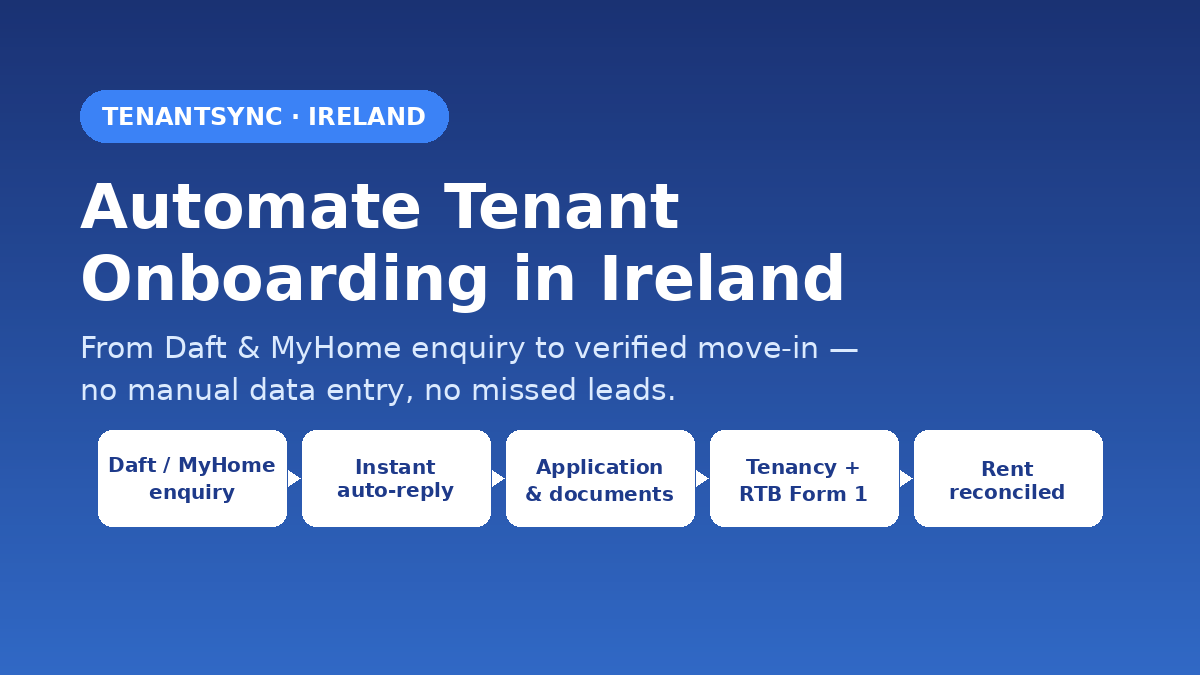
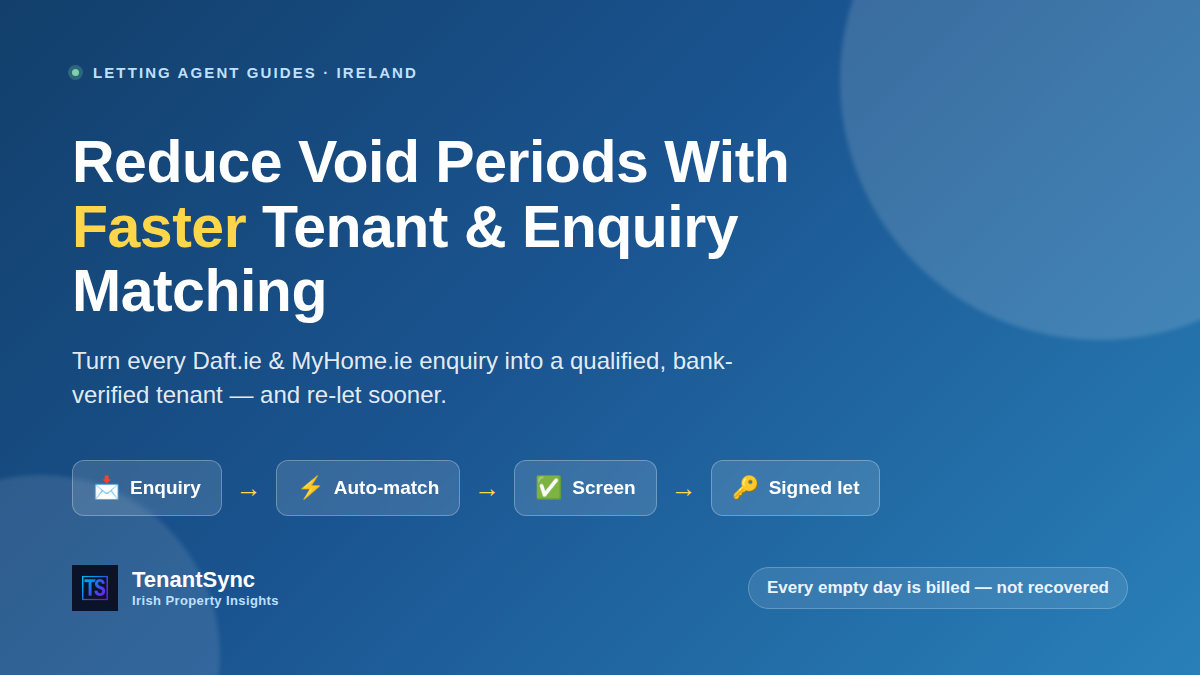
Enquiry → auto-response → application → affordability check → viewing → decision → e-signed lease → Open Banking rent reconciliation and RTB compliance. The lead that started as a Daft message becomes a live, compliant tenancy without ever being re-keyed into a second tool — which is also how agencies scale without adding headcount.
🏠 Re-let sooner from the enquiries you already get
Matched enquiries, instant replies, structured applications and bank-verified affordability — the system a busy agency uses to close voids faster. Start free; no credit card to begin.
Measuring Void & Matching Performance
You can't shorten what you can't see. The final advantage of centralising enquiries is that, for the first time, you can measure the funnel — per listing, per branch, per landlord.
TenantSync's enquiry dashboard shows the shape of your pipeline at a glance:
- Total leads and how many are new, contacted, application submitted and reviewed — your live conversion funnel.
- Unmatched enquiries waiting for a property assignment, so nothing sits in limbo.
- The count of enquiries that needed manual attention, so you can see where the process snags.
And every individual lead carries a complete activity timeline — enquiry received, parsed, property matched, auto-response sent, follow-up sent, application submitted, documents uploaded, reviewed. That's a full audit trail of who did what and when.
What this unlocks for the agency
- Evidence for landlords. Show a client exactly how many enquiries their property drew and how they were handled — a powerful trust signal while the property is between tenants. (See what agencies need that landlord apps lack.)
- Pricing conversations. If a listing draws few enquiries, that's a data-backed prompt to talk to the landlord about asking rent or presentation — see our national rent-cap guide for what's legally possible in 2026.
- Where the void hides. Plenty of applications but few viewings booked is a very different problem from few applications at all — and now you can tell them apart.
The "without adding staff" part, quantified
The work that used to justify a lettings coordinator — sorting the inbox, retyping replies, chasing forms, matching messages to properties, verifying income — is exactly the work that's now automated. You handle more enquiries, faster, with the team you already have. That's the unit-economics case for cutting manual property-management cost.
Doing It Right: GDPR, Equal Status & PSRA
Handling applicant and financial data at volume raises real obligations. Done well, centralising the process makes them easier to meet — but only if you know what they are.
- GDPR. Applicants share personal and financial data. Collecting it through a single secure, time-limited link — and, for affordability, a derived summary rather than stored raw transactions — gives you cleaner consent, storage and retention than a shared inbox ever could. Keep applicant data only as long as you need it and tell applicants how it's used.
- Equal Status Acts. Screening must not discriminate on any of the protected grounds, and refusing a tenant in receipt of HAP is prohibited — recurring housing supports count as income. A structured application and a decision-support affordability check help you apply criteria consistently and fairly.
- PSRA licensing. Letting agents must hold a Property Services Regulatory Authority licence. Software doesn't change that — it just gives you a cleaner audit trail of how each applicant was handled.
Automate the admin, not the decision
Automate acknowledgement, data capture, follow-up and income verification. Keep the decision — who to approve — a documented human judgement made on lawful, consistent criteria. That's the line that keeps speed on the right side of the law.
How to Set It Up — Step by Step
Connect your enquiry mailbox
Register the email your Daft.ie and MyHome.ie enquiries arrive at, and set up auto-forwarding so every enquiry flows in automatically.
Let enquiries match to the right property
TenantSync reads each enquiry, extracts the applicant and property details, and matches it to the right listing. Unmatched ones are flagged for a one-click assignment.
Reply instantly and follow up automatically
Each new lead triggers an immediate reply with a secure application link — and an automatic follow-up if the applicant doesn't respond within 24 hours.
Qualify with a structured application
Applicants complete one consistent form — contact details, employment, move-in date and documents — so you compare like with like, with no phone tag.
Confirm affordability, then view
Invite shortlisted applicants to a read-only bank-verified affordability check, and spend your viewing slots on the ones who can genuinely proceed.
Sign, register & measure
Progress your chosen applicant to an e-signed RTB-compliant lease, register with the RTB inside 30 days, and track void & conversion on the dashboard.
A quick note on where this lives
Enquiry, lead and screening management runs in the TenantSync web dashboard, where a lettings team does its desk work. Once a tenancy is live, day-to-day tasks like rent tracking and compliance reminders travel with you on the native iOS and Android apps.
Frequently Asked Questions
What is a void period, and why does it cost so much?
A void period is the time a rental sits empty between tenancies, earning no rent while costs continue. It's expensive because a vacant property is effectively billed by the day and that lost rent is never recovered — on a €2,000 rent, every empty day is worth roughly €66, so a two-week delay costs about €920 (illustrative). Because void rent can't be clawed back, re-letting faster usually beats holding out for a marginally higher asking rent.
How does faster enquiry matching reduce void periods?
A single Daft.ie or MyHome.ie listing can draw dozens of enquiries within hours, and renters message several properties at once and go with whoever replies first. TenantSync captures every enquiry into one pipeline, parses the applicant and property details, matches each enquiry to the right listing automatically, sends an instant reply with an application link, and follows up after 24 hours — so more of the same enquiries convert to viewings before the applicant lets elsewhere.
What is a bank-verified affordability check, and is it fair to tenants?
The applicant connects their bank once through regulated read-only Open Banking, and TenantSync returns a derived affordability summary — recurring net income, income stability, existing housing costs, a rent-to-income ratio, an affordability band and identity/risk signals — instead of chasing payslips by email. It's decision support for a fair human choice, never automatic rejection. Agents must still apply the Equal Status Acts, and HAP and other recurring housing supports count as income.
Doesn't rushing the re-let mean taking a weaker tenant?
No — faster matching means reaching a qualified decision sooner, not lowering the bar. A structured application collects the same information from every applicant, and an optional affordability check confirms real income before you commit a viewing. You spend limited viewings on applicants who can actually afford the tenancy, which reduces the risk of a placement failing and creating a second void.
Which banks does the affordability check support?
It uses regulated PSD2 Open Banking, which covers Irish institutions including AIB, Bank of Ireland, PTSB, EBS, Revolut and N26, among others, supervised by the Central Bank. The connection is read-only — it cannot move money — and the applicant consents on their bank's own screen, so credentials are never shared with the agent.
Does this work if I use Daft or MyHome and a separate CRM?
Yes. TenantSync is the Irish enquiry-to-tenancy and compliance layer, so it can sit alongside a general estate-agency CRM. If you're weighing tools, see our guides to the best property management software for Irish letting agents and Daft & MyHome inquiry management.
Summary
- A void period is billed by the day and never recovered, so re-letting speed — the lever you control — usually beats holding out for a slightly higher rent.
- Voids are mostly a matching problem, not a demand problem: days leak from slow replies, wrong-property confusion, unqualified viewings and failed placements.
- Enquiry matching captures every Daft.ie and MyHome.ie enquiry into one pipeline, parses it, and matches it to the right property automatically — with an instant auto-response and a 24-hour follow-up so you're first, every time.
- Tenant matching uses a structured application plus an optional bank-verified affordability check (read-only Open Banking) to qualify the right applicant faster — as decision support, never auto-rejection, within the Equal Status Acts.
- The chosen tenant flows straight to an e-signed RTB-compliant lease, RTB registration inside 30 days, and ongoing rent and compliance tracking — one system, no re-keying.
- An enquiry dashboard with per-lead activity timelines lets you measure void and conversion per listing, branch and landlord — handling more volume without adding staff.
📈 Close voids faster with matching that runs itself
Match every Daft & MyHome enquiry, reply in minutes, screen tenants with bank-verified affordability, and re-let sooner — on the platform Irish agencies run peak season on. See it on your own portfolio, or start free today.
Related Articles