How to Improve Follow-Ups and Convert More Enquiries into Instructions
Almost every Irish letting agency replies to enquiries. Far fewer follow up. That gap — between the first reply and the second, third and fourth touch — is where applicants go quiet, viewings never fill, and landlords quietly decide you're hard work. This guide sets out the follow-up system that fixes it: enquiry automation for Daft.ie and MyHome.ie, tenant screening that focuses your effort on the right applicants, and tenant & landlord communication that turns a well-run let into the next instruction.
The short version
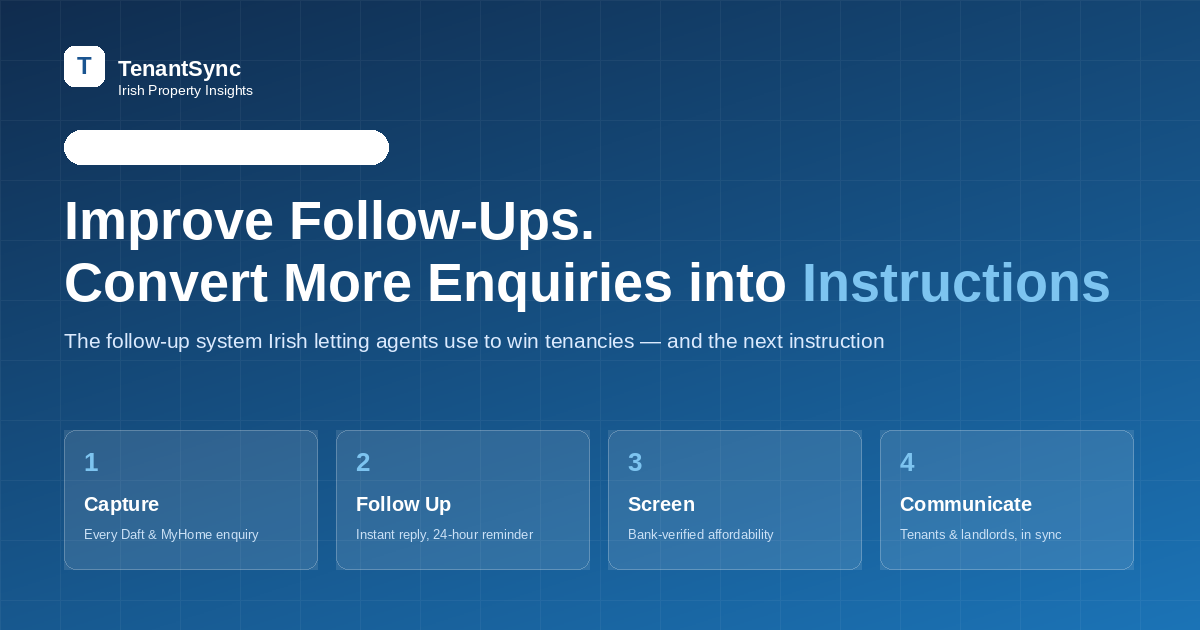
How do you convert more enquiries into instructions? Stop treating follow-up as a personal habit and make it a system. Route every Daft.ie and MyHome.ie enquiry into one pipeline instead of a shared inbox; make the first reply automatic so it never waits for a free pair of hands; put the second touch on a 24-hour clock that stops itself once the applicant responds; screen shortlisted applicants with a bank-verified affordability check so your time goes to people who can actually take the tenancy; and automate tenant and landlord communication so no client ever has to ask you for an update. Do those four things and both conversions improve at once — more enquiries become signed tenancies, and more landlords become signed instructions.
The Two Conversions: Tenancies and Instructions
Before you can improve conversion, you have to be clear about what you're converting. An Irish lettings business runs two funnels, and they share a single engine.
What is an "instruction"?
An instruction is a landlord formally appointing your agency to let and/or manage a property. In Irish practice that appointment is documented by a Letter of Engagement (also called a Property Services Agreement) — which a licensed Property Services Provider must have agreed with a client, stating the services and all costs, before acting for them, under section 43 of the Property Services (Regulation) Act 2011.
So the two funnels are:
| Funnel | Starts with | Converts into | What follow-up decides |
|---|---|---|---|
| Applicant funnel | A tenant enquiry from Daft.ie or MyHome.ie | A signed, RTB-registered tenancy | Whether the applicant is still interested by the time you get back to them — and whether you have enough qualified applicants to fill a viewing. |
| Client funnel | A landlord enquiry, referral or valuation request | A signed instruction (Letter of Engagement) | Whether the landlord believes you'll run their tenancy better than the last agent — which they judge almost entirely on how you communicate. |
Here's the part most agencies miss: the second funnel is largely won inside the first. A landlord watching you let their neighbour's apartment in eleven days, with a full applicant file and a monthly statement that arrives without being asked, has already made their decision before you pitch. Conversely, an agency that lets slowly and goes quiet between updates has to win every instruction the hard way, on fee.
That's why follow-up is not a sales tactic. It's the operating system of a lettings business — and it's the one thing you can improve this quarter without hiring anyone. If you want the wider commercial case, see our guide to winning and keeping landlord clients.
Why Follow-Ups Fail (It Isn't Laziness)
Ask any agency why an enquiry went cold and you'll hear a version of "it got busy." That's true, but it isn't the cause. Follow-up fails for structural reasons, and structural problems can be fixed once rather than fought every week.
| The structural gap | How it shows up on a busy week | The fix |
|---|---|---|
| No single pipeline | Enquiries live in a shared inbox alongside contractor invoices and RTB post. Nobody can answer "how many open enquiries do we have?" | Every enquiry becomes a structured lead in one list, with a status. |
| No owner | Two people reply to the same applicant; three enquiries get no reply at all because each assumed the other had it. | Leads are scoped to a branch and a property automatically, so ownership is unambiguous. |
| No clock | The first reply goes out. The second touch depends on somebody remembering — and nobody does, at 5:40pm on a viewing day. | The second touch fires on a fixed schedule, without human input. |
| No record | "Did we ever get back to her?" is answered by scrolling an inbox. Applicants get chased twice or not at all. | Every touch is written to an immutable per-lead activity timeline. |
| No qualification | Ten follow-ups go to applicants who were never in a position to take the tenancy, while one serious applicant waits. | A consistent application form and, after viewing, a bank-verified affordability check. |
Notice that none of those fixes is "try harder." Each one replaces an act of memory with a piece of infrastructure — which is exactly why a two-person agency with a good system out-converts a five-person agency running on a shared inbox.
💡 The honest diagnostic
Open your shared inbox and count the portal enquiries from the last fourteen days. Now count how many received a second message from you. Most agencies find the first number is healthy and the second is close to zero. That difference is your conversion problem — and it's entirely fixable.
Step 1: Capture Every Daft & MyHome Enquiry
You cannot follow up on an enquiry you can't see. In Ireland, the overwhelming majority of rental enquiries arrive as notification emails from Daft.ie and MyHome.ie, which is why the first step is turning that stream of email into a structured pipeline.
How enquiry capture works in TenantSync
You register the mailbox that receives your portal enquiry notifications. From then on, TenantSync does the rest:
- Continuous capture. Inbound enquiries are collected and processed on a five-minute cycle, so nothing waits for someone to open an inbox.
- Portal-aware parsing. Dedicated parsers for Daft.ie and MyHome.ie extract the applicant's name, email, phone, message and the property reference or listing title from the notification — including forwarded copies with Fwd: prefixes — with a fallback parser for anything unusual.
- Automatic property matching. Each enquiry is scored against your properties on exact address and name matches plus token overlap, and attached to the best candidate above the confidence threshold. Anything below it is marked unmatched and surfaced for a one-click manual assignment rather than being silently dropped.
- Correct scoping from the start. The resulting lead inherits the right agency and branch from the registered mailbox and the matched property — so in a multi-branch agency it lands with the team that owns it.
- De-duplication. Enquiries are keyed on an idempotency signature, so a notification that gets forwarded twice becomes one lead, not two. No more double-chasing the same applicant.
- Only what you registered. An enquiry arriving from an address you haven't registered doesn't create a lead — it's held for manual review instead, so nothing unexpected lands in your pipeline and nothing is quietly thrown away.
One-time setup, then it's automatic
Enquiry capture needs a short, one-time setup with the TenantSync team: we provide your dedicated inbound address and help you configure the forwarding rule in Gmail or Outlook so Daft and MyHome notifications flow through. It takes one sitting — after that, capture runs on its own.
💡 Going deeper on capture
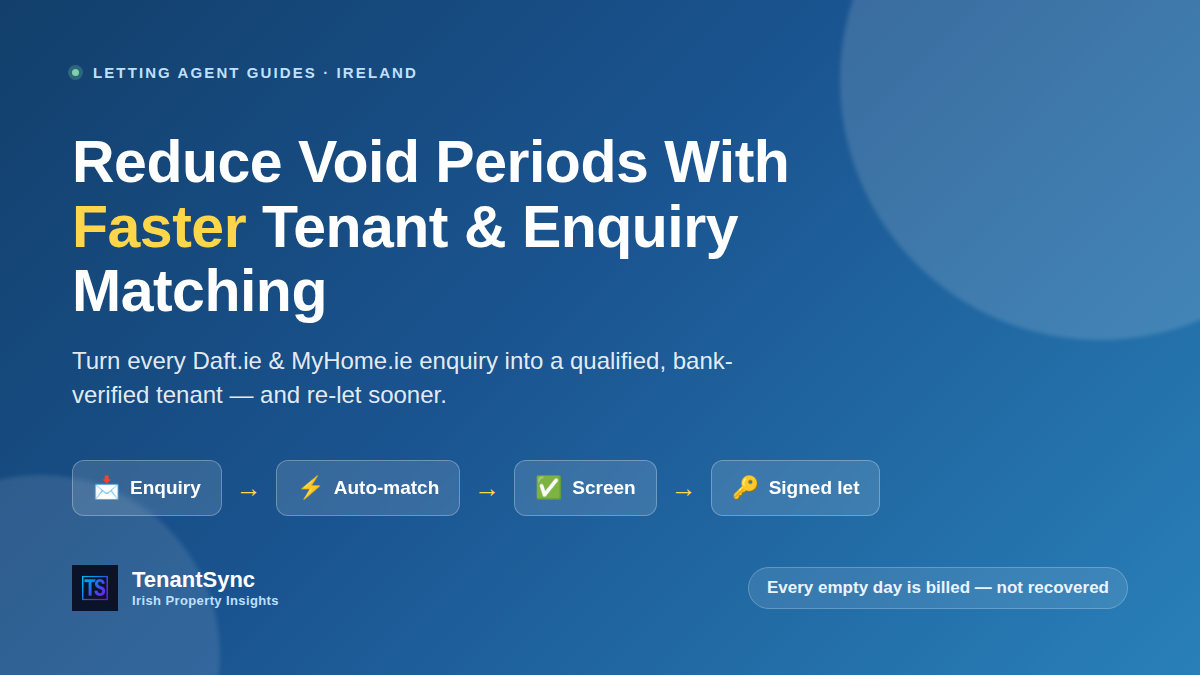
This section is the short version. For the full treatment of shared-inbox failure modes, speed-to-lead and portal enquiry handling, read managing Daft.ie & MyHome.ie enquiries for Irish letting agents, and for the void-period maths behind it, reducing void periods with faster tenant & enquiry matching.
📥 See every Daft & MyHome enquiry in one pipeline
Watch a live enquiry get captured, parsed, matched to the property and answered automatically — on a walkthrough shaped like your own agency and your own listings.
Step 2: The Follow-Up Sequence That Runs Itself
Capture solves visibility. It doesn't yet solve conversion. What converts is a sequence: a first touch that never depends on availability, and a second touch that never depends on memory.
Touch one: the instant acknowledgement
The moment a lead is created, TenantSync emails the applicant an acknowledgement — "Thanks for your rental inquiry for [property]" — that does more than confirm receipt. It carries a secure, tokenised link to your application form, so the applicant's next step is available while their interest is at its peak, not after a phone call you haven't made yet. The link is time-limited (valid for seven days by default) and the lead's status moves from New to Contacted automatically.
This is the single highest-leverage change most agencies can make, because it converts your response time from a staffing question into a constant. Whether the enquiry lands at 11am on a Tuesday or 10pm on a bank holiday Sunday, the applicant hears back the same way.
Touch two: the 24-hour reminder
Plenty of applicants open the acknowledgement, mean to complete the form, and don't. So an hourly job looks for every lead that is still sitting at Contacted — acknowledged more than 24 hours ago, with no application submitted and no follow-up sent — and sends exactly one reminder: "Reminder: complete your rental application for [property]", carrying the same secure link.
Three details matter here, and they're the difference between a follow-up system and a nuisance:
- It stops itself. The moment the applicant submits the form, the lead moves to Form Submitted and drops out of the reminder queue. Nobody gets chased for something they've already done.
- It sends once. The follow-up is recorded on the lead, so the job never sends a second copy — a system that nags is worse than one that forgets.
- It's recorded. Auto-response sent and follow-up sent are written to the lead's activity timeline with timestamps, so "did we get back to them?" is a glance, not an archaeology project.
What the application actually collects
The form on the other end of that link is what makes applicants comparable. Every applicant supplies the same structured details — name, email, phone, current address, employment status, employer, desired move-in date and any notes — and can upload supporting documents in the same submission. Instead of ten different email threads with ten different levels of detail, you get one shortlist you can rank on the same basis.
The pipeline, end to end
Each lead moves through a visible status — New → Contacted → Form Submitted → Reviewed → Approved or Rejected — with an activity timeline underneath recording every event: enquiry ingested, parsed, property matched (or manually assigned), lead created, auto-response sent, follow-up sent, application submitted, document uploaded, reviewed, rejected. That timeline is the record that makes follow-up auditable instead of anecdotal.
💡 Where the human belongs
Automation should own the predictable touches — the acknowledgement and the reminder. It shouldn't own the phone call. Free your team from typing the same first reply forty times a week and they'll have time for the conversation that actually books the viewing.
Step 3: Screen So Your Follow-Up Effort Lands
More follow-up isn't automatically better follow-up. If half your shortlist can't sustain the rent, chasing them harder just moves the disappointment later — after the viewings, after the references, sometimes after the offer. Qualification is what makes the rest of the sequence pay.
The traditional method — payslips and bank statements by email — is slow for you and uncomfortable for the applicant, and PDFs are trivially editable. Bank-verified affordability screening replaces the paper chase with a single consented connection.
How it works
- You raise the check. Enter the applicant's name and email, optionally link the property, and set the target monthly rent they'd be signing up to. You also tick an attestation that the applicant has viewed the property or arranged a viewing — recorded with a timestamp as a compliance record.
- The applicant connects once. They receive a one-off secure link and authorise a read-only connection to their bank through regulated PSD2 Open Banking. Consent is given on the bank's own screen; credentials are never shared with you, and the connection can never move money.
- You get a derived summary. TenantSync analyses the data transiently and returns a report — the check moves through Requested → Link sent → Bank connected → Report ready, so you always know where each applicant stands.
What the report shows
- Detected recurring net monthly income, average monthly inflow, and the number of salary-like credits behind the figure.
- Income stability — is the income steady or variable across the months analysed?
- Existing housing outflow — recurring rent or mortgage payments already going out.
- Rent-to-income ratio and an affordability band: Strong (under 30%), OK (30–40%), Stretched (40–50%), High risk (above 50%), or Unknown where income couldn't be established with confidence.
- A confidence level (high / medium / low) plus plain-English data-quality notes such as "Only 1 month of data available" — a low-data case returns a caveat rather than a confident wrong number.
- An identity check comparing the bank account-holder name to the applicant you entered, and risk flags with severity — gambling activity, returned or unpaid items, overdraft reliance, an existing housing commitment, or a name mismatch — each with one line of supporting detail.
Decision support — never an automated decision
An affordability band is guidance to inform a human letting decision. It is not a credit score, and it must never be used to auto-reject an applicant. The value is that it lets you focus follow-up and viewings on applicants who can genuinely take the tenancy — and gives your landlord client a defensible, consistent basis for the recommendation you make.
Privacy by design
Only the aggregated summary is stored — never the applicant's raw transactions. The public link token is held as a hash, not in the clear, and once the report is ready the applicant's bank consent is revoked and purged, with a daily retention sweep as a backstop for anything left behind. That's GDPR data minimisation built into the mechanism rather than bolted on, and it's a genuinely easier ask of an applicant than emailing you three months of statements.
Bank-verified Tenant Screening is available on the Standard plan and above. For the full walkthrough, see tenant screening and income verification explained.
✅ Qualify shortlisted applicants in minutes, not days
Bank-verified income, affordability band and risk flags — no payslips, no PDF chasing, and only the summary is ever stored. Start free; no credit card to begin.
Step 4: Communication That Earns the Next Instruction
Now the funnel turns. Once the tenancy is signed, follow-up stops being about applicants and starts being about tenants and landlords — and this is the stage that decides whether you win the landlord's next property, their referral, or their notice.
Landlords almost never leave over one mistake. They leave because they had to ask, more than once, for something they expected to arrive on its own. Every "any update?" email is a small withdrawal from an account you were building.
The messages that should never need a human
- Rent invoices and reminders. Invoices are issued to the tenant as PDFs, then reminders fire automatically 7 days before the due date, on the due date, and again at 3 and 10 days overdue — de-duplicated so each reminder is sent once. Your team stops being the collections department.
- Arrears alerts. When bank data shows rent hasn't arrived, both the owner and the tenant are alerted early, without anyone drafting a word.
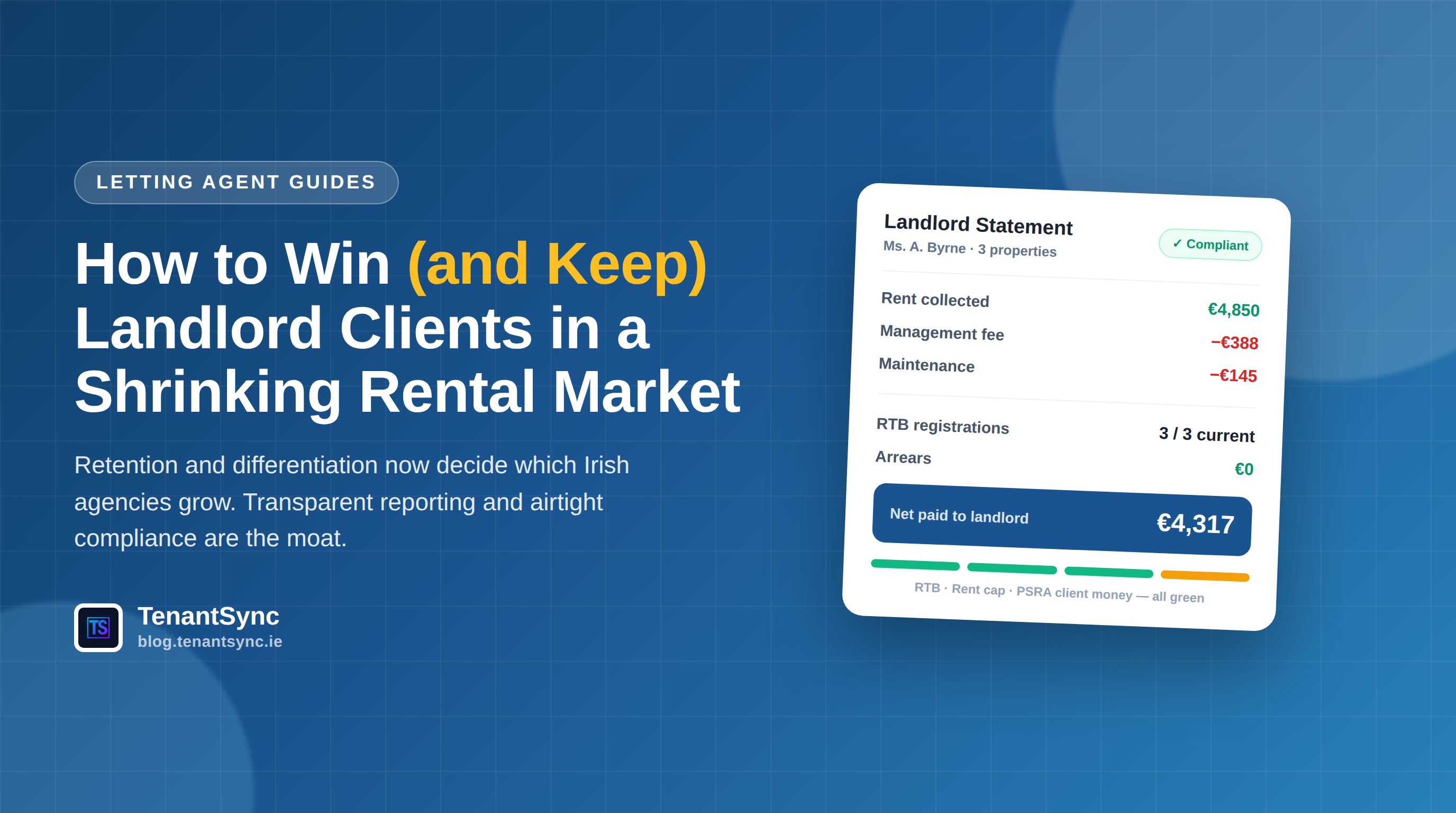
- Monthly landlord statements. A disbursement statement shows exactly what was collected, what was deducted and what was paid over — delivered with a secure link the landlord can open and approve without creating an account. That's the "any update?" email answered before it's written.
- Tenant self-service. Tenants can see their own bank-verified statement of account and be issued a rent certificate when they need one, instead of emailing you for it.
- Compliance notices. RTB registration deadlines, annual renewals, rent-review windows and Part 4 milestones notify the right party at the right time — so your landlord learns about their obligations from you, on schedule.
- Maintenance on one thread. Each maintenance request carries a role-aware comment thread shared by tenant, agent and landlord, so nobody is relaying messages between three inboxes. Agencies can also send bulk landlord-to-tenant emails from one place.
All of it runs across email, in-app and mobile push, with per-user preferences so people are reached the way they actually read.
💡 The referral loop, made concrete
A landlord who receives a statement on the 5th of every month without asking, hears about an arrears case the day it happens, and never has to chase a maintenance update is a landlord who mentions you to the other landlord in their building. That's the cheapest instruction you'll ever win — and it's manufactured, not lucky.
Automated ≠ impersonal
Automating communication protects the human touch rather than replacing it. The system handles the predictable messages — bills, reminders, statements, alerts, notices — so your team's attention goes to the conversations that genuinely need judgement: a tenant in real difficulty, a landlord weighing a decision, a shortlist that needs a recommendation. The chasing disappears; the relationship gets more of you.
Step 5: Close the Instruction Properly
When the landlord says yes, the follow-up isn't finished — it just changes form. In Ireland, the close is a compliance event as much as a commercial one: as a licensed Property Services Provider, you must have an agreed Letter of Engagement stating the services and all costs in place before you act for that client, under section 43 of the Property Services (Regulation) Act 2011.
Handled on a Word template, that's exactly the step that drifts: the letter gets drafted, then sits unsigned while you're already advertising the property. TenantSync's PSR/PSRA compliance module (available from the Growth plan) tracks it as a record rather than a document:
- Draft with an itemised fee schedule. Fee lines can be expressed as a percentage of rent (e.g. a monthly management fee), a fixed amount (e.g. a tenant-find fee), an hourly rate, or another agreed basis — which is what "all costs" requires in practice.
- Faithful snapshots. The landlord's legal name and address, the property or portfolio it covers, and your own trading name, address and PSRA licence number are captured onto the letter at generation time, so the document stays a self-contained record even if those details later change.
- A tracked lifecycle. Draft → Issued → Signed → Superseded, with a generated PDF and a secure link the client can open to view and retrieve their copy. An unsigned engagement is visible as an outstanding item instead of an assumption.
- Reminders that fire. Unsigned Letters of Engagement sit alongside licence renewals, insurance expiry and client-account reconciliation in the same escalating reminder set — the same follow-up discipline, applied to your own compliance.
Why this belongs in a follow-up article
Because an unsigned Letter of Engagement is a follow-up failure with a regulatory consequence attached. The agency that treats the instruction as a tracked record — not a document someone will chase — both closes faster and stays on the right side of the PSRA. See our practical guide to the Letter of Engagement for Irish letting agents.
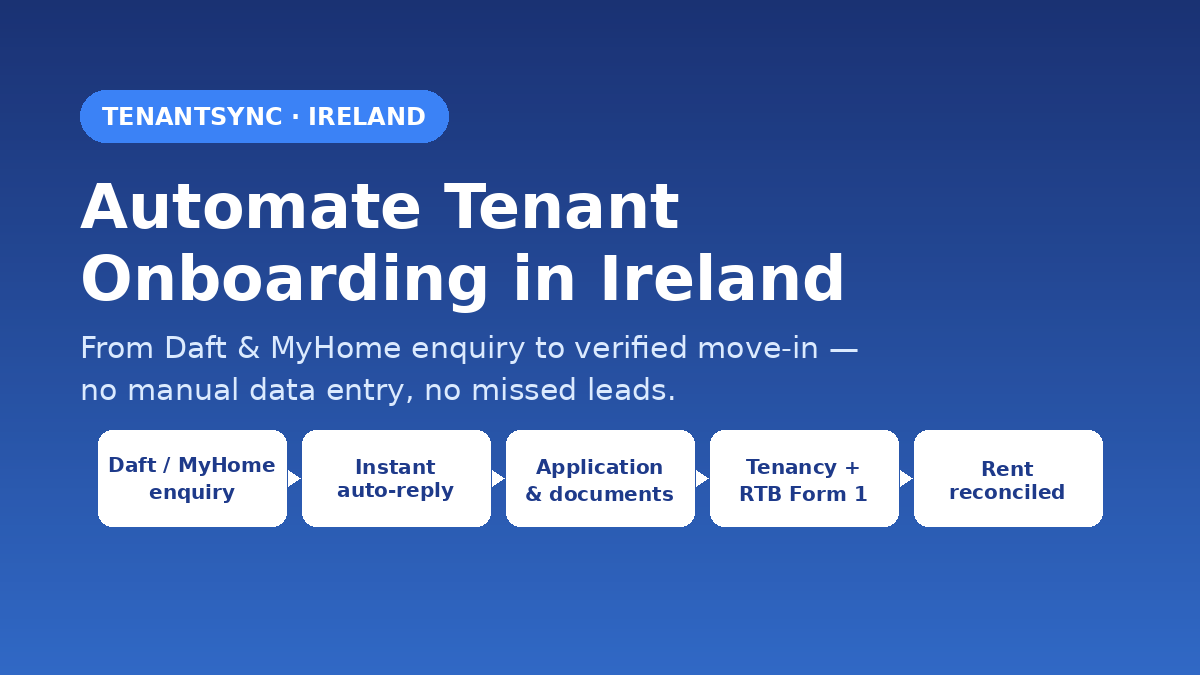
From there the chain continues without re-keying: the instruction leads to an RTB-compliant lease, the lease starts its own 30-day RTB registration clock, and the rent that arrives is reconciled automatically against it — which is what keeps the landlord communication in the previous section running on real data rather than on your memory.
Measuring Follow-Up Performance
Follow-up is one of the few parts of lettings that becomes measurable the moment you systematise it. Once every enquiry is a lead with a status and a timeline, the questions that used to be unanswerable become a dashboard.
| Question | Where the answer comes from | What to do with it |
|---|---|---|
| How many enquiries are open right now? | Total leads, plus counts at New and Contacted. | A rising Contacted count with a flat Form Submitted count means your application step needs attention, not more enquiries. |
| What share of enquiries actually apply? | Form Submitted ÷ total leads, per property or branch. | Compare listings. A listing with plenty of enquiries and few applications usually has a pricing, photo or description problem. |
| Are any enquiries falling through the cracks? | The unmatched and parsing failed counts. | Assign unmatched leads to the right property in one click — these are real enquiries that would otherwise be invisible. |
| Did we follow up on this specific applicant? | The per-lead activity timeline. | Answer a landlord's question about their property in seconds, with timestamps. |
| Which branch converts best? | The same metrics scoped by branch. | Move the practice that's working, rather than guessing which office is busy. |
The point of measuring isn't the report. It's that a number nobody can produce is a number nobody improves — and enquiry-to-application conversion is the earliest, cheapest lever in the whole funnel.
Doing It Right: GDPR, Equal Status & PSRA
Automated follow-up touches personal data, financial data and letting decisions — three areas where Irish agents carry real obligations. Done properly, systematising the work makes compliance easier to evidence, not harder.
- Collect what you need, when you need it. Ask for contact details at enquiry stage and financial detail only from shortlisted applicants after a viewing. Under the Data Protection Commission's guidance on data minimisation, requesting detailed financial information before an applicant has viewed a property is treated as excessive — which is why the screening step is gated behind a viewing attestation.
- Apply screening consistently. Screen every shortlisted applicant on the same basis, and never on any ground protected by the Equal Status Acts 2000–2018 — including family status, age, disability, race, membership of the Traveller community, or receipt of housing assistance such as HAP.
- Keep the decision human. Affordability bands and risk flags are inputs to a documented human choice. Refusing an applicant on an automated score is both bad practice and legally exposed.
- Delete what you no longer need. When a lead is rejected, TenantSync deletes the applicant's uploaded documents from storage along with the associated records — so unsuccessful applicants' files don't accumulate indefinitely in a shared drive.
- Read-only by design. Open Banking connections are consented on the bank's own screen and can never move money, and the affordability consent is revoked and purged once the report is produced.
- Remember the PSRA layer. A signed Letter of Engagement before acting, correct licensing, and proper handling of client money are your obligations as an agency — software makes them visible and hard to miss, but it doesn't discharge them.
Software supports compliance — it doesn't replace your duties
TenantSync tracks deadlines, drafts documents and keeps records, but you remain responsible for holding a valid PSRA licence and meeting your RTB, data-protection and equality obligations. Always confirm current rules with the RTB, the PSRA and the Data Protection Commission.
How to Set It Up — Step by Step
If you want to go from "we reply when we can" to a working follow-up system, this is the order that gets results fastest.
- Route the enquiries. Book the one-time setup, register the mailbox that receives your Daft.ie and MyHome.ie notifications, and confirm the forwarding rule in Gmail or Outlook. Watch the first enquiry arrive as a lead.
- Turn on the first touch. Let the automatic acknowledgement carry the secure application link. Measure your reply time before and after — this is the change you'll feel in week one.
- Let the 24-hour reminder run. Don't disable it because it feels impersonal; measure it. The reminder is aimed at people who meant to apply and got distracted.
- Standardise the application. Send every applicant to the same structured form with document upload, so your shortlist is comparable rather than a pile of email threads.
- Add screening after viewings. Raise bank-verified affordability checks on shortlisted applicants only, with the viewing attestation ticked, and apply it to everyone on the shortlist.
- Automate the client side. Switch on rent reminders, arrears alerts, maintenance threads and monthly landlord disbursement statements — the follow-up that wins your next instruction.
- Close instructions as records. Move Letters of Engagement out of Word and into a tracked draft → issued → signed lifecycle with an itemised fee schedule.
- Review the numbers monthly. Enquiries, applications, unmatched leads and conversion per branch. Fix the biggest gap, then repeat.
Moving from spreadsheets or another system
You don't have to start from scratch. TenantSync imports from Letman, CSV and spreadsheets, so your properties, tenancies and landlord clients come across without re-keying — see migrating a letting agency off spreadsheets. Pricing is flat and per-portfolio with no per-property fees: Starter €20/mo (up to 10 units), Standard €99/mo (up to 100, includes Tenant Screening), Growth €149/mo (up to 200, includes the PSR/PSRA module), Premium €199/mo (up to 300), and custom Enterprise above that — with a 14-day free trial and no card to start. Full detail in our guide to lettings software pricing in Ireland.
Frequently Asked Questions
What does "converting an enquiry into an instruction" mean for an Irish letting agent?
An instruction is a landlord formally appointing your agency to let and/or manage a property — documented in Irish practice by a Letter of Engagement (Property Services Agreement), which a licensed Property Services Provider must have in place under section 43 of the Property Services (Regulation) Act 2011 before acting for a client. A lettings business runs two conversions off the same follow-up discipline: applicant enquiries from Daft.ie and MyHome.ie converting into signed tenancies, and landlord enquiries converting into signed instructions. The second is largely earned by the first — landlords instruct the agent who lets quickly and keeps them informed.
Why do letting agents lose enquiries even when they reply?
Because the loss happens at the second touch, not the first. A shared inbox will get one reply out on a quiet Tuesday, but nobody owns the reminder three days later, nobody notices that half the applicants never returned their details, and nobody can tell which enquiries went unanswered during a busy week. Follow-up fails for structural reasons — no single pipeline, no owner, no clock, no record and no qualification step — so the fix is structural: capture every enquiry into one list, make the first reply automatic, and put the second touch on a schedule that runs whether or not anyone remembers.
How does TenantSync automate Daft.ie and MyHome.ie enquiry follow-up?
You register the mailbox that receives your portal enquiry notifications — a one-time setup with the TenantSync team, who provide the inbound address and help configure the forwarding rule in Gmail or Outlook. TenantSync then checks for new inbound enquiries every five minutes, parses each Daft.ie or MyHome.ie notification for the applicant's name, email, phone, message and property reference, matches it to the right property and branch, and creates a lead. It immediately emails the applicant an acknowledgement containing a secure, time-limited link to your application form, and if that form hasn't been completed 24 hours later it sends one automatic follow-up. Duplicate forwards are de-duplicated, so one enquiry never becomes two leads.
Won't automated follow-up feel impersonal to applicants?
Only if you automate the wrong things. Applicants don't want a personalised acknowledgement — they want a fast one, with a clear next step. Automating the acknowledgement and the single 24-hour reminder means every applicant is treated the same regardless of how busy your week is, while your team keeps the calls, the viewings and the recommendations. The reminder also stops itself the moment someone applies, so nobody is chased for something they've already done.
How does bank-verified tenant screening work in Ireland?
The agent raises a check against a named applicant for a specific target monthly rent, confirming the applicant has viewed the property or arranged a viewing. The applicant receives a one-off secure link and connects their bank once through regulated, read-only Open Banking (PSD2 account information access — it can never move money). TenantSync returns a derived summary: detected recurring net monthly income, income stability, existing housing costs, a rent-to-income ratio, an affordability band (strong under 30%, OK 30–40%, stretched 40–50%, high risk above 50%), a confidence level, an identity check against the bank account-holder name, and any risk flags. Only the aggregated summary is stored — never raw transactions — and the consent is revoked and purged once the report is ready. It's guidance to inform a human decision, not a credit score.
Is it legal to screen tenants this way under GDPR and the Equal Status Acts?
Financial screening is lawful when it's proportionate, consented and consistent — but the sequence matters. Under the Data Protection Commission's guidance on data minimisation, asking for detailed financial information before an applicant has viewed a property is treated as excessive, which is why a check should only be raised on genuine, shortlisted applicants after a viewing. Screening must also be applied to every shortlisted applicant on the same basis, and never on any ground protected by the Equal Status Acts 2000–2018 — including family status, age, disability, race, membership of the Traveller community and receipt of housing assistance such as HAP. Confirm current obligations with the Data Protection Commission and the Irish Human Rights and Equality Commission.
How does better tenant and landlord communication win new instructions?
Landlords rarely leave over a single mistake; they leave because they had to ask for something they expected to arrive on its own. TenantSync issues invoices and sends rent reminders 7 days before the due date, on the due date, and again at 3 and 10 days overdue; alerts owner and tenant when bank data shows rent hasn't arrived; keeps each maintenance request on one role-aware thread shared by tenant, agent and landlord; and delivers monthly disbursement statements the landlord can open and approve through a secure link without an account. A landlord who never has to chase you is a landlord who refers you — and referrals are the cheapest instructions you'll ever win.
Which TenantSync plans include enquiry follow-up, tenant screening and the PSRA module?
Pricing is flat and per-portfolio with no per-property fees: Starter €20/month (up to 10 units, 1 user), Standard €99/month (up to 100 units, 3 users), Growth €149/month (up to 200 units, 5 users), Premium €199/month (up to 300 units, 10 users), and custom Enterprise above that — with a 14-day free trial and no card required. Bank-verified Tenant Screening is available on Standard and above; the PSR/PSRA compliance module, which includes Letters of Engagement, is available on Growth and above. Enquiry capture from Daft.ie and MyHome.ie requires a one-time setup with the TenantSync team.
Summary
- A lettings business runs two conversions on one engine: applicant enquiries into signed tenancies, and landlord enquiries into signed instructions (a s.43 Letter of Engagement). The second is largely won inside the first.
- Follow-up fails for structural reasons — no single pipeline, no owner, no clock, no record, no qualification — not because anyone is lazy. Each one is fixable once.
- Capture: register the mailbox receiving your Daft.ie and MyHome.ie notifications and every enquiry becomes a parsed, property-matched, branch-scoped lead — checked every five minutes and de-duplicated.
- Sequence: an instant acknowledgement carrying a secure 7-day application link, then one automatic reminder after 24 hours that stops itself the moment the applicant applies — every touch written to the lead's activity timeline.
- Screen: after a viewing, a bank-verified affordability check returns income, stability, rent-to-income ratio, an affordability band and risk flags — decision support for a human choice, with only the derived summary stored.
- Communicate: automatic rent reminders (7 days before, due date, 3 and 10 days overdue), arrears alerts, shared maintenance threads and monthly landlord statements approved by secure link — the follow-up that earns referrals.
- Close: track the Letter of Engagement as a record — draft → issued → signed, with an itemised fee schedule and your PSRA licence number on the letter — instead of a Word file someone will chase.
- Flat per-portfolio pricing from €20/month with a 14-day free trial; Tenant Screening from Standard, the PSR/PSRA module from Growth.
📈 Turn follow-up from a habit into a system
Capture every Daft & MyHome enquiry, reply and follow up automatically, screen shortlisted applicants with bank-verified affordability, and keep landlords informed without lifting a finger — on the platform built for Irish letting agents and agencies.
Related Articles