Automate Tenant Onboarding in Ireland: From a Daft or MyHome Enquiry to Move-In (2026)
A popular listing on Daft.ie or MyHome.ie can pull dozens of enquiries in a day. Most of them land in a shared inbox, get read hours later, and the best applicants are already gone. This is a 2026 guide to automating the Irish lettings funnel — from the first enquiry to a registered, rent-reconciled tenancy — with a fair look at the platforms that do it, where each one is strong, and how TenantSync takes the manual re-keying out of an agent's day.
The short version
- Speed wins lettings. The agency that replies to a Daft or MyHome enquiry first usually books the viewing. An automatic acknowledgement in seconds is the single highest-leverage automation you can add.
- The Irish journey has two halves. The front half (enquiry → reply → application → documents) is about speed and organisation; the back half (tenancy → RTB registration → rent) is about Irish compliance. Generic UK tools are strong on the first and absent on the second.
- No single tool owns the whole funnel. TenantSync automates the Irish enquiry-to-tenancy spine including RTB and rent; Property CRM is a full Irish sales-and-lettings CRM; Goodlord leads on UK-style automated referencing. We compare them honestly below.
- Verification still needs a human decision. Software can collect and organise ID, income and references; approving the tenant remains the agent's call — and must respect GDPR and the Equal Status Acts.
If you take one thing from this guide: stop measuring your lettings process by how hard your team works, and start measuring it by how few times the same applicant's details get typed in. Every re-key between your inbox, your spreadsheet, your lease and the RTB is a place a tenancy can slip.
The six stages of the Irish lettings funnel
Whether you let two properties or two hundred, a tenancy travels the same road from a portal enquiry to a registered tenancy. Naming the stages makes it obvious where the time goes — and where automation pays off.
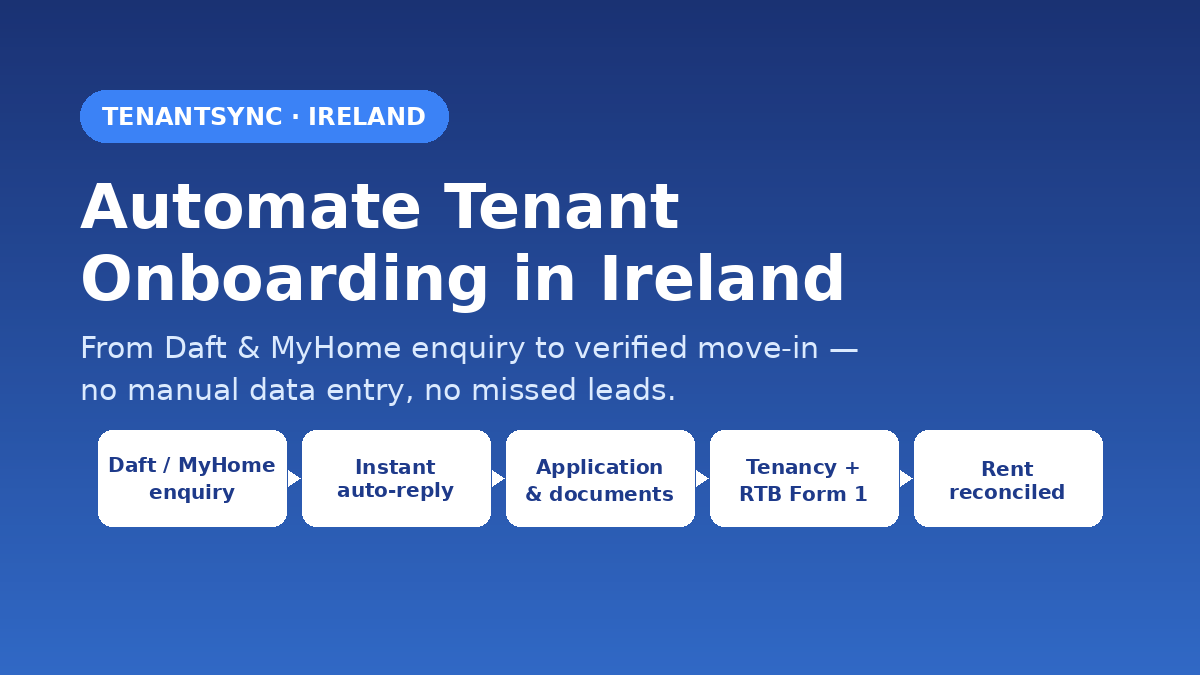
Enquiry → move-in, in six stages
- 1. Capture. A prospective tenant clicks "Email agent" on your Daft.ie or MyHome.ie listing. The portal emails you their details.
- 2. Reply. They expect an answer fast — and they're emailing three other listings at the same time.
- 3. Qualify & view. You match the enquiry to the right property, screen out the obvious mismatches, and book a viewing.
- 4. Apply & document. The interested applicant submits their details and the proof you need — ID, evidence of income, references.
- 5. Set up the tenancy. You approve, issue the lease, take the deposit and first month, and invite the tenant in.
- 6. Register & reconcile. You register the tenancy with the RTB inside 30 days, then track rent as it arrives.
Done by hand, those six stages mean the same name, email and phone number get typed into a mailbox reply, a spreadsheet, a viewing calendar, an application record, a lease, a deposit receipt and an RTB Form 1 — seven times for one tenant. Automation's job is to type it once.
Where the manual process breaks down
The manual version isn't just slow — it leaks. Here's where Irish agents most often lose a tenant, a client, or a night's sleep:
- The shared inbox. Daft and MyHome enquiries pile into lettings@ alongside everything else. On a busy listing, the genuinely good applicant is buried by 4pm and gone by 6.
- Slow first reply. Studies of rental and sales lead handling consistently show response time is the strongest predictor of conversion. A reply the next morning is often a reply to someone who has already signed elsewhere.
- Document chasing. Payslips arrive as phone photos over WhatsApp, references as forwarded emails, ID as a blurry scan — scattered across three channels and impossible to audit later.
- Re-keying into the tenancy. Approved applicant details get re-typed into the lease and the deposit receipt, where a transposed digit becomes a real problem.
- The RTB deadline. The registration clock starts the day the tenant moves in. Miss the 30-day window across a portfolio and you're into late fees and compliance risk — a spreadsheet won't remind you.
The hidden cost isn't the admin — it's the void
Every day a good applicant waits for a reply is a day closer to your client's property sitting empty. A single extra week of voids on an average Dublin rent dwarfs a year of software cost. Speed at the top of the funnel is a revenue lever, not an admin nicety.
What you can actually automate (and what stays human)
It's worth being precise here, because some vendors blur the line. There's a difference between automating the plumbing (moving data so nobody re-keys it) and automating the judgement (deciding whether to grant a tenancy). The first is where the wins are; the second should stay with a person.
| Stage | Safe to automate | Keep human |
|---|---|---|
| Capture | Reading Daft/MyHome enquiry emails into one inbox | — |
| Reply | Instant acknowledgement & next-steps message | The personalised follow-up |
| Qualify | Matching enquiry to property; basic shortlisting | Who you invite to view |
| Apply | One link that collects details & documents | — |
| Verify | Collecting & organising ID, income, references | The approval decision |
| Tenancy | Pre-filling the lease, deposit invoice, portal invite | Signing off the terms |
| Register | RTB Form 1 draft & deadline tracking | Final review before finalising |
| Reconcile | Matching rent to the tenancy; flagging arrears | How you handle an arrear |
Read that table and the strategy is clear: automate every data hand-off in the funnel, and reserve human attention for the two or three genuine decisions. That's the version of "no manual intervention" that's both achievable and responsible.
The platforms compared
Six realistic options for an Irish agency, with the honest "best for" up front. We've put TenantSync first because this guide is published by TenantSync — and we've been specific about where each of the others is the stronger choice, because you'll verify it anyway.
1. TenantSync — Irish enquiry-to-tenancy automation with RTB & rent
Best for: Irish letting agents and small-to-medium agencies who want the whole Irish journey — Daft/MyHome enquiry to a registered, rent-reconciled tenancy — in one system built for Irish law.
TenantSync is an Irish-built platform that ingests enquiry emails from Daft.ie and MyHome.ie, parses each into a structured lead in a centralised inbox, and fires an automatic acknowledgement within seconds. From there it carries the applicant through a single application link (details, employment, and document uploads), into a tenancy with a tenant portal invitation, and then does the uniquely Irish work: the RTB Form 1 draft-to-finalise with the 30-day deadline tracked, the national rent-cap calculation, and Open Banking rent reconciliation against Irish banks. It's web-based and mobile-responsive.
Where it's not the answer: TenantSync does not run automated third-party credit-and-affordability referencing — it collects and organises the proof for you to decide on, rather than returning a credit score. If algorithmic referencing is the centre of your process, pair it with a referencing service (see Goodlord) or weigh that requirement carefully. TenantSync is also a newer, smaller company; we'd rather say that plainly than invent customer numbers.
2. Property CRM Ireland — full sales & lettings CRM
Best for: Irish agencies that want one CRM across sales and lettings with portal feeds and e-signing built in.
Property CRM (propertycrm.ie) is an Irish estate-agent CRM built for PSRA-licensed agents, with documented integrations to Daft.ie, MyHome.ie, PropertyPal, Offr, BidNow and DocuSign, and intelligent matching of enquiries to available properties for both sales and lettings. If your agency's centre of gravity is a sales-and-lettings pipeline with e-signature via Offr or DocuSign, it's a serious Irish contender. Confirm directly whether it automates RTB Form 1 registration, the national rent cap and Open Banking rent reconciliation, as those are TenantSync's particular focus.
3. Goodlord — UK digital onboarding & tenant referencing
Best for: agencies operating to UK rules whose priority is fast, automated referencing and digital contracts.
Goodlord is the UK gold standard for pre-tenancy automation: combined identity, affordability, credit and fraud checks in one referencing workflow (Goodlord reports around 30% of references returned instantly and 90% within 72 hours), digital contracts, and tenant payments — used by 3,500+ UK agencies and integrated with UK PMS platforms like Alto, Reapit and Street.co.uk. The catch for an Irish agency is fit, not quality: it's built for the UK, so it has no concept of the RTB Form 1, the Irish national rent cap, Part 4, or reconciliation against Irish banks. Pricing is listed from around £87.50/month.
4. UK agency CRMs (Reapit, Alto, AgentOS)
Best for: larger agencies already standardised on a UK estate-agency CRM.
These established platforms handle portal feeds, applicant pipelines and property management at scale, and many Irish firms use them. But like Goodlord they're configured around the UK market, so Irish compliance — RTB registration, the rent cap, Irish-bank reconciliation — isn't native; agencies typically bolt referencing and Irish workflows on top manually.
5. Standalone referencing services
Best for: agencies that just need the checks, and already have a system for everything else.
Specialist referencing providers (HomeLet-style services and Irish referencing firms) verify identity, employment, income and previous-landlord references on request. They do one stage of the funnel well, but they aren't a platform — you still need something to capture the enquiry, run the application, set up the tenancy and handle RTB and rent.
6. Shared inbox & spreadsheets — the manual default
Best for: a handful of tenancies, and not much more.
Most agencies start here: enquiries in lettings@, applicants tracked in a sheet, documents over email and WhatsApp. It's free and flexible, and it's exactly what every tool above is trying to replace — because it's where slow replies, lost documents and missed RTB deadlines come from once you're past a few properties.
See your own enquiries flow end-to-end
Book a 15-minute agency demo and we'll show you a real Daft/MyHome enquiry land, auto-reply, become an application, and turn into an RTB-registered tenancy — on your workflow, not slideware.
At-a-glance comparison
Where we can verify a capability from public sources or the product itself, we've stated it. Where a capability isn't publicly documented for a product, we've said "check with provider" rather than claim it's missing — confirm anything decision-critical directly with each vendor.
| Capability | TenantSync | Property CRM IE | Goodlord | UK CRMs |
|---|---|---|---|---|
| Built for | Irish enquiry-to-tenancy + RTB & rent | Irish sales & lettings CRM | UK pre-tenancy & referencing | UK estate agency |
| Daft.ie / MyHome.ie enquiry capture | Built-in (email ingestion + parsers) | Built-in (integrations) | Via UK portals / PMS | Via portal feeds |
| Instant auto-reply to enquiry | Built-in (seconds) | Check with provider | Yes (workflow) | Check with provider |
| Online application + document upload | Built-in (tokenised link, up to 5 files) | Check with provider | Built-in | Check with provider |
| Automated credit/affordability referencing | No (collects & organises proof) | Check with provider | Core strength | Often via add-on |
| Lease generation & e-signature | Built-in (lease agreement + e-sign) | Via Offr / DocuSign | Built-in (UK contracts) | Yes |
| RTB Form 1 registration & 30-day tracking | Built-in | Check with provider | No (UK) | No (UK) |
| National rent-cap (2% / CPI) calculator | Built-in | Check with provider | No (UK) | No (UK) |
| Open Banking rent reconciliation (Irish banks) | Built-in (AIB, BOI, PTSB, EBS, Revolut, N26) | Check with provider | UK payments | Check with provider |
| Tenant self-service portal | Built-in (maintenance, docs, payments) | Check with provider | Tenant flows | Yes |
The pattern: TenantSync automates the Irish spine end-to-end and owns the RTB/rent back half; Property CRM is the broad Irish sales-and-lettings CRM; Goodlord is unmatched on automated referencing but UK-bound; the UK CRMs scale the pipeline but leave Irish compliance to you. None is "best" in the abstract — it depends which stage of the funnel is costing you most.
How TenantSync automates the journey
Everything below is a capability that exists in the product today — built around Irish residential tenancies law rather than adapted from a UK or US tool. The thread running through it is simple: the applicant's details are entered once and carried all the way to a registered tenancy.
Daft & MyHome enquiry capture
Enquiry emails from Daft.ie and MyHome.ie are read automatically by dedicated parsers and turned into structured leads — name, email, phone, property reference and message — in one centralised inbox, so nothing is lost in lettings@.
Instant acknowledgement
Each new enquiry triggers an automatic, professional reply within seconds — confirming receipt and next steps before the applicant emails the next listing. Speed at the top of the funnel, without a person watching the inbox.
Qualify & assign to property
Match an enquiry to the right property and move it along a clear lead status, so your shortlist for each listing is always one screen away rather than scattered across a thread.
One application link, documents included
Send a single tokenised application link. The applicant submits their details, employment information, desired move-in date and supporting documents (up to five files) — collected in one place against the lead, ready to review.
Tenancy setup & tenant portal
Approve an applicant and carry their details into a tenancy: generate the lease agreement, capture an e-signature, and invite the tenant to a self-service portal for documents, maintenance requests and payments.
RTB Form 1, draft-to-finalise
Pre-fill the RTB Form 1 from the tenancy data, with the 30-day registration deadline computed from the start date and tracked on a portfolio-wide compliance dashboard alongside renewals and Part 4.
National rent-cap calculator
Work out the maximum legal increase under the post-March-2026 rules — 2% or CPI inflation, whichever is lower — with the rule and figure shown, so a future rent review is defensible.
Open Banking rent reconciliation
Connect the agency or landlord account (AIB, Bank of Ireland, PTSB, EBS, Revolut, N26) and incoming rent auto-matches to the right tenancy, with arrears surfaced the day they happen. Credentials stay on the bank's screen.
Put your own letting through it
In one session: capture a live enquiry, send the auto-reply, collect an application, set up the tenancy and draft a real Form 1. That's the fastest way to know if TenantSync fits your agency.
What it costs (as published, June 2026)
These products price on different models, so compare the total monthly cost at your portfolio size, not the headline figure. Pricing below is as published in June 2026 — always confirm on each provider's own site.
| Tool | Model | Indicative price |
|---|---|---|
| TenantSync — Starter | Flat tier | €20 / mo · up to 10 properties |
| TenantSync — Standard | Flat tier | €99 / mo · up to 100 properties |
| TenantSync — Growth ⭐ | Flat tier | €149 / mo · up to 200 properties |
| TenantSync — Premium | Flat tier | €199 / mo · up to 300 properties |
| Goodlord | Subscription (UK) | From £87.50 / mo (as listed; UK) |
| Property CRM Ireland | Quote-based | Contact vendor |
| UK agency CRMs | Quote-based | Contact vendor |
A useful sanity check: weigh the monthly fee against the cost of one extra week of voids on a single property, or one missed RTB registration. That's the real thing good software insures you against. TenantSync includes a 14-day free trial (no credit card) and the tenant portal in every plan; compare plans for your portfolio size.
Verification, GDPR & PSRA — automating without cutting corners
"Automate tenant verification" is a phrase worth handling carefully. You can — and should — automate the collection and organisation of the evidence. You cannot outsource the decision, and Irish law sets clear limits on how you screen.
Screen fairly, and keep a clean file
- Get consent. Identity, employment, income and previous-landlord checks should be done with the applicant's clear consent — TenantSync collects them through a link the applicant fills in themselves.
- Mind the Equal Status Acts. You can assess affordability and references; you cannot discriminate on protected grounds, including discriminating against applicants in receipt of HAP or other housing supports.
- GDPR by design. Collect only what you need, store it securely against the right record, and be able to produce or delete it. One organised application file beats payslips scattered across WhatsApp.
- PSRA standards. Letting agents are licensed by the Property Services Regulatory Authority — your process and record-keeping should stand up to that standard, which a structured system makes far easier than a shared inbox.
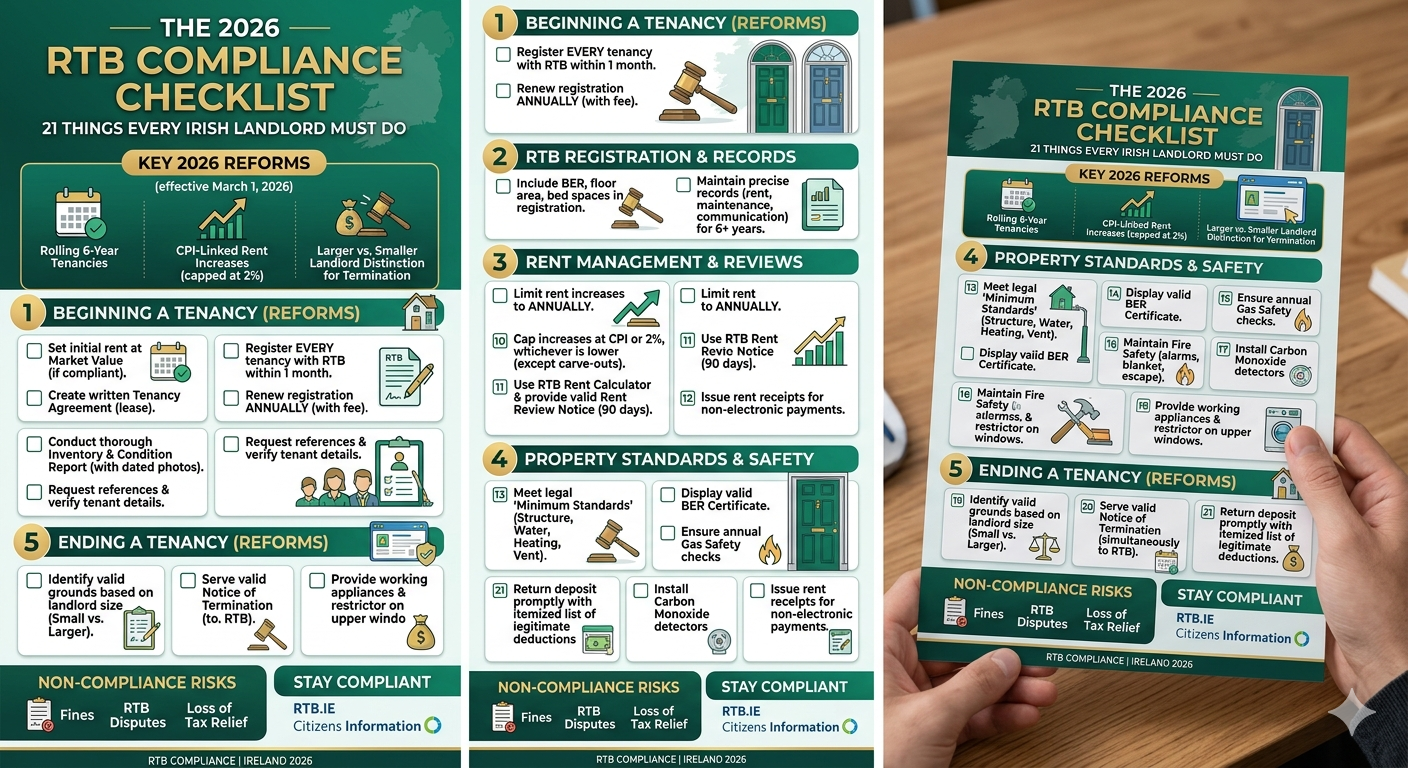
The honest framing of "no manual intervention" is this: the software removes the re-typing, chasing and forgetting, so your team's attention goes where judgement is actually required — deciding who to approve, and on what terms. For the compliance back half, our 2026 RTB compliance checklist and the guide to setting rent under the new rules are useful companions.
Stop re-typing the same tenant seven times
Tell us how your enquiries arrive today and we'll map a flow that captures them once and carries them to a registered tenancy — with the RTB and rent handled.
Frequently asked questions
How do I manage Daft.ie and MyHome.ie enquiries automatically?
Route the enquiry emails the portals send you into a tool that reads them automatically. TenantSync ingests the enquiry emails forwarded from Daft.ie and MyHome.ie, parses the applicant's name, email, phone, the property reference and their message, and creates a lead in a single centralised inbox — then sends an automatic acknowledgement back within seconds. That removes the copy-paste from a shared mailbox into a spreadsheet and means no enquiry is missed during a busy letting.
What is the best tenant onboarding software for Irish letting agents in 2026?
It depends on which part of the funnel hurts most. If you want the whole Irish journey — Daft/MyHome enquiry capture, instant replies, applications, document collection, tenancy setup, RTB Form 1 registration and Open Banking rent reconciliation — in one Irish-built system, TenantSync is designed around exactly that. If you need a full sales-and-lettings CRM with Offr/DocuSign e-signing, Property CRM Ireland is a strong Irish option. If automated credit-and-affordability referencing is your priority and you operate to UK rules, Goodlord is the gold standard, though it is built for the UK and does not handle RTB registration or the Irish rent cap.
How fast should a letting agent reply to a rental enquiry?
As close to instantly as possible. In a tight rental market a popular listing can attract dozens of enquiries in a day, and the agents who reply first get the viewings booked before the applicant has moved on. An automatic acknowledgement that confirms receipt and sets expectations within seconds — even before a human looks at the lead — protects your conversion rate and your client's void period.
Does TenantSync integrate with Daft.ie and MyHome.ie?
TenantSync captures enquiries from Daft.ie and MyHome.ie by ingesting the enquiry notification emails those portals send to your agency mailbox. Dedicated parsers read the Daft and MyHome email formats and turn each one into a structured lead — applicant name, email, phone, property reference and message — with an automatic reply. It is an email-based ingestion rather than a direct portal API, so you simply forward or connect the mailbox the portals already email.
Can I screen and reference tenants in Ireland, and is it legal?
Yes. Irish letting agents routinely verify a prospective tenant's identity, employment, income (typically evidence of earning around 2.5–3 times the rent) and previous-landlord references, with the tenant's consent and in line with GDPR and the Equal Status Acts. TenantSync collects and organises that evidence — applicant details, employment information and uploaded documents such as ID, payslips and references — against each lead so your file is complete and audit-ready; the agent still makes the approval decision. Deep automated credit-and-affordability referencing is offered by specialist services such as Goodlord (UK) and standalone referencing providers.
Why do generic UK lettings platforms fall short for the Irish onboarding journey?
UK platforms are excellent at referencing and digital contracts, but the Irish journey has steps they do not perform: registering the tenancy with the Residential Tenancies Board (the RTB Form 1) within 30 days and again every year, applying the national rent cap of 2% or CPI inflation (whichever is lower) in force since March 2026, tracking Part 4 rights, and reconciling rent against Irish banks. An Irish-built platform carries those steps natively, so the back half of onboarding is automated rather than manual.
How much does tenant onboarding software cost for an Irish agency?
Compare the total monthly cost at your portfolio size rather than the headline figure. TenantSync uses all-in flat tiers: €20 Starter (up to 10 properties), €99 Standard (up to 100), €149 Growth (up to 200) and €199 Premium (up to 300), with custom Enterprise pricing and a 14-day free trial, no credit card required. Goodlord lists pricing from around £87.50 per month for UK agencies, and Property CRM Ireland and the UK agency CRMs are quote-based. Always confirm current pricing on each provider's own site.
Sources & further reading
Facts in this article are drawn from official and primary sources, each provider's public materials, and TenantSync's own product. Pricing and product details were correct as published in June 2026 — verify on each provider's own site before deciding.
- Residential Tenancies Board — registering a tenancy and rental law changes from 1 March 2026
- Citizens Information — changes to the rules for renting from March 2026
- Property Services Regulatory Authority — licensing of letting agents (psr.ie)
- Daft.ie — daft.ie and agent products
- MyHome.ie — myhome.ie
- Property CRM Ireland — propertycrm.ie (features and integrations)
- Goodlord — goodlord.co (referencing and digital onboarding)
Related Articles