March 2026 Reforms: What Every Letting Agent Must Tell Their Landlord Clients
The March 2026 rental reforms are the biggest shake-up of Irish tenancy law in a generation — a national rent cap, Tenancies of Unlimited Duration, and a hard line between small and large landlords. Your clients have heard the headlines and half-understood them. This is the plain-English brief you can forward straight to a landlord — and the reason they'll keep the management contract with the agency that got it right.
The short version
- Four things changed on 1 March 2026: a national rent cap, Tenancies of Unlimited Duration, a small-vs-large landlord split, and tighter rules on when rent can reset to market value.
- There is now a dual system. Tenancies created before 1 March keep their old framework (but still follow the rent cap on reviews); tenancies created on or after 1 March run under the new rules. The start date of every tenancy now decides which rulebook applies.
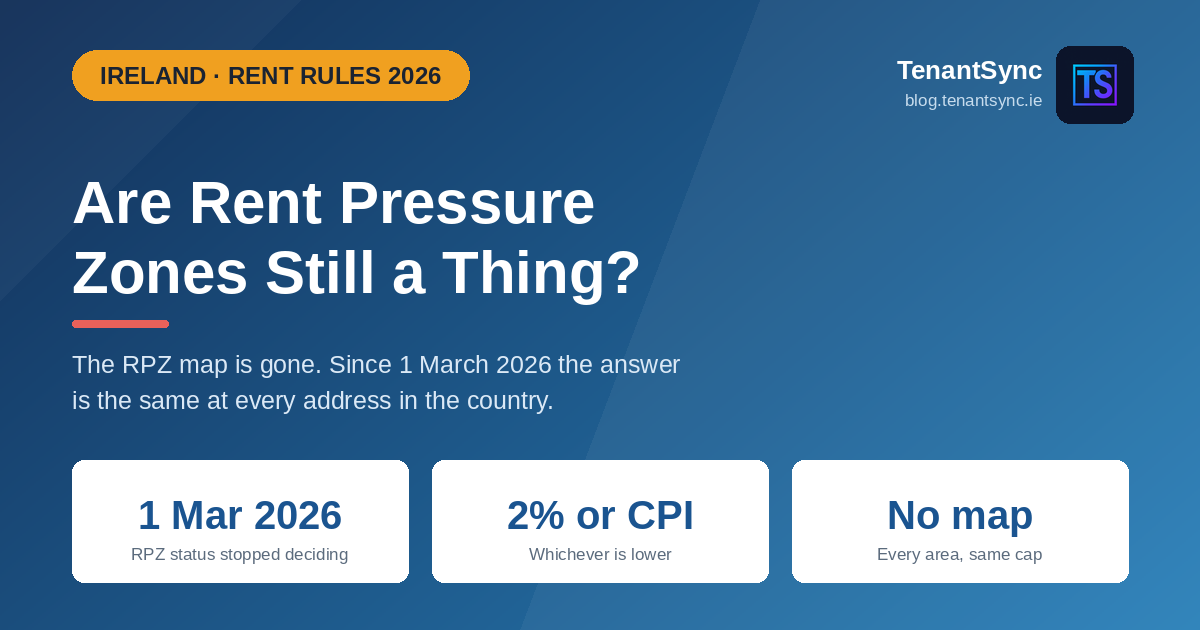
- The rent cap is national. A review is limited to the lower of 2% or CPI — RPZ maps are gone, so no property is "exempt because of where it is."
- Landlord size sets the rights. A small landlord (3 or fewer tenancies) keeps meaningful flexibility; a large landlord (4 or more) is far more constrained on ending a tenancy.
- Your job is to make it simple for the client. The agency that turns this complexity into a clear, per-client brief is the one that renews the contract.
This guide is written so you can lift sections straight into a client email or a landlord information pack. It pairs with our fuller March 2026 rentals playbook and our national rent cap field guide — link clients to those when they want the detail.
Why the reforms are an agent's opportunity, not just a compliance headache
Every landlord in the country got the same news at once, and almost none of them read the legislation. What they have is a vague, anxious sense that "the rules changed" and that getting it wrong is now expensive. That gap — between the headline and the practical answer — is exactly where a good letting agent earns their fee.
The reforms arrive as Ireland's small-landlord base continues to shrink and consolidate; the landlords who stay are more valuable, and more nervous, than ever (we covered the pattern in the landlord exodus). An agent who can calmly explain what each client must do — and prove it's handled — becomes indispensable. An agent who fumbles the first rent review under the new cap, or advises a large landlord they can sell with vacant possession when they can't, loses the client and possibly faces a claim.
The positioning move
Don't send clients a link to the legislation. Send them your brief — branded, plain-English, specific to whether they're a small or large landlord — with a line that says "we've already checked this across your portfolio." That single email does more for retention than any discount. This article gives you the raw material for it.
The four reforms, in one place
Strip away the noise and the March 2026 package comes down to four moving parts. Everything you'll advise a client on sits inside one of them.
| Reform | What it means | Who it hits hardest |
|---|---|---|
| National rent cap | Every rent review is capped at the lower of 2% or CPI, nationwide. RPZ designations are gone. | Any landlord outside the old RPZs who assumed they had freedom to increase. |
| Tenancies of Unlimited Duration | New tenancies run on a rolling six-year cycle and continue indefinitely unless ended on a permitted ground. | Landlords who valued flexible turnover and short holds. |
| Small vs large landlord split | Landlords with 3 or fewer tenancies keep more rights; those with 4 or more are far more restricted. | Portfolio landlords at or above four tenancies. |
| Restricted rent resets | Rent can only reset to market value in defined circumstances — and never after a no-fault eviction. | Landlords expecting a market reset on every change of tenant. |
The rest of this guide takes each one and turns it into something you can say to a client. First, though, the single fact that governs all four.
The dividing line every client must understand: existing vs new tenancies
If a landlord takes only one thing from you, make it this: 1 March 2026 is a hard line in the law. The rules that apply to a tenancy depend on when that tenancy was created.
- Tenancies created before 1 March 2026 continue under their existing framework — including existing Part 4 security of tenure. They do not automatically convert into Tenancies of Unlimited Duration. But they do follow the national rent cap on any rent review.
- Tenancies created on or after 1 March 2026 run under the new regime: a Tenancy of Unlimited Duration on a rolling six-year cycle, with termination rights that depend on whether the landlord is small or large.
That creates a dual system that will run for years. A single landlord — or a single agency book — can hold both kinds of tenancy side by side, each governed by different rules. The practical consequence is unavoidable: you must know, and record, the exact commencement date of every tenancy, because that date decides everything downstream.
The mistake that ends relationships
Advising a client based on the wrong framework — telling them a pre-March tenancy has new six-year protections it doesn't, or treating a post-March tenancy like an old Part 4 — is the kind of error that gets a rent unwound at the RTB and a management contract cancelled. When tenancy dates live in a spreadsheet, this is a matter of time. When they're tracked automatically, it's a non-issue. More on that in the Part 4 & six-year tenancies quick-reference.
Reform 1 — The national rent cap (2% or CPI, whichever is lower)
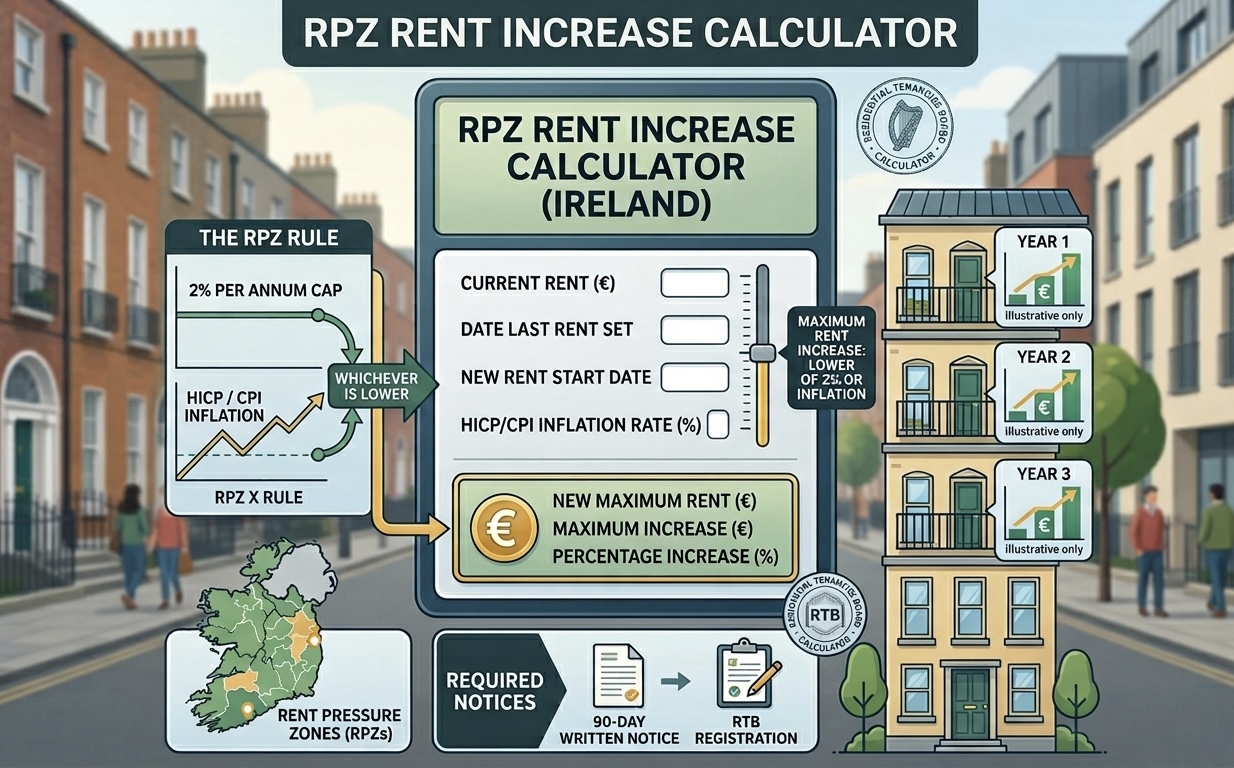
Since 1 March 2026 the Rent Pressure Zone system has been replaced by a single national rent control that applies to every private tenancy and Student-Specific Accommodation in the State, regardless of location. On a rent review, the increase is capped at the lower of 2% or the rate of inflation, measured by the Consumer Price Index (CPI). CPI replaces the HICP used under the old RPZ rules.
What to tell the client, in one sentence: "There's no map to check anymore — every one of your rent reviews is capped at the lower of 2% or inflation, and 2% is a ceiling, not an entitlement, so when inflation is below 2% the lower figure governs."
The everyday case
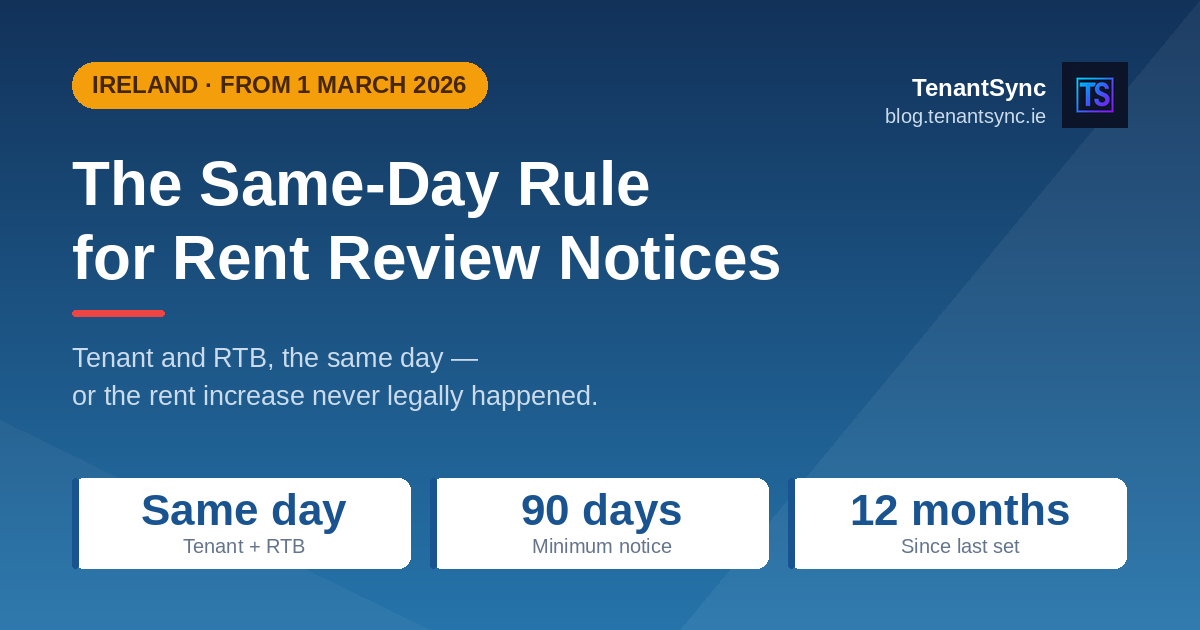
A sitting tenant's rent can be reviewed at most once every 12 months, with a written rent review notice served at least 90 days before the new rent takes effect. Get either timing rule wrong and the increase simply doesn't take effect — a common, avoidable error that delays a client's income by a full quarter.
There are narrow carve-outs: new apartments and Student-Specific Accommodation that commenced development on or after 10 June 2025 (with the required certification) have increases linked to CPI only, without the 2% ceiling — but that is inflation-only, not uncapped. For the full mechanics, the worked examples and the market-reset rules, point clients to our national rent cap field guide and the deeper walk-through in setting rent in Ireland under the new rules.
Reform 2 — Tenancies of Unlimited Duration and the six-year cycle
For tenancies created from 1 March 2026, the old fixed-and-Part-4 structure gives way to a Tenancy of Unlimited Duration that runs on a rolling six-year cycle. In plain terms:
- A new tenancy continues indefinitely, in repeating six-year periods, unless it's ended on a permitted ground.
- The tenant can end the tenancy at any time by giving proper notice.
- The landlord's ability to end it — and when — depends entirely on whether they're a small or large landlord (next section).
What to tell the client: "Any tenancy you start now is, in effect, a long-term commitment. You're not signing up to a one-year let with an easy exit — you're entering a six-year cycle, so tenant selection and clear documentation matter more than they ever did."
Some detail is still being clarified
Parts of the framework — the precise definition of "hardship" grounds, and how "market value" is evidenced on a reset — are still being finalised in guidance. Tell clients the shape of the rules with confidence, but flag that specifics can move, and point them to the RTB for the current position rather than committing the agency to a hard interpretation on an edge case.
Reform 3 — The distinction that changes everything: small vs large landlords
This is the reform most of your clients haven't grasped, and it's the one that most changes what you can advise. The legislation splits landlords by the number of tenancies they hold — not the number of properties:
| Classification | Definition | What they keep |
|---|---|---|
| Small landlord | 3 or fewer tenancies | More flexibility: at the end of a six-year cycle they may end a tenancy for sale, substantial refurbishment, family occupation or change of use, plus certain hardship and family-need grounds during the term (definitions being clarified). |
| Large landlord | 4 or more tenancies | Far more restricted: generally limited to ending a tenancy for tenant breach or where the property no longer suits the tenant's needs — no sale/refurbishment grounds, even at the six-year mark. |
Because the count is per tenancy, a landlord with one building of four separately let apartments is likely a large landlord with four tenancies — a fact that surprises many clients who think of themselves as "small." A client sitting at three or four tenancies is exactly the person who needs advice before they let another unit, because that next tenancy can flip their entire classification.
The advice line for the borderline client
If a client is at or near the threshold (two to four tenancies), tell them the classification "locks in" rights for years and is worth clarifying with legal advice before they expand — corporate ownership and multi-unit edge cases are still being clarified. Being the agent who raised this before they got caught out is worth more than any feature you could sell them.
One protection applies to all landlords and is worth stating plainly to reassure nervous clients: any landlord can sell a property with the tenant in situ at any time. Restricted termination rights don't trap their capital — they can still exit by selling with the tenancy in place.
Reform 4 — When rent can reset to market value (and the no-fault trap)
Under the reforms a rent stays constrained by the cap between tenancies unless a reset to market value is specifically permitted. According to the RTB, a reset is allowed where the previous tenancy ended because:
- the tenant left voluntarily;
- the tenant breached their obligations;
- the property no longer suited the tenant's needs; or
- a six-year Tenancy of Minimum Duration reached its end.
And the line every agent must hold with clients: you cannot reset to market value after a no-fault eviction. This is the government's guard against "economic evictions." If a landlord ends a tenancy without valid grounds, they forfeit the market reset — the constrained rent carries into the next tenancy.
Evidence, not estimates
Where a reset is allowed, the new rent must not exceed market rent and must be backed by three comparable properties from the RTB Rent Register — matched on local electoral area, bedrooms, floor area and BER. A new tenant can refer the opening rent to the RTB, so a loosely chosen comparable is a weak defence. Tell clients: "We don't guess the new rent — we document it, so it holds up if it's ever challenged."
What to tell clients with existing (pre-March) tenancies
Most of your book on day one is pre-March tenancies. Clients are often relieved to hear these aren't being rewritten — but there's still a short, specific brief for them:
- Your framework hasn't changed — except on rent. Existing Part 4 protections continue. But any rent review now follows the national cap: the lower of 2% or CPI, once every 12 months, with 90 days' notice.
- Don't assume a change of tenant unlocks market rent. Whether you can reset depends on how the last tenancy ended, and never applies after a no-fault eviction.
- The commencement date matters now more than ever. It's what proves this tenancy sits under the old framework — keep it documented and to hand.
- If you re-let after 1 March, the new tenancy is a new regime. Ending a pre-March tenancy and starting a fresh one means the replacement is a Tenancy of Unlimited Duration under the new rules.
What to tell clients with new (post-March) tenancies
Every tenancy your client starts now lands squarely under the new regime. The brief here is about setting expectations before they sign:
- This is a six-year commitment. The tenancy runs on a rolling six-year cycle and continues unless you have a permitted ground to end it.
- Your exit options depend on your size. Small landlord: additional grounds at the six-year mark and certain hardship/family grounds. Large landlord: breach or unsuitability only.
- Set — and record — the opening rent carefully. It anchors every future review, and if you ever claim a below-market position later, today's documented figure is your evidence.
- You can still sell at any time with the tenant in situ, whatever your size.
- Tenant selection is now a long-term decision. With turnover harder, screening and affordability checks matter more — see our note on fair income verification.
Give every client the same confident answer
Book a 15-minute agency demo and we'll show how TenantSync tags each tenancy as pre- or post-March, tracks the six-year cycle and applies the rent cap — so your advice is consistent across the whole book.
The agent's client action checklist
Here's a checklist you can run for each landlord client — and, lightly edited, forward to them. Working through it once per client turns "the rules changed" into a set of concrete, closed actions.
- Classify the client. Count their tenancies (not properties). Confirm small (≤3) or large (4+), and flag anyone at the threshold for legal clarification before they let another unit.
- Audit every tenancy's start date. Split the portfolio into pre-March (old framework) and post-March (new regime) so you always advise on the right rulebook.
- Check rent-review status per tenancy. Confirm the last-review date, whether 12 months have passed, and calculate the lawful increase at the lower of 2% or CPI — never a reflex 2%.
- Record how each tenancy ended (or will end) so it's clear whether a market reset is permitted, and never assume a reset after a no-fault eviction.
- Confirm RTB registration and renewals are current across the whole book — the reforms don't relax registration, and gaps undermine everything else. See the bulk RTB compliance workflow.
- Update tenancy documentation for new lettings to reflect the six-year Tenancy of Unlimited Duration and the client's reset rights.
- Send each client their brief. A short, branded, small-or-large-specific summary with the line "we've checked this across your portfolio."
- Set the review rhythm. Diary the next rent-review window and six-year milestone per tenancy so nothing is served early or missed.
The checklist in one line
Classify → audit start dates → check rent reviews → record endings → confirm RTB status → update documents → brief the client → diary the dates. Run it the same way for every landlord and the reforms become routine, not risk.
Managing this across a whole book of clients
For a single landlord, the checklist above is an afternoon. For an agency, it's the same eight steps across dozens of landlord clients and hundreds of tenancies — each with its own start date, classification, review window and ending history. The rule doesn't get harder per tenancy; the bookkeeping does, and that's precisely where the professional risk sits when it's run on spreadsheets.
Three capabilities turn the reforms from an ongoing liability into a quiet, handled process across the portfolio:
Every tenancy dated and classified
Start date, ending reason and the small-vs-large picture recorded once — so pre- vs post-March framework and reset eligibility are clear at a glance, per client.
A rent cap you can't get wrong
The lower-of-2%-or-CPI applied automatically with the figure shown, so no one is doing percentage maths by hand on the two-hundredth tenancy of the year.
Deadlines that surface themselves
Rent-review windows, six-year milestones and RTB renewals raised ahead of time across the whole book — nothing served early, nothing missed.
Run this way, advising clients on the reforms stops being a per-tenancy research project and becomes a confident, consistent answer — the exact capability that renews management contracts. It's the same moat we describe in winning and keeping landlord clients, and it feeds directly into the per-client landlord report that proves it every month.
Keep your whole portfolio aligned with the new rules
See how TenantSync tracks tenancy dates, landlord classification, the rent cap and RTB status across every client — in a 15-minute demo on data shaped like your own book.
For landlords: the one-page takeaway
If you manage your own property rather than through an agent, the same reforms apply to you directly — and so does the liability. The essentials:
- Know your size. Count your tenancies. 3 or fewer keeps you a small landlord with more flexibility; 4 or more makes you a large landlord with tighter termination rights.
- Every rent review is capped at the lower of 2% or CPI, once every 12 months, with 90 days' written notice — wherever your property is.
- New tenancies are long-term. A letting you start now is a Tenancy of Unlimited Duration on a rolling six-year cycle.
- Rent only resets to market value in defined cases — and never after a no-fault eviction. Document how each tenancy ends.
- Keep your records straight. Start dates and ending reasons now decide your rights; a free rent-cap calculator gives you a compliant increase in seconds.
If you'd rather have the dates, reviews and notices handled for you, TenantSync's Starter plan is built for small landlords. For the full plain-English breakdown, read the March 2026 rentals playbook.
Find your maximum legal rent in seconds
Use the free rent-cap calculator to get the exact figure the national cap allows for your tenancy — no account needed — or start a free trial to have the dates and notices handled for you.
How TenantSync helps agents stay ahead of the reforms
TenantSync is an Irish-built platform that keeps every client tenancy aligned with the March 2026 rules automatically — for a single landlord or across an agency's whole book. Each capability below maps to a step in the action checklist.
Tenancy dates & framework
Records each tenancy's start date and ending reason, so pre- vs post-March framework and market-reset eligibility are clear at a glance — no spreadsheet lookups.
National rent-cap calculator
Applies the lower-of-2%-or-CPI rule, returns the maximum allowable rent per tenancy and shows the figure it used — so every increase is defensible.
Six-year cycle tracking
Tracks the rolling six-year milestones and 12-month review windows per tenancy, with reminders before each date so nothing is served early or missed.
Bulk RTB compliance
Keeps RTB registration, renewals and compliance items current across every landlord client, with a portfolio-wide dashboard so nothing slips.
Per-client landlord reports
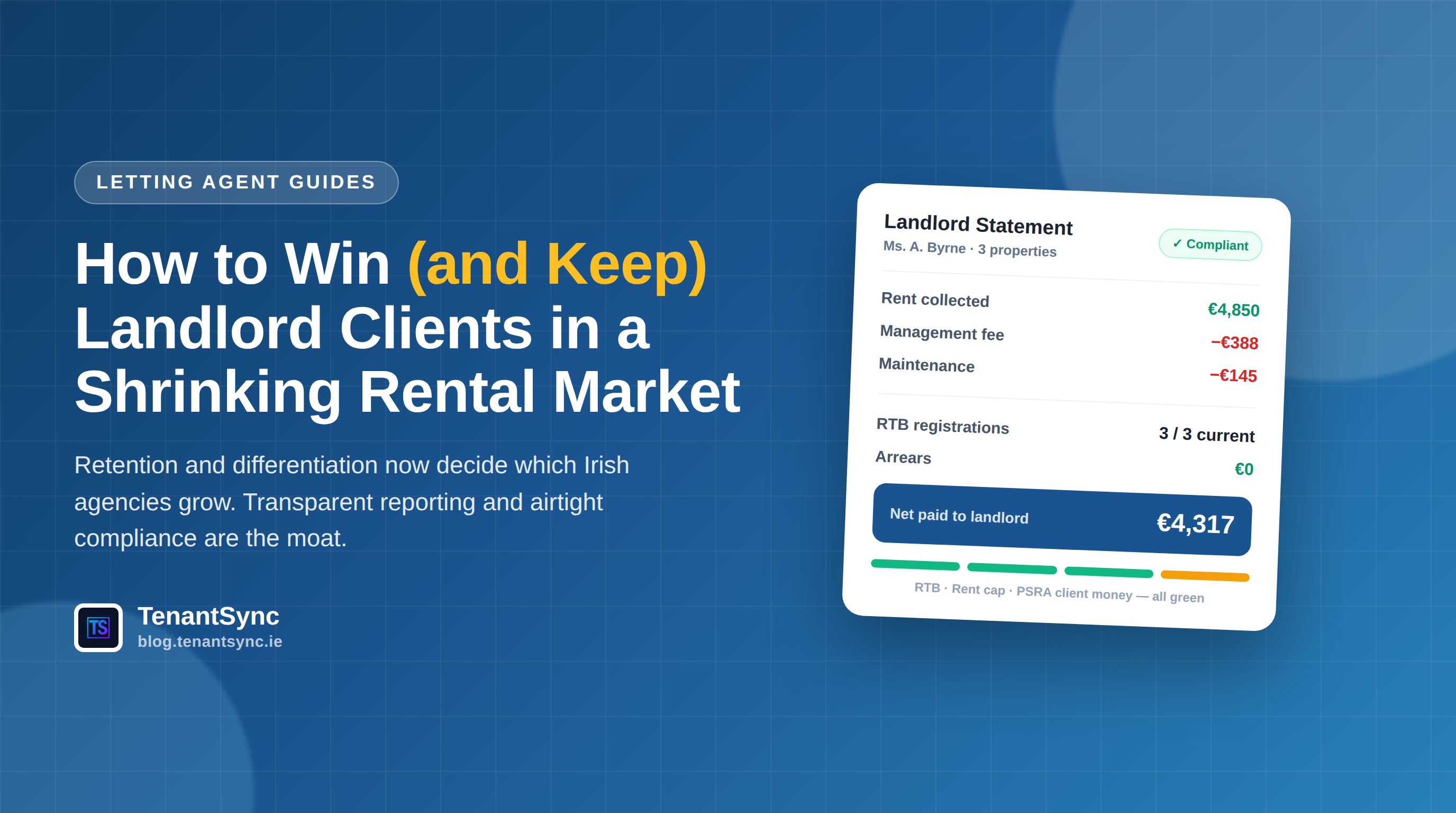
One-click per-landlord statements — rent collected, arrears, fees, net paid and a green compliance status — that make the agency look indispensable at review time.
Timestamped audit trail
Every calculation, notice and compliance action logged with a timestamp — a complete defence file for RTB scrutiny or a landlord query.
It runs on web plus iOS and Android, includes landlord and tenant portals, connects Irish bank accounts for Open Banking rent reconciliation (AIB, BOI, PTSB, EBS, Revolut, N26), and imports directly from Letman, a CSV or a spreadsheet so an agency can get its whole book in quickly. Pricing is flat per-portfolio tiers (Standard €99 up to 100 properties, Growth €149 up to 200, Premium €199 up to 300, plus a €20 Starter for up to 10), each with a 14-day free trial — see our guide to lettings software pricing in Ireland.
Want to brief a client today? Forward them the free rent-cap calculator — no account needed.
Frequently asked questions
What are the March 2026 rental reforms in Ireland?
From 1 March 2026 a package of reforms changed how Irish tenancies are regulated. The main elements are a national rent cap (a rent review is limited to the lower of 2% or the rate of inflation measured by CPI, replacing the old Rent Pressure Zone system), Tenancies of Unlimited Duration under which new tenancies run on a rolling six-year cycle, and a new distinction between small landlords (3 or fewer tenancies) and large landlords (4 or more) that shapes termination rights. Tenancies created before 1 March 2026 keep their existing framework but still follow the rent cap on reviews. Always confirm the current rules on rtb.ie before advising a client.
Do the March 2026 rules apply to existing tenancies?
Not in full. A tenancy created before 1 March 2026 continues under its existing framework and does not automatically become a Tenancy of Unlimited Duration. It does, however, follow the national rent cap on any rent review. The new six-year cycle and the reformed termination grounds generally apply to tenancies created on or after 1 March 2026, which is why the exact start date of every tenancy now matters and should be recorded. Verify the position for a specific tenancy with the RTB.
What is a Tenancy of Unlimited Duration?
Under the reforms, tenancies created from 1 March 2026 run as Tenancies of Unlimited Duration on a rolling six-year cycle. The tenancy continues indefinitely, in repeating six-year periods, unless it is ended on a permitted ground. A tenant can end the tenancy at any time with proper notice. For a landlord, the grounds available to end the tenancy — and when they can be used — depend on whether they are a small or large landlord. Confirm the detail on rtb.ie, as guidance is still being clarified.
What is the difference between a small and large landlord under the 2026 reforms?
The reforms distinguish landlords by the number of tenancies they hold. A small landlord holds 3 or fewer tenancies; a large landlord holds 4 or more. The classification is generally counted per tenancy rather than per property. Small landlords keep more flexibility, including additional grounds to end a tenancy at the end of a six-year cycle, such as sale, substantial refurbishment, family occupation or change of use, and certain hardship grounds. Large landlords are more restricted, typically limited to ending a tenancy for tenant breach or where the property no longer suits the tenant's needs. Edge cases near the threshold should be checked with legal advice.
Can a landlord still reset rent to market value after March 2026?
Only in defined circumstances. According to the RTB, a rent can be reset to market value where the previous tenancy ended because the tenant left voluntarily, the tenant breached their obligations, or the property no longer suited the tenant's needs, or at the end of a six-year Tenancy of Minimum Duration. A reset is not permitted after a no-fault eviction. Where a reset is allowed, the new rent must not exceed market rent and must be evidenced with three comparable properties from the RTB Rent Register.
What should a letting agent tell landlord clients about the March 2026 reforms?
Explain four things clearly: first, every rent review is now capped at the lower of 2% or CPI nationally, so location no longer decides the cap; second, tenancies created from 1 March 2026 are Tenancies of Unlimited Duration on a rolling six-year cycle; third, whether the client is a small (3 or fewer) or large (4 or more) landlord decides what termination rights they keep; and fourth, the start date and ending reason of every tenancy must be documented because they determine which rules and rent-reset rights apply. Position the agency as the adviser that keeps each client compliant, and confirm specifics on rtb.ie.
How does TenantSync help letting agents manage the March 2026 reforms across a portfolio?
TenantSync records each tenancy's start date and ending reason so it is clear which framework applies and whether a market reset is permitted, applies the lower-of-2%-or-CPI rent cap and returns a defensible figure per tenancy, tracks the six-year cycle and review dates with reminders, keeps RTB registration and compliance items current across every landlord client, and produces per-client landlord reports with a compliance status. For an agency it does this across the whole book, per landlord, with a timestamped audit trail.
Sources & further reading
Facts in this article are drawn from official and primary sources. Rental reform rules, CPI rates, notice requirements and the finer points of the small/large distinction can change — verify the current position on rtb.ie and gov.ie before advising a client or acting on any tenancy.
- Residential Tenancies Board — Rental law changes from 1 March 2026
- Government of Ireland — Reforms to the rental sector, starting 1 March 2026
- Residential Tenancies Board — Rent controls and rent reviews
- Residential Tenancies Board — Ending a tenancy and security of tenure
- Central Statistics Office — Consumer Price Index (CPI)
- Citizens Information — Renting a home: your rights and obligations
Related Articles