Part 4, Six-Year Tenancies & Notice Periods: The Agent's Quick-Reference
Since 1 March 2026 you've been running two rulebooks at once: the tenancies that existed before then, and the new six-year Tenancies of Minimum Duration that started after. Get a notice period wrong, or serve on a ground a landlord no longer has, and the notice is void — the tenancy carries on and your client loses months. This is the clean, current reference you can keep open on every tenancy: Part 4 security of tenure, the six-year cycle, the small vs large landlord split, the valid grounds, and the notice-period tables — plus how to track the dates across a whole book of business.
The short version
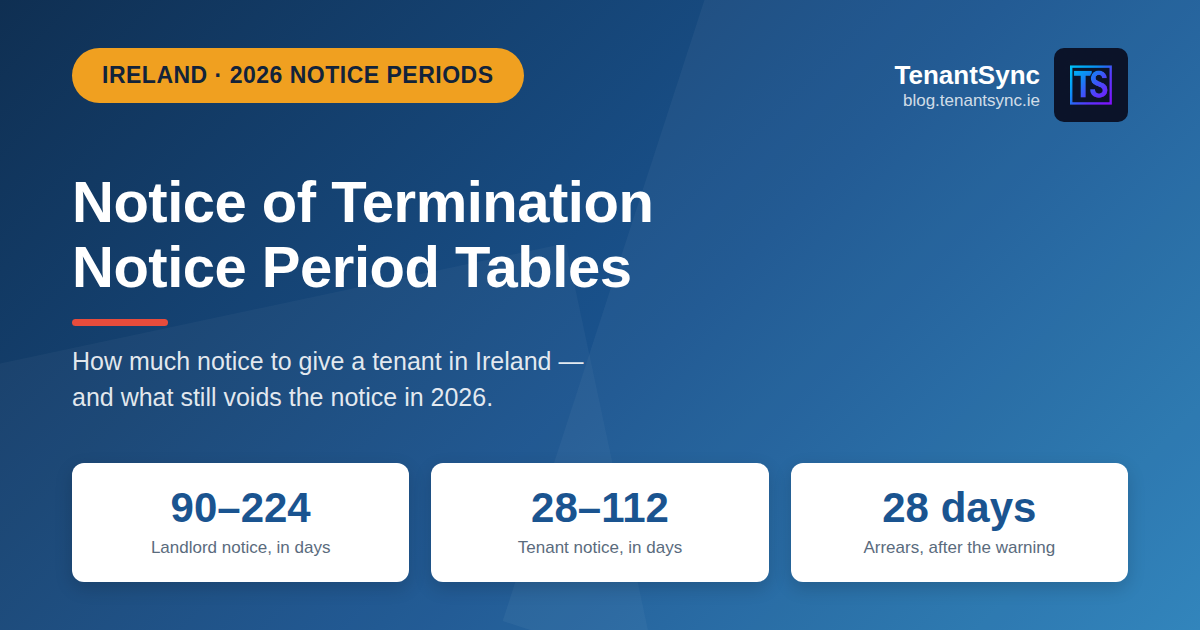
How do Part 4, the six-year tenancy and notice periods fit together after March 2026? A tenant acquires Part 4 security of tenure after six months' continuous occupation, so from that point a landlord can only end the tenancy on a limited legal ground. For any tenancy created on or after 1 March 2026, that protection sits inside a six-year Tenancy of Minimum Duration that rolls into another six years at the end. Large landlords (four or more tenancies, or a company) can no longer use no-fault grounds such as sale; small landlords (three or fewer) keep a few more options. Whatever the ground, the notice period is set by how long the tenancy has run — 90 to 224 days for a landlord — and every formal requirement must be met or the notice is void. Tenancies that started before 1 March 2026 keep their existing rules, so agencies manage both regimes side by side.
First, the Big Picture: You're Running Two Regimes at Once
The single most important thing to hold in your head in 2026 isn't a notice period — it's a date. The rules that apply to a tenancy depend on when it started.
- Tenancies created before 1 March 2026 keep the rules that applied when they began — including Part 4 security of tenure and, for most lettings since June 2022, tenancy-of-unlimited-duration protection.
- Tenancies created on or after 1 March 2026 are Tenancies of Minimum Duration — the new six-year framework, with the small/large landlord distinction and tighter termination grounds.
Citizens Information and the RTB are both explicit that the new rules apply to new tenancies — they do not rewrite the rules for tenancies that already existed on 1 March 2026.
For an agency, that means your book of business is a mix. A landlord client with a tenant who moved in in 2023 and another who moved in last month is sitting under two different rulebooks — and the notice you can serve, and the grounds available, differ between them. Getting this first branch right is the whole game; everything below hangs off it.
⚠️ The costly mistake
Applying a new-regime assumption to an old tenancy — or vice versa — is how a notice gets ruled void at the RTB. When that happens the tenancy simply continues, and your landlord client has lost the months they were counting on. The fix is boring and effective: record every tenancy's exact start date and treat it as the anchor for which rules apply.
Part 4: How Security of Tenure Is Acquired
"Part 4" refers to Part 4 of the Residential Tenancies Act 2004, which gives tenants security of tenure. The mechanics that matter on a day-to-day basis:
- The six-month trigger. Once a tenant has been in continuous occupation for six months, and no valid notice of termination was served during those first six months, Part 4 rights kick in automatically. The tenant doesn't apply for them.
- Before six months. In the first six months a landlord can end the tenancy without giving a reason — but the correct notice period and every formal requirement still apply (and, for new-regime tenancies, the RTB must be copied — see below).
- After six months. The landlord can only terminate on one of the limited legal grounds. A notice that doesn't state a valid ground is void.
Under the older framework you'll also hear "Further Part 4" — the point where a Part 4 cycle rolled over and a fresh cycle began. TenantSync still tracks Part 4 and Further Part 4 milestones for tenancies that pre-date the reforms, because those tenancies keep running under the rules they were created under.
Why the six-month date is worth tracking precisely
The six-month point is a hard hinge: before it, a landlord has flexibility; after it, they need a ground. If you're advising a client who's unsure about a new tenant, the decision window closes on a specific calendar date. Miss it by a day and the flexibility is gone — the tenant now has security of tenure.
The Six-Year Tenancy of Minimum Duration
According to the RTB's guidance on the rental law changes from 1 March 2026, every new tenancy created from that date is a Tenancy of Minimum Duration (TMD) lasting a minimum of six years. It is a rolling term: when a six-year TMD ends, the tenancy renews into another six-year TMD rather than simply expiring. During the six years the tenant has security of tenure and the landlord can only terminate on the limited grounds that apply to their landlord type.
How the cycle looks in practice
| Stage | What it means | What the landlord can do |
|---|---|---|
| Months 0–6 | Initial period, before Part 4 security of tenure. | End for any reason, with the correct notice period, copying the RTB within 7 days of the date of service. |
| Month 6 → Year 6 | Security of tenure inside the first six-year TMD. | Terminate only on a valid ground available to their landlord type. |
| End of Year 6 | The TMD rolls into a new six-year term. | A limited reset window may apply (for example, a permitted sale for a small landlord); a market-rent reset is allowed at the end of a TMD. |
| Next six years | A fresh TMD, same protections. | Back to grounds-only termination for the duration. |
The rent angle matters here too: a landlord generally cannot reset the rent to market after a no-fault termination, but a reset is permitted at the end of each six-year TMD. We cover the maths and the traps in the national rent cap field guide.
💡 Say it plainly to clients
"For anything you let from March 2026 on, think in six-year blocks. You're committing to the tenant for six years at a time, you can only end it early on specific grounds, and the grounds you have depend on whether you're a small or large landlord." That one sentence prevents most of the confusion.
Small Landlord vs Large Landlord
The reforms split landlords into two categories, and the category decides which grounds a landlord can use during a TMD. This applies to tenancies created from 1 March 2026.
| Small landlord | Large landlord | |
|---|---|---|
| Definition | Three or fewer tenancies. | Four or more tenancies, or a company. |
| No-fault termination | More flexibility (see grounds below). | Cannot end a tenancy where the tenant has done nothing wrong. |
| Selling with vacant possession | Permitted in limited circumstances — notably at the end of a TMD, and during it only on a hardship basis. | Cannot rely on the sale ground. |
| Own / family use | Can end for use by the landlord or an immediate family member as their principal residence. | Restricted to very limited circumstances — confirm the current position with the RTB. |
| Fault-based grounds | Available to both — breach of obligations, dwelling no longer suited to the household's needs, and non-payment of rent. | |
⚠️ Count the tenancies, not the properties
The small/large line is drawn on number of tenancies, and any company landlord is treated as large. For an agency this is a live judgement call on each client — a landlord who crosses from three to four tenancies changes category, and with it the grounds they can rely on. Some of the finer boundaries are still being settled, so verify a client's status against current RTB guidance before you advise on a termination.
📅 Never guess which rules a tenancy is under
TenantSync anchors every tenancy to its start date, tracks Part 4 and six-year milestones, and flags the notice period per tenancy — across every landlord client and branch. See it on a walkthrough shaped like your own portfolio.
Valid Grounds to End a Tenancy
After the first six months, a landlord needs a lawful ground. The Residential Tenancies Acts set out the grounds; the 1 March 2026 reforms then restrict which of them a landlord can use depending on their category. Here's the working list.
Fault-based grounds (available to all landlords)
| Ground | What it covers | Notice note |
|---|---|---|
| Non-payment of rent | Rent arrears, after a written rent-arrears warning notice (copied to the RTB) and the arrears remain unpaid. | 28 days, regardless of tenancy length. |
| Breach of obligations | The tenant has breached tenancy obligations (other than rent) and failed to remedy it after a warning. | 28 days after the warning process. |
| Serious anti-social behaviour | Serious anti-social behaviour or threat to others / the property. | Short notice applies in the most serious cases — check current RTB rules. |
| Dwelling no longer suits the household | The property is no longer suited to the accommodation needs of the tenant household (e.g. overcrowding). | Standard duration-based notice period. |
Landlord (no-fault) grounds — now category-dependent
| Ground | Small landlord | Large landlord |
|---|---|---|
| Sale of the property | Limited — at the end of a TMD, or during it only on a hardship basis. | Not available. |
| Own or family member's use | Available (principal residence for landlord or immediate family). | Very limited — confirm with the RTB. |
| Substantial refurbishment | Available, subject to the statutory conditions and reinstatement rules. | Very limited — confirm with the RTB. |
| Change of use | Available, subject to the statutory conditions. | Very limited — confirm with the RTB. |
The headline for large landlords
The biggest single change is that a large landlord can no longer end a tenancy simply because the tenant has done nothing wrong — the no-fault route, including sale, is closed off (bar very limited exceptions). If you manage portfolios for institutional or multi-property clients, this reshapes what you can advise. When a no-fault ground was used, remember the rent generally can't be reset to market for the next tenancy.
💡 Some detail is still bedding in
A number of the finer points — the precise hardship test for a small-landlord sale, and the exact exceptions for large landlords — are still being clarified as the reforms commence. Treat the tables above as a working reference, not the last word, and check rtb.ie for the current position before you serve.
Notice-Period Quick-Reference Tables
Once you have a valid ground, the notice period is set by how long the tenancy has been in place at the date of service — not by the reason. These statutory minimums (under the Residential Tenancies (Amendment) Act 2021) continue to apply to terminations from 1 March 2026.
Landlord notice periods
| Tenancy duration | Landlord notice (minimum) |
|---|---|
| Less than 6 months | 90 days |
| 6 months to 1 year | 152 days |
| 1 year to 2 years | 180 days |
| 2 years to 3 years | 180 days |
| 3 years to 4 years | 180 days |
| 4 years to 7 years | 180 days |
| 7 years to 8 years | 196 days |
| More than 8 years | 224 days |
Tenant notice periods
| Tenancy duration | Tenant notice (minimum) |
|---|---|
| Less than 6 months | 28 days |
| 6 months to 1 year | 35 days |
| 1 year to 2 years | 42 days |
| 2 years to 3 years | 56 days |
| 3 years to 4 years | 84 days |
| 4 years or more | 112 days |
⚠️ Two things agents get wrong on the clock
1. The clock starts at service, not receipt. The notice period runs from the day the notice is served, and the tenancy ends on the termination date stated in the notice — not on the day the tenant acknowledges it. 2. The 28-day rent exception is narrow. The 28-day period only applies to non-payment of rent after the correct warning process. Don't apply it to any other ground.
These are minimums. You can always give more notice, and a buffer is good practice — it absorbs a small error in the notice without blowing the whole timeline. Our full notice of termination guide works through the periods, the requirements and the scenarios in detail.
🧾 Generate a correctly-dated notice — free
TenantSync's free Notice of Termination generator builds a correctly formatted PDF and calculates the termination date from your date of service, for the grounds you can serve directly. No login required.
Serving a Notice That Isn't Void
A notice of termination is the start of the process, not the end — it can't force a tenant out on its own, and if it's defective the tenancy simply continues. To stand up, a landlord notice must generally:
- Be in writing. Verbal notice has no legal effect.
- Be signed and dated by the landlord or their authorised agent.
- State the termination date, and make clear the tenant has the whole of the 24 hours of that day to vacate.
- Give the correct notice period for the tenancy's duration (the tables above).
- State the ground where the tenancy is past six months — and, for certain grounds, include the required statutory declaration or supporting statement.
- Be served correctly on the tenant, with proof of how and when.
- Copy the RTB where required (see the next section).
Every one of these is cumulative: miss one and the notice can be ruled invalid. Because the requirements are exacting, this is precisely the kind of task worth generating from a template rather than drafting from scratch each time.
Keep the paper trail
If a termination is disputed, the RTB will look at the notice, the ground, the calculation and the proof of service. Retaining all four per tenancy — the notice PDF, the stated ground, the date maths and evidence of service — is what turns "we think we served it right" into a defensible record.
The First Six Months & the RTB Copy Rule
The initial six months is still the window where a landlord has the most flexibility — but the reforms tightened the paperwork. For tenancies created from 1 March 2026, a landlord ending a tenancy in the first six months must copy the notice of termination to the RTB and state the reason they are ending it. Since 14 September 2026 that copy is due within 7 days of the date of service rather than on the same day — and the notice must no longer be sent to the tenant by post.
- Reason required. Even though no Part 4 ground is needed pre-six-months, the notice must state a reason under the new rules.
- RTB copy within 7 days. The RTB's copy is due within 7 days of the date the tenant receives the notice — a step that's easy to miss, and easier still now that it can wait almost a week.
- Not by post. From 14 September 2026 a notice of termination must not be posted to the tenant: they have to receive it on the date of service printed on the notice, and post cannot guarantee that. Email it, or hand it over, or leave it at the dwelling.
- Notice period still applies. The 90-day landlord notice for a tenancy under six months still applies; "any reason" does not mean "immediately".
💡 Build the RTB copy into your workflow
The RTB copy is a small step with an outsized consequence if skipped, and a seven-day window makes it easier to forget than a same-day one did. Send it with the tenant's copy and make it a fixed checklist item on every early termination — or use a system that prompts for it — so it can't fall through when a negotiator is moving fast.
Tracking Part 4 & Notice Dates Across a Portfolio
Everything above is manageable for one tenancy. The problem is scale. An agency managing 150 tenancies across 40 landlord clients is tracking 150 start dates, 150 six-month Part 4 anchors, a growing set of six-year TMD milestones, two regimes running in parallel, and a notice period that changes with each tenancy's age. On a spreadsheet, that's where dates quietly slip.
This is the specific job TenantSync is built for:
Every tenancy anchored to its start date
Each tenancy carries its exact commencement date, so the platform knows which regime it's under and which rules apply — no manual cross-referencing.
Part 4 & six-year milestones tracked automatically
Part 4 and Further Part 4 dates for older tenancies, and the six-year TMD milestones for new ones, are calculated and surfaced with reminders to landlord and tenant — no diary entries to forget.
The right notice period, per tenancy
Because the platform knows each tenancy's age, it works out the correct minimum notice period and termination date rather than leaving it to a manual table lookup under time pressure.
A portfolio-wide compliance dashboard
Part 4 sits alongside RTB registration, renewals, rent reviews, BER, insurance and safety certs on one colour-coded dashboard — so nothing slips across dozens of clients, and you can show a landlord their status in seconds.
Compliance as a retention tool
Airtight date-tracking isn't just risk management — it's how an agency looks indispensable at contract-review time. If you want the wider playbook, see bulk RTB compliance across every client tenancy and the best property management software for Irish letting agents.
The One-Screen Cheat Sheet
Bookmark this. It's the sequence to run on any tenancy before you advise on ending it:
| Ask | Why it matters |
|---|---|
| When did the tenancy start? | Before or from 1 March 2026 decides the whole regime. |
| Is it past six months? | Past six months = Part 4 security of tenure = a ground is required. |
| Small or large landlord? | Three or fewer vs four+ (or a company) decides which grounds are open. |
| Is there a valid ground? | No valid ground stated = void notice. |
| How long has it run? | Sets the notice period: 90–224 days (landlord), or 28 days for rent arrears. |
| Every formal box ticked? | Written, signed, dated, correct termination date, ground stated, served properly, RTB copied where required. |
Frequently Asked Questions
What is a Part 4 tenancy in Ireland?
A Part 4 tenancy refers to the security of tenure under Part 4 of the Residential Tenancies Act 2004. After six months' continuous occupation (with no valid termination served in that period), a tenant automatically acquires the right to stay, and the landlord can then only end the tenancy on one of the limited legal grounds. The tenant doesn't have to apply for Part 4 rights — they arise by operation of law.
What is a Tenancy of Minimum Duration (the six-year tenancy)?
From 1 March 2026, every new tenancy is a Tenancy of Minimum Duration lasting a minimum of six years, and it rolls into a fresh six-year term at the end. During the six years the tenant has security of tenure and the landlord can only terminate on limited grounds. TMDs apply only to tenancies created on or after 1 March 2026 — they don't change the rules for tenancies that already existed.
What are the notice periods for ending a tenancy in Ireland?
Landlord notice periods run from 90 days (tenancy under six months) up to 224 days (over eight years), based on how long the tenancy has been in place. Tenant notice periods run from 28 to 112 days on the same scale. The one exception is termination for non-payment of rent after the correct warning process, which uses a 28-day period regardless of tenancy length. All figures are minimums — more notice can always be given.
What's the difference between a small and a large landlord after March 2026?
For tenancies created from 1 March 2026, a small landlord has three or fewer tenancies and a large landlord has four or more, or is a company. Large landlords can no longer end a tenancy on a no-fault basis — for example, they lose the sale ground — while small landlords keep some additional grounds, such as needing the property for themselves or an immediate family member, and a narrow ability to sell in cases of hardship. Confirm a client's exact position at rtb.ie.
Do the six-year rules apply to my existing tenancies?
No. The Tenancy of Minimum Duration framework applies only to tenancies created on or after 1 March 2026. Tenancies that began before then keep the rules in place when they started, including Part 4 and tenancy-of-unlimited-duration protections. Agencies therefore manage both regimes side by side for years — which is exactly why recording each tenancy's start date is so important.
Can a letting agent serve a notice of termination on behalf of a landlord?
Yes — a landlord's authorised agent can sign and serve a notice, provided every statutory requirement is met and the agent is properly authorised. Letting agents in Ireland must be licensed by the PSRA. Because a single defect can make the notice void, many agencies generate notices from a validated template and keep the ground, calculation and proof of service on file. This article is general information, not legal advice — verify specifics at rtb.ie.
How can I track Part 4 and notice dates across a whole portfolio?
Manually, agents track start dates, six-month Part 4 anchors, six-year TMD milestones and notice periods in spreadsheets — which is where things slip at scale. TenantSync anchors each tenancy to its start date, tracks Part 4 and Further Part 4 milestones automatically, calculates the notice period per tenancy, and surfaces upcoming dates on a portfolio-wide compliance dashboard.
Sources & Official Guidance
This reference is drawn from the official guidance below. For a specific tenancy, always confirm the current position with the RTB or a qualified legal professional before serving any notice.
- Residential Tenancies Board — Rental law changes from 1 March 2026
- RTB — A tenant's right to stay in a rented property from 1 March 2026
- RTB — How a landlord can end a tenancy from 1 March 2026
- RTB — Notice of Termination guides
- Citizens Information — Changes to the rules for renting from March 2026
- Citizens Information — If your landlord wants you to leave
- Government of Ireland — Rental market reforms information
- Property Services Regulatory Authority (PSRA)
Summary
- The start date decides everything. Tenancies from 1 March 2026 are six-year Tenancies of Minimum Duration; earlier tenancies keep their existing Part 4 / unlimited-duration rules. Agencies run both at once.
- Part 4 security of tenure arrives after six months' continuous occupation — after which a landlord needs a valid ground to terminate.
- The six-year TMD rolls — it renews into another six years, with a limited reset window at the end of each term.
- Small (≤3 tenancies) vs large (≥4, or a company) decides the grounds. Large landlords lose no-fault termination, including sale; small landlords keep own/family use and a narrow, hardship-based sale route.
- Notice periods are set by tenancy age — 90 to 224 days for a landlord, 28 to 112 for a tenant — with a 28-day exception for rent arrears after the warning process.
- A notice is void unless it's in writing, signed, dated, states the correct termination date and (post-six-months) the ground, is served properly, and copies the RTB where required.
- At portfolio scale, track the dates in a system, not a spreadsheet. TenantSync anchors each tenancy, tracks Part 4 and six-year milestones, and calculates the notice period per tenancy so nothing slips across clients.
📌 Track Part 4 & six-year dates automatically
Stop reconstructing tenancy dates by hand. TenantSync anchors every tenancy, tracks Part 4 and TMD milestones, calculates the right notice period per tenancy, and shows it all on one compliance dashboard — across every landlord client. See it on your own portfolio, or start free today.
Related Articles