How to Manage Lettings and Client Records in One System
Most Irish letting agencies don't have a records problem because they're disorganised — they have one because the work is spread across a spreadsheet for tenancies, an inbox for enquiries, a folder for documents, a bank statement for rent and a separate note for every landlord client. Each tool is fine on its own; together they leak deadlines, lose history and make a simple client report take an afternoon. This is a practical guide to bringing lettings and client records into one connected system — what to keep linked, what fragmentation actually costs, and a six-step plan to consolidate without losing a thing.
The short version
- The goal isn't to store everything in one place — it's to connect it: every tenancy linked to its landlord client, property, tenant, lease and rent, so one update flows everywhere and there's a single source of truth.
- An Irish agency has to keep seven kinds of record — landlord clients, tenants, properties/tenancies, leases/documents, money, RTB/PSRA compliance, and enquiries — and the value is in the links between them, not the folders.
- Fragmentation isn't a tidiness issue; it's where missed RTB deadlines, un-reconciled rent and slow landlord reporting come from — the things that lose clients.
- You can consolidate in six steps — and import from Letman, CSV or a spreadsheet without rekeying or losing history.
If you read nothing else: a letting agency runs on records, and records only pay off when they're connected. One system that links landlords, tenants, properties, leases, money and compliance is what turns "where did I put that?" into a business that scales.
Why an agency's records end up in ten places
No one designs a fragmented back office — it accumulates. You start with one landlord and a spreadsheet. You add a shared inbox for Daft and MyHome enquiries. Leases live in a documents folder; certificates live in email; rent lives on a bank statement you check once a month; each landlord has a WhatsApp thread and a running note. Every tool was a reasonable choice at the time. The problem only shows up later, when the same fact has to be kept true in five places at once.
By the time an agency manages 40, 80 or 150 tenancies across a dozen landlord clients, that's exactly what's happening. A tenant's new phone number, a rent that changed at review, a lease that renewed, a property that switched landlord — each of these now has to be updated in the spreadsheet and the inbox and the folder and the note, or the records quietly disagree with each other. They always drift. And when they drift, the version in someone's head becomes the real system — which doesn't scale and doesn't survive that person being on holiday.
The tell-tale sign
If producing a single landlord's monthly statement means opening the bank app, a spreadsheet, an email folder and a maintenance thread and stitching them together by hand, your records aren't in a system — they're in a filing pattern only you can run. That's the gap this article closes.
This matters more in Ireland than in most markets, because an agent isn't just holding data for convenience — they're accountable for it. You carry your clients' obligations under residential tenancies law (RTB registration, the national rent cap, valid notices) across every tenancy, and your own obligations as a PSRA-licensed property services provider (client-money reconciliation, record retention). Both depend on records that are complete, current and connected. Our guide to the biggest compliance mistakes Irish estate agents make shows how often the root cause is simply records living in the wrong place.
What "one system" actually means
"One system" is easy to misread as "one folder" — put every file in the same Drive and you're done. You're not. A shared folder centralises storage but not meaning: it still can't tell you which lease belongs to which tenancy, whether that tenancy's RTB renewal is due, or what this landlord is owed this month. The value of a real system is in the relationships between records.
Stored together vs. connected
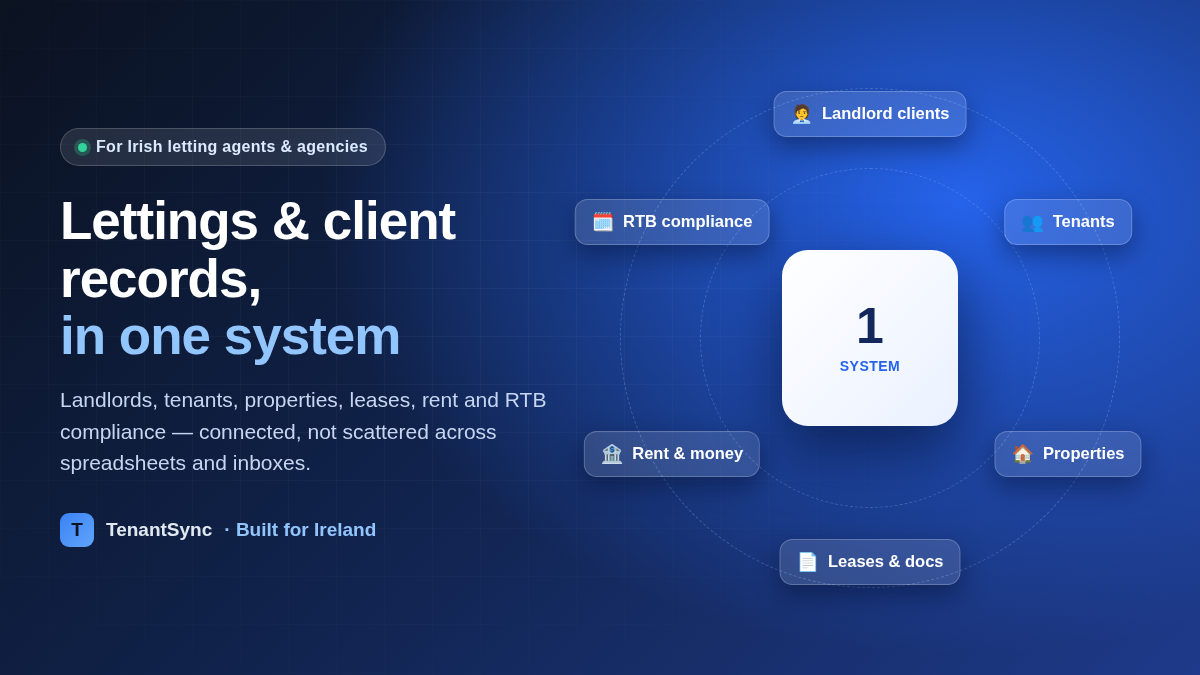
Stored together: a "Leases" folder, a "Tenants" tab and a bank statement that never talk to each other. Connected: a tenancy record that knows its landlord, property, tenant, lease, rent, RTB status and documents — so opening one shows you all of it, and changing one keeps the rest true.
Practically, a connected system means three things:
- One source of truth. Each fact — a rent amount, a phone number, a lease end date — is entered once and lives in one authoritative place. Everything else references it instead of copying it.
- Records that link to each other. A landlord links to their properties; a property links to its current tenancy; a tenancy links to its tenant, lease, rent and compliance status. Follow any thread and you reach the rest.
- The system does the work the links make possible. Because the tenancy record holds a start date, it can compute the RTB deadline. Because it holds the rent, it can check a review against the cap. Because rent is matched to it, it can flag arrears and build the landlord's statement. Connection is what unlocks automation.
That last point is the difference that pays for itself. Scattered records make you the integration layer — the human who copies a figure from the bank app into the spreadsheet into the landlord email. A connected system removes that job. For a fuller view of the buying decision, see what to look for in property management software.
The records that must stay connected
An Irish lettings business runs on seven kinds of record. Keeping each one is table stakes; keeping them linked is what makes the difference. Here's what each holds and why it can't live on an island. (This guide covers lettings and property management — the letting and ongoing management of rented homes — rather than property sales.)
1. Landlord client records
For an agency, the landlord is the client. The record holds their contact and bank details, the properties they own, the agreed management fee, and the Letter of Engagement that authorises you to act. Linked properly, one landlord record rolls up every property, tenancy and euro you manage on their behalf — which is exactly what a per-client landlord report needs, and what a real multi-client structure is built on. Isolated, it's just a name in a contacts app with the real information scattered elsewhere.
2. Tenant records
The tenant record holds contact details, the tenancy they're on, their payment history and your correspondence. Connected to the tenancy and to rent, it answers "is this tenant up to date, and if not by how much?" instantly. Disconnected, that answer lives in a bank statement and a memory.
3. Property & tenancy records
The property (and unit) record is the anchor everything else hangs off: the address, the current tenancy, its start date and rent. The tenancy is where compliance begins — the start date drives the RTB clock, the rent drives the cap calculation, and a time-stamped history of what happened and when protects the client in any dispute. This is the record that most needs to be connected, because almost every other record refers back to it.
4. Lease & document records
Leases, BER certificates, gas and electrical certificates, RTB correspondence and identity documents are the paper trail an inspection or a dispute turns on. Held against the tenancy they belong to — rather than in an inbox — a lapsing certificate or an expiring lease can be flagged before it becomes a problem, and the right document is one click from the record it proves.
5. Rent, invoice & disbursement records
Money is where fragmentation hurts most. Rent received, invoices raised, arrears outstanding, the management fee and the per-landlord disbursement all belong against the tenancy and the landlord — not on a separate statement you reconcile by eye. When money is linked to the record, a short payment is caught against the amount actually due, and a landlord statement is generated, not assembled. Our guide to Open Banking rent reconciliation covers how this is automated.
6. RTB & PSRA compliance records
Two layers again: your clients' RTB position (registration, annual renewal, Part 4, rent-review history) and your own PSRA position (licence, Professional Indemnity Insurance, Letters of Engagement, client-account reconciliation, roughly six-year retention). Both are derived from the records above — which is precisely why they can be automated once those records are connected, and why they stay broken while records are scattered. See our RTB compliance checklist and the guide to a PSRA-licensed, tech-enabled agency.
7. Enquiry & lead records
The pipeline in front of a tenancy — enquiries from Daft.ie and MyHome.ie, applicants, viewings — is a record type too. Kept in a shared inbox it's just unread email; kept as structured leads that move through a pipeline (new → contacted → applied → reviewed → approved) with an activity log, it becomes something you can act on and, crucially, connect to the tenancy it becomes. See Daft and MyHome enquiry management.
The point isn't the list — it's the links
Any agency already keeps all seven. The question is whether a landlord record reaches their properties, whether a property reaches its tenancy, whether a tenancy reaches its lease, rent and RTB status. Where those links exist, the system works for you. Where they don't, you work for the records.
The hidden cost of fragmented records
Scattered records don't announce themselves — they show up as small, recurring frictions that add up to real money and real risk. Here's what the same job looks like with records fragmented versus connected in one system.
| The job | Records scattered across tools | One connected system |
|---|---|---|
| Check if a tenant is in arrears | Open the bank app, find the transfer, compare to the rent in a spreadsheet | Rent auto-matched to the tenancy; a shortfall is flagged the same day |
| Know an RTB deadline is due | Remember it, or hope the spreadsheet formula is right | Computed from the tenancy start date and shown on a dashboard |
| Produce a landlord's monthly statement | Stitch together bank, spreadsheet, email and maintenance notes by hand | Generated in one click from linked rent, fees and disbursements |
| Answer "is this rent increase legal?" | Look up the cap, do the maths, hope you used the right figure | Calculated against the national cap from the tenancy's own rent |
| Find a lease or certificate | Search an inbox and a shared folder | Attached to the tenancy record it belongs to |
| Bring a new colleague up to speed | Explain where everything lives and who keeps what | The system is the process; access is scoped by role |
The compliance risk is the sharp end. A missed RTB registration or renewal is the most common and most avoidable failure an agency makes — and it's almost always a tracking failure, not a knowledge failure. The deadline was real; it just lived somewhere no one was watching. Connected records move that deadline onto a dashboard where it can't hide. For the wider picture of what manual processes cost, see the real cost of manual property management and how agencies scale without adding headcount.
See your own records connected, live
Bring a slice of your portfolio to a 15-minute demo and watch landlords, tenancies, rent and RTB status link up into one dashboard — with deadlines computed and a per-landlord statement generated on screen.
How to bring it all into one system (6 steps)
Consolidating sounds daunting; in practice it's a sequence you can run over a few weeks. The order matters — get the records in and connected first, then let the automation and reporting follow.
Step 1 — Choose one system as your source of truth
Pick one platform and decide it becomes the single place every landlord, tenant, property, lease and payment lives. For an Irish agency, that platform should be built around the RTB, the national rent cap and the PSRA — not a UK or US tool adapted afterwards — because the whole payoff of connected records is the compliance and money automation on top, and that only works if the system understands Irish rules. Everything else (the inbox, the folder) becomes a feeder into this system, not a competing store.
Step 2 — Import your clients, properties and tenancies
Bring existing data in rather than rekeying it. A good platform imports directly from Letman or from a CSV/spreadsheet, with onboarding support, so landlord clients, properties, tenancies, leases and rent details transfer without losing history. This is also the moment to retire the shadow spreadsheets — if data still lives in two places after import, you haven't consolidated. Our guide to migrating a letting agency off spreadsheets walks through doing this cleanly.
Step 3 — Connect the records to each other
Link each tenancy to its landlord client, property, tenant, lease and rent. This is the step that turns storage into a system: once the relationships exist, a change to a rent or a contact detail is made once and is true everywhere, and you can follow any record to everything related to it.
Step 4 — Turn on compliance automation
With records connected, let the system compute what it now can: RTB registration and renewal deadlines from each tenancy's start date, national rent-cap limits from each tenancy's rent, and your PSRA licence, insurance and client-money obligations — all surfaced on a live compliant / upcoming / overdue dashboard. This is the moment the deadlines leave people's heads for good.
Step 5 — Connect Open Banking so money reconciles to the record
Connect the account via PSD2 Open Banking so incoming rent auto-matches to the correct tenancy, arrears surface the same day, and the management fee and per-landlord disbursements come off the same linked data. The connection is read-only — it can see transactions to match them, not move money. Now the money records maintain themselves instead of being reconciled by eye.
Step 6 — Standardise reporting and scope team access
Finally, turn connected data into output: one-click per-landlord reports that show each client what you did for them this month, and agency / branch / member roles so each person sees only the records they should. This is what makes the system safe to grow on and turns your back office into a client-retention tool. See how per-client reporting helps you win and keep landlord clients.
A realistic timeline
Most agencies run this over about 30 days: import and connect in the first two weeks, switch on compliance and Open Banking in the third, standardise reporting and roll out to the team in the fourth. You don't have to do it all at once — but you do have to finish, or you'll run two systems in parallel and get the worst of both.
How TenantSync does it
TenantSync is an Irish-built lettings and property management platform designed around exactly this idea: one connected system for a letting agent's lettings and client records, built around the RTB, the national rent cap and the PSRA. Here's how the seven record types come together.
Landlord clients
A true multi-landlord structure — each client with their own properties, tenancies, bank details, management fee and Letter of Engagement — with one-click per-landlord reports and disbursement statements (white-label on higher tiers).
Tenants & portal
Tenant records linked to the tenancy and its ledger, plus a tenant self-service portal for payments, maintenance requests and documents.
Properties & tenancies
Property and unit records with the current tenancy, start date, rent and a time-stamped history, so every other record and deadline hangs off a single anchor.
Leases & documents
RTB-compliant lease generation with e-signature, plus document storage, BER certificate tracking and RTB correspondence held against the tenancy — with renewal and expiry alerts.
Rent & money
PSD2 Open Banking reconciliation (AIB, Bank of Ireland, PTSB, EBS, Revolut and N26) auto-matches rent to the right tenancy, flags arrears the same day, and drives invoices, expenses and per-landlord disbursements.
RTB & PSRA compliance
RTB registration, annual renewal and Part 4 tracking, the national rent-cap calculator with a Section 12 notice, and PSRA licence, insurance and client-money reconciliation — on one compliant / upcoming / overdue dashboard.
Enquiries & leads
Daft.ie and MyHome.ie enquiries parsed into structured leads with sub-60-second auto-replies and a pipeline that connects straight through to the tenancy it becomes.
One system, everywhere
Web plus native iOS and Android apps, with agency/branch/member roles and GDPR-grade access control — so the record is centralised for the agency and visible to the people who depend on it.
Moving your records in is a direct import from Letman, CSV or a spreadsheet with concierge onboarding, so nothing is rekeyed and no history is lost. On pricing, TenantSync uses flat, per-portfolio tiers so cost is predictable: €20 Starter for up to 10 units (aimed at individual landlords), €99 Standard up to 100 units, €149 Growth up to 200, and €199 Premium up to 300 with white-label reports, API access and a dedicated account manager; multi-branch agencies use a custom Enterprise plan. Every plan includes a 14-day free trial, no credit card required, and the automation is designed to save up to 8 hours of admin a week. For how the pricing compares, see our lettings software pricing guide.
Bring your lettings and client records into one system
Import a slice of your portfolio and we'll connect landlords, tenants, properties, leases, rent and RTB compliance on screen — then generate a per-landlord report from it. It's the fastest way to see what one system does for your agency.
On the road a lot? TenantSync runs on iOS and Android, or try the free RTB deadline checker and rent-cap calculator — no account needed.
Frequently asked questions
What does it mean to manage lettings and client records in one system?
It means every record a lettings business relies on — landlord clients, tenants, properties, tenancies, leases, documents, rent, invoices and RTB/PSRA compliance — lives in one connected platform rather than being spread across spreadsheets, email inboxes and shared folders. The key word is connected, not just stored together: each tenancy is linked to its landlord, property, tenant, lease and payments, so updating one record updates everywhere and there is a single source of truth for the whole book. For an Irish agency, that source of truth should be built around the RTB, the national rent cap and the PSRA.
What client records does a letting agent need to keep in Ireland?
A letting agent typically keeps: landlord client records (contact and bank details, the properties they own, the management fee and a Letter of Engagement); tenant records (contact details, the tenancy, payment history and correspondence); property and tenancy records (the unit, the current tenancy, its start date and rent); lease and document records (the signed lease, BER and other certificates, RTB correspondence); money records (rent received, invoices, arrears and per-landlord disbursements); and compliance records (RTB registration and renewal, rent-review history, and the agency's own PSRA licence, insurance and client-account reconciliation). As a PSRA-regulated business, an agent must be able to retain and produce records for roughly six years. Confirm your obligations at rtb.ie and psr.ie.
Can I move my landlord and tenancy records from Letman or a spreadsheet?
Yes. TenantSync supports a direct import from Letman and from CSV or spreadsheets, with concierge onboarding, so landlord clients, properties, tenancies, leases and rent details move across without rekeying and without losing history. The point of consolidating is to bring existing records in and connect them, not to start from a blank system.
Does keeping records in one system help with RTB and PSRA compliance?
Significantly. When every tenancy record holds its own start date, rent and history, the system can compute the RTB 30-day registration and annual renewal deadlines, check a rent increase against the national cap (2% or CPI, whichever is lower), and track the agency's own PSRA licence renewal, Professional Indemnity Insurance and client-account reconciliation — then show it all on one compliance dashboard as compliant, upcoming or overdue. Scattered records can't do this: a deadline living in someone's head or a spreadsheet is the most common and most avoidable compliance failure. Always verify current rules on rtb.ie and psr.ie.
Is one system for lettings and client records suitable for a single landlord or only agencies?
Both. TenantSync is built first for letting agents and agencies managing many tenancies across multiple landlord clients, with agency and branch structure, per-client reporting and bulk RTB compliance. It also serves individual landlords in Ireland as a secondary audience: the €20 Starter plan (up to 10 units) gives a single landlord the same connected records and RTB automation on a smaller scale.
Does it work on mobile, and do landlords and tenants get access?
Yes. TenantSync runs on the web plus native iOS and Android apps, so an agent can check a record, log a maintenance issue or quote a legal rent figure at a viewing. Tenants get a self-service portal for payments, maintenance requests and documents, and landlord clients can receive one-click per-landlord reports and disbursement statements through a secure link — so the record isn't just centralised for the agency, it's visible to the people who depend on it.
Sources & further reading
Facts in this article are drawn from official and primary sources. Rules, fees, deadlines and rent-cap figures change — verify the current position on rtb.ie and psr.ie before relying on any figure.
- Residential Tenancies Board — Register a tenancy (RTB Form 1 and the annual registration system)
- Residential Tenancies Board — Rental law changes from 1 March 2026 (national rent control)
- Residential Tenancies Board — Rent, rent reviews and the Notice of Rent Review
- Property Services Regulatory Authority — Licensing and regulation of property services providers (Property Services (Regulation) Act 2011)
- Central Bank of Ireland — PSD2 and regulated payment/Open Banking providers
- Data Protection Commission — GDPR guidance for organisations
Related Articles