Self-Manage or Use a Letting Agent? The Irish Landlord's Complete Guide (2026)
You've just become a landlord in Ireland. Now comes the question nobody warns you about: do you manage the property yourself or hand it to an agent? The answer depends on costs, time, and compliance risk — all of which are more nuanced than most guides let on. This is the honest breakdown.
Every new Irish landlord hits the same fork in the road. You've signed the deeds, sorted the mortgage, and now a tenant is waiting to move in. Someone mentions letting agents. Someone else says their cousin self-manages fine. The internet gives you six contradictory opinions.
The truth? Neither option is universally right. Letting agents solve some real problems — but they cost real money, every month, for as long as your tenancy runs. Self-management saves money but creates genuine compliance risk if you don't know the rules.
And there is now a third option that most landlord guides from three years ago don't mention: software-assisted self-management — where modern tools handle the operational complexity that used to require an agent.
Before we start: the Irish-specific context
- RTB compliance is mandatory. Every tenancy must be registered with the Residential Tenancies Board. There are strict deadlines and annual renewal requirements.
- National rent control applies. Since March 2026, all private tenancies fall under a single national rent cap: the lower of 2% per year or HICP inflation. You cannot increase rent freely.
- Notice rules are strict. Invalid notices — wrong period, wrong format — are legally void. Mistakes here are costly.
- Small landlords dominate. The vast majority of Irish landlords own 1–3 properties. The economics of full management fees are brutal at this scale.
What does a letting agent actually do in Ireland?
To decide whether you need one, you first need to understand what you're actually paying for. Letting agents in Ireland typically offer two service tiers: tenant-find only and full property management.
Tenant-find only
The agent finds your tenant and then steps away. This includes:
- Listing the property on Daft.ie, MyHome.ie, and possibly their own book of applicants
- Conducting viewings (often weekend viewings)
- Referencing — employment verification, previous landlord checks
- Preparing the lease agreement
- Handling deposit collection
- RTB registration (Form 1 submission)
Once your tenant moves in and the paperwork is signed, you're on your own. All day-to-day management, rent collection, and compliance is your responsibility from that point.
Full property management
The agent takes ongoing responsibility for:
- Rent collection: chasing payments, issuing receipts, handling arrears
- Tenant communication: all queries, complaints, and requests go through the agent
- Maintenance coordination: logging issues, sourcing contractors, arranging access
- Periodic inspections: typically quarterly or bi-annually, with written reports
- Rent reviews: calculating the allowable increase, serving correct notice
- RTB annual renewals
- Lease renewals and tenancy documentation
- Compliance oversight: keeping up with regulatory changes
The honest reality of full management
Full management doesn't mean zero involvement. You'll still receive financial statements, approve contractor costs above agreed thresholds, handle major decisions, and remain legally responsible for the property. The agent is an operational intermediary — not the landlord.
What letting agents actually charge in Ireland
Agent fees in Ireland are not regulated, which means they vary. But the market has settled into recognisable structures you should know before signing anything.
| Service type | Typical fee | Example: €2,000/month rent |
|---|---|---|
| Tenant-find only | 1 month's rent + 23% VAT | €2,460 one-off |
| Full management | 8–12% of monthly rent + 23% VAT | €197–€295/month (€2,362–€3,540/year) |
| Full management (Year 1 total) | Tenant-find + ongoing management | €4,822–€6,000 first year |
| Full management (Year 2+) | Ongoing management only | €2,362–€3,540/year |
Watch for hidden extras
- Renewal fees: some agents charge a reduced fee each time the tenancy is renewed
- Inspection fees: periodic inspection reports are sometimes charged separately
- Maintenance mark-ups: agents may add a 10–15% administration charge on top of contractor invoices
- VAT on all of the above: at 23%, this adds up quickly
Always get a full fee breakdown in writing before signing with an agent.
On a 10-year tenancy with a €2,000/month property, a fully managed agent relationship at 10% costs approximately €35,400 in fees — before VAT and before any one-off charges. That is a significant sum that comes directly off your net rental yield.
Pro tip: negotiate the tenant-find fee
Many agents are willing to reduce the tenant-find fee if you commit to their full management service from the outset. It's worth asking. Some landlords also use an agent purely for tenant-find — taking advantage of their marketing reach and referencing capability — and then self-manage from move-in day.
The real workload of self-managing an Irish rental
Self-management isn't just "not using an agent." It means you take on every task the agent would have done. For many landlords, that's manageable. For others, it becomes a second job they weren't expecting.
What you'll do every month
- Monitor rent payments: manually check your bank statement, match payments to the correct tenant and property, follow up on late payments
- Handle tenant queries: maintenance reports, lease questions, neighbour complaints — these come to your personal phone
- Coordinate maintenance: source contractors, arrange access, chase completion, pay invoices
- Keep financial records: track income and expenses for Revenue, maintain receipt copies
What you'll do periodically
- Periodic inspections: ideally quarterly — document the condition of the property in writing
- RTB annual renewal: €40 per tenancy, due within 1 month of the tenancy anniversary
- Rent reviews: calculate the allowable increase under national rent control, serve 90 days' written notice
- Lease renewals: issue updated agreements when needed
What you'll do at tenant changeover
- List the property (Daft.ie, MyHome.ie — a Daft.ie landlord listing currently costs €299 for a standard ad)
- Field and filter enquiries
- Conduct viewings (often evenings and weekends)
- Reference prospective tenants (employment letters, previous landlord references, ID verification)
- Prepare and sign the lease
- Collect and lodge the deposit (maximum 1 month's rent as of 2024)
- Register the new tenancy with the RTB within 30 days of move-in
- Conduct a move-in inspection with a signed inventory
Time estimate: what self-management actually costs you
Industry data and landlord surveys consistently suggest 4–8 hours per month for an established tenancy with a good tenant. During a tenant change, expect 20–40 hours of additional work spread over the advertising and onboarding period.
At a conservative personal time value of €25/hour, that's €1,200–€2,400/year in time cost for an ongoing tenancy — plus the changeover spike.
Your RTB obligations: the non-negotiable compliance layer
Whether you self-manage or use an agent, you — the landlord — are legally responsible for RTB compliance. An agent can handle the paperwork on your behalf, but if they miss a deadline, the consequences land on you.
This is one of the most misunderstood aspects of Irish landlord law. Many first-time landlords assume that handing a property to an agent transfers legal responsibility. It does not.
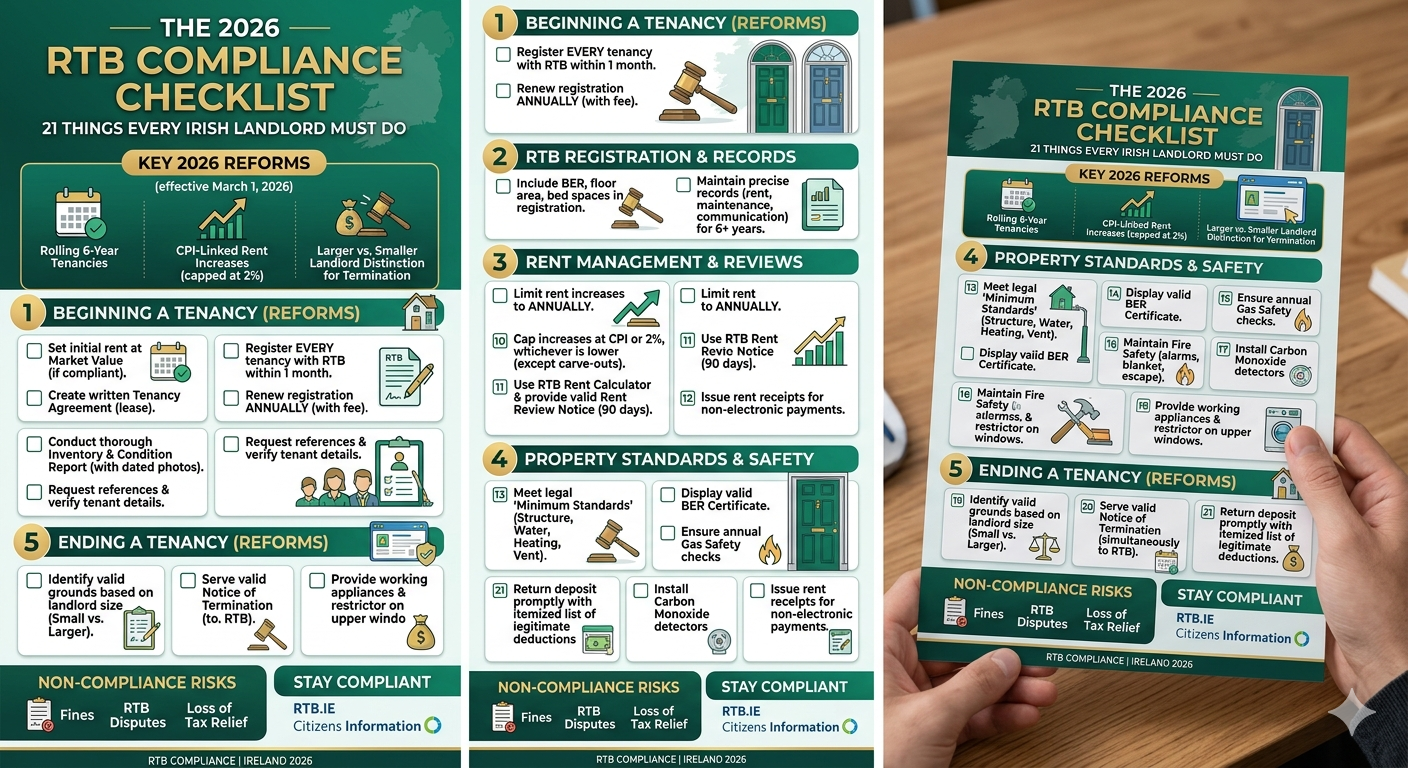
The 5 RTB obligations every Irish landlord must meet
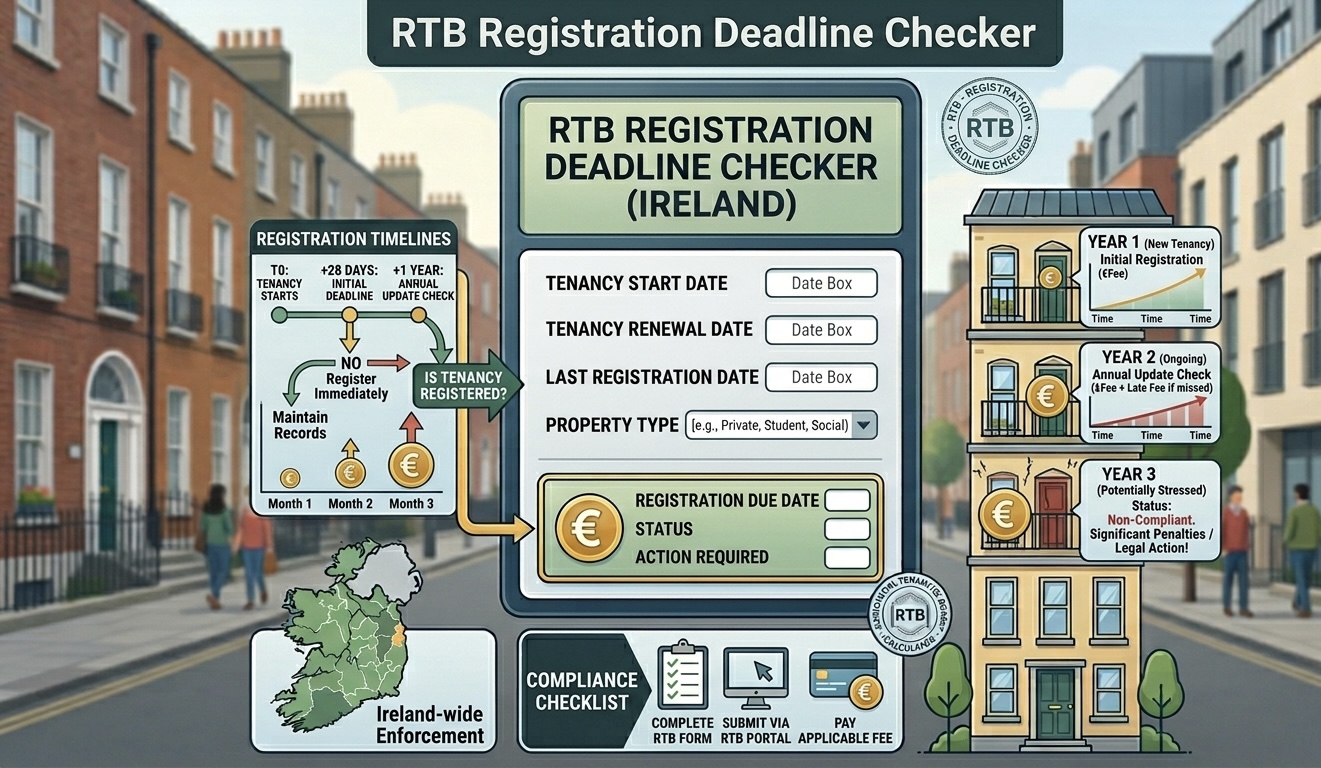
- Register within 30 days: every new tenancy must be registered with the RTB within 30 days of the tenancy commencement date. Late registration incurs surcharges and prevents access to RTB dispute resolution.
- Annual renewal: from 2022, RTB registrations must be renewed annually (€40/year). Letting it lapse has the same consequences as missing initial registration.
- Rent review compliance: since March 2026, all rent increases must comply with the national cap (lower of 2% or HICP), with 90 days' written notice in the prescribed format.
- Valid notice of termination: if you ever need to end a tenancy, the notice must meet strict legal requirements — correct period, correct grounds, correct format. Invalid notices are void.
- Minimum standards: the property must meet the minimum standards for rental accommodation (heating, ventilation, sanitary facilities, structural condition, etc.).
These obligations don't go away with an agent — they just get delegated. And if your agent misses them, you have a claim against the agent, but you still face the consequences from the RTB.
Real cost comparison: Dublin, Cork, and Galway examples
Abstract percentages are hard to feel. Here's what the numbers actually look like for typical Irish rental properties.
Dublin 2-bedroom apartment: €2,400/month rent
| Cost item | Full agent (10% + VAT) | Self-managed | Software-assisted |
|---|---|---|---|
| Tenant-find (Year 1 only) | €2,952 (€2,400 + VAT) | €299 (Daft.ie ad) + your time | €299 (Daft.ie ad) + your time |
| Ongoing management fee | €295/month = €3,540/year | €0 | ~€35/month = €420/year |
| Your time cost (est. 6hr/mo @ €25/hr) | Minimal | €1,800/year | €600/year (reduced admin) |
| Total Year 1 cost | ~€6,492 | ~€2,099 + time | ~€1,319 + reduced time |
| Total Year 2+ annual cost | €3,540 | €0 cash + time | €420 + reduced time |
The 10-year picture: a fully managed agent relationship on this property costs approximately €36,000–€38,000 in fees over a decade. Software-assisted self-management costs approximately €4,200 — a difference of over €30,000 in retained rental income.
Cork 3-bedroom house: €1,800/month rent
| Cost item | Full agent (10% + VAT) | Software-assisted | Annual saving |
|---|---|---|---|
| Management fees | €2,214 + VAT = €2,723/year | €420/year | €2,303/year |
| % of annual rent saved | — | 10.6% | |
Galway student property: €1,100/month rent
| Cost item | Full agent (10% + VAT) | Software-assisted | Annual saving |
|---|---|---|---|
| Management fees | €1,353 + VAT = €1,664/year | €420/year | €1,244/year |
| % of annual rent saved | — | 9.4% | |
The compounding math works hard against agent fees
At a 4% rental yield, Irish property investment margins are already tight. Paying 10–12% of gross rent to a management agent consumes a significant fraction of net yield. For portfolio landlords, this arithmetic makes software-assisted management an operational necessity, not a nice-to-have.
Calculate what agent fees are actually costing you
Enter your rent and management fee percentage to see your annual and 10-year cost — and what you'd save with a software-first approach.
When self-management goes wrong: the scenarios nobody warns you about
Self-management works very well — right up until it doesn't. Most problems come not from bad intentions, but from not knowing the rules in enough detail. Here are the scenarios that repeatedly trip up Irish landlords.
Scenario 1: The 30-day RTB miss
Your tenant moves in on 3 March. Life gets busy. On 7 April — 35 days later — you finally sit down to register with the RTB. You're 5 days late.
What happens: late registration surcharges apply. More seriously, for the 5 days you were unregistered, you have no access to RTB dispute resolution. If any issue arose during that window, you cannot bring it to the RTB. And you cannot legally implement a rent increase until your registration is in order.
This is the single most common self-management mistake. The RTB will not remind you. Your calendar must.
Scenario 2: The WhatsApp maintenance spiral
Your tenant messages you on WhatsApp about a damp patch in January. You verbally agree to look at it. Life intervenes. In April, the tenant files an RTB dispute claiming you failed to address a maintenance issue.
What happens: you have no written record of when the issue was reported, what was agreed, or what action was taken. The RTB adjudicator sees a tenant with a dated WhatsApp message and a landlord with nothing. The outcome frequently goes against the landlord — not because they did nothing, but because they can't prove what they did.
All maintenance must be logged in writing: date reported, agreed action, completion date. Every time.
Scenario 3: The invalid rent increase
You decide to review the rent. You write your tenant a letter giving 60 days' notice of an increase effective next month.
What happens: the notice is legally invalid. Irish law requires 90 days' written notice for rent increases. A notice with less than 90 days is void — the rent increase does not take effect. You have to restart the clock with a compliant notice, costing you months of potential income.
Scenario 4: The missing lease
Your tenancy began four years ago, and you can't find the original signed lease. Your tenant is now in an RTB dispute with you. The adjudicator asks for the tenancy agreement.
What happens: not having a signed lease doesn't automatically mean you lose, but it severely weakens your evidential position. What are the agreed terms? What was the agreed rent? What were the tenant's obligations? Without a document, every disputed fact becomes "he said / she said."
Scenario 5: Spreadsheet chaos at tax time
Many self-managing landlords track rental income and expenses in a spreadsheet — if they track them at all. At year end, trying to reconstruct annual figures from twelve months of bank statements, paper receipts, and email threads is a painful, error-prone process that either wastes hours or results in underreported expenses and an unnecessary tax bill.
The common thread in all these scenarios
None of these problems require an expensive letting agent to prevent. They require organised record-keeping, timely reminders, and structured workflows. That is exactly what modern property management software provides.
The modern alternative: software-assisted landlord management
There is a quiet revolution in how Irish landlords manage properties. A growing number — particularly those with 1–5 units — have moved away from both traditional letting agents and informal self-management, toward a third model: software-assisted self-management.
The shift is driven by a simple insight: letting agents were expensive because landlords historically lacked the operational tools to do what agents do. Chasing rent, managing maintenance, tracking compliance deadlines, generating lease documents — all of these required human intermediaries because there was no scalable alternative.
That is no longer true.
| Task | Traditional agent | Manual self-management | Software-assisted (TenantSync) |
|---|---|---|---|
| Rent collection tracking | Agent manages | Manual bank statement checking | Automated invoice + open banking reconciliation |
| RTB registration | Agent handles | Your responsibility, easy to miss | Guided workflow, deadline reminders |
| Rent review compliance | Agent calculates | Your calculation, risk of errors | Automated cap calculation + compliant notice generation |
| Maintenance logging | Agent coordinates | WhatsApp / email chaos, no audit trail | Centralised ticketing with timestamps and evidence |
| Lease documents | Agent prepares and stores | Your own template, stored wherever | Digital signing, cloud storage, always retrievable |
| Tenant communication | Buffered through agent | Direct — personal phone/email | In-platform messaging with full audit trail |
| Expense tracking | Agent provides statements | Spreadsheets, receipts in a drawer | Integrated expense log, ready for Revenue |
| Compliance reminders | Agent manages | Your calendar, easy to miss | Automated alerts for all key dates |
| Annual cost (€2,000/month property) | €2,900–€3,800+ | €0 cash (time cost) | ~€420 |
Software doesn't replace everything an agent does. It doesn't conduct viewings or handle late-night emergency calls. But for the ongoing operational and compliance layer — the part you'd pay 10% of rent for every month, indefinitely — modern tools have made agent fees optional for most Irish landlords.
How TenantSync changes the calculation for Irish landlords
TenantSync is an Irish-built property management platform designed specifically for the Irish rental market. It is not a generic app adapted from another market. Every feature is built around Irish law, RTB requirements, and the operational realities of managing property in Ireland.
RTB compliance workflows
Step-by-step RTB registration guidance from move-in day. Automatic deadline tracking for the 30-day initial window and annual renewal. RTB Form 1 drafting support and reminder alerts so you never miss a filing.
Rent invoicing & tracking
Automatically generate and send rent invoices to your tenant each month. Track payment status at a glance. Identify arrears immediately — no more manual bank statement checking on the 5th of every month.
Open banking reconciliation
Connect your bank account and automatically match incoming rent payments to the correct tenant and property. Eliminate the manual reconciliation step that costs self-managing landlords hours every year.
Rent review compliance
TenantSync tracks the last rent review date and the applicable HICP rate. When you're eligible to review, it calculates the legal maximum increase and generates a compliant 90-day written notice — removing the risk of invalid notices.
Maintenance management
Tenants submit maintenance requests through the platform. Every issue is timestamped, tracked through to resolution, and retained permanently. Your audit trail is built automatically — essential if a dispute ever reaches the RTB.
Document storage & digital leases
Store your tenancy agreements, RTB registration confirmations, inspection reports, and correspondence in one secure, always-accessible location. Digital lease signing means no more printing, scanning, or posting.
Tenant onboarding & communication
Structured tenant onboarding keeps the move-in process organised. In-platform messaging keeps all landlord-tenant communication in one searchable, dated record — not scattered across WhatsApp, email, and phone calls.
Expense tracking & financial reporting
Log maintenance costs, insurance, management expenses, and other outgoings against each property. At year end, your income and expense summary is ready — significantly reducing accountancy time and ensuring you claim every allowable deduction.
See how modern Irish landlords manage their properties
TenantSync is used by landlords across Ireland — from first-time accidental landlords to portfolio investors with multiple units. Start with a free account and see how much of your current management workload can be automated.
How to decide: a practical framework
There is no universal answer. The right choice depends on your situation. Here is an honest framework.
Use a letting agent if:
- You are overseas and cannot attend to Irish property matters in person
- You genuinely do not have 4–8 hours per month available for property administration
- You are managing a high-value property where professional tenant selection and presentation is worth the premium
- You are a new landlord with no operational systems and need a few years to build knowledge before taking over
- Your rental income is high enough that 10% management fees are a rounding error compared to your overall yield
Self-manage (with software) if:
- You own 1–5 properties and the 10–12% management fee significantly erodes your yield
- You want full visibility and control over your property operations
- You are comfortable using a modern app (the learning curve is minimal)
- You are willing to invest 4–6 hours per month in administration
- You value building direct landlord-tenant relationships
- You want your compliance handled through guided workflows rather than trusted to a third party
Consider a hybrid approach
Many experienced Irish landlords use the tenant-find only service from an agent and self-manage from move-in day. You get professional marketing, viewings, and referencing for the one-off cost of a single month's rent — then take over ongoing management with software support. This approach captures most of the agent's value at a fraction of the total cost.
The landlord checklist: before you decide
- Calculate exactly what full management would cost you per year (include VAT)
- Estimate how many hours per month you realistically have available
- Identify your main compliance concerns (RTB? Rent reviews? Maintenance documentation?)
- Try a property management software demo — most offer free trials
- Price the software against the management fee: the gap is usually eye-opening
Note: This article is for information purposes. Irish tenancy law is complex and changes frequently. For significant decisions — particularly around tenancy terminations, large rent reviews, or RTB disputes — always seek guidance from a qualified solicitor or the RTB directly.
Frequently Asked Questions
Is it cheaper to self-manage a rental property in Ireland?
Yes, in most cases. A fully managed letting agent typically charges 8–12% of monthly rent plus VAT. On a €2,000/month property, that's €1,920–€2,880 per year before tenant-find fees. Self-management has no ongoing agency cost. Using property management software typically costs €25–€40/month — roughly 10% of what you'd pay an agent — while automating the most time-intensive compliance and administrative tasks.
What does a letting agent charge in Dublin?
Dublin letting agents typically charge: (1) Tenant-find only: 1 month's rent + 23% VAT (so €2,952 on a €2,400/month property). (2) Full management: 8–12% of monthly rent + VAT. On a €2,400/month rent at 10%, that's €295/month or €3,540/year in ongoing fees. Year 1 total (tenant-find + management) typically runs €6,000–€7,000 for a Dublin apartment.
Do landlords need to register with the RTB?
Yes. All private landlords in Ireland must register every tenancy with the Residential Tenancies Board within 30 days of the tenancy start date. Annual renewals are also required (€40/year). Failure to register prevents access to RTB dispute resolution and can result in surcharges. Whether you use an agent or not, this obligation is non-negotiable.
Can software replace a letting agent in Ireland?
For the ongoing management layer — yes, largely. Modern property management software automates rent tracking, RTB compliance reminders, maintenance logging, lease storage, and tenant communication. What software doesn't do is physically show your property to prospective tenants. But landlords who handle viewings themselves (or use a tenant-find only service) and then manage ongoing operations with software can replicate most of what an agent does for a fraction of the cost.
What is the best landlord software in Ireland?
TenantSync is an Irish-built platform designed specifically for Irish landlord compliance and operations. It covers RTB registration workflows, rent review tracking under the national 2%/HICP cap, digital lease signing, automated rent invoicing, maintenance management, open banking reconciliation, and expense tracking. It's available as both a web platform and a mobile app.
How much time does self-managing a rental take each month?
Established tenancies with reliable tenants typically take 4–8 hours per month: rent monitoring, maintenance coordination, occasional communication, and record-keeping. During a tenant changeover, expect 20–40 additional hours for advertising, viewings, referencing, and onboarding. Property management software significantly reduces the routine monthly admin burden.
What happens if I miss the RTB registration deadline?
Missing the 30-day window triggers: (1) late registration surcharges on top of the standard €40 fee; (2) loss of access to RTB dispute resolution services for the unregistered period; (3) inability to lawfully implement rent increases until registration is current. The RTB does not send reminders — you must track this yourself or use software that does it for you.
Do I need a letting agent to find tenants?
No. Many Irish landlords successfully find tenants directly through Daft.ie, MyHome.ie, and social media. A Daft.ie landlord listing currently costs €299 for a standard ad. The key tasks — referencing, lease preparation, RTB registration — can all be handled without an agent. If you want professional marketing without ongoing fees, consider a tenant-find only service from an agent and self-manage from move-in day.
How do I legally increase rent in Ireland in 2026?
Since March 2026, a national rent control applies to all private tenancies. You can only increase rent if: (1) at least 12 months have passed since the last review, (2) the increase does not exceed 2% per year or the HICP rate — whichever is lower, and (3) you give 90 days' written notice in the correct format. Rent Pressure Zones as a distinct concept have been replaced by this nationwide cap. See our guide: Can I Increase My Rent in Ireland? (2026 Complete Guide).
What documents must an Irish landlord keep?
Retain: the signed tenancy agreement; RTB registration confirmation; all rent invoices and payment records; maintenance reports and contractor invoices; written communications regarding rent reviews or termination; the deposit receipt; and property inspection reports. These are essential for RTB disputes and Revenue compliance. Digital storage via property management software keeps all of this accessible and retrievable.
What are the main risks of self-managing in Ireland?
The principal risks are: missing the RTB 30-day registration window; serving notices with incorrect periods or format; failing to document maintenance in writing; not keeping compliant rent review records; applying incorrect rent increases; and losing documents needed for RTB disputes. All of these risks are significantly reduced by using property management software with built-in compliance workflows.
Is property management software worth it for a landlord with one property?
Yes. RTB compliance requirements, rent review rules, maintenance documentation needs, and tax record-keeping are identical regardless of portfolio size. At €25–€40/month, landlord software typically costs less than 2% of monthly rent income — far less than the 10–12% an agent charges. The compliance protection alone justifies the cost: one missed RTB deadline or invalid rent notice can cost more than a year's software subscription.
How do I handle maintenance requests properly as a self-managing landlord?
Always insist on written maintenance reports — email or an in-platform message, not just a phone call. Log the date each issue was reported, the agreed action, and the completion date. Retain contractor invoices. This documentation trail is critical if an RTB dispute arises. Property management software with a maintenance ticketing feature builds this audit trail automatically without any extra effort on your part.
Related Articles