Are Rent Pressure Zones Still a Thing? What Replaced the RPZ Map in 2026
You came here looking for a map — whether Dublin 2 is still in one, when Cork City went in, where the RTB keeps the 2026 version. There isn't one any more, and that is genuinely the good news, because the answer is now the same in every part of the country. What follows is the short answer for your area, what replaced the map on 1 March 2026, and the four things that still do vary from one tenancy to the next.
The short answer
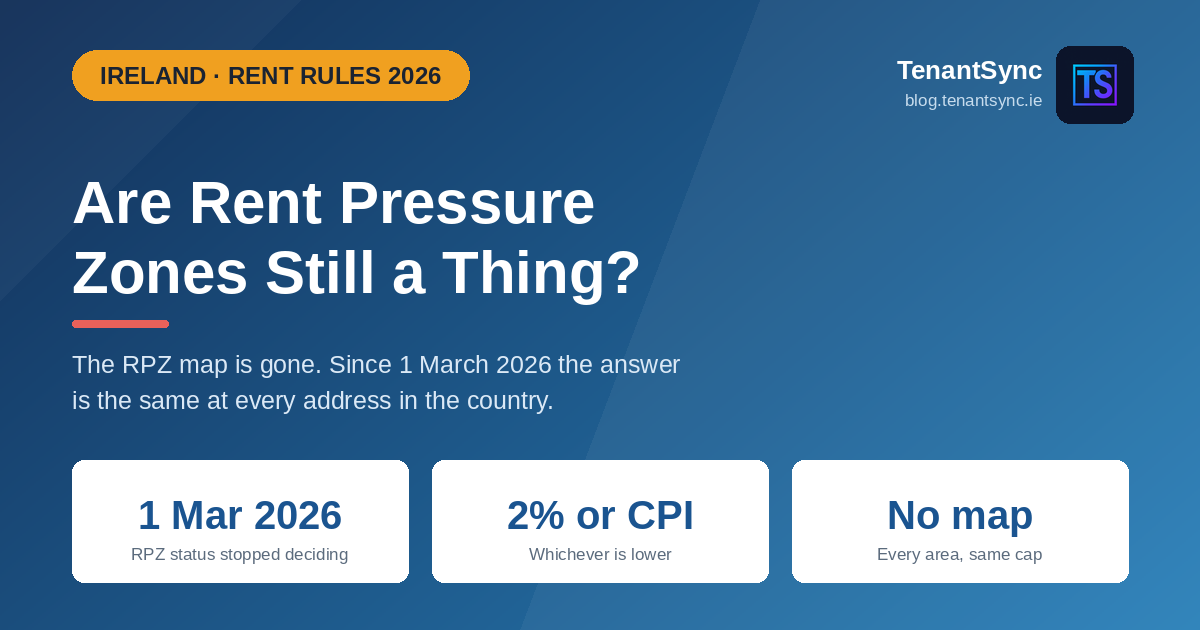
No — Rent Pressure Zones no longer decide anything about your rent cap. On 1 March 2026 the RPZ system was replaced by national rent control that applies to every private tenancy and Student-Specific Accommodation in the State, whatever the address. A rent review is capped at the lower of Consumer Price Index inflation or 2% a year, once in any 12 months, with at least 90 days' written notice. Dublin 2, Grand Canal Dock, Cork City, Galway, a cottage in Leitrim that was never designated — same rule. The old designation dates now matter for one thing only: auditing an increase that took effect before 1 March 2026.
Find your area ↓1. Is My Area Still a Rent Pressure Zone?
The honest version of this section is one sentence long, so here it is before the detail: since 1 March 2026 the answer is the same for every address in the Republic of Ireland. National rent control applies whether or not the area was ever designated. Below are the places people most often type into a search box alongside the letters "RPZ", and the answer for each — which is, deliberately, the same answer six times.
Dublin 2
Inside the RPZ system for its whole life, and still capped now — but by the national rule, not by a designation. Nothing about a D2 address makes the cap stricter than it is in Longford.
Grand Canal Dock
It straddles the Dublin 2 and Dublin 4 districts, which used to be worth arguing about when a boundary decided the cap. It no longer decides anything.
Cork City
One of the first areas designated, back in December 2016. That start date still matters for auditing an old increase — see section 5 — and for nothing else.
Galway, Limerick, Waterford
Brought in during the later rounds of designation. Same position as everywhere else now: the cap is the lower of CPI inflation or 2% a year.
The commuter belt LEAs
Meath, Kildare, Wicklow, Louth and the rest went in area by area, which is why agents kept lists. The lists are now historical records, not working documents.
An area never designated at all
This is the one that catches people. A property that sat outside every RPZ before 2026 is inside the national cap now. "It's not in an RPZ" is no longer a reason for anything.
The advice that now ends a management relationship
"That one's not in an RPZ, so you can put it up to market." Before 1 March 2026 that could be correct. Said today it is simply wrong, and an increase set on it is not valid because the tenant paid it — the tenant can bring an overpaid-rent claim to the RTB later, and the file will show who advised what.
You have the answer. Now get the number.
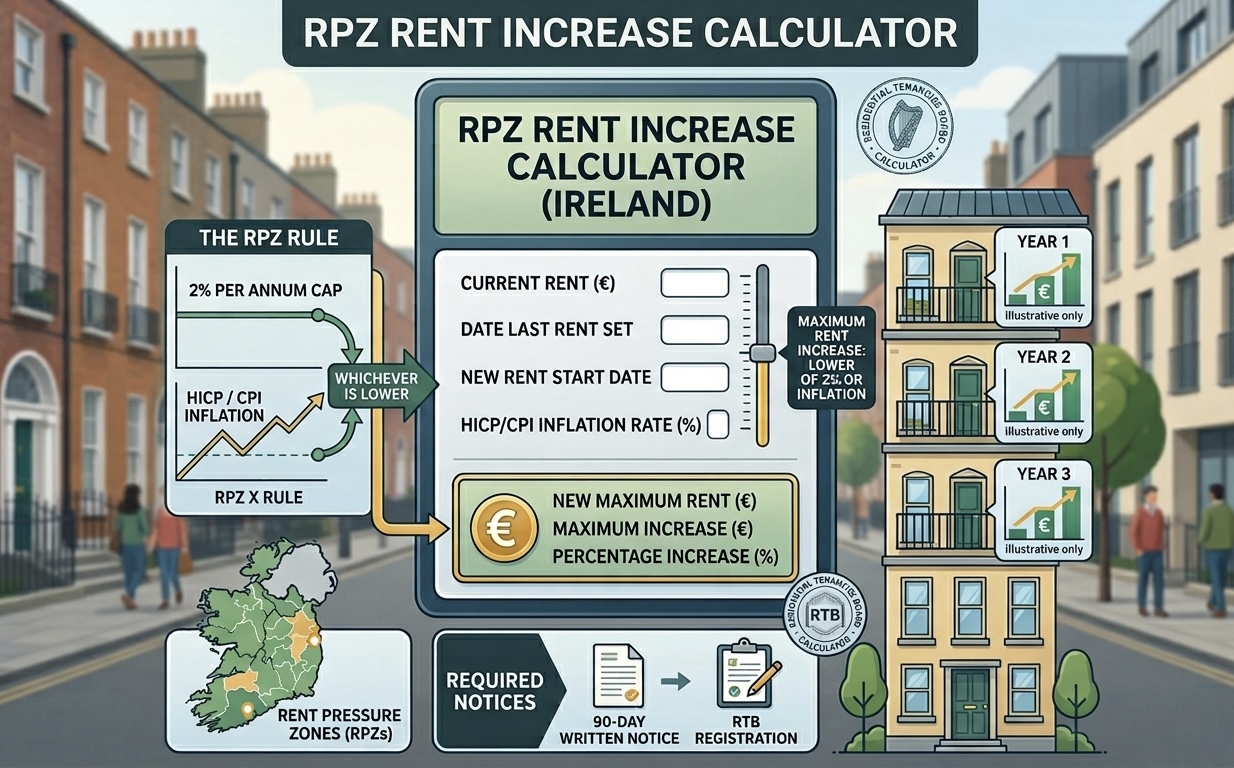
The cap is the same everywhere, but the maximum legal rent is different for every tenancy, because it depends on when the rent was last set. The free calculator does that arithmetic against the published CSO index and tells you which rule bound the result.
2. Where the RPZ Map Went
For most of a decade the first question on any Irish rent increase was geographic. Is this property in a designated area? If it was, the cap applied — 4% a year at first, then from December 2021 the lower of inflation or 2%. If it wasn't, the landlord had far more room. Agencies kept spreadsheets of Local Electoral Areas and checked them tenancy by tenancy, and the RTB published a map and a lookup for exactly that purpose.
There is no 2026 RPZ map, and there is nothing for one to show
Rent control now applies across the State, so no area is inside or outside it. A map with everything shaded the same colour tells you nothing you do not already know from this sentence.
If you are checking an increase that took effect before 1 March 2026, you do need the historical designation position for that area on that date — and that is a question for the RTB, which holds the record of what was designated and from when. It is not a question a current map can answer, because the current map does not exist.
Why the phrase hasn't gone away
You will keep meeting "RPZ" for years: in leases signed in 2019, in letters of engagement, in accountants' notes, in the names of tools — including rent-cap calculators, ours among them. That is accurate history rather than an error, and a calculator called an RPZ calculator can be perfectly correct for a 2026 review, provided its arithmetic follows the current rule. What matters is the rule underneath the label. In conversation with a landlord client, though, use the plain words: the national rent cap, and the lower of CPI or 2%. Clients who hear "RPZ" hear a question about their address, and there isn't one.
The one thing that got harder
The map disappearing removed an argument and added a duty. There is no longer any tenancy in the country where a rent increase can be treated casually, and the rules around resetting rent, evidencing market value and serving notice are stricter than most landlords were used to. Fewer questions to answer, less room to be wrong. Our field guide to the national rent cap is the long version of how to apply it.
3. The Rule That Replaced It, With the Arithmetic
This page is not the full field guide to the national cap — that is over here, and it is where to go once you know the rule applies to you. What follows is the minimum you need to stop thinking about maps and start getting the number right.
For a rent review on a sitting tenant, the maximum is the lower of two figures:
- Consumer Price Index inflation over the period since the rent was last set. The reference series is the CSO's Consumer Price Index — which replaced the HICP used under the old RPZ rules. If your spreadsheet or template still indexes against HICP, it is using the wrong series for any review dated on or after 1 March 2026.
- 2% a year, applied proportionately to the actual period between the two dates rather than as a flat annual step.
Whenever inflation is running above 2%, the 2% ceiling is what actually binds — which has been the ordinary case since the rule came in. Here is a full worked example using published index values, so you can see which one wins and by how much.
Worked example: a €1,800 tenancy reviewed after twelve months
The maximum increase is €35.98 a month, not the €61.05 that inflation alone would have allowed. Index values are CSO Consumer Price Index, base December 2023 = 100, as carried in TenantSync's calculator on the date this article was verified. Check the current published figures before you serve anything — the CSO revises and extends the series, and the correct value depends on the exact months either side of your review.
Where the exception lands
Now take the same tenancy and change one fact: the dwelling was first available to rent on or after 10 June 2025, or it is Student-Specific Accommodation. Those categories are limited by inflation only — the 2% ceiling is waived — so the binding figure flips to the CPI line, €1,861.05. Same address, same dates, €25.07 a month of difference, and geography plays no part in it whatsoever. That is the shape of the whole 2026 regime in one comparison: the questions that decide your number are now about the dwelling and the dates, never about the map.
The other two rules that go with it
- Once in any 12 months. A rent review cannot come round more often than annually, whatever the market is doing.
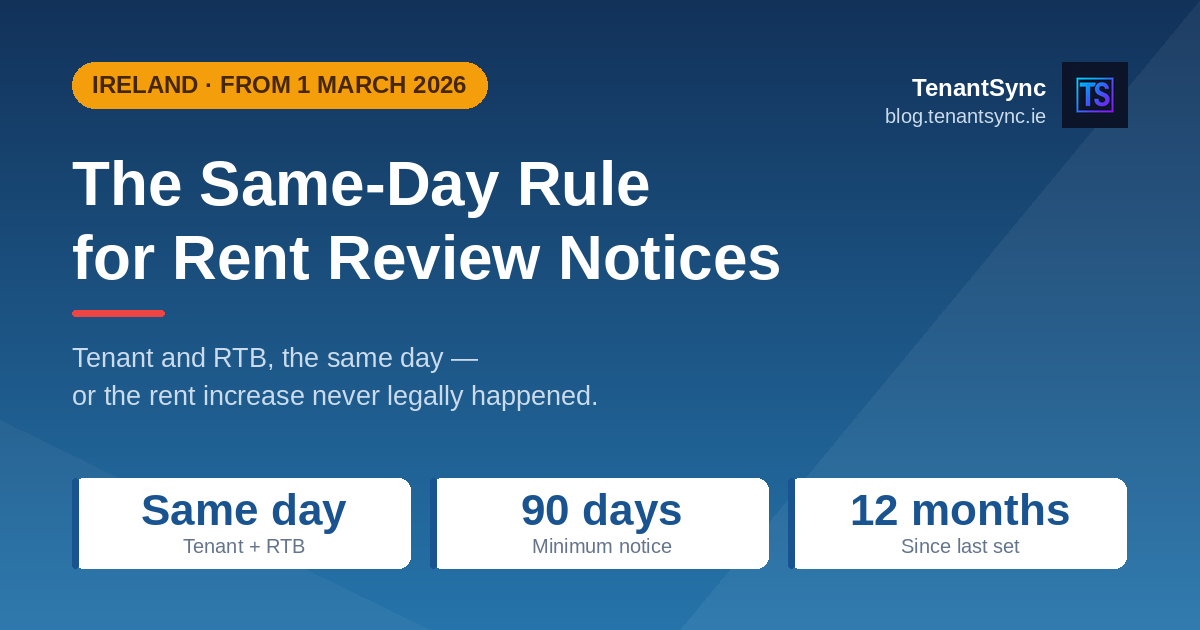
- At least 90 days' written notice, and a copy has to reach the RTB within 7 days of the date of service, or the increase never legally happened.
4. Which Rules Apply to This Tenancy?
Four questions decide which version of the rulebook a tenancy sits under. Not one of them is about the area. Answer them here and you will know which cap applies, which tenancy framework governs it, and what the landlord's position is — then take the tenancy to the calculator for the actual figure.
Which rulebook governs this tenancy?
Runs entirely in your browser. Nothing is sent anywhere, and nothing is stored.
Enter a tenancy start date.
—
This routes you to the right rulebook; it does not compute a maximum rent, because that depends on the date the rent was last set and the published index values either side of it. For the figure itself use the free rent-cap calculator, which shows the CPI line, the 2% line and which one bound the result. General information, not legal advice.
5. When the Old Designation Date Still Matters
A large share of the people searching for RPZ dates are not confused at all. They are doing something precise: checking whether an increase applied two or four years ago was lawful at the time. For that job the designation history is still live evidence, and this is the one context in which the old map has not gone anywhere.
- December 2016 The Rent Pressure Zone system begins. The four Dublin local authority areas and Cork City are the first areas designated — which is why "cork city rpz since 2016" is still one of the most-typed versions of this question. The cap at this stage is 4% a year.
- 2017 – 2019 Designation extends in stages, Local Electoral Area by Local Electoral Area, across Galway, Limerick, Waterford, Cork County and the commuter belt. This is the period the agency spreadsheets were built for, and the reason two properties on the same road could sit under different rules.
- December 2021 The cap inside designated areas changes from 4% a year to the lower of HICP inflation or 2% a year. Any increase you are auditing from this period has to be tested against that formula, not against 4%.
- 1 March 2026 Designation stops deciding anything. National rent control applies everywhere, the reference index moves from HICP to the CSO's Consumer Price Index, and the map becomes a historical document.
The audit question, in the right order
For an increase that took effect before 1 March 2026: (1) was the property in a designated area on the date the new rent took effect, and from when? (2) which cap was in force at that date — 4%, or the lower of HICP and 2%? (3) was the increase within it, was it at least 12 months since the last one, and was 90 days' notice given? Get the RTB's designation record for step one; do not reconstruct it from a blog post, ours included.
Why this is worth an hour of an agency's time: an overpaid-rent claim is brought by the tenant, long after the fact, and it is decided on what the file shows. If a rent was set too high in 2023 under a cap nobody re-checked, that liability did not expire on 1 March 2026 — the reform changed the rule going forward, not the lawfulness of what was already done. Agencies that inherited a book from another agent are the most exposed, because they are carrying somebody else's arithmetic.
6. Four Things That Genuinely Do Still Vary
"The same everywhere" is true of the cap and only of the cap. Four variables still change the answer for a specific tenancy, and every one of them is a property of the tenancy or the landlord rather than the address. If you take a single table away from this page, take this one.
Scroll the table sideways to see every column.
| Variable | What it changes | What it does not change |
|---|---|---|
| When the tenancy began — before or on/after 1 March 2026 | Whether it is a six-year Tenancy of Minimum Duration, and therefore which grounds are available to end it and when a market reset can arise. | The review cap. Both sides of that line are capped at the lower of CPI or 2%. |
| When the rent was last set | Everything about the number: whether a review is due at all, the index window that gets measured, and how the 2% is apportioned. | Which rule applies. The formula is the same; only its inputs move. |
| What the dwelling is — first available to rent on or after 10 June 2025, or Student-Specific Accommodation | The 2% ceiling is waived and inflation alone limits the increase, which in an above-2% period allows a larger rise. | The notice, the 12-month interval and the evidence requirements. The carve-out is about the ceiling, not the process. |
| How many tenancies the landlord holds — three or fewer, or four or more | Which termination grounds the landlord may use during a six-year tenancy, and so how often a lawful market reset can ever arise. | The review cap, which is identical for a landlord with one tenancy and a landlord with two hundred. |
Counting tenancies, not doors
The small-versus-large line is drawn on tenancies, and any company is treated as large regardless of size. A client who buys a fourth property crosses the line, and their position on the post-March-2026 tenancies changes with it. Re-count when a client's portfolio moves.
And one thing that never varies
The address. There is now no combination of the four variables above in which the property's area, postcode, Local Electoral Area or former RPZ status alters the cap. If you find yourself reaching for a map to answer a 2026 rent question, the question has been mis-framed — go back to the four rows above.
7. What You Now Have to Serve, and On Whom
Knowing the right number is half the job. The 2026 regime is noticeably less forgiving about how that number is communicated, and a correct figure served incorrectly produces exactly the same outcome as a wrong one: the increase does not take effect.
-
The rent review notice, in the required form
At least 90 days' written notice before the new rent applies, and no more than one review in any 12 months. The RTB publishes the notice requirements and sample documents — take the current version from them rather than from an old template in your document store.
-
The RTB copy, within 7 days
A rent setting or review notice has to reach the RTB within 7 days of the date of service — the date the tenant receives it. Before 14 September 2026 that copy was due on the same day. Miss the window and the increase never legally happened, however correct the arithmetic was. This is the single most common way a well-calculated 2026 increase fails — the full failure mode is set out in the RTB copy rule.
-
The three comparables, where you are setting rather than reviewing
Where a market rent is being set — a new let, or one of the defined reset circumstances — the figure has to be supported by three comparable rents from the RTB Rent Register, and that statement served with the notice. Our guide to setting rent under the 2026 rules walks the Rent Register workflow through screen by screen.
-
The evidence pack, kept where you can find it in two years
The calculation, the index values used, the notice as served, the date and method of service, and the RTB copy. A rent increase is challenged long after everybody has forgotten it; the file is the only thing that answers.
A market reset is the exception, not the reward for a vacancy
A change of tenant does not by itself entitle a landlord to re-set the rent, and rent generally cannot be re-set to market after a no-fault termination. That single rule has changed the economics of ending a tenancy more than anything else in the reforms — worth raising with a client before they instruct you to serve, not after. See notice of termination in 2026 for how that plays out.
8. Sixty Tenancies, One Rule, Sixty Dates
For a landlord with one property, the 2026 regime is easier than what came before: one rule, no map, one date to remember. For an agency it is the opposite, and the reason is arithmetic rather than law.
The rule is a paragraph. Applying it is sixty separate calculations, each anchored to a different "rent last set" date, each with its own index window, each with a 12-month gate and a 90-day notice clock that has to be worked backwards from the date the client wants the increase to land. Add the dwellings that fall into the inflation-only categories and you have two formulas running side by side across one book. Nothing about that is hard. All of it is easy to get wrong at volume, and every instance of getting it wrong is repayable rent plus a conversation with a landlord client.
Where agencies actually lose money on this
- The review that never gets served. No fine, no dispute — just a tenancy that quietly sits below market for another year because nobody spotted the anniversary. Across a book, this is the largest number on the page and the only one that never shows up in a compliance report.
- The template that still says HICP. One stale spreadsheet, applied to every review, produces a consistent and consistently wrong answer.
- The 90 days worked forwards instead of backwards. The client asks for an increase from 1 January; the notice has to be out by early October. Discovering that in November costs a quarter.
- The inherited book. Tenancies taken on from another agent arrive with rent histories nobody in your office set — and with whatever was done to them before 2026.
The one report worth building before anything else
Every tenancy on the book, with the date the rent was last set, the next date a review is permitted, and the date a notice would have to be served to hit it. That single view turns rent reviews from a thing you react to into a thing you schedule — and it is the report most agencies discover they cannot produce from their current system.
See that report built from your own book
Fifteen minutes, your tenancies, your dates: rent-review eligibility across the portfolio, the cap calculated per tenancy with the rule applied shown, and reminders that arrive before the 90-day clock runs out instead of after.
9. How TenantSync Handles This
TenantSync is built for Irish residential tenancies, so the 2026 rent rules are implemented in the product rather than approximated by a general-purpose field. Specifically:
- The rent-cap calculator does the two-line comparison and shows its working. It indexes against the CSO Consumer Price Index, computes the 2% figure proportionately to the actual period, takes the lower of the two, and then tells you which one bound the result — with the exemption reason where the 2% cap was waived, and a note when the latest published index value had to be used because the review month is not out yet.
- The inflation-only categories are inputs, not footnotes. Newly built dwellings first available to rent on or after 10 June 2025 and Student-Specific Accommodation are toggles on the calculation, so the waived cap is applied deliberately and visibly rather than remembered.
- Rent-review eligibility is tracked per tenancy, alongside RTB registration deadlines, annual renewals, Part 4 milestones and the rest of the compliance dashboard's eleven obligation types — with reminders by email, in-app and mobile push.
- The working is kept. The figure, the rule applied and the date sit against the tenancy, which is what an overpaid-rent claim two years later actually turns on.
- Agencies see it by branch and by client, so "which of our tenancies are eligible for review this quarter" is a view rather than an afternoon.
The calculator is free and public — use it without an account, and have the result emailed to you if you want a record of it.
What TenantSync does not do
It is not affiliated with the RTB. It does not serve notices on tenants or submit anything to the RTB — both remain your actions. It does not hold or reproduce the RTB's historical Rent Pressure Zone designation record, so if you are auditing a pre-2026 increase (section 5), the designation position for that area on that date has to come from the RTB. And the calculator is an estimate to be checked against the RTB's own guidance before you serve, which is exactly what its on-screen disclaimer says.
Frequently Asked Questions
Are Rent Pressure Zones still in effect in Ireland after 1 March 2026?
No. Rent Pressure Zone designation stopped deciding the rent cap on 1 March 2026, when a national rent control system replaced it. A rent review cap now applies to every private tenancy and Student-Specific Accommodation in the State, regardless of location. You will still see the term RPZ in older documents, in legal history and in the names of some calculators, which is accurate context rather than an error — but there is no longer an in-or-out question to answer about a property's area.
Is Dublin 2 still a Rent Pressure Zone in 2026?
The question no longer changes the answer. Dublin 2 was inside the Rent Pressure Zone system for its whole life, but since 1 March 2026 the national rent cap applies there on exactly the same terms as everywhere else in the State. A rent review is capped at the lower of Consumer Price Index inflation or 2% a year, once in any 12 months, with at least 90 days' written notice. Being in Dublin 2 does not make the cap stricter, and being outside it does not make a landlord free.
Is Grand Canal Dock in a Rent Pressure Zone?
Grand Canal Dock sits across the Dublin 2 and Dublin 4 postal districts, and like the rest of Dublin it was covered by the Rent Pressure Zone system before 2026. Since 1 March 2026 the location is not the deciding factor: the national rent cap applies to the tenancy wherever the dwelling is. What decides the maximum rent is when the rent was last set, when the tenancy began, and whether the dwelling falls into one of the inflation-only categories.
Is Cork City still a Rent Pressure Zone, and when did it become one?
Cork City was among the first areas brought into the Rent Pressure Zone system, designated in December 2016 alongside the four Dublin local authority areas. That designation ran until the system was replaced on 1 March 2026. Since then the national rent cap applies in Cork City on the same terms as everywhere else. The historical designation date can still matter when you are auditing a rent increase that took effect before 1 March 2026 — the RTB is the source for the historical list of designated areas and dates.
Where is the RTB Rent Pressure Zone map for 2026?
There isn't one, because there is nothing left for a map to decide. Rent control now applies across the State, so no area is inside or outside it. If you are checking a rent increase that took effect before 1 March 2026, you need the historical designation position for that area at that date, which is a question for the RTB rather than a current map.
My property was never in a Rent Pressure Zone. Can I still increase the rent freely?
No. This is the most expensive misunderstanding of the 2026 reforms. A property that was outside every Rent Pressure Zone before 1 March 2026 is inside the national rent cap now. Telling a landlord client that a property is not in an RPZ so the increase is unrestricted is wrong, and an increase set on that basis is not valid simply because the tenant paid it.
How much can I increase the rent in Ireland in 2026?
For a rent review on a sitting tenant, the increase is capped at the lower of Consumer Price Index inflation over the period since the rent was last set, or 2% a year applied proportionately to that period. In practice, whenever inflation is running above 2% the 2% cap is the binding limit. Rent can be reviewed once in any 12 months and at least 90 days' written notice is required. Newly built dwellings first available to rent on or after 10 June 2025, and Student-Specific Accommodation, are limited by inflation only rather than by the 2% cap. The free calculator does the comparison for a specific tenancy.
Does the 2% cap apply to every property in Ireland?
Almost, but not quite, and the exception is about the dwelling rather than its area. Newly built dwellings first available to rent on or after 10 June 2025, and Student-Specific Accommodation, are limited by Consumer Price Index inflation only — the 2% ceiling is waived for them. In a period where inflation exceeds 2%, that carve-out permits a larger increase than the ordinary cap allows. Geography has nothing to do with which category a dwelling falls into.
Which inflation index is used for the rent cap in 2026?
The Consumer Price Index published by the Central Statistics Office. It replaced the Harmonised Index of Consumer Prices, which was the reference index under the old Rent Pressure Zone rules. If you are working from a spreadsheet, template or calculator that still indexes against HICP, it is using the wrong series for a review dated on or after 1 March 2026.
Does it still matter when my area became a Rent Pressure Zone?
Only backwards. For any rent increase that took effect on or after 1 March 2026, the designation history is irrelevant. For an increase that took effect before then, whether the property was in a designated area at that date, and from when, decides which cap applied — which is exactly what an overpaid-rent claim at the RTB turns on. Keep the working for historical increases; stop applying the map to new ones.
Can I reset the rent to market value between tenancies in 2026?
Only in defined circumstances, and a change of tenant is not automatically one of them. In particular, rent generally cannot be reset to market after a no-fault termination. Where a reset is permitted, the figure has to be supported by three comparable rents from the RTB Rent Register, and that statement has to be served with the notice. Our guide to setting rent in 2026 covers the workflow.
Why do rent calculators and documents still say RPZ?
Because the phrase is what people searched for and what a decade of leases, letters and templates called it. A tool named an RPZ calculator can still be correct for a 2026 review, provided it indexes against the Consumer Price Index, applies the lower of inflation or 2% a year, and handles the inflation-only categories. The name is legacy; what matters is which rule the arithmetic follows.
Summary
- RPZ designation no longer decides your cap. Since 1 March 2026 national rent control applies to every private tenancy and Student-Specific Accommodation in the State. Dublin 2, Cork City, Grand Canal Dock and an area that was never designated are all in the same position.
- There is no 2026 RPZ map, because there is nothing left for one to show.
- The review cap is the lower of CPI inflation or 2% a year, apportioned to the actual period, once in any 12 months, with at least 90 days' written notice. While inflation runs above 2%, the 2% line is what binds.
- The reference index is now the CSO's CPI, not HICP. Any template still indexing against HICP is wrong for a 2026 review.
- Newly built dwellings first available to rent on or after 10 June 2025, and Student-Specific Accommodation, are limited by inflation only. That is about the dwelling, never the area.
- The old designation dates still matter for one job: auditing an increase that took effect before 1 March 2026. Get that record from the RTB.
- What varies now is dates and dwellings, not addresses — and at portfolio scale, dates are where the money is lost.
Calculate your maximum legal rent — free
Enter the current rent, the date it was last set and the date the review takes effect. You get the CPI line, the 2% line, which one binds, and the figure — with the working shown, so you can put it in front of a landlord client.
Sources & Further Reading
The RTB sets and changes the rules described here, and the CSO publishes and revises the index the cap is measured against. Several 2026 boundaries are still being clarified. Check every detail against the sources below before you set or review a rent. Details on this page were last verified on 5 September 2026.
- RTB — Rental law changes from 1 March 2026
- RTB — Rent setting and reviews
- RTB — including the record of which areas were designated Rent Pressure Zones, and from when, for auditing pre-2026 increases
- CSO — Consumer Price Index (the reference series since 1 March 2026)
- Citizens Information — Rent increases
- Residential Tenancies Act 2004
- Planning and Development (Housing) and Residential Tenancies Act 2016 (the Act that introduced Rent Pressure Zones)
Related reading on this site: the national rent cap field guide · setting rent under the 2026 rules · the rent review calculator guide · the RTB copy rule for rent review notices · the March 2026 reforms · notice of termination in 2026.
Related Articles