The Real Cost of Manual Property Management for Estate Agents
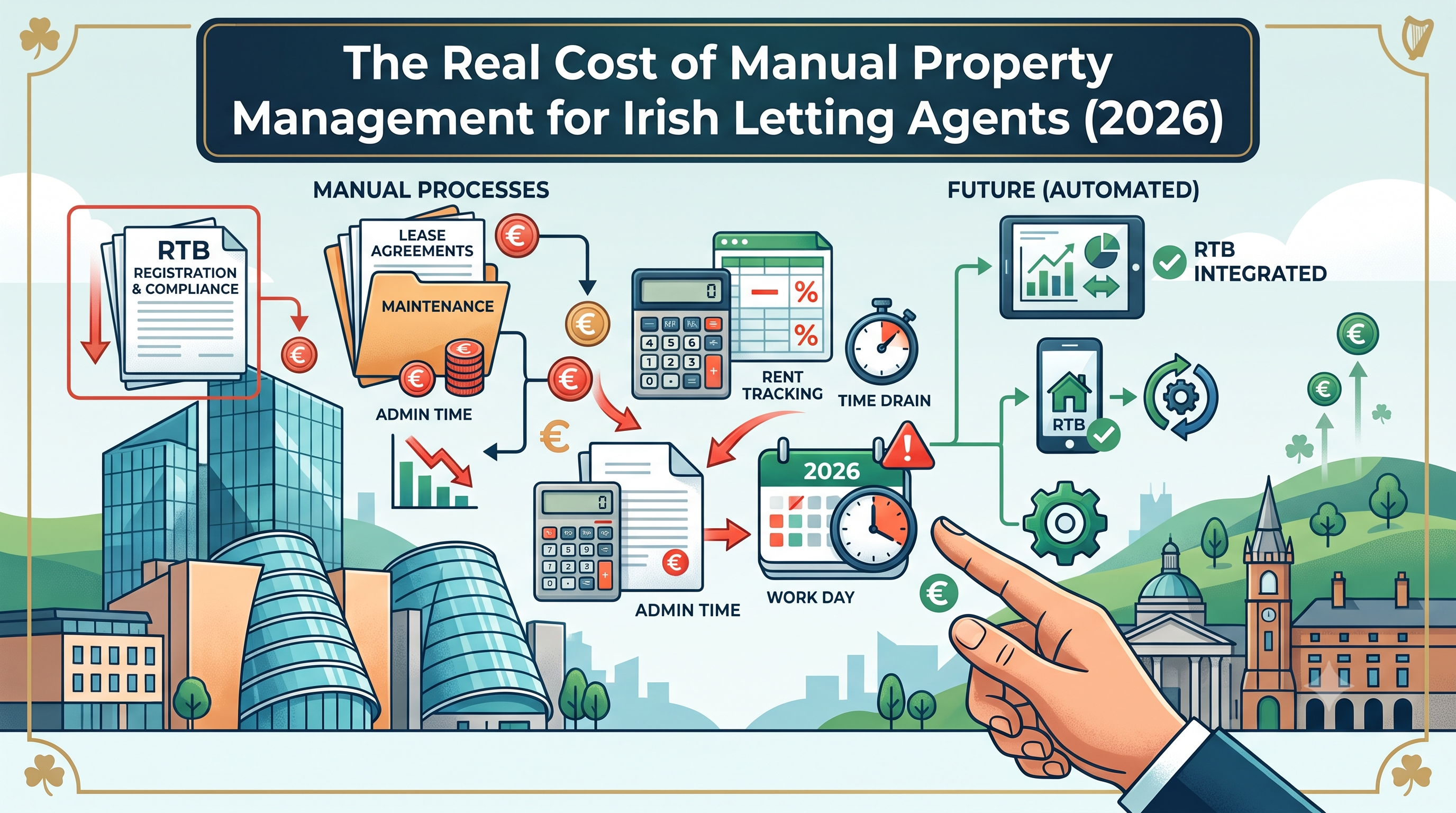
Ask most Irish agents what manual property management costs and they'll point at the hours. Those hours are real — but they're the small half of the bill. The expensive half hides in three systems that manual work quietly breaks: compliance (RTB & PSRA), rent reconciliation, and tenant & landlord communication. This guide puts an honest cost on each — the fees, the risk and the lost clients — and shows exactly how a modern platform closes the gap, without adding headcount.
The short version
What does manual property management really cost an Irish agency? Far more than the staff hours you can see. The real cost is concentrated in three systems that manual work breaks: compliance — RTB registrations and rent reviews plus PSRA/PSR licence obligations that carry fees, sanctions and even your licence to operate; rent reconciliation — arrears and mismatched payments caught late when you match rent by eye against bank statements; and tenant & landlord communication — the endless chasing and the client trust you lose when a landlord feels out of the loop. TenantSync removes the manual work in all three: it tracks every RTB and PSRA deadline, reconciles rent automatically via read-only Open Banking, and keeps tenants and landlords updated on autopilot — for less than the admin time it replaces.
Cost Centre 1: Compliance (RTB & PSRA)
Compliance is the cost centre where manual work is most dangerous, because the price of a mistake isn't measured in hours — it's measured in fees, sanctions and, for agencies, your licence. There are two regimes to keep straight, and manual management struggles with both.
RTB: keeping every tenancy compliant
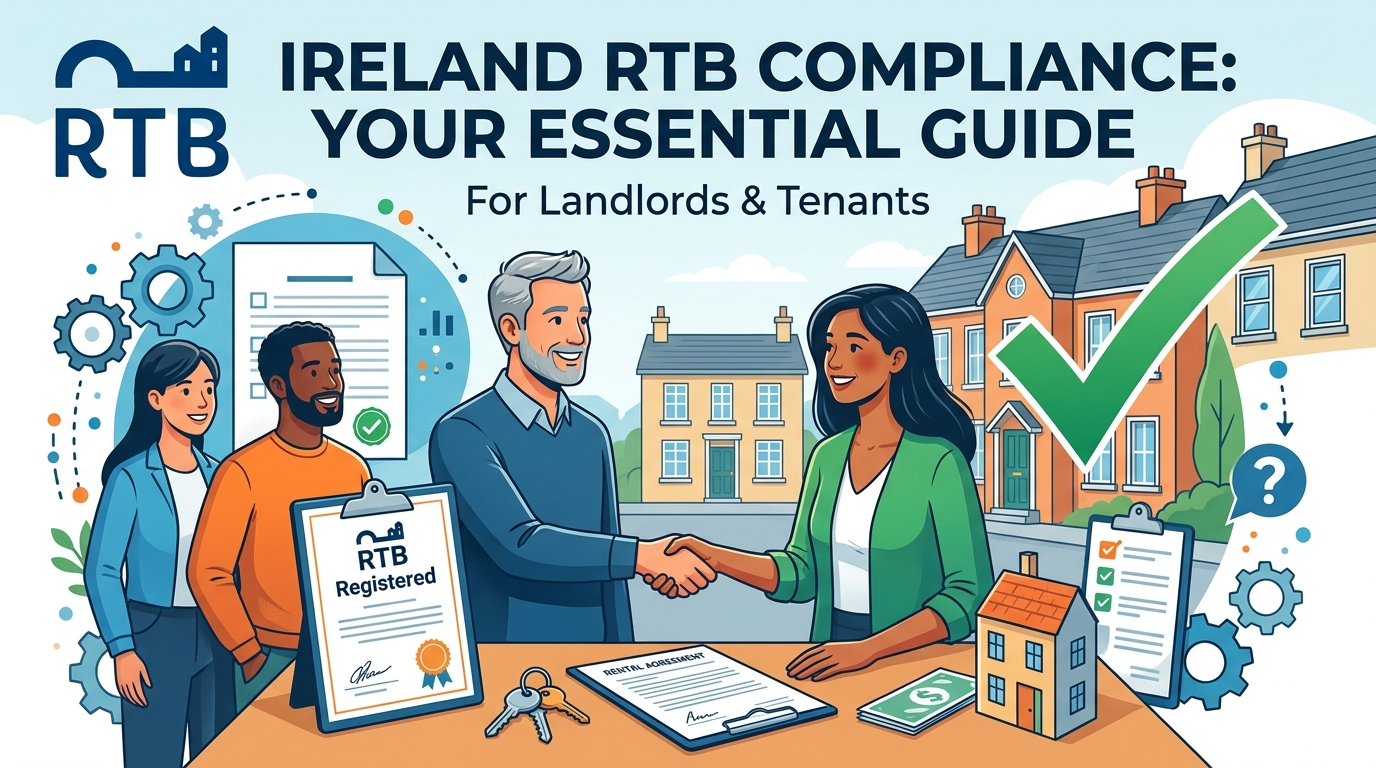
Every private tenancy must be registered with the Residential Tenancies Board (RTB) within one month of it starting. On time, the standard annual registration fee is €40 per tenancy, with a composite fee for multiple tenancies in the same building; miss the one-month window and a late fee applies, with the RTB able to pursue sanctions for non-registration. (Confirm current fees and penalties on rtb.ie — they change.) Multiply one 30-day clock by a portfolio of tenancies, each starting on a different date, and you have a diary problem that a spreadsheet was never built to win.
And registration is only the start. Under the national rent cap in force since 1 March 2026, most rent reviews are limited to the lower of 2% or inflation (HICP), the review notice must be served correctly and on time, and Part 4 tenancy rights accrue at fixed anniversaries. Each of these is a date you cannot afford to miss — and by hand, each is a sticky note waiting to be lost.
How TenantSync removes the manual RTB work
- The clock starts itself. When you create a lease, TenantSync automatically creates an RTB registration record, sets the registration deadline at 30 days from the tenancy start, computes the annual renewal date, and pre-fills the RTB1 form from your lease, property, landlord and tenant data.
- The RTB1, drafted for you. Save, validate field by field, preview as an A4 PDF and finalise — with proof of registration uploaded and stored (SHA-256 hashed) against the tenancy.
- A compliance dashboard. See counts of compliant, upcoming-deadline and overdue registrations across the portfolio, and a per-lease compliance timeline of every event — registration, renewal, Part 4 dates, rent-review dates.
- Rent reviews, tracked and calculated. A rent-review tracker stores the last and next eligible review dates, and the built-in RPZ / rent-cap calculator works out the maximum permissible rent using stored HICP inflation data.
- Reminders that actually fire. Automated daily jobs notify you of approaching registration deadlines, annual renewals, rent-review eligibility windows and Part 4 rights — by email, in-app and mobile push — with de-duplication so you're nudged, not spammed.
The manual cost, quantified
The fee for registering on time is fixed and small. The cost of doing it manually is the exposure: one forgotten 30-day deadline across a busy month of move-ins turns a €40 obligation into a late fee plus sanction risk — and a very awkward conversation with the landlord. Automating the clock removes the exposure, not just the typing.
PSRA / PSR: keeping your licence to operate
Here's the regime that's easy to under-manage because it's about the agency, not the tenancy. Letting agents are Property Services Providers (PSPs) regulated under the Property Services (Regulation) Act 2011 and licensed by the Property Services Regulatory Authority (PSRA). Where RTB compliance protects the tenancy, PSRA compliance protects your right to trade — so a lapse here is existential, not routine.
The obligations that manual systems tend to drop:
- Licensing. The correct licence — Type C for letting — held per entity and per person, and renewed on a fixed clock (the renewal invitation lands well ahead of expiry, and the application is due weeks before it).
- Letters of Engagement. A written, s.43 Letter of Engagement (Property Services Agreement), with itemised fees, must be in place before you act for a landlord client.
- Client money. Rent an agency collects is client money under the Client Moneys Regulations 2012 — it must sit in a designated client account, be tracked in a per-client ledger, be reconciled at least monthly, and be covered by an annual Accountant's Report.
- Assurance. Professional indemnity insurance (statutory minimum cover of €1,000,000), tax clearance, and Property Services Compensation Fund contributions — each with its own expiry.
- Standards & complaints. Advertising/particulars that meet minimum standards, and a complaints register with proper handling and retention (records kept for six years).
How TenantSync removes the manual PSRA work
TenantSync includes a dedicated PSR/PSRA compliance module (available from the Growth plan) that mirrors the RTB engine for the agency itself: it tracks each licence and its renewal clock, generates and issues Letters of Engagement (with a secure public link for the client to view and retrieve), maintains the designated client account register and per-client ledgers, runs the monthly client-account reconciliation to a signed-off status, and assembles the annual Accountant's Report. It keeps PII, tax clearance and compensation-fund records with expiry reminders, holds an advertising-compliance checklist and complaints register, and can produce a one-click inspection pack honouring the six-year retention rule — with every change written to an audit trail. Escalating reminders cover licence renewal, assurance expiry, unsigned LoEs, reconciliation-due and the annual report.
Why this is the cost that ends businesses
An RTB slip costs a fee. A PSRA slip — an expired licence, an un-reconciled client account, a missing Accountant's Report — can cost the ability to trade at all. Manually juggling these across a growing agency is exactly where things fall through. A system that watches the clocks for you turns "hope we didn't miss anything" into a dashboard you can show an inspector.
📋 See every RTB & PSRA deadline on one dashboard
Watch tenancy registration, rent reviews, licence renewals and client-account reconciliation tracked automatically — on a walkthrough shaped like your own agency.
Cost Centre 2: Rent Reconciliation
Rent reconciliation is the task that feels like "just checking the account" and is, in reality, the single most error-prone job in lettings. Every month you open a bank statement, scan the credits, and try to answer one question for every tenancy: did this rent come in, in full, on time — and from whom? Payment references are inconsistent, part-payments muddy the picture, and one tenant paying under a partner's name is enough to break the match.
Done by hand, this has three costs. First, time that grows with every unit. Second, arrears caught late — the earlier you spot a short payment, the easier the conversation and the smaller the debt. Third, disputes: without a clean, timestamped record, "I did pay" versus "we never received it" becomes your problem to untangle.
How TenantSync reconciles rent for you
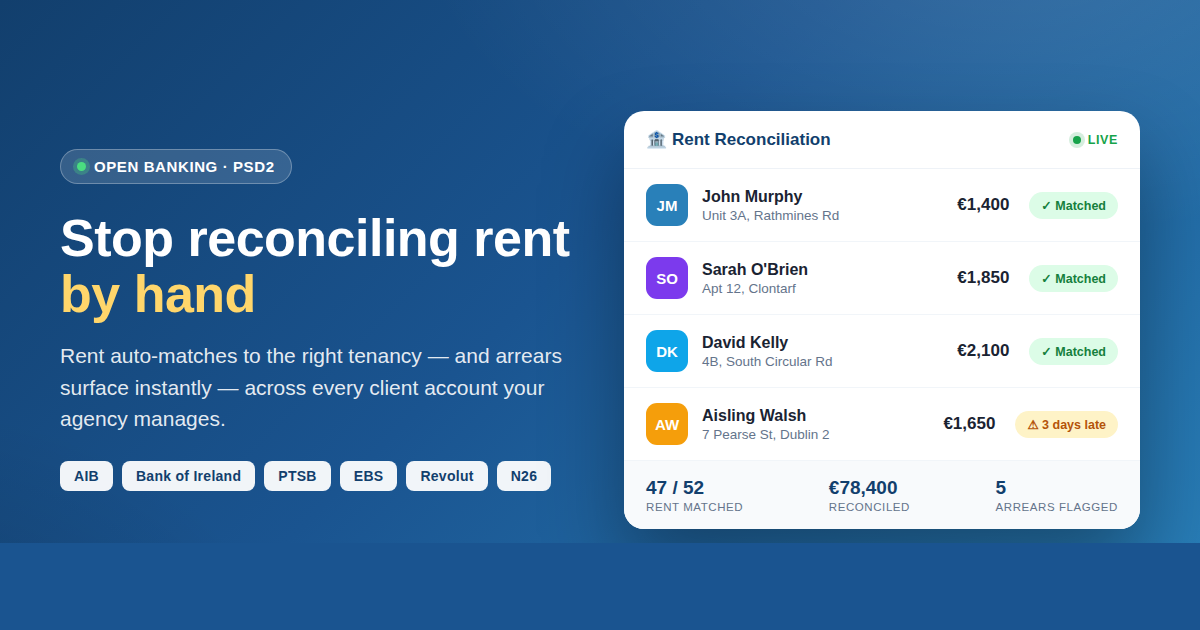
TenantSync connects a landlord's, agency's or designated client bank account through regulated, read-only Open Banking (PSD2) — the same rails Irish banking runs on, covering institutions including AIB, Bank of Ireland, PTSB, EBS, Revolut and N26. The connection can never move money; it only reads transactions. From there it runs continuously:
- Automatic import. Balances and transactions sync several times a day, de-duplicated, with no statement to download.
- Deterministic matching. Each inbound payment is scored against your active leases and invoices using multiple signals — exact or near-exact amount, the invoice's billing period and due-date window, the tenant's legal name and payer aliases, explicit rent reference tokens, and the recurring monthly pattern from the same account.
- A clear status on every payment. Each transaction becomes MATCHED, REVIEW_REQUIRED (plausible but ambiguous — ranked candidates shown for a one-click confirm) or UNMATCHED, each with a confidence score and the reasons for the match.
- Books that update themselves. A confident match creates the payment record and updates the linked invoice's paid amount and status automatically — no double entry.
- Bank-verified arrears detection. A tenant with no matching payment since the last due date is flagged automatically, and alerts go to both the property owner and the tenant (with a cooldown so nobody is over-messaged).
- A tenant statement of account. Each lease has a ledger of rent charged versus bank-verified rent paid — the clean, shared record that ends "did they pay?" disputes.
For agencies: reconciliation feeds the whole money flow
Because the same feed underpins agency rent collection, it flows straight through: collect rent, deduct the configured management fee, record and approve contractor work, and generate a monthly landlord disbursement statement — with a secure link the landlord can view and approve. Reconciliation stops being a monthly chore and becomes the engine that pays everyone correctly. See how Open Banking rent reconciliation works for Irish letting agents and how to identify rent payments on a bank statement.
💡 The unit-economics point
Manual reconciliation is the clearest example of a cost that scales with your portfolio: 20 units is an afternoon, 200 units is a full-time job. Automated matching breaks that link — you add doors without adding the hours. That's the core of scaling a letting agency without adding headcount.
Cost Centre 3: Tenant & Landlord Communication
The third cost centre is the one agents feel every day but rarely cost out: communication. It's the rent reminder you send by hand, the arrears nudge you keep meaning to send, the landlord report you assemble at month-end, and the steady drip of "any update?" emails from clients who simply can't see what's happening. Individually, each is minutes. Together, they're the reason the phone never stops — and the reason landlords sometimes leave.
Because here's the uncomfortable truth: a landlord rarely leaves over a single mistake. They leave because the service feels unreliable — because they had to ask, more than once, for something they expected to arrive on its own. Communication is where trust is won or lost, and manual communication loses it slowly.
How TenantSync keeps everyone in the loop, automatically
TenantSync turns communication from a chase into a system, across three channels — email, in-app and mobile push — with per-user preferences so people are reached the way they want to be:
- Tenants get billed and reminded on autopilot. Invoices are issued as PDFs and sent to the tenant, then reminders fire automatically — 7 days before the due date, on the due date, and again at 3 and 10 days overdue — so you stop being the collections department.
- Arrears alerts reach the right people. When bank data shows rent hasn't arrived, both the owner and the tenant are alerted — early, and without you drafting a word.
- Landlords get statements, not silence. Monthly disbursement statements show exactly what was collected, deducted and paid over — delivered with a secure link the landlord can open and approve without an account. That's the "any update?" email answered before it's sent.
- Tenants can self-serve. A tenant can view their own bank-verified statement of account and be issued a rent certificate when they need one — no back-and-forth.
- Compliance keeps people informed too. RTB reminders — including Part 4 milestones — notify the right party at the right time, so tenants and landlords learn about their rights and obligations from you, on schedule.
- Maintenance stays on one thread. Each maintenance request carries a role-aware comment thread, so tenant, agent and landlord work from the same record — a tenant comment even moves the request status forward automatically. And for outreach at scale, agencies can send bulk landlord-to-tenant emails from one place.
Automated ≠ impersonal
Automating communication doesn't remove the human touch — it protects it. The system handles the predictable, repetitive messages (bills, reminders, statements, alerts) so your team's real attention goes to the conversations that need judgement: a tenant in genuine difficulty, a landlord weighing a decision. The chasing disappears; the relationship gets more of you, not less.
A note on what this is — and isn't
TenantSync's communication is structured and automated — invoices, reminders, alerts, statements, certificates, RTB notices and per-request maintenance threads across email, in-app and push. It's designed to end the manual chasing and keep everyone informed on time, which is where the cost and the client risk actually live.
🤝 Keep tenants and landlords in the loop — without the chasing
Automatic rent reminders, arrears alerts, landlord statements and RTB notices across email, app and push. Start free; no credit card to begin.
Putting a Number on It
You can't manage what you won't measure, so here's a simple, honest way to size your own bill. The figures below are illustrative — swap in your own — but the structure holds at every scale.
| Cost centre | Manual, today | With TenantSync |
|---|---|---|
| Compliance (RTB) | Deadlines diarised by hand; risk of a missed 30-day registration and late fees. | Every 30-day clock, renewal and rent-review date tracked automatically, with the RTB1 pre-filled. |
| Compliance (PSRA) | Licence, insurance, LoEs and client-account rules managed on paper and memory. | Licence renewals, LoEs, monthly client-account reconciliation and the Accountant's Report tracked in one module. |
| Rent reconciliation | Hours reading bank statements; arrears caught late. | Payments matched to leases automatically; arrears flagged the day they occur. |
| Communication | Manual reminders, ad-hoc updates, month-end report assembly. | Automatic reminders, arrears alerts and landlord statements across email, app and push. |
| The tool itself | Spreadsheets + inbox + bank app (and the errors between them). | Flat per-portfolio pricing, no per-property fees, one connected system. |
Do the arithmetic on your own numbers. Estimate the hours your team spends each month on reconciliation, compliance diarising and landlord updates, and value them at a loaded hourly rate. Then add the risk: the expected cost of one missed RTB deadline, one late-caught arrears case, and — the biggest line — the annual fee value of one landlord client you'd lose to unreliable service. For almost every agency, that total lands well above the price of the software that removes the work.
Transparent, per-portfolio pricing
TenantSync is priced flat and per-portfolio, with no per-property fees: Starter €20/mo (up to 10 units), Standard €99/mo (up to 100), Growth €149/mo (up to 200, including the PSRA/PSR compliance module), Premium €199/mo (up to 300), and custom Enterprise above that. There's a 14-day free trial and no credit card to start. For the full breakdown, see our guide to lettings software pricing in Ireland.
One System, Not Five
The deepest cost of manual management isn't in any single task — it's in the gaps between tools. Rent lives in the bank app, deadlines live in a spreadsheet, updates live in an inbox, leases live in a folder. Every gap is a place for something to be re-keyed, missed or lost, and every gap is a place a client's confidence quietly erodes.
TenantSync closes the gaps by making the three cost centres one connected flow. A signed, RTB-compliant lease creates the tenancy; that tenancy starts its own RTB registration clock and, for agencies, its client-money ledger; the rent that arrives is reconciled automatically against it; and the resulting activity drives the communication — the reminders, the alerts, the landlord statement. Nothing is re-typed into a second system, because there is only one.
- Built for agencies, not just landlords. Multi-branch structure, landlord clients, per-client reporting and PSRA/PSR compliance are modelled natively — the things a single-landlord app can't do. (See what agencies need that landlord apps lack.)
- Web for desk work, mobile for the move. The full dashboard runs in the browser where your team works; day-to-day tenancy tasks and reminders travel with you on the native iOS and Android apps.
- Switching is straightforward. TenantSync imports from Letman, so moving off spreadsheets — or an older system — doesn't mean starting from scratch. See migrating a letting agency off spreadsheets.
💡 The compounding effect
Each cost centre saves time on its own. Connected, they compound: reconciliation feeds the landlord statement, compliance feeds the reminders, the lease feeds them all. That's how agencies handle more doors with the team they already have — the essence of cutting admin for Irish letting agents.
Doing It Right: GDPR & the Human Decision
Automating money and compliance data raises real obligations — and done well, centralising the work makes them easier to meet, not harder.
- Read-only by design. Open Banking connections are read-only and consented on the bank's own screen — they can never move money, and the applicant or account holder's credentials are never shared with you.
- GDPR-friendly records. A single system with a clear audit trail gives you cleaner consent, storage and retention than data scattered across an inbox, a spreadsheet and a bank app — and it makes the PSRA's six-year retention requirement something you can actually satisfy on demand.
- Automate the admin, keep the judgement. Let the system handle reminders, reconciliation and reporting. Keep the decisions — how to handle a tenant in arrears, how to advise a landlord — as documented, human choices. That's the line that keeps efficiency on the right side of good practice.
Software supports compliance — it doesn't replace your duties
TenantSync tracks deadlines, drafts forms and keeps records, but you remain responsible for holding a valid PSRA licence and meeting your RTB and client-money obligations. Treat the platform as the system that makes those duties visible and hard to miss — and always confirm current rules with the RTB and PSRA.
Frequently Asked Questions
What does manual property management actually cost an Irish letting agency?
The visible cost is unbillable staff hours, but the larger cost is concentrated in three systems: compliance (RTB registrations, rent reviews and PSRA/PSR obligations that carry fees, sanctions and licence risk), rent reconciliation (arrears caught late when you match rent by eye), and tenant/landlord communication (time spent chasing, plus the landlord clients lost when service feels unreliable). Add your admin hours to the compliance and client-loss risk, and the total almost always exceeds the price of software that removes the manual work.
How much does RTB registration cost, and what are the penalties for missing it?
A tenancy must be registered with the RTB within one month of starting. On time, the standard annual fee is €40 per tenancy, with a composite fee for multiple tenancies in one building; miss the deadline and a late fee applies, with the RTB able to pursue sanctions for non-registration. Always confirm the current fees and penalties on rtb.ie, as they change. The real cost of manual management here is the risk of a missed deadline across a whole portfolio — which software prevents by tracking every 30-day clock automatically.
What is PSRA / PSR compliance and why does it matter for letting agents?
Letting agents are Property Services Providers regulated under the Property Services (Regulation) Act 2011 and licensed by the PSRA. Compliance includes holding and renewing the correct licence (Type C for letting), professional indemnity insurance, tax clearance, a signed Letter of Engagement before acting for a client, and handling rent as client money under the Client Moneys Regulations 2012 — a designated client account, per-client ledgers, monthly reconciliation and an annual Accountant's Report. Where RTB compliance protects the tenancy, PSRA compliance protects the agency's licence to operate, so a lapse is existential rather than routine.
How does automated rent reconciliation work in Ireland?
TenantSync connects a landlord's, agency's or designated client bank account via regulated, read-only Open Banking (PSD2) and imports transactions automatically. It matches each inbound payment to the right lease and invoice using deterministic signals — amount, invoice billing period and due-date window, tenant name and payer aliases, rent reference tokens, and the recurring monthly pattern — and marks each transaction matched, review-required or unmatched with a confidence score. Matched payments update the invoice automatically, and bank-verified arrears detection flags any tenant with no matching payment since the last due date, alerting owner and tenant.
Which Irish banks does Open Banking support?
TenantSync uses regulated PSD2 Open Banking, which covers Irish institutions including AIB, Bank of Ireland, PTSB, EBS, Revolut and N26, among others, supervised by the Central Bank. The connection is read-only — it cannot move money — and consent is given on the bank's own screen, so credentials are never shared with the agent.
Is TenantSync only for letting agents, or can individual landlords use it too?
It's built primarily for Irish letting agents and agencies — it models branches, landlord clients, per-client reporting, agency rent collection and PSRA/PSR compliance in ways a single-landlord app can't. It also serves individual landlords who want RTB compliance tracking, Open Banking rent reconciliation and automated tenant communication for their own portfolio. Pricing is flat and per-portfolio from €20/month, with a 14-day free trial and no per-property fees.
Summary
- The real cost of manual property management isn't the visible admin hours — it's the risk that hides in three systems manual work breaks.
- Compliance (RTB & PSRA): RTB registration within 30 days (€40 on time, late fees and sanctions after), rent-review limits under the 2026 national rent cap, and PSRA duties — licence, LoEs, client money, insurance — where a lapse risks your licence to operate. TenantSync tracks every clock and drafts the forms.
- Rent reconciliation: matching rent by eye against bank statements is error-prone and scales with every unit. Read-only Open Banking matches payments to leases automatically, flags arrears the day they occur, and updates the books.
- Tenant & landlord communication: automatic reminders, arrears alerts, landlord disbursement statements, rent certificates and RTB notices across email, app and push — ending the chasing that quietly loses clients.
- One connected system — not a spreadsheet, an inbox and a bank app — closes the gaps where money and trust leak, so you grow the portfolio without growing the headcount.
- Priced flat and per-portfolio from €20/month, with a 14-day free trial — almost always less than the manual work it replaces.
📈 Stop paying the hidden cost of manual management
Track every RTB & PSRA deadline, reconcile rent automatically via Open Banking, and keep tenants and landlords in the loop — on the platform built for Irish letting agents and agencies. See it on your own portfolio, or start free today.
Related Articles