How Irish Letting Agents Can Reduce Admin Time by Up to 50%
Ever found out an RTB registration deadline passed two weeks ago — on a tenancy that wasn't even yours to set up, but is now yours to explain to the landlord? The admin in an Irish letting agency rarely fails loudly. It fails quietly, in a date nobody opened, and it lands on you. This is where the recurring hours actually go, which ones better workflow management can take off your desk, and an honest tally of how close to half your structured admin you can realistically claw back.

You're not short on work ethic. You're short on hours, because a chunk of your week goes on repetitive admin that carries real liability — a registration that has to be filed inside 30 days, a rent increase that has to sit under the legal cap, a payment that has to be matched to the right tenant before a landlord rings asking where their money is. None of it is hard. All of it is exposure if it slips. The point of this article is not to tell you to work faster. It's to show you which of those tasks a computer should be doing, and roughly how many hours that hands back.
Where do the admin hours actually go?
Before anyone talks about saving time, it's worth being specific about where the time goes. Take an illustrative agency: around 120 tenancies across roughly 40 landlord clients, two or three staff. Strip out the parts of the week that aren't really back-office admin — viewings, phone calls, landlord meetings, chasing contractors — and you're still left with something like 30 hours a week of structured, repeatable admin. Here's a rough map of it, and what's left of each task once it's automated.
| Recurring admin task | Roughly, by hand | With workflow automation |
|---|---|---|
| Registering tenancies with the RTB & tracking 30-day deadlines | ~2 hrs / week | ~15 mins |
| Working out a legal rent increase under the cap | ~1.5 hrs / week | ~10 mins |
| Reconciling rent to the right tenant from the bank | ~4 hrs / week | ~45 mins |
| Replying to Daft.ie / MyHome.ie inquiries & collecting documents | ~4 hrs / week | ~1 hr |
| Tracking BER, gas, electrical, insurance & AML | ~1.5 hrs / week | ~20 mins |
| Monthly landlord statements & disbursements (weekly average) | ~2 hrs / week | ~20 mins |
| Generating rent invoices & chasing late payments | ~2 hrs / week | ~15 mins |
| Total (illustrative) | ~17 hrs / week | ~3 hrs / week |
These figures are illustrative, not a study — your numbers will differ with portfolio size, how many landlord clients you carry, and how much of this you've already tightened up. The point isn't the exact total. It's that these specific tasks are repetitive, rules-driven and high-stakes, which is exactly the profile of work software handles better than a person with a spreadsheet and a good memory.
The real problem isn't effort — it's fragmentation
Here's the thing most agents already sense: the hours don't disappear into any single task. They disappear into the gaps between tasks. A new inquiry lands in the Daft inbox. The applicant's details get typed into a spreadsheet. The lease is drafted in Word. The rent shows up in the bank's online portal. The registration is filed on the RTB portal. The compliance dates live in a tracker nobody fully trusts. And the CRM your agency runs on — most likely Acquaint — was built for sales, listings and contacts, not for Form RTB1 or the national rent cap.
So the same tenancy gets re-keyed five times across five systems that don't talk to each other. Every hand-off is a chance to drop a date, mistype a rent figure, or lose track of which applicant sent which document. That's the swivel-chair tax: not the work itself, but the constant moving of the same information from one screen to another. Better workflow management isn't about working harder inside each of those tools. It's about removing the gaps between them so a tenancy flows from inquiry to registered, rent-reconciled and compliant without being typed in five times.
What does better workflow management look like?
Take the six high-cost tasks from the table and look at what each becomes once the system does the moving for you. This is where TenantSync fits — the Irish compliance-and-automation layer that handles the regulatory admin a generic CRM leaves open.
Registering tenancies with the RTB
The moment you save a lease, a registration record is created and the Form RTB1 is pre-populated from the lease, property, landlord and tenant data you already entered. The 30-day registration deadline and the annual renewal date are calculated automatically, and reminders chase you before either lands. You move through a draft, validate, preview and finalise workflow, and the finalised PDF is stored against the tenancy. The outcome: registration stops being two hours a week of form-filling plus a low hum of worry about a missed date, and becomes a draft sitting ready for a quick check. If you want to sanity-check a deadline right now, the free RTB deadline checker does it in seconds, and our guide to the RTB registration deadline every agent should know covers the rules in full.
Working out a legal rent increase
What is an RPZ rent cap?
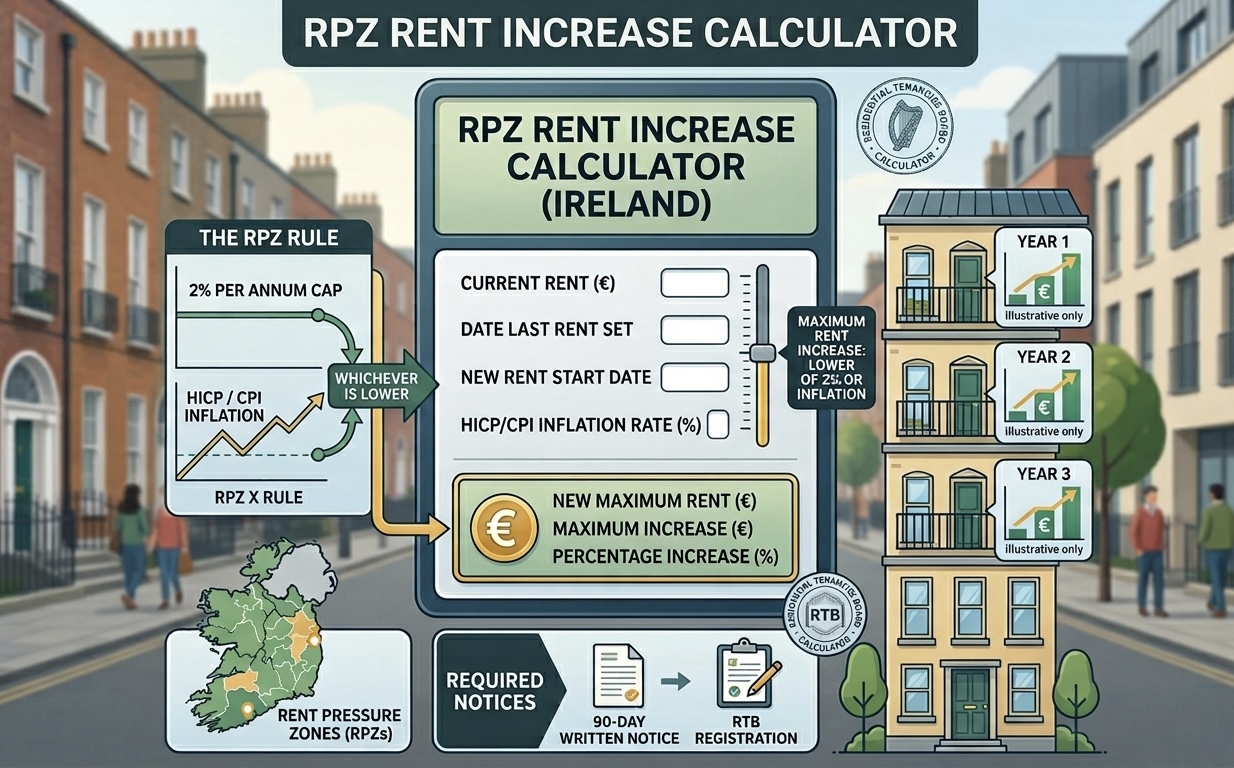
An RPZ rent cap is the legal limit on how much rent can be increased at a review. Since 1 March 2026 these controls apply nationwide, not just in designated Rent Pressure Zones: the increase is capped at inflation (measured by HICP) or 2%, whichever is lower, between valid rent reviews.
Getting that figure right by hand means cross-referencing the relevant HICP notice, applying the lower of the two rules, and documenting your working in case it's ever questioned. The free RPZ rent-increase calculator does it with live HICP data and returns the suggested maximum rent, the HICP-linked figure, the 2% figure, and which rule applied — so a calculation that used to take fifteen minutes of careful cross-referencing takes about thirty seconds, with the working shown. That matters more now that an invalid review can be unwound. For the mechanics, see how the RPZ rent calculation actually works.
Reconciling rent to the right tenant
Connect your Irish bank accounts through Open Banking — AIB, Bank of Ireland, PTSB, EBS, Revolut, N26 and others — and incoming transactions are auto-matched to tenants and invoices on amount, reference, name and recurring pattern. A clean match updates the invoice on its own; anything ambiguous drops into a review queue instead of guessing. So the weekly line-by-line read of the bank statement becomes a short queue of edge cases, and arrears surface the day they happen rather than the day a landlord asks. We go deeper on this in our guide to finding rent payments in a bank statement.
Handling Daft.ie and MyHome.ie inquiries
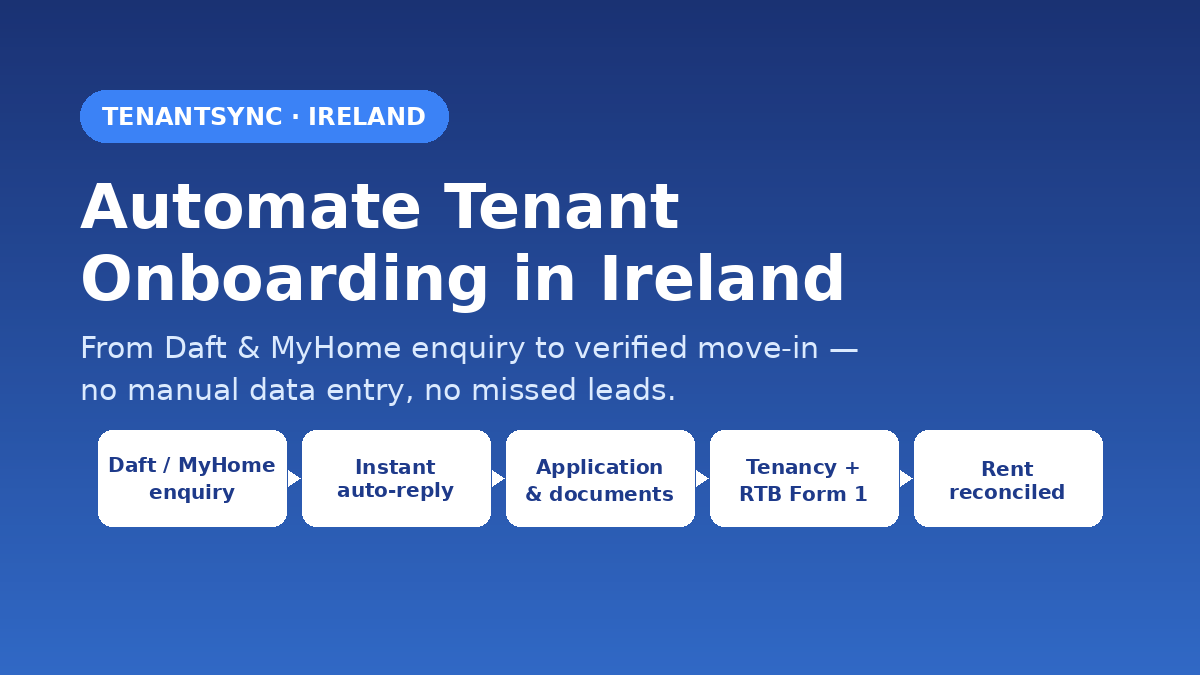
Register the mailbox that receives your portal inquiries and inbound emails are parsed into structured lead records — applicant name, email, phone, message and property — instead of sitting in an inbox waiting to be re-typed. Each lead moves through a clear pipeline (new, contacted, form submitted, reviewed, approved or rejected), and an auto-response sends the applicant a token-gated form to submit their details and upload ID, payslips and references themselves. The agent who replies first to a busy listing tends to win it, and here the first reply is automatic while the document collection becomes self-serve. Our walkthrough on automating tenant onboarding from a Daft or MyHome enquiry shows the full funnel.
Keeping BER, gas, electrical, insurance and AML current
A compliance dashboard tracks the full obligation surface for every property — RTB registration and renewal, rent review, Part 4 notices, BER certificate, insurance, fire alarm, gas safety cert, electrical cert and AML review — colour-coded as compliant, upcoming or overdue, with automated reminders. Instead of a spreadsheet plus memory, you get one view that tells you what's due and when, across the whole portfolio. For a landlord-facing version of the same obligations, our 2026 RTB compliance checklist doubles as an audit of what your tracker should already cover.
Monthly landlord statements and disbursements
Rent invoices generate automatically across the portfolio each month, with PDFs and a reminder schedule (seven days before, on the due date, and at three and ten days overdue). For agencies, the month-end is built in too: management-fee deduction, contractor payments, and per-branch landlord disbursement statements, with a token-gated approval page where the landlord signs off their own statement. The monthly statement run stops being something you rebuild from scratch and becomes something you review and release.
So where does the 50% actually come from?
Add the table back up. In the illustrative agency, those repetitive tasks came to about 17 hours a week by hand and roughly 3 hours once automated — call it 14 hours handed back. Set that against the ~30 hours of structured back-office admin the same agency does in a week, and you're cutting it by a little under half. That's where the 50% comes from: not a marketing stat, but the sum of the specific tasks above.
Be honest about what doesn't move
Automation takes the repetitive, rules-driven half of the admin. The relational half — viewings, negotiations, the phone call to a landlord who's anxious about their tenant, the judgement calls — isn't going anywhere, and shouldn't. The realistic claim isn't "do your whole job in half the time." It's "get back roughly half the hours you currently lose to the work a computer should be doing."
The figures here are a worked example, not your agency. The useful exercise is to run your own: take last week, mark every task that was repetitive and rules-driven, and add up the hours. Then check one of those rules for free right now — run a rent review through the RPZ calculator — and see how long the manual version really took you.
Do you have to replace Acquaint?
No — and you shouldn't have to. If your agency runs on Acquaint for sales, listings and contacts, your team knows it and it works for that. TenantSync isn't a rip-and-replace; it's the Irish compliance-and-automation layer that sits alongside the CRM you already use, filling the regulatory and reconciliation gap those tools leave open. Keep your CRM for what it's good at, and add RTB registration, the national rent cap, Open Banking reconciliation, portal inquiry handling and the compliance calendar around it.
If you're weighing where it fits, our honest look at Acquaint alongside TenantSync and our buyer's guide to property management software for Irish agencies compare the options without pretending there's one tool that does everything.
Check a rent cap before you commit to anything
The fastest way to see whether TenantSync is built for Irish rules is to use it. Run a real rent review through the free RPZ calculator, or check a registration deadline — no login, about thirty seconds.
Frequently asked questions
Do I have to replace my CRM to reduce admin?
No. TenantSync is the Irish compliance-and-automation layer that sits alongside your existing CRM, not a rip-and-replace. Most agencies run Acquaint for sales, listings and contacts and keep it. TenantSync handles the part those tools were never built for: RTB registration, the national rent cap, Open Banking rent reconciliation, portal inquiry handling and the compliance calendar. You keep the CRM your team already knows and add the Irish-regulatory layer it leaves open.
Is TenantSync actually built for Irish rules?
Yes — that is the whole point of it. Generic UK or global property tools don't know about Form RTB1, the 30-day registration deadline, annual RTB renewal, Part 4 tenancies, or the national rent cap of 2% or HICP, whichever is lower. TenantSync pre-populates the RTB1 from your lease and property data, calculates the registration and renewal deadlines, and checks every rent review against the live HICP-linked cap. It's Irish-specific by design, not a settings toggle bolted onto a foreign product.
How long does it take to set up?
For a typical small or medium Irish agency, the slow part is gathering your data, not the software. Properties, tenancies, leases and rent details import from a spreadsheet or directly from other software, and a guided first session can have you importing, validating RTB dates, connecting a bank account for reconciliation and registering the inquiry mailbox the same day. Plan for a few days end to end rather than weeks, and run it alongside your current setup for one rent cycle before switching fully.
What happens to the RPZ calculation when the rules change?
The calculator uses live HICP inflation data and the current statutory cap, so it reflects the rule in force when you run it rather than a figure hard-coded once and forgotten. It returns the suggested maximum rent, the HICP-linked figure, the 2% figure and which rule applied, so you can see the working. When the underlying rate or rule changes, the calculation changes with it — which matters now that controls apply nationwide and an invalid rent review can be unwound.
Can the mobile app do all of this?
Not yet, and we'd rather be straight about it. Invoicing, Open Banking reconciliation, RTB registration, the RPZ rent-cap calculation and lead management are web features. The mobile app complements them but doesn't currently include those workflows, so the admin reduction described here is delivered through the web app. Don't plan around mobile parity for those specific tasks.
Does the free RPZ calculator need a login?
No. The RPZ rent-increase calculator and the RTB deadline checker are free public tools with no login required — enter the figures and you get the answer in about thirty seconds. They're the same calculations used inside TenantSync, released publicly so you can sanity-check a rent review or a registration deadline without signing up for anything.
Sources & further reading
Facts in this article are drawn from official and primary sources. Product details were correct as published in June 2026 — verify on tenantsync.ie before deciding. The admin-hour figures are an illustrative worked example, not a study.
- Residential Tenancies Board — Register a tenancy and rental law changes from 1 March 2026
- Citizens Information — Rules around rent increases and registering a tenancy with the RTB
- Government of Ireland — Reforms to the rental sector, starting 1 March 2026
- TenantSync — tenantsync.ie (features, free tools and pricing)
Related Articles