The 3-Comparables Rule: Setting Rent With the RTB Rent Register, Screen by Screen
Every Irish letting agent has heard the rule described: back the rent with three comparables from the RTB Rent Register. Far fewer have watched someone do it well. This is the walkthrough — what to have in hand before you search, how the Register decides what counts as a match, why the first three results are usually the wrong three, what goes in Part C of the notice, and the evidence pack that still has to exist when the rent is challenged a year from now.
The short version
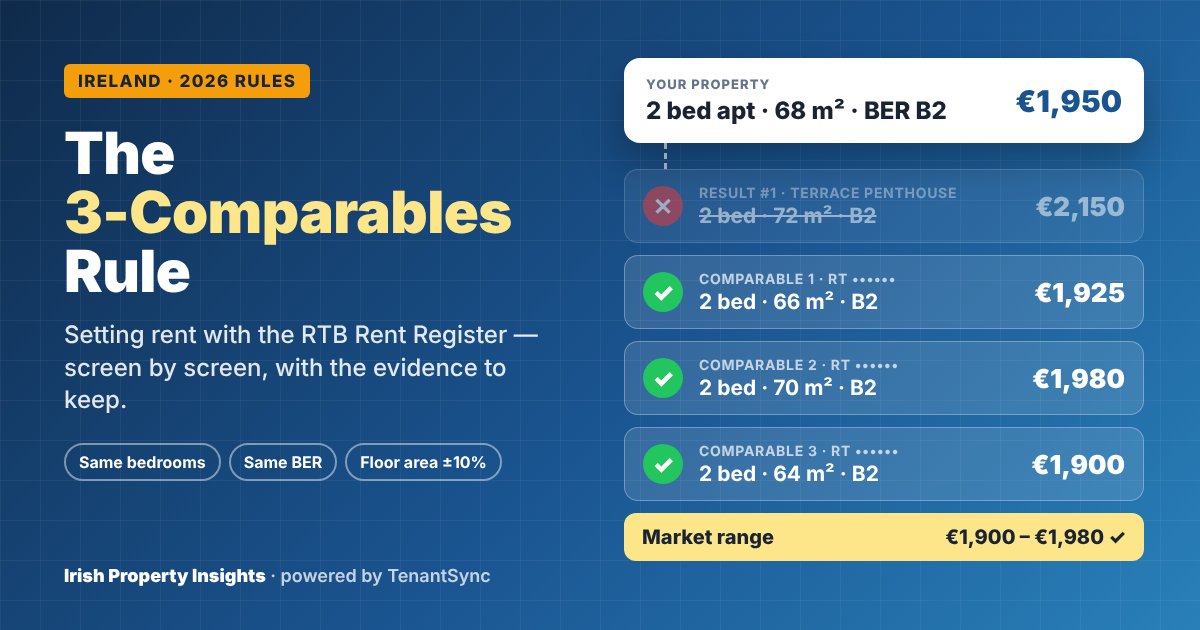
What is the 3-comparables rule? When you set or review a rent in Ireland, you must be able to show it is not above market rent using the RTB Rent Register: three recent rents for dwellings of similar size, bedrooms, type, character and BER in a comparable area, each cited by its RT number and rent. The Register searches by the Local Electoral Area of your Eircode and ranks exact matches first — same bedrooms, same BER, floor area within 10%. You choose the three; they don't have to be the first three. Keep a dated printout with the notice.
When You Need Three Comparables
The RTB Rent Register is the RTB's published record of the rents being paid on registered tenancies. Since 1 March 2026, it is also the reference point for one question every rent now has to answer: is this rent above market rent? The RTB's guidance is that you use information from the Register to show it isn't, by giving three examples of the most recent rents paid for similar properties in a comparable area.
The legal test behind "similar" is now spelled out: dwellings of a similar size (measured by floor area), number of bedrooms, type and character, and — where it applies — BER, in a comparable area. Hold on to that list. Every step below is about satisfying it, and only some of it is something the Register can filter for you.
Where it bites depends on what you are doing with the rent:
| Situation | What caps the rent | What the comparables do |
|---|---|---|
| New tenancy, rent reset to market Dwelling not let for 2 years, or a Part D exemption — e.g. the last tenant left voluntarily |
Market rent only | They are the ceiling. The whole case for the figure rests on them. |
| New tenancy, previous rent carries over e.g. the last tenancy ended on a no-fault ground |
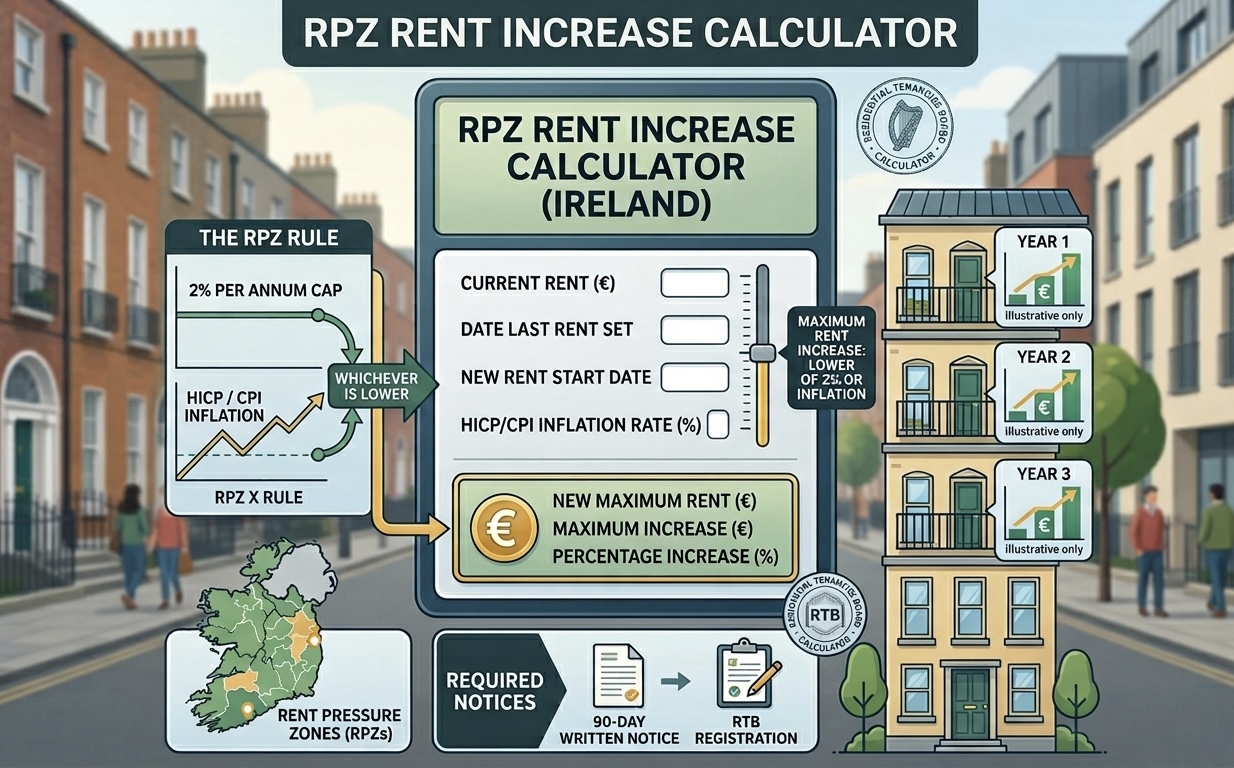
The national rent cap from the last rent and the date it was set | Part C of the Notice of Rent Setting still asks for three — they show the capped figure isn't above market either. |
| Rent review, sitting tenant | The cap: the lower of 2% a year or CPI, once in 12 months, 90 days' notice | The RTB frames the test around market rent — check its rent review guidance for your facts. Including them costs nothing; omitting them where required can cost the notice. |
| Same tenant, new fixed term | The cap — a renewal is a continuation, not a reset | As for a review. There is no "reset on renewal". |
This page is the how. If you need the whether — which endings allow a reset to market rent and which carry the old rent forward — start with how to set rent under the 2026 rules, then come back.
Two Ceilings: The Cap and the Market
The most common misunderstanding about the Register is that it tells you what you're allowed to charge. It doesn't. It tells you what the market is paying. The legal maximum is the lower of two separate numbers:
So comparables can lower what you can charge, but they can never raise a capped rent. A three-bed whose rent has been carried over at €1,700 doesn't get to €2,100 because the street is now paying €2,100 — the cap governs until a lawful reset point. Our national rent cap field guide covers Ceiling 1. The rest of this page is Ceiling 2.
What to Have in Hand Before You Search
The search takes minutes. The mistakes happen before it, when someone types a floor area from memory or guesses the BER. Assemble the subject property's facts first, from documents you'd be happy to show an adjudicator:
- Eircode — this is what the Register uses to find the Local Electoral Area.
- Dwelling type — apartment, house and so on, as you'd describe it on the registration.
- Number of bedrooms — the Register requires an exact match on this.
- Floor area in m² — one measured figure, with its source noted. Gross from one document and net from another is how a 10% band quietly goes wrong.
- BER rating — from the current certificate, not last year's advert.
- The character notes the Register can't filter — own-door or apartment block, floor level, period or new build, outdoor space, parking, condition, furnished or not.
- The rent you intend to set, and — if a cap applies — the last rent and the date it was set.
Use the same numbers everywhere
Floor area and BER appear on the RTB registration, on the Notice of Rent Setting and in the Register search. If the three disagree, the first question at a hearing will be which one is true. Capture them once, from the source document, and reuse them.
The RTB Rent Register, Screen by Screen
The Register lives on rtb.ie and is free to use without logging in. TenantSync isn't affiliated with the RTB; the steps below describe how the RTB says the search behaves, and the layout on the day may differ from our description.
-
Set the area
Enter the property's Eircode or address. The Register matches it to a Local Electoral Area and returns results only from that area. It does not rank by distance from your property. Where your own area has no good matches, you can search a comparable area by choosing a different one — note why you did.
-
Describe the dwelling
Enter the dwelling type, number of bedrooms, floor area and BER — the facts you assembled above.
-
Read the ranking, not just the rents
The Register returns a short ranked list — the RTB describes up to 10 results. Exact matches come first: same bedrooms, same BER and floor area within 10% of yours. If there are fewer than 10, weaker matches fill the list: first those that differ only on BER, then those whose floor area is more than 10% away. Note which kind each result is.
-
Choose three — on character as well as attributes
Shortlist the exact matches, then test each one against the things the Register can't see: type and character, floor level, outdoor space, condition. Prefer the most recent rents. You do not have to use the first three results — and often you shouldn't (see why).
-
Record each one
For each comparable, write down its RT number (the registered tenancy number) and its rent — these are what the notice cites. Add your own note of why you chose it and how it differs from the subject property.
-
Save the results, with the date
Download or print the results page. The Register is live data: new tenancies register, rankings move, and the list you saw today will not be the list a tenant sees in six months. A dated printout is the only way to show what the Register said when you set the rent.
-
Test the rent against both ceilings
Is your figure at or below what the three comparables support? If a cap applies, is it also within the cap? If it's above the comparables, stop and ask whether you can genuinely justify it as market rent — because the Register says otherwise.
-
Complete the notice and file the pack
Enter the three RT numbers and rents in Part C of the RTB's prescribed notice, serve it, copy it to the RTB within the deadline, and file the printout, your notes and the notice together against the tenancy.
What a results list can look like
Here is an invented example for a two-bed apartment, 68 m², BER B2, where the landlord is entitled to reset to market and the agent proposes €1,950 a month.
| # | Floor area | BER | Rent | Match & verdict |
|---|---|---|---|---|
| 1 · 2 bed apt | 72 m² (+6%) | B2 | €2,150 | Exact Skip Top-floor unit with a large terrace — not similar in character. |
| 2 · 2 bed apt | 66 m² (−3%) | B2 | €1,925 | Exact Use Same block type, mid floor, balcony. |
| 3 · 2 bed apt | 70 m² (+3%) | B2 | €1,980 | Exact Use Similar age and spec. |
| 4 · 2 bed apt | 64 m² (−6%) | B2 | €1,900 | Exact Use Smaller, otherwise alike. |
| 5 · 2 bed apt | 69 m² (+1%) | B3 | €1,940 | Weaker · BER Reserve if one of 2–4 falls away. |
| 6 · 2 bed apt | 81 m² (+19%) | B2 | €2,200 | Weaker · size Skip Outside the 10% band. |
Result 1 ranks first and carries the highest rent. It is also the one an adjudicator would pick apart: a penthouse with a terrace isn't "similar in character" to a mid-floor flat. Results 2, 3 and 4 support €1,900–€1,980, and €1,950 sits comfortably inside that range. Had the agent taken the top three by rent instead (1, 6 and 3), the "evidence" would have pointed to over €2,100 — and fallen apart the first time a tenant looked at it.
Why the First Three Results Are Usually the Wrong Three
The Register ranks by how well a tenancy matches the attributes you typed in. That's useful, and it's not the same thing as "comparable". Five reasons the top of the list is a starting point, not an answer:
It can't see character
Type, character and condition are part of the test, but only type is a search field. A period conversion and a 2019 block can be an exact match on paper.
An LEA is not a neighbourhood
Results come from the whole Local Electoral Area, not the nearest streets. Two exact matches can sit in markets that rent very differently.
Weaker matches fill thin areas
With fewer than 10 exact matches, BER-mismatched and size-mismatched tenancies appear in the same list. Easy to cite one without noticing.
Recency matters
The RTB asks for the most recent rents. An older tenancy in a fast-moving market understates — or overstates — what the market pays now.
Highest-first looks like cherry-picking
Three comparables that happen to be the three highest rents in the list is the pattern a tenant's representative will look for first.
The defensible habit is simple: shortlist the exact matches, rule out the ones that fail on character, choose the most recent of what's left, and write one line on each saying why. That line is what turns three numbers into an argument.
🧮 Check Ceiling 1 before you search for Ceiling 2
If the previous rent carries over, comparables can't lift it. Enter the last rent and the date it was set and get the maximum under the national rent cap — with the rule that applied (2% or CPI) and the CPI figure shown. Free, no login.
Free Comparables Match Checker
Before you commit three comparables to a notice, check them against the subject property the way the Register grades a match — and see whether your proposed rent sits inside the range they support. It's pre-filled with the example above; change anything.
Comparables match checker
Grades each comparable against the RTB's described match rules (same bedrooms, same BER, floor area within 10%) plus type and area, and compares your rent to the range. Runs entirely in your browser — nothing is sent anywhere.
—
A sense-check, not a ruling. The grading follows the RTB's published description of how the Register matches (same bedrooms, same BER, floor area within 10%) and adds type and area, which the Register filters on. It can't judge character — floor level, outdoor space, condition, period or new build — which is part of the legal test and yours to assess. Where your rent sits outside the range, it doesn't mean the rent is unlawful; it means you need to be able to justify it. Confirm the rules on rtb.ie.
Filling in the Notice: Part C and Friends
On a new tenancy, the comparables travel on the RTB's prescribed Notice of Rent Setting. Part C is where they live, but it only makes sense alongside the parts around it — and the parts around it are where a careful Part C gets undone by a careless field elsewhere.
| Part | What it holds | Where agents slip |
|---|---|---|
| A · The dwelling | Address, Eircode, previous and current RT numbers, tenancy start date, floor area, BER, and whether it's a new apartment or SSA where development commenced from 10 June 2025 | A floor area or BER that doesn't match the one used in the Register search |
| B · The rent | The new rent, the last rent and the date it was set, the rent control rule applied, and whether the RTB Rent Calculator output is attached | Last rent or date missing, so the cap can't be checked |
| C · Comparables | Three comparable dwellings from the Register — each by RT number and rent | Two comparables, or an address instead of an RT number |
| D · Exemption | Any ground claimed for setting the rent outside the cap — no tenancy in two years, substantial change, or how the last tenancy ended | Claiming a ground with no evidence, or a substantial-change ground without the declaration |
| E · Documents | The supporting documents attached — e.g. BER certificates, an architect's letter, planning permission | "Attached" ticked, nothing attached |
Part D is where a reset is claimed — so Part C has to carry it
The grounds in Part D fall under three headings: no tenancy (none in the two years before this one; or none in 12 months for a protected structure), substantial change (a permanent extension adding at least 25% of floor area; a BER improved by seven or more ratings; or at least three of five listed works — each with a declaration that the works weren't done solely to meet minimum standards), and end of tenancy or cycle (the tenant ended the last tenancy; it ended for breach or because the dwelling no longer suited them; or, for student-specific accommodation, the end of a three-year cycle). Claim one and the cap falls away — leaving Part C as the only thing standing between your figure and a successful challenge.
Serving It: The Tenant and the RTB
Two recipients, two clocks — and the clocks differ by notice type, which is exactly why they get confused.
| Notice | Tenant | Copy to the RTB |
|---|---|---|
| Notice of Rent Setting (new tenancy) | At the start of the tenancy — by email, post or hand delivery | Within one month of the tenancy start date, per the RTB's current guidance |
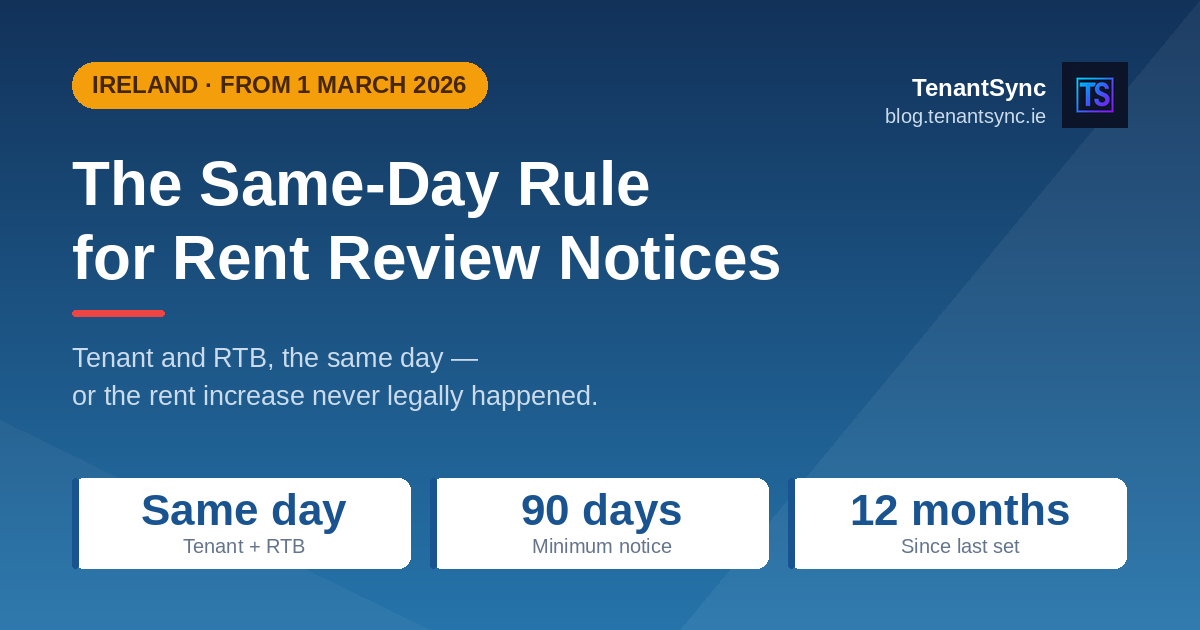
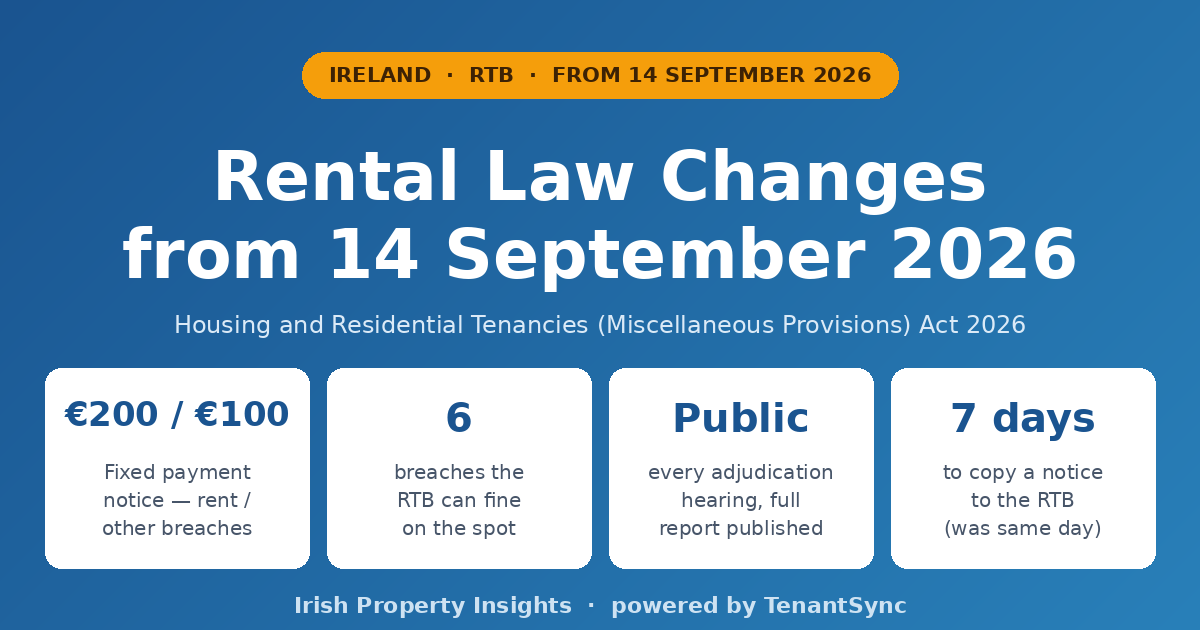
| Notice of Rent Review (sitting tenant) | At least 90 days before the new rent applies | Within 7 days of the date the tenant was served (since 14 September 2026) |
Both go to the RTB through its online Service Centre — see our guide to the RTB portal. Our advice is the same for both: send the RTB copy the day you serve the tenant. One action, nothing pending, and no window in which a holiday or a sick day turns into a breach. The full review rules are in why your rent review notice can be invalid.
Since 14 September, the slips are cheaper to fine
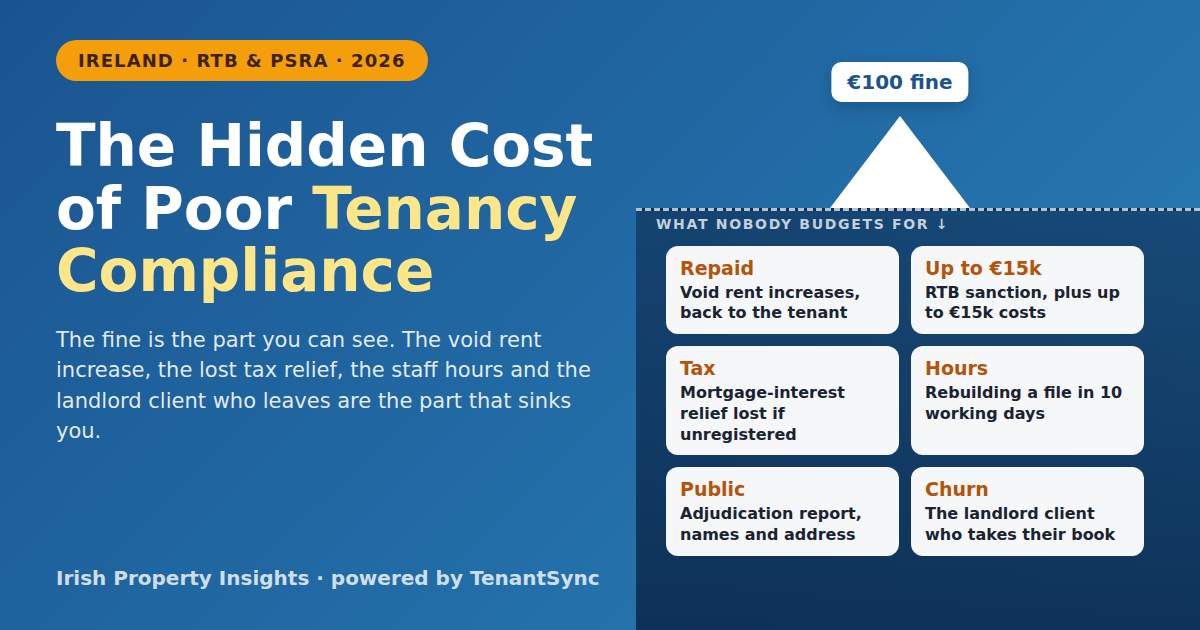
The RTB can now issue fixed payment notices without opening an investigation, and three of the six breaches sit squarely on this page: failing to give rent setting information at the start of a tenancy, failing to notify the RTB of a rent exemption, and setting rent above the legal limit — €100 for the first two, €200 for a rent breach. The fine is the small part: any excess collected is repayable, and adjudication reports for disputes applied for from 14 September are published with the property address. See the hidden cost of poor tenancy compliance.
The Evidence Pack to Keep
An incoming tenant can refer the rent to the RTB if they believe it's above market rent. Under six-year Tenancies of Minimum Duration, the rent you set on day one is the base every later review is measured from — so the file behind it may be opened years from now, by someone who wasn't there. Build it as if that someone is an adjudicator, because they might be:
- The dated Register printout The results as they appeared on the day, with the search inputs visible.
- The three comparables, with your reasoning RT number, rent, and one line each on why it's comparable — and why higher-ranked results were set aside.
- The subject property's facts and their sources Floor area and BER as used, and the documents they came from.
- The cap calculation, if a cap applied Last rent, date set, the rule applied (2% or CPI) and the CPI figure — the RTB Rent Calculator printout.
- Part D evidence, if a reset was claimed Why the last tenancy ended, or the works and certificates behind a substantial-change ground.
- The notice exactly as served Not a regenerated copy — the PDF the tenant received.
- Proof of service on the tenant and the RTB How and when the tenant got it, and the RTB submission confirmation.
Keep it against the tenancy, not in the inbox of whoever happened to do the let. Agencies don't lose disputes because their comparables were weak. They lose them because the comparables were in a negotiator's downloads folder and the negotiator left in March.
Doing It 120 Times a Month
For a landlord with four properties, the comparables step is an evening a year. For an agency it is a production line — and production lines fail differently. The issue isn't whether a skilled negotiator can pick three good comparables. It's whether every negotiator does, the same way, on a Friday in August, and whether the result can be found again.
Worked example: one mid-sized agency's month
An agency managing 300 tenancies does 15 new lets and 25 rent reviews in a month — 40 notices.
- Comparables sourced: 40 × 3 = 120 a month, or 1,440 a year
- At 25 minutes per notice to gather the facts, search, choose, record and file: 40 × 25 = ~17 hours a month
- Evidence packs that must be retrievable on demand: 480 new ones a year, each tied to a tenancy that may run six years
The search is the cheap part. The expensive parts are variance between negotiators and retrieval a year later — and neither shows up until a tenant disputes a rent. Illustrative figures; use your own.
That's the case for a standard operating procedure: the same facts captured the same way, a written selection rule, a reviewer on resets, and one place where every pack lives. We cover the broader operational version in scaling a letting agency without adding headcount.
Ten Mistakes That Sink a Rent
Taking the first three results. Ranking is attribute-matching, not a judgement of comparability.
Taking the three highest rents. It's the first pattern a tenant's representative checks for.
A floor area from nowhere. Different sources, different numbers — and a 10% band that silently fails.
Ignoring BER. It's in the statutory test where it applies, and the Register treats a different BER as a weaker match.
A different area with no reason. Searching another LEA can be right — but write down why yours had no good matches.
Stale rents. The RTB asks for the most recent rents. Prefer the newest of the genuine matches.
No dated printout. The Register changes. Without a record, you can't show what it said on the day.
Using comparables to beat the cap. Where the old rent carries over, market evidence can't lift it.
Mixing up the RTB deadlines. One month for a rent setting notice, 7 days for a review. Do both on the day.
Reusing last year's pack. A re-let in the same block a year on needs fresh comparables, not a copy.
Where TenantSync Fits
Full disclosure: this blog is published by TenantSync, and what follows is our product. It's here because everything after the search — the facts, the cap, Part C, Part D, service and the archive — is structured, repeatable work that shouldn't depend on which negotiator did the let.
| Step | The risk | In TenantSync |
|---|---|---|
| The facts | Floor area and BER typed differently each time | The Notice of Rent Setting is pre-filled from the lease: address, Eircode, previous and current RT numbers, start date, floor area, BER, last rent and the date it was set, and the agent's PSRA licence number. |
| Ceiling 1 | A carried-over rent set above the cap | The national rent cap is computed from the last rent to the start date, showing which rule applied (2% or CPI) — with a plain warning if the rent is above it, and a note when no cap applies and why. |
| Part C | Two comparables, or no RT numbers | Three comparables by RT number and rent, plus the address for your own reference. Until there are three, the check says so — "You have added 2." |
| Part D | An exemption claimed that won't stand up | Each ground is checked: at least three works for the "other works" ground, the declaration for substantial-change grounds, the reason the last tenancy ended, SSA-only grounds kept to SSA — and a warning when no supporting documents are listed. |
| The notice | A home-made form missing a field | Renders the RTB's prescribed Notice of Rent Setting as a PDF, previewed before it's issued — optionally emailed to the tenants, with the RTB-copy and registration due dates shown. |
| The archive | The pack lives in someone's downloads | Stored against the lease with the exact figures it was rendered from and the cap check in force on the day, so a re-download years later reproduces what the tenant received. Served it elsewhere? Mark it complete and the record keeps who said so, and when. |
What it does not do — plainly
TenantSync does not search or scrape the RTB Rent Register — you choose the comparables, and the judgement on character is yours. It does not submit notices to the RTB; before issuing, you confirm that the RTB copy is your responsibility, and you upload it through the RTB's Service Centre. Issuing rent notices is on the web app today; the rent-cap calculator and compliance dashboard are also in the iPhone and Android apps. Nothing here is legal advice.
🗂️ Every rent you set, with its evidence still attached a year from now
In 15 minutes we'll take one of your recent lets through a Notice of Rent Setting — the facts pre-filled from the lease, the cap checked, three comparables in Part C — and show you where the evidence pack lives when a tenant asks.
Frequently Asked Questions
What is the RTB Rent Register?
The RTB Rent Register is the Residential Tenancies Board's published register of rents paid on registered tenancies in Ireland. Since 1 March 2026 landlords use it to show that a rent being set or reviewed is not above market rent, by citing three recent rents for similar dwellings in a comparable area, each identified by its registered tenancy (RT) number and rent. It is free to search on rtb.ie by Eircode, dwelling type, number of bedrooms, floor area and BER.
Do I need three comparables for every new tenancy?
The RTB's prescribed Notice of Rent Setting has a Part C for three comparable dwellings from the Register, so plan to complete it on every new tenancy. It matters most when the rent is reset to market — a dwelling not let for two years, or a Part D exemption such as the last tenant leaving voluntarily — because then the comparables are the only limit on the rent. Where the previous rent carries over, the national rent cap still governs and the comparables show the capped figure is not above market rent either.
How does the RTB Rent Register decide what is a match?
According to the RTB, the Register matches your Eircode to a Local Electoral Area and returns results only from that area — it does not search by distance. It returns up to 10 results, exact matches first: the same number of bedrooms, the same BER and a floor area within 10% of yours. If there are fewer than 10 exact matches, it adds weaker matches — first tenancies that differ only on BER, then those whose floor area is more than 10% away.
Do I have to use the first three results?
No. The three comparables do not have to be the first three results. The legal test is dwellings of similar size, bedrooms, type, character and, where it applies, BER, in a comparable area — and the Register cannot filter for character. Shortlist the exact matches, set aside any that are not genuinely similar, prefer the most recent rents, and record a line on why you chose each one.
What details go on the notice for each comparable?
For each of the three comparable dwellings, the notice cites its registered tenancy (RT) number and its rent. Keep a dated printout or download of the Register results alongside the notice, because the Register changes as new tenancies register and you may need to show what it showed on the day you set the rent.
When does the RTB need a copy of a rent setting notice?
The tenant receives the Notice of Rent Setting at the start of the tenancy. The RTB's current guidance is that a copy must reach the RTB within one month of the tenancy start date. A rent review notice is different: since 14 September 2026 its RTB copy is due within 7 days of the date the tenant was served. The safest habit is to send the RTB copy on the day you serve the tenant. Confirm the current deadlines on rtb.ie.
What if my rent is higher than all three comparables?
Then the Register points to a lower market rent than the one you want to charge, and you would need to be able to justify your figure as market rent. A tenant can refer the rent to the RTB, any excess collected can be repayable, and since 14 September 2026 the RTB can issue a €200 fixed payment notice for setting rent above the legal limit. If a cap applies, the cap still binds whatever the comparables say.
Does TenantSync search the RTB Rent Register for me?
No. TenantSync does not search or scrape the RTB Rent Register and does not submit notices to the RTB. It pre-fills the Notice of Rent Setting from the tenancy, records three comparables by RT number and rent, warns while there are fewer than three, checks the national rent cap and any Part D exemption, renders the RTB's prescribed notice as a PDF, and stores it against the lease with the figures and cap check in force on the day it was issued.
Summary
- The rule: show a rent isn't above market rent with three recent Register rents for dwellings similar in floor area, bedrooms, type, character and BER, in a comparable area — cited by RT number and rent.
- Two ceilings: the lawful rent is the lower of the cap (where one applies) and what the comparables support. Comparables never lift a capped rent.
- The Register's ranking: Local Electoral Area from your Eircode; exact = same bedrooms, same BER, floor area within 10%; weaker matches fill thin areas.
- Choose, don't accept: the first three results are a shortlist. Rule out on character, prefer recent, write one line on each.
- Deadlines: rent setting notice to the tenant at the start, RTB within one month; rent review RTB copy within 7 days. Do both on the day.
- Keep the pack against the tenancy — dated printout, reasoning, cap calculation, Part D evidence, the notice as served and proof of service.
📎 Store every rent-setting evidence pack against the tenancy
Facts pre-filled, cap checked, three comparables in Part C, Part D validated, and the notice exactly as served — retrievable by anyone in the agency, a year or six from now.
Sources & Further Reading
The Register and the rules around it are the RTB's. Check every point against the source pages before you rely on it or advise a landlord client.
- RTB — RTB Rent Register (how the search matches: Local Electoral Area, exact and weaker matches, three examples, RT number and rent)
- RTB — Guide to rent setting notices (the Notice of Rent Setting, service on the tenant and the RTB)
- RTB — Setting and reviewing rent from 1 March 2026: a guide for landlords (PDF)
- RTB — Setting and reviewing private rents (resets, the national rent cap)
- RTB — Guide to rent review notices
- RTB — Important changes to rental law from 14 September 2026 (fixed payment notices, the 7-day copy rule, public hearings)
- Residential Tenancies (Miscellaneous Provisions) Act 2026, section 11 (the comparison test: floor area, bedrooms, type, character, BER)
- Arthur Cox — RTB enforcement powers expanded
- Citizens Information — Rent increases in private rented housing
Related Articles