Client Money: Ledgers, Monthly Reconciliation, and Surviving a PSRA Inspection
Your accountant asks how much you were holding for one landlord on 30 June, and it takes you an afternoon to answer. That afternoon is the problem. This is the guide to the Client Moneys Regulations 2012 as they work on a Tuesday in a letting agency: what counts as client money, the account it must sit in, the ledger that has to exist for every landlord, the two balancing dates the law fixes, the monthly routine that makes them easy, what to do when the figures don't agree, and what an inspector will expect you to produce.
The short version
What do the Client Moneys Regulations require of a letting agent? Lodge rent, deposits and other client money without unnecessary delay into a designated client account at a bank in the State, with "client" in its name and separate from office money. Keep a cash book and a ledger for every client that never goes into debit. Prepare a balancing statement at your two balancing dates a year, within two months of each. Keep the records for seven years, and have an accountant report on them with every licence renewal. Reconcile monthly: it isn't the legal minimum, but it is what makes the rest routine.
What Counts as Client Money
The Property Services (Regulation) Act 2011 (Client Moneys) Regulations 2012 — S.I. No. 199 of 2012, "the Regulations" from here on — apply to every PSRA licensee who receives, holds or controls money for or on behalf of a client. For a letting agent, the client is the landlord, and the money is almost everything that passes through your hands:
- Rent — from the tenant, from a local authority under HAP, and any tenant top-up on top of HAP.
- Tenancy deposits the agency holds, for as long as it holds them.
- Money for outlays not yet paid — a float a landlord sends for a repair, say. The Regulations require it to be lodged to the client account and treated "in all respects as client moneys".
- Tax withheld for a non-resident landlord where you act as their collection agent: it belongs to the landlord's tax position, not to you, until it is remitted to Revenue.
Two things follow, and most problems start with forgetting one of them.
It is client money the moment it is received. Not when it has been matched to a tenancy, and not when the month's statement has been run. The Regulations require you to pay it into a client account without unnecessary delay. Rent paid by bank transfer lands there directly, provided tenants are paying into the right account. Cash and cheques are where delays creep in — and an accountant will compare receipt dates with lodgement dates.
Your own money is not client money, even when it is sitting in the client account. The management fee you deduct becomes the agency's when it is due, and from then on the clock is running: money the agency is beneficially entitled to must not stay in a client account for longer than one month. Leave fees in "to be safe" and you have turned a buffer into a breach.
The Designated Client Account — and the Mistakes That Fail an Audit
The account itself is the simplest part of the Regulations to get right, which is why getting it wrong reads so badly. The rules:
A bank in the State
Client money is kept in a client bank account held at a bank in the State.
"Client" in the name
The account's title includes the word "client" — so the bank, a liquidator and anyone reading a statement can see whose money it is.
Separate from office money
Never one account for everything. No office or personal expenditure is paid from it.
One bank, unless authorised
You may keep more than one client account, but all at the same bank unless the PSRA authorises otherwise in writing.
The name is not a formality. Under section 49 of the 2011 Act, creditors of a licensee — including a liquidator — can't claim against a client account until the clients' own claims are met in full. That protection is for your landlords, and it depends on the account being recognisably theirs.
Six patterns an accountant or inspector will flag
| The pattern | Why it fails | The fix |
|---|---|---|
| One account for everything | Client and agency money are mixed; no balance can be said to be "the clients'". The PSRA has named this as a breach accountants must report. | Open a designated client account, move tenants' payment details to it, and keep the office account for the agency's own money. |
| "Rent account" or "Lettings No. 2" | Separate in practice, but not designated: the title doesn't say "client". | Ask the bank to retitle it, and keep the letter confirming the change. |
| Rent lands in the office account and is "moved across" | Client money sat in the wrong account, however briefly — and every transfer is a chance to move the wrong amount. | Give every tenant and every local authority the client account's details. Treat any stray receipt as an exception to correct and record. |
| Fees left in "as a buffer" | Agency money held over a month. And a buffer usually means someone suspects a shortfall nobody has found. | Draw fees monthly, each transfer posted to the client's ledger. If you need a buffer, you need a reconciliation. |
| A bill paid from the client account | An office or personal expense from client money — even "to be paid back on Friday". | Payments from the client account only on a client's behalf, each on that client's ledger. |
| An account nobody reconciles | An old deposit account or a closed branch's client account still holding a few hundred euro is still a client account. | Keep a register of every client account you hold and reconcile each one — or close it properly, with the money returned to whoever it belongs to. |
A Ledger per Client: What It Must Let You Reconstruct
The minimum books under the Regulations are a cash book, office and client ledgers, and records of bank lodgements. The cash book tells you what moved through the account. The client ledgers tell you whose it was. One ledger per client — per landlord, not per property — showing every receipt and payment and a running balance.
Here's the test that matters, because it is the one an inspector or accountant will actually run: pick any landlord and any date. Can you say exactly how much of their money you held at the close of that day, and show every movement that produced the figure? If yes, you have a ledger. If you'd need to rebuild it from bank statements and emails, you have a bank account and a memory.
| Date | Entry | In | Out | Balance |
|---|---|---|---|---|
| 1 Sep | Opening balance | — | — | €0.00 |
| 2 Sep | Rent · 14 Elm Court · tenant | €1,850.00 | — | €1,850.00 |
| 5 Sep | Rent · 3 Mill Lane · HAP (local authority) | €1,420.00 | — | €3,270.00 |
| 8 Sep | Rent · 3 Mill Lane · tenant top-up | €180.00 | — | €3,450.00 |
| 19 Sep | Plumber · 14 Elm Court · approved by landlord | — | €240.00 | €3,210.00 |
| 30 Sep | Held for M. Byrne at month end | €3,210.00 | ||
| 1 Oct | Management fee 10% + VAT → office account | — | €424.35 | €2,785.65 |
| 3 Oct | Paid to landlord · September statement | — | €2,785.65 | €0.00 |
A ledger that will stand up to that question has five habits:
- Every entry points at a source — a bank transaction, a tenancy, an approved invoice, a statement. "Rent" isn't an entry; "Rent · 14 Elm Court · 2 Sep · bank ref" is.
- It never goes into debit. The Regulations prohibit a debit balance on a client's ledger unless another of that same client's ledgers fully offsets it. A ledger in the red means you paid out one landlord's bill with another landlord's money — and the next tenant's rent quietly covered it.
- Corrections are entries, not edits. Reverse the wrong posting and post the right one. A history that changes after the fact is worth nothing as evidence.
- Deposits are visible. A deposit you hold sits on the landlord's ledger (or a deposit ledger for that client), tenancy by tenancy, until it is refunded or applied.
- Unidentified money has a home. A receipt you can't place yet goes on a named list — never into whichever ledger looks closest. It is client money, owned by no ledger, until you find whose it is.
HAP makes the ledger harder — plan for it
A local authority pays HAP in bulk, for many tenancies at once, with a remittance that lists them. The tenant's top-up arrives separately. Both belong on the landlord's ledger against the right tenancy, which means splitting one bank line into many ledger entries. Agencies that skip the split end up with a perfect bank reconciliation and ledgers nobody can stand over.
Balancing Dates: The Two Reconciliations the Law Fixes
Many guides say the Regulations require a monthly reconciliation. The statutory checkpoints are more specific than that. The Regulations define two balancing dates in every accounting year:
The date six months after the start of your accounting period — 30 June for a 31 December year end.
The end of the accounting period itself — 31 December, in the same example.
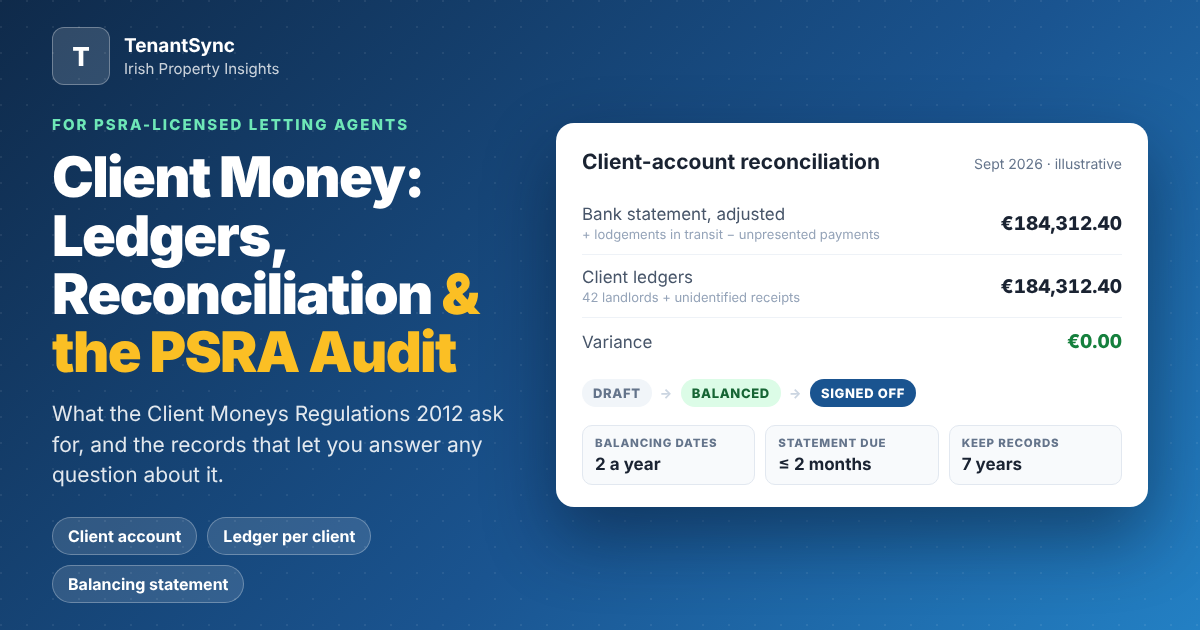
At each, you prepare a balancing statement, and it must be completed no later than two months after the balancing date it relates to: by 31 August and 28 February for a calendar-year agency. The statement shows three views of the same money agreeing:
− payments not yet presented
+ receipts not yet identified
The balancing statement is the document your reporting accountant tests for the Accountant's Report, and the one the PSRA most often sees go wrong: a balance calculated incorrectly, or liabilities to clients left off the statement. Two balancing statements a year is the floor. The question is how you want to arrive at them.
Why You Reconcile Monthly Anyway — and How
Client money in a letting agency has an awkward shape. Rent arrives daily, in small amounts, from dozens of people, with references that range from perfect to imaginative. It leaves monthly, in larger amounts, to landlords, minus fees, contractor bills and deposits refunded. Every one of those movements is a chance for a posting to land on the wrong ledger.
Find a misposting in the month it happened and it is one transaction, a phone call and a correcting entry. Find it at the balancing date, five months later, and it is buried under hundreds of later movements that each have to be ruled out. That's why monthly reconciliation is the standard practice even though the Regulations' fixed dates are half-yearly — and why a run of twelve signed reconciliations makes each balancing statement a report you print rather than a project you undertake.
The routine, every month, for every client account:
-
Close the month
Get the bank statement for every client account to the last day of the month. One statement per account, including any account opened or closed in the month.
-
Write up the cash book
Every receipt and payment through the client account, in date order, with a running balance. If it moved through the account, it is in the cash book.
-
Post every receipt to a client's ledger
Rent, HAP, tenant top-ups and deposits each go to the ledger of the landlord they belong to, against the tenancy. Anything you cannot place goes on a list of unidentified receipts — still client money, owned by no ledger yet.
-
Post every payment out
Payouts to landlords, fees transferred to the office account, contractor payments, deposit refunds and any tax remitted for a non-resident landlord — each on the ledger of the client whose money it was.
-
List the timing items
Lodgements made but not yet on the statement, and payments sent but not yet presented. Each one with its date and amount.
-
Agree the three figures
The bank balance plus lodgements in transit minus unpresented payments must equal the cash book; the cash book must equal the total of the client ledgers plus agency money not yet drawn plus unidentified receipts.
-
Run the exception checks
Is any client ledger in debit? Has agency money been in the client account more than a month? Is any lodgement more than a few days in transit, or any payment unpresented for months? Each is a finding before it is a figure.
-
Sign, date and file it
Whoever is responsible signs and dates the reconciliation, with a note explaining every difference and what was done about it. File it with the bank statement and the ledger listing it was built from.
Who signs matters
A reconciliation prepared and signed by the same person who posts every entry proves arithmetic, not control. In a small agency that's often unavoidable — so have the principal review and countersign at least the two balancing statements, and keep the evidence that they did.
Free Client-Money Calendar and Balance Check
Two quick checks, both running entirely in your browser — nothing you type is sent anywhere. The first turns your accounting year end and licence expiry into the dates that matter. The second is a fast three-way check on one month's figures; it's pre-filled with an example that doesn't balance, so you can see what each finding looks like.
Your client-money calendar
Balancing dates, statement deadlines, your renewal deadline and how long this year's records must be kept.
Balancing dates follow the Regulations' definition: six months after the start of the accounting period, and the accounting date. Each statement is due within two months. The renewal application, with the Accountant's Report, is due at least six weeks before the licence expires. Retention runs from the later of the last entry and the last dealing with client money — the date shown assumes the year's last entry is at year end.
Quick three-way balance check
One client account, one month end. Enter totals in euro.
This is a quick test, not a reconciliation: it can't see individual ledgers or dates. For the full version — every timing item and ledger itemised, your balancing dates, an Accountant's Report checklist and an Excel workbook to keep — use the free Client Money Reconciliation Workbook.
🧾 Run the full three-way reconciliation, free
Itemise every lodgement in transit, unpresented payment and client ledger; see what an accountant would flag; get your balancing dates and an Accountant's Report checklist — and an Excel workbook to file. No login.
When It Doesn't Balance
Sooner or later a month won't agree. What you do next is what separates an agency with a control from an agency with a spreadsheet. First, work out which kind of difference you have — because they are not equally serious.
The ledgers say you owe clients more than the account holds
Money that belongs to landlords isn't there. Whatever the cause, some client's money is currently doing another job. Treat it as urgent: find it, and don't leave it unrestored while you look.
The account holds more than the ledgers explain
Less alarming, still a finding. It's usually an unposted receipt or fees not drawn. Until you know whose it is, it's unexplained client money — not a cushion and not income.
The usual causes, and where to look
| Symptom | Likely cause | Where to look |
|---|---|---|
| Bank ≠ cash book | Bank charges or interest not in the cash book; a direct credit nobody posted; an entry posted twice; a timing item missed. | Tick the statement against the cash book line by line. A difference that is exactly one transaction usually is one. |
| Cash book ≠ ledgers | A receipt recorded in the cash book but never posted to a ledger, or a ledger posting with no cash movement behind it. | Compare each ledger's movements for the month with the cash book; look for the amount, then for half or double it. |
| A ledger in debit | A contractor or a refund paid for a landlord before their rent arrived; a payout made on rent that never cleared; a posting to the wrong landlord. | The ledger itself: the first day it went negative, and what was paid out that day. |
| Small, persistent difference | Rounding on fees or VAT, or a correction made by editing an old entry instead of posting a new one. | The month it first appeared — which a monthly routine tells you, and a half-yearly one doesn't. |
| Payment unpresented for months | A cheque never cashed or a transfer that bounced back without being posted. | Contact the payee. If it won't be presented, write it back to the client's ledger — it is still their money. |
What not to do, and what to do
Don't
- Post an "adjustment" or "suspense" entry to make the figures agree.
- Sign off a reconciliation that still shows an unexplained variance.
- Cover a debit ledger by moving money from another landlord's ledger.
- Carry the same difference forward month after month.
Do
- Find the cause, and record what it was and what you did, on the reconciliation.
- Make good any shortfall or debit ledger from agency funds straight away — the standard practice — and note it.
- Tell your reporting accountant. A shortfall found, explained and fixed reads very differently from one they find.
- Fix the process that let it happen, not just the figure.
Seven Years: Retention and the Evidence Pack
The Regulations require client-money accounting records to be kept for at least seven years, counted from the later of the last entry in them and the last dealing with the client's money. That is longer than the six years section 44 of the 2011 Act sets for records of the services you provide — so if your archive policy says "six years for everything", the client-money half of it is short.
"Accounting records" means the books and every other document you're required to keep, in electronic form as much as on paper. In practice, the pack for each year is:
Bank
- A register of every client account: bank, title, number, branch it serves
- Every statement, every month, every account
- Lodgement records
- The bank's letter on the account's designation
Books
- The client cash book
- A ledger per client, with every entry's source
- Fee transfers to the office account, per client
- Deposits held, tenancy by tenancy
Reconciliations
- Twelve monthly reconciliations, signed and dated
- Two balancing statements, with their dates
- The note behind every difference
- The Accountant's Report and anything it raised
Clients
- The s.43 Letter of Engagement for each landlord
- Statements and remittance advices sent to them
- Approvals for deductions and repairs
- Correspondence about any query or dispute
Records rebuilt for an audit are not records
A reconciliation dated last March that was produced last week is easy to spot — the bank statement downloads are dated, the file metadata is dated, and the figures are too tidy. If something is missing, say so and produce it now, dated now, with a note of how you derived it. That is a gap. Back-dating it is a different conversation.
What a PSRA Audit Looks For
The PSRA is required to carry out compliance audits of its licensees, and does so through its own Regulatory Inspectors and contract investigators. Separately, complaints can lead to an investigation by an appointed inspector — and complaints are rising: the PSRA received 304 in 2025, up 28% on the year before.
Client money is where an audit turns serious, because it's where a licensee can harm a landlord without anyone noticing for months. In early 2025 the PSRA published a major sanction against a letting agent trading as New Ireland Lettings, after an investigation found seven instances of improper conduct — among them deductions taken from client funds without the client's agreement, and failures to account for client money. The licence was suspended for six months, with a payment to the Property Services Compensation Fund and a contribution to the investigation's costs. The High Court confirmed the sanction in January 2025.
What to have ready
Based on the Regulations and the PSRA's published audit information, expect to be asked for:
- Your licences — business, principal officers and employees — and where they are displayed
- The client account register and statements for every client account
- The cash book and a ledger for each client, brought up to date
- Your monthly reconciliations and the two most recent balancing statements
- Your last Accountant's Report, and what you changed in response to it
- A signed Letter of Engagement for each landlord you act for, with the fees you then charged
- Professional indemnity insurance, tax clearance and CPD certificates — inspectors can ask for CPD for the four years before the audit year
- Your complaints records
The 11pm test
Answer these honestly, tonight, without opening anything. Each "not sure" is the place to start tomorrow.
- Is every client account titled with the word "client", at one bank in the State?And do you have a list of all of them, including the old ones?
- Does every tenant and local authority pay into the client account?Not "nearly all".
- For any landlord, on any date, could you produce their balance within ten minutes?With every movement behind it.
- Has any client ledger been in debit this year?If you don't know, that's the answer.
- Were all agency fees drawn within a month?Each transfer on the client's ledger.
- Is there a signed reconciliation for every month of the last twelve?Signed at the time, not since.
- Do you know your two balancing dates — and were both statements done within two months?
- Is every difference you've ever found explained in writing?Including the €3.17 one.
- Could you find the client-money records from seven years ago?Including the ones on the laptop that was replaced.
- Does every landlord have a signed Letter of Engagement covering the deductions you make?Deductions without agreement were at the centre of the 2025 sanction.
The Accountant's Report Is the Output of the Year, Not a September Scramble
Every licence renewal goes in with a signed Accountant's Report — on form PSRA/S35 – Renewal ABC where you hold a client account (and Renewal D where service charges or sinking fund contributions are paid into a relevant account). An independent accountant tests your client account records and a sample of transactions — lodgements, bank statements and the balancing statement — and gives an opinion on whether you've complied with the Regulations, reporting any breach it finds.
The PSRA has published the problems it sees most often on these reports. Several of them are not the accountant's fault at all; they're the records the accountant was given:
- A balancing statement whose balance is calculated incorrectly.
- Liabilities to clients not reported on the balancing statement.
- Client liabilities reduced by money owed in — rent due but not yet received — which was never in the client account.
- A licensee using one account for all client and business transactions.
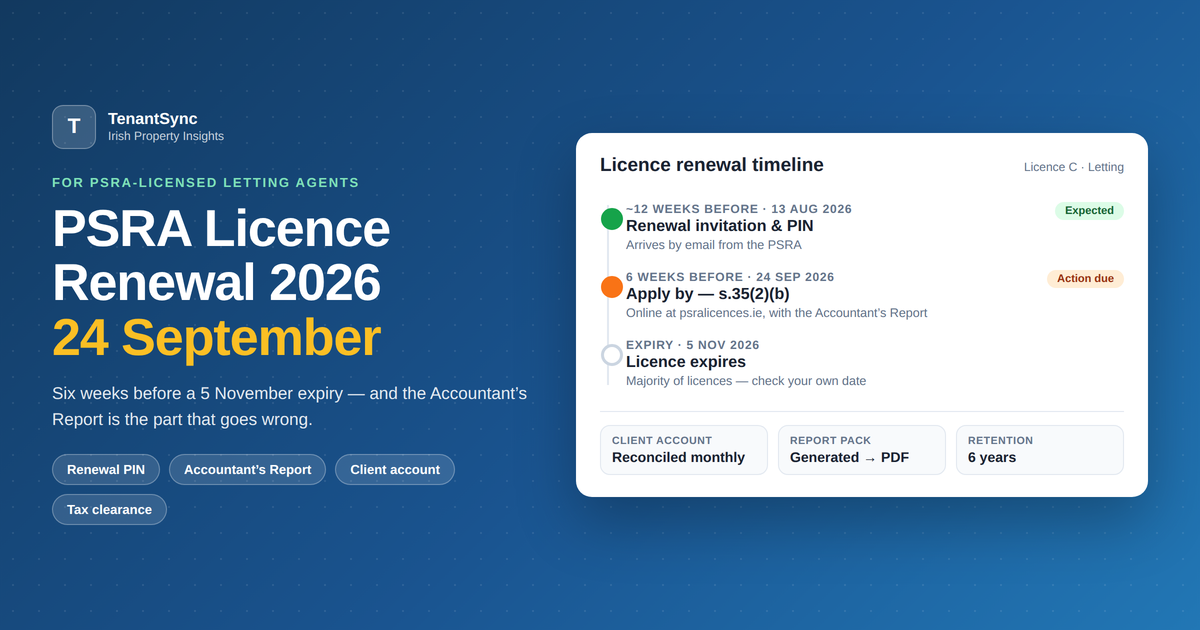
For most agencies the renewal application is due by 24 September, six weeks before a 5 November expiry, which puts the Accountant's Report in the busiest weeks of every reporting accountant's year. If twelve signed reconciliations and two balancing statements already exist, the report is a test of records that agree. If they don't, the accountant is building your records rather than testing them — a different engagement, a different fee and a different timeline, against the same deadline. Our PSRA licence renewal guide walks through the dates week by week.
What Good Looks Like When Rent Arrives Daily and Payouts Go Monthly
None of this is exotic. It's a rhythm — and an agency that keeps it barely notices the balancing dates come round.
-
Every day
Rent lands, and is matched to a tenancy and a ledger. Anything that can't be matched goes on the unidentified list the same day. Cash and cheques are lodged without unnecessary delay.
-
Every week
Clear the unidentified list. Chase arrears while they are small. Approve contractor invoices against the landlord's agreement before they're paid.
-
1st of the month
Landlord statements are produced from the ledger: rent received, fees, VAT, contractor costs, any tax withheld, net payable.
-
Within days
Landlords are paid and fees are drawn to the office account — well inside the one-month limit — each movement on the client's ledger.
-
Month end + a few days
Reconcile every client account three ways, run the exception checks, and sign it off with a note on any difference.
-
Twice a year
Balancing statements at your two balancing dates, completed within two months — assembled from reconciliations that already agree, and reviewed by the principal.
-
Once a year
The Accountant's Report, with your renewal at least six weeks before the licence expires. Then the year's pack is archived for seven years.
Look at where the effort sits. The daily and monthly steps are where client money is actually controlled, and they're also the most repetitive — matching hundreds of bank lines a month, splitting HAP remittances, posting fees, producing statements. That's the part worth taking off a person.
Where TenantSync Fits
Full disclosure: this blog is published by TenantSync, and what follows is our product. It's here because the ledger and the monthly reconciliation are most of the work in this article, and both can be built from records an agency already has: the bank feed and the landlord statements.
| Obligation | The risk | In TenantSync |
|---|---|---|
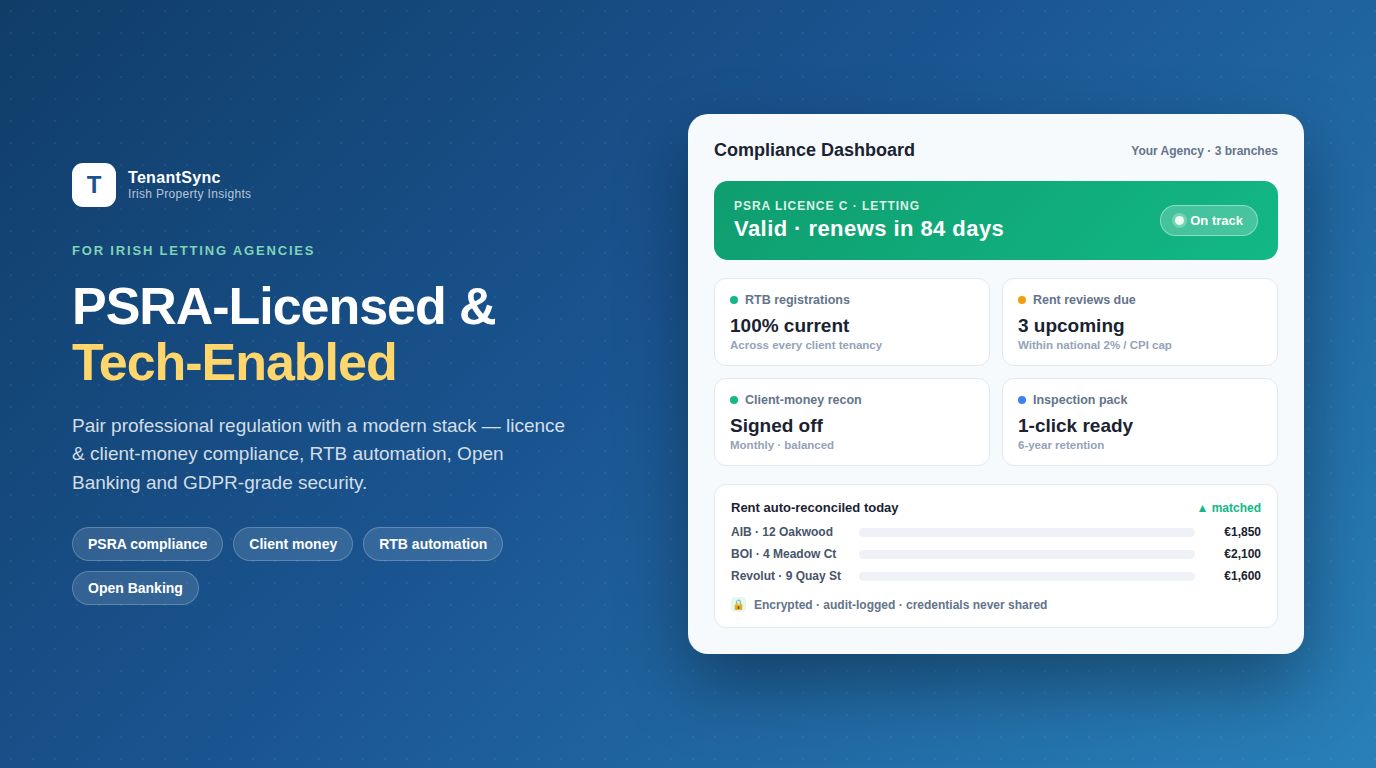
| Designated account | An account that isn't titled or kept as a client account | A register of client accounts that checks each title contains "client" and records who confirmed it's a designated account, separate from the office account, and when. IBANs are encrypted, shown masked, and revealed only on request. |
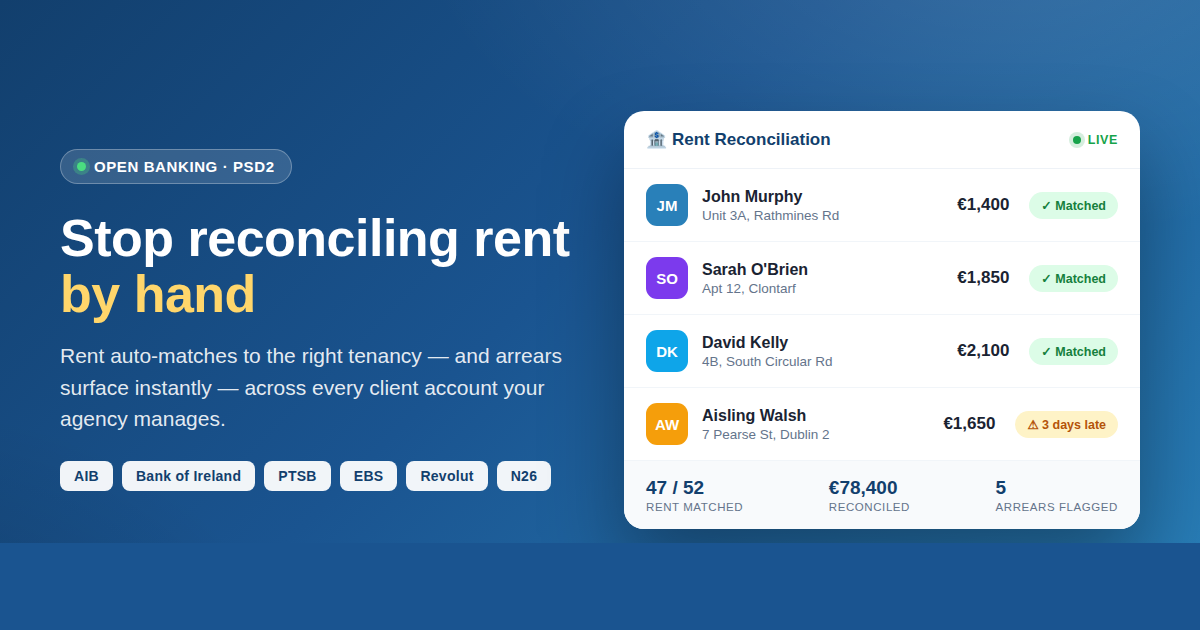
| Rent in | Hundreds of bank lines matched by hand | Open Banking reads the client account from 18 Irish banks on a six-hourly sync and matches rent to tenancies. You approve every suggested match; anything unsure goes to a review queue. |
| Ledger per client | Balances that only exist after a rebuild | A ledger for every landlord, built from reconciled rent and the disbursement statements — rent, fees, VAT, contractor costs, payouts, withholding tax — with a running balance and a drill-down to each entry. Corrections post as a reversal and a replacement, never an edit, and the ledger flags itself if it disagrees with the posted record. |
| Monthly reconciliation | Months that never get reconciled, or signed | Pick an account and a month: the bank balance is pulled from the linked account (or typed from the statement), compared with the total of the client ledgers, and the variance shown. It moves from draft to balanced or discrepancy, then to signed off with a name, time and note — and is locked once signed. A reminder goes out early each month for any account whose last month is missing or unsigned. |
| Accountant's Report | Handing the accountant a bank download | An annual pack for your accountant: every client account's monthly reconciliations for the year, with any month not signed off flagged as a gap, as a PDF. |
| Inspection & retention | Records scattered across inboxes and drives | A single inspection pack — licences, Letters of Engagement, reconciliations, complaints, insurance, tax clearance and advertising records — by branch and date range. Records inside their retention period (seven years for client money, six for service records) can't be deleted, and key actions are written to an audit log. |
What it does not do — plainly
TenantSync never holds or moves client money: it stays in your own client account at your own bank, and your team makes the payments; TenantSync records them and confirms them against the bank feed. It does not prepare or sign the Accountant's Report — your reporting accountant does, from the pack. It does not submit anything to the PSRA. The monthly reconciliation compares the bank balance with the ledgers; timing items are explained in the sign-off note. The PSRA module is on the Growth plan (€149 a month, up to 200 units, three connected bank accounts) and above, in the web app. Nothing here is legal or accounting advice.
🔍 See a client-account reconciliation run from your own bank feed
In 20 minutes we'll take a month of rent from the bank feed to per-landlord ledgers, reconcile the client account, sign it off — and show you the pack your accountant and an inspector would see. Free migration from any system or spreadsheet.
Frequently Asked Questions
What is client money for a letting agent in Ireland?
Client money is money a PSRA licensee receives, holds or controls for or on behalf of a client: for a letting agent, mainly the rent collected for landlords, tenancy deposits the agency holds, and money held for outlays not yet paid. It is client money from the moment it is received, and the Client Moneys Regulations 2012 require it to be paid into a designated client account without unnecessary delay.
Does a client account have to have the word client in its name?
Yes. A client account must be held at a bank in the State, kept separate from the agency's office account, and its title must include the word "client". You can keep more than one client account, but they must all be at the same bank unless the PSRA authorises otherwise in writing.
How often does a letting agent have to reconcile the client account?
The Regulations fix two balancing dates a year — six months into your accounting period and your accounting date at its end — and a balancing statement must be prepared within two months of each. Monthly reconciliation is not the statutory minimum, but it is the standard practice: it keeps every difference small and recent, and it turns each balancing statement into a report you run rather than a reconstruction.
What is a client account balancing statement?
A balancing statement is the reconciliation the Regulations require at each balancing date. It shows that the total owed to clients on the client ledgers agrees with the client cash book and with the client account bank statements, after lodgements in transit and payments not yet presented. Your reporting accountant tests it for the Accountant's Report that goes with your licence renewal.
How long must client money records be kept?
At least seven years, counted from the later of the last entry in the records and the last dealing with the client's money. That is longer than the six years the Property Services (Regulation) Act 2011 sets for records of the services you provide, so plan your archive around seven.
Can agency fees stay in the client account?
Only briefly. Money the agency is beneficially entitled to — management fees, commission, VAT on fees — must not be held in a client account for longer than one month. Transfer it to the office account and record each transfer on the ledger of the client it came from. Never pay office or personal expenses from the client account.
What does a PSRA inspector look at?
The PSRA carries out compliance audits of licensees through its Regulatory Inspectors and contract investigators. Client money is central: expect to be asked for the client account bank statements, the cash book, a ledger for each client, your reconciliations and balancing statements, and your last Accountant's Report — alongside licences, Letters of Engagement, insurance and CPD records. The test is whether the records let someone else trace every euro to the client it belongs to.
What should I do if the client account does not balance?
Find the cause before you do anything else, and never post an unexplained adjustment to force it to agree. If client ledgers show more owed to clients than the account holds, that is a shortfall: the usual practice is to make it good from agency funds straight away, record what happened and tell your reporting accountant. Unexplained extra money is still client money until you have identified whose it is.
Does TenantSync hold client money?
No. Client money stays in your own designated client account at your own bank. TenantSync reads the account through Open Banking, matches incoming rent to tenancies for you to approve, builds a ledger per landlord from the rent and disbursement records, and runs the monthly reconciliation and sign-off. Your reporting accountant still prepares and signs the Accountant's Report.
Summary
- Client money is rent, deposits and outlay money you hold for landlords — from the moment it's received. Lodge it without unnecessary delay.
- The account: a bank in the State, "client" in the title, separate from office money, no office spending from it, agency fees out within a month.
- The ledger: one per client, every entry sourced, never in debit, corrections posted not edited. Any landlord, any date, any balance — on demand.
- The law's checkpoints: two balancing dates a year, each balancing statement within two months.
- The practice: reconcile every account three ways every month, check the exceptions, sign and date it.
- Keep it all for seven years — and let the Accountant's Report be a test of records that already agree.
📒 Ledgers that build themselves from the bank feed
Rent matched from your client account, a ledger per landlord, a monthly reconciliation signed off and locked, and the inspection pack ready when someone asks. See it on your own figures in a 20-minute demo.
Sources & Further Reading
The Regulations and the PSRA's guidance are the authority. Check every point against them, and agree your procedures with your reporting accountant.
- S.I. No. 199 of 2012 — Property Services (Regulation) Act 2011 (Client Moneys) Regulations 2012 (client accounts, lodgement, accounting records, balancing dates and statements, seven-year retention)
- PSRA — Synopsis of the Client Moneys Regulations (PDF)
- Property Services (Regulation) Act 2011, section 49 (client accounts protected from creditors) and section 46 (accounting records)
- PSRA — Information on audits
- PSRA — Major sanction imposed on letting agent following investigation and the March 2025 PSRA newsletter (PDF)
- Chartered Accountants Ireland — Completing the PSRA's accountant's reports: the regulator's perspective
- PSRA — Renewing a licence
- RTÉ — Number of property service complaints up by 28% in 2025
Related Articles