Looking for a Rentman Alternative? An Honest 2026 Comparison for Irish Letting Agents
If you run an Irish lettings agency, you may already use or have looked at Rentman (rman.co.uk, rentman.online, rmcloud.online) — a long-established UK estate-agency and lettings suite that also markets itself in Ireland. The real question in 2026 isn't "is Rentman good software?" — it's "is a UK-built agency system the right fit now that the March 2026 reforms have rewritten Irish rent rules and RTB compliance is a daily, portfolio-wide job?" This is a fair, no-hype comparison of Rentman and TenantSync — what each does well, where they differ, what they cost, and how to switch if you decide to.

The short version
- Rentman (from Rentman Software Ltd) is a long-established UK estate-agency and lettings suite, marketed across the UK and Ireland. Its strengths are combined sales + lettings workflow, client (trust) accounting, portal uploads, reference checks, and room-level management for HMOs and student lets.
- TenantSync is a newer, Irish-built platform focused on RTB compliance automation (Form 1 draft-to-finalise, the post-March-2026 national rent cap, Part 4 and registration-deadline tracking) and Open Banking rent reconciliation against Irish banks, with a web app and a mobile app.
- Pick on the job you most need done: a combined sales-and-lettings agency system with deep client accounting points to Rentman; automated Irish RTB compliance and rent reconciliation across many client tenancies points to TenantSync.
No tool wins on every axis, and any comparison that pretends otherwise isn't worth your time. Below is the honest version — including the parts where Rentman is the stronger choice, and the parts where we've written "confirm with the provider" rather than guess.
Why Irish agents start looking for a Rentman alternative
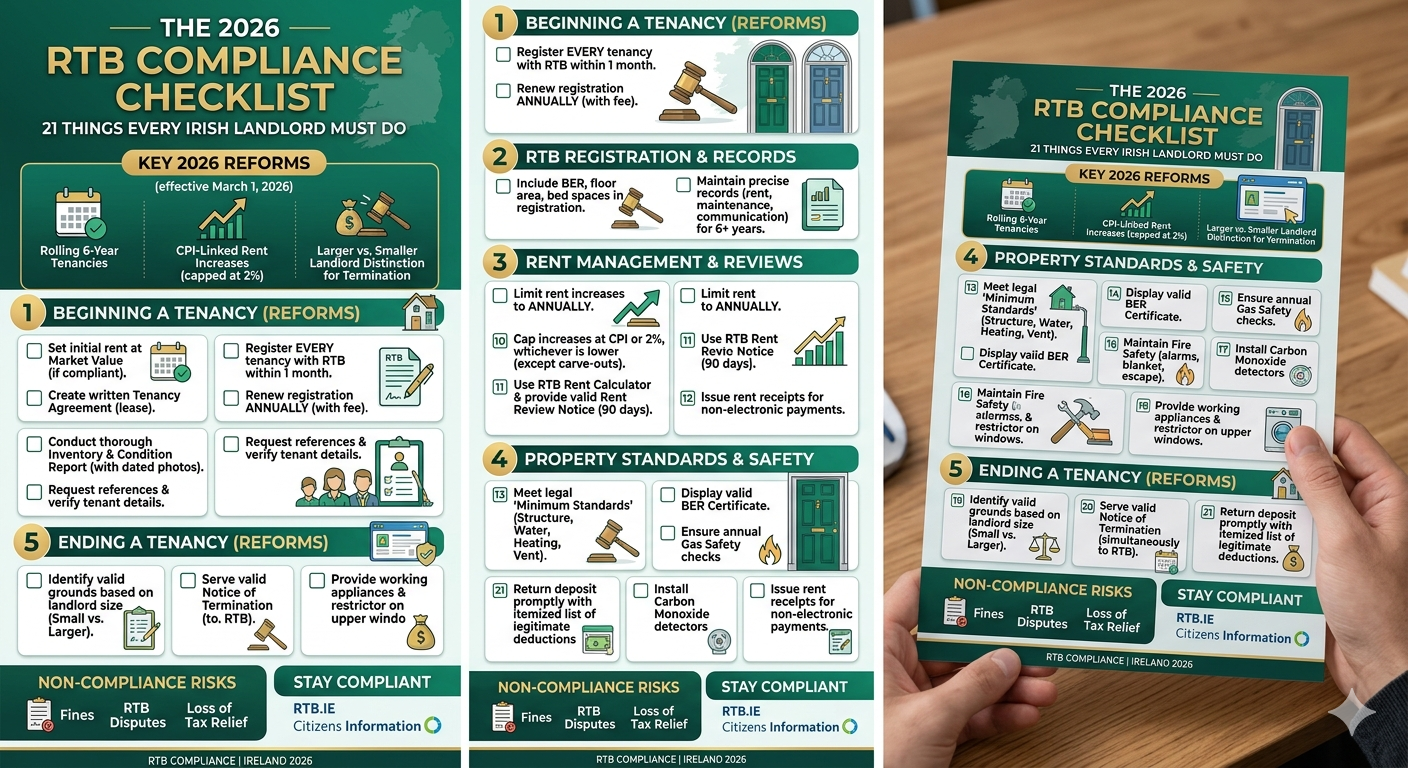
Agencies rarely go shopping because their current system is bad. They go shopping because the job changed. In 2026, three things changed at once for Irish letting agents:
- Compliance became a daily, portfolio-wide task. Annual RTB registration (mandatory for every tenancy), Part 4 cycles, and the post-March-2026 rent rules mean a missed deadline isn't just a fine — it's a professional-liability problem and a route to losing a landlord client.
- Rent maths got harder — and specifically Irish. The national rent cap replaced Rent Pressure Zones, and the inflation measure changed from the HICP to the CPI (more on that below). A UK-built rent-review workflow doesn't know these rules; getting an Irish rent review wrong is now easy, and an invalid review can be unwound.
- Reconciliation stopped scaling. Matching rent to the right tenancy across bank accounts, by hand, every week, is where agency hours quietly disappear — and it's a job a UK product designed around sterling deposit schemes wasn't built to automate for Irish banks.
So the question isn't "Rentman or not?" — it's "which platform does the 2026 Irish version of my job best?" That depends on which of these problems hurts most.
What Rentman is — and what it genuinely does well
Rentman is a property software hub from Rentman Software Ltd, in the market for decades, that brings together lettings, sales, property management and client accounting for estate and letting agencies. It's marketed as a complete software-and-portal solution for agencies across the UK and Ireland, it's cloud-based, and its subscriptions include the rentman.online website and macOS access. Its public-facing sites are rman.co.uk, rentman.online and rmcloud.online.
Rentman's core strengths (from publicly available information on rman.co.uk)
- Combined sales + lettings. One system for both estate-agency sales and lettings, with a unified pipeline that links enquiries, viewings and contract stages.
- Client (trust) accounting. Bank transaction import/export, bank reconciliation, a client-account trial balance and audit-trail management — the money side, done properly.
- Lettings operations. Tenancy agreements and legal notices, applicant matching, automatic reference checks, invoicing and tax reports, full rent histories, certificate storage and maintenance-request tracking.
- HMO & student lets. Room-level management within a property, with per-tenant rent, deposit and tenancy terms, plus bill/utility allocation across tenants — a genuine strength for shared and all-inclusive rentals.
- Portal uploads & portals. Uploads to the major property portals, plus landlord and tenant access.
If your agency runs both sales and lettings, leans on client trust-account accounting, or manages a lot of HMO/student rooms, that is territory Rentman is built for. Any honest comparison has to start there.
Where TenantSync fits
TenantSync comes at the same market from a different angle — and a different country of origin. Instead of being a UK agency suite adapted for Ireland, it's built specifically for Irish residential tenancies law, and it starts from the two things Irish agents now spend the most anxious time on: RTB compliance and getting rent matched and reconciled.
It's a newer platform (and a smaller company — we'll be upfront about that rather than invent customer numbers). The headline capabilities:
- RTB Form 1 draft-to-finalise — fill, validate, preview in the browser, finalise to a signed PDF; status advances automatically.
- National rent-cap calculator — computes the maximum legal rent under the post-March-2026 rules and shows the rule and figure it used, with a disclaimer, so you stay audit-ready.
- Registration lifecycle — the 30-day deadline is auto-computed from tenancy start; annual renewals and Part 4 rights are tracked, with reminders.
- Open Banking reconciliation (PSD2) — connect an Irish bank account and incoming rent auto-matches to the right tenancy; arrears surface the day they happen.
- Web + mobile — a React web app and a Flutter mobile app for working on the go.
Rentman vs TenantSync: an honest feature comparison
Where we can verify a Rentman capability from public sources, we've stated it. Where a capability isn't publicly documented — particularly Irish-specific RTB automation — we've written "confirm with provider" rather than claim it's missing. You should verify anything decision-critical directly with each vendor.
| Capability | Rentman (rman.co.uk) | TenantSync |
|---|---|---|
| Origin & focus | Long-established UK estate-agency & lettings suite (Rentman Software Ltd); marketed UK & Ireland | Newer, Irish-built RTB-compliance & rent platform |
| Sales (estate agency) module | Yes — combined sales + lettings pipeline (sales module priced separately) | No — lettings/property management only, not estate-agency sales |
| Client-account (trust) accounting | Core strength — bank reconciliation, client-account trial balance, audit trail | Invoicing, recurring billing, arrears & aging — not a dedicated trust-accounting ledger |
| RTB Form 1 registration | Generates tenancy agreements & legal notices; Irish RTB Form 1 workflow not publicly documented — confirm with provider | Built-in Form 1 draft-to-finalise (signed PDF) |
| National rent-cap (2%/CPI) calculator | Not publicly documented — confirm with provider | Automated; shows the rule and figure it applied, with a disclaimer |
| RTB registration-deadline & Part 4 tracking | Diary/tasking and legal-compliance tooling; Irish RTB-specific automation not documented — confirm with provider | 30-day deadline auto-computed; renewals & Part 4 tracked with reminders |
| Rent reconciliation | Bank transaction import/export & bank reconciliation | Open Banking (PSD2) auto-match to the right tenancy against Irish banks; arrears surface instantly |
| HMO / room-level management | Strong — per-room rent, deposit, term; bill/utility allocation | Property/unit/tenant/lease management; confirm room-level split for your use case |
| Mobile app | Cloud-based with macOS access; confirm native mobile apps with provider | Native web + Flutter mobile app |
| Landlord / tenant portal | Yes — landlord & tenant access; free rentman.online website included | Yes — landlord/tenant access included |
| Pricing model | Per user seat, in sterling (£) | Per property, in euro (€), all-in tiers |
The pattern is clear: Rentman is the deeper agency operating system (sales + lettings + client money + HMOs), built and priced for the UK; TenantSync is the deeper Irish RTB compliance and reconciliation layer. They overlap in the middle but lead with different jobs.
Pricing compared (as published, 2026)
The two products are priced on completely different models — Rentman per user seat in sterling, TenantSync per property in euro — so compare on your own headcount and portfolio, not the headline number.
| Plan / model | Price | Scope |
|---|---|---|
| Rentman — first seat | From £65 / month | Per user; includes rentman.online website & macOS access |
| Rentman — additional seats | £50 (2–5), £40 (6–10), £30 (11+) / month | Per additional user seat |
| Rentman — sales module | +£50 / month | Estate-agency sales add-on |
| TenantSync — Starter | €20 / month | Up to 10 properties (small-landlord tier) |
| TenantSync — Standard | €99 / month | Up to 100 properties; 1 bank (Open Banking) |
| TenantSync — Growth ⭐ | €149 / month | Up to 200 properties; 3 banks; RTB bulk compliance |
| TenantSync — Premium | €199 / month | Up to 300 properties; 5 banks; account manager |
| TenantSync — Enterprise | Custom | Multi-branch / white-label |
How to read this fairly
Rentman's per-seat model scales with team size: a five-person agency pays for five seats (plus the sales module if it does sales), regardless of how many tenancies it manages. TenantSync's per-property model scales with portfolio size: unlimited users, priced on the number of properties, with the landlord/tenant portal and RTB compliance included at every tier. A small team managing a big book of Irish tenancies usually pays less on TenantSync's model; a larger sales-and-lettings agency that lives in client accounting may value Rentman's depth more. TenantSync also offers a 14-day free trial. Currency and cross-border VAT differ too — always confirm current pricing on each provider's own site.
Why March 2026 raised the stakes for every Irish agency
This is the context that makes the software choice urgent — and specifically Irish. On 1 March 2026, Ireland's rental rules changed materially, and the changes touch every tenancy an agent manages.
What changed on 1 March 2026
- National rent control replaced Rent Pressure Zones. A single national system now applies to all private tenancies. Rent can be increased once a year by a maximum of 2%, or by inflation if inflation is lower.
- The inflation measure changed. The cap is now measured by the Consumer Price Index (CPI), not the HICP that applied under the old RPZ regime — for all tenancies, new and existing.
- 6-year Tenancies of Minimum Duration (TMD). New tenancies created from 1 March 2026 run in rolling 6-year cycles.
- Small vs large landlords. A "small" landlord has three or fewer tenancies; a "large" landlord has four or more, with different termination rights.
- 90-day written notice for rent reviews still applies.
For an Irish agent, the practical upshot is blunt: you now have to apply the national cap correctly to every client tenancy, with the right index, on the right schedule, with valid notice — and register and renew each one with the RTB on time. That's a calculation-and-tracking problem at portfolio scale, tied to Irish law and Irish banks. A UK-first suite can hold your data and produce notices, but the Irish RTB maths and deadlines are exactly what TenantSync's rent-cap calculator and compliance dashboard were built to remove. Whichever tool you choose, make sure it keeps pace with the 2026 Irish rules — not UK deposit schemes or the old RPZ/HICP regime.
Who should switch — and who should stay on Rentman
Here's the part most "alternative" pages skip. Switching isn't free — it costs time and change-management — so only do it if the fit is genuinely better.
TenantSync is likely the better fit if…
- Your biggest daily pain is Irish RTB compliance across many landlord clients — registrations, renewals, Part 4, and getting rent reviews right under the new national cap.
- You want Open Banking reconciliation against Irish banks so rent auto-matches to the right tenancy and arrears surface immediately.
- You're a lettings/management agency (not primarily estate-agency sales) and want a tool built for Irish law rather than adapted from a UK product.
- You value a modern web + mobile experience and per-property, euro pricing with unlimited users.
Rentman may remain the better fit if…
- You run combined sales and lettings and want one estate-agency system for both.
- Your agency's centre of gravity is client (trust) accounting — bank reconciliation, client-account trial balance and audit trail — and you need that depth above all else.
- You manage a lot of HMO / student rooms and rely on room-level rent, deposit and bill allocation.
- You operate across the UK and Ireland and want a single system spanning both jurisdictions.
A useful test: list the five things your agency does most often, then ask each vendor to show you those five — live — on your own data during a trial or demo. If "finalise a Form 1" and "calculate the legal rent cap" are on your list, watch who can actually do them on screen.
How migrating to TenantSync actually works
The number one reason agencies stay on a tool they've outgrown is the fear of a painful migration — losing history, re-keying tenancies, breaking compliance dates. TenantSync is built to remove that fear.
The migration path
- CSV & spreadsheet import. Export your properties, units, tenancies, leases and rent details from Rentman, and import them into TenantSync without re-keying. (A direct Letman import is also available if you're coming from Letman.)
- RTB date validation. Registration and renewal dates are checked so nothing falls through during the move.
- First reconciliation in session. Connect an Irish bank account and watch recent rent match to the right tenancies.
- Done-with-you onboarding. You're not handed a blank screen — the import and your first real Form 1 can be done together.
See your own portfolio inside TenantSync
Start a 14-day free trial, or book a 15-minute demo and we'll import a sample of your data and finalise a real RTB Form 1 on it — no slideware.
What TenantSync does for Irish lettings agencies
TenantSync is built around Irish residential tenancies law — not adapted from a UK or US product. Every capability below is aimed at an agency managing tenancies across multiple landlord clients.
RTB Form 1, draft-to-finalise
Fill and validate the registration, preview it in the browser, then finalise to a signed PDF. The 30-day deadline is computed from the tenancy start date and tracked automatically.
National rent-cap calculator
Works out the maximum legal increase under the post-March-2026 rules — 2% or inflation, whichever is lower — and shows the rule and figure it applied, so a rent review is defensible.
Open Banking reconciliation
Connect the agency or landlord account (AIB, Bank of Ireland, PTSB, EBS, Revolut, N26, Wise) and incoming rent auto-matches to the right tenancy. Arrears surface the day they happen. Credentials stay on the bank's screen.
Compliance dashboard
Registration, renewal, rent review, Part 4 and other obligations tracked per tenancy and colour-coded compliant / upcoming / overdue — across your whole book of clients.
Invoicing & arrears
Recurring monthly invoices, PDF generation, an aging report and automated reminders (before due, on due, and overdue) so collection doesn't depend on someone remembering.
Per-client reporting
Reporting per landlord client, plus agency/branch scoping — so review meetings and renewals are quick, and your agency looks on top of every tenancy.
Put your agency's real workflow to the test
Import a sample from Rentman, finalise one real Form 1, and reconcile last month's rent — in a single session. That's the fastest way to know if TenantSync fits.
Frequently asked questions
What is the best Rentman alternative for Irish letting agents in 2026?
It depends on the job you most need done. TenantSync is an Irish-built platform focused on RTB compliance automation (Form 1 draft-to-finalise, the post-March-2026 national rent cap, Part 4 and registration-deadline tracking) and Open Banking rent reconciliation against Irish banks. Rentman (rman.co.uk) is a long-established UK estate-agency and lettings suite with strong client (trust) accounting, sales and lettings modules, portal uploads and HMO/room-level management, marketed across the UK and Ireland. If your priority is automated Irish RTB compliance and rent reconciliation, TenantSync is built for that; if you need a combined sales-and-lettings agency system with deep client accounting, evaluate Rentman on those strengths.
What is Rentman?
Rentman is a property software hub from Rentman Software Ltd that brings together lettings, sales, property management and client accounting for estate and letting agencies across the UK and Ireland. Publicly documented features include lettings and sales modules, uploads to the major portals, applicant matching, automatic reference checks, tenancy agreements and legal notices, invoicing and tax reports, bank transaction import/export and reconciliation, client-account trial balance, audit trail, full rent histories, maintenance tracking, and room-level management for HMOs and student lets. It is cloud-based, with landlord and tenant access, and all subscriptions include the rentman.online website and macOS access. Its main sites are rman.co.uk, rentman.online and rmcloud.online.
Does Rentman handle Irish RTB compliance, Form 1 and the national rent cap?
Rentman is a UK-first estate-agency and lettings suite that is also marketed in Ireland, and it generates tenancy agreements and legal notices as part of its lettings workflow. It does not publicly document Irish-specific automation such as an RTB Form 1 draft-to-finalise workflow, an automatic national rent-cap (2%/CPI) calculator, RTB registration-deadline tracking, or Part 4 reminders. If those Irish RTB features are decision-critical, confirm them directly with Rentman. TenantSync is built specifically around Irish residential tenancies law and automates each of those tasks.
How much does Rentman cost compared with TenantSync?
As published on rman.co.uk, Rentman is priced per user seat in sterling: £65 per month for the first seat, then £50 for seats 2–5, £40 for seats 6–10 and £30 for seats 11+, with a sales module available for an extra £50 per month; subscriptions include the rentman.online website and macOS access. TenantSync uses all-in euro tiers priced per property: €20 Starter (up to 10), €99 Standard (up to 100), €149 Growth (up to 200), €199 Premium (up to 300), and custom Enterprise, with a landlord and tenant portal included. Because one is priced per seat and the other per property, compare on your own agency's headcount and portfolio size. Pricing is as published in 2026 — always confirm on each provider's own site.
Does TenantSync do client (trust) accounting like Rentman?
Be deliberate here. TenantSync handles invoicing, recurring billing, Open Banking reconciliation, arrears and aging reports, but it is not a dedicated client-account (trust) accounting ledger with a client-account trial balance in the way Rentman is. If full client-money accounting is the core of how your agency operates, evaluate that requirement carefully — it is one of Rentman's strengths. Many Irish agencies move to TenantSync for the RTB compliance and rent-reconciliation automation; map your must-haves first and confirm each tool covers them.
Can I move my data from Rentman to TenantSync?
Yes. TenantSync supports CSV and spreadsheet import for properties, units, tenancies, leases and rent details, plus a direct Letman import, and offers done-with-you onboarding to validate RTB dates and run your first reconciliation. Export your portfolio, tenancy and rent data from Rentman, and TenantSync's team can help map it across so you are not re-keying.
How does the March 2026 national rent cap affect Irish letting agents?
Since 1 March 2026, Rent Pressure Zones have been replaced by a national system of rent control: rent can rise at most once a year by 2%, or by inflation if inflation is lower, measured by the Consumer Price Index (CPI) rather than the HICP used under the old RPZ regime. New tenancies from that date are 6-year Tenancies of Minimum Duration, with different rules for small landlords (three or fewer tenancies) and large landlords (four or more), and the 90-day written-notice rule still applies. Agents now apply the national cap to every client tenancy — exactly the kind of calculation TenantSync automates.
Sources & further reading
Facts in this article are drawn from official and primary sources. Rentman product and pricing details are summarised in good faith from publicly available information as of 2026 and may change — verify on Rentman's own site before deciding.
- Rentman — rman.co.uk and rentman.online (features and pricing)
- Rentman Software Ltd — company profile
- Residential Tenancies Board — Rental law changes from 1 March 2026 and registration fees
- Citizens Information — Changes to the rules for renting from March 2026
- Government of Ireland — Reforms to the rental sector, starting 1 March 2026
Related Articles