Notice of Termination Ireland 2026: Notice Periods, Valid Grounds and Legal Requirements
Ending a residential tenancy in Ireland requires a valid, written notice of termination that meets every legal requirement. Get it wrong and the notice is void — the tenancy continues, you must start again, and months can be lost. This guide covers the minimum notice periods (90 to 224 days), the seven requirements every notice must meet, the valid grounds for Part 4 tenancies, step-by-step scenarios, and the mistakes that make a notice legally unenforceable.
Generate Your Notice of Termination — Free
TenantSync's free Notice of Termination generator builds a correctly formatted PDF in minutes for the three landlord grounds you can serve directly — ending a tenancy in the first 6 months (90 days' notice, no reason required), rent arrears (28 days' notice, after a warning copied to the RTB), and breach of tenant obligations (28 days' notice, after a warning). It calculates the termination date automatically from your date of service. No login required.
This generator and guide are for general information and not legal advice.
What Is a Notice of Termination in Ireland?
A notice of termination is the formal legal document used to bring a private residential tenancy in Ireland to an end. Under the Residential Tenancies Act 2004 (as amended), neither a landlord nor a tenant can end a tenancy simply by stopping payment, refusing to renew a lease, or asking the other party to leave. A valid written notice of termination is the required legal instrument, and it must comply with specific rules to be enforceable.
This applies to all standard private residential tenancies — houses, apartments, bedsits, and most short-term letting arrangements that fall under the Act. It applies equally to landlords and tenants, though the notice periods and grounds differ significantly between the two.
Key principle: a notice is the start of the process — not the end
Serving a valid notice of termination starts the clock on the minimum notice period. The tenancy does not end on the date of service. It ends on the termination date stated in the notice — which must be at least the minimum notice period away. If the tenant does not vacate by that date, the landlord must apply to the RTB for a determination order. A notice cannot compel a tenant to leave — it is a legally required precursor to further action.
When Part 4 Rights Change the Rules
The rules on ending a tenancy differ significantly depending on whether the tenant has acquired Part 4 rights. Part 4 of the Residential Tenancies Act grants security of tenure to tenants who have been in continuous residence for six months. Once these rights are in place, a landlord cannot terminate the tenancy without one of the prescribed legal grounds — this is not optional, and a notice that fails to state a valid ground is void.
In the first six months of a tenancy, before Part 4 rights are acquired, a landlord may end the tenancy for any reason — but the correct notice period and all formal requirements still apply. After six months, the grounds become mandatory.
Minimum Notice Periods for Ending a Tenancy in Ireland (2026)
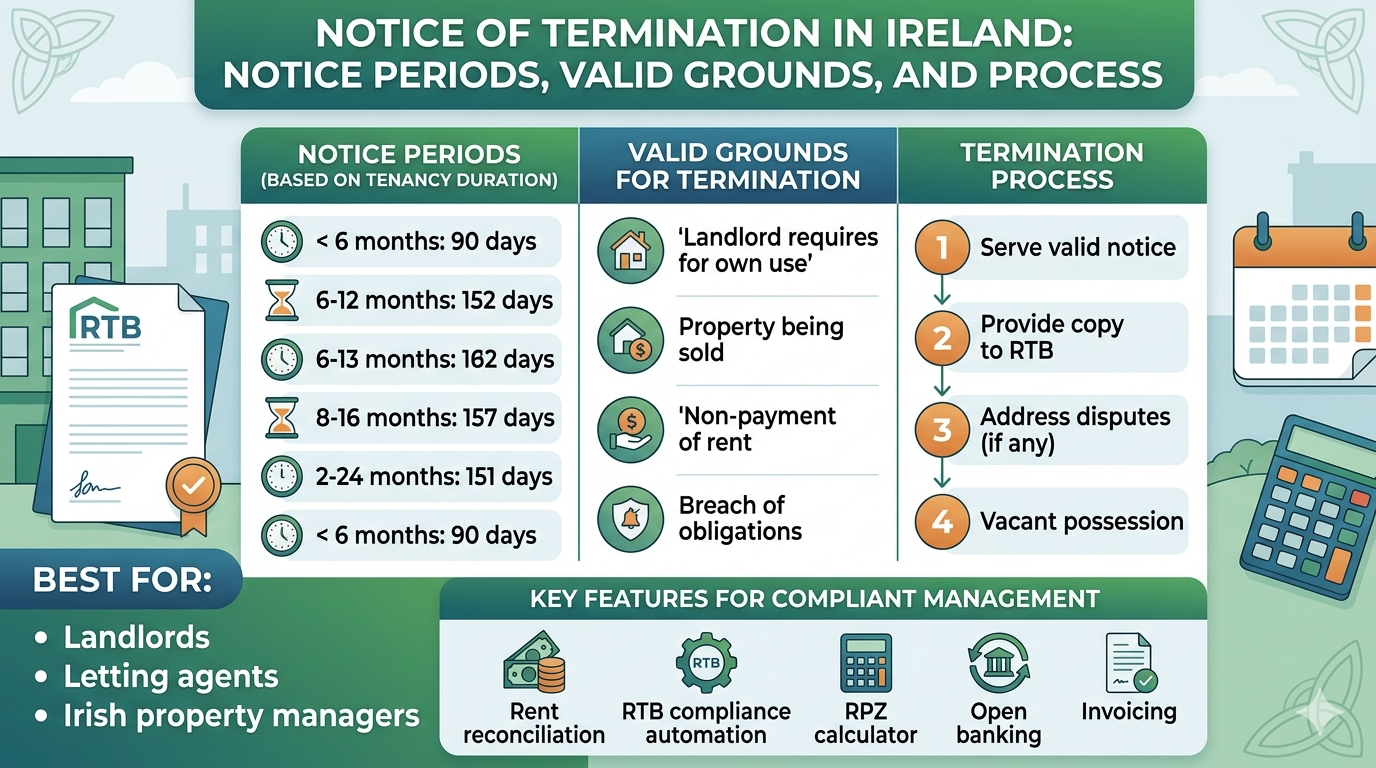
These are the statutory minimum notice periods under the Residential Tenancies (Amendment) Act 2021. The notice period runs from the date the notice is served — not from the date it is received or when the tenant acknowledges it.
| Tenancy Duration | Landlord Notice (minimum) | Tenant Notice (minimum) |
|---|---|---|
| Less than 6 months | 90 days | 28 days |
| 6 months to 1 year | 152 days | 35 days |
| 1 year to 2 years | 180 days | 42 days |
| 2 years to 3 years | 180 days | 56 days |
| 3 years to 4 years | 180 days | 84 days |
| 4 years to 7 years | 180 days | 112 days |
| 7 years to 8 years | 196 days | 112 days |
| More than 8 years | 224 days | 112 days |
Important: these are minimums, not maximums
A landlord may give more notice than the minimum — and in many cases it is good practice to do so. Giving the bare minimum provides no buffer for administrative errors in the notice itself. Always verify that your notice period calculation is correct before serving.
One Statutory Exception: Non-Payment of Rent
There is one important exception to the notice period table above. Where a landlord is terminating for non-payment of rent, after the correct warning process has been followed, the termination notice period is 28 days — regardless of how long the tenancy has been in place. This shorter period is a statutory exception and applies only in this specific scenario.
The 7 Requirements for a Valid Notice of Termination
A notice that fails to meet any one of the following requirements is legally defective and void. The tenancy does not end on the stated date. Every requirement must be met — they are cumulative, not optional.
Must be in writing
A notice of termination must be a physical written document. Verbal notices — no matter how clearly communicated — are not valid under Irish law and have no legal effect.
Must state the termination date
The notice must clearly state the specific date on which the tenancy will terminate. That date must be at least the minimum notice period from the date of service. A notice that omits the date or gives a date that is too soon is void.
Must state the ground (Part 4 tenancies)
For tenancies where the tenant has Part 4 rights (six months or more in residence), the notice must state the specific statutory ground for termination. A generic statement such as "end of lease" is not sufficient and will invalidate the notice.
Must be signed by the landlord or their agent
The notice must be signed. If signed by a letting agent or property manager, the notice should make clear that they are acting as authorised agent on behalf of the named landlord.
Must be served correctly
The notice must be served by hand, by post, or by email to the tenant at the tenancy address. Keep proof of service for all delivery methods. A notice that cannot be proved to have been served may be challenged.
Must be submitted to the RTB on the same day
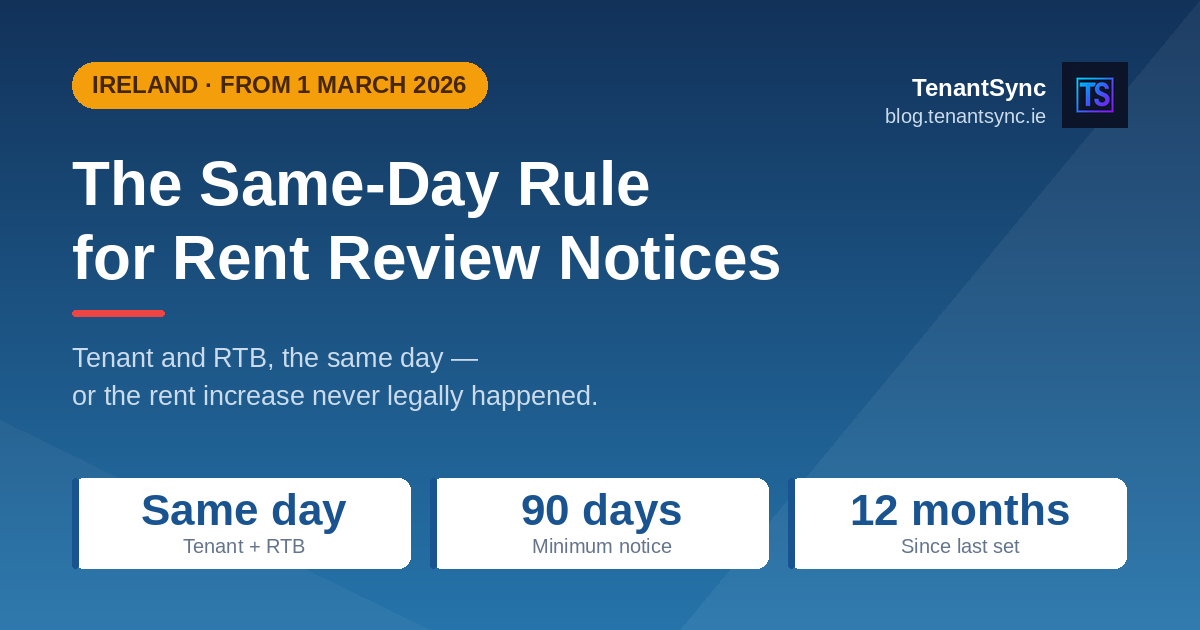
A copy of the notice must be submitted to the RTB via services.rtb.ie on the same day it is served on the tenant. This is a strict legal requirement. Failure to submit to the RTB on the same day makes the notice legally invalid — even if it is otherwise perfectly prepared.
May require a statutory declaration
For terminations on grounds of sale or owner/family occupancy, a statutory declaration confirming the landlord's intention may be required. This must be completed before a solicitor or commissioner for oaths before serving the notice.
Valid Grounds for Ending a Part 4 Tenancy
Once a tenant has Part 4 rights, a landlord cannot end the tenancy without one of the following grounds, as set out in the Residential Tenancies Act. The ground stated in the notice must be genuine — if the landlord does not follow through on the stated intention, the former tenant may have a right of first refusal to return to the property.
A fixed-term lease ending is not a ground for termination
Many landlords mistakenly believe that the expiry of a fixed-term lease automatically ends the tenancy. It does not. Once Part 4 rights are in place, the tenancy continues beyond the fixed term. The landlord must serve a notice of termination based on one of the valid grounds above. Issuing a notice that simply cites "end of lease" or "fixed term expired" is not a valid ground and will be void.
Step-by-Step: How to Serve Notice by Scenario
The correct process for ending a tenancy depends on the reason. Below are the four most common scenarios Irish landlords face, with the required steps for each. → Generate a compliant notice with our free tool — it formats the document and works out the termination date for the first-6-months, rent arrears, and breach-of-obligations grounds.
Scenario 1: Non-Payment of Rent
- Issue a written arrears warning. Serve a written warning to the tenant stating the amount of rent owed and requesting payment within 28 days. Submit a copy of this warning to the RTB via services.rtb.ie on the same day it is served.
- If arrears remain after 28 days, serve the notice of termination. This notice has a statutory 28-day notice period regardless of tenancy length — a specific exception that applies only in this scenario.
- Submit the notice to the RTB. Upload the notice to the RTB portal on the same day it is served on the tenant. Retain proof of service.
Scenario 2: Landlord Intends to Sell the Property
- Prepare a written notice of termination. State clearly: "The landlord intends to sell the property within the next nine months." This is the prescribed wording for this ground.
- Calculate and apply the correct notice period. Use the full notice period based on tenancy duration — 180 days for most tenancies of 1–7 years, or 224 days for tenancies over 8 years.
- Right of first refusal obligation. If the property is not sold or listed for sale within nine months of the tenant vacating, you must offer the former tenant the right to return to the property at the same rent.
Scenario 3: Property Needed for Landlord or Family Member
- Prepare a written notice identifying the specific family member. State the name and relationship of the person requiring the property (parent, child, or sibling). The need must be genuine.
- Include a statutory declaration if required. A sworn statutory declaration confirming the landlord's genuine intention should be prepared before a solicitor or commissioner for oaths and served with the notice.
- Right of first refusal applies. If the property is re-let within 12 months of the tenant vacating, the former tenant has the right of first refusal. This is strictly enforced under the Residential Tenancies Act.
Scenario 4: Tenant in Breach of Tenancy Obligations
- Issue a written warning. Specify the exact breach — whether anti-social behaviour, damage to property, or another obligation — and give the tenant a reasonable time to remedy it (typically 14 days for most breaches).
- If the breach is not remedied, issue the notice of termination. Cite the specific breach as the ground. The normal tenancy-length notice period applies, unless the breach involves serious anti-social behaviour causing severe concern, in which case a reduced notice period may be available.
- Keep all evidence. Retain the written warning, any tenant response, and all supporting evidence. If the tenant disputes the notice at the RTB, your paper trail will be essential.
What Happens If a Notice of Termination Is Defective?
A defective notice does not end the tenancy
If a notice of termination fails to meet all legal requirements — wrong notice period, missing or invalid ground, not signed, not submitted to the RTB on the day of service, or served incorrectly — it is void. The tenancy does not end on the stated date. The tenant is entitled to remain in the property. The landlord must serve a new, compliant notice from scratch. This can add months — and sometimes the better part of a year — to the process.
The Most Common Defects That Void a Notice
- Too short a notice period — calculating from the wrong date, or applying the minimum for the wrong tenancy duration bracket.
- No valid ground stated — citing "end of lease" or "we need the property" without the specific statutory wording.
- Not submitted to the RTB on the day of service — the most commonly missed requirement. Even one day late makes the notice void.
- Missing signature — unsigned notices or notices signed by an agent without clearly identifying their authority to act.
- No termination date — notices that state a notice period ("give you 180 days notice") rather than a specific calendar date.
- Incorrect service method — no proof of delivery, or serving via a method not recognised under the Act (e.g., WhatsApp message).
What a Tenant Can Do With a Defective Notice
A tenant who receives a notice they believe is defective can refer the matter to the RTB for dispute resolution. The RTB adjudicator or tribunal will assess whether the notice complies with the Residential Tenancies Act. If the notice is found to be invalid, the tenancy continues and the landlord must restart the process. Tenants who believe their notice is defective should act promptly — there are time limits on referring disputes.
What a Landlord Cannot Do When Ending a Tenancy
Serving a valid notice of termination is the only lawful method for a landlord to initiate the end of a tenancy. The following actions are illegal under Irish law and constitute an illegal eviction, regardless of whether a valid notice has been served or whether the tenant owes rent:
If a tenant does not vacate by the termination date, the correct — and only lawful — course of action is to apply to the RTB for a determination order. That order can subsequently be enforced through the courts if necessary. Landlords who resort to self-help eviction methods face serious legal consequences including RTB sanctions and civil claims.
How TenantSync Helps Manage Tenancy Terminations
The most common reason a notice of termination is voided is an administrative error — the wrong date, a missed RTB submission, or an insufficient notice period. TenantSync is built specifically for Irish landlords and addresses each of these risks directly.
Tenancy timeline and notice period calculator
TenantSync tracks the start date of every tenancy and automatically calculates the minimum valid notice period for each one. There is no manual calculation or risk of using the wrong bracket.
Part 4 rights tracker
See exactly when each tenant acquires Part 4 rights, when the 6-year TMD cycle resets, and what that means for your notice obligations — before the relevant date arrives.
RTB compliance dashboard
Track registration status, annual renewal deadlines, and tenancy milestones across your whole portfolio in a single view — so nothing is missed under pressure.
Centralised communication and document storage
Every written warning, notice, and tenant communication is stored and timestamped in TenantSync — creating the evidence trail you need if a dispute ever proceeds to the RTB.
Track Every Tenancy Notice Period Automatically
TenantSync is free to try and takes minutes to set up. Irish landlords use it to stay on top of notice periods, RTB deadlines, and compliance obligations — without spreadsheets or guesswork.
Frequently Asked Questions: Notice of Termination Ireland
What is a notice of termination in Ireland?
A notice of termination is the formal legal document a landlord or tenant must serve to end a private residential tenancy in Ireland. It must be in writing, state the date of termination, and comply with the notice period requirements under the Residential Tenancies Act 2004. Without a valid notice of termination, a tenancy cannot be legally ended.
How much notice must a landlord give to end a tenancy?
The minimum notice period depends on how long the tenancy has been in place. For tenancies under 6 months: 90 days. For 6 months to 1 year: 152 days. For 1–7 years: 180 days. For 7–8 years: 196 days. For more than 8 years: 224 days. These are minimums — landlords can give longer notice.
Can a landlord end a tenancy without a reason?
Only in the first 6 months of a tenancy — before Part 4 rights are acquired. Once a tenant has been in residence for 6 months, the landlord must state one of the valid grounds for termination listed in the Residential Tenancies Act. Landlords cannot simply end a tenancy because a fixed-term lease has expired once Part 4 rights are in place.
Does a notice of termination need to be sent by registered post?
A notice of termination can be served by hand, post, or email. Keep proof of service in all cases. You must also submit a copy to the RTB via services.rtb.ie on the same day you serve the tenant. Failure to submit to the RTB on the same day makes the notice legally invalid.
What happens if a notice of termination is defective?
A defective notice — one that fails to state the correct ground, gives insufficient notice, or is not properly served — is void. The tenancy does not end. The tenant can refer the matter to the RTB for dispute resolution. The landlord must restart the process with a fresh, compliant notice. This can add months to the timeline.
Can a tenant challenge a notice of termination?
Yes. A tenant who believes a notice of termination is invalid — because the ground is not legitimate, the notice period is too short, or the notice does not comply with legal requirements — can refer the matter to the RTB. The RTB will adjudicate on whether the notice is valid. Tenants should act promptly as dispute referral time limits apply.
What is the right of first refusal after a termination notice?
If a landlord ends a tenancy on the ground of sale and the property is not sold or listed within nine months of vacation, the former tenant has a right of first refusal to return at the same rent. If a tenancy is ended for owner or family occupancy and the property is re-let within 12 months, the same right applies. Failure to honour this right is a breach of the Act.
How many days notice does a tenant need to give?
Tenant notice periods are shorter than landlord notice periods. For tenancies under 6 months: 28 days. For 6 months to 1 year: 35 days. For 1–2 years: 42 days. For 2–3 years: 56 days. For 3–4 years: 84 days. For 4+ years: 112 days. The tenant must serve a written notice.
Does a landlord need a solicitor to serve a notice of termination?
Not necessarily, but it is strongly advisable for Part 4 terminations and complex situations such as sale, family use, or disputes. Defective notices are common and costly. For straightforward situations early in the tenancy, a carefully prepared written notice may suffice — but the risk of error is high if you are not familiar with the precise requirements.
What is the difference between a notice of termination and an eviction?
A notice of termination is the formal start of the process to end a tenancy. It does not mean the tenant must leave immediately. If the tenant does not vacate by the termination date, the landlord must apply to the RTB for a determination order, which can then be enforced through the courts. Landlords cannot change locks, remove belongings, or physically force a tenant out — that constitutes an illegal eviction with serious legal consequences.
Ready to Serve Notice? Start With a Correctly Formatted Document
Don't risk a void notice over a formatting slip or a miscalculated date. TenantSync's free Notice of Termination generator builds a formatted PDF for the three landlord grounds — first 6 months, rent arrears, and breach of tenant obligations — and calculates the termination date from your date of service. No login, no card required.
This generator and guide are for general information and not legal advice.
Related Articles