Can I Increase My Rent in Ireland? (2026 Complete Guide)
Yes — but the rules have fundamentally changed. Rent Pressure Zones were abolished on 1 March 2026, replaced by a single national rent control system that applies to every private residential tenancy in Ireland. This guide explains exactly when you can raise rent, by how much, what paperwork is required, and what happens if you get it wrong.

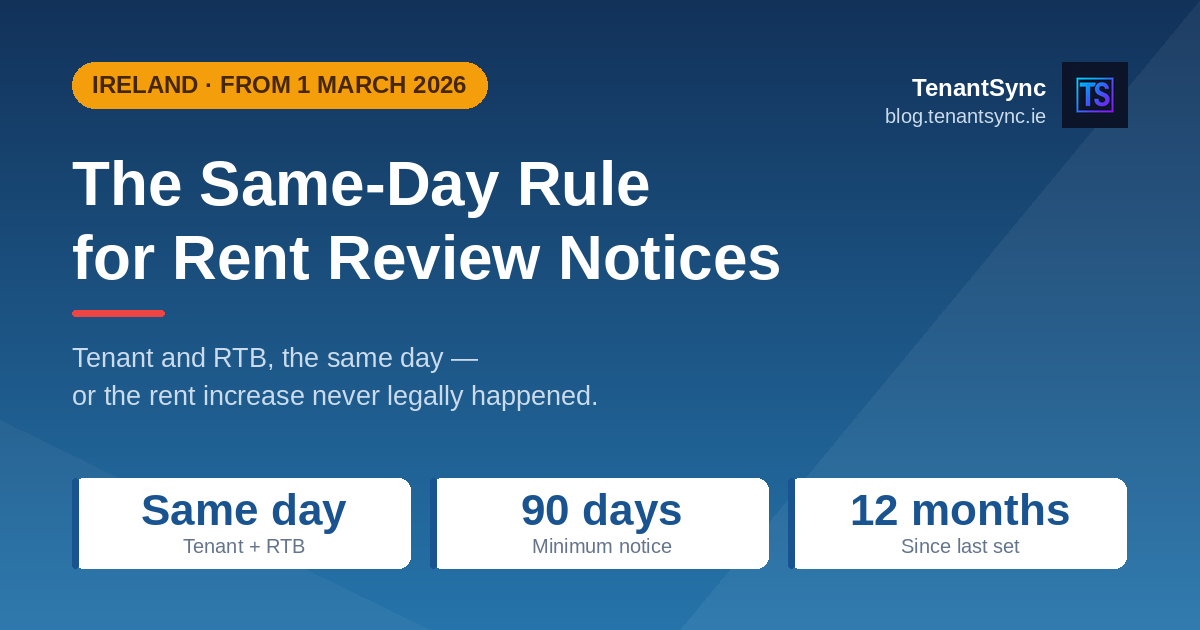
Yes — but only if all three conditions are met:
-
1
12 months have passed since the rent was last set
-
2
The increase does not exceed the lower of 2% per year or CPI inflation
-
3
You give the tenant at least 90 days' written notice
These rules now apply to every private residential tenancy in Ireland — RPZs no longer exist.
What's the most you can charge?
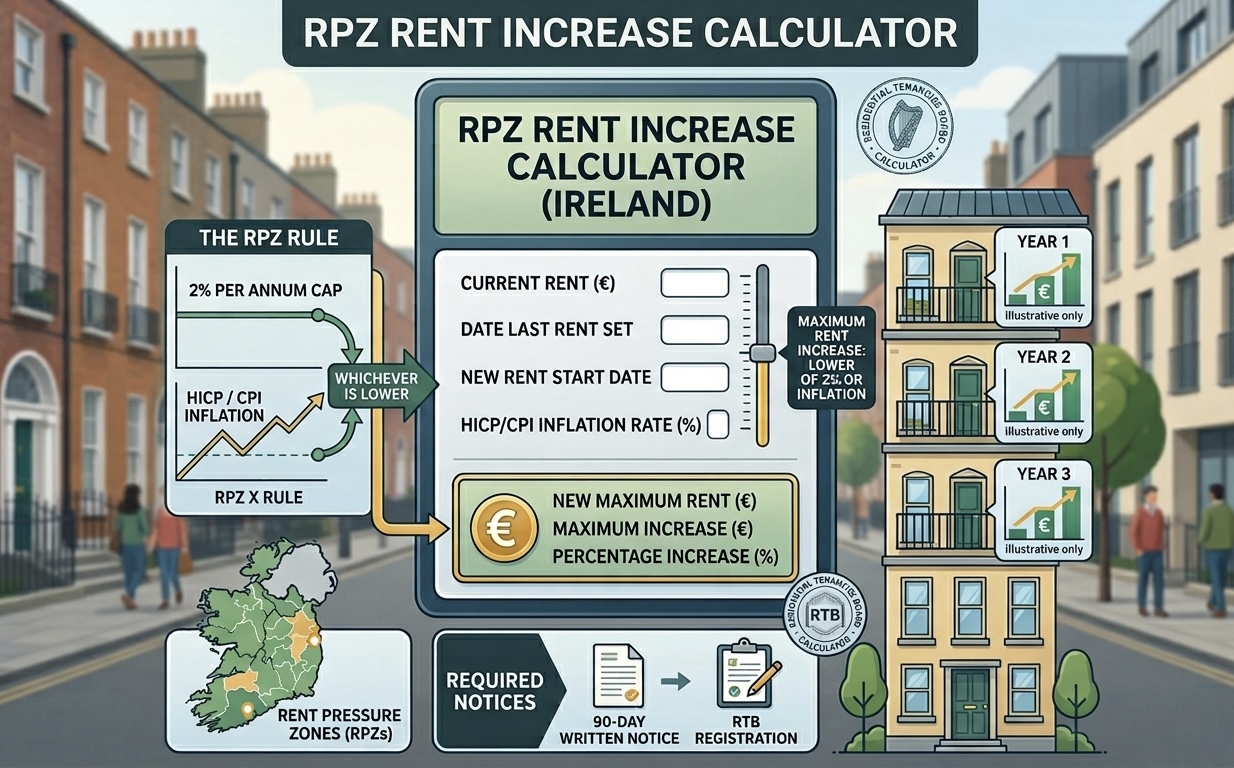
Enter the current rent and the date it was last set. The free calculator applies the 2% and CPI caps and gives you the legal maximum in seconds.
What Changed on 1 March 2026?
If you last researched rent review rules before 2026, the landscape has shifted significantly. The most important thing to understand is this:
Rent Pressure Zones no longer exist.
The Irish government abolished RPZ designations and replaced them with a single national rent control system under the Residential Tenancies Acts. The cap — the lower of 2% per year or the CPI rate — now applies to every private residential tenancy in Ireland, not just properties in previously designated RPZ areas.
What this means in practice:
- There is no longer a distinction between "RPZ" and "non-RPZ" properties
- The same rent review rules apply whether you rent in Dublin 4 or rural Leitrim
- Exceeding the cap is a serious legal breach — RTB proceedings and damages of up to €20,000 can follow
- Landlords who assumed they were exempt because they were outside an RPZ are now fully subject to the regime
The 3 Rules You Must Follow Before Raising Rent
Every valid rent increase in Ireland must satisfy three conditions simultaneously. Missing any one of them makes the increase legally unenforceable.
Wait 12 Months
You can only review rent once every 12 months, measured from when the rent was last set — not from the tenancy start date.
Respect the Legal Cap
The increase cannot exceed the lower of 2% per year (pro-rated) or the CPI inflation rate since the rent was last set.
Give 90 Days' Notice
You must serve a formal written Rent Review Notice specifying the new rent and effective date — at least 90 days before it takes effect.
Rule 1: You Must Wait 12 Months
The 12-month period is measured from when the rent was last set — not from the start of the tenancy, and not from the calendar year. If you set a new rent on 15 June 2025, the earliest you can review it again is 15 June 2026.
Common Mistake
Landlords frequently count from the tenancy start date rather than the date the rent was actually last changed. These can be different — especially if the tenancy has been running for several years and the rent was reviewed at some point mid-tenancy. Always trace the rent history, not just the original lease date.
Rule 2: You Cannot Exceed the Legal Cap
The maximum rent increase is the lower of:
| Method | How it works |
|---|---|
| CPI cap | The percentage increase in the Harmonised Index of Consumer Prices since the rent was last set (RTB-published figure) |
| 2% annual cap | 2% per year, pro-rated for the actual number of months since the rent was last set |
Whichever figure is lower is the maximum you can legally charge.
Not sure what the current CPI figure is or how to calculate it?
Use TenantSync's free Rent Increase Calculator → — it pulls the latest CSO CPI figures automatically and shows you the exact maximum you can charge.
Rule 3: You Must Give 90 Days' Written Notice
You cannot simply start charging a higher rent on a given date. You must follow a formal process:
-
Calculate the permitted new rent
Using the CPI/2% cap rules above — lower of the two figures applies.
-
Serve a formal written Rent Review Notice
The notice must specify: the proposed new rent amount; the date it will take effect (minimum 90 days from the date the tenant receives it); and a statement that the new rent is in line with the market rate.
-
Keep a copy of the notice
Retain all documentation. If a dispute arises — even years later — you will need to prove the notice was served correctly.
Postal delivery — allow extra time
The 90 days starts from the date the tenant receives the notice, not the date you send it. If serving by post, allow additional working days for delivery. Email is acceptable if the tenant has agreed to this communication method in writing.
What happens if you give less than 90 days?
The notice is legally invalid and the rent increase does not take effect — regardless of what the notice says. The tenant is within their rights to continue paying the old rent. There is no workaround.
Step-by-Step: How to Increase Rent Correctly in 2026
Check the date the rent was last set
Look at your lease agreement or the last rent review notice you served. If you cannot find it, check your rent payment history. If in doubt, use the tenancy start date as a conservative assumption.
Confirm 12 months have passed
Count forward from the date the rent was last set. Do not proceed with a notice until this date has been reached or passed — an early notice is invalid.
Calculate the maximum permitted increase
Use the TenantSync Rent Increase Calculator — it applies both the 2% cap and the latest CSO CPI figures and returns the lower figure automatically. Or calculate manually: pro-rate 2% over the number of months elapsed, compare with the CPI percentage, take the lower.
Draft and serve the Rent Review Notice
Send the notice in writing to the tenant. It must state the new rent amount and the effective date (at least 90 days from receipt). Email is acceptable only where the tenant has agreed to electronic communication in writing.
Update your records
Record: the new rent, the effective date of the increase, the date the notice was served, and the next eligible review date (12 months from the effective date). You will need this if an RTB dispute ever arises.
What If My Tenant Disputes the Rent Increase?
A tenant who believes a rent increase exceeds the legal cap can refer the matter to the RTB within 28 days of the date the new rent takes effect — not from the date they received the notice.
If the RTB finds in the tenant's favour:
- The excess amount must be repaid to the tenant
- Damages of up to €20,000 can be awarded against the landlord
- The RTB can order that the lawful rent figure applies instead
This is why accuracy matters. A €50/month overcharge across 12 months is €600 in direct liability — plus potential RTB damages on top. Getting the calculation right the first time is not optional.
Eliminate calculation risk entirely. The free TenantSync Rent Increase Calculator uses the latest CSO CPI figures and applies the lower-of-two-caps rule automatically. Your result is defensible if challenged.
Can I Increase Rent for a New Tenancy?
Sometimes — it depends on why the previous tenancy ended. This is one of the most misunderstood areas of the 2026 reforms.
When a market rent reset IS permitted
When a tenancy ends and you re-let to a new tenant, you may be able to set a market rent if the previous tenancy ended because:
- The tenant left voluntarily
- The tenant was in breach of their obligations
- The property no longer suited the tenant's household needs
- The tenancy reached the end of a 6-year Tenancy of Minimum Duration cycle
- The property was not rented for 2 or more years
Critical restriction — no-fault terminations
If you ended the previous tenancy for reasons such as selling the property, a family member moving in, or substantial refurbishment, you cannot reset to market rent when re-letting.
The previous rent cap continues to apply to the initial rent for the new tenancy. This is one of the most significant tenant protections introduced under the 2026 national rent control reforms.
If you are unsure whether your circumstances allow a market rent reset, seek legal advice before setting the new rent.
Where a market rent reset is permitted:
- You should still ensure the rent is defensible as a market rent — tenants can challenge an excessive initial rent within 28 days of the tenancy starting
- Once set, the 12-month/cap rules apply to all future reviews from that date
Renewing a fixed term with the same tenant
If the property has been rented continuously — i.e., you are renewing with the same tenant under a new fixed-term agreement — this is treated as a continuation of the existing tenancy, not a new tenancy. The rent review cap still applies. There is no "reset on renewal" shortcut.
Exceptions: When the Rent Cap Does Not Apply
The national rent control rules do not apply to all accommodation arrangements. The main exceptions are:
| Exception | Details |
|---|---|
| Licences (lodger arrangements) | If the occupant shares the main residence with the landlord, the Residential Tenancies Act does not apply — the landlord-occupier relationship is a licence, not a tenancy |
| Social housing | Approved Housing Bodies and cost-rental tenancies operate under separate statutory frameworks |
| Holiday lettings | Short-term tourist lettings of fewer than 14 consecutive days |
| Business tenancies | Commercial properties are not subject to the Residential Tenancies Act |
| New apartments (post June 2025) | For private apartments where construction commenced after 10 June 2025, only the CPI cap applies — the 2% annual ceiling does not. The permitted increase is the full CPI rate for the period with no 2% limit |
If you are unsure whether your tenancy falls outside the standard rules, consult a solicitor or contact the RTB directly before taking any action.
The Biggest Mistakes Landlords Make with Rent Reviews
Based on RTB dispute patterns, these are the five errors that most frequently result in invalid notices or successful tenant challenges:
Measuring 12 months from the wrong date
The clock starts when the rent was last set, not when the tenancy started and not on 1 January. Serving a notice before the 12 months is up renders it invalid — even if the effective date is far in the future.
Using the old HICP index
Since 1 March 2026 the cap is measured by the CSO’s Consumer Price Index (CPI), which replaced the HICP used under the old Rent Pressure Zone rules. A spreadsheet or template that still indexes against HICP gives the wrong maximum for a 2026 review.
Short-dating the notice
90 days is the legal minimum with no exceptions. A notice with a 30- or 60-day effective date means the increase legally cannot take effect at that date, regardless of what the notice says or what the tenant agrees to verbally.
Failing to document the review
If a tenant disputes a rent increase years later, you need to prove: (a) when the rent was last set, (b) what the CPI figure was at the time, and (c) that the 90-day notice was properly served. No documentation means no defence.
Not tracking the next review date
The 12-month window starts from the effective date of the last increase, not the date you served the notice. Losing track means either missing a review window or inadvertently serving early — and invalidating the notice.
How TenantSync Automates Rent Reviews
Manually tracking review dates, pulling CPI figures from the CSO, and calculating pro-rated caps across multiple properties is error-prone and time-consuming — especially when you add RTB registration renewals and BER certificates to the mix. TenantSync handles rent reviews automatically:
Review Date Alerts
TenantSync notifies you when each lease becomes eligible for a rent review, based on the exact date the rent was last set — not a generic 12-month reminder.
Automatic Cap Calculation
Pulls the latest CSO CPI figures and calculates the exact maximum permitted increase for each lease in your portfolio — pro-rated for the actual number of months elapsed.
RTB Compliance Dashboard
Surfaces upcoming rent reviews alongside RTB registration renewals, BER certificates, and other compliance deadlines — so nothing falls through the cracks.
Full Audit Trail
Every rent review action is logged with timestamps. If a dispute is ever raised, you have complete evidence of what was calculated, when, and how the notice was served.
Stop tracking rent reviews in a spreadsheet.
TenantSync calculates the cap, reminds you when the next review is due and keeps the paper trail for every property. €20/month for up to 10 properties — 14-day free trial, no card to start.
Frequently Asked Questions
Can I increase rent mid-tenancy?
Yes, subject to the 12-month rule and 90-day notice requirement. You do not need to wait until the end of a fixed-term period to conduct a rent review — you can do it at any point as long as 12 months have elapsed since the rent was last set and you provide the required notice.
What if the tenant refuses to pay the increased rent?
If the rent increase was served correctly and does not exceed the legal cap, the new rent is legally enforceable. A tenant who refuses to pay can be referred to the RTB for a dispute resolution hearing. Always keep evidence of the notice you served and the calculation you used.
Can I increase rent more than 2% if I've made improvements to the property?
No. The 2%/CPI cap applies regardless of improvements made during the tenancy. Improvements may be factored into the initial rent when the property is re-let to a new tenant (where a market rent reset is permitted), but they do not override the cap for an existing tenancy.
What is the RTB and do I need to register?
The Residential Tenancies Board (RTB) is the Irish state body that regulates the private rented sector. All private residential tenancies must be registered with the RTB, typically within one month of the tenancy start date. Failure to register is a breach of the Residential Tenancies Act — the RTB can investigate and impose financial sanctions.
Do I need to notify the RTB of a rent increase?
No — rent increases do not need to be reported to the RTB. However, if a dispute arises, the RTB will scrutinise the calculation and notice procedure closely. Keeping accurate records is essential.
Which inflation figure is used for rent reviews?
The CSO’s Consumer Price Index (CPI), which replaced the HICP on 1 March 2026. Rather than checking manually, use the TenantSync Rent Increase Calculator — it uses the latest CSO CPI figures and handles the pro-rating automatically.
Can I increase rent for a student who rents from September to May each year?
If this is a private residential tenancy (not a holiday letting), the standard rules apply. However, if the tenancy ends each May and a new tenancy starts each September with the same student, this may be structured as a series of fixed-term tenancies — each of which could allow you to set a market rent at the start. Seek legal advice if unsure, as the RTB will look at the substance of the arrangement, not just the paperwork.
Rent Increase Checklist
Before serving a rent review notice, confirm all of the following:
Want this tracked automatically for every property? TenantSync logs every rent review, alerts you when the next one is due, and keeps a full audit trail — so this checklist runs itself.
Tools & Resources
This article is for informational purposes only and does not constitute legal advice. Always consult the RTB website or a qualified solicitor for guidance specific to your situation.
Last updated: May 2026 — reflects national rent control rules in force from 1 March 2026.
Related Articles